Volume 2007, Article ID 71432,6pages doi:10.1155/2007/71432
Research Article
Adaptive Resolution Upconversion for
Compressed Video Using Pixel Classification
Ling Shao
Video Processing and Analysis Group, Philips Research Laboratories, High Tech Campus 36, 5656 AE Eindhoven, The Netherlands
Received 22 August 2006; Accepted 3 May 2007
Recommended by Richard R. Schultz
A novel adaptive resolution upconversion algorithm that is robust to compression artifacts is proposed. This method is based on classification of local image patterns using both structure information and activity measure to explicitly distinguish pixels into content or coding artifacts. The structure information is represented by adaptive dynamic-range coding and the activity measure is the combination of local entropy and dynamic range. For each pattern class, the weighting coefficients of upscaling are optimized by a least-mean-square (LMS) training technique, which trains on the combination of the original images and the compressed downsampled versions of the original images. Experimental results show that our proposed upconversion approach outperforms other classification-based upconversion and artifact reduction techniques in concatenation.
Copyright © 2007 Ling Shao. This is an open access article distributed under the Creative Commons Attribution License, which permits unrestricted use, distribution, and reproduction in any medium, provided the original work is properly cited.
1. INTRODUCTION
With the continuous demand of higher picture quality, the resolution of high-end TV products is rapidly increasing. The resolution of broadcasting programs or video on stor-age discs is usually lower than that of high-definition (HD) TV. Therefore, those video materials have to be upconverted to fit the resolution of the HDTV. Due to the bandwidth limit of the broadcasting channels and the capacity limit of the storage media, the video materials are always compressed with various compression standards, such as MPEG1/2/4 and H.26x. These block-transform-based codecs divide the im-age or video frame into nonoverlapping blocks (usually with the size of 8×8 pixels), and apply discrete cosine transform (DCT) on them. The DCT coefficients of neighboring blocks are thus quantized independently. At high or medium com-pression rates, the coarse quantization will result in various noticeable coding artifacts, such as blocking, ringing, and mosquito artifacts.
Most existing resolution upconversion algorithms ap-ply content-adaptive interpolation according to the struc-ture or property of a region [1–7]. For compressed mate-rials, the coding artifacts will be preserved after upscaling. These coding artifacts, for example, blocking artifacts, will be even more difficult to remove than those in the original
low-resolution image, because the coding artifacts will spread among more pixels and become not trivial to detect after upscaling. One solution is to reduce the coding artifacts before applying resolution upscaling. However, most coding artifact reduction algorithms [8–11] blur details while sup-pressing various digital artifacts. Those details lost during artifact reduction cannot be recovered during resolution up-scaling. We propose to remove coding artifacts and apply res-olution upconversion simultaneously in this paper. Different filter coefficients are used for different image regions based on a classification scheme that utilizes both structure and an activity metric. The optimal coefficients are obtained by making the mean square error (MSE) between the reference pixels and the processed distorted pixels minimized statisti-cally during the training process. The distortion we use here is first downsampling then adding coding artifacts by com-pression.
Most superresolution algorithms [12,13] in the litera-ture attempt to recover high-resolution images from low-resolution images based on multiframe processing. We pro-pose a single-frame processing solution for resolution up-conversion of compressed images and video. Therefore, the proposed technique is more efficient and cost-effective.
Table1: Coarse classification of a region.
DR Entropy (high) Entropy (low)
DR (high) Object edge/highly textured region Strong blockiness
DR (low) Fine texture Mild blockiness/mosquito noise
100 104 108 102 105 52
98 55 50
ADRC
1 1 1
1 1 0
1 0 0
Figure1: Illustration of ADRC coding.
InSection 3, we present the least-mean-square technique to obtain the optimized coefficients for each class. Experimen-tal results and performance evaluation are given inSection 4. Finally, we conclude our paper inSection 5.
2. PIXEL CLASSIFICATION
Adaptive dynamic-range coding (ADRC) [14] has been suc-cessfully used for representing the structure of a region. The ADRC code of each pixelxiin an observation aperture is de-fined as ADRC(xi)= 0 ifV(xi) ≤Vav, 1 otherwise, where
V(xi) is the value of pixelxi, andVavis the average of all the pixel values in the aperture.Figure 1shows the ADRC coding of a 3×3 aperture. ADRC has been demonstrated to be an efficient classification technique for resolution upconversion [1]. However, obviously it is not enough for compressed ma-terials, because it cannot distinguish object details from cod-ing artifacts. For example, the ADRC codes of an object edge could be exactly the same as that of a blocking artifact. There-fore, local activity measure should be appended to ADRC, in order to fully differentiate object details from compression artifacts.
The activity measure we employ is the local entropy cou-pled by dynamic range of a region. Local entropy has been shown to be a good measure for distinguishing information from digital noise [8]. The local entropy is calculated on the probability density functions (PDFs) of some descriptors in-side a region. The PDFs are approximated by the histogram of a descriptor. Considering the context of video processing, we employ luminance intensity as the descriptor. Therefore, the entropy calculation can be defined as
H= −N
i=1
PR(i) log2PR(i), (1)
whereiindicates the bin index in the histogram,Nis the to-tal number of bins, andRis a local region around the central
HD images
2D downsample Codec HD-derived SD images
with coding artifacts ADRC + activity
classification
LMS optimization
per class
Store upscaling coefficients for each class in LUT
Figure2: The training procedure of the proposed method.
pixel over which the entropy is calculated. A region with high activity has a distributed histogram, while the histogram of a region with low activity usually only contains a few peaks. Note that the distribution of the histogram is dominated by the local structure of the region, such that noise and cod-ing artifacts will not affect the overall distribution of the his-togram.
According to the information theory, H has a higher value for a spread-out histogram than a peaked one [8], that is, the entropy value of a complex region tends to be larger than a smooth region. EntropyH can be also used as a lo-cal blockiness metric, because blocking artifacts reduce the variation of intensities, thus decrease the entropy value. Typ-ically, the entropy value of a region decreases when increasing the compression rate.
To further quantize a region’s activity or coding artifacts, entropy should be coupled with dynamic range (DR). DR is defined as the absolute difference between the maximum and minimum pixel values of a region.Table 1depicts a coarse classification of a region based on the combination of en-tropy and dynamic range. Here, each 1 bit is used for both entropy and DR. Ringing artifact can be also differentiated, because it usually has a medium-valued entropy and a rela-tively low DR. For more detailed description of the classifica-tion method based on entropy and DR, please refer to [9].
Accordingly, a pixel and its surrounding region can be classified based on the structure, which is represented by ADRC, and the activity measure, which is the local entropy plus dynamic range.
3. LEAST-MEAN-SQUARE OPTIMIZATION
Input SD image Filtering Output HD image
ADRC + activity classification
Upscaling coefficients
LUT
Figure3: The filtering procedure of the proposed method.
each class based on the pixel classification of the previous section. Figure 2 shows the proposed optimization proce-dure. Uncompressed HD reference images are first down-sampled using bilinear interpolation. The downdown-sampled im-ages are then compressed to introduce coding artifacts. We refer to the compressed downsampled images as corrupted images. Each pixel in the corrupted images is then classified on that pixel’s neighborhood using the classification method described in the previous section. All the pixels and their neighborhoods belonging to a specific class and their corre-sponding pixels in the reference images are accumulated, and the optimal coefficients are obtained by making the mean square error (MSE) minimized statistically.
Let FD,c,FR,c be the apertures of the distorted images and the reference images for a particular classc, respectively. Then, the filtered pixelFF,c can be obtained by the desired optimal coefficients as follows:
FF,c=
n
i=1
wc(i)FD,c(i,j), (2)
wherewc(i),i∈[1· · ·n], are the desired coefficients,nis the number of pixels in the aperture, andjindicates a particular aperture belonging to classc.
The summed square error between the filtered pixels and the reference pixels is
e2=Nc
j=1
FR,c−FF,c 2
=
Nc
j=1
FR,c(j)− n
i=1
wc(i)FD,c(i,j)
2 ,
(3)
whereNcrepresents the number of pixels belonging to class
c. To minimize e2, the first derivative of e2 to w
c(k), k ∈ [1· · ·n], should be equal to zero:
∂e2
∂wc(k)= Nc
j=1
2FD,c(k,j)
FR,c(j)− n
i=1
wc(i)FD,c(i,j)
=0.
(4)
By solving the above equation using Gaussian elimination, we will get the optimal coefficients as follows:
⎡ ⎢ ⎢ ⎢ ⎢ ⎢ ⎢ ⎢ ⎣
wc(1)
wc(2) .. .
wc(n)
⎤ ⎥ ⎥ ⎥ ⎥ ⎥ ⎥ ⎥ ⎦ = ⎡ ⎢ ⎢ ⎢ ⎢ ⎢ ⎢ ⎢ ⎢ ⎢ ⎢ ⎢ ⎢ ⎢ ⎢ ⎢ ⎢ ⎣ Nc
j=1
FD,c(1,j)FD,c(1,j) ...
Nc
j=1
FD,c(1,j)FD,c(n,j)
Nc
j=1
FD,c(2,j)FD,c(1,j) · · · Nc
j=1
FD,c(2,j)FD,c(n,j)
..
. ... ... Nc
j=1
FD,c(n,j)FD,c(1,j) · · ·
Nc
j=1
FD,c(n,j)FD,c(n,j) ⎤ ⎥ ⎥ ⎥ ⎥ ⎥ ⎥ ⎥ ⎥ ⎥ ⎥ ⎥ ⎥ ⎥ ⎥ ⎥ ⎥ ⎦ −1 × ⎡ ⎢ ⎢ ⎢ ⎢ ⎢ ⎢ ⎢ ⎢ ⎢ ⎢ ⎢ ⎢ ⎢ ⎢ ⎢ ⎣ Nc
j=1
FD,c(1,j)FR,c(j)
Nc
j=1
FD,c(2,j)FR,c(j)
.. . Nc
j=1
FD,c(n,j)FR,c(j) ⎤ ⎥ ⎥ ⎥ ⎥ ⎥ ⎥ ⎥ ⎥ ⎥ ⎥ ⎥ ⎥ ⎥ ⎥ ⎥ ⎦ . (5)
The LMS-optimized coefficients for each class are then stored in a lookup table (LUT) for future use.Figure 3shows the fil-tering procedure of resolution upconversion for compressed materials using the optimized coefficients retrieved from the LUT. A more comprehensive explanation of the LMS opti-mization technique can be found in [1].
4. EXPERIMENTS AND EVALUATION
Table2: Comparison of numbers of coefficients in the LUT of the three algorithms.
Algorithm Reference [15] + reference [1] Reference [1] + reference [15] Proposed
No. coefficients 4096×16×13 + 256×9 256×9 + 4096×16×13 256×16×9
Table3: MSE comparison of different algorithms.
Sequence Reference [1] Reference [15] + reference [1] Reference [1] + reference [15] Proposed
Hotel 116.28 113.40 108.53 104.92
Parrot 36.13 32.15 35.05 31.92
Girl 66.93 59.85 63.72 59.42
Bicycle 183.48 164.25 170.19 161.43
Helicopter 89.01 89.81 83.07 82.85
Game 208.80 209.74 198.27 192.82
For benchmarking, we compare our algorithm with two state-of-the-art classification-based resolution upversions [1] and artifact reduction [15] methods in con-catenation. ADRC is used for classification in the resolution upconversion algorithm. Same as our proposed approach, a 3 ×3 aperture is used for classification and interpola-tion. The coding artifact reduction method is based on the classification of structure by adaptive dynamic-range cod-ing (ADRC) and relative position of a pixel in the codcod-ing block grid. A diamond-shape 13- aperture is used, which re-quires 12 bits for ADRC and 4 bits for relative position cod-ing. The drawback of this method is that block grid positions are not always available, especially for scaled material. For the cascaded method of first applying resolution upconver-sion then doing coding artifact reduction, the classification of coding artifact reduction is carried out on the upscaled HD signal and the relative position of a pixel in the block grid is also upscaled accordingly to suit the HD signal. The coefficients of both methods are obtained by the LMS tech-nique. These two methods have significant advantages over other analysis-based filtering techniques. For cost compari-son,Table 2shows the numbers of coefficients that need to be stored in lookup tables (LUT) for each of the three algo-rithms. The proposed algorithm is much more economical than the other two in terms of LUT size. Since the training process is done offline and only needs to be done once, thus the computational cost is limited for all the three methods.
We test the algorithms on a variety of sequences first downsampled then compressed using the same setting used during the training.Figure 5shows the snapshots of the se-quences we use. All the test sese-quences are excluded from the training set. The objective metric we use is mean square er-ror (MSE), that is, we calculate the MSE between the origi-nal HD sequences and the result sequences processed on the compressed downsampled versions of the original sequences. Table 3shows the results of the proposed algorithm in com-parison to the results of first applying coding artifact reduc-tion then upconversion and first applying upconversion then
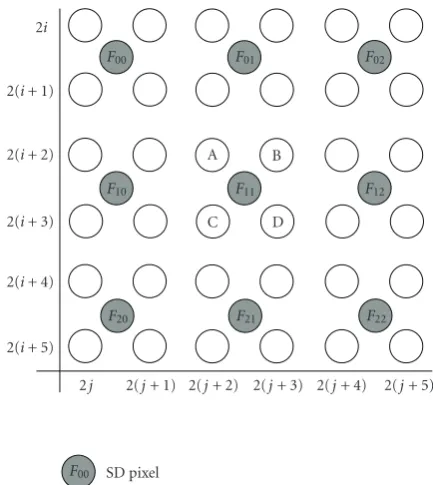
2j 2(j+ 1) 2(j+ 2) 2(j+ 3) 2(j+ 4) 2(j+ 5) 2(i+ 5)
2(i+ 4) 2(i+ 3) 2(i+ 2) 2(i+ 1) 2i
F00 SD pixel
HD pixel
F00 F01 F02
F10 F11 F12
F20 F21 F22
A B
C D
Figure4: Aperture used in the proposed method. The white pix-els are interpolated HD pixpix-els (FHD). The black pixels are SD pixels (FSD), withF12as a shorthand notation forFSD(1, 2) and so forth. The HD pixel A that corresponds toFHD(2(i+ 2), 2(j+ 2)), is inter-polated using nine SD pixels (F00up toF22).
(a) Hotel (b) Parrot (c) Girl
(d) Bicycle (e) Helicopter (f) Game
Figure5: Snapshots of test sequences for experiments.
(a) (b) (c)
Figure6: The cutouts of the girl sequence processed using the three methods: (a) first artifact reduction then resolution upconversion; (b) first resolution upconversion then artifact reduction; (c) the proposed method.
sequences, applying artifact reduction first gives better re-sults; for other sequences, vice verse.
For subjective comparison,Figure 6shows the results of the three methods on the girl sequence. It is easy to see that the result of first applying upconversion then artifact reduc-tion contains more residual artifacts than the proposed algo-rithm, because upscaling makes coding artifacts spread out in more pixels and the enlarged coding artifacts are more diffi -cult to remove. The result of first applying artifact reduction then resolution upconversion is blurrier than our proposed
algorithm, because the artifact reduction step blurs some de-tials, which cannot be recovered by the upscaling step.
5. CONCLUSION
optimized weighting coefficients for upscaling. The opti-mization is done using a training set composed of the origi-nal HD images and the compressed downsampled versions of the original images. The experimental results are com-pared to two classification-based artifact reduction and res-olution upconversion algorithms in concatenation. Our pro-posed approach outperforms the other two both objectively and subjectively.
REFERENCES
[1] T. Kondo, Y. Node, T. Fujiwara, and Y. Okumura, “Picture con-version apparatus, picture concon-version method, learning appa-ratus and learning method,” US patent: no. 6,323,905, Novem-ber 2001.
[2] C. B. Atkins, C. A. Bouman, and J. P. Allebach, “Optimal image scaling using pixel classification,” inProceedings of IEEE Inter-national Conference on Image Processing (ICIP ’01), vol. 3, pp. 864–867, Thessaloniki, Greece, October 2001.
[3] X. Li and M. T. Orchard, “New edge-directed interpolation,” IEEE Transactions on Image Processing, vol. 10, no. 10, pp. 1521–1527, 2001.
[4] J. A. P. Tegenbosch, P. M. Hofman, and M. K. Bosma, “Im-proving non-linear up-scaling by adapting to the local edge orientation,” inVisual Communications and Image Processing, vol. 5308 ofProceedings of SPIE, pp. 1181–1190, San Jose, Calif, USA, January 2004.
[5] N. Plaziac, “Image interpolation using neural networks,”IEEE Transactions on Image Processing, vol. 8, no. 11, pp. 1647–1651, 1999.
[6] R. G. Keys, “Cubic convolution interpolation for digital image processing,”IEEE Transactions on Acoustics, Speech, and Signal Processing, vol. 29, no. 6, pp. 1153–1160, 1981.
[7] H. Greenspan, C. H. Anderson, and S. Akber, “Image enhance-ment by nonlinear extrapolation in frequency space,” IEEE Transactions on Image Processing, vol. 9, no. 6, pp. 1035–1048, 2000.
[8] L. Shao and I. Kirenko, “Content adaptive coding artifact re-duction for decompressed video and Images,” inProceedings of International Conference on Consumer Electronics (ICCE ’07), pp. 1–2, Las Vegas, Nev, USA, January 2007.
[9] L. Shao, “Unified compression artifacts removal based on adaptive learning on activity measure,” to appear inDigital Signal Processing.
[10] I. Kirenko, R. Muijs, and L. Shao, “Coding artifact reduc-tion using non-reference block grid visibility measure,” in Pro-ceedings of IEEE International Conference on Multimedia and Expo (ICME ’06), pp. 469–472, Toronto, Ontario, Canada, July 2006.
[11] M. Yuen and H. R. Wu, “Reconstruction artifacts in digital video compression,” inDigital Video Compression: Algorithms and Technologies, vol. 2419 ofProceedings of SPIE, pp. 455–465, San Jose, Calif, USA, February 1995.
[12] W. T. Freeman and E. C. Pasztor, “Markov networks for super-resolution,” inProceedings of the 34th Annual Conference on In-formation Sciences and Systems (CISS ’00), Princeton, NJ, USA, March 2000.
[13] S. Baker and T. Kanade, “Limits on super-resolution and how to break them,” inProceedings of IEEE Computer Society Con-ference on Computer Vision and Pattern Recognition (CVPR ’00), vol. 2, pp. 372–379, Hilton Head Island, SC, USA, June 2000.
[14] T. Kondo, Y. Fujimori, S. Ghosal, and J. J. Carrig, “Method and apparatus for adaptive filter tap selection according to a class,” US patent: no. 6,192,161 B1, February 2001.
[15] M. Zhao, R. E. J. Kneepkens, P. M. Hofman, and G. de Haan, “Content adaptive image de-blocking,” inProceedings of IEEE International Symposium on Consumer Electronics (ISCE ’04), pp. 299–304, Reading, Mass, USA, September 2004.
Ling Shao is a Research Scientist at the Video Processing and Analysis Group, Philips Research Laboratories, Eindhoven, The Netherlands. He did his B.Eng. degree in electronics engineering at the University of Science and Technology of China, and his M.S. degree in medical imaging and Ph.D. degree in computer vision at Oxford Uni-versity in the UK. From March to July 2005, he worked as a Senior Research Engineer at