CSEIT1726114 | Received : 10 Nov 2017 | Accepted : 24 Nov 2017 | November-December-2017 [(2)6: 378-383]
International Journal of Scientific Research in Computer Science, Engineering and Information Technology © 2017 IJSRCSEIT | Volume 2 | Issue 6 | ISSN : 2456-3307
378
An Efficient Face Detection and Recognition Method Based on
Semi-Supervised Learning with Improved LPP Projection
Method
Kanika Bhatia
1, Prof. Umesh Kumar Lilhore
2, Prof. Nitin Agrawal
3M. Tech. Research Scholar1, Head PG2, Associate Professor3 NRI Institute of Information Science & Technology Bhopal (M.P), India
ABSTRACT
Machine learning and pattern recognition methods play a vital role in face detection and recognition from an image. Face recognition methods have an important role in various fields e.g. security, authentication, and authorization. The facial recognition method extracts a facial feature from a human image face. A high accuracy is always desirable in face recognition system. Human faces have a complex multidimensional structure so required an efficient and advanced method for accurate detection and recognition. It attracts researchers to work in the field of face recognition. Various existing methods e.g. pattern recognition, machine learning, Eigenfaces (E.g. PCA), Fisher faces (E.g. LDA) and Laplacian Face (E.g. LPP). An LPP method is widely used for face recognition. Existing LPP method has the limitation of singular matrix problem. An LPP method is basically an appearance based unsupervised linear dimensionality reduction. LPP preserve the local structure of face image space which is usually more significant than the global structure preserved by principal component analysis (PCA) and linear discriminant analysis (LDA). In this research, we are presenting an efficient and more accurate face detection and recognition method based on improved locality preserving projection with Multilinear principal component analysis MPCA. Proposed method firstly finds an embedding to preserve local and global information and then find a sub-face to detect the desired face. Proposed method apply semi-supervised learning method which uses combine features of supervised as well as unsupervised learning. The proposed method uses KNN (K-Nearest Neighbor) "supervised" classification method in that it uses the class labels of the training data and LPP dimensionality reduction method (unsupervised learning). An experimental study clearly shows that proposed method performs much better in terms of accuracy %, detection rate % over existing LPP method.
Keywords : Face Detection, Face recognition, ILPP-SSLM, MPCA, LPP and Semi-supervised learning
I.
INTRODUCTION
The human faces, as well as some animals’ faces, convey information by generating voluntarily and involuntarily expressions reflecting the emotional state of the person. The face is a particularly deformable object, and facial expressions are available in an extensive form of viable configurations. Time-various adjustments encompass boom and elimination of facial hair, wrinkles, and sagging of the pores and skin resulting from growing older and change in pores and skin color because of publicity to sunlight. The process is influenced by several factors such as shape, reflectance, pose, occlusion and illumination which
II.
FACE RECOGNITION
The face is a complex multidimensional structure and needs good computing techniques for recognition. The face is our primary and first focus of attention in social life playing an important role in the identity of the individual.
Figure 2.1. Face Recognition
We can recognize a number of faces learned throughout our lifespan and identify that faces at a glance even after years. There may be variations in faces due to aging and distractions like beard, glasses or change of hairstyles. Face recognition is an integral part of biometrics.
2.1 APPLICATION OF FACE
RECOGNITION-There are numerous application areas in which FR can be exploited for these two purposes, a few of which are outlined below-
Verification (one-to-one matching)- When presented with a face image of an unknown individual along with a claim of identity, ascertaining whether the individual is who he/she claims to be [11].
Security-Access control of buildings, airports/seaports, ATM machines and border checkpoints; computer or network security; email authentication on multimedia workstations.
Criminal justice systems- Mug-shot or booking systems, post-event analysis, forensics.
Image database investigations-Searching image databases of licensed drivers benefit recipients, missing children, immigrants and police bookings.
Identification (one-to-many matching) - Given an image of an unknown individual, determining that person's identity by comparing (possibly after encoding) that image with a database of (possibly encoded) images of known individuals [12].
Access Control- Face verification, matching a face against a single enrolled exemplar, is well within the capabilities of current Personal Computer hardware.
III.
EXISTING METHODS & CHALLENGES
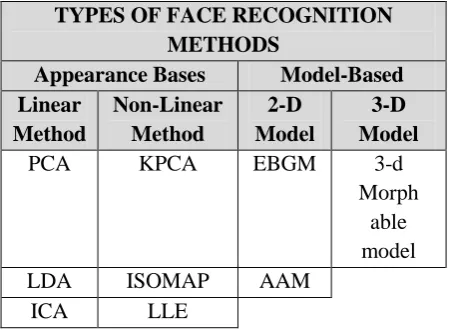
TYPES OF FACE RECOGNITION
Jie Pan [1] et al, due to the wide applications in applies; face recognition has been a vigorous analysis topic. With the availability of adequate data and image samples, several machine learning ways might yield high face recognition accuracy. However, underneath the circumstance of inadequate coaching samples, particularly the intense case of getting only one data sample, face recognition becomes difficult. M. Theresa [2] et al, a face recognition system that North American countries joint feature learning that helps us learn feature illustration directly from raw pixels. Unattended feature learning allows North American country to acknowledge faces even in free surroundings like variable poses and expressions. Firstly, researchers have a tendency to input a picture or video into proposed system.
Weng-Tai Su [3] et al, LPP method plays an important role in single face recognition. The foremost accepted ways discovering the face assorted anatomy embrace Eigenface, Fisher's face, and Laplacian face. Face analogy is basically apropos the number of assorted acquirements which is an ascent assay space. Ravish R Singh [4] et al, a hybrid technique is employed for crucial the face from a picture. Face detection is one amongst the tedious job to achieve with terribly high accuracy. During this paper Ravish et al, have a tendency to plan a method that mixes 2 techniques that's Orthogonal Laplacian face (OLPP) and Particle Swarm improvement (PSO).
occlusion detection algorithms, EMD for identity verification and SVM classifier. A category space environment with thirty students is employed alongside some constraints like the position of the camera being fastened during a method that covers all the scholars, the quasi-static student’s position and the category surroundings with the fastened lighting conditions. Wonjun Kim [6] et al, This special issue aims at providing the new optimization techniques for detection and recognition in laptop vision. The optimization techniques are widely understood and utilized to accurately find an answer for a given task in the fled of laptop vision. As an example, visual SLAM (simultaneous localization and mapping), camera standardization, denoising, and segmentation may be robustly enforced based on optimization algorithms.
IV.
PROBLEM STATEMENT
The face recognition is a fairly controversial subject right now. A system such as this can recognize and track dangerous criminals and terrorists in a crowd, but some contend that it is an extreme invasion of privacy. The proponents of large-scale face recognition feel that it is a necessary evil to make our country safer. It could benefit the visually impaired and allow them to interact more easily with the environment.
Also, a computer vision-based authentication system could be put in place to allow computer access or access to a specific room using face recognition. Another possible application would be to integrate this technology into an artificial intelligence system for more realistic interaction with humans. Face recognition in outdoor platforms still remains a challenging topic the effect of variation in the illumination conditions, which causes dramatic changes in the face appearance, is one of the most challenging problems that a practical face recognition system needs to achieve.
Poor detection rate
Less accuracy %
Less efficiency
V.
PROPOSED SOLUTION
The facial recognition method extracts a facial feature from a human image face. A high accuracy is always desirable in face recognition system. Human faces have a complex multidimensional structure so required an
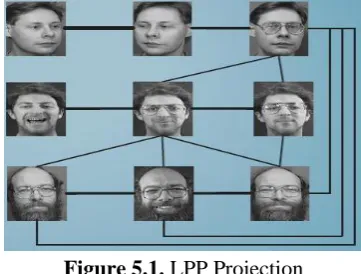
efficient and advanced method for accurate detection and recognition. It attracts researchers to work in the field of face recognition. Various existing methods e.g. pattern recognition, machine learning, Eigenfaces (E.g. PCA), Fisher faces (E.g. LDA) and Laplacian Face (E.g. LPP). Existing methods encounters with several issues e.g. detection rate, accuracy and time. In this research, we are presenting an efficient and more accurate face detection and recognition method based on improved locality preserving projection with Multilinear principal component analysis MPCA. Proposed method firstly finds an embedding to preserve local and global information and then find a sub-face to detect the desired face.
Figure 5.1. LPP Projection
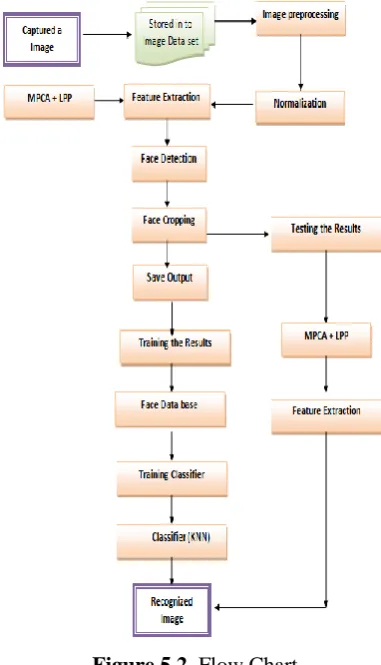
5.1 ALGORITHM OF PROPOSED METHOD ((ILPP-SSLM)-
(ILPP-SSLM) improved locality preserving projection and semi-supervised learning method for efficient face recognition.
Input- Set of images (used as training data set and testing data sets)
Output- Face detection and recognized Step-1 Create an Adjacency Matrix Graph- 1.1: Let X is a graph with n nodes.
1.2 Put edges between i and j
1.3 If Xi and Xj are two nodes, set them “Close” There are two variations:
1.3.1 €-neighborhoods- [parameter €-∈ R] Nodes i and j are connected by an edge
if ||Xi- Xj ||2 < €, Where the norm is the usual Euclidean norm in Rn
1.3.2 k nearest neighbors- [parameter k ∈ N] Nodes i and j are connected by an edge if i is among k nearest neighbors of j or j is among k nearest neighbors of i. 1.4 Set feedback Matrix= Target
Step-2 choose the weight parameters- 2.1 Sij = e- || xi –xj ||2 / t--- (5.3.1)
Step-3: Eigen map: generalized eigenvector problem- XLXT = α XdXTw---(5.3.2)
3.1 Let W0, W1………Wk-1, be the solutions. With Eigen values 0 <= α 0 <= α1 <= --- αk-1 3.2 locality preserving face subspace is spanned by- W`LPP = {W0, W1, ---Wk-1} Step-4 Recognition-
While Feedback Matrix! = Target Matrix Repeat 4.1 to 4.3
4.1 A new face Xi is projected into the face space by- Yi = W`TLPP * Xi--- (5.3.3)
4.2 To determine which face class find the minimum value of.
Dk =|| Yi- Yk || ---(5.3.4)
Where Yk is the vector representing the kth face class
Figure 5.2. Flow Chart
VI.
IMPLEMENTATIONS & RESULTS
ANALYSIS
Proposed ILPP and existing LPP method both are implemented over MATLAB 8.1 simulator. For simulation following hardware and software are required.
Database- AT&T Face database has been used in this project. Total 400 images are used. Total 119 images are used for the training set and rest 281 images for testing set. This dataset contains total 40 subjects and 10 pictures for each subject (total 400). These pictures include Male, Female, with and without spectacles and beard. Each image in the database contains different facial expression and different head pose.
Figure 6. Simulation
6.1 RECOGNITION RATE (EFFICIENCY %)-The Recognition rate is calculated using the correlation, it is a measure of similarity of Images, the higher the correlation values obtained, the better the recognition rate of the system.
Figure 6.1 Recognition Rate % (Existing & Proposed)
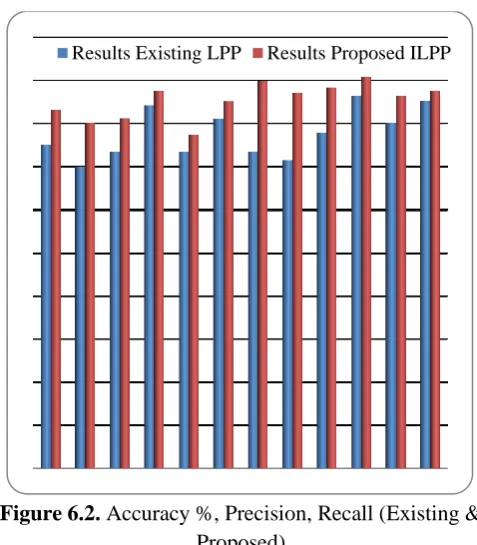
6.2 ACCURACY %-In this dissertation, we need to identify whether the given test face track is present in
RECOGNITION RATE % Existing LPP
the database or not. If it is present, it recognizes the subject and its corresponding movie in which he/she has acted. Accuracy is used as a statistical measure of how well a binary classification test correctly identifies or excludes a condition.
ACCURACY= TP+TN / TP+TN+FP+FN Where, TP-True positive, TN-True negative FP-False positive, FN-False negative
Figure 6.2. Accuracy %, Precision, Recall (Existing & Proposed)
VII.
RESULT COMPARISONS
Proposed ILPP and existing LPP method both are implemented over MATLAB 8.1 simulator and following results were calculated.
Result Comparison Result
Parameters
Existing LPP
Proposed ILPP Precision Average Better
Recall Average Better
Accuracy Poor Better
Recognition
Rate Lesser Better
Table 6.5.1. RESULT COMPARISONS
Analysis-The above table 6.5.1 clearly shows proposed ILPP method shows better precision, recall, accuracy and recognition rate %, over existing LPP methods.
VIII.
CONCLUSIONS & FUTURE WORKS
Machine learning and pattern recognition methods play a vital role in face detection and recognition from an image. In this research work, we have presented an efficient and more accurate face detection and recognition method based on improved locality preserving projection and semi-supervised learning method (ILPP-SSLM). An LPP method is basically an appearance-based method. One extra feedback parameters are added to existing LPP which helps to improve the accuracy %. Existing methods encounters with several issues e.g. detection rate, accuracy and time. The proposed method and existing method both are implemented in MATLAB simulator. An experimental result analysis clearly shows proposed ILPP method shows better precision, recall, accuracy and recognition rate %, over existing LPP methods.
In future work, we can implement ILPP-SSLM for color and 3-dimensional images and more comparison parameters can be calculated. A real-time dynamic environment and static environment can be used to check the efficiency and accuracy level of proposed method, instead of working just over a simulator.
IX.
REFERENCES[1]. Jie pan, Xue-song wang, and yu-hu Cheng,” single-sample face recognition based on LPP Feature Transfer”, IEEE. Translations and content mining, year 2016, PP 1-12.
[2]. M. Theresa, S.M. Poonkuzhali, K. Hemapriya and S. Raja, “Face Recognition using Unsupervised Feature Learning (UFL) Approach”, Middle-East Journal of Scientific Research 24 (S2): 238-242, 2016.
[3]. Weng-Tai Su, Chih-Chung Hsu, Chia-Wen Lin, Weiyao Lin," Supervised learning based face hallucination for enhancing face recognition", ICASSP IEEE 2016, pp1751-1756.
[4]. Dr. Ravish R Singh, Ronak K Khandelwal, Manoj Chavan, "face recognition using orthogonal Locality preserving projections", International Conference on Signal Processing, Communication, Power and Embedded System (SCOPES)-2016, IEEE 16, PP1323-1329.
[5]. G.Suvarna Kumar P.V.G.D Prasad Reddy R.Anil Kumar Sumit Gupta, "Position Detection with Face Recognition using Image Processing and
Machine Learning Techniques", IJCA Special Issue on “Novel Aspects of Digital Imaging Applications” DIA, 2011, PP 79-88.
[6]. Wonjun Kim, Chanho Jung, and Simone Bianco,"Optimization for Detection and Recognition in Images and Videos ", Hindawi Mathematical Problems in Engineering Volume 2017, PP 1-3
[7]. Jianzheng Liu, Chunlin Fang, and Chao Wu,"A Fusion Face Recognition Approach Based on 7-Layer Deep Learning Neural Network", Hindawi Publishing Corporation Journal of Electrical and Computer Engineering Volume 2016, PP 11-17 [8]. Mehmet Korkmaz and Nihat Yilmaz,"Face
Recognition by Using Back Propagation Artificial Neural Network and Windowing Method", Journal of Image and Graphics, Vol. 4, No. 1, June 2016, PP 15-20
[9]. H.Arora1, K. Tayagi1, P.Sharma1, K.Jain,"A Comprehensive Comparative Performance Analysis of Eigenfaces, Laplacianfaces and Orthogonal Laplacianfaces for Face Recognition", International Journal of Advanced Research in Electrical, Electronics and Instrumentation Engineering Vol. 3, Issue 5, May 2014, PP 9734-9741
[10]. Tikoo S and Malik N,"Detection, Segmentation, and Recognition of Face and its Features Using Neural Network", Journal of Biosensors & Bioelectronics Volume 7 • Issue 2, 2016, PP 12-19
[11]. Avenir K. Troitsky,"Two-Level Multiple Face Detection Algorithm Based on Local Feature Search and Structure Recognition Methods”, International Journal of Applied Engineering Research ISSN 0973-4562 Volume 11, Number 6 (2016) pp 4640-4647
[12]. Kamini Solanki, Prashant Pittalia, Ph.D., "Review of Face Recognition Techniques", International Journal of Computer Applications (0975 – 8887) Volume 133 – No.12, January 2016, PP 20-25.
[13]. Dr. Nita Thakare1, Meghna Shrivastava2, Nidhi Kumari,"Face detection and recognition for automatic attendance system", JCSMC, Vol. 5, Issue. 4, April 2016, PP 74 -78
[14]. Supriya D Kakade, "A Review Paper on Face Recognition Techniques”, International Journal for Research in Engineering Application &
Management (IJREAM) ISSN: 2494-9150 Vol-02, Issue Vol-02, MAY 2016, PP 1-4
[15]. Kavita, Ms. Manjeet Kaur,"A Survey paper for Face Recognition Technologies", International Journal of Scientific and Research Publications, Volume 6, Issue 7, July 2016, PP 441-446 [16]. C. Wang, H. Li, and M. Ma, “Face recognition
technology based on the identification card,” in Proc. Int. Conf. Intell. Comput. Technol. Autom., 2012, pp. 173-176.
[17]. M. Baktashmotlagh, M. T. Harandi, B. C. Lovell and M. Salzmann, “Unsupervised domain adaptation by domain invariant projection,” in Proc. Int. Conf. Comput. Vision, 2013, pp. 769-776.
[18]. R. Ibrahim and Z. M. Zin, “Study of automated face recognition system for office door access control application,” in Proc. IEEE Int. Conf. Commun. Software Netw., 2011, pp. 132-136. [19]. J. Wang, Q. Ruan, W. Li and S. Deng, “One-shot
learning gesture recognition from RGB-D data using a bag of features,” J. Mach. Learn. Res., vol. 14, pp. 2549-2582, Sep. 2013.
[20]. J. Lu, Y.-P. Tan, G. Wang, “Discriminative multi