The 2014 Conference on Computational Linguistics and Speech Processing ROCLING 2014, pp. 193-203
The Association for Computational Linguistics and Chinese Language Processing
Spectrum Analysis of Cry Sounds in Preterm and Full-Term
Infants
Li-mei Chen
1, Yu-Hsuan Yang
1, Chyi-Her Lin
2, Yuh-Jyh Lin
2, Yung-Chieh Lin
2Abstract
Long-time average spectrum (LTAS) was used to analyze the cry phonations of 26 infants
under four months old; 16 of them are full-term and the other 10 infants are preterm. The
results of first spectral peak, mean spectral energy, spectral tilt, high frequency energy were
used to compare the cry phonatory between full-term and preterm infants. In addition, cry
duration and percent phonation is also compared. According to previous studies, full-term and
preterm infants’ crying behavior show significant differences because immature neurological
development of preterm infants. Major findings in this study are: (1) There was no significant
difference in unedited cry phonation across groups; (2) There was no significant difference in
percent phonation across groups; (3) There was no significant difference in first spectral peak
across groups, and no significant difference within groups could be found. However, full-term
infants have higher first spectral peak than that of preterm infants; (4) There was no significant
difference in mean spectral energy across groups, yet there was a significant main effect for
partition; (5) There was no significant difference in spectral tilt across groups. Post hoc
comparisons identified higher spectral tilt in P2 than in P3 in the full-term infants; (6) There
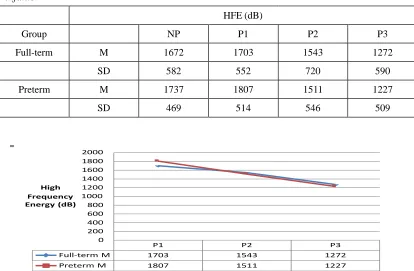
was no significant difference in high frequency energy across groups. Significant differences
were observed across partition, and in both groups, P1 had higher HFE than P3. The
differences in the measures of crying behavior between full-term and preterm infants can help
to estimate health condition of infants who are under 4 months old.
Keywords: Long-time average spectrum, Infant cry, Preterm infants
1. Introduction
Previous studies show that preterm infants are prone to immaturity of neurological development which
leads to their sensitiveness toward pain stimulation, and the greater pain they suffer would reflect on
crying behavior. If a set of distinctive measures can be identified, it might be possible to differentiate
infant cries in the spectrum of normative behavior and cries due to organic pathology. The measures
1
Department of Foreign Languages, National Cheng Kung University 2
would be helpful for doctors and caregivers to identify if the unknown cries are caused by just infant
colic or other more complicated factors. Long-time average spectrum (LTAS) of crying behavior were
analyzed in two groups of newborn infants in this study. LTAS was used to analyze the infant’s
non-partitioned crying episode (NP), as well as the 3 equal-length partitions (P1, P2, P3). First spectral
peak (FSP), mean spectral energy (MSE), spectral tilt (ST), and high frequency energy (HFE) were
measured.
Colic strikes infants who are under four months old, and it makes the infants cry in the evening
on a daily bases or at the moment of waking up (Lester, Boukydis, Gracia-Coll, & Hole, 1990). The
cause of this pain is still unknown (Zeskind & Barr, 1997). Colic occurs when infants are around one
month old and it often disappears without a reason when infants are older than three months (Clifford,
2002). It is a universal and commonly-seen phenomenon which is the cause for excessive cry behavior.
Though previous studies have suggested that higher fundamental frequency and a larger percentage of
dysphonation in crying behavior can be found in the pain cries of infants who suffer from colic, no
standard acoustic features in cry vocalization of infants with colic was established (Zeskind & Barr,
1997). Long-time average spectrum might provide an option to see if there are any significant
variations in the cries of infants with colic and those who are healthy from first spectral peak, mean
spectral energy, spectral tilt, and high frequency energy.
Though infants are not able to talk, they can express their feelings and emotions through crying,
facial expression, and body movements. Diseases are able to be discovered by some characteristics in
crying behavior (Radhika, Chandralingam, Anjaneyulu, & Satyanarayana, 2012). For example,
different pain stimuli would lead to different fundamental frequencies in infant cry vocalization
(Radhika et al., 2012). If more specific characteristics are found in certain diseases, it would be more
effective in prescribing and curing. Sometimes parents can differentiate why their babies cry by their
various crying behavior (Soltis, 2004). As for the way of eliciting cries, Johnston, Stevens, Craig, &
Grunau (1993) had proposed two different ways: the heel-stick procedure and injection. In this current
study, injection was used as the only standard method of eliciting cries to avoid any nuances that might
caused by the different types of pain stimuli. However, even though there are some scientific ways of
detecting the pain intensity infants endure, the experience of pain is quite subjective and is not merely
related to physiological but also psychological factors (Qiu, 2006). Moreover, since infants use crying
to arouse caregivers’ attention, it can be expected that infants’ crying behavior differs with and without
their caregivers around them (Green, Gustafson, Irwin, Kalinowski, & Wood, 1995). Usually, the
responses from caregivers bring cry behaviors to a halt (Green et al., 1995). Thus, crying is regarded
not only an independent behavior but also plays an important role in social interactions between infants
and their caretakers (Green et al., 1995). Furthermore, crying is a way of drawing other people’s
attention to help infants get rid of the uncomfortable situation or meet their needs (LaGasse, Neal, &
Because of the immature development of nervous systems caused by premature birth, preterm
infants’ crying behavior is believed to reveal different characteristics from that of full-term infants
whose nervous systems are comparatively well-developed (Goberman & Robb, 1999). Premature
infants are reported to have higher fo in their cry phonation, and it might be due to the immature,
shorter vocal folds (Johnston et al., 1993). Or as Zeskind (1983) stated that high-risk infants are not
able to perfectly control their crying behavior and that they tend to react more intensely towards pain
stimuli than low-risk infants. Infants react differently to the same stimulus pain whether they are
healthy or born at risk. However, while some studies have shown that preterm infants are more
sensitive to pain stimuli, others found that some premature infants have less intense reactions towards
pain than normal infants (Qiu, 2006).
The main objective of this current study is to find out how the crying behavior between full-term
and preterm infants differs from each other. The findings might help in detecting infants’ health
conditions. Moreover, if the differences of the crying behavior can be systematically characterized, the
measurements can be further applied to identify features in neonate cries due to infant colic.
2. Method
2.1
Participants
Previous studies indicated that gender did not lead to significant differences in first spectral peak, mean
spectral energy, spectral tilt, and high frequency energy (Goberman & Robb, 1999; Goberman, Johnson,
Cannizzaro, & Robb, 2008). Therefore, gender was not controlled in this study. There were 26 infant
participants; 16 were full-term infants and the other 10 were preterm infants. The infants were all under
four months old for both full-term infants and preterm infants according to their gestational ages. All of
the infants in this study were considered to have normal hearing according to interview with parents.
2.2
Data Collection
For data collection, TASCAM wave recorder and RODE uni-directinal microphone were used while
recording the cry phonation of both preterm and full-term infants. The microphone was held near the
infants’ mouth. All infants were in the supine position while receiving the injection because acoustic
properties (e.g. fundamental frequency) might be influenced by postures of infants (Lin & Green, 2007).
Data were collected in the hospital. The cry phonation of both groups of infants was recorded during
and after they receive the injection. The pain stimulus was the same in both groups of infants.
2.3
Acoustic Analysis
Based on Goberman and Robb (1999), a crying episode of infants was defined as the duration of the
continuous crying activity, beginning with the first audible cry sound after the pain stimulus, and an
were first edited out in the cry vocalization, making a “non-partitioned crying episode” (Goberman &
Robb, 1999). In this current study, all the inspiratory cry was eliminated from pain stimulus, only the
phonatory parts were analyzed. Then, a non-partitioned episode was divided into three partitions with
the same length of durations (P1, P2, P3). P1, P2, P3 are regarded as the early, middle, and late sections
of the crying episode, respectively, corresponding to the attack, cruise, and subdual phases of a crying
episode as suggested by Truby and Lind (1965). First spectral peak, mean spectral energy, spectral tilt,
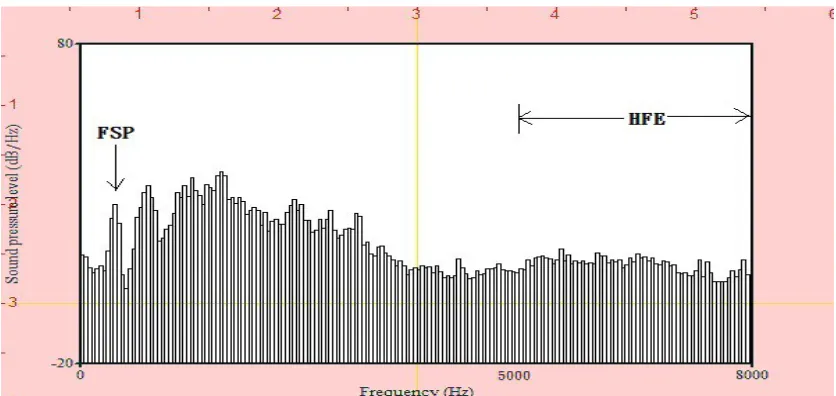
and high frequency energy were measured. First spectral peak was identified as the first amplitude peak
across the LTAS display. Mean spectral energy was measured with the mean amplitude value from 0 to 8000
Hz. Spectral tilt was the ratio of energy between 0-1000 Hz, and 1000-5000 Hz. High frequency energy
was the sum of amplitudes from 5000 Hz to 8000 Hz.
Figure 1. Typical LTAS display showing the location of the first spectral peak (FSP) and high
frequency energy (HFE) between 5000Hz and 8000Hz.
3. Results & Discussion
3.1
Unedited Cry Duration
The average duration of crying episodes for the 16 full-term infants was 43.26s (SD=31.27), and for the
10 preterm infants was 36.21s (SD=30.93). Although full-term infants have longer average duration of
crying episodes, there are no significant differences between the two groups, t(24) = 0.48, two-tailed, p
> .05. The result is the same as that of Goberman and Robb (1999).
3.2
Percent Phonation
The percentage of cry phonation in a long-term non-partitioned, unedited crying episode was calculated.
The average percent phonation across the crying episodes of the 16 full-term infants and the 10 preterm
episode contained cry phonation. Like what was found in Goberman and Robb (1999), there is no
significant differences across groups in the percentage of cry phonation, t(24) = 0.39, two-tailed, p
> .05.
3.3
First Spectral Peak (FSP)
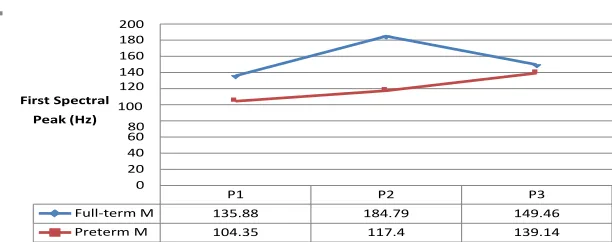
The non-partitioned and partitioned first spectral peak values of the 16 full-term and the 10 preterm
infants are listed in Table 1. A two-way analysis of variance (ANOVA) was performed to check if there
were significant differences in FSP values between the two groups, and whether there was significant
variation between the three equal-length cry durations (P1, P2, P3) in each group. The results indicated
no significant term by partition interaction (p > .05), no significant main effect for term status (p > .05),
and no significant main effect for partition (p > .05). Despite the fact that there were no significant
differences in statistical tests, we found that full-term infants have higher non-partitioned FSP
(182.07Hz) than that of preterm infants (130.44Hz). From overall observation, full-term infants
demonstrated higher FSP in non-partitioned and the three partitioned episodes. Full-term and preterm
infants displayed different trends of FSP in P1, P2, and P3.
While the infants were receiving injections, the sharp pain stimulated them and all the infants
burst out crying. According to the previous studies (Johnston et al., 1993), preterm infants are expected
to have higher FSP because preterm infants were thought to be more sensitive and would react more
intensely to pain. Intensive crying behavior causes the increase of the subglottal pressure and the
stiffness of the vocal folds. However, in this current study, the mean FSP of the full-term infants turned
out to be higher than that of the preterm infants, in both the non-partitioned episode and the three
equal-length episodes. Moreover, full-term infants’ crying episode involved more distinct phases with
decrease of FSP in P3. In preterm infants, FSP kept increasing from P1 to P3.
Table 1. First spectral peak from the non-partitioned episodes (NP) and three partitioned
crying episodes with equal length (P1, P2, P3) from the full-term and preterm groups of
infants
FSP (Hz)
Group NP P1 P2 P3
Full-term M 182.07 135.88 184.79 149.46
SD 139.06 113.24 142.45 119.31
Preterm M 130.44 104.35 117.40 139.14
P1 P2 P3
Full-term M 135.88 184.79 149.46
Preterm M 104.35 117.4 139.14
200 180 160 140 120 First Spectral 100 Peak (Hz) 80 60 40 20 0
Figure 2. First spectral peak of full-term and preterm infants over time (P1, P2, and
P3 are three equal-length partitioned crying episodes.)
3.4
Mean Spectral Energy (MSE)
The mean spectral energy of non-partitioned and partitioned episodes of the 16 full-term and the 10
preterm infants are compared and listed in Table 2. A two-way analysis of variance (ANOVA) was
performed to investigate if there was significant variation between the two groups, and whether there
was significant variation between the three equal-length cry durations (P1, P2, P3) in each group. No
significant term by partition interaction (p > .05) was found. There was a significant main effect for
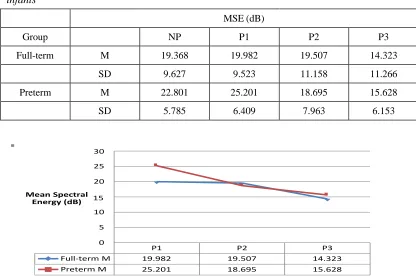
partition (F = 6.47, p < .05), yet there was no significant main effect for term, p > .05. One-way
ANOVA tests were then performed in each group to check the changes in MSE (in P1, P2, P3). In
full-term infants, P2 was significantly higher than P3. In preterm infants, P1 showed significantly
higher energy than P2 and P3. The changes are illustrated in Figure 3.
Premature infants, compared to full-term infants, are reported to have higher fo in their cry
phonation, and it might be due to tension of the larynx (Johnston et al., 1993). Greater pain stimulus
makes laryngeal muscles tighten. In this current study, although no significant differences could be
identified, preterm infants showed higher mean of MSE in non-partitioned episode and the three
equidurational crying episodes. This shows that during the cry duration, the preterm infants’ laryngeal
muscles are tighter and they have a more severe reaction toward pain stimulus. The tighter laryngeal
muscles suggest a more intense cry behavior. Moreover, a decrease in MSE could be observed in both
full-term and preterm infants. This might suggest that the laryngeal muscles of both groups of infants
loosen by phase, especially in preterm infants. There is sharper decrease of MSE from P1 to P3 in
Table 2. Mean spectral energy from the non-partitioned episodes (NP) and three partitioned
crying episodes with equal length (P1, P2, P3) from the full-term and preterm groups of
infants
Figure 3. Mean spectral energy of full-term and preterm infants over time (P1, P2,
and P3 are three equal-length partitioned crying episodes.)
3.5
Spectral Tilt (ST)
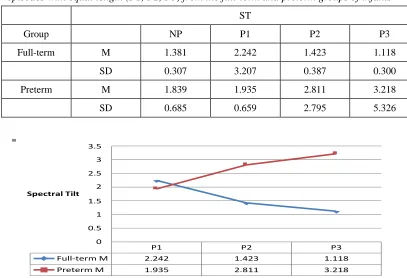
The spectral tilt of non-partitioned and partitioned crying episodes of the two groups are compared and
listed in Table 3. In order to identify if there was significant differences of ST between the two groups
and whether there was significant variation between the three equal-length cry durations (P1, P2, P3) in
each group, a two-way analysis of variance (ANOVA) was performed. There were no significant term
by partition interaction (p > .05), no significant main effect for partition, and no significant main effect
for term. To investigate changes in ST across partitions within each group, separate one-way ANOVA
tests were performed for full-term and preterm infant groups. In full-term infants, post hoc comparisons
identified a significantly higher ST for P2 than for P3 (p < .05), but no significant differences in ST
across partitions for the preterm infants (p > .05). Overall, the full-term infants showed higher ST
values at the onset of crying vocalization which decreased over time; whereas the preterm infants had
lower ST values at the onset, which increased over time. The changes are demonstrated in Figure 4. For
full-term infants, higher P2 than P3 in ST was observed. The ST of full-term infants does not increase
over time as mentioned in Goberman and Robb (1999); on the contrary, the ST of full-term infants
P1 P2 P3
Full-term M 19.982 19.507 14.323
Preterm M 25.201 18.695 15.628
30 25 20
Mean Spectral 15 Energy (dB)
10 5 0
MSE (dB)
Group NP P1 P2 P3
Full-term M 19.368 19.982 19.507 14.323
SD 9.627 9.523 11.158 11.266
Preterm M 22.801 25.201 18.695 15.628
infants might use more strength in crying, hoping their caretakers would alleviate their pain. Third,
some caretakers tended to soothe the infants as soon as they started crying, which would significantly
change the natural cry episode since the soothing and consolation from the caretakers might influence
their cry phonation. The infants might feel safe and stopped crying. This might cause incomplete early,
middle, and late sections in a cry episode, as Goberman and Robb (1999) mentioned. In further studies,
the interaction of infants and their caregivers is probably one of the variables that should be strictly
controlled. Moreover, video recording should be implemented in order to identify whether the infants
stopped crying spontaneously or their attention was drawn by other things. Lacking complete three
sections of cry episode might be the main reason of the discrepancy in the findings of this current study
and previous studies.
4. Summary
Cry phonations of neonates from 16 full-term infants and 10 preterm infants were analyzed with
long-time average spectrum (LTAS). Major findings were: (1) Full-term infants had higher first
spectral peak than that of preterm infants; (2) Mean spectral energy in both groups of infants decreased
over time; (3) Spectral tilt in full-term infants decreased, but increased in preterm infants over time; (4)
High frequency energy in both full-term and preterm infants decreased over time. In further study, the
environmental noise (e.g., from nurses, parents, and other infants around) should be controlled in order
to acquire sufficient data to identify more systematic distinctions in the patterns of cry phonation
between full-term and preterm infants.
Acknowledgements
This research was supported by a grant from National Science Council (NSC102-2410-H-006 060) and
the Ministry of Education, Taiwan, R.O.C. The Aim for the Top University Project to the National
Cheng Kung University. We thank the infant participants and their families for their time and
cooperation.
References
Clifford, T. (2002). Infant colic: A prospective, community-based Examination (Unpublished doctoral
dissertation). The University of Western Ontario, Canada.
Goberman, A. M., Johnson, S., Cannizzaro, M. S., & Robb, M. P. (2008). The effect of positioning on
infant cries: Implications for sudden infant death syndrome. International Journal of Pediatric
Otorhinolaryngology, 72, 153-165.
Goberman, A. M. & Robb, M. P. (1999). Acoustic examination of preterm and full-term infant cries:
The long-time average spectrum. Journal of Speech, Language, and Hearing Research, 42,
Green, J. A., Gustafson, G. E., Irwin, J. R., Kalinowski, L. L., & Wood, R. M. (1995). Infant crying:
Acoustics, perception, and communication. Early Development and Parenting, 4(4), 161-175.
Johnston, C., Stevens, B., Craig, K., & Grunau, R. (1993). Developmental changes in pain expression
in premature, full-term, two- and four-month-old infants. Pain, 52, 201-208.
LaGasse L. L., Neal A. R., & Lester B. M. (2005). Assessment of infant cry: Acoustic cry analysis and
parental perception. Mental Retardation and Development Disabilites, 11, 83-93.
Lester, B., Boukydis, C., Gracia-Coll, C. & Hole, W. (1990). Colic for developmentalists. Infant
Mental Health Journal, 11(4), 321-333.
Lin, H. C., & Green, J. A. (2007). Effects of posture on newborn crying. Infancy, 11(2), 175-189.
Mendoza, E., Munoz, J., & Naranjo, N. (1996). The longtime average spectrum as a measure of voice
stability. Folia Phoniatrica, 48, 57–64.
Qiu, J. (2006). Does it hurt? Nature, 444, 143-145.
Radhika, R. L., Chandralingam, S., Anjaneyulu, T. & Satyanarayana, K. (2012). A suggestive
diagnostic technique for early identification of acyanotic heart disorders from infant’s cry.
International Journal of Electrical and Electronics, 1(3), 32-38.
Soltis, J. (2004). The signal functions of early infant crying. Behavioral and Brain Sciences, 27,
443-458.
Truby, H., & Lind, J. (1965). Cry motions of the newborn infant. In J. Lind (Ed.), Acta Paediatrica
Scandanavica: Newborn Infant Cry (Suppl.163), 7–58.
Zeskind, P. (1983). Production and spectral analysis of neonatal crying and its relation to other
biobehavioral systems in the infant at-risk. In T. Field & A. Sostek (Eds.), Infants born at-risk:
Physiological and perceptual processes. New York: Grune & Stratton.
Zeskind, P. & Barr, R. (1997). Acoustic characteristics of naturally occurring cries of infants with