International Journal of Scientific Research in Computer Science, Engineering and Information Technology © 2018 IJSRCSEIT | Volume 3 | Issue 3 | ISSN : 2456-3307
Artificial Upper-LIMB Prostheses Usage in Present Trends
B. Shyamala
Assistant Professor, Department of CSE, GITAM Deemed To Be University, Bangalore, Karnataka, India
ABSTRACT
Skeletal muscles are evaluated and recording is called as diagnostic technique and is also called as Electromyography (EMG). By using the instrument called an electromyograph to produce a record called an electromyogram. To detect the electric potential generated by muscle cells are operated. In this paper, various discussion have been done on Electromyography (EMG) usage and its advantages.
Keywords: Electromyography (EMG), skeletal muscles, UPPER-LIMB PROSTHESES.
I.
INTRODUCTION
EMG signals are getting to be one of the indispensable organic parameters which have extensive variety of uses in biomedical designing, prosthetic gadget advancement, and human machine association (HMI) and recovery gadgets [1].
The electromyogram (EMG) is a bio-potential flag which is obtained by anodes through a muscle fiber skin to watch the muscle movement. It is likewise connected with neural flag, sent from spinal line to muscles [2], [3]. The voltage scope of
EMG flag is 50uV to 100 mV and the recurrence is fluctuated from 10 Hz to 500 Hz for surface Electromyography (EMG) [4]. The EMG flag is obtained by applying noninvasive cathodes.
II.
MATERIAL AND METHODS
1. Subjects' information six upper-appendage amputees comprising of five males and one female took an interest in the examination. Five of the six subjects had translational removal and one had a Tran’s humeral removal. The lingering and in place appendages of the subjects were altogether inspected to guarantee appropriate similarity with the
exploratory prerequisite. Every one of the subjects had a one-sided removal and three of the trans radial amputees had involvement in the utilization of myoelectric prostheses.
Prior to the trial started, the subjects were obviously advised about the goal of the investigation. From that point, they all concurred and gave composed educated assent and in addition consent for the production of their photos for logical and instructive purposes. The convention of this investigation was endorsed by the Institutional Review Board of Shenzhen Institutes of Advanced Technology, Chinese Academy of Sciences, China.
and remote capacity, which comply with the prerequisite of the investigation.
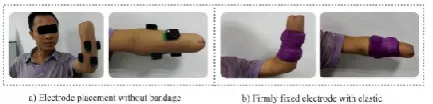
To secure myoelectric and accelerometer signals comparing to different appendage movements, the situating and introduction of the six sensors were gone before by palpation of the remaining muscles in the removed arm so as to distinguish the length and gut of the muscles as determined in an anatomical chart book [20,21]. By utilizing the Delsys Adhesive Interface, the six remote sensors were connected to the skin surface hidden the cut off and in place arm muscles of the subjects. Also, four of the six sensors were set around the zenith of the muscle swell, 2– 3 cm distal to the elbow wrinkle while the staying two sensors were set on the flexor and extensor muscles. Before appending the sensors, the sensor site also the subject's skin were legitimately cleaned with liquor swabs to evacuate dry dermis and any skin oil that is fit for debasing the nature of the chronicles. In circumstances where a subject's skin is exorbitantly dry, the dry skin cells were removed by spotting the site with restorative tapes to guarantee appropriate cathode skin contact. An outline of the remote flag sensors put on the arm of a subject is appeared in Figure 1. Note that comparative anode design and skin readiness method was connected to the excised and in place arms of the considerable number of amputees to ensure reasonable examination between the two arms as for impact of portability on EMG-PR movement classifier.
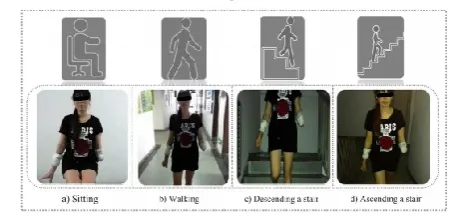
To research the impact of versatility on the order execution of EMG-PR movement classifier, four unique situations including sitting ona seat (S1), strolling on
Figure 1. Wireless signal sensors placed on the arm of a subject. To the right, an elastic bandage was used to firmly fix the sensors to the skin to minimize sensor displacement/movement and vibration during the experiment.
a level ground (S2), dropping a stair (S3), and climbing a stair (S4) were intended for the information gathering. What's more, seven distinctive upper-appendage movements including: hand (open and close), wrist (flexion, augmentation, pronation, and supination), and no development were considered in the examination. Before the information accumulation, each subject was told to work on playing out every one of the classes of arm developments utilizing moderate power for around 3– 5 min while in static situation (S1) and around 5– 8 min while in non-static situations (S2, S3, and S4). This preliminary advance was intended to acquainted the subjects with the trial methodology to empower them play out the appendage movements in an exact and steady way. A delineation of a delegate subject expecting the four situations from which the EMG and ACCmmg chronicles were procured is appeared in Figure 2.
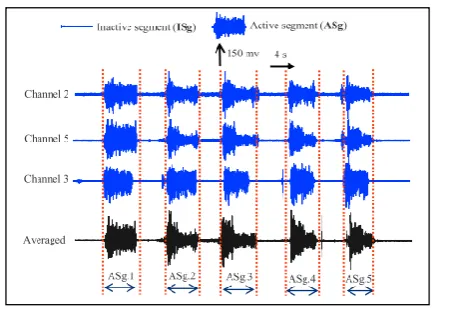
manner delivering an aggregate of 25s of dynamic movements and 20s of in-dynamic movements (totaling to 45s EMG and ACCmmg accounts per movement class) as appeared in Figure 3. These techniques were rehashed for the other three non-static situations (S2, S3, and S4) with EMG and ACCmmg signals recorded all the while from the severed and in place arms of the subjects, and the information was later put away for disconnected preparing.
It is vital that for the main non-static situation (S2), the amputees watched the upper appendage developments with a normal strolling velocity of around 1.0 m/s in a level ground territory in which 10.0 m way was set apart out for the test. In the mean time, the stairs landscape comprises of 12 stages with each progression having an ascent tallness and tread profundity of roughly 0.15 m and 0.25 m individually, and the amputees played out the appendage developments with a normal speed of around 1.0 m/s in both the dropping (S3) and climbing (S4) situations. Likewise, unique levels of speed were analyzed over the three versatile territories (S2, S3, and S4), and we understood that 1.0 m/s would be confortable for the amputees and also direct for our investigation, consequently it was utilized.
3. Data pre-processing and segmentation With the
guide of MATLAB (R2014a) programming
instrument, the EMG and ACCmmg signals were individually examined at the rate of 1024 Hz, and a 50 Hz step channel was in this way used to wipe out the electrical cable commotion inborn in the accounts. Moreover, a fifth-arrange Butterworth high-pass channel with 5 Hz slice off recurrence was utilized to constrict the moderate varieties in the EMG chronicles caused by movement curios. For every dynamic movement, the EMG accounts comprise of five sections relating to the five reiterations of muscle withdrawals. Via deliberately reviewing the signs, an appropriate division of
constriction/noncontract ion ages was done physically for each movement class. To accomplish this, channels have clear EMG exercises with peaceful benchmark in the middle of were outwardly chosen and arrived at the midpoint of as a solitary information stream as appeared in Figure 4. At that point the beginning and balance times of every dynamic section were resolved and connected to alternate channels. A while later, a covering sliding window of length 150 ms with addition of 100 ms was connected. The covering windowing strategy was received in this investigation to upgrade use of constrained information stream and congruity of choice yield by the classifier [22]. Sympathetically take note of that comparable division method was connected to the ACCmmg accounts.
Figure 2. A representation of the scenarios assumed by each subject during arm motion data collection. a) Acquisition of data in sitting position (S1). b) Collection of data while walking on a flat ground (S2). c) Collection of data while descending a stair (S3). d) Collection of data while ascending a stair (S4).
Figure 4. Active segments of EMG signals from randomly selected channels during a hand close task with five repetitions. Signals from a number of randomly chosen channels were averaged to produce the required data segmentation.
4. Feature extraction and classification Highlight extraction, a procedure of getting a lessened arrangement of data that precisely portrays the diverse appendage movement expectations of a subject, is a fundamental stage in EMG-PR. It is critical that diverse element extraction techniques have been examined for arranging the appendage development goals in amputees [3,7,23– 25]. To decide the list of capabilities that is most appropriate for the present investigation, a preparatory assessment of EMG include extraction techniques was led. In the assessment, the execution of an as of late proposed highlight extraction technique comprising of ASS include (the outright estimation of the summation of square base of the EMG information in a given examination window) and ASM highlight (the supreme estimation of the summation of the expth base of the EMG information in an investigation window) [3], was contrasted and that of the Hudgins include set (mean total esteem, waveform length, number of zero intersection, and incline sign changes) that has been broadly connected in the field of EMG-PR based control [9,14– 16,18,19,27,28].
In light of the assessment comes about, a normal Intra-situation order mistake (CE) of 5.22% ± 0.86% was accomplished by ASS þ ASM highlight set in contrast with the 9.50% ± 1.08% for the Hudgins set.
Henceforth, the Intra-situation aftereffects of the ASS þ ASM include set is superior to the Hudgins set. Considering the fundamental issue in the present investigation which is to determine the impact of portability, the ASS þ ASM include set showed improvement over the Hudgins highlight set since the ASS þ ASM accomplished a normal Inter-situation CE of 21.00% ± 3.92% as against 18.48% ± 3.39% for the Hudgins set. As it were, this proposes the Hudgins set would be better utilized as a part of the present examination since it gave off an impression of being more hearty to portability that the ASS þ ASM highlight set. Then again, the ASS þ ASM include set might be favoured in applications where subjects/patients versatility isn't required/considered. For example, in the improvement of dynamic restoration systems in view of EMG-PR for arm work recuperation in post-stroke survivors where the post-stroke patients might be required to keep up a static (nonmobile) situation while perception diverse sorts of upper appendage developments, the ASS þ ASM include set might be wanted to the Hudgins set. Note that the Intra-situation CE was gotten via preparing and testing a classifier with EMG information from a similar situation.
great execution upon preparatory assessment in the present examination. In this manner, the removed EMG highlights were anticipated into a solitary grid (include vector) that speaks to the component coefficients. Thus, an element vector was gotten for the ACCmmg dataset.
Appendage movement characterization strategies in view of liner discriminant examination (LDA), k-closest neighbors (kNN), bolster vector machine (SVM), simulated neural systems (ANN), calculated relapse, Bayesian method, Decision three, and Gaussian blend demonstrate, have been broadly explored. Be that as it may, the LDA based grouping plan has been received in a few past investigations since it is less unpredictable to actualize and could accomplish comparative arrangement execution contrasted with complex characterization plans [26]. SVM plot has similarly increased wide applications (because of its bit trap trademark) and the kNN classifier (because of its non-parametric nature). In this way, LDA, kNN, and SVM classifiers were constructed and prepared with a bit of the removed capabilities and the prepared classifiers were tried with the rest of the piece of the component vector to decide the arrangement execution in recognizing the diverse appendage movement aims of the subjects. The basis behind utilizing three unique classifiers in the present examination is on account of the decision of a classifier has been beforehand detailed as an essential factor in EMG-PR based control frameworks. The characterization blunder (CE) metric prominently characterized as the quantity of mistakenly ordered examples to the aggregate number of tests was utilized to assess the impact of portability in the examination.
5. Settling the impact of portability
To limit the impact caused by portability in deciphering amputees' appendage movement goals, the accompanying three conceivable arrangements to be specific: Dual stage successive grouping plan,
Multi-situation preparing methodology, and Hybrid preparing system were proposed and inspected.
5.1. Double stage successive characterization plot The double stage successive plan composed in this investigation is conceptualized as appeared in Figure 5. The plan is comprised of two levels of five successive classifiers in which the principal level comprise of a situation classifier worked to distinguish every one of the situations (S1, S2, S3, and S4) accepted by the subject in view of the ACCmmg chronicles. At this level, the ACCmmg dataset from each subject was utilized to prepare the classifier to explicitly distinguish the subject's present situation. In the second level, four diverse appendage movement classifiers were composed with each relating to a specific situation. At that point, every one of the four movement classifiers was prepared with EMG information gained from every one of the classes of movements performed in the relating situation. All together words, the situation/status of the subject is decoded in the main stage in light of the ACCmmg information and by utilizing the decoded situation, a suitable movement classifier is chosen in the second stage to group the appendage movement plan of the subject utilizing the EMG information.
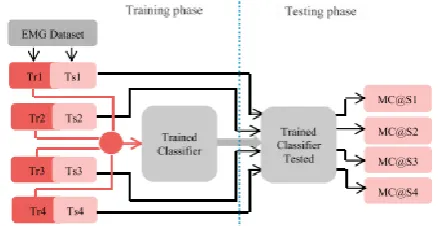
5.2. Multi-situation preparing system
While trying to diminish the impact of versatility on the EMG-PR movement classifier, a preparation
system that includes the incorporation of every conceivable example into the preparation set (Figure
6.) named as the Multi-situation preparing system is constructed and some past examinations had
endeavoured to build up a to some degree comparable strategy to address different issues [12–
16,27]. In the methodology, we acquainted an arbitrary stage procedure with successfully segment
strategies [12– 16,27]. Along these lines, the preparation set from all the four situations was connected into a solitary vector that was utilized to prepare the LDA, kNN, and SVM classifiers. At that point, the prepared classifiers comprising of EMG dataset pulled over all situations were independently tried with the test set from every situation to acquire
the comparing appendage movement characterization result.
Figure 5. Dual-stage sequential classification scheme. The scenario classifier determines the scenario assumed by a subject and informs the motion classifier which then classifiers the limb motion intents of the subject. And S1, S2, S3, and S4 represent the four scenarios considered in the study
5.3. Cross breed preparing system
We similarly conjectured that preparation an example acknowledgment based movement classifier with both EMG and ACCmmg chronicles acquired from a specific situation could enhance the heartiness of such a classifier. This was done to check whether including all the more preparing data identified with the arm movements of the subjects could definitively build the classifier's power against the impact of portability. In such manner, the classifiers were manufactured and prepared with both ruler of signs.
6. Measurable investigations
To look at if the proposed arrangements could fundamentally diminish the impact of versatility on
the characterization execution of EMG-PR movement classifier, investigation of difference (ANOVA) factual strategy was connected with the SPSS Statistical Modeling Software (SPSS 21.0 IBM
Corp., Chicago, IL). Also, the level of measurable essentialness was set to p < 0.05 (95% certainty level).
Figure 6. Schematic diagram of the Multi-scenario training strategy. Tr1-Tr4 denote the training data corresponding to S1–S4 respectively, while Ts1-Ts4 represent the test set that corresponds to S1–S4 respectively. Meanwhile, MC@S1-MC@S4 are the motion classification outputs corresponding to the four scenarios.
III.
CONCLUSION
enhancing the clinical heartiness of multifunctional myoelectric prostheses. In spite of the fact that a versatile wrap was utilized to immovably settle the anodes to the skin of the amputees to limit their removal amid the investigation (Figure 1), however some slight move in anode positions were seen in a few amputees because of sweat and motion. Subsequently, it is obscure whether such slight move would influence the execution of the proposed arrangements. In our future work, we would like to additionally look at the vigor of the proposed arrangements by considering variables such terminal move, wrist and elbow joints status close by portability in real-time situation.
IV.
REFERENCES
[1].Kiguchi, K.; Hayashi, Y. An EMG-based control for an upper-limb power-assist exoskeleton robot. IEEE Trans. Syst. Man Cybern. Part B Cybern. 2012, 42, 1064–1071.
[2].Yagi, E.; Harada, D.; Kobayashi, M. Upper-limb power-assist control for agriculture load lifting. Int. J. Autom. Technol. 2009, 3, 716–722.
[3].Su, H.; Li, Z.; Li, G.; Yang, C. EMG-based Neural Network Control of an Upper-limb Power-assist Exoskeleton Robot. In Advances in Neural Networks–ISNN 2013; Springer: Berlin, Germany, 2013; pp. 204–211.
[4].Lawrence P, Herberts P, Kadefors R. Experiences with a multifunctional hand prosthesis controlled by myoelectric patterns. In: Gav rilovic MM, Wilson AB Jr, editors. Advances in external control of human extremities. Belgrade (Yugoslavia): Etan; 1973. p. 47–65.