End-to-End Evaluation of Machine Interpretation Systems: A Graphical
Evaluation Tool
Susanne J. Jekat, Lorenzo Tessiore
University of Hamburg
Computer Science Department1
Vogt-Kölln Str., 30
e-mail: jekat,[email protected]
Abstract
VERBMOBIL as a long-term project of the Federal Ministry of Education, Science, Research and Technology aims at developing a mobile translation system for spontaneous speech. The source-language input consists of human speech (English, German or Japanese), the translation (bidirectional English-German and Japanese-German) and target-language output is effected by the VERBMOBIL system. As to the innovative character of the project new methods for end-to-end evaluation had to be developed by a subproject which has been established especially for this purpose. In this paper we present criteria for the evaluation of speech-to-speech translation systems and a tool for judging the translation quality which is called Graphical Evaluation Tool (GET)2.
1
This work was funded by the Federal Ministry of Education, Science, Research and Technology (BMBF) in the framework of the VERBMOBIL Project under Grant 01 IV 101 A/O and in the framework of the SFB 538 Mehrsprachigkeit (Collaborative Research Center No. 538 Multilingualism) by the Deutsche Forschungsgemeinschaft (DFG). The responsibility for the contents of this study lies with the authors.
2 To simplify the presentation of this paper, we only refer to the language pair German-English.
Introduction
The performance of evaluation very often is driven by the characteristics of the system that has to be judged (Andenfilger, 1994). As to the Verbmobil project the evaluation should meet three aspects:
• the needs of the developers,
• the needs of the user,
• the constraints on the evaluation of translation quality in general.
In our concept and performance of evaluation we tried to combine these three aspects but one should keep in mind that at least the constraints on translation quality in general were meant to describe human translation with all its varieties and specific stylistic features. As to the special case of machine interpretation still only texts from limited domains can be transferred. So in our view it seems to be legitimate to simplify some of the procedures that are applied to the evaluation of human translation. An evaluation method based on any well known standard (EAGLES, 1995; Spark Jones and Galliers, 1996; Manzi, 1996) could not have integrated the three cited aspects, as traditional evaluation methods are intended for comparative evaluations more than for the investigation of a system during its development; therefore, to meet the requirements we had, we developed an integrated methodology and a tool for speech-to-speech quality evaluation which also allows easy access to the data.
Translation Quality
Evaluation of translation quality is a complicated matter per se. One reason may be the diversification of the field, another the different manifestations of translation (from
simultaneous interpretation to written translations). In this paper we will refer to dialogue interpretation, that is the transfer of spoken language 1 to spoken language 2. In our view, interpretation differs clearly from written translation:
1. The process of writing a translation can take as much
time as necessary (within a reasonable time-frame), but interpretation has to be fast because the ongoing communication should not be disturbed.
2. Written translation has to be very clear in order to
avoid misunderstandings. The receiver of a written translation in contrast to the receiver of an interpretation has no contact to the translator nor access to situational or pragmatic cues to solve ambiguity. On the other hand, written translation offers the opportunity to use footnotes and explanations, which for the condition of time pressure can not be used in interpretation.
3. The input for the translation of written texts is
complete and formed. Deviations from the well-known and well documented standard of written texts in most of the cases are no mistakes but motivated by special intentions of the author. Different from this, the input for interpretation is incomplete and sometimes ill-formed as compared to the structures of written language. Additionally, specific characteristics of a speaker or the actual situation may influence the appearance of the input.
VERBMOBIL. The output always consists of only one of the translations, which is selected by the actual system’s configuration. In the framework of this paper it would lead too far to describe all translation models. We only present two examples here:
1. the dialog-act based translation: the generation of the target-language turn is based on the central function (the dialog-act) of the input and some domain specific information elements,
2. the translation is based on a deep analysis of every
lexical item and the syntactic structure of the source-language turn.
As evaluators should judge from the user's point of view and should not be influenced by a preference for one of the translation models, we test different configurations of the system but show them only one result at a time. Examples for configurations are first wins (the first result that is generated is taken into consideration) and waiting for deep, where the result of the deep analysis gets a very high priority.
During one evaluation phase (which normally lasts two weeks) the different configurations are tested in comparable numbers of test suites.
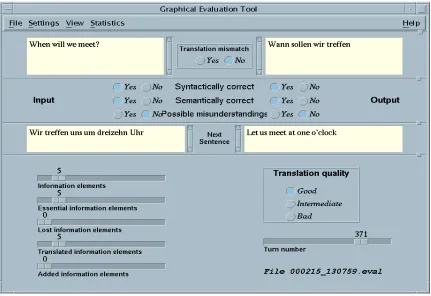
Figure 1: Main window of the GET
Feedback to Developers during Evaluation
Within one evaluation phase more than one version of the system is tested as changes or updates are possible. The test results are continuously transmitted to the developers and they are informed immediately if there arise problems with a certain configuration. During the tests, evaluators and developers try to find out the weak points of a module or a module combination; changes are implemented and installed whenever possible throughout the evaluation phase.
Feedback to Developers after Evaluation
Once an end-to-end evaluation phase is finished, all results are analysed under different aspects and presented to the
project members through the Graphical Evaluation Tool GET (see figure 1 above); the use of the same tool both for the evaluation procedure and the presentation of the results allows complete transparency of the evaluation method and a strong effectiveness. Ongoing improvement of the system is then based on the latest evaluation results.
The Design of Experiments and the
Evaluation Tool GET
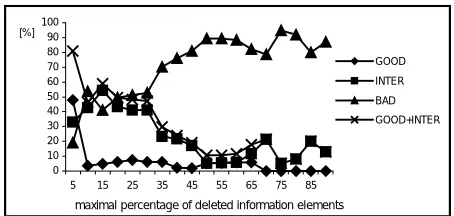
and 8, where the value axis shows the percentage of turns for different translation and output qualities.
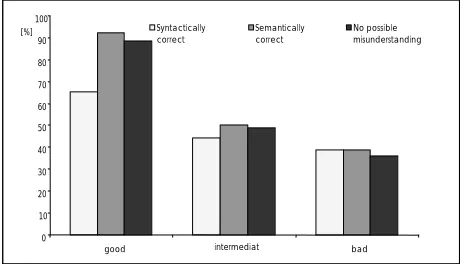
The correlation between quality of the output, translation mismatch and translation quality is shown in figure 9, where all the analysed turns contain a translation mismatch.
0 10 20 30 40 50 60 70 80 90 100
good intermediat bad
[%] Syntactically
correct
Semantically correct
No possible misunderstanding
Figure 9: Distribution of output quality when a translation mismatch occurs for different translation qualities
Conclusions
The GET tool allows a visual representation of dialogues that is useful both in the evaluation phase and for the improvement of the system because a large database can be processed. As to translation quality of machine interpretation, our evaluation method reveals that the preservation of the ongoing communication as a qualitative criterion is more important than a possible loss of information caused by a translation mismatch. When the output quality is related to the translation quality, semantic correctness is preferred to syntactic correctness. Despite individual differences between human evaluators all of them follow the same course of evaluation by the help of the GET. Statistical analysis of the results as well as quantity of the evaluated turns and number of different evaluators in our view lead to a relatively objective evaluation of translation quality performed by VERBMOBIL.
References
Andelfinger U. (1994). Some Remarks about the Validation of Information Systems Development. In Interdisciplinary Foundation of Systems Design and Evaluation. Seminar Report 97 of International Conference and Research Center for Computer Science, edited by R. Keil-Slawik, Saarbrücken Schloss Dagstuhl, University of Saarland.
EAGLES-Expert Advisory Group on Language Engineering Standards (1995). Evaluation of Natural Language Processing Systems, Final Report. Document EAG-EWG-PR.2. Obtainable from ISSCO, University of Geneva.
House, J. (2000). Übersetzungsäquivalenz: ein Schlüsselbegriff in der Übersetzungswissenschaft? In Knapp, K. and Knapp-Potthoff, A. (eds.) Sprachmitteln und interkulturelle Kommunikation. München: iudicium.
International Standard ISO/IEC 9126. (1991). Information Technology - Software product evaluation - Quality characteristics and guidelines for their use. International Organization for Standardization, International Electrotechnical Commission.
Jekat, S.J., Tessiore, L. and Lause, B. (1999). Das Graphical Evaluation Tool für die End-to-End-Evaluation des Verbmobil Systems. Verbmobil-Techdoc. Nr. 73, Universität Hamburg.
King, M. (1996). Evaluating Natural Language Processing Systems. Special edition of Communications of the ACM on Natural Language Processing, 39(1), pp. 73-79 Lehman, M.M., (1980). Life Cycles, and Laws of Software Evolution. In Proceedings IEEE, 68(9), pp. 1060— 1076.
Manzi, S. King, M. and Douglas, S. (1996). Working towards user-oriented Evaluation. In Proceedings of the International Conference NLP+IA/TAL+AI, Mouncton, Canada (pp. 155—160).