ISSN 2286-4822 www.euacademic.org
Impact Factor: 3.4546 (UIF) DRJI Value: 5.9 (B+)
Effect of 4 weeks weight training program on WBCs
count and blood glucose level
BITAM SADOKPAM
Ph.D. Scholar B.V.D.U., Pune, M.H., India Dr. GAURAV PANT Assistant Professor Department of Physical Education B.V.D.U. Pune, M.H., India
Abstract:
data’s of the pre and post-test were achieved further statistical calculation was analyzed by using dependent t-test from the data’s. As for WBCs, (pre-test: Mean “x” =7.18; MD= -0.62; SE=0.31 and post-test: Mean “x” =7.80; MD= -0.62; SE=0.29) the t-value 2.13˃ Tab t.05 (25) 1.708. So, there was significant difference in pre and post-test on weight training for the WBCs count. But, in blood glucose, (pre-test: Mean “x” =85.46; MD= -4.42; SE=3.41 and post-test: Mean “x” =89.88; MD= -4.42; SE=2.66) the t-value 1.12˂ Tab t.05 (25) 1.708. So, there was no significant difference in pre and post-test on weight training for the blood glucose level, as the graphical representation had shown that blood glucose level was decreased after weight training.
Key words: WBCs, blood glucose and weight training.
Introduction
Weight training is a common type of strength training for developing the strength and size of skeletal muscles. It uses the weight force of gravity (in the form of weighted bars, dumbbells or weight stacks) to oppose the force generated by muscle through concentric or eccentric contraction. Weight training uses a variety of specialized equipment to target specific muscle groups and types of movement. Sports where strength training is central are bodybuilding, weightlifting, power lifting, and strongman, Highland games, shot-put, discus throw, and javelin throw. Many other sports use strength training as part of their training regimen, notably; mixed martial arts, American football, wrestling, rugby football, track and field, rowing, lacrosse, basketball, baseball and hockey. Strength training for other sports and physical activities is becoming increasingly popular1.
Our white blood cells are components in our immune system that actively seek out and fight various forms of
infection. When we exercise, these cells increase their numbers and circulate more quickly through our body. If we don't exercise too much or too heavily, increased of activity by our white blood cells can improve our ability to fight off viral and bacterial infections2.
In scientific studies, strength training has been found to improve insulin sensitivity in people with diabetes to the same extent that aerobic exercise does. Extended periods of strength training improve blood sugar control as well as taking a diabetes drug. In fact, in people with diabetes, strength training in combination with aerobic exercise may be even better3.
Typically, the intensity and duration of exercise required to boost our white blood cells are less than those required by a rigorous aerobic exercise routine. Even individuals who are new to exercise or only exercise moderately can enjoy the immune-boosting benefits of their activity. We can optimize physical activity's effects on our immune system if we get 20 to 30 minutes of exercise five days a week.4
Methodology
The Subject
The present study was conducted on a maximum 26 male students from B.V.D.U, college of physical education, Katraj and the age group of the subject was arranged from 22 to 25 years only.
2Elevated White Blood Cells after Exercise (10th August 2014). Retrieved from the online website: http://www.livestrong.com/article/386072-elevated-white-blood-cells-after-exercise/
3Diabetes and the Benefits of Strength Training (10th August 2014). Retrieved from the online website: http://www.webmd.com/diabetes/strength-training-diabetes
Variables used for Study
The following WBCs count and Blood glucose level variables were used for the study.
WBCs count. Blood glucose level.
Inclusion criteria
Only the students which belong to B.V.D.U, college of physical education, Katraj was included.
Only the total of 26 male students was selected as the subject for the present study and their age were ranged from 22 to 25 years.
Only the WBCs count was included as the variable of the study.
Only the blood glucose level was included as the variable of the study.
Objectives of the Study
The research work was carried out with the following objectives:
To find out the effect of four weeks weight training schedule on WBC count of physical education students. To find out the effect of four weeks weight training
schedule on blood glucose level of physical education students.
Hypothesis
On the basis of literature, discussion with experts and the researcher own understanding it was hypothesized that:
Ho2- There may be no significance difference between pre-test and post-test in blood glucose level of physical education students.
Research Design
The study is the single group experimental of pre- post type study and under the comparison research. For the purpose of the present study the researcher was randomly selected26male students. Researcher was collected the blood sample for WBCs count and blood glucose level from the subjects before the 4 weeks training program in the gymnasium hall of B.V.D.U, college of physical education, Katraj. A preparatory or conditioning training program of one week was provided before the actual training program of four weeks. In the starting of actual training program, i.e. Ist day on1st week of pre-test was
conducted. A post-test was also conducted after the accomplishment of four weeks weight training program.
Result and Discussion of Findings
Findings
Sections one - White Blood Cells (Hematology cell counter- Mindray, Germany)
Sections two - Blood Glucose GOP-POD (Glucose oxidase and peroxidase).
These two sections are shown in the following tables and graphs:
Table-01: Analysis of Pre and Post Test on WBCs COUNT
TEST n MEAN MEAN DIFF.
STD.
ERROR t-RATIO
Pre 26 7.18
-0.62 0.32 2.13
Post 26 7.80 0.30
*Significant at 0.05 level Tab t.05 (25) = 1.708
From the Table- 01 it is evident that the obtained t-value 2.13 is greater than the tabulated t-value 1.708 with the degree of freedom (25). Therefore there is significant difference among pre and post-test on WBCs count. As, cal. t (2.13) > tab. t (1.708) with the degree of freedom (25).
Graphical Representation of Pre and Post Analysis of WBCs Count
Table – 02: Analyses of Pre and Post Test on Blood Glucose Level
TEST n MEAN MEAN DIFF.
STD.
ERROR t-RATIO
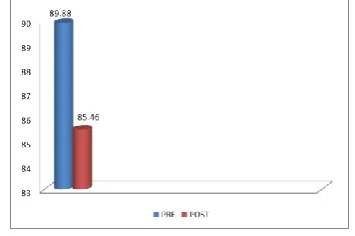
Pre 26 89.88
4.42 2.71 1.12
Post 26 85.46 3.47
*Significant at 0.05 level Tab t.05 (25) = 1.708
From the Table- 02 it is evident that the obtained t-value 1.12 is lesser than the tabulated t -value 1.708 with the degree of freedom (25). Therefore there is no significant difference among pre and post-test on blood glucose level. As, cal. t (1.12) < tab. t (1.708)with the degree of freedom (25).
Graphical Representation of Pre and Post Analysis of Blood Glucose Level
From the graphical representation it is shown that blood glucose level are decreased after weight training for four weeks.
Discussion of findings
1. The study reveals that pre-test and post-test have significance difference in WBCs count as the obtain t-value 2.13 is greater than the tabulated t -t-value (25)1.708 and for the blood glucose level, the obtain t-value is 1.12 which is not significant at 0.05 level as the t-value is much lesser than tabulated t-value (25)1.708. 2. The appearance of this type of results may be due to the
proper weight training schedule was followed to achieve a goal as to find out the importance of weight training. Weight training helped the subjects to raise WBCs count after training. Rising of WBCs count affects our human body as to increase immune system to fights against diseases and flushing bacteria from our body deliberately. But, glucose level decreased after the four weeks weight training program. The carbohydrates were used for the energy during weight training, as carbohydrates is the main source of energy next to fats. So, less carbohydrates means less blood glucose level in our body. Thus, the researcher concluded that blood glucose decreased after the weight training program.
Discussion of Hypothesis
On the basis of the findings the hypotheses stated earlier that: Ho1- There would be no significance difference between pre-test and post-pre-test in WBCs count of physical education students is rejected.
Ho2- There would be no significance difference between pre-test and post-pre-test in blood glucose level of physical education students is accepted.
Conclusion
On the basis of findings of the present study, the following conclusions are drawn:
In case of WBCs count on weight training, it is concluded that there was significant difference on pre and post-test.
Recommendations
Based on the conclusion of the study the following recommendations are made as:
An experiment may also be conducted on large populations with same subjects.
An experiment may also be conducted on other subjects such as long distance runner, endurance sports, cycling, etc.
A similar type of experiment may be conducted compressing on different physiological factors.
A study may also be conducted on female athletes also.
REFERENCES
Weight training (10th August 2014). Retrieved from the online
website: http://en.wikipedia.org/wiki/Weight_training Elevated White Blood Cells after Exercise (10th August 2014).
Retrieved from the online website:
http://www.livestrong.com/article/386072-elevated-white-blood-cells-after-exercise/
Diabetes and the Benefits of Strength Training (10th August
2014). Retrieved from the online website:
http://www.webmd.com/diabetes/strength-training-diabetes
Elevated White Blood Cells after Exercise (28th November
2014). Retrieved from the online website:
http://www.livestrong.com/article/386072-elevated-white-blood-cells-after-exercise/
G Jorgensen. “Genetic and phylogenetic aspects of games and
sports (author's transl.)” MMW (Munch Med
Wochenschr).Germany, 19th June 1981; Volume-123,