Available online: https://edupediapublications.org/journals/index.php/IJR/ P a g e | 2887
A Comparative Study of Various Thresholding
Techniques for Image Segmentation
Ch an ch al Ran i
, Student Baba Banda Singh Bhadur
Engineering Collage Fatehgarh Sahib
E-mail- [email protected]
Dr. Baljit Sin g h Kh e h ra
, HOD Computer Science
Department Baba Banda Singh Bhadur Engineering
Collage Fatehgarh Sahib
E-mail- [email protected]
A bstract—Image segmentation is a prominent area of th e res earch field. Several research works h as b een p erfo rmed u n der th is field b u t s till th ere is a req u iremen t o f mo re imp ro v emen ts in th e tech n iq u es u s ed fo r th is . Imag e s egmentation is process which is implemented on an image in o rd er to highlight tho s e areas o f th e imag e wh ich can b e p roved more meaningful and informative. Segmentation is the p ro cess of sectioning the digital image into number of regions wh ich are called as p ixels . M an y alg o rith ms h av e b een d eveloped wh ich can b e u s ed fo r th e p u rp o s e o f imag e s egmentation. Some of the techniques are clu s terin g b as ed s egmentation methods, co mp res s io n b as ed s eg men tatio n meth o d , s p lits an d merg e tech n iq u e, th res h o ld b as ed s egmentation method, Histogram b ased segmentation etc. this p aper focuses on the Thresholding based image segmentatio n techniques. Th ere is a b rief in tro d u ctio n to th e v ario u s s egmentation techniques and along with their procedures. This wo rk can be beneficial for choosing the suitable segmentatio n tech n iq u e acco rd in g to th e n eed o f th e en v iro n men t. Keywords— image segmentatio n , en tro p y , Th res h o ld in g
I. INTRODUCTION
Segmentation is the process of sectioning the digital image into number of regions which are called as pixels. The image obtain by the segmentation is more informative, clear and expressive that will easily depicts the information present in the pixel. The lines, boundaries, curves etc that are present in the image are detected by the image segmentation process. As the output of the image segmentation is the region that is segmented or is the set of the contour that are also taken from the image the pixels that are presented in the image are related to each other on the behalf of some properties. The properties can be color, intensity or texture. Image segmentation plays important role in the medical imaging, Following is the list of other applications of image segmentation:
Detect objects in satellite images like mountains, tracks, trees, etc.
Face recognition Fingerprints recognition
Automatic traffic controlling systems Machine vision
Only digital image is used for computation and processing. If there is analog image, it first gets converted into digital form so that it can be used for further computer purposes. Digital image is composed of discrete pixels of different brightness and color. Each pixel has its own numerical value. Moreover it has its own data number value which quantifies the radiance of the image at the particular spot. It basically represents the value between black and white which are typically the shades of gray.
II. TECHNIQUES
Segmentation is a process which divides the image into small multiple parts of tiny sized and generally known as pixels.. The use of segmentation is to simplify the image and change the illustration which is more significant and easy to figure out. Image segmentation is a tool used to find out objects and boundaries. The outcome of image segmentation is a collection of regions which conjointly cover the thorough image, or a set of contours extracted from the image. Pixels in a region are similar in terms of characteristics or computed properties like color, intensity or texture features.
Many algorithms have been developed which can be used for the purpose of image segmentation. These techniques are based on domain specific knowledge in order to s olve the domain segmentation issues. The techniques are categorized as follows:
Clustering Based Method Compression Based Method Histogram Based
Available online: https://edupediapublications.org/journals/index.php/IJR/ P a g e | 2888 Thresholding
Global Thresholding Local Thresholding Adaptive Thresholding Shannon Entropy Thresholding Non-Shannon Entropy
A. CLUSTERING BA SED METHOD
This technique follows the idea of clustering. It divides the image into number of small k-clusters. The steps of this algorithm or technique are as follows:
1. Selection of k-cluster center either randomly or via some heuristic method.
2. In order to reduce the distance between pixels each pixel is allotted to the clusters or cluster centers. 3. After allocation of clusters, on the basis of average
value cluster center is re-selected again.
4. Above 2 steps will repeat until the convergence is achieved.
In this method the distance refers to the difference between cluster centers and pixels. The difference is calculated on the basis of pixel intensity, color value of the pixel. The output or accuracy of the output relies on the value of k and set of clusters.
B. COM PRESSION BASED METHOD
As the name suggest this technique is based on data compression. This is referred as the optimal technique for image segmentation. The reason behind its optimal nature is that it reduces the all the available segmentation and length of coded data. The logic behind this technique is that the segmentation is done by locating some matching patterns in the image and any regular data is used for compression. In this technique the segmentation is recognized by its consistency and outline that it follows. For available image segmentation, this technique bears that the large number of bits are needed to encode that the image is segmentation based. Then from various segmentation of the image the best segmentation is selected on the basis of reduced coding length.
C. HISTOGRA M BASED
This method is most preferable as compare to other. The difference between this and other techniques is that in other technique at least one pass is required throughout the pixels of the image but in this technique a histogram is used for computation corresponding to all pixels. The peak and valley of histogram helps to locate the clusters in the image. An
enhanced version of this technique is implemented on th e clusters of the image for categorized them into various small clusters.
D. SPLIT A ND MERGE TECHNIQUE
The basic idea behind this technique is quad tree division of the image. Therefore another name is quad tree segmentation. The working of this technique is as follows: The process starts from the root here rot refers to the whole image. If the root is heterogeneous then it further divides it into four son-squares and so on. If the divided son-squares are homogeneous then they are merged as various linked sources. The nodes of the tree are segmented nodes. This procedure continues until no separation or merges are required.
E. DSHIE
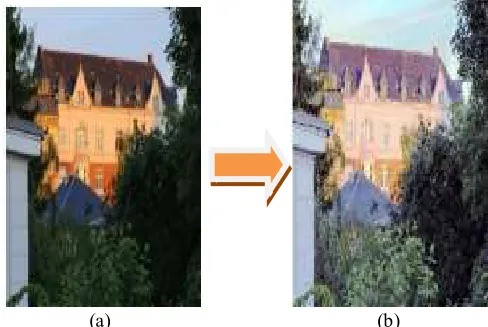
DSHIE stands for Dualistic Sub Image Histogram Equalization. This is a technique which divides the image into two parts on the basis of grey level PDF (Probability Density Function). Then the sub-parts of the image are processed which leads to the final image which is more enhanced as compare to the original image.
DSHIE technique is based on BBHE method where input image or original image is divided into two sub images. On the two divided images i.e. sub images, histograms has been applied separately. In DSHIE method, image has been divided on the basis of equal area property. With this property, sub images contain equal number of pixels i.e. one bright and one dark.
(a) (b)
Available online: https://edupediapublications.org/journals/index.php/IJR/ P a g e | 2889 F. THRESHOLDING
It is the simplest method for image segmentation. The working of this technique is based on a threshold value defined by user. This technique is used to change an image from gray scale to binary image. In this technique a threshold value is used which is pre-defined. The methods which are based on this technique are entropy methods, k-mean clustering technique etc.
a. Global Thresholding b. Local Thresholding c. Adaptive Thresholding d. Entropy Based Thresholding
a)GLOBAL THRESHOLDING
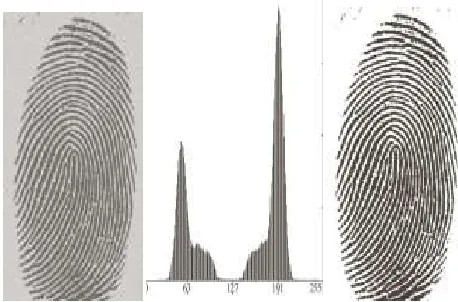
Global Thresholding is also called single Thresholding. In case when there is a large difference between the intensity of foreground and background of the image then in such cases single threshold value is used to distinguish between foreground and background of the image. Hence in this algorithm the value of threshold T depends upon the properties of the pixels and grey level value of the image. Example of Global threshold technique is Otsu method, entropy based Thresholding, etc. The steps included in the algorithm of global Thresholding are as follows:
1. First step is to select the value of threshold which is denoted by T.
2. Image segmentation is performed by using the following equation. The output of the equation will number of pixel which will be partitioned into two groups respectively 𝐺1 and𝐺2. The first group will have all the pixels whose corresponding intensity values will be consisting > T, and 𝐺2consists all the pixel value which has low intensity values as compare to the value of threshold T.
𝑔(𝑥, 𝑦) = 𝑓(𝑥) = {
1. 𝑖𝑓 𝑓(𝑥, 𝑦) > 𝑇
0, 𝑖𝑓 𝑓(𝑥, 𝑦) ≤ 𝑇
3. Next step is to compute the mean intensity of value of 𝐺1 and 𝐺2 which will be denoted as 𝑚1and 𝑚2 respectively.
4. In this step the threshold value is updated by using the equation: 𝑇 =1
2(𝑚1+ 𝑚2)
5. Step 2 and 3 will be repeated until the mean value do not vary successively.
This algorithm is suitable in case where there is a huge or big difference between nodes of histogram which relates to object and background.
Figure 2 Example of Global T hresholding
b)LOCAL THRESHOLDING
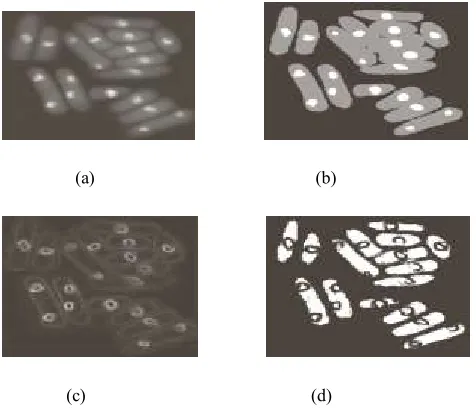
Unlike single Thresholding technique, Local Thresholding firstly divides the whole image into segments and then select threshold values T corresponding to each segment individually. Hence in this technique threshold value T is selected on the basis of both f (x, y) and P (x, y). Example of local Thresholding technique is simple statistical Thresholding, 2-D entropy-based and histogram transformation Thresholding etc. In local Thresholding threshold value is calculated on the basis of local properties of the image as shown in following example:
𝑇
𝑥𝑦= 𝑎𝜎
𝑥𝑦+ 𝑏𝑚
𝑥𝑦(1)
𝑇
𝑥𝑦= 𝑎𝜎
𝑥𝑦+ 𝑏𝑚
𝐺(2)
.
In order to perform image segmentation the following equation is used and this predicate value is denoted by 𝑄𝑥𝑦:
𝑔(𝑥, 𝑦) = {
1, 𝑖𝑓 𝑄
𝑥𝑦0, 𝑜𝑡ℎ𝑒𝑟𝑤𝑖𝑠𝑒
(3)
Here 𝑄𝑥𝑦 defines the instance for:
𝑓(𝑥, 𝑦) > 𝑇
𝑥𝑦(4)
Available online: https://edupediapublications.org/journals/index.php/IJR/ P a g e | 2890 This technique is a comprehensive method for multiple
thresholds segmentation.
(a) (b)
(c) (d)
Figure 3 Example of local T hresholding (a) Original image (b) segmentation of original image with double threshold (c) local standard deviation (d)
segmentation with local T hresholding
c)ADAPTIVE THRESHOLDING
Adaptive Thresholding is a technique which processes the color image or grayscale image and converts it into binary image as the result of image segmentation. The threshold calculation in this is different from others since it calculates the threshold value corresponding to each and every pixel of the image. If the value of the pixel is lesser than the threshold value then it is treated as background value but if the value of the pixel is greater than the value of the threshold then it is treated as foreground value. In this technique following approaches are used for calculating the value of the threshold:
Chow and kaneko Local Thresholding
The basic criteria for both of the approaches is that the regions of the image which covers the smaller area are likely to be more even elucidation, hence it makes it more suitable for Thresholding.
d)ENTROPY BASED THRESHOLDING
Entropy is a term which is used to measure the variations or arbitrariness in an image. If the variations are small or few
then it is termed as minimum entropy and if the variations are large then it is termed as maximum entropy. There are many entropy measurement techniques such as Shannon, Tsallis and Renyi etc.
SHA NNON ENTROPY
There are various theories of entropy among which Shannon is considered the classic method which is considered to be the basis for other entropy based methods. Basic Shannon entropy has been used which is given as,
𝑆𝐸 = − ∑
𝑝
𝑖𝑙𝑜𝑔
2𝑛
𝑖=0
𝑝
𝑖(6)
Multi levels were obtained on the basis of the three values computed from the three entropy based methods.
NON-SHA NNON ENTROPY
Non-Shannon entropy is more preferable technique as compare to Shannon entropy. The advantage of non Shannon entropy is that it has many parameters as compare to other techniques. The list of parameters varies as shown below:
e)Renyi Entropy: It is defined as[23]
𝑅 =
1
1 − 𝛼
𝑙𝑜𝑔
2( ∑ 𝐻
𝑖𝛼 𝑁𝑔−1
𝑖=0
) (7)
𝛼 ≠ 𝛼 > 0 f) Havrda and Charvat defined as
𝐻𝐶 =
1
1 − 𝛼
𝑙𝑜𝑔
2( ∑ 𝐻
𝑖𝛼− 1
𝑁𝑔−1
𝑖=0
) (8)
𝛼 ≠ 𝛼 > 0 g)Kapur entropy defined as
𝐾
𝛼,𝛽=
1
𝛽 − 𝛼
𝑙𝑜𝑔
2∑
𝑁𝑔−1𝐻
𝑖𝛼 𝑖=0∑
𝑁𝑖=0𝑔−1𝐻
𝑖𝛽(9)
Available online: https://edupediapublications.org/journals/index.php/IJR/ P a g e | 2891 G. REGION BA SED SEGM ENTATION M ETHODS
Region based segmentation is work totally opposite to the edge based segmentation method. As in Edge based segmentation method segments are created on the basis of variation intensity of the pixels but in Region based segmentation method the image is divided into regions that are shares same properties by following set of pre defined parameters and criteria. Therefore the region based segmentation method is more efficient and immune to noise as compare to the edge based segmentation. Region Based Segmentation method works on the following basis:
Region Growing
Region Splitting and Merging a)REGION GROWING:
In this method the pixels having the same properties are grouped together into a group on the basis of pre-defined criteria. In other words it groups the pixels of same nature from the whole image into sub regions. This has the following steps:
i. Select a group of seed particles in original image ii. On the basis of various properties such as grey level
intensity or color chose a criteria for defining the similar seeds
iii. Grow the region by adding to each seed those adjacent pixels that have predefined properties similar to the seed pixel
iv. Stop the procedure when the pixel with dissimilar values occurs.
b)REGION SPLITTING AND MERGING
In this, the image is divided into segments known as regions that are not connected to each other. The connection or disconnection or concatenation of these regions is based on various conditions. This particular splitting technique is usually implemented with theory based on quad tree data. Quad tree is a tree in which each node has exactly four branches. The steps included in this technique are as follows:
a) Start splitting the region into four branches
b) Merge any region when no further splitting is possible. Stop when no further merging is possible
H. THEORY BA SED SEGM ENTATION:
In theory based segmentation derivations from various fields are used for segmentation. Example of this is genetic algorithms, wavelet based algorithms, fuzzy based algorithms, and neural network based algorithms, clustering based algorithms and so on.
I. EDGE DETECTION BASED SEGMENTATION:
In digital image processing or image segmentation,
Edge detection is an important or first step. In an
image various segments are created by identifying
the boundaries or edges of the image. When there is
a change in intensity or color it indicates the object
or e4ndge of the image. Edge detection is an
algorithm to identifying the edges in the images by
plotting various points and then these points are
combined together in order to get a closed object
boundary. Binary image is the result of edge
detection algorithm. There are number of ways to
implement edge detection algorithms but most
effective and efficient ways are as follows:
a)Gray histogram Technique b)Gradient Based Method
a) GRA Y HISTOGRA M TECHNIQUE:
In this technique, the segmentation is done by
separating the foreground from background by
selecting a threshold value T. In this technique, a
curve of object and a background with two conic
Gaussian curves are used or added to solve the
problem of selecting the threshold value since grey
threshold is uneven due to the presence of noise in
it. The intersecting point of Gaussian curves are
used as threshold value T.
b) GRA DIENT BA SED M ETHOD:
In this method gradient generates the derivative
image of f (x,y) in case when any variation found in
edges of the image. Another method of combines
the gradient operator with the image. The change in
the intensities of two segments or sub-regions can
be used as high value of gradients namely edge
pixels and combined together to form a closed edge.
Most commonly used operators in gradient based
methods are as follows:
Sobel operator,
canny operator,
Laplace operator,
Available online: https://edupediapublications.org/journals/index.php/IJR/ P a g e | 2892
Canny operator is used widely but it is more time
consuming as compare to the Sobel operator.
Edge detection algorithms are efficient for those
images which does not include noise and simple not
so complex. Because in edge detection algorithms
there is a imbalance between edge detection and
reduction in noise. If edges are detected accurately
then the noise can-not be reduced which leads to the
o remove noise from the image then it leads to loss
in detecting the useful edges.
III. RELATED WORK
I. Fari Mohammad Abubakar[1] image segmentation is a process which is used for making an image more informative and qualitative. It is used to distinguish between foreground and background of an image. In this paper the main focus is on the concept of using the image segmentation along with thresholding methods in order to remove noise from an image. The simulation is performing under the software MATLAB 7.12. The paper also highlights the performance of the proposed work.
II. Sh eema Sh u ja kh attak[2], the work shows the importance of image segmentation in medical field. Hence most appropriate methods should be used for image segmentation hence best decisions can be taken in future. In this paper the segmentation is performed by using thresholding techniques to calculate the maximum entropy such Shannon, Renyi, Tsallis. This research work is based on the concept of detecting disease form the body such as lesions etc.
III. Vars hika Pan d ey [3], The main aim of this work is to represent and improve the use of image segmentation in the field of medical science in order to diagnose the tumor in the MRI images of a patient. MRI is a process which diagnose the human brain and detect the tumor from the scanned image. Hence the techniques used for image segmentation should be quite efficient because the decision related to the disease depends upon the analysis of the scanned image. The proposed work is based upon the Shannon, Renyi, Harvard, Charvat, kapur and vajda entropy methods.
IV. Pis ka irenda vasthi[4],In this work the author studies the concept of object segmentation along with the process of image analysis. The procedure of object analysis is widely used in the field of fruit image analysis. There are many techniques which are used for the purpose of object segmentation but the mostly suitable and reliable technique is OHTA. In this an
enhanced OHTA technique is proposed to solve the problems of traditional OHTA. The threshold value is used for more efficiency. It is set to be 50. The threshold value is used to resolve the problem of over segmentation and under segmentation. The results are analyzed and it is observed that the propos ed system has more accuracy for various kinds of images such as apple, banana and tomato.
V. Yim an d Foran .[5] proposed the segmentation of CT images with watershed and active contour method and proposed standard value of parameters which give better segmentation results. It compares both methods. The watershed technique was not so effective because it gives the segmentation error on the maximum number of slices and no improvement in the reproducibility was seen although the contouring was done manually. The size of the tumor is the basic measure of the seriousness of deadly disease cancer and the watershed algorithm as well as active contour methods is initialized by tracing it manually. The outcomes of these algorithms are taken by comparing manual tracing results and their reproducibility terms .
VI. Liju n Yin et al. [6]gave another method for detecting the region of interest (abnormal area) which is considered as important part for the surgeries. The exact width and area of the tumor part can help the surgeons to assess the tumor before and after the treatment. Various methods have been proposed for the exact segmentation of the image but due to some drawbacks they are not considered as best. Some of them did not tackle noise. So in this paper mesh based active contour method is discussed which helps in finding the exact location and area of the object in the starting stage. Firstly, the mesh distributes itself over the whole region of the image and it tells the region of interest. Secondly, the final region of interest is selected from all the possible options. Thirdly, meh energy is used to control the active contour to extract the appropriate contour of the region of interest.
Available online: https://edupediapublications.org/journals/index.php/IJR/ P a g e | 2893 VIII. Sav elonas et al.[8] In this paper author introduces an
active contour method and named as Variable Background Active Contour Model. It has main applicable in field of medical science in order to detect the thyroid in images of ultrasound. This technique have various advantages such as there is no requirement for smoothing the image and have no need to detect the boundaries. This technique is much efficient as compare to the traditional active contour without edge model technique. This technique decreases the image homogeneity by using a background variable. The output images of this technique consist of perturbation and speckle noise which uses the concept of Raleigh distribution To detect the thyroid module of infected objects in such kind of images infringe which uses segmentation which inherent the properties of noise automatically. Active contour models have not been employed for the effective detection of thyroid nodules in ultrasound images
IV. CONCLUSION
Digital image segmentation is crucial for medical imaging. Now segmented images have been used in various applications including tissue volume quantification, diagnosis, study of anatomical structure. Image segmentation is a hard task for the researchers because of variation of object shapes and image quality. Image segmentation is a process which divides the image into small segments or parts in order to extract information from it. It is a part of image analysis process. There are many techniques which are used for segmentation. In this paper the focus is on the thresholding based image segmentation techniques. This paper concludes the various thresholding based techniques such as non -Shannon, -Shannon, local thresholding and global thresholding techniques. This paper provides an overview to multiple thresholding techniques for image segmentation.. In particular, old segmentation techniques cannot be applied to medical images because of hindrance of noise. Therefore, these methods fail to give precise results.
In future traditional techniques can be enhanced by introducing more parameters so that the techniques can become more efficient and generate accurate results.
References
[1] Fari Mohammad Abubakar,”Study of image segmentation using Thresholding techynique on a noisy image”, ijsr, vol 2(1), Pp 49-51, 2013
[2] Sheema Shuja khattak,”Maximum Entropy based image segmentation of human skin lesion”, ijceacie, vol 9(5), Pp 1094-1099, 2015
[3] Varshika pandey<”MRI image segmentation using Shannon and non- Shannon entropy measures”, ijaiem, vol 3(7), Pp 4146, 2014
[4] Priska Irenda Vasthi,” Object segmentation for fruit images using OHTA colour space and cascade threshold”, IEEE, Pp 321-325, 2015
[5] Yim and Foran.(2003), Automatic Extraction of moving objects using Distributed Genetic Algorithms, springer, vol. 23, pp 263-270
[6] Lijun Yin et al. (2003), Analyzing Facial Expressions Using Intensity-Variant 3D Data For Human Computer Interaction, ICPR '06 Proceedings of the 18th International Conference on Pattern Recognition, Vol. 01 , Pp 1248-1251
[7] Nilanjan Ray and Scott T. Acton.(2004), Motion Gradient Vector Flow: An External Force for Tracking Rolling Leukocytes With Shape and Size Constrained Active Contours, Ieee Transactions On Medical Imaging, Vol. 23, No. 12, pp 1466-1478 [8] Savelonas et al. (2005), A variable active contour
model for automatic detection of thyroid nodules in ultrasound images, IEEE, pp 17-20
[9] Kalyf Abdalla Buzar Lima, “Adaptive Method for Segmentation of Vehicles through Local Threshold in the Gaussian Mixture Model”, IEEE, Pp 204-207, 2015
[10]YunLan Zou, “A New Image Segmentation Approach by Using Automation Threshold Selection”, IEEE, Pp 410-413, 2015
[11]Yuan Been Chen,” Image Segmentation Method Using Thresholds Automatically Determined from Picture Contents”, Springer, Pp 1-15, 2009
[12]M. Zhao,” A technique of three-level Thresholding based on probability partition and fuzzy 3-partition”, IEEE, Pp 469-476 , 2002
[13]Sapna Varshney, “Comparative study of image segmentation techniques and object matching using segmentation” IEEE, Pp 1-6, 2009
[14]Vijyashree gautam,”Implementation of Non- Shannon and Shannon entropy measures for color image segmentation and comparison with Shannon entropy measures”, ijsr, vol 2(5), Pp 391-394, 2013
[15]Nikhil R Pal ,” A review on image segmentation techniques”, ELSEVIER, Volume 26(9), Pp 1277-1294, 1993
[16]y.j.zhang,” a survey on evaluation methods for image segmentation”, ieee, pp 1-13, 2002
Available online: https://edupediapublications.org/journals/index.php/IJR/ P a g e | 2894 and Evolutionary Approach”, IOSR-JCE, Volume 15,
Issue 3, PP 71-78
[18]C.Sriramakrishnan (May, 2012) “Performance Analysis of Advanced Image Segmentation Techniques”, International Journal of Computer Applications, Volume 45– No.7, pp 13-18
[19]Khang Siang Tan (January, 2011) “Color image segmentation using histogram Thresholding – Fuzzy C-means hybrid approach”, ELSEVIER, VOl:44, Issue:1, pp 1-15
[20]Alzate, C (April, 2007) “Image Segmentation using a Weighted Kernel PCA Approach to Spectral Clustering”, IEEE, CIISP 2007, pp 208-2013
[21]Rafika Harrabi “Co lo r imag e s eg men tatio n u s in g mu lti-lev el Th res h o ld in g ap p ro ach an d d ata fu s io n tech n iq u es : ap p licatio n in th e b reas t can cer cells imag es ”, Springer, pp 1-12, 2012 [22]Rajiv Kumar ,” Image Segmentation using
Discontinuity-Based Approach”, IJMIP, Volume 1, Issues ¾, pp 72-78,2011
[23]V. Sivakumar,” A brief study of image segmentation using Thresholding Technique on a Noisy Image”, IEEE, 2014
[24]Wen-Bing Tao , “Image segmentation by three-level Thresholding based on maximum fuzzy entropy and genetic algorithm” ELESIVER Pattern Recognition Letters , Pp 3069–3078,2003
[25]Ezzendie Ben Braiek ,“Co lo r imag e s eg men tatio n u s in g mu lti-lev el Th res h o ld in g ap p ro ach an d d ata fu s io n tech n iq u es : ap p licatio n in th e b reas t can cer cells imag es ”, Springer, pp 1-12,2012
[26]Khang Siang Tan ,“Color image segmentation using histogram Thresholding – Fuzzy C-means hybrid approach”, ELSEVIER, VOl:44, Issue:1, pp 1-15,2011
[27]Amar pratap singh,”Shannon and non- Shannon measures of entropy for statistical texture feature extraction in digitized mammograms”, WCECS, vol 2, Pp 1-6, 2009
[28]Hakeem Aejaz Aslam , “A New Approach to Image Segmentation for Brain Tumor detection using Pillar K-means Algorithm”, IJARCCE, Vol. 2, Issue 3, pp 1429-1436,2013
[29]Adis Alihodzic,” Improved Bat Algorithm Applied to Multilevel Image Thresholding”, Pp 16, 2014
[30]Lianbo Ma,”A Novel Plant Root Foraging Algorithm for Image Segmentation Problems”, Hindawi, 2014 [31]Kanjana Charansiriphaisan,” A Comparative Study of
Improved Artificial Bee Colony Algorithms Applied to Multilevel Image Thresholding”, Hindawi, Pp 17, 2013
[32]Cheng, H. D., Jim-Rong Chen, and Jiguang Li. "Threshold selection based on fuzzy c-partition
entropy approach." ELSEVIER, vol 31(7), Pp 857-870,1998.
[33]Ashraf A. Aly et al. Oct 2011, “Research review for digital image segmentation techniques”, IJCSIT Vol 3, No 5, pp 99-106
[34]H C Sateesh Kumar et al, February 2009, “Automatic Image Segmentation using Wavelets”
[35]Hui Zhang, “Image Segmentation Evaluation: A Survey of Unsupervised Methods, Image”, ELSEVIER, Vol. 110, No. 2, Pp. 260-280, May 2008.
[36]Ilya Pollak, FEBRUARY 2000, “Image Segmentation and Edge Enhancement with Stabilized Inverse Diffusion Equations”
[37]Dr. A. Sri Krishna et al, August 2013, “contrast enhancement techniques using histogram equalization methods on color images with poor lightning”, IJCSEA, Vol. 3, No. 4, Pp. 15-24. [38]Omprakash Patel et al, “a comparative study of
histogram equalization based image enhancement techniques for brightness preservation and contrast enhancement”, SIPIJ, Vol. 4, No. 5, PP. 11-25 [39]Amandeep Kaur et al, July 2016, “Review Paper on