ISSN 2286-4822 www.euacademic.org
Impact Factor: 3.4546 (UIF) DRJI Value: 5.9 (B+)
Design and Implementation of Home Automation
System Based on Wi-Fi
GETANEH BERIE TAREKEGN
Lecturer, Department of Computer Science College of Computing and Informatics, Assosa University Assosa, Ethiopia
Email- [email protected] YIRGA YAYEH MUNAYE
Lecturer, Department of Information Technology College of Computing and Informatics, Assosa University Assosa, Ethiopia
Email- [email protected]
Abstract:
The aim of this paper is to develop a design and framework implementation of new home automation system that uses Wi-Fi technology as a network infrastructure connecting its parts. With the help of a web server and a LAN connection the system provides a scalable and a wide range coverable device. The system is highly advanced as it uses a cheaper Wi-Fi connection and a server that can store data. Basically the proposed system consists of two main components; the first part is the server (web server), which presents system core that manages, controls, and monitors users’ home. Users and system administrator can locally (LAN) or remotely (internet) manage and control system code. Second part is hardware interface module, which provides appropriate interface to sensors and actuator of home automation system. The system is secured as the user has to enter password and that is not known to any intruders.
1. INTRODUCTION
Home automation has an important role in today’s human life and it improves the quality of people's life by facilitating a comfortable and safe environment. Home automation systems are developed in recent years that make use of emerging technologies for the development. Home automation has become a one of the upcoming field that introduces many technologies for making the automation easy and with good performance. Most of the systems make use of a web server and mobile communication for controlling the home appliances.
A home automation system is a means that allows users to control electric appliances of various kinds. Home automation is also known as domestics, a contraction of the words “domestic robotics”. When home automation principles are applied to buildings not falling in the “home” category, building automation system is a commonly used term. The most common usage scenario of a home automation system is lighting control, which is fairly easy to both explain and set up.
The main objective of the paper is to design an advanced home automation system based on Wi-Fi technology where the devices can be enabled or disabled using a Personal Computer (PC) or Laptop or Smart Phones through Wi-Fi. This technology finds its importance in the field of technology due to its user friendly nature. The technology serves well with the replacement of the traditional switch systems.
Automation
automation system was developed to control the appliances in the house.
Wireless Fidelity (Wi-Fi)
It is an advanced automation system that uses radio frequency to transmit data through the air. With an initial speed of 1 mbps to 2 mbps, it transmits data with a frequency band of 2.4 GHz thus establishing the concept of frequency division multiplexing technology and ranges from 40-300 feet. The devices are mainly controlled through a microcontroller. The data is sent from the PC over Fi and will be received by Wi-Fi module connected to the microcontroller which reads the data and decides the switching mode of the electrical devices connected to it through Relay Boards. The microcontroller is programmed using C language.
Home Automation System
It is a technique to use computer/smartphone and information technology in controlling home appliances and home features is called HOME AUTOMATION SYSTEM.
Some of the advantages of wireless technology over
wired technology:
Due to its non-necessity of cabling, the installation cost is reduced to a greater extent.
In adjacent or remote places, wireless nodes can be mounted everywhere. This helps in enlarging the covered area.
System is scalable and the extension is easy as it does not need any physical support.
Placement of wireless nodes is very easy as it can be installed at any location such as glass buildings or historical buildings.
Any number of mobile devices can be attached with the
2. PROBLEM DEFINITION
Home automation systems face four main challenges [3], these are high cost of ownership, inflexibility, poor manageability, and difficulty achieving security. The main objectives of that research is to design and to implement a cheap and open source home automation system that is capable of controlling and automating most of the house appliance through an easy manageable web interface to run system has a great flexibility by using Wi-Fi technology to interconnect its distributed modules to home automation server. That will decrease deployment cost and will increase the ability of upgrading, and system reconfiguration. System will make use of secure wireless LAN connections between distributed hardware modules and server, and secure communication protocols between users and server.
3. FEATURES AND BENEFITS OF HOME AUTOMATION SYSTEMS
A. Features
Wi-Fi based user-friendly interfacing. Low power consumption.
Controls high and low voltage devices. . Long life.
Reduced installation costs.
Easy development, installation, and coverage. System scalability and easy extension.
B. Benefits of Home Automation Systems
I. Reduced installation costs: First and foremost, installation costs are significantly reduced since no cabling is necessary. Wired solutions require cabling, where material as well as the professional laying of cables (e.g. into walls) is expensive.
II. Easy deployment, installation, and coverage:
Wireless nodes can be mounted almost anywhere. In adjacent or remote places, where cabling may not be feasible at all, e.g., a garden house or the patio, connection to the home network is accomplished instantly by simply mounting nodes in the area. Hence, wireless technology also helps to enlarge the covered area.
III. System scalability and easy extension: Deploying a wireless network is especially advantageous when, due to new or changed requirements, extension of the network is necessary. In contrast to wired installations, additional nodes do not require additional cabling which makes extension rather trivial. This makes wireless installations a seminal investment.
IV. Aesthetical benefits: As mentioned before, placement of wireless nodes is easy. Apart from covering a larger area, this attribute helps to full aesthetical requirements as well. Examples include representative buildings with all-glass architecture and historical buildings where design or conservatory reasons do not allow laying of cables.
disconnects after having finished the task; or control of blinds using a remote control. For all these reasons, wireless technology is not only an attractive choice in renovation and refurbishment, but also for new installations.
4. SYSTEM REQUIREMENTS
4.1. User Requirements
Through easy web based interface, user can easily manage system remotely or locally home automation system.
4.2. Business Requirements
Home automation system commonly provides a graphical user interface through a browser, and communicates with devices over a wireless network. Due to this networked property of home automation related systems, it is natural that communication with the interface is carried out over a networked structure as well. The Internet is a network that already exists, is high standardized, and been proven able to handle information sharing in a heterogeneous environment. Thus it is a prime candidate for the higher level of abstraction.
5. SYSTEM DESIGN AND IMPLEMENTATION
A. Proposed Home Automation System layout
Figure 1. The proposed home automation system layout
B. Proposed Home Automation System Functions (Home Area Interface)
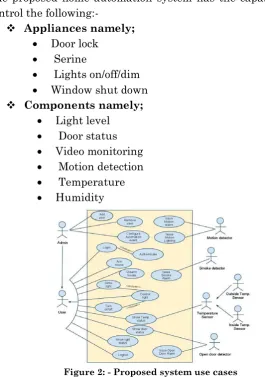
The proposed home automation system has the capabilities to control the following:-
Appliances namely;
Door lock
Serine
Lights on/off/dim
Window shut down
Components namely;
Light level
Door status
Video monitoring
Motion detection
Temperature
Humidity
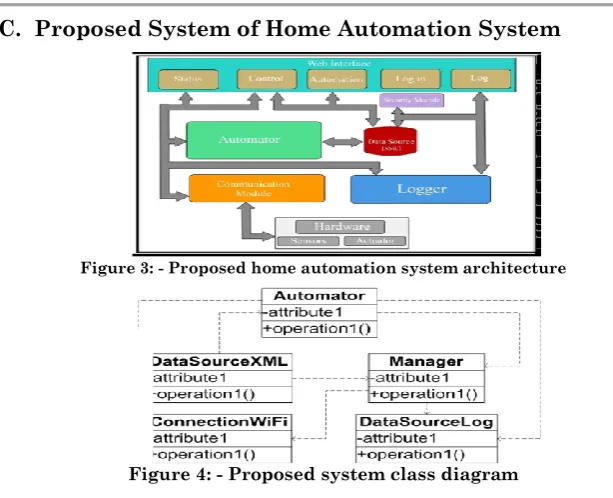
C. Proposed System of Home Automation System
Figure 3: - Proposed home automation system architecture
Figure 4: - Proposed system class diagram
D. Design and Implementation Constraints
The Proposed home automation system is implemented using ASP, HTML and CSS. The server application is implemented in ASP.Net, and the embedded hardware interface application shall be implemented using C Processing Language.
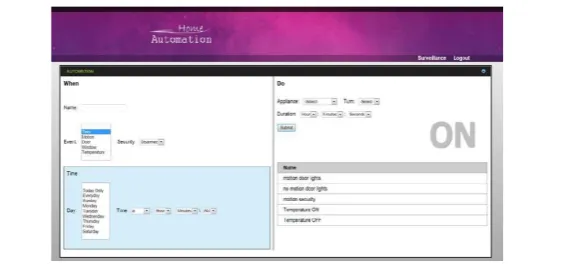
Figure 6: - Automation interface (system configuration)
6. CONCLUSION
This paper proposes a low cost, secure, ubiquitously accessible, auto-configurable, remotely controlled solution.
The approach discussed in the paper is novel and has achieved the target to control home appliances remotely using the Wi-Fi technology to connect system parts, satisfying user needs and requirements. Wi-Fi technology capable solution has proved to be controlled remotely, provide home security and is cost-effective as compared to the previously existing systems.
Hence we can conclude that the required goals and objectives of home automation system have been achieved.
The system design and architecture were discussed, and prototype presents the basic level of home appliance control and remote monitoring has been implemented. Finally, the proposed system is better from the scalability and flexibility point of view than the commercially available home automation systems.
Acknowledgment
REFERENCES
[1] A.J. Bernheim Brush, Bongshin Lee, Ratul Mahajan, Sharad Agarwal, Stefan Saroiu, and Colin Dixon, "Home Automation in the Wild: Challenges and Opportunities", CHI 2011, May 7–12, 2011, Vancouver, BC, Canada
ABOUT THE AUTHORS
GETANEH BERIE TAREKEGN, received his B.Sc. Degree in Computer Science from University of Gondar (UoG).Currently perusing M.Sc. in Computer Science, School of Computing and Electrical Engineering, IOT, Bahir Dar University, Ethiopia. He has published seven research papers in reputable journal publication and His main research interest is Neural Network, Data Mining, Machine Learning and Big Data.
YIRGA YAYEH MUNAYE, received his B.Sc. Degree in Information Technology from Bahir Dar University (BDU) and MSc Degree in Information Science from Addis Ababa University. Currently working as Instructor in Collage of Computing and Informatics, Information Technology Department, Assosa University, Ethiopia. He has published several research papers in reputable journal publication and interest is Neural Network, Data Mining, Machine Learning and Big Data.