www.elsevier.com / locate / bres
Research report
Restriction of task processing time affects cortical activity during
processing of a cognitive task: an event-related slow cortical potential
study
*
Claus Lamm , Herbert Bauer, Oliver Vitouch, Susanne Durec, Roswitha Gronister,
¨
Reinhard Gstattner
Brain Research Laboratory, Department of Psychology, University of Vienna, Liebiggasse 5, A-1010 Vienna, Austria
Accepted 25 July 2000
Abstract
As is known from psychometrics, restriction of task processing time by the instruction to respond as quickly and accurately as possible leads to task-unspecific cognitive processing. Since this task processing mode is used in most functional neuroimaging studies of human cognition, this may evoke cortical activity that is functionally not essential for the particular task under investigation. Using topographic recordings of event-related slow cortical potentials, two experiments have been performed to investigate whether cortical activity during processing of a visuo-spatial imagery task is substantially influenced by the time provided to process the task. Furthermore, it was investigated whether this effect is additionally modulated by a subject’s task-specific ability. The instruction to respond as quickly and accurately as possible led to increased negative slow cortical potential amplitudes over parietal and frontal regions and significantly interacted with task-specific ability. While cortical activity recorded over parietal and frontal regions was different between subjects with low and high spatial ability when processing time was unrestricted, no such differences were found between ability groups when subjects were instructed to answer both quickly and accurately. These results suggest that restricting processing time has considerable effects on the amount and the pattern of brain activity during cognitive processing and should be taken into account more explicitly in the experimental design and interpretation of neuroimaging studies of cognition. 2001 Elsevier Science B.V. All rights reserved.
Theme: Neural basis of behavior
Topic: Cognition
Keywords: Experimental design; Task processing; Individual differences; Slow cortical potentials; Functional neuroimaging; Visuo-spatial imagery
1. Introduction strategy to process a task. These psychometric findings are usually not considered in the design of functional neuroim-Different cognitive processes are evoked in subjects aging studies of cognition where it is common practice to solving cognitive tasks when speed and accuracy are restrict task processing time and to instruct subjects to required rather than accuracy alone. While the so-called respond as quickly and accurately as possible whenever a ‘power’ component of cognitive task processing is as- task is presented. Since this processing mode might lead to signed to task-specific processing, the ‘speed’ component neural activity not directly attributable to the task investi-is related to more general cognitive processes, such as gated, it might confound the functional interpretation and directed attention, allocation of processing resources, or generalizability of findings. The effects of time pressure on effort [14,26,34]. The resulting speed-accuracy trade-off event-related potentials have been investigated in several [11] might additionally reflect changes in the cognitive studies [10,16]. These studies used simple reaction or choice reaction paradigms, and considerable time pressure was induced. The latter also applies to a recent study
*Corresponding author. Tel.: 143-1-4277-47829; fax: 1
43-1-4277-investigating modulations of several EEG frequency bands
47859.
E-mail address: [email protected] (C. Lamm). by time pressure during execution of a visuomotor task
[31]. However, whether the rather moderate time pressure pressing one of two response buttons (answers yes / no) induced by the instruction to respond as quickly as mounted on a response board using the dominant right possible affects cortical activity during processing of a task hand. The decision to use 3DC-tasks in the investigation of requiring higher-order cognitive functions has not yet been visuo-spatial imagery was based on several favourable investigated systematically. Therefore, we conducted two properties of the 3DC task material. Psychometric prop-consecutive experiments in which event-related slow corti- erties such as reliability and validity are known and high cal potentials (SCPs) were recorded while subjects were and have been determined using large calibration samples. solving a visuo-spatial imagery task either with or without This is in contrast to most task material used in cognitive restrictions of task processing time. Task-specific ability of neuroimaging where face validity sometimes is the only subjects was additionally varied in order to investigate known psychometric property. 3DC-tasks also allow the whether the previously observed modulation of cortical assessment of visuo-spatial imagery with high intra- and activity by ability differences [18,22,35] interacts with the interindividual homogeneity since they fulfill the criteria of
effects of task processing mode. the Rasch model [27]. Tests which conform to this model
are unidimensional, which means that identical cognitive processes are involved in all tasks and in different groups
2. Methods of subjects. This is contrary to, e.g., 2-dimensional letter or
object comparison tests in which some tasks do not invoke
2.1. Subjects and experimental setting mental rotation of stimuli [8,9], or in which some subjects
might dominantly use verbalizing instead of visuo-spatial Only right-handed [1] healthy volunteers (age range strategies. Different task processing instructions were used 18–34 years) participated in the two experiments. Subjects in the two experiments. In experiment I the subjects were were selected out of a large pre-testing sample in which informed that there was no time limit for solving each task about 600 subjects had been tested for their visuo-spatial and hence task processing time would not be restricted imagery ability using a standardized three-dimensional (power condition). In experiment II, the subjects were cube comparison test (3DC) [12]. Only subjects whose test instructed to answer both quickly and accurately since task performance fell either into the first (poor performers) or processing time was restricted (speed condition). However, into the fourth quartile (good performers) of the age- and in order to induce only moderate time pressure and to sex-specific calibration sample of the 3DC were investi- avoid demotivating or frustrating participants, task pre-gated. Twenty-two (12 males) subjects with high and 16 (8 sentation time was chosen to be only approximately 10% males) subjects with low test scores participated in experi- shorter than the median processing times of the respective ment I (unrestricted processing time), and an independent group under power conditions (which corresponded to 14 s sample of 29 (16 males) good and 27 (14 males) poor for the poor group and 11 s for the good group).
performers was investigated in experiment II (restricted
processing time). Pre-testing also was used to yield com- 2.2. EEG recording parable levels of experience between subjects in processing
3DC-tasks since they were also used during EEG record- EEG was recorded via 22 Ag /AgCl electrodes attached ing. Each task involved two blue-coloured cubes with to small collodion-fixed plastic adapters evenly distributed white patterns (triangles, squares, crosses etc.) on their over the scalp. With the aid of an application cap a 21435 faces (see Fig. 1) simultaneously displayed in the middle equidistant matrix montage (locations: Fp19, Fp29/ F79, of a computer screen which was located approximately 70 F39, Fz,F49, F89/ T39, C39, Cz, C49, T49/ T59, P39, Pz, P49, cm in front of the subjects. The subjects had to determine T69/ O79, O39, Oz, O49, O89, all referenced to linked whether or not the cubes could be identical. This required mastoids; due to the equidistance constraint electrodes the mental rotation / transformation of one of the cubes and marked with an apostrophe only approximated the posi-a mposi-atching to the other cube. Answers were given by tions specified in the international 10–20 system) was achieved. To minimize skin potential artifacts and to keep electrode impedance reliably #1 kV skin scratching was used. Electrodes and adapters were filled with degassed electrode gel and connected to a high input impedance ($100 GV) DC amplifier with high baseline stability. Vertical (electrodes above and below right eye) and horizontal (electrodes on outer canthi) electrooculograms (EOG) were recorded bipolarly in order to eliminate eye movement artifacts offline using a linear regression
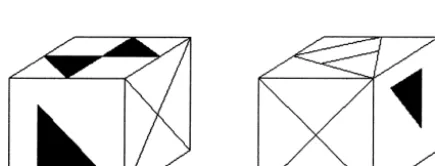
algo-Fig. 1. Black / white sample of a cube comparison task used in the
rithm (see [35] for a detailed description). Recordings were
experiments. Correct answer: ‘yes — the two cubes could be identical’. In
sampled at 4 kHz (down-sampled to 250 Hz for digital
the experiments, cubes were blue with white patterns and edges and
Table 1
(notch filter at 50 Hz). Variable data epochs covering a 2 s
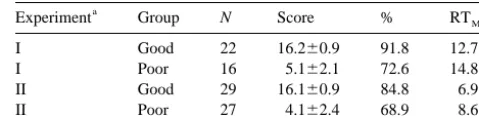
Behavioral data of the two experiments
pre-presentation baseline and the entire processing period
a
Experiment Group N Score % RT
were stored to disk trial by trial. Median
I Good 22 16.260.9 91.8 12.7
2.3. Data analysis and dependent variables I Poor 16 5.162.1 72.6 14.8
II Good 29 16.160.9 84.8 6.9
II Poor 27 4.162.4 68.9 8.6
Artifact rejection was performed off-line by visual
a
Experiment, I / II5unrestricted / restricted task processing time; Group,
inspection of all trials, with subjects having processed 68
Good / Poor5good / poor test performers; N, sample size; Score, test score
trials in the mean. Trials without responses within the
in the three dimensional cube comparison test (k517 items; Mean6S.D.,
required time limit and with incorrect responses, respec- [12]); %, percentage of correctly answered tasks; RT , median item
Median
tively, were excluded from the analyses. After making sure processing time (s). that there were no systematic or relevant differences in the
baseline interval, stimulus onset linked averages of all
artifact-free and correctly answered trials were computed correctly also when processing time was restricted. In with a 200 ms pre-stimulus baseline for each subject. experiment II, only about 4% of trials had to be excluded Averages and their current source density (CSD) trans- from the analyses because no response was given within forms were mapped by means of spherical-spline interpola- the required time limit. All of the subjects completed the tion [25] as a visualization aid for topographic interpreta- experiments, and none of them reported having been tion. CSD (surface Laplacian) transformation was used overcharged by the more demanding task processing since it is known to yield reference-free maps and to instruction or the restriction in processing time, respective-attenuate low spatial frequencies (‘smearing’) introduced ly.
into the scalp potential distribution due to volume
conduc-tion, thus providing a more precise estimate of the 3.2. Event-related slow cortical potentials epicortical surface potential distribution [23,24]. Since
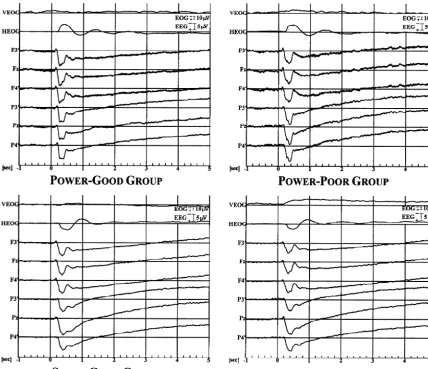
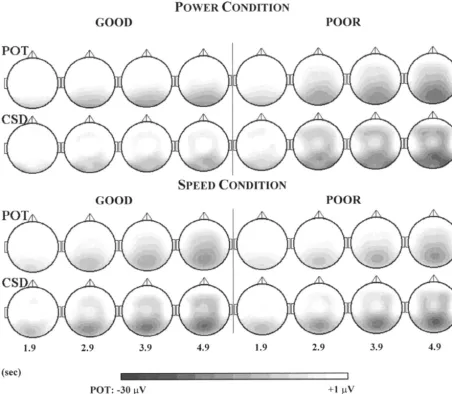
response times were variable within and across subjects in Grand mean waveforms for parietal and fronto-medial both experiments, an analysis epoch of a length of 5 s was electrodes are plotted in Fig. 2, and grand mean potential selected based on the median reaction times. This epoch and CSD maps at four latencies are displayed in Fig. 3. In length was chosen since it was long enough to reliably both experiments and both groups, stimulus presentation induce cognition-related SCPs, and since only a few trials was followed by a small negative phasic deflection peaking had to be rejected due to response times shorter than 5 s. In at around 140 ms and a positive phasic deflection peaking order to exclude activity from movement preparation and around 350–400 ms. Around 500–700 ms after stimulus execution related to the button press, only trials with presentation, negative-going SCPs could be observed. response times$5500 ms were included in the averages. SCPs were most pronounced over parieto-occipital regions For statistical analysis, mean SCP amplitudes were calcu- where they showed gradually increasing amplitudes in the lated at various latencies (200 ms epochs centred around course of task processing. Additional negative-going SCPs 1.9, 2.4, 2.9, 3.4, 3.9, 4.4 and 4.9 s after stimulus onset). with a similar onset time were also observed over central Greenhouse-Geisser [13] adjusted repeated-measures anal- and frontal brain areas (see Fig. 2). While experiment I yses of variance (ANOVAs) with the between-subject revealed topographies that clearly differed between the two
factors EXPERIMENT (power vs. speed) and GROUP groups (cf. [18]), the SCP pattern of good and poor
(good vs. poor), and the within-subject factor electrode performers was basically identical in experiment II. This LOCATION (22) were computed with both SCP raw and obvious difference between the two processing modes and
z-normalized amplitude values [15,20]. Significant (P# their interaction with task-specific ability was confirmed by 0.05) results of ANOVAs were evaluated using hypothesis- the statistical analyses (see Table 2). The interaction driven linear contrasts calculated with specific error vari- EXPERIMENT3LOCATION was significant for all seven
ances [3]. latencies, and starting at 3.4 s (with a tendency towards
significance at 2.9 s), the interactions GROUP3
LOCATION and EXPERIMENT3GROUP3LOCATION
3. Results were also significant. Based on earlier findings [18,35] and
due to the fact that the largest negative difference between
3.1. Behavioral data experiments was found over the parietal and fronto-medial
cortex (see Fig. 3), SCPs of these regions were further Table 1 summarizes response times and the percentage evaluated using linear contrasts.
Fig. 2. Event-related SCP waveforms at parietal and fronto-medial leads of good and poor performers processing a visuo-spatial imagery task with (bottom) and without (top) the instruction to respond as quickly and accurately as possible. Stimulus presentation at 0 s. Note the clear difference in SCP amplitude and time-course between ability groups for parietal as well as frontal recordings when processing time was unrestricted and the almost identical waveforms when processing time was restricted.
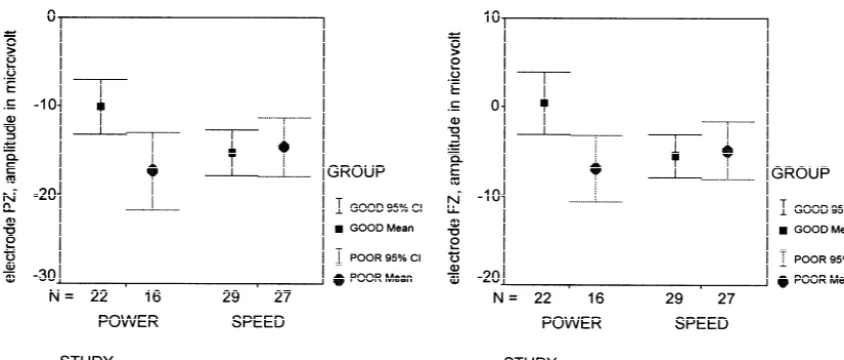
4.33, P50.04, mean difference D523.79 mV; fronto- latencies, we compared the topographies at 4.4, 3.9, 3.4 medial5F39FzF49: F1,9059.02, P50.003,D525.48 mV). and 2.9 s under the speed with those at 4.9 s under the At the 1.9 s latency, only the fronto-medial contrast was power condition. The interactions EXPERIMENT3
significant (F1,9054.06, P50.047, D523.00 mV). No LOCATION, GROUP3LOCATION and
EXPERI-significant results were obtained when the same contrasts MENT3GROUP3LOCATION were significant for all were calculated for the poor group. Also, no significant analyses. It is therefore unlikely that the differences between-group contrasts were observed in experiment II, between the speed and power condition arose solely from a which contrasted with the significantly higher parietal and comparison of differently timed stages of cognitive pro-fronto-medial activity of poor performers under power cessing.
conditions (value at 1.9 s: fronto-medial: F1,3457.68, P5
0.007,D524.80 mV; parietal: F1,3454.38, P50.039, D5
23.79 mV; value at 4.9 s: fronto-medial: F1,34514.78, 4. Discussion
P,0.001,D527.68 mV; parietal: F1,34511.25, P50.002,
D527.15 mV). Fig. 4 demonstrates these differences Presenting tasks with the instruction to answer as between experiments by showing the SCP means and 95% quickly and accurately as possible is the preferred pre-confidence intervals of electrodes Fz and Pz at the latency sentation mode in most functional neuroimaging studies.
of 5 s. This is at variance with psychometric findings showing
Fig. 3. Slow cortical potential (SCP) topographies of good and poor performers processing a visuo-spatial imagery task with (bottom) and without (top) the instruction to respond as quickly and accurately as possible. Shown are grand mean maps at 1.9, 2.9, 3.9 and 4.9 s post-stimulus. Only negative SCPs are displayed. Upper rows, potential maps (POT); lower rows, current source density maps (CSD). Note that the topographies of the two performance groups were almost identical when processing time was restricted and clearly different when subjects had ample time to solve the tasks.
Table 2
Results of the repeated measures ANOVAs (SCP raw and z-normalized amplitude values) at seven latencies (200 ms epochs centred around 1.9, 2.4, 2.9, a
3.4, 3.9, 4.4 and 4.9 s post-stimulus
1.9 2.4 2.9 3.4 3.9 4.4 4.9
eGG50.18 eGG50.19 eGG50.21 eGG50.23 eGG50.23 eGG50.24 eGG50.26
F PGG F PGG F PGG F PGG F PGG F PGG F PGG
Raw amplitude values
E3L 2.49 0.046 3.41 0.009 3.87 0.033 5.24 ,0.001 6.00 ,0.001 6.31 ,0.001 9.47 ,0.001 G3L 1.34 0.255 1.57 0.180 2.07 0.077 2.24 0.048 2.38 0.041 3.12 0.008 2.42 0.031 E3G3L 1.56 0.187 2.02 0.090 2.08 0.075 2.29 0.045 2.53 0.031 2.89 0.031 2.36 0.035
z-normalized amplitude values
E3L 2.36 0.039 2.25 0.042 3.20 0.004 2.89 0.008 4.59 ,0.001 5.00 ,0.001 5.69 ,0.001 G3L 1.89 0.094 1.58 0.157 1.98 0.063 2.20 0.039 2.17 0.034 1.98 0.066 2.29 0.029 E3G3L 0.86 0.511 1.33 0.247 1.78 0.096 2.13 0.046 2.27 0.043 2.55 0.019 3.21 0.003
a
Fig. 4. Mean amplitudes695% confidence interval (CI) at the latency value of 5 s of electrodes Pz and Fz.
activity to ‘genuine’ task-specific processing. However, that this should be taken into account more explicitly in the there exists some controversy about the involvement of design and interpretation of future neuroimaging experi-frontal areas in visuo-spatial imagery and mental rotation. ments aiming to localize task-specific activity.
Contrary to a positron emission tomography (PET) study specifically designed to assess frontal activity during
mental rotation [17], several fMRI studies [5,7] found Acknowledgements
activity in frontal areas during visuo-spatial imagery, albeit
only in some of their subjects. In these studies, frontal We would like to thank Michael and Ulrich Leodolter activity was assigned to more general (task-unspecific) for their support in data recording and analysis, and
¨
functional requirements, such as increased directed atten- Brigitte Roder for her comments on an earlier draft of this tion or effort, respectively. Although the cerebral location paper.
of the generators of frontal SCPs in our experiments might not be known exactly (candidates being the rostral medial
frontal cortex and / or lateral premotor / supplementary References
motor areas, as suggested by recent findings [29,36]), this
interpretation seems to be supported by the results of our [1] M. Annett, Left, Right, Hand, and Brain: the Right Shift Theory, Erlbaum, London, 1992.
experiments. Here, subjects showed frontal cortex
in-[2] H. Bauer, Slow potential topography, Behavior Res. Meth. Instrum.
volvement only when they were sufficiently challenged by
Comput. 30 (1998) 20–33.
task processing. Since poor performers have general [3] R.J. Boik, A priori tests in repeated measures designs: effects of difficulties in solving visuo-spatial imagery tasks, this nonsphericity, Psychometrika 46 (1981) 241–255.
might have been the case irrespective of processing mode [4] R. Cabeza, L. Nyberg, Imaging cognition II: an empirical review of 275 PET and fMRI studies, J. Cogn. Neurosci. 12 (2000) 1–47.
for them. Contrary, good performers showed frontal
activi-[5] P.A. Carpenter, M. Just, T.A. Keller, W. Eddy, Graded functional
ty only when they were required to respond within a
activation in the visuospatial system with the amount of task
limited time, which might reflect that tasks were suffi- demand, J. Cogn. Neurosci. 11 (1999) 9–21.
ciently demanding for these subjects only under the speed [6] H. Caspers, E.J. Speckmann, A. Lehmenkuhler, Electrogenesis of¨
condition. Following these arguments, one might speculate cortical DC potentials, in: H.H. Kornhuber, L. Deecke (Eds.), Motivation, Motor and Sensory Processes of the Brain. Electrical
that frontal cortex activity was not consistently found in
Potentials, Behavior and Clinical Use. Progress in Brain Research,
previous investigations [5,7,17] because only some of the
Vol. 54, Elsevier, Amsterdam, pp. 3–16.
subjects of these studies have been sufficiently challenged [7] M.S. Cohen, S.M. Kosslyn, H.C. Breiter, G.J. DiGirolamo, W.L. by the tasks. However, the modulation of cortical activity Thompson, A.K. Anderson, S.Y. Bookheimer, B.R. Rosen, J.W.
observed in this study might alternatively be explained by Belliveau, Changes in cortical activity during mental rotation: a mapping study using functional MRI, Brain 119 (1996) 89–100.
changes in the task-processing strategy [11].
Strategy-[8] M. Cohen, M. Kubovy, Mental rotation, mental representation, and
related changes in cortical activity were repeatedly
re-flat slopes, Cognit. Psychol. 25 (1993) 351–382.
vealed using electrophysiological recordings [21,32]. [9] M.C. Corballis, N.J. Zebrodoff, L.I. Shetzer, B.B. Butler, Decisions Hence, whether the increase in frontal cortex activity about identity and orientation of rotated letters and digits, Memory
observed in the present study is related to increased Cognition 6 (1978) 98–107.
[10] M. Falkenstein, J. Hohnsbein, J. Hoormann, Time pressure effects
directed attention or effort, to the adoption of a different
on late components of the event-related potential (ERP), J.
Psycho-processing strategy, or even to both, remains to be
physiol. 8 (1994) 22–30.
explored. [11] P. Fitts, The information capacity of the human motor system in
If the instruction to answer as quickly and accurately as controlling the amplitude of movement, J. Exp. Psychol. 47 (1954)
possible affects cortical activity during solving of a task 381–391.
¨
[12] G. Gittler, Dreidimensionaler Wurfeltest (3dw). Theoretische
Grun-requiring higher-order cognitive processing has not been
dlagen Und Manual, [Three-dimensional Cube Test. Theoretical
investigated systematically before. However, it is this type
Foundations and Manual], Beltz Test, Weinheim, 1990.
of cognitive processing which is now increasingly investi- [13] S.W. Greenhouse, S. Geisser, On methods in the analysis of profile gated using functional neuroimaging techniques such as data, Psychometrika 24 (1959) 95–112.
PET or fMRI (see, e.g., Fig. 1 in the recent extensive [14] H. Gulliksen, Theory of Mental Tests, 5th Edition, Wiley, New York, 1965.
review by Cabeza and Nyberg [4]). The results of the
[15] A.R. Haig, E. Gordon, S. Hook, To scale or not to scale: McCarthy
present study clearly demonstrate that additional
neuro-and Wood revisited, Electroenceph. Clin. Neurophysiol. 103 (1997)
cognitive activities are evoked when subjects are required 323–325.
to solve a task under processing restrictions. These ac- [16] J. Hohnsbein, M. Falkenstein, J. Hoormann, Effects of attention and
tivities are presumably not specifically attributable to the time-pressure on P300 subcomponents and implications for mental workload research, Biol. Psychol. 40 (1995) 73–81.
task under investigation, but to rather general processing
[17] S.M. Kosslyn, G. DiGirolamo, W.L. Thompson, N.M. Alpert,
requirements imposed by speeded task processing. Thus,
Mental rotation of objects versus hands: neural mechanisms revealed
restricting task processing time might considerably con- by positron emission tomography, Psychophysiology 35 (1998) found the functional interpretation and generalizability of 151–161.
¨
ability to process a visuo-spatial task are reflected in event-related [29] W. Richter, R. Samorjai, R. Summers, M. Jarmasz, R.S. Menon, J.S. slow cortical potentials of human subjects, Neurosci. Lett. 269 Gati, A.P. Georgopoulos, C. Tegeler, K. Ugurbil, S.-G. Kim, Motor (1999) 137–140. area activity during mental rotation studied by time-resolved single-[19] W. Lang, M. Lang, M. Podreka, M. Steiner, F. Uhl, E. Suess, Ch. trial fMRI, J. Cogn. Neurosci. 12 (2000) 310–320.
¨ ¨ ¨
Muller, L. Deecke, DC-potential shifts and regional cerebral blood [30] F. Rosler, M. Heil, B. Roder, Slow negative brain potentials as flow reveal frontal cortex involvement in human visuomotor learn- reflections of specific modular resources of cognition, Biol. Psychol. ing, Exp. Brain. Res. 71 (1988) 353–364. 45 (1997) 109–141.
[20] G. McCarthy, Ch.C. Wood, Scalp distribution of event-related [31] S.M. Slobounov, K. Fukada, R. Simon, M. Rearick, W. Ray, potentials: an ambiguity associated with analysis of variance Neurophysiological and behavioral indices of time pressure effects models, Electroenceph. Clin. Neurophysiol. 62 (1985) 203–208. on visuomotor task performance, Cogn. Brain Res. 9 (2000) 287– [21] L.K. McEvoy, M.E. Smith, A. Gevins, Dynamic cortical networks 298.
of verbal and spatial working memory: effects of memory load and [32] M.E. Smith, L.K. McEvoy, A. Gevins, Neurophysiological indices task practice, Cerebr. Cortex 8 (1998) 563–574. of strategy development and skill acquisition, Cogn. Brain Res. 7 [22] A. Neubauer, H.H. Freudenthaler, G. Pfurtscheller, Intelligence and (1999) 389–404.
spatiotemporal patterns of event related desynchronisation, Intelli- [33] G.A. Tagaris, S.-G. Kim, J.P. Strupp, P. Andersen, K. Ugurbil, A.P. gence 20 (1995) 249–266. Georgopoulos, Quantitative relations between parietal activation and [23] P. Nunez, Estimation of large scale neocortical source activity with performance in mental rotation, NeuroReport 7 (1996) 773–776.
EEG surface Laplacians, Brain Topogr. 2 (1989) 141–154. [34] G.P.J. VanBreukelen, E.E. Roskam, A rasch model for speed-accura-[24] P. Nunez, R.B. Silberstein, P.J. Cadusch, R.S. Wijesinghe, A.F. cy trade-off in time limited tests, in: J.-P. Doignon, J.E. Falmagne Westdorp, R. Srinivasan, A theoretical and experimental study of (Eds.), Mathematical Psychology. Current Developments, Springer, high resolution EEG based on surface Laplacians and cortical New York, 1991, pp. 251–272.
imaging, Electroenceph. Clin. Neurophysiol. 90 (1994) 40–57. [35] O. Vitouch, H. Bauer, G. Gittler, M. Leodolter, U. Leodolter, [25] F. Perrin, J. Pernier, O. Bertrand, J.F. Echallier, Spherical splines for Cortical activity of good and poor spatial test performers during scalp potential and current source density mapping, Electroenceph. spatial and verbal processing studied with slow potential topog-Clin. Neurophysiol. 72 (1989) 184–187. raphy, Int. J. Psychophysiol. 27 (1997) 183–199.
[26] O. Porebski, A psychological and statistical study of speed and [36] C. Windischberger, C. Lamm, H. Bauer, E. Moser, Whole-cortex power as variables of human ability, Occup. Psychol. 28 (1954) fMRI with single-trial analysis of a mental rotation paradigm at 3
218–231. Tesla, Neuroimage 11 (2000) S75.
[27] G. Rasch, Probabilistic Models For Some Intelligence and Attain- [37] A. Yoshino, M. Inoue, A. Suzuki, A topographic electrophysiologic ment Tests, The University of Chicago Press, Chicago, 1980. study of mental rotation, Cogn. Brain Res. 9 (2000) 121–124. [28] W. Richter, K. Ugurbil, A.P. Georgopoulos, S.-G. Kim,