1159
Student’s Worksheet Design To Improve
Problem-Solving Ability For Tenth Grade With Pbl
Diyah Istriani, Suparman
Abstract: Solving mathematical problems is a critical ability mastered by students. This study aims to produce worksheets for mathematical learners based on PBL to improve problem-solving skills. This research uses research and development (R&D). This study uses a 4D development model with several stages, including defining, design, development and dissemination. The subjects of this study were tenth-grade high school students in Central Java, Indonesia. Data collection methods using observation, interviews, and questionnaires. The instrument used in this study was a validation sheet. Analysis of needs in worksheets used by students is the first stage in this study. The results of the report are used as a reference for the development of instructional media in the form of student worksheets. The research is a limited study where research is limited to the initial design stage. The results of the initial design validation found that the category is perfect, with an average value of 36. This research can be continued at the development and dissemination stage.
Index Terms: Student’s Worksheet, Problem Solving, Problem Based Learning.
—————————— ——————————
1.
INTRODUCTION
MATHEMATICS is essential in the process of developing students ability to think [1]. The mathematical skills that must be possessed by students are problem-solving ability [2]. Every individual needs to have an effort in solving problems in certain situations by involving the thinking process to the maximum [3]. Problem-solving is one part that students must have in the development of 21st century skills [4]. Problem-solving involves a person's skills in analyzing, interpreting, reasoning, predicting, and evaluating [5]. Following one of the essential goals of learning mathematics at various levels is related to the ability of problem-solving [6]. The abilities to solving mathematic problems is the ability to get solutions in solving mathematical problems [3] and is expected to be able to create many ideas [7]. Then the results were obtained that it turns out students in learning mathematics still need more problem-solving skills..
The results of research conducted by the 2015 PISA team generally showing that Indonesian students are still lacking in completing base mathematical concepts [8]. The lack of students in problem solving skills is a familiar phenomenon. Lack of accurate understanding to identify, analyze, recognize meaning, and not use strategies influences failure in solving [6,9]. Minimizing failure in problem-solving can be carried out by various efforts, one of which is by choosing the right, exciting, and innovative learning model [10]. One inspiring, appropriate, and creative learning model is PBL [10]. PBL is an instructional activity of students [11] who have problem-centered problems [12] as the empowerment of abilities, student competence [13] and problem-solving skills of students [14] in related daily life to obtain solutions [15]. Problem-based learning is student-centered, where the teacher is only a facilitator in developing students' skills to solve problems [12]. Therefore it can be said that errors in making learning models affect problem-solving abilities.The quality of learning can be maximized by the learning model [16], in supporting learning models, innovative learning tools
are needed, such as one example is a student worksheet [10]. Student’s worksheets are used to facilitate students in improving problem-solving skills [17,18] mathematics related to everyday life [19]. The sheet contains information on assignments and questions submitted to students. However, based on the results of observations, it was found that the available student worksheets still did not improve students' problem-solving abilities. Therefore, it is necessary to develop student’s worksheets that use problem-based learning models to improve problem solving skills.
2
METHODS
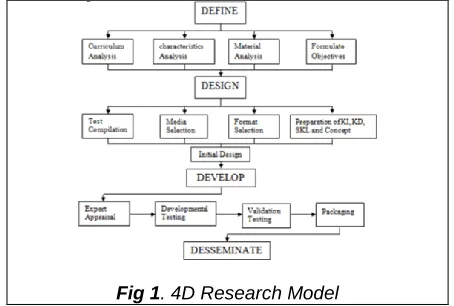
This type of research is development research. This study produces learning resources in the form of problem-based student learning worksheets to improve problem solving skills for the tenth grade. This research model uses a 4D development model research [20], which consists of define, design, development, and disseminate [10]. In this study only limited to the design stage. The steps of developing a 4D model can be seen from Figure 1 [10].
Fig 1. 4D Research Model
The research subjects were class tenth grade students of senior high school. Instrument data collection uses observation, interviews, and tests. The observation guide is used to find out data about curriculum and student characteristics. The interview guide is use to find out data about teaching resources. Tests are use to determine student abilities. Data analysis used the analysis of Miles and Huberman's model [21], which consisted of data reduction, data display, and verification.
————————————————
Diyah Istriani, master’s degree program of mathematics education in Ahmad Dahlan University, Indonesia, PH-082313491992. E-mail: [email protected]
1160
3
DISCUSSION
AND
RESULT
3.1 Define Stage
Student’s worksheets development using the 4D development model, several steps are: The first stage is the preliminary analysis. Preliminary analysis to find out which curriculum will be develop in the student’s worksheet. The results of curriculum analysis are listed in the mathematics syllabus in the sequence of lessons that refer to the 2013 curriculum. Base competencies that can be derived from indicators of achievement of competencies. Base competencies found can be seen in Table 1.
TABLE1
BASE COMPETENCE No Base Competence
3.2 Describe linear programs with two variables and their methods of completion using contextual problems
4.2 Resolve contextual problems related to linear two-variable programs
Based on Table 1, there are two base competencies that will be used in the construction of student’s worksheets. Next is the second stage of the participant analysis. Student analysis was carried out on of tenth grade senior high school students and teachers. Characteristic study to determine the characteristics of students in preparing the worksheet of students. At this stage, the results show that high school students at the age of 15-16 years have mathematical abilities that are still relatively low, in the third stage of the material analysis. The material analysis is used as a reference in the preparation of the material on the student’s worksheet. The fourth stage is task analysis. Task analysis is used as a guide in making assignments according to students skills. The development of this student’s worksheet is expected to be able to improve student problem-solving skills. And the purpose of making this worksheet product is to make it easier for students to solve mathematical problem in everyday life in the form of mathematics.
3.2 Design Stage
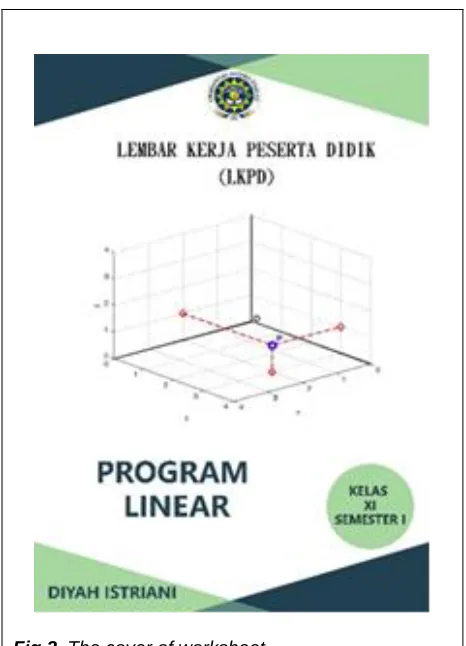
The design phase is used to create student worksheets according to the problems found in the study. The student worksheet is compiled to contain the introduction, content, and cover. This student’s worksheet product is following the steps of problem-based learning. The initial design results from the protection of the student’s worksheet with titled "Mathematics Student’s Worksheets Based on the Problem Based Learning of Linear Progam Materials" And the cover can be seen in Figure 2.
Fig 2. The cover of worksheet
The next step is the introduction. The introduction contains supporters from the student’s worksheet. One of the parts of the presentation is the introductory section. The design of the introduction can be see in Figure 3.
Fig 3. The design of the introduction
1161 Fig 4. The introduction for using student worksheet
Instructions for use contain procedures for using worksheets so that material goals are reached. Next is the table contents of student’s worksheet in Figure 5.
Fig 5. Table contents of student’s worksheet
The table of contents shows what is on the student’s worksheet while making it easier for students to find the topic they want to address. Next is the contents section. The contents section contains concept maps, core competencies, competency achievement indicators. The following Figure 6 shows the base competencies, core competencies, and competency indicators that students will achieve.
Fig 6 Competency indicators that students will achieve
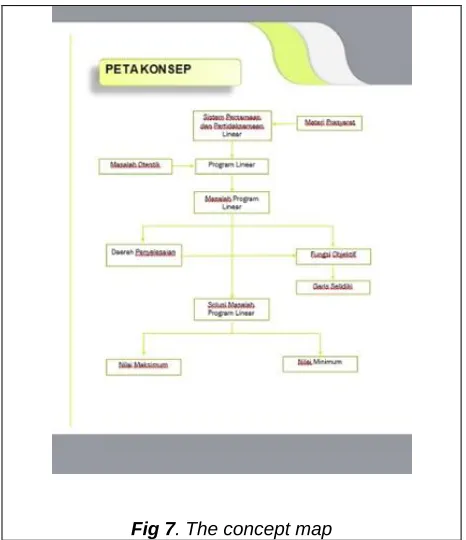
To facilitate the achievement of learning, a concept map is prepared. The concept map compiled in this student’s worksheet can be seen in Figure 7.
Fig 7. The concept map
1162
Fig 8. Supporting information of worksheet
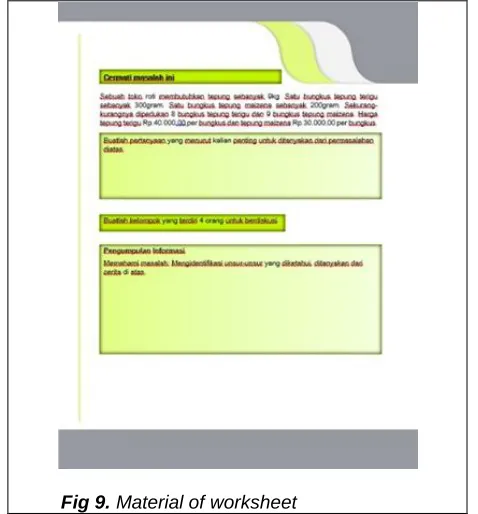
The act of continuing to understand supporting information. Then the problem is presented about linear programs according to the steps in problem based learning. The steps of the action can be seen in Figure 9.
Fig 9. Material of worksheet
Figure 9 shows the steps for that students will take in learning the material present. The measures contained in the student’s worksheet are following the stages of problem-based learning. The student’s worksheet is also equipped with training. The drawing of the exercise on the student’s worksheet can be seen in Figure 10.
Fig 10. Exercise worksheet
The last point in the student’s worksheet contains the practice questions. Problem training is given to training students in understanding subject matter, and practice is also able as a tool for measuring student problem-solving abilities after learning material [10]. The student’s worksheets have been validated by two expert validators, namely Titik Handayani, M.Pd., as Mathematics Teachers at Senior High School in Wonosobo, Indonesia and Ageng Triyono, S.Pd., as Al-Azhar Mathematics Teacher Coordinator. The validator, in this case, does not revise the media and learning material. However, the validator only corrects the initial design of the student’s worksheet. The following are some inputs and suggestions from the validator summarized in Table 2.
TABLE2
INPUTS AND SUGGESTION FROM THE VALIDATORS Suggestions and Comments Follow-up
Add examples of more interesting questions with the character of students
Giving more interesting examples
Add goals from the student worksheet
Giving learning objectives on the worksheet of students Add an example that shows the
problem based learning step
Giving examples that are easy for students to imagine
The suggestions and comments provided by the validators were then revised. On the other hand, the feasibility og the initial design of learning media by the validator is calculated using questionnaire calculation. For the results are shown in Table 3.
TABLE3
RESULT OF CALCULATION OF QOUESTION FOR FEASIBILITY OF
INITIAL DESIGN
Accessor Position Score Criteria Qualitative Data for
Titik Handayani, M.Pd.
Mathematics study teacher at SMA Negeri 1 Sapuran
34 Good
Ageng Triyono, S.Pd.
Mathematics
1163 at Al-Azhar
Total 72
Average 36 Very Good
In Table 3, it shows that the average score obtained is 36. These results indicate that the initial design of learning media that will be developed in the category is very good.
4
CONCLUSION
Development of student’s worksheets is carried out in the analysis and design stages. In the initial design phase, it contains covers, introductory words, usage instructions, table of contents, intended competencies, concept maps, supporting information, and individual tasks. The initial design used in making student worksheets using CorelDraw and Microsoft Word 2013. The results of the design validation found that the category was perfect, with an average value of 36.
ACKNOWLEDGMENT
The author is grateful to Ahmad Dahlan University for providing the opportunity to facilitate the author in completing this research. Thanks also to schools and teachers who have allowed us to do research.
REFERENCES
[1] R.D.E. Prismana, T.A. Kusmayadi, and I. Pramudya, ―Analysis of Difficulties in Mathematics Problem Solving Based on Revised Bloom’s Taxonomy Viewed From High Self-Efficacy‖, Journal of Physics, 2018.
[2] NCTM, ―Principles and Standards for School Mathematics. Association Drive Reston‖, 2000
[3] S. A. Widodo, and T. Turmudi, ―Guardian Student Thinking Process in Resolving Issues Divergence‖, Journal of Education and Learning, 11(4), 432-438, 2017.
[4] S. Greiff, S. Wüstenberg, B. Csapó, A. Demetriou, J. Hautamäki, A. C. Graesser, and R. Martin, ―Domain-general problem solving skills and education in the 21st century‖, Educational Research Review, (13), 74-83, 2014.
[5] J. Anderson, ―Mathematics Curriculum Development and The Role of Problem Solving. In K School‖, Australian Curriculum Studies Association National Biennial Conference. Curriculum: A National Conversation, pp. 1-8, 2009. (ASCA Conference)
[6] M.A. Al-Khateeb, ―The Effect of Teaching Mathematical Problems Solving Through Using Mobile Learning on the Seventh Grade Students' Ability to Solve them in Jordan‖, International Journal of Interactive Mobile Technologies (iJIM), vol. 12, no. 3, 178-191, 2018. [7] N.A. Dina, and S.M. Amin, ―Flexibility in Mathematics
Problem Solving Based on Adversity Quotient‖, In Journal of Physics: Conference Series, vol. 947, no. 1, p. 012025, 2018. (IOP Publishing)
[8] OECD, PISA 2012 assesment and analytical framework: mathematics, reading, science, problem solving and financial literacy, 2015. (German: OECD Publising) [9] D. Bautista, M. Mitchelmore, and J. Mulligan, ―Factors
influencing Filipino children’s solutions to addition and subtraction word problems‖, Educational Psychology, vol. 29, no. 6, pp. 729-745. 2009.
[10] T. Akma, ―The Design of Student Worksheet Problem Based Learning to Improve Problem Solving Ability of the Eight-Grade Students Junior High School in
Indonesia‖, International Journal of Engineering & Technology, vol. 7 no. 4.30, pp. 11-15, 2018.
[11] J.R. Savery, ―Overview of Problem-based Learning: Definitions and Distinctions‖, Interdisciplinary Journal of Problem-Based Learning, vol. 1, no. 1, pp. 9-20, 2006. [12] D. Jonassen, ―Supporting Problem Solving in PBL‖,
Interdisciplinary Journal of Problem-Based Learning, vol. 5, no. 2, pp. 95-119, 2011.
[13] P. Chung, R.C. Yeh, and Y. Chen, ―Influence of problem-based learning strategy on enchancing student’s industrial oriented competence learned: an action research on learning weblog analysis‖, Int J Technol Des Educ, vol. 26, pp. 285-307, 2016.
[14] R.E. Simamora, D.R. Sidabutar, and E. Surya, ―Improving Learning Activity and Students’ Problem Solving Skill through Problem Based Learning (PBL) in Junior High School‖, International Journal of Sciences: Basic and Applied Research, vol. 33, no. 2, pp. 321–331, 2017. [15] K.B. Hartman, C.R. Moberg, J.M. Lambert, ―Effectiveness
of Problem-Based Learning in Introductory Business Courses‖, Journal of Instructional Pedagogies, vol. 12, pp. 1-13, 2013.
[16] G.I.D. Purba, E. Surya, M. Manullang, and Asmin, ―The Effect of Students Worksheet in the Model of Discovery Learning Against the Students Ability of Reasoning and Mathematical Communication in the Faculty of Mathematics and Natural Science of State University of Medan‖, International Journal of Sciences Basic and Applied Research, vol. 37, no. 3, pp. 70-82, 2018. [17] S. Merdekawati, and H.P. Lestari, ―Developing Students
Worksheet in English Based on Constructivism using problem solving approach for mathematics learning on the topic of Social Arithmetics‖, International Seminar and the Fourth National Conference on Mathematics Education, vol. 13, no. 1, pp. 30-38, 2011. (Conference proceedings)
[18] P. Barniol, and G. Zavala, ―A Tutorial Worksheet to Help Students Develop the Ability to Interpret the Dot Product as a Projection‖, Eurasia Journal of Mathematics Science & Technology Education, vol. 12, no. 9, pp. 2387-2398, 2016.
[19] Y. Zulyadaini. ―A Development of Students Worksheet Based on Contextual Teaching and Learning‖. International Journal of Learning , Teaching and Educational Research, vol. 16, no. 6, 2017.
[20] T. Sivasailan, D.S. Semmel, and M.I. Semmel, ―Instructional Development for Training Teachers of Exceptional Children: A Sourcebook‖, Educational Resources Information Center, 1974.