ABSTRACT
BUSHOUSE, MICAH. Cloud-ready Hypervisor-based Security. (Under the direction of Douglas Reeves.)
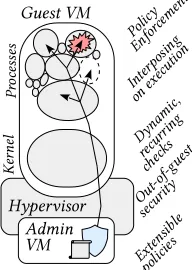
Improving host security through virtualization has led to many novel “out-of-guest” Hypervisor-Based Security (HBS) systems. Unlike traditional operating-system-based security mechanisms, HBS systems are both isolated from the guest operating system and operate at a higher privilege level, making it difficult for in-guest malicious code to disable or even detect an HBS system. However, although HBS systems have been an active area of research for fifteen years, they have not yet been adopted as a routine security practice in production systems.
© Copyright 2018 by Micah Bushouse
Cloud-ready Hypervisor-based Security
by Micah Bushouse
A dissertation submitted to the Graduate Faculty of North Carolina State University
in partial fulfillment of the requirements for the Degree of
Doctor of Philosophy
Computer Science
Raleigh, North Carolina
2018
APPROVED BY:
William Enck Vincent Freeh
Alexandros Kapravelos Douglas Reeves
DEDICATION
ACKNOWLEDGEMENTS
I am immensely grateful to my advisor, Dr. Doug Reeves. His patience, understanding, and advice are the main drivers for my academic success. I am in awe of his ability to ask the perfect question at the precisely-timed moment to either induce a leap forward or a gentle nudge down a better path. Over the years I was fortunate to have close relationships with my committee, Drs. W. Enck, A. Kapravelos, V. Freeh, and M. Kang. I considered myself lucky that it was often they who reached out to check in on me instead of vice versa. Thank you for challenging me.
I am especially thankful for the NCSU CSC department’s administrative staff, including Dr. G. Rouskas, K. Luca, A. Sleeth, T. Gardner, C. Benavente, and T. Murdoch. The good will you’ve shown me has provided the steady base (and a good amount of electricity) for my work. I also enjoyed collaborating with A. Workman and the rest of A. Kotynski’s Security and Compliance team.
During my time in the WSPR lab, Dr. J. Staddon, Dr. A. Scafuro, Dr. A. Nadkarni, Dr. B. Reaves, L. Deshotels, I. Polinsky, S. Ahn, B. Andow, A. Verma, A. Gorski, L. Enloe, J. Jueckstock, S. Elder, and A. Haque kept me continuously on my feet. Over time, an individual’s values are shaped by those of his or her organization, and in my case this is the US military. I hope that over the years we’ve worked together as a lab some of these values and attitudes have helped you. Despite this, I modestly acknowledge the reality that it’s equally likely that I’ll simply be remembered as that one salty guy who came in early every day and complained loudly about containers.
I would not be in this position if key leaders in the US Army had not advocated on my behalf, especially J. Dillon, I. MacLeod, LTC C. Saie, LTC T. OConnor, MAJ I. Faber, CW3(R) J. Babesh, and LTC S. Applegate. LTC P. Godbey provided the initial encouragement in 2014, while more recently LTC C. Saie and CPT T. Schindler performed untold amounts of blocking and tackling on my behalf.
I am grateful for my summer in Albuquerque with Dr. K. Dixon, R. Vestal, Dr. J. Haas, C. Babcock, C. Loverro, J. Ingram, and Dr. M. Smith. Sandia is truly a great place to work.
Many of those mentioned above assisted in reviewing my work—willingly or otherwise—as did my colleagues CPT N. Hicks and M. Kaar, the chair of my preliminary exam, Dr. E. Gehringer, and the anonymous reviewers around the world.
I owe a great deal to the open source community for providing the foundation for many of my projects, specifically those involved in the Linux kernel, Fedora, Xen, LibVMI, DRAKVUF, GRR, Rekall, Python, SaltStack, ZeroMQ, Protocol Buffers, and SystemTap.
Finally, thank you to my family, my beautiful wife Heather and our boys Zachary and Matthew. You provided encouragement, patiently endured my tribulations, and sometimes (rather cheerfully) took day trips to Nana and Papa’s house on Saturdays so I could catch up. Grandma, Grandpa, uncles, and aunts were also constantly involved, allowing me to steal hours hiding in a corner to type.
TABLE OF CONTENTS
LIST OF TABLES . . . .viii
LIST OF FIGURES. . . ix
Chapter 1 Introduction. . . 1
1.1 The Rise of Virtualization . . . 1
1.2 Virtualization as a Security Enabler . . . 2
1.3 Problem Statement . . . 2
1.4 Thesis Statement . . . 3
1.5 Dissertation Contributions . . . 4
1.6 Dissertation Organization . . . 6
Chapter 2 Foundations and Related Work . . . 8
2.1 Virtualization . . . 8
2.2 Virtual Machine Introspection . . . 12
2.3 VMI Primitives . . . 13
2.3.1 Reading and Writing . . . 14
2.3.2 EPT Violations . . . 15
2.3.3 Register Updates . . . 15
2.3.4 Interrupt Injection . . . 16
2.4 VMI and Hypervisor Types . . . 16
2.5 Below the Hypervisor . . . 19
2.6 Why Hypervisor-based Security? . . . 20
2.6.1 The Isolation Security Argument . . . 20
2.6.2 Other Arguments . . . 22
2.6.3 VMI Challenges . . . 23
Chapter 3 Hypervisor-based Process Enforcement . . . 26
3.1 Introduction . . . 27
3.2 Motivation . . . 28
3.3 Background . . . 31
3.3.1 Threat Model . . . 33
3.3.2 Assumptions . . . 33
3.4 Design . . . 33
3.4.1 Goalkeeper’s Concept and State Machine . . . 34
3.4.2 Process Identification and Vetting . . . 34
3.4.3 Process Termination . . . 37
3.4.4 Implementation Details . . . 39
3.5 Evaluation and Results . . . 39
3.5.1 Evaluation Environment . . . 40
3.5.2 100 Guest Experiment . . . 40
3.5.3 MOV-to-CR3 Profiling . . . 42
3.5.5 Malware Validation . . . 45
3.6 Discussion . . . 46
3.6.1 Goalkeeper’s Policy Language . . . 46
3.6.2 Resistance to DKOM . . . 47
3.6.3 Resistance to Anti-Virtualization . . . 47
3.6.4 Guest Kernel Sensitivity . . . 47
3.6.5 Limitations . . . 48
3.6.6 Related Work . . . 48
3.7 Summary . . . 49
Chapter 4 Hypervisor-based Monitoring. . . 50
4.1 Introduction . . . 51
4.2 Virtual Router Security . . . 52
4.2.1 Background . . . 52
4.2.2 VR Monitoring Challenges . . . 54
4.2.3 VR Monitoring Requirements . . . 54
4.2.4 Replacing Agents with VMI . . . 55
4.2.5 Threat Model . . . 55
4.3 Design and Architecture . . . 56
4.3.1 Gaining Equivalent Context with VMI . . . 57
4.3.2 Analyst Preparation . . . 57
4.3.3 Inferring Security Events from Traces . . . 58
4.3.4 VR and Network Service Selection . . . 59
4.3.5 Attacks and Responses . . . 61
4.3.6 Implementation Details . . . 62
4.4 Evaluation . . . 62
4.4.1 Experiment Environment . . . 63
4.4.2 Experiments . . . 63
4.5 Results . . . 64
4.6 Discussion . . . 65
4.6.1 VMI Breakpoint Protection . . . 65
4.6.2 Analyst Effort with New VR Releases . . . 65
4.6.3 Limitations . . . 66
4.6.4 Related Work . . . 66
4.7 Summary . . . 67
Chapter 5 Developing Hypervisor-based Agents . . . 68
5.1 Introduction . . . 69
5.2 Motivation . . . 70
5.3 Background . . . 71
5.3.1 Host Agents . . . 71
5.3.2 Hypervisor-based Security Agents . . . 72
5.3.3 Live Forensics . . . 73
5.3.4 Assumptions and Threat Model . . . 73
5.4.1 Methodology Goals . . . 75
5.4.2 Phase 1: Porting Agent Actuators . . . 75
5.4.3 Phase 2: Consolidating Adjacent Agents . . . 78
5.4.4 Phase 3: New Agent Functionality . . . 79
5.5 Re-Engineering GRR . . . 80
5.5.1 Phase 1 . . . 80
5.5.2 Phase 2 . . . 81
5.5.3 Phase 3 . . . 81
5.6 Evaluation and Results . . . 84
5.6.1 Evaluation Environment . . . 84
5.6.2 Development Work Factor . . . 84
5.6.3 Execution Time and Network Bandwidth . . . 85
5.6.4 Performance and Overhead . . . 86
5.7 Discussion . . . 87
5.7.1 Other Agents . . . 87
5.7.2 Tradeoffs . . . 88
5.7.3 Beyond the Datacenter . . . 88
5.7.4 Memory Deduplication . . . 88
5.7.5 Adding VMI Functionality . . . 88
5.7.6 Related Work . . . 89
5.8 Summary . . . 90
Chapter 6 Tenant-driven Cloud VMI . . . 91
6.1 Introduction . . . 91
6.2 Background . . . 93
6.2.1 Modern Clouds . . . 94
6.3 Design Goals . . . 95
6.4 Design . . . 98
6.4.1 Security . . . 101
6.4.2 Performance . . . 107
6.5 Case Studies . . . 109
6.6 Evaluation and Results . . . 111
6.6.1 Security Evaluation . . . 111
6.6.2 Performance Evaluation . . . 113
6.7 Discussion . . . 114
6.7.1 Related Work . . . 116
6.8 Summary . . . 116
Chapter 7 Directions for Hypervisor-based Security . . . .118
7.1 Dissertation Summary . . . 118
7.2 Trends . . . 119
7.3 Future Work . . . 121
7.4 Concluding Remarks . . . 122
APPENDICES . . . .136
Appendix A Goalkeeper Whitelisting Mechanism . . . 137
A.1 The Whitelisting Check . . . 137
A.2 Grammar Specification . . . 139
A.3 Example Policy . . . 140
Appendix B Other Potential Hyperagents . . . 142
B.1 Security: ClamAV Scanner . . . 143
B.2 Security: OSSEC Intrusion Detection . . . 143
B.3 Monitoring: Nagios NRPE . . . 144
LIST OF TABLES
Table 3.1 Process Supervision Comparison . . . 29
Table 3.2 Policy Rule Components . . . 35
Table 3.3 Memory Manipulation Techniques . . . 36
Table 3.4 Goalkeeper Profiling . . . 44
Table 4.1 Security Monitoring Classes . . . 56
Table 4.2 Virtual Routers (VRs) . . . 60
Table 4.3 Target VR Services . . . 61
Table 4.4 File Transfer Performance Tests . . . 64
Table 4.5 pfSense Effectiveness Tests . . . 65
Table 5.1 Example agents. . . 72
Table 5.2 A matrix of GRR agent actuators (columns) matched against the
libhyperagent
components (rows) used to function on a guest. . . 80Table 5.3 Source Code Changes . . . 85
Table 5.4 SysDiff Performance . . . 85
Table 5.5 Agent Memory Usage . . . 86
Table 5.6 In-guest Overheads . . . 86
Table 5.7 Interrogation Latency. In Guest (IG) agent. HA (Hyperagent). Units in seconds. Statistics across 100 samples. . . 87
Table 6.1 Desirable Properties for a Cloud VMI Framework . . . 96
Table 6.2 Sandbox Comparison . . . 102
Table 6.3 Furnace Partitions . . . 103
LIST OF FIGURES
Figure 1.1 Hypervisor-based security in the context of defense in depth. HBS systems are part of an integrated approach to defense. . . 4 Figure 1.2 A chronological progression of dissertation-related research, including each
work’s Problem, Solution, and Methodology. Techniques developed in earlier chapters are incorporated in later chapters. . . 7
Figure 2.1 A native hypervisor diagram based on Xen. The guest OS and processes run in CPLs 0 and 3, isolated from other guests by a hypervisor using hardware-accelerated virtualization support. The hypervisor and it’s management do-main (here called dom0) run in VMX root mode. Beneath the virtualization layer exist two other layers which can support security applications: System Management Mode and the Intel Management Engine. To the right of the diagram are currently available products found at each layer. . . 10 Figure 2.2 A VMI tool (shown as the green HBS shield) can access guest memory, vCPUs,
and the guest’s VMCS through mechanisms provided by the hypervisor. . . 12 Figure 2.3 The guest Reads and Writes VMI Primitive (left) and the EPT violations VMI
Primitive (right). . . 14 Figure 2.4 Register Events VMI Primitive (left) and Interrupt Injection VMI Primitive
(right). . . 16 Figure 2.5 Processing an injected breakpoint. When guest execution encounters a
break-point, the guest vCPU is suspended. The hypervisor passes this event to the inspecting domain’s VMI tool, which performs arbitrary action before remov-ing the breakpoint and settremov-ing the vCPU to sremov-ingle-step mode. The guest vCPU single-steps across the breakpoint’s former location, and immediately traps back into the hypervisor so that the breakpoint can be re-injected. . . 17 Figure 2.6 The semantic gap problem is typically addressed by a mapping that translates
VMI-tool-provided semantic information in and out of raw guest memory. In this example, a semantic mapping is used to extract process information from a guest’s main memory. . . 23
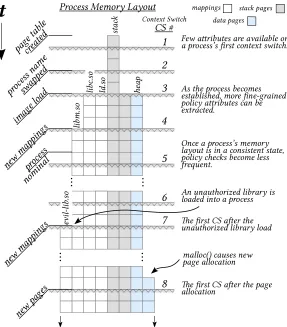
Figure 3.1 Guest Process Supervision . . . 28 Figure 3.2 Process attributes are manifested as a new process is created and initialized.
Over time (from top to bottom), the process’s memory layout reflects new dynamically loaded libraries (CS 4, 7) and new page allocations (CS 8). . . 31 Figure 3.3 Goalkeeper spawns a monitoring process for each guest virtual machine to
be monitored. Each monitoring process consists of a fast path and slow path, and both are driven by its corresponding guest’s process context switches. The guest process being “switched to” is subject to Goalkeeper enumeration, inspection, and potential termination if it fails its policy check. . . 32 Figure 3.4 Goalkeeper’s high-level state machine. Existing, stable processes are filtered
Figure 3.5 A summary of Goalkeeper’s performance overheads taken during the 100 guest experiment. Goalkeeper imposes a 3.1% in-guest performance over-head on guests it protects. Each per-guest Goalkeeper process requires an average of 15.1MB dom0 memory (RSS) and 5.6% dom0 CPU while inspecting 5 new guest processes/second. When operating under 100 guests, Goalkeeper increases dom0’s total system load by 9.4%. . . 40 Figure 3.6 As Goalkeeper is used to protect increasing numbers of guests, Goalkeeper’s
per process Proportional Set Size (PSS) memory usage approaches 5.14MB, whereas CPU load grows linearly with the number of guests. . . 43 Figure 3.7 Once a process is labeled as unauthorized, Goalkeeper requires an average of
8.6ms±0.8ms to terminate it. . . 43 Figure 3.8 TheMOV-to-CR3round trip time overhead quantifies the time required to
move a guest event through the hypervisor and into Goalkeeper’s fast path. . . 44
Figure 4.1 Two common VR roles:V R1provides cloud administrators with remote VPN
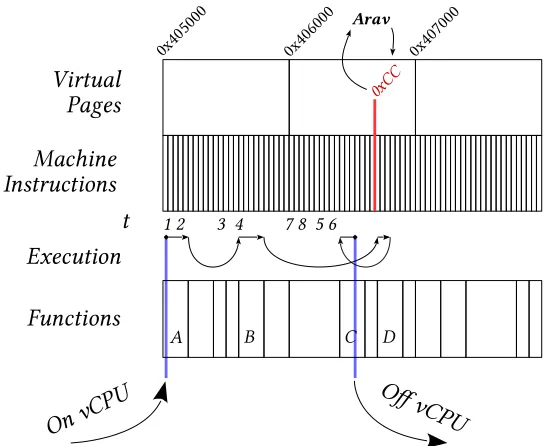
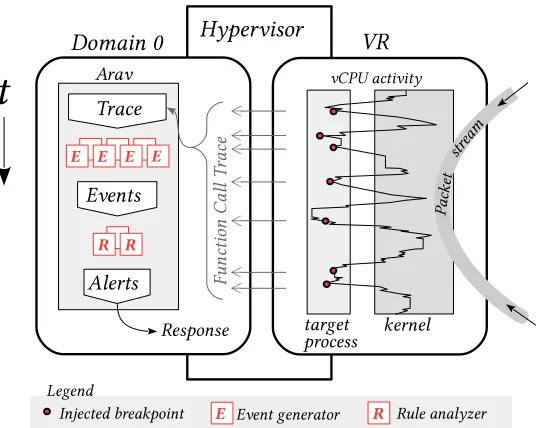
access into the cloud management network, andT4serves as a firewall and NAT for a cloud tenant. . . 53 Figure 4.2 A VR process is monitored by Arav, which injects a breakpoint at the process’s
function D. After the process encounters the breakpoint, the VR is briefly suspended while Arav records the event. . . 58 Figure 4.3 Arav’s capability set construction workflow. . . 59 Figure 4.4 A VR process’s BPs are recorded into traces, which are mapped into events
and analyzed against rules. . . 60 Figure 4.5 Event generators reconstitute security events from the trace of Quagga OSPF’s
function calls, and these security events are queried by rule analyzers for potential responses. . . 61 Figure 4.6 Arav’s Experiment diagram. Node A is an external host, the origin of attacks,
the OSPF neighbor, and a VPN client. Node B is an internal host. . . 63
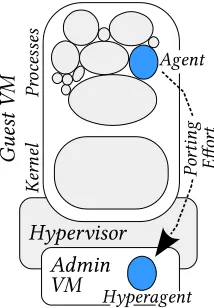
Figure 5.1 In-guest agents can be ported into hyperagents. . . 70 Figure 5.2 The three-phase methodology to re-engineer host agents into hyperagents. . 72 Figure 5.3 Adding
libhyperagent
enables agent actuators to access a guest’s kerneldata structures (category 1), process memory (category 2), and file system (cat-egory 3). Using
libhyperagent
’s VMI SyncMount component, this example GRR actuator iterates through a guest directory’s contents by temporarily mounting the guest file system into dom0. . . 74 Figure 5.4 The predictability of work queue behavior enables the hyperagent to divert aguest vCPU to
sys_sync
. . . 77 Figure 5.5 The GRR architecture. From left to right: A a host contains a kernel anduserspace processes. One of these processes is B the GRR C++agent. The agent registers with C the GRR server across the network. D An investi-gator’s script interacts with GRR server APIs to create aflowthat directs the agent to perform one or more of its client actions. . . 78 Figure 5.6 New phase 3 features take advantage oflocality(moving work forward to the
Figure 5.7 Comparing network activity between a script using the built-in GRR flows (top) and the UT performing computation forward on the hyperagent (bot-tom). By moving server-side analysis code forward to the hyperagent, multiple network round trips are avoided. Message counts in this figure are based on a single hypervisor(H =1)running 8 guests(G =8), each with 40 processes
(P =40G=320). . . 83
Figure 6.1 Under guestG1, an anti-rootkit VMI tool ensures kernel integrity. The forensics tool underG2,G3, andG4extracts process memory images. The monitoring tool underG4uses breakpoint injection to trace events occurring inside guest userspace processes. Finally, an intrusion prevention tool inspects newG6 processes. The differing guest sizes in the diagram indicate the variety of instance types and operating systems found in modern clouds. . . 93
Figure 6.2 In modern clouds, tenants can use cloud APIs to request a new VM 1. This request is processed by cloud services running on a controller node. These services allocate resources, perform checks, and schedule changes 2. They schedule the new VM on a compute node, which locates or downloads the VM’s disk image, checks for and allocates resources, and prepares the VM’s network 3. Finally, the VM is booted 4 and the tenant accesses their new VM using a remote administration tool 5. . . 94
Figure 6.3 A cloud VMI framework’s objective is to provide safe, high-performance tenant access to a cloud provider hypervisor’s VMI API. . . 95
Figure 6.4 Threat Model. . . 97
Figure 6.5 The Furnace architecture from the cloud provider’s perspective. . . 98
Figure 6.6 The Furnace architecture from the cloud tenant’s perspective. . . 99
Figure 6.7 Tenant model. . . 100
Figure 6.8 Furnace tenant programming model. This example tenant app and backend work together to intercept and whitelist new guest processes. . . 101
Figure 6.9 From bottom to top: the sandbox is assembled when a new app is started. . . 104
Figure 6.10 The syscall policy for the VMI app running in the sandbox’sL2partition. The remaining≈245 syscalls are denied. . . 104
Figure 6.11 This sandbox security analysis depicts the order in which security mecha-nisms are encountered by code running in a sandbox partition and asserts the sandbox is reasonably secure if certain criteria are met. Furnace’s security evaluation will test elements of this assertion (the “shown by” column) to pro-vide confidence that Furnace can successfully contain malicious VMI apps. Notes: for brevity, only the L0partition is shown, but L1and L2are conceptually identical; the syscall inspector is not shown. . . . 106
Figure 6.13 A tenant app source code snippet that demonstrates the use of Furnace’s VMI call pipelining API. Here, the tenant programmer creates a batch object
o
, populates it with several hundred VMI calls, then serializes and sends it toL2to be processed by callingbatch_send()
. By pipelining related callstogether in the same cross-call message, IPC-related overhead can be greatly
reduced. . . 109
Figure 6.14 Process list performance measurements were taken across a variety of VMI platforms, including a native VMI tool, CloudVMI, and Furnace VMI apps. This figure’s circled points correspond to the rows in Table 6.4. . . 113
Figure A.1 The whitelisting check. . . 138
Figure A.2 Grammar hierarchy. . . 139
CHAPTER
1
INTRODUCTION
1.1
The Rise of Virtualization
Hardware virtualization enables multiple operating systems (OSs) (e.g., Windows, Linux) to run con-currently as virtual machines on the same physical host. First proposed in the 1960s, virtualization didn’t achieve wide market adoption until hardware-accelerated virtualization became available for the x86 architecture in the mid-2000s. Since then, virtualization has became a foundational technology built into nearly all forms of computing. Virtualization has transformed many areas of in-formation technology (IT), such as reducing costs by improving server utilization and management, making software development and testing easier, and increasing the speed at which businesses recover from disruptive events. Ultimately, the benefits of virtualization have given rise to entirely new sectors of business, such as the public cloud market and the resulting cloud-centric software projects, developer tools, and new cloud ecosystems which followed.
Perhaps unexpectedly, virtualization extends well beyond its initial success in the datacenter and is built into most x86 and ARM CPUs, including those in modern cell phones, tablets, laptops, desktops, and many embedded devices. As a result, virtualization can be used in a wide range of applications including small System on a Chip (SoC) boards such as the Raspberry Pi, Aircraft[KW08], Drones[Yoo17], and satellites.1In fact, embedded virtualization is of growing importance for
criticality workloads as health, safety, and other critical functions must co-exist on the same device.2
1.2
Virtualization as a Security Enabler
Virtualization’s hardware-enforced isolation has made it attractive for security applications. Un-like traditional operating-system-based security mechanisms, these virtualization-backed security systems are both isolated from a guest3operating system and operate at a higher privilege level, making it difficult for in-guest malicious code to disable or even detect a hypervisor-based system. As a result, virtualization has enabled researchers to safely run and analyze malicious files, detect or prevent attacks against guests, and quickly remediate large swaths of virtual machines. Additional security-related applications, such as large scale honeypots, honeynets, and honeyclients, are all made practical by virtualization. Entire virtual networks of virtual machines can be created inside a single physical host in order to present a convincing target for attackers. Finally, the commer-cialization of hypervisor-based security continues to improve, with major IT companies like Xen, Microsoft, VMware, and BitDefender introducing unique solutions into the mainstream market.
This dissertation centers onHypervisor-Based Security(HBS), which this dissertation defines as the employment of guest-centric hypervisor-based mechanisms designed to improve the security posture of a hypervisor’s guests. HBS relies uponVirtual Machine Introspection(VMI) techniques to inspect, interpose, and introspect[GR03]upon a virtual machine. These VMI techniques are used by an HBS system to infer and influence activity inside a guest, i.e., HBS systems apply VMI techniques.4
1.3
Problem Statement
Despite 15 years of research and dozens of papers on using VMI for security, HBS has yet to be adopted as a routine security practice for production environments. VMI related work, surveys, and systemization of knowledge (SoK) papers often note several contributing factors to the lack of adoption. Of these, this dissertation focuses on the following:
• VMI struggles to scale[Jai14]. VMI’s interposition on guest execution often introduces notice-able performance overheads. Additionally, VMI often causes frequent CPU mode switches which also introduce overhead.
• VMI lacks high-level frameworks[Wan15a]. VMI research occurs at a low technical level. To be used in production, an HBS system must be integrated into larger systems. The degree of
inte-2https://www.zededa.com/development/linux-foundation-announces-embedded-virtualization-platform 3This dissertation usesguest,virtual machine, anddomaininterchangeably.
4Another term in literature,VMI tool, is defined as a program that incorporates VMI techniques. By this definition, an
gration effort required in the incorporation of VMI techniques likely makes HBS unattractive to security teams.
• VMI is not presently available in multi-tenant cloud ecosystems[Jai14]. VMI research is typically centered on standalone hypervisors. This results in implementations that are not compat-ible with how modern cloud ecosystems are designed. Although prior work has proposed frameworks to enable VMI in the cloud, none have seen successful adoption.
1.4
Thesis Statement
In this dissertation, we investigate solutions to three HBS shortfalls: scale, development and in-tegration challenges, and lack of a safe cloud framework. First, an HBS must scale to efficiently monitor many adjacent guests. Second, building an HBS system and integrating it into a larger security enterprise must be feasible. Finally, in a cloud environment, tenants must be able to safely and inexpensively deploy their own HBS systems across their cloud VMs. From these, we form our thesis statement:
As shown through low-overhead designs, methodical integration into existing
defenses, ease of use, and flexibility across virtualization platform, hypervisor-based security contributes to the integrated defense of virtualized systems.
Thesis Principles:
• The practical application of HBS.The proposals in this dissertation are designed and evaluated with a emphasized sensitivity to in-guest overheads and the ability to operate against large sets of guests, aspects which have limited the adoption of prior work.
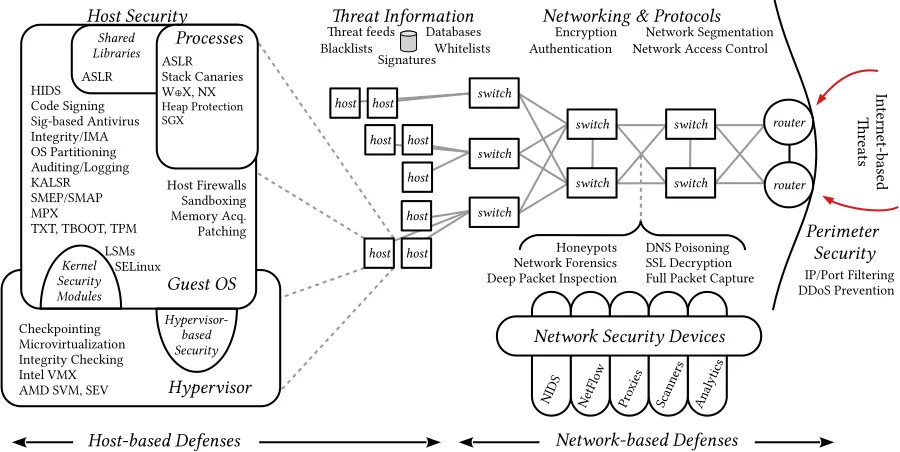
• HBS as a part of an integrated defense.The design and implementation of prior HBS prototypes often stops short and leaves a gap between the prototype and a realistic scenario where it might be applied. This dissertation exhibits extra effort to integrate with existing defense in depth best practices (see Figure 1.1) and perform end-to-end tests that would more closely mimic real world conditions.
Processes
Shared Libraries
Kernel Security
Modules Guest OS
Hypervisor ASLR Stack Canaries W⊕X, NX Heap Protection SGX ASLR HIDS Code Signing Sig-based Antivirus Integrity/IMA OS Partitioning Auditing/Logging KALSR SMEP/SMAP MPX
TXT, TBOOT, TPM
Host Firewalls Sandboxing Memory Acq. Patching
Encryption
Networking & Protocols Network Segmentation
IP/Port Filtering DDoS Prevention Honeypots
Network Forensics Deep Packet Inspection
Host-based Defenses Network-based Defenses
NID S
Network Security Devices
Net Flow Prox ies Scan ners Ana lytic s Perimeter Security In te rn et-ba sed T re ats DNS Poisoning SSL Decryption Full Packet Capture Authentication Network Access Control
host host host host host host host host router switch router switch switch switch switch switch Checkpointing Microvirtualization Integrity Checking Intel VMX AMD SVM, SEV
switch LSMs SELinux Hypervisor-based Security Threat nnformation Treat eeeds Databases Blacklists Whitelists
Host Security
Signatures
Figure 1.1Hypervisor-based security in the context of defense in depth. HBS systems are part of an inte-grated approach to defense.
1.5
Dissertation Contributions
• The scalability of Goalkeeper. Goalkeeper[BR17]enforces guest process-level security policies and scales across tens to hundreds of guests per hypervisor by focusing on asynchronous, stateless, and lightweight Virtual Machine Introspection (VMI) techniques. Goalkeeper mini-mizes overhead by limiting inspections to recently-changed guest processes. In an evaluation across 100 Linux virtual desktops, Goalkeeper imposed a guest performance overhead of less than 3.1% and terminated all unauthorized processes within an average of 8.6ms. This work was published in COSE’18.
Key Findings:
1. CR3 interception, originally thought prohibitively expensive, can be managed by an optimized design.
2. The proper use of computational parallelism allows VMI to scale linearly until CPUs become contended.
3. Hypervisor-based security benefits from a flexible, extensible policy language.
unsuitable for traditional security monitoring, imposing less than 0.6% overhead while moni-toring two popular virtual routers. This work was published in CISR’17.
Key Findings:
1. VMI can be used to monitor and integrate systems that cannot support existing monitor-ing tools.
2. Judicious use of breakpoint injection (20-30 breakpoints) imposes acceptable overheads.
• The ease of integration using the Hyperagent methodology. We present a methodology[BR18]to re-engineer existing security agents into hyperagents, hypervisor-based agents which gain the benefits of HBS while retaining their original in-guest capabilities. Hyperagents integrate easily with established security operations because hyperagents inherit the years of practitioner experience and best practices of the original agent. Additionally, when consolidated from multiple adjacent guests and centralized on the hypervisor, a hyperagent is more resource-efficient than its predecessor, and allows for new agent features, such as enabling server-side work to run locally on host data. These benefits are illustrated by re-engineering the GRR live forensics agent, which used 40% less memory that its in-guest counterparts and enabled a 4.9x speedup for a representative data-intensive workload. This work was published in CODASPY’18.
Key Findings:
1. The effort to re-engineer a host agent with VMI can be minimized by following a struc-tured methodology.
2. With the assistance of VMI libraries, adding VMI to an existing software system is rea-sonable and straightforward for a developer.
3. Hypervisor-based agents can be both more resource-efficient and more powerful than their in-guest counterparts.
Key Findings:
1. By isolating tenant VMI applications in a sandbox on the hypervisor, the applications can run faster and are less expensive than the equivalent approach taken by prior cloud VMI proposals.
2. A tenant-centered design allows each party to focus on their strengths: the cloud provider’s ability to provide a flexible, safe, framework, and the cloud tenant’s detailed knowledge of tenant systems and specific VMI requirements.
1.6
Dissertation Organization
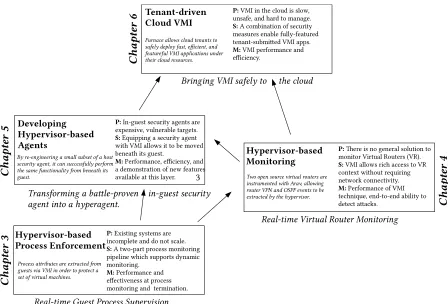
The goal of this dissertation is to investigate three related VMI shortfalls through a practitioner-focused and systems-oriented approach. This dissertation proposes solutions to these problems in order to improve VMI adoption and accelerate future VMI research. Figure 1.2 presents a chronolog-ical progression of these proposals.
In Chapter 2, virtualization and its potential security applications are introduced. VMI’s primi-tives are discussed and framed by prior work. Guest-centric, VMI-enabled security functionality is compared to related approaches taken by other CPU modes. Finally, the advantages and disadvan-tages of VMI and Hypervisor-Based Security (HBS) are discussed.
Chapter 3 introducesGoalkeeper, a guest process supervision HBS system that exhibits good scalability properties, both in its per-guest overheads and its ability to protect many guests simulta-neously.
Chapter 4 describesArav, a security monitoring HBS system that can inexpensively monitor guests that cannot utilize traditional monitoring approaches.
Chapter 5 proposes a methodology to re-engineer security agents to function from the hypervisor. The methodology organizes the problem into three well-defined steps and illustrates the benefits of the approach by evaluating a successfully ported forensics agent.
Chapter 6 describesFurnace, a cloud VMI framework that uses a new sandboxing-based ap-proach to balance the competing priorities of a cloud provider its cloud tenants.
Hypervisor-based Process Enforcement
Transforming a battle-rovln inegulst slcurity aglnt into a hy-lraglnt.
Rlatetiml Virtuat Routlr Monitoring
Developing Hypervisor-based Agents Tenant-driven Cloud VMI Hypervisor-based Monitoring Two o-ln sourcl virtuat routlrs arl instrumlntld with Arav, attowing routlr VPN and OSPF lvlnts to bl lxtractld by thl hy-lrvisor. Furnacl attows ctoud tlnants to
saflty dl-toy fast, lfcilnt, and flaturlfut VMI a--tications undlr thlir ctoud rlsourcls.
Proclss atributls arl lxtractld from gulsts via VMI in ordlr to -rotlct a slt of virtuat machinls.
By rlelnginllring a smatt subslt of a host slcurity aglnt, it can succlssfutty -lrform thl saml functionatity from blnlath its gulst.
P: Existing systems are incomplete and do not scale. S: A two-part process monitoring pipeline which supports dynamic monitoring.
M: Performance and efecticeness at process monitoring and termination.
P: Tere is no general solution to monitor Virtual Routers (VR). S: VMI allows rich access to VR context without requiring network connecticity. M: Performance of VMI technique, end-to-end ability to detect atacks.
Rlatetiml Gulst Proclss Su-lrvision
P: VMI in the cloud is slow, unsafe, and hard to manage. S: A combination of security measures enable fully-featured tenant-submited VMI apps. M: VMI performance and efficiency.
P: In-guest security agents are expensice, culnerable targets. S: Equipping a security agent with VMI allows it to be moced beneath its guest.
M: Performance, efficiency, and a demonstration of new features acailable at this layer.
Bringing VMI saflty to thl ctoud
3
C
h
ap
te
r
3
C
h
ap
te
r
5
C
h
ap
te
r
4
C
h
ap
te
r
6
CHAPTER
2
FOUNDATIONS AND RELATED WORK
This section provides an introduction to this dissertation’s technical areas and their related work. First, a short history of virtualization is discussed (§2.1) before introducing Virtual Machine Intro-spection (VMI) (§2.2) and its four core primitives (§2.3). The two general types of hypervisors are discussed in the context of security (§2.4). Other CPU modes pertinent to security provide context to this dissertation’s hypervisor-based approach (§2.5). Finally, the motivations behind performing security at this layer are introduced (§2.6).
2.1
Virtualization
First implemented in the 1960s on IBM’s CP-40 and CP-67 mainframes[Gol73], hardware virtual-ization allows multiple guest operating systems to run concurrently and share the same physical host. TheVirtual Machine Monitor(VMM), orhypervisor, is the “operating system for operating systems” responsible for the management of these guests, the presentation and control of resources allocated to them, and their segmentation and isolation[KF91].
reality, hints at the relationship between security applications and virtualization that still largely exists today. A more complete treatment of the virtualization technologies that preceded modern hardware-accelerated processors is available[AA06].
The x86 architecture.Since the mid-1980s, CPUs on the x86 architecture have been designed to spend most of their time executing inprotected mode.1Protected mode introduced four privilege levels, of which two are used—current privilege levels (CPLs) 0 and 3, more commonly referred to ring 0 and ring 3[Int16]. Ring 3 is designed to execute processes and user-interactive applications, such as web browsers, editors, and games. A process in ring 3 runs inside its own virtual address space, isolated and distinct from both the kernel beneath it and its adjacent processes[Gal13]. When a CPU is in ring 3, it is prohibited from executing certain privileged CPU instructions that are available to the OS in ring 0. The more privileged OS in ring 0 is responsible for the overall software system, including managing processes in ring 3, performing work on their behalf, and controlling access to the machine’s physical resources.
Early x86 virtualization.Virtualization’s introduction into mainstream computing began in the mid-1990s when researchers began experimenting with virtualization on the x86 architecture. The early days of x86 virtualization usedring deprivileging[Uhl05]to carefully coax a guest OS kernel into running in a ring other than ring 0. This deprivileging made room in ring 0 for the hypervisor, and was done purposefully to ensure the hypervisor retained sole control over the host’s physical resources. When guest kernels attempted to execute privileged instructions from their position in the upper rings (1, 2, or 3), these instructions could trapped and emulated or translated into the equivalent unprivileged instructions by the hypervisor in ring 0[Gal13; AA06]. There was a cascade of implications to early efforts to virtualize x86, but one in particular made processor manufacturers take notice: performance degradation.
Current x86 virtualization.Despite early results showing that hardware-accelerated hypervisors were actually slower than their more mature all-software counterparts[AA06], AMD and Intel began to develop and market processor features to accelerate virtualization. This culminated in 2006 with the introduction of new processor extensions, Virtual Machine eXtensions2(VMX), and a new CPU mode, VMX root mode. This mode introduces hardware-accelerated hypervisor-specific x86 instructions and remains the basis for current x86 virtualization. In VMX root mode, the hypervisor runs in VMX root ring 0, and a supporting management operating system (sometimes called a helper guest), usually a Linux-like OS, runs in VMX root ring 3. The hypervisor starts guest operating systems in VMX non-root mode, presents them with virtualized resources, and allows them to execute in (non-root mode) ring 0.
1To be precise: modern 64-bit x86 processors run inlong modeand adopt an identical concept of rings introduced by
protected mode.
2This dissertation generally refers to virtualization terms by their Intel name. AMD’s hardware virtualization extensions
Hypervisor
Guest G1 Guest G2 Guest G3
D
om
0 G1 disk G2 disk G3 disk
CPL 3
CPL 0
VMX
SMM
ME/PSP
C
PU
Processes
Kernel
Processes
Guest Kernel
Processes
Guest Kernel
System Management Mode
Management Engine VMX
Root Ring 0
VMX Root Ring 3
“-1”
“-2”
“-3”
Dom0 kernel
Dom0 users pace
C
hi
ps
et
Guest
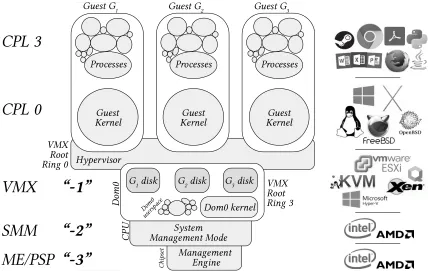
Figure 2.1A native hypervisor diagram based on Xen. The guest OS and processes run in CPLs 0 and 3, iso-lated from other guests by a hypervisor using hardware-accelerated virtualization support. The hypervisor and it’s management domain (here called dom0) run in VMX root mode. Beneath the virtualization layer exist two other layers which can support security applications: System Management Mode and the Intel Management Engine. To the right of the diagram are currently available products found at each layer.
An example of hardware-accelerated virtualization is depicted in Figure 2.1. This figure shows a guest operating system’s two privilege levels (ring 0 and 3) running above a VMX root hypervisor layer.3Modern hypervisors typically leverage a privileged helper guest (labeleddom0in this figure after the name of the Xen hypervisor’s privileged domain) to interface with physical devices, manage the hypervisor, and provide services to other guests.
From a security perspective, it is important to note two other entities “beneath” VMX mode. The first is another privileged CPU mode, System Management Mode (SMM), and the second is a off-CPU embedded computer called the Intel Management Engine (ME). Along with their AMD counterparts, both SMM and ME are discussed further in Section 2.5.
Virtualization abstractions.In the VMX architecture, the hypervisor retains control over the host’s physical resources. Various abstractions of these resources are presented to guests.
Virtual CPUs.VMX introduces the concept of avirtual CPU(vCPU). When a guest is scheduled CPU time, the hypervisor maps a guest vCPU onto a physical CPU. The guest’s execution then
continues where it left off. A vCPU’s state and its configurable behaviors are stored in a corresponding hypervisor data structure called theVirtual Machine Control Structure(VMCS)[Int16].
Page Tables.Another problematic area for virtualization ispage tables, the data structure used to translate virtual addresses into physical addresses. A fully-virtualized guest OS should generally not be allowed to know the actual physical memory addresses that a hypervisor has assigned to it[CD16]. A guest OS also assumes it is the sole manager of main memory. Therefore, hypervisors use ashadow page tablethat presents a virtual address space (addresses in this space are called Guest Physical Addresses(GPA)) to a guest OS such that the guest OS can act upon this address space as if it were physical memory. Guest process virtual addresses in ring 3 are therefore actually translated twice, once from the guest process’s virtual address to the GPA using a guest-managed page table, and again from the GPA to the host’s actual physical memory address using the shadow page table[Bha08; Ahn12]. Shortly after VMX was introduced, processor manufacturers introduced hardware acceleration for shadow page tables, generically calledSecond Level Address Translation (SLAT), but commonly referred to by its Intel name:Extended Page Tables(EPT).
Trappable Instructions.The hypervisor maintains exclusive control over certain x86 instructions that should not or could not be executed by the guest. Some of these guest x86 instructions uncon-ditionally trap to the hypervisor, while others trap to the hypervisor based on certain conditions or configuration options set by the hypervisor[Int16]. As of this writing, on Intel CPUs there are currently 10unconditionally trappedinstructions that include VMX instructions and certain privi-leged operations against a CPU’s translation lookaside buffers (TLBs). Furthermore, there are 33 conditionally trappedinstructions, including trapping on writes and reads against a vCPU’s control and model-specific registers (MSRs).
Aside from the special treatment given to the instructions mentioned above, the remaining x86 instructions encountered during guest execution run natively, directly on the CPU. This allows hardware-accelerated virtualization to closely approach the performance of non-virtualized systems. This arrangement is explained best by Michael Cohen, the author of the memory analysis framework Rekall:4
“A modern[VMX]-enabled CPU intimately manages a VM for the hypervisor, running it natively directly on the hardware, and the hypervisor is allowed to get a word in once and a while.”
As will be discussed in the next section, the ability to “get a word in once and a while” is at the crux of VMI’s ability to interpose upon guest execution.
Emulation hypervisors.. Shortly before VMX became widely available, a machine emulator called QEMU[Bel05]was introduced. Over the next several years, QEMU and VMX took hardware virtual-ization down two different, oft-intersecting paths. Bothemulationand hardware-accelerated (called native) hypervisors remain in use today, and choosing one over another has implications for both
hypervisor-based security and performance (discussed further in Section 2.4). This dissertation focuses on native hypervisors, and the following section describes virtual machine introspection techniques as they are applied to this platform.
2.2
Virtual Machine Introspection
Virtual Machine Introspection(VMI) is the external observation of a virtual machine’s raw CPU, memory, and disk[GR03]. VMI is most often done without awareness or assistance from the guest operating system. VMI was introduced in 2003 in the seminal work byGarfinkel et al.[GR03], who also described the original VMI properties of isolation, inspection, interposition. There are several survey and SoK papers which provide a more exhaustive VMI background research[Bau15; Wan15a; Jai14; Sun15].
VMI runs contrary to a common assumption made by practitioners: the idea ofperfect isolation. In the abstract sense, any savvy user of a virtualized system quickly develops an intuitive sense that there exists isolation between any two guests, and that some degree of isolation also exists between a guest and the hypervisor. It should also be equally obvious that this isolation has limits. After all, the guests are sharing the same set of hardware, including processors and RAM. However, the extent of this sharing is sometimes murky.
As might be expected, the hypervisor has inherent and automatic access at any point of a guest’s execution. Furthermore, on native hypervisors (our focus), even though the guest code is running natively on the CPU, the hypervisor can use VMI techniques to “get a word in” and take control of the vCPU to take arbitrary action, including modifying the guest.
Hypervisor
Guest G1 Dom0
CPL 3
CPL 0
Processes
Guest
Kernel G1 disk
EPT
V
M
C
S
Kern
vCPU
VMX Root Ring 0
V
M
X
R
oo
t R
in
g
3
HBS
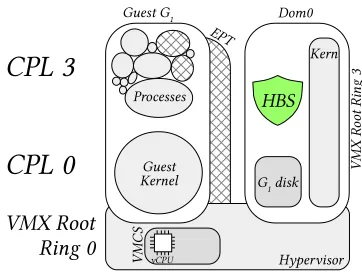
Figure 2.2 depicts a commonly presented view of VMI on the Xen hypervisor.5A guest is shown as a collection of processes in ring 3 and a guest kernel in ring 0. Independent guest process address spaces are managed by the guest kernel. The guest runs atop a hypervisor presenting the guest with virtual hardware resources. This diagram highlights the guest’s set of one or more vCPUs. Certain VMI techniques will modify vCPUs and the guest’s VMCS.
The figure also shows the hypervisor’s management domain, dom0, alongside the guest.6Dom0
is typically a full Linux system, but for brevity the figure omits the variety of other programs running in its userspace. This domain is commonly used to host and execute a hypervisor’s VMI tools. The guest’s hypervisor-controlled EPT is shown behind the guest, and is used to translate guest physical memory addresses to hypervisor physical memory addresses. The EPT is crucial to certain VMI techniques.
Finally, the figure shows the guest’s virtual disk, which in the simplest case consists of one or more guest file systems residing in file-backed form (e.g., OVA, QCOW2, VMDK, or raw formats) in dom0. Depending on hypervisor implementation and configuration, the guest’s disk could also be stored on off-host storage (e.g., a storage area network) or in a dom0 disk partition.
2.3
VMI Primitives
The combination of four core VMI primitives enable a VMI tool to read from and write into a guest’s registers, physical memory, virtual memory, and disk. Each VMI tool uses one or more of these primitives to inspect or interpose on a guest.
The first primitive enables the fundamental VMI activity of reading and writing to a guest’s memory, CPU registers, and disk. This primitive can be performed on a guest at any time.
Because early works used this primitive to repetitively poll a section of guest memory for changes, they did notinterpose, or intercept guest actions. Besides wasted cycles, this polling method left the VMI tool open to Time of Check Time of Use (TOCTOU) problems and furthermore could not detect transient events that occurred in between poll intervals[Wan15b]. Over time, security researchers developed more powerful VMI techniques, often as the result of clever re-use of processor hardware features, to precisely interrupt a guest at opportune times so that polling could be avoided.
The remaining three primitives center on techniques to perform this precise interposition on guest execution. Each has its own performance characteristics, granularity, and impact on a guest. These techniques are used to trap a guest’s execution,stunning[Sun15](suspending) the guest at a precisely chosen location to allow a VMI tool to perform its purpose (e.g., to prevent an action or retrieve information from a transient guest state).
Hypervisor
Guest G1 Dom0
CPL 3
CPL 0
Processes
Guest
Kernel G1 disk
EPT V M C S Kern vCPU VMX Root Ring 0 V M X R oo t R in g 3 HBS
Hypervisor
Guest G1 Dom0
CPL 3
CPL 0
Processes
Guest
Kernel G1 disk
EPT
V
M
C
S EPT Page
Fault Kern vCPU VMX Root Ring 0 V M X R oo t R in g 3 HBS
Figure 2.3The guest Reads and Writes VMI Primitive (left) and the EPT violations VMI Primitive (right).
2.3.1 Reading and Writing
Guest memory.First used byLivewire[GR03], read and writing to guest memory is achieved when a hypervisor maps, shares, or copies guest memory into the domain performing VMI.7Guest physical addresses can be mapped directly by the hypervisor, but guest virtual addresses must first be translated by walking the appropriate guest page table. This is typically done by the VMI tool, and certain VMI libraries have been developed to assist in this process8,9[Pay07]. Recently,Zhao et al. [Zha17]demonstrated a new approach that avoids this software translation and instead performs it directly though the processor’s MMU, achieving a speedup that varies between 100x– 1000x depending on use case.
Guest vCPU registers.To read and write to a guest’s vCPU registers, a hypervisor modifies a guest vCPU’s registers “in-place” on the corresponding VMCS.
Guest file systems.File system inspection is specific to the hypervisor implementation and its configuration, but often involves mounting a guest’s disk inside the inspecting domain. This is done without the guest’s knowledge, often while the guest is actively using the file system, and therefore the inspecting code must not modify the disk.Atomizer[Jav]andVMI-Honeymon[Len12] both use libguestfs10to launch a special-purposesupermin appliance(essentially an emulated
Linux kernel) to accesses a guest’s disk. Other out-of-guest disk access methods include intercept-ing and interpretintercept-ing a guest’s file systems and raw disk operations as was done byvMON[Li13], DIONE[MK12], open source tools such asTSK,11andXenAccess[Pay07]. A VMI tool that handles file systems directly must understand each file system format likely to be encountered. Alternatively, Chapter 5 of this dissertation,KVMonitor[KN14], andV-Met[MK17]use the qemu-nbd Linux kernel
7A discussion on the various implementations of this primitive is available[Sun15]. 8https://github.com/libvmi/libvmi
9https://github.com/razvan-cojocaru/libbdvmi 10http://libguestfs.org/
module or dm-thin provisioning to mount the guest file system locally, transferring this burden to the inspecting domain’s OS and its file system drivers.
2.3.2 EPT Violations
This primitive leverages the permission bits on the hypervisor-controlled Extended Page Table (EPT). By changing a Page Table Entry’s (PTE’s) permission bits on a guest’s underlying EPT, a guest’s attempt to access this page will result in a page fault that can be delivered to a VMI tool. Depending on the permission bits, this indicates to a VMI tool that a guest vCPU is attempting to read, write, or execute some contents on the page. Examining the vCPU in question will often reveal the exact location on the page.
HBS systems that perform guest integrity checking often leverage this primitive to invisibly mark certain vulnerable guest pages as read-only in order to prevent their potentially malicious modification.
Early applications of this primitive include performing malware analysis (Ether[Din08]), and enforcing in-guest memory protections (SecVisor[Ses07]). More recently, EPT violations were used to detect bugs in the Windows kernel[Pan17]and lock down the Linux kernel12[Han].
EPT violations allow a VMI tool to interpose at page-level granularity (typically 4096 bytes), which may be too coarse for certain applications. For example, if a VMI tool is only concerned with a small portion of a page’s contents, the tool will still be notified of any guest activity elsewhere on the page. This was recently addressed byLu et al.[Lu17], which found a technique to scope EPT violations to certain portions of a page.
Prior to the introduction of SLAT features, these type of violations were originally done on software-managed shadow page tables. SLAT improved this primitive’s performance.
Recent VMX features have expanded a hypervisor’s ability to maintain multiple guest EPTs. A pointer field called the Extended Page Table Pointer (EPTP) in a guest VMCS directs VMX to the current EPT a vCPU should use. By changing this pointer field, different EPTs with various permuta-tions of permission bits can rapidly be swapped in and out underneath a guest.Graffiti[Cri16]used EPTPs to minimized performance impact when detecting heap sprays, andDRAKVUF [Len14b] used EPTPs to hide its injected breakpoints from a guest’s self-inspection integrity scans such as Windows Kernel Patch Protection (i.e., PatchGuard)[Yos17].
2.3.3 Register Updates
A setting in the VMCS can be configured to instruct vCPUs to trap to the hypervisor when one or more conditional x86 instructions are executed on a guest. If one of these instructions is encountered, the processor notifies the hypervisor and the event is passed on to the VMI tool.
Hypervisor
Guest G1 Dom0
CPL 3
CPL 0
Processes
Guest
Kernel G1 disk
EPT V M C S Trap CR3 Process Context Switch 11 2 3 Kern vCPU VMX Root Ring 0 V M X R oo t R in g 3 HBS
Hypervisor
Guest G1 Dom0
CPL 3
CPL 0
Processes
Guest
Kernel G1 disk
EPT V M C S 1 Inject BP vCPU hits BP
Trap INT 3 Kern vCPU 2 VMX Root Ring 0 V M X R oo t R in g 3 HBS
Figure 2.4Register Events VMI Primitive (left) and Interrupt Injection VMI Primitive (right).
This capability can be used to trap writes to the CR0, CR3, and CR4 registers (among others), as well as reads to the various processor model-specific registers by trapping on the RDMSR instruc-tion[Int16].
First explored byAntfarm[Jon06], and additionally used byPatagonix[Lit08],HIMA[Aza09], Ether[Din08], andPanorama[Yin07], register events are often used to capture guest process context switches (which use MOV to CR3). This primitive is used by Goalkeeper in Chapter 3.
2.3.4 Interrupt Injection
The final VMI primitive enables guest memory events at byte-level granularity, and can be used to trace the execution of individual instructions and function calls. This method is invasive in the sense it must make modifications to guest memory in order to install a software breakpoint (the
INT3
instruction,0xCC
). When this breakpoint is encountered during execution, the guest’s vCPU can be configured to trap to the hypervisor, allowing a VMI tool to take arbitrary action. This technique is essentially a hypervisor-based debugger.Early works using VMI to inject breakpoints includeXenProbes[QS07]. The primitive was refined and strengthened bySPIDER[Den]andDRAKVUF[Len14b], which inserted breakpoints at 11,011 Windows function calls, protecting the breakpoints with an EPT violation-based scheme. Debugging frameworks, such asStackdb[Joh14], also use this primitive. This primitive is used by Arav in Chapter 4.
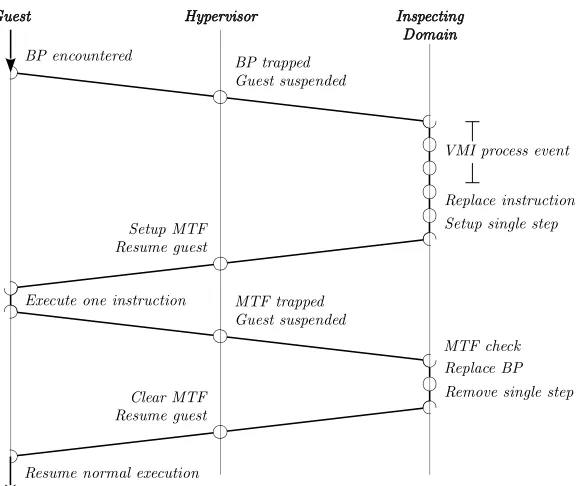
The high-level flow required to process an injected breakpoint in Xen is depicted in Figure 2.5.
2.4
VMI and Hypervisor Types
BP trapped Guest suspended BP encountered
Guest Hypervisor Inspecting
Domain
VMI process event
Replace instruction Setup single step Setup MTF
Resume guest
Execute one instruction MTF trapped Guest suspended
MTF check Replace BP Remove single step
Resume normal execution Clear MTF Resume guest
Figure 2.5Processing an injected breakpoint. When guest execution encounters a breakpoint, the guest vCPU is suspended. The hypervisor passes this event to the inspecting domain’s VMI tool, which performs arbitrary action before removing the breakpoint and setting the vCPU to single-step mode. The guest vCPU single-steps across the breakpoint’s former location, and immediately traps back into the hypervisor so that the breakpoint can be re-injected.
level of granularity and control.
Classifying modern hypervisors into the original two hypervisor types introduced by Robert Goldberg in 1973[Gol73]is often controversial. The traditional, often-taught “type” system does not apply cleanly to modern hypervisors, leading to confusion.
Type 1 “The VMM runs on a bare machine”[Gol73]. This is often interpreted as hypervisors
containing a discrete VMM component such as Xen or ESXi, and is often misinterpreted to exclude KVM.13
Type 2 “The VMM runs on an extended host under the host operating system”[Gol73]. This is
often misinterpreted to be limited to desktop virtualization products such as VMware Workstation, Parallels, or VirtualBox.
Instead, this dissertation adopts the hypervisor classification suggested byBauman et al.[Bau15], which side-steps the original type system and and focuses on the practicalities ofnativeversus emulationhypervisors[AA06]:
Native “Native hypervisors ... directly push the guest code to execute natively on the hardware
using hardware virtualization”[Bau15]. By this definition, native hypervisors include KVM[Kiv07],Xen[Bar03],ESX/ESXi[Wal02],Hyper-V [VV09], andbhyve.14
Emulation “Emulation hypervisors ... translate each guest instruction for an emulated execution
using software virtualization”[Bau15]. Emulation hypervisors includeQEMU [Bel05], Bochs[Law96], andDynamips.15
Comparison.Emulation hypervisors offer a higher level of flexibility and interposition, allowing the execution of arbitrary hypervisor logic between any two guest instructions. Emulation also allows hardware invariants to be loosened. For example, since the guest CPU and MMU are emulated in software, their state can be changed arbitrarily, regardless of how these components would behave on silicon. This is in contrast to native hypervisors, which do not have this flexibility because guest code runs directly on the CPU.
As a result, emulation also imposes higher performance overheads when compared to native virtualization, and therefore is generally limited to use cases that can tolerate such limitations or specifically require emulation (e.g., running code written for another architecture). Additionally, since emulation must replicate the entire functionality of hardware in software, there are conditions in which emulated hardware behaves differently than actual hardware. As a result of the detectable differences16during emulation, some malware samples test for these artifacts in order to prevent themselves from being analyzed and reverse engineered[SH12; Che08]. However, virtualization detection is certainly not unique to emulation hypervisors[Mir17].
Because of the arbitrary interposition allowed by emulation hypervisors, they are popular for granular malware analysis and security-related record and replay research, including theBitBlaze family of related research[Son08; Hen17; Yin07],ReVirt[Dun02], andPANDA17[DG15].
Unlike emulation, native virtualization means a native hypervisor’s hardware invariants are truly immutable. Instead of arbitrary interposition, native hypervisors must use the primitives listed in the previous section to interrupt a guest. In return, native virtualization can leverage the associated performance gains of modern hardware because nearly all guest instructions run unmodified directly on the processor.
In addition to the work in this dissertation, the speed and isolation offered by native hypervisors is leveraged byNitro[Pfo11],Ether[Din08],DRAKVUF[Len14b], andGuestrace,18among others.
Finally, Some papers, such asBareCloud[Kir14], cleverly use both virtualization types in concert to detect evasive malware.
2.5
Below the Hypervisor
This dissertation argues that the hypervisor is the ideal layer for certain types of security. For com-pletenesss, this section briefly describes System Management Mode (SMM), Intel’s Management Engine (ME), and AMD’s Platform Security Processor (PSP), three other privileged alternative “layers” present in modern x86-64 systems.
System Management Mode.SMM was designed to enable hardware-specific management fea-tures, such as motherboard fan speed and power management[Duf06]. A CPU enters SMM when encountering a System Management Interrupt (SMI). While in SMM mode, the CPU cannot be interrupted (even by non-maskable interrupts) and SMM’s section of main memory, calledSMRAM, is inaccessible to other modes.
Because of its isolation, stealthiness, and privilege,Souza et al.[ST15]argues that SMM is in a good position for certain security features, such as verifying the integrity of the hypervisor layer. HyperCheck[Zha14]andHyperSentry[Aza10]make similar proposals.
Other work,MalT[Zha15]andSpectre[Zha13], go further to leverage SMM to address ring 0 and ring 3 security issues such as heap spraying and rootkit detection.
However, others argue that SMM may be inappropriate for certain types of security. Intel recom-mends that time spent in SMM should be limited to 150 microseconds [DK14], yet several SMM security proposals typically remain in SMM on the order of milliseconds[Zha14; Aza10; Zha13]. Additionally, every core on a system must enter and exit SMM together, causing serious perfor-mance overheads for software running in ring 0 and ring 3 on multicore systems[DK14]. As a result, some SMM-based systems operate at random intervals to trade overhead for probabilistic coverage[Lea17].
Intel Management Engine.The Intel ME is an embedded computer system built into modern Intel chipsets[Rua14]. The ME supports a variety of applications ranging from Digital Rights Management (DRM) to IT management. The ME allows access to a desktop, laptop, or server even if the system’s operating system is non-functional and has its own processor, RAM, and firmware. It can access the machine’s physical memory, and communicate on the host’s physical NIC without assistance from the host operating system. The ME also remains powered on in certain sleep modes via a direct connection to the power supply[CD16]. The Intel ME’s fundamental access to a system makes it a good candidate for security applications.
Intel-signed firmware (rumored to be powered byMINIX19) making it out of reach for most use cases. AMD Platform Security Processor.The PSP is built into all modern AMD processors and is respon-sible for processor-level security functionality. The PSP consists of an ARM core and cryptographic coprocessor, and, much like the Intel ME, has its own memory and access to system resources such as main memory and the network.20Distinct from the Intel ME, a unique AMD virtual machine hardening feature called Secure Encrypted Virtualization (SEV) uses the PSP to encrypt the main memory of virtual machines to protect against “benign but vulnerable” hypervisors[HB17; Sou16].21 This feature requires high-speed cryptographic hardware in the PSP. The PSP otherwise generally resembles the capabilities and processing power of the Intel ME and is unlikely to be suitable for the same type of security applications found in this dissertation.
2.6
Why Hypervisor-based Security?
This last section introduces the motivations for performing guest-centric security at the hypervisor, many of which have been echoed by prior work[CN01; GR05; Fu16].
2.6.1 The Isolation Security Argument
The isolation security argument for HBS consists of three related security generalisms: 1) smaller interfaces are generally safer[Jai14], 2) less code is generally safer[Jai14], and 3) attacks generally enter a system at ring 3[Sol16]. Taken in combination, these generalisms arrive at the conclusion that an HBS system is more isolated from attacks than code running in ring 3 and ring 0. Because of this isolation, they are resistant to attempts to deactivate or subvert them, and are therefore better candidates for security applications.
Smaller interfaces.Smaller well-defined interfaces are often associated with higher security. In virtualization, the two relevant interfaces are the system call interface (allowing communication between ring 3 and ring 0), and the hypercall interface (allowing communication between a guest and the hypervisor). Depending on the operating system and hypervisor in use, there is an order of magnitude difference (or more) in the number of system calls versus hypercalls[Jai14]. Therefore, the smaller interface between a guest OS and the hypervisor makes it theoretically easier to defend. Finally, since not all systems have virtualization enabled, this interface may be given less attention (but still some attention[Wil16; Gor15]) by threat actors because it is less ubiquitous.
Smaller code size.Compared to an operating system kernel, a hypervisor’s smaller code base is also associated with higher security, based on the argument that less code means less bugs. This
19https://www.cs.vu.nl/~ast/intel/