An Effective Signcryption Based Authentication
for Security in Cloud Computing
Miss. Richa Singh Dangi1 Mr. Amit Saxena2 Mr. Manish Manoria3
1
Scholar 2Associate Professor 3Professor
1,2,3Dept. Of Computer Science & Engg.
Truba Institute of Engg. & I.T,Bhopal (M.P)
Abstract— Here a well-organized procedure is implemented
for Mutual Authentication of data between various users of the cloud. The Proposed algorithm implemented here provides security from various attacks as well as provides load balancing monitoring at the virtual machines and message verification. The idea to create a cloud environment and allots various users and data centers at the virtual machine to send their data in a secure manner. First of all the data from various users are set up and load is computed at both culmination of the statistics centers and finally setup and key generation and finally encryption and decryption of the data. The planned procedure applied here provides less computational time and security from a variety of attacks as well as less power consumption and ability to balance load at the data centers and the virtual
Index Terms— Public key, Cloud Computing, Public Key
Encryption, Attacks, Data Sharing.
I.INTRODUCTION
The recent advancements in technology have changed the way how electronic data is stored and retrieved. Nowadays, individuals and enterprises are increasingly utilizing remote services (such as Dropbox [1], Google Cloud Storage [2] and Amazon Simple Storage Service [3]), mainly for economical benefits. These services not only permit information sharing but also ensure availability of data from anywhere at any time. However, the rising use of remote services raises serious privacy issues by putting personal data at risk, particularly when the server’s offering such services are untrusted. Unfortunately, servers get straight admittance to the statistics they store and process. For protecting sensitive data from servers in untrusted environments, data could be encrypted before leaving trusted boundaries. Regardless of whether the data is encrypted or not, the server will need to decide who will increase admittance to it. For regulating access to the data, access control policies could be specified. These are access control policies that will describe who can gain access to the data. State-of-the-art policy-based systems can ensure application of these policies. However, the matter becomes complicated when sensitive policies, which may leak private information, have to be enforced in untrusted environments. Although around may immobile be some misperception as to what precisely Cloud Computing earnings, and no overall agreement on a definition for Cloud Figuring has remained reached [4, 5], for the possibility of this work we will accept the casual definition of Cloud Computing planned in [6] and testified under:
Cloud Computing is a prototypical for empowering opportune, on claim grid admittance to a collective puddle of configurable totaling properties (e.g., networks, servers, storage, applications, and amenities) that can be swiftly provisioned and unrestricted with negligible organization exertion or provision provider interaction.
CLOUD COMPUTING
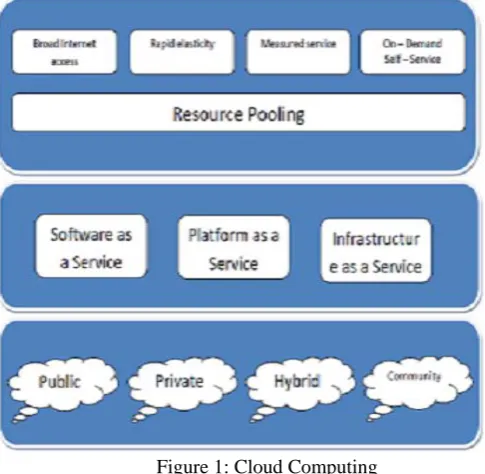
The underlying concept of cloud computing is the separation of applications from the operating systems and the hardware on which they run. Cloud computing convey applications via the internet, which are accessible from mesh browsers and desktop and moveable apps, while the software and data are stored on servers at a remote location.
Today, our data is migrating beyond the boundaries of our personal computers and all our data would still safely reside on the web, accessible from any Internet-connected computer, anywhere in the world because of cloud computing.
Figure 1: Cloud Computing
SHARED KEY CRYPTOGRAPHY
DATA SHARING
Today’s computing technologies have attracted more and more people to store their private data on third-party servers either for ease of sharing or for cost saving. Every people want that their data may be secure by the unauthorized user. In this figure we are performing data sharing. We are using three level of sharing important group midpoint, statistics proprietor and operator. In statistics storage midpoint all the data keep store in encrypted form.
Whenever user want to access this data then he or she gets a key by the KGC and with the help of this key user gets this data but the user is registered user otherwise he or she will not having this key. So by this we perform data sharing in small level.
Whenever we performing data sharing we have to maintain the data policies and time to time update these policies. One solution of this issue is using a policy which is good in performing encryption that is Cipher text policy attribute-based encryption (CP-ABE). This policy provides that every user had to define their own policy and enforce that policy on the data distribution.
SIGNCRYPTION
In cryptography, Signcryption is a public-key encryption scheme that performs the purposes of numerical name as well as of encryption simultaneously. The two fundamental cryptographic tools are Encryption and Digital signature which can guarantee confidentiality, integrity, and non-repudiation. Until the late early 2000s, both of them have been viewed as important but different basic requirement of various cryptographic systems. In community important arrangements, a outdated method is signature-then-encryption i.e. to digitally sign a communication then shadowed by an encryption. But it can intend us to two problems: Low efficiency and high cost, and the case that no arbitrary scheme can guarantee the security. Signcryption is a cryptographic method that achieves the functionalities and possessions of numerical name and encryption in a solitary rational stage i.e. together at the similar instance and can decrease the computational costs very effectively and it also decreases communication overheads when we liken it with the outdated signature-then-encryption arrangements.
Signcryption is a scheme that provides the properties and functionality of both encryption and digital signatures schemes in such a way so that it becomes more efficient than signing and encrypting separately one by one. The meaning of all this is that under a particular model of security at least some aspect of its efficiency (e.g. the computation time) is much better than any hybrid combination of digital signature and encryption schemes. Sometimes hybrid encryption can be applied in place of simple encryption, and a single session-key for several encryptions is reused to attain better overall efficiency for numerous name encryptions than a signcryption arrangement but the reuse of session key results in breach of security under even the relatively weak CPA model Mr. Yuliang Zheng was the one who introduced signcryption for the first time in 1997 [7].An elliptic curve-based signcryption scheme was also proposed by Zheng
which saves computational and communication costs by 58% and 40% respectively when it is compared to the outdated elliptic curve-based signature-then-encryption schemes. Meanwhile many other signcryption schemes are also proposed but there are many problems and limitations that each of them are having, on the other sidethe also offer different level of computational costs and security services.
II.LITERATURE SURVEY
Since encryption can provide confidentiality of the message and digital signature can provide authentication and non repudiation of a message. To simultaneously provide two roles in reality, in 1997, Zheng [7] first proposed a new crypto graphical primitive: signcryption, by which digital signature and PKE can be performed in a logic step, at lesser communication overheads and lower computational cost than the above sign-then encrypt way. Meanwhile then, here are numerous signcryption schemes proposed. It is solitary newly that a proper refuge waterproof prototypical [8] is dignified only if sanctuary resistant for Zheng's scheme [12] in the haphazard revelation prototypical. By coalescing ID grounded cryptology [9] and signcryption, Malone-Lee projected a major ID-based signcryption arrangement. But Libert and Quisquater [10] piercing out that Malone-Lee's arrangement is not semantically safe, meanwhile the autograph of the communication is noticeable in the signcrypted communication. Chow et al [11] planned an ID-based signcryption arrangement that can deliver together community verifiability an onward security. In 2003, Boyen [12] future a safe identity-based signcryption arrangement with cryptograph manuscript secrecy and demonstrable safe in the chance oracle perfect. Their refuge resistant perfect is somewhat dissimilar from that of [8] which comprises the code manuscript secrecy. In 2004, Libert and Quisquater adapted Boyen's safety resistant perfect to nonidentity founded signcryption arrangement and future a signcryption arrangement [13].
measure decrypted data using their own private keys. The privacy of the content and the keys is protected regarding the cloud, for the reason that the cloud cannot entirely decrypt the information. They also suggest an expansion to the exceeding approach to get better the competence of encryption at the data owner on cloud. Experimental result shows that proposed system has it’s enhance security and performance and that schemes are proficient and practical use in real time application.
This building can be watched as a Uniqueness Founded Encryption of a communication under several attributes that compose a (fuzzy) identity [15, 16].
III.PROPOSED METHODOLOGY
The practice applied here for provided that Lively Data at Statistics middles with Multi Receiver Identity based Signcryption. The proposed methodology implemented will consists of following phases:
1. First of all create a cloud Environment.
2. The cloud Environment Setup consists of ‘N’ number of Cloudlets ‘Ci’, Data Centers ‘DCi’, Virtual Machines ‘VMi’, Brokers ‘Bi’.
3. Now the user of the cloud starts sharing of data to other users of the cloud.
4. During the sharing of data over cloud
environment four steps are performed initialized with Setup Phase and Key Generation Phase and Encryption Phase and Decryption and Verification Phase.
Cloud Environment Setup
Here the cloud environment is setup and simulate using Cloud Simulator in which first of all Cloudlets and Data Centers and Virtual Machines and Brokers are created.
a) If ‘N’ be the number of Requests to be send from Cloudlets ‘Ci’ to the Data Centers ‘DCi’ through Brokers ‘Bi’.
b) Let us suppose ‘Ri’ number of resources to used during the sharing of data from Cloudlets ‘Ci’ to Data Centers ‘DCi’.
Ci Bi DCi
c) For each of the Resource to be shared to data Centers
Ri DCi d) End
Security Algorithm
The technique implemented for the Secure Data Sharing uses Multi Receiver Identity Based Signcryption using Elliptic Curves which consists of Following Phases:
Setup
During the setup phase of the Signcryption methodology implemented here for data security. Here in the setup phase Elliptic Curves are created using the equation:
Where,
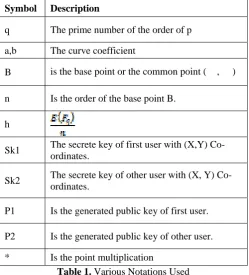
Elliptic Curve Cryptography contains the following Parameters over the finite field
Symbol Description
q The prime number of the order of p
a,b The curve coefficient
B is the base point or the common point ( , )
n Is the order of the base point B.
h
Sk1 The secrete key of first user with (X,Y) Co-ordinates.
Sk2 The secrete key of other user with (X, Y) Co-ordinates.
P1 Is the generated public key of first user.
P2 Is the generated public key of other user.
* Is the point multiplication
Table 1. Various Notations Used
Key Generation
If User’Ui’ of the Cloudlet ‘Ci’ wants to share data with other users of the Cloud then during the setup of the elliptic curves both the users of the cloud shared a Common Base Point of the elliptic Curve ‘B’. Now one User chooses a random point over the elliptic curve that would be the secrete key of the first user as ‘Sk1’. The Chosen Secrete Key is the combination of ‘X’ and ‘Y’ axis parameters as Sk1(X, Y). Similarly other user of the cloud also shares random point over the elliptic Curve of another secrete key as Sk2. The Chosen Secrete Key is the combination of ‘X’ and ‘Y’ axis parameters as Sk2(X, Y). With the help of the Secrete Key Public Key Parameters are generated using.
Here Point Multiplication ‘*’ used here is the combination of point addition and point doubling.
Point Addition is the addition of two point
Figure 2. Point Addition
Point Doubling is the addition of point J to itself to obtain
Figure 3. Point Multiplication
Signcryption Phase
The signcryption algorithm implemented here uses the Identity of the other users ‘ID1’.
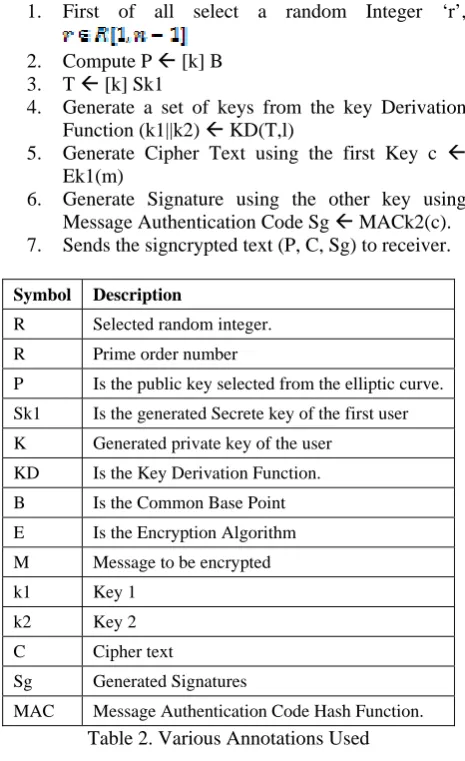
1. First of all select a random Integer ‘r’,
2. Compute P [k] B 3. T [k] Sk1
4. Generate a set of keys from the key Derivation Function (k1||k2) KD(T,l)
5. Generate Cipher Text using the first Key c Ek1(m)
6. Generate Signature using the other key using Message Authentication Code Sg MACk2(c). 7. Sends the signcrypted text (P, C, Sg) to receiver.
Symbol Description
R Selected random integer.
R Prime order number
P Is the public key selected from the elliptic curve.
Sk1 Is the generated Secrete key of the first user
K Generated private key of the user
KD Is the Key Derivation Function.
B Is the Common Base Point
E Is the Encryption Algorithm
M Message to be encrypted
k1 Key 1
k2 Key 2
C Cipher text
Sg Generated Signatures
MAC Message Authentication Code Hash Function.
Table 2. Various Annotations Used
UnSigncryption Phase
As soon as the signcrypted message (P, C, Sg) is received to the Receiver with Identity ‘IDi’.
1) Generate a message String T using T [x] P 2) Generate a set of Key pairs using Key Derivation
Function
(k1||k2) KD(T,l)
3) Decrypt the message using Key k1, m Dk1(c). 4) Generate Signature using the other key using
Message Authentication Code Sg1
MACk2(m).
5) Now verify the message by checking if the generated signatures from the user Sg == Sg1 6) If equal then message is verified message else
invalid.
IV.RESULT ANALYSIS
The Table shown below is the analysis and comparison of prevention from various attacks during the authentication between user and server. The existing methodology implemented here for the authentication between user and server using Elliptic Curves provides security from various attacks while the mutual authentication technique implemented is still vulnerable to certain attacks.
S. No. Security Attacks Existing Work
Proposed Work
1 Password Impersonation No Yes
2 Password Guessing Attack Yes Yes
3 Confidentiability No Yes
4 Public Verifiability Yes Yes
5 DoS Attack Yes Yes
6 Insider Attack No Yes
7 Denning Sacco Attack Yes Yes
8 DDoS Attack No Yes
9 Outsider Attack Yes Yes
10 Online Dictionary Attack Yes Yes
11 Offline Dictionary Attack Yes Yes
12 Server Masquerade Attack Yes Yes
13 Integrity Yes Yes
14 Unforgeability Yes Yes
15 Non-Repudiation Yes Yes
16 Forward Secrecy Yes Yes
17 Additional Authentication No Yes
Table 3 Analysis of Prevention from Various Attacks
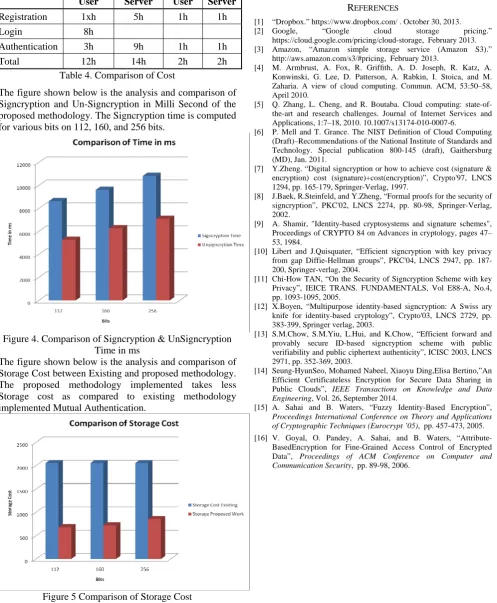
and 14 hash functions at the server end while the proposed methodology takes 2 hash functions at the user end and 2 hash functions at the server end. Since the proposed methodology implemented takes less hash function hence the overall cost will be less as compared to the existing methodology.
Scheme Existing Work Proposed Work
User Server User Server
Registration 1xh 5h 1h 1h
Login 8h
Authentication 3h 9h 1h 1h
Total 12h 14h 2h 2h
Table 4. Comparison of Cost
The figure shown below is the analysis and comparison of Signcryption and Un-Signcryption in Milli Second of the proposed methodology. The Signcryption time is computed for various bits on 112, 160, and 256 bits.
Figure 4. Comparison of Signcryption & UnSigncryption Time in ms
The figure shown below is the analysis and comparison of Storage Cost between Existing and proposed methodology. The proposed methodology implemented takes less Storage cost as compared to existing methodology implemented Mutual Authentication.
Figure 5 Comparison of Storage Cost
V.CONCLUSION
The proposed methodology implemented here for the efficient data sharing by providing mutual authentication between users of the public clouds. The methodology implemented here provides efficient computational cost and time for encryption and decryption as well as provides secure data communication over public clouds.
REFERENCES
[1] “Dropbox.” https://www.dropbox.com/ . October 30, 2013.
[2] Google, “Google cloud storage pricing.” https://cloud.google.com/pricing/cloud-storage, February 2013.
[3] Amazon, “Amazon simple storage service (Amazon S3).” http://aws.amazon.com/s3/#pricing, February 2013.
[4] M. Armbrust, A. Fox, R. Griffith, A. D. Joseph, R. Katz, A. Konwinski, G. Lee, D. Patterson, A. Rabkin, I. Stoica, and M. Zaharia. A view of cloud computing. Commun. ACM, 53:50–58, April 2010.
[5] Q. Zhang, L. Cheng, and R. Boutaba. Cloud computing: state-of-the-art and research challenges. Journal of Internet Services and Applications, 1:7–18, 2010. 10.1007/s13174-010-0007-6.
[6] P. Mell and T. Grance. The NIST Definition of Cloud Computing (Draft)–Recommendations of the National Institute of Standards and Technology. Special publication 800-145 (draft), Gaithersburg (MD), Jan. 2011.
[7] Y.Zheng. “Digital signcryption or how to achieve cost (signature & encryption) cost (signature)+cost(encryption)”, Crypto'97, LNCS 1294, pp. 165-179, Springer-Verlag, 1997.
[8] J.Baek, R.Steinfeld, and Y.Zheng, “Formal proofs for the security of signcryption”, PKC'02, LNCS 2274, pp. 80-98, Springer-Verlag, 2002.
[9] A. Shamir, "Identity-based cryptosystems and signature schemes", Proceedings of CRYPTO 84 on Advances in cryptology, pages 47– 53, 1984.
[10] Libert and J.Quisquater, “Efficient signcryption with key privacy from gap Diffie-Hellman groups”, PKC'04, LNCS 2947, pp. 187-200, Springer-verlag, 2004.
[11] Chi-How TAN, “On the Security of Signcryption Scheme with key Privacy”, IEICE TRANS. FUNDAMENTALS, Vol E88-A, No.4, pp. 1093-1095, 2005.
[12] X.Boyen, “Multipurpose identity-based signcryption: A Swiss ary knife for identity-based cryptology”, Crypto'03, LNCS 2729, pp. 383-399, Springer verlag, 2003.
[13] S.M.Chow, S.M.Yiu, L.Hui, and K.Chow, “Efficient forward and provably secure ID-based signcryption scheme with public verifiability and public ciphertext authenticity”, ICISC 2003, LNCS 2971, pp. 352-369, 2003.
[14] Seung-HyunSeo, Mohamed Nabeel, Xiaoyu Ding,Elisa Bertino,”An Efficient Certificateless Encryption for Secure Data Sharing in Public Clouds”, IEEE Transactions on Knowledge and Data Engineering, Vol. 26, September 2014.
[15] A. Sahai and B. Waters, “Fuzzy Identity-Based Encryption”, Proceedings International Conference on Theory and Applications of Cryptographic Techniques (Eurocrypt ’05), pp. 457-473, 2005. [16] V. Goyal, O. Pandey, A. Sahai, and B. Waters,