LSP International Journal, Vol. 4, Issue 2, 2017, 13–25 © Universiti Teknologi Malaysia
E-ISSN 2289–3199 / ISSN 0128–732X
e-Practices in Developing Community in Online ESL Learning Environment
Farhana Diana Deris* & Abdul Rahim Salam
Language Academy, University Teknologi Malaysia, 81310 UTM Johor Bahru, Johor, Malaysia
ABSTRACT
Arguably, online language teaching and learning entails developing and sustaining community. Online community can serve as a rich source for opportunities for language learning and language use, and ensure persistence of language learners in the online environment. Given that bringing a language class online does not necessarily develop community, this study investigated how a community was developed in an online English as a Second Language (ESL) learning environment. Specifically, the e-practices of one online teacher and 25 ESL learners populating a microsite in MyLinE (Malaysia Online Resources for Learning in English) were explored using interviews, teaching journals, observations, online documents, and surveys. Evidence suggested that the community was developed due to the prevalence of self-disclosure in the online learning environment where the affordances of the online forums were tapped in providing a range of opportunities for self-disclosure to develop shared repository and nurture social connections.
Keywords: e-practices, online community, online language teaching and learning, ESL
1.0 INTRODUCTION
Community refers to a group of individuals in a shared space who feel a sense of ‘connectedness’ (Rovai et al., 2004), and who “interact and engage in shared activities, help each other, and share information with each other” (Lave, 2014). A community has purpose, gathering space, leadership and member roles, and norms and conducts (Pallof and Pratt, 2007) and it is designed (Wenger, 2006). Online communities could benefit learning as it could enable learning unrestricted of time and space (Mason, 2011; Chang et al., 2008) and facilitate knowledge construction (Pallof and Pratt, 2007). Other studies have also reported that online communities are supportive in language learning; developing community could reduce anxiety in communication (Deris et al., 2012), promote interaction and train discussion skills (Nunan, 2010), avoid ‘superficial exchanges’ and facilitate language use (Compton, 2009), facilitate reading and writing (Raith, 2009), and facilitate self-correction (Baten et al., 2009). In second language (L2) learning contexts where learners experience social and psychological barriers, and language is taught “in a separate context from the native
speakers of the target language” and “as a subject”, and use of the target language is not apparent outside the classroom (Ipek, 2009: 160), developing community is deemed practical. Nurturing a community might alleviate the affective filter, and other social and psychological barriers, and as learners interact with one another, exposure to and use of the target language is increased.
In a world that is technology-supported and interconnected, language learning could now be extended outside the classroom and brought online (Lai et al., 2015; Tian and Wang, 2010). Unfortunately, bringing a language class online does not necessarily develop community. It was found in a study that there was no community and learners were found “very quiet” and language use was “minimal” and merely for “survival” (Sun, 2011: 437). While power in the online learning environment was suggested as one of the factors for positive outcomes (Baten et al., 2009, Harrison and Thomas, 2009), it might not be fundamental. As revealed in a study, community was developing and interactions were not sustained, “sparse and infrequent” although learners were housed in a teacher-less environment (Deris et al., 2015: 83). Researchers generally agree that little is known about how online communities are developed. It is also claimed that language teachers have “little understanding of how to build a learning community” in the online medium (Yang, 2012: 19). This gap prompted the study to investigate how a community was developed.
2.0 METHODOLOGY
The main concern of this study was to explore the experiences of an English language teacher and 25 English language learners (ELLs) populating an online ESL learning environment to determine the e-practices that led to the development of community. Rooted in phenomenology philosophical underpinnings, the primary interest of this study was “the study of experience” (Henriksson et al., 2012: 1). In particular, hermeneutic phenomenology was employed because it is most suitable in communicating pedagogical practice, “it addresses questions in their concrete situatedness” and it illuminates aspects “often overlooked in research but deeply felt” (Henriksson et al., 2012: 8). Specifically, the data was collected from an eight-week English course that was made available on MyLinE, an online ESL learning environment (http://myline.utm.my). The instruments included interviews, teaching journals, observations, online documents, and surveys. Qualitative data analysis tool, TRANSANA and quantitative data analysis tool, SPSS, were used. Sociocognitive approach to Second Language Acquisition (SLA) was adopted to guide this research as the sociocognitive paradigm bridges the gap between earlier SLA theories (Larsen-Freeman, 2007) and is particularly relevant for online learning environment with emphasis on community (Lyman-Hager, 2009; Malinowski, 2011).
3.0 FINDINGS AND DISCUSSION
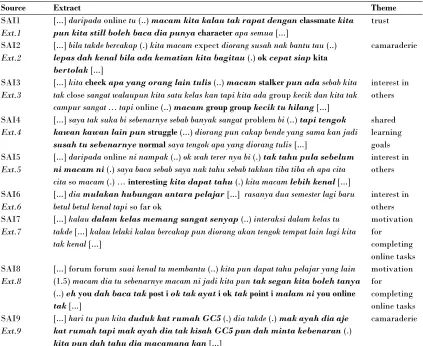
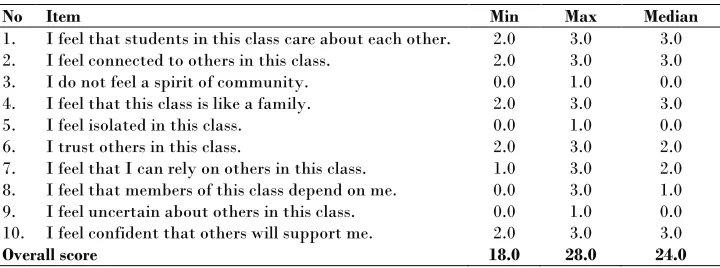
it brought into light information about others that was private and otherwise unavailable. Further probes suggested that self-disclosure may reduce uncertainties about personality characteristics, which then nurture interest in others (Exts. 3, 5 and 6), shared learning goals (Ext. 4), trust (Ext. 1), camaraderie (Exts. 2 and 9), and the motivation for completing online tasks (Exts. 7 and 8). Although the themes that emerged varied from one interviewee to another, it is worthy to note that the themes corresponded to the elements of community mentioned in various studies on online communities (Zhang et al., 2011; Drouin, and Vartanian, 2010; Vesely et al., 2007), and this could explain how self-disclosure is related to the development of community in this context. Meanwhile, data in Table 2 reflect the ELLs’ positive feelings towards the class as a social community, confirming the existence of a community and supporting the ELLs’ accounts in Table 1.
Table 1 Effects of self-disclosure
Source Extract Theme
SAI1 Ext.1
[...] daripada online tu (..) macam kita kalau tak rapat dengan classmate kita
pun kita still boleh baca dia punya characterapa semua [...]
trust
SAI2 Ext.2
[...] bila takdebercakap (.) kita macam expect diorang susah nak bantu tau (..)
lepas dah kenal bila ada kematian kita bagitau (.) ok cepat siap kita
bertolak [...]
camaraderie
SAI3 Ext.3
[...] kita check apa yang orang lain tulis (..) macam stalker pun ada sebab kita
tak close sangat walaupun kita satu kelas kan tapi kita ada group kecik dan kita tak
campursangat... tapi online (..) macam group group kecik tu hilang [...]
interest in others
SAI4 Ext.4
[...] saya tak suka bi sebenarnye sebab banyak sangat problem bi (..) tapi tengok
kawan kawan lain pun struggle (...) diorang pun cakap bende yang sama kan jadi susah tu sebenarnye normalsaya tengok apa yang diorang tulis [...]
shared learning goals SAI5
Ext.5
[...] daripada online ni nampak (..) ok wah terer nyabi (.) tak tahu pula sebelum
ni macam ni (.) saya baca sebab saya nak tahu sebab takkan tiba tiba eh apa cita cita so macam (.) ...interesting kita dapat tahu (.) kita macam lebih kenal [...]
interest in others
SAI6 Ext.6
[...] dia mulakan hubungan antara pelajar [...] rasanya dua semester lagi baru
betul betul kenal tapi so far ok
interest in others SAI7
Ext.7
[...] kalau dalam kelas memang sangat senyap (..) interaksi dalam kelas tu
takde [...] kalau lelaki kalau bercakap pun diorang akan tengok tempat lainlagi kita tak kenal [...]
motivation for completing online tasks SAI8 Ext.8
[...] forum forum suai kenal tu membantu (..) kita pun dapat tahu pelajar yang lain
(1.5) macam dia tu sebenarnye macam ni jadi kita pun tak segan kita boleh tanya
(..) eh you dah baca tak post i ok tak ayat i ok tak point i malam ni you online
tak [...]
motivation for completing online tasks SAI9 Ext.9
[...] hari tu pun kita duduk kat rumah GC5 (.) dia takde (.) mak ayah dia aje
kat rumah tapi mak ayah dia tak kisah GC5 pun dah minta kebenaran (.) kita pun dah tahu dia macamana kan [...]
camaraderie
Table 2 Online ELLs’ feeling as a social community
No Item Min Max Median
1. I feel that students in this class care about each other. 2.0 3.0 3.0
2. I feel connected to others in this class. 2.0 3.0 3.0
3. I do not feel a spirit of community. 0.0 1.0 0.0
4. I feel that this class is like a family. 2.0 3.0 3.0
5. I feel isolated in this class. 0.0 1.0 0.0
6. I trust others in this class. 2.0 3.0 2.0
7. I feel that I can rely on others in this class. 1.0 3.0 2.0
8. I feel that members of this class depend on me. 0.0 3.0 1.0
9. I feel uncertain about others in this class. 0.0 1.0 0.0
10. I feel confident that others will support me. 2.0 3.0 3.0
Overall score 18.0 28.0 24.0
*0=Strongly Disagree, 1= Disagree, 2=Agree, 3=Strongly Agree; n=25 ; perfect score for overall score = 30.0
The extract in Table 3 shows the teacher identifying the use of forum as a medium to provide opportunities for self-disclosure. It is asserted that online environment that allow self-disclosure can be an “asset in building a community” of language learners (Blattner and Fiori, 2009: 20). In the context of this study, the teacher stated that forums were used “to collect information” to develop a shared repository for the online learning environment. The excerpt also shows that the teacher believed that attending to the social needs of the ELLs for “real connections” is a prerequisite before learning can proceed. According to sociocognitive SLA, L2 is learned through interaction within L2 environments (Atkinson, 2014) and L2 learners need to be in “constant interactions with the environment” (Fahim and Mehrgan, 2012: 162). However, participating in the online L2 learning environments can be “intimidating… especially in the early stages or if courses are delivered wholly online” where the language learners feel more insecure and less able to express themselves (Mason, 2011: 279). Attending to the social needs of the ELLs might be practical to ameliorate the initial issues faced in the online learning environment.
Table 3 The use of forums for self-disclosure
*Ext. = Extract number
Observations on the online forums also indicated regular use of forums for social interactions and substantiated the above mentioned findings. As shown in the data in Table 4, forums were used as an enabling technology to provide opportunities for self-disclosure that supported “interconnectedness and openness” (Ext. 11) and “comfortable atmosphere” (Ext. 12) where the ELLs could interact
Source Excerpt
TAI
Ext.10 i also used the forum concerns (..) offline activitiesto hold chit-chat session and (.) and other things ummm (..) (.) to collect informationnot just for my own knowledge (.) about their interests (..)
but for the class (1.0) because you know (.) the online learning can be very flat (.) and distant (.)
and lonely (.) and you need to address the social needs first and (..) because if they are no real
about “themselves and their feelings” and “feelings and thoughts about other students and the class” (Ext. 13) and discover “differences and similarities” (Ext. 14). In the context of this study, the forums also acted as a shared repository and that the repository became a part of the learning environment.
Table 4 Online ELLs’ participation in the self-disclosure forum
Source Excerpt
RAE1 Ext no.11
… the induction at the beginning of the online course also demonstrated to students its’
interactivity… the continuous replies illustrated interconnectedness and openness instead of
series of individual students who are strangers to one another. RAE2
Ext no.12 …the most popular type of forum. It was a great idea to start this kind of discussion space so that everybody could say something, anything, because that really played a major role in creating a comfortable atmosphere of this course. With so much being shared, one can answer a quiz on the class without much difficulty.
RAE6
Ext no.13 …seems to be themselves and their feelings. Students’ posts continue to involve ongoing with social interactions that allow the students to talk about feelings about themselves,
but the posts now also involve feelings and thoughts about other students and the class.
RAE18 Ext no.14
…participation in the forum open to all tended to be broad, representing posts from many individuals, rather than multiple contributions from the same online students (at most three messages), however it demonstrated the wide variety of resources available to them to use in
exploring their differences and similarities.
*Ext. = Extract number
Table 5 Reasons for creating self-disclosure forums
Source Excerpt
TAJ1 Ext. 15
I want my students to relax and ease into the online mode. I want to create a safe social space
where they enjoy themselves and are comfortable to learn. This is high on my list of priorities for
this induction week. TAJ2
Ext.16 … another. Not like a one-to-one session where their posts are directed to me only. to get to know one another and bond with each other so that they will interact with one TAJ3
Ext.17 These forums are important for this class. more willing they will be in participating… to log in regularly. The closer they feel, the more comfortable they feel, the TAJ4
Ext.18
I hope the students can see from what they are going through. To reveal something personal…
their vulnerable side… strategies to support one another …relating to one another, empathising,
bonding.
TAJ9
Ext.19 …to communicate to students that also that I don’t see them as just ‘students’. I am interested in who they are as a personeach one of them is a unique person in the online class, and . This week, the task is rather dry too and I am also hoping this gets them online.
TAJ10
Ext.20 I am same way. From the way they are interacting, discovering so much about my students and I’m pretty sure I am not the only one feeling the it’s like they are rediscovering one another. TAJ11
Ext.21 The students I am asking them to read those posts again, to look at their friends again as people with surprised me with their writing. They wrote so much and shared so much. This week interesting background.
TAJ13
Ext.22 I have picked the most common interest of the students from previous forum, KPOP, for a new discussion topic. … they know that I read their posts and that their interests matter.
*Ext. = Extract number
Apparently, these significant influences of self-disclosure in the context of L2 teaching and learning were also realised by other scholars. It has been established that self-disclosure is an important building block for developing intimacy in the English language classroom (Farani and Fatemi, 2014). Meanwhile, in another study, the use of self-disclosure lowered language learners’ classroom anxiety and once they felt comfortable with each other, interaction and communication became natural (Blattner and Fiori, 2009). In another study on online EFL environment, the use of self-disclosure facilitated meaningful communication and sustained an interpersonal atmosphere (Saylag, 2013). It is argued that self-disclosure can be engaging and motivating for language learners thus increasing their willingness to invest effort and time in learning (Sanders, 2014).
were in the form of questions that did not imply a statement, e.g. ‘Can I ask you something?’ (GD5, DTEO1TFNA) and ‘you love chocolate cake or just plain cake?’ (GD3, DTAO1TFNA).
Table 6 Online forums promoting self-disclosure
Week Examples of Topic of Discussion Threads (DTs) DTs Posts
1 If you were a chocolate bar...(DTAO1TFNA); When I grow
up…(DTAO2TFNA); Learning English: Your personal experience
(DTAO3TFAA), Hershey’s Kisses (DTAC1TFNA)
10 178
2 Participating in discussions (DTBO1TFAA); PALAPES (DTBO2TFNA) 2 37
5 Share more about yourself (DTEO1TFNA) 1 103
6 The best writer (DTFO1TFNA) 1 16
7 The official KPOP fan club (DTGO1TFNA) 1 23
8 When are you free to meet online (DTHO1TFNA) 1 21
TOTAL 16 378
Further analysis of the posts indicated that the teacher and ELLs disclosed themselves by revealing facts, thoughts and feelings about self and things other than self (i.e. other people, general ideas and subjects) (Table 7) with communicating of facts as the most occurring. For the ELLs, the numbers of posts that communicated about self was higher than the numbers of posts communicating about things other than self. In contrast, the online teacher communicated less about herself and more about others.
Table 7 Categories of self-disclosure posts by online teacher and ELLs
Categories of self-disclosure Teacher ELLs
self others self others
Communication of facts (CFA) 16 32 188 64
Communication of thoughts (CTO) 3 7 97 55
Communication of feelings (CFE) 4 10 62 30
*some of the categories overlap in a post
pertain to achieving learning outcomes; establishing deep connections between language learners and teacher was not part of the intentions. The main disclosures in this study were the ELLs while the teacher played her part primarily as the provider of the opportunities. This imperatively indicates that while the study concurs with the argument that teacher self-disclosure is not very much exploited, it also strongly supports the argument that recognises the importance of illustrative teacher self-disclosure. Revealing self-disclosure may result in unclear professional boundary and as cautioned by an advocator of teacher self-disclosure, English language teacher should self-disclose “with the intention of teaching and modelling” (Saylag, 2013: 684).
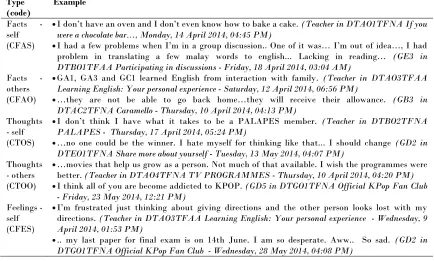
Table 8 illustrates the categories of self-disclosure with examples extracted from the posts in the DTs that promoted self-disclosure. Communication of facts was most occurring and provided general information such as age, description of family members, physical appearance, behaviours, personal characteristics and traits, personal experiences, health/illnesses, and interests. In terms of thoughts, the online ELLs and teacher expressed personal thoughts on past events and future plans, wishes and aspirations, and other thoughts concerning personal characteristics of self and others. When disclosing feelings, the ELLs and teacher expressed excitement, joy, inconvenience, confusion, anxiety, fear and frustration. Self-disclosure is voluntary and purposeful and that the content of self-disclosure is determined by three things; the disclosure, the context of the relationship, and the recipient of the information (Farani and Fatemi, 2014). In the context of this research, these categories of disclosure are those that the ELLs and the teacher found relevant and were willing to reveal.
Table 8 Examples of self-disclosure posts
Type
(code) Example
Facts - self (CFAS)
I don’t have an oven and I don’t even know how to bake a cake. (Teacher in DTAO1TFNA If you
were a chocolate bar..., Monday, 14 April 2014, 04:45 PM)
I had a few problems when I’m in a group discussion.. One of it was… I’m out of idea…, I had
problem in translating a few malay words to english... Lacking in reading… (GE3 in
DTBO1TFAA Participating in discussions - Friday, 18 April 2014, 03:04 AM) Facts -
others (CFAO)
GA1, GA3 and GC1 learned English from interaction with family. (Teacher in DTAO3TFAA
Learning English: Your personal experience - Saturday, 12 April 2014, 06:56 PM)
…they are not be able to go back home…they will receive their allowance. (GB3 in
DTAC2TFNA Caramello - Thursday, 10 April 2014, 04:13 PM) Thoughts
- self (CTOS)
I don’t think I have what it takes to be a PALAPES member. (Teacher in DTBO2TFNA
PALAPES - Thursday, 17 April 2014, 05:24 PM)
…no one could be the winner. I hate myself for thinking like that... I should change (GD2 in
DTEO1TFNA Share more about yourself - Tuesday, 13 May 2014, 04:07 PM) Thoughts
- others (CTOO)
…movies that help us grow as a person. Not much of that available. I wish the programmes were
better. (Teacher in DTAO4TFNA TV PROGRAMMES - Thursday, 10 April 2014, 04:20 PM)
I think all of you are become addicted to KPOP.(GD5 in DTGO1TFNA Official KPop Fan Club
- Friday, 23 May 2014, 12:21 PM) Feelings -
self (CFES)
I’m frustrated just thinking about giving directions and the other person looks lost with my
directions. (Teacher in DTAO3TFAA Learning English: Your personal experience - Wednesday, 9
April 2014, 01:53 PM)
.. my last paper for final exam is on 14th June. I am so desperate. Aww.. So sad. (GD2 in
Type
(code) Example
Feelings -others (CFEO)
Wow! It is ecstatic to see you guys wrote so much about yourself and so much about KPop. Great
job! (Teacher in DTGO1TFNA Official KPop Fan Club - Wednesday, 21 May 2014, 05:40 AM)
GE4..be brave please..dont be so coward...you need to be in front…(GC5 in DTAO1TFNA If you
were a chocolate bar..., - Wednesday, 9 April 2014, 01:57 PM)
In some cases, disclosure of facts, thoughts and feelings were found in the same posts. The following extract in Table 9, taken from an online ELL’s (GB1) post in ‘Share more about yourself’ (DTEO1TFNA), illustrates multiple self-disclosures in one post. The analysis of the extract indicated that the online learner (GB1) expressed facts concerning her family description, personal experience, preference, and general information about herself. She also expressed mild feeling (surprise) and strong feeling (fear). In addition, thoughts on general subjects were also expressed. The extract is also descriptive and explanatory in nature. In the context of this study, the self-disclosure posts were generally descriptive and explanatory. The intimacy and probability of reciprocity between the interactants increases with self-disclosure of this nature because it presents the least amount of risk to self (Serag, 2011).
Table 9 Example of multiple disclosures
Extract from online ELL’s post Theme
GB1 - Thursday, 8 May 2014, 10:31 AM
… I understand about being a mother part as I witnessed myself two of my sisters raising their very first son. [1] It is a very tiring job when taking care of them as they grow up. Everytime, when I took care of them, I myself are so so so sick with worries, afraid they might run and accidentally fall on the floor, or roll around on the edge of bed and accidentally fall from it, or the worst, they found something on the floor and tries to eat it. [2]
Wow, you play Red Alert previously? And Warcraft too! [3] Those games are amazing, [4] although I prefer to watch my brothers play it because I’m not familiar with playing the game. [5] I enjoyed playing The Sims 3, Theme Hospital, fighting games, Final Fantasy, and my personal favorites: GTA San Andreas and Left4Dead 2 [6] (though those games are too violent and not suitable for children). Those two games are very stress-releasing, some sort of a therapy for me to let off my steam [7] but unfortunately, I don’t have them installed in my laptop [8]
[1] facts: personal experience,
description of family [2] feelings: fear [3] feelings: surprised
[4] thoughts: general [5] facts: family description, preference
[6] facts: preference [7] thoughts: general [8] facts: general info about self
Table 10 Analytical post by the online ELL
Forum Post by online ELL
GA5 in
DTBO1TFAA Participating in discussions - Friday, 18
April 2014,
11:08 PM
After reading what thier post, I could not disagree with what their said. Its true that things like lack of information about the topics, being less confident when giving our point, failed to achieve the objective, and other else but for me the true challenges is giving out our opinion or speak out during the discussion. Just like what GE5 post before, we always afraid that people will reject our point or even worse laugh at it. Well sometimes, it really happen and I’m positive with it because it happen to me. To strengthen my point, when people laugh at us due to our words or action, it eventually hurt our emotion and as we know, being hurt mentally more severe then hurt physically.What can we do to overcome it?Well, just smile and ignore them because that what it means with discussion, we share our opinion and “discuss” about it. Not making fun about other opinion.
*Ext. = Extract number
The example illustrates that GA5 has not only read others’ posts, but has also produced a synthesis of the contents by pointing out the themes (“lack of information about the topics”, “being less confident when giving our point”, “failed to achieve the objective”). GA5 also compared his experience with the experience of others and provided specific reference to GE5’s post to augment his post. He then made a statement that he had personal experience, which served to strengthen his authority in giving his suggestions on how those challenges could be overcome. This example illustrates the self-disclosure in DTBO1TFAA that was produced from the ELL’s evaluation and judgment of self, others and others’ disclosure on a topic revealing their vulnerabilities. Engaging in this type of communication presents more risk to self but it also “signifies a significant bond” (Serag, 2011: 552).
The teacher’s account concerning DTBO1TFAA (Ext. 25, TAJ4) suggests that sharing their “experiences, insights, concerns and reactions as language learner” might create a sense of solidarity because “the students are supporting each other directly and indirectly…mutual feelings towards learning English and similarities in the challenges”. However, the teacher also noted that “my students seem not so keen of committing more. There was not much interaction”. In a study, evidence was found indicating self-disclosure on vulnerabilities as language learners improved learners’ attitude towards English language and increased their willingness to use the target language (Farani and Fatemi, 2014). Thus, in the context of this study, it is possible that the self-disclosure led to positive outcome that was not observable in this particular DT but in the perception of the learners (e.g. SAI4 Ext. 4 in Table 1). Moreover, “internal mental process” may not necessarily be reflected in “immediate behavioural change” (Fahim and Mehrgan, 2012: 161).
4.0 FINAL REMARKS
promoting and maintaining interactions, establishing solidarity and shared learning goals, and encouraging group task completion. A number of online academic and non-academic forums were utilised to nurture social connections. In these forums, the online English language teacher and the online ELLs revealed facts, thoughts and feelings about self and others through posts that were descriptive and/or explanatory and, occasionally, analytical, which provided insights about the online ELLs at a deeper level. These disclosures formed the shared repository of the online ESL learning environment. The overarching role of self-disclosure in developing community in the online ESL learning environment cannot be ignored. In fact, experts in the communication field declared it impossible to “initiate, develop, or maintain a relationship without self-disclosure” and people “terminate relationships, in part, by terminating self-disclosure” (Tardy and Dindia, 2006: 230). Therefore, it is suggested that e-practices in online ESL learning environment provide opportunities for self-disclosure through the use of communication tools. It would be worthwhile to investigate other e-practices that support the development of communities. In addition, teacher’s illustrative self-disclosure is also worthy of attention and of being studied.
ACKNOWLEDGEMENTS
We would like to thank the UTM MyLinE Administrator who granted us access to the learning portal for the purpose of this study.
REFERENCES
Atkinson, D. 2014. Language Learning in Mindbodyworld: A Sociocognitive Approach to Second Language Acquisition. Language Teaching. 47(4): 467-483.
Baten, L., Bouckaert, N., & Kan, Y. 2009. The Use of Communities in a Virtual Learning Environment. In M. Thomas (Ed.). Handbook of Research on Web 2.0 and Second Language Learning Hershey, PA: Information Science Reference. 137-155.
Blattner, G., & Fiori, M. 2009. Facebook in the Language Classroom: Promises and Possibilities. International Journal of Instructional Technology and Distance Learning. 6(1): 21-32.
Chang, C. K., Chen, G. D. & Li, L. Y. 2008. Constructing a Community of Practice to Improve Coursework Activity. Computers & Education. 50(1): 235-247.
Compton, L. K. L. 2009. Preparing Language Teachers to Teach Language Online: A Look at Skills, Roles, and Responsibilities. Computer Assisted Language Learning. 22(1): 73-99.
Deris, F. D., Tan, R. H. K., & Salam, A. R. 2015. Virtual Communities in an Online English Language Learning Forum. International Education Studies. 8(13): 79-87.
Deris, F. D., Zakaria, M. H., Wan Mansor, W. F. A., & Saidalvi, A. 2012.Using VLE to Supplement English Language Proficiency Course. In W. F. A. Wan Mansor (Ed.). Research in Online Language Teaching and Learning. Johor: Universiti Teknologi Malaysia.
Drouin, M. & Vartanian, L. R. 2010. Students’ Feelings of and Desire for Sense of Community in Face-to-Face and Online Courses. Quarterly Review of Distance Educ. 11(3): 147-159.
Fahim, M. & Mehrgan, K. 2012. Second Language Acquisition: A Sociocognitive Perspective. Advances in Digital Multimedia. 1(3): 159-165.
Farani, S. T. & Fatemi, A. H. 2014. The Impact of Teacher’s Self-disclosure on Students’ Attitude towards Language Learning in a Foreign Language Context. Theory and Practice in Language Studies. 4(11): 2415-2422.
Harrison, R. & Thomas, M. 2009. Identity in Online Communities: Social Networking Sites and Language Learning. Int. Journal of Emerging Technologies & Society. 7(2): 109-124.
Henriksson, C., & Friesen, N. 2012. Introduction. In N. Friesen, C. Henriksson, & T. Saevi (Eds.). Hermeneutic Phenomenology in Education: Method and Practice The Netherlands: Sense Publishers. 1-14.
Ipek, H. 2009. Comparing and Contrasting First and Second Language Acquisition: Implications for Language Teachers. English Language Teaching.2(2): 155-163.
Lai, C., Zhu, W., & Gong, G. 2015. Understanding the Quality of Out-of-Class English Learning. TESOL Quarterly. 49(2): 278-308.
Larsen-Freeman, D. 2007. Reflecting on the Cognitive–Social Debate in Second Language Acquisition. The Modern Language Journal. 91: 773-787.
Lave, J. 2014. Communities of Practice (Lave and Wenger), in Learning Theories. Available online at https://www.learning-theories.com/communities-of-practice-lave-and-wenger.html.
Lyman-Hager, M. A. 2009. Teaching World Languages Online. In I. Lancashire (Ed.). Teaching Literature and Language Online. New York: Modern Language Association.
Malinowski, D. 2011. Teaching Literature and Language Online. Language Learning and Teching, 15(2).
Nunan, D. 2010. Foreword. In L, England. Online Language Teacher Education: TESOL Perspectives. Routledge.
Palloff, R. M., & Pratt, K. 2007. Building Virtual Communities: Techniques that Work. Proceedings of the 23rd Annual Conf on Distance Teaching and Learning.
Raith, T. 2009. The Use of Weblogs in Language Education. In M. Thomas (Ed.). Handbook of Research on Web 2.0 and Second Language Learning. Hershey, PA: Information Science Reference. 274-291.
Rovai, A. P., Wighting, M. J., & Lucking, R. 2004. The Classroom and School Community Inventory: Development, Refinement, and Validation of a Self-Report Measure for Educational Research, Internet & Higher Edu. 7: 263-28.
Sanders, A. J. 2014. Exploring the Construct of Teacher Self-Disclosure and its Connection to Situational Interest, Intended Effort, and the Learning Experience in a Foreign Language Learning Context (Doctoral thesis). Retrieved from UT Electronic Theses and Dissertations (25052).
Saylag, R. 2013. Facebook as Tool in Fostering EFL Teachers’ Establishment of Interpersonal Relations with Students through Self-Disclosure. Procedia - Social and Behavioral Sciences. 82: 680-685.
Sun, S. Y. H. 2011. Online Language Teaching: The Pedagogical Challenges. Knowledge Management & E-Learning: An International Journal. 3(3): 428-447.
Tian, J. & Wang, Y. 2010. Taking Language Learning outside the Classroom: Learners’ Perspectives of eTandem Learning via Skype. Innovation in Language Learning & Teaching. 4(3): 181-197. Tardy, C. H. & Dindia, K. 2006. Self-disclosure: Strategic Revelation of Information in Personal and
Professional Relationships. In O. Hargie (Ed.). The Handbook of Communication Skills. London and New York: Routledge. 229-266.
Vesely, P., Bloom, L., Sherlock, J. 2007. Key Elements of Building Online Community: Comparing Faculty and Student Perceptions. MERLOT JOLT. 3(3): 234-246.
Wenger, E. 2006. Communities of Practice: A Brief Introduction. Available online at http://wenger-trayner.com/introduction-to-communities-of-practice/.
Yang, Y–F. 2012. Preparing Language Teachers for Blended Teaching of Summary Writing, Computer Assisted Language Learning. iFirst article:1-22.