Conceptual Framework of Authentic Chemistry Problem-Solving
Competency among School Students
Suraiya Muhamad [email protected]
Department of Educational Sciences, Mathematics and Multimedia Creative Faculty of Education, Universiti Teknologi Malaysia, Johor Bahru, Johor, Malaysia.
Jamalludin Harun [email protected],
Department of Educational Sciences, Mathematics and Multimedia Creative Faculty of Education, Universiti Teknologi Malaysia, Johor Bahru, Johor, Malaysia.
Johari Surif [email protected],
Department of Educational Sciences, Mathematics and Multimedia Creative Faculty of Education, Universiti Teknologi Malaysia, Johor Bahru, Johor, Malaysia.
Noor Dayana Abd Halim [email protected]
Department of Educational Sciences, Mathematics and Multimedia Creative Faculty of Education, Universiti Teknologi Malaysia, Johor Bahru, Johor, Malaysia.
Muhammad Umar Khan [email protected]
Department of Applied Psychology, GC University Faisalabad, Pakistan
Abstract
Keywords:Problem-solving competency; Authentic learning practice, Open-ended problem
1.0 Introduction
In this 21st Century era, the role of formal education in school aims to provide the learning environment for them to explore and apply the knowledge in developing competency to solve a real life problem outside the school (Suryawati, Osman, & Meerah, 2010). Fisher (2005) highlighted that a key to success in life depends on ability of individual to apply his thinking to solve problems since life is a problem solving itself. The real problems are open-ended, multi-faceted with many possible solution due to the condition and justification (Boži & Tramullas, 2014).
2.0 Literature Review
Conventional classroom in Malaysia education are merely transfer knowledge and tend examination- oriented to measure students’ performance. Most of problems that solved by students for the formal assessment are routine and well-defined problem. This type of problem only involved the low order thinking level that requires skill of knowing and understanding the fact to solve the problems given. Due to high expectation of global community, modern life has turned into a continuous process of problem solving and decision making to generate the future leader that equip with problem solving competency to solve real world problems. Problem solving competency is required to develop higher order thinking due to many job perspective demand advanced skills, requiring that people be able to learn, reason, think creativity, make decision and solve problems. Solving the real life problems are not only involve the application of knowledge but requires the application of Higher Order Thinking Skills (Overton & Potter, 2005). In this research, problem solving competency is a combination of scientific knowledge competencies and problem-solving skills that require to solve open-ended Chemistry problem based on students’ actual performance in their problem solving ability test. Open-ended problem is an ill-defined and non-routine problem, which is presenting in real-life context (Scottish QRA, 2010). If either one of the variables whether the data, method or goal is not known, then the problem is regarded as an open problem and encountered in real life (Johnstone, 1993).
2.1 Problem Solving Competency in Chemistry
Problem solving competency is defined as individual’s capacity to engage his cognitive processing to understand and resolve a problem situation where the method of solution is not immediately obvious (OECD, 2012). The research literature found that successful problem solving indicates that students have applied the knowledge, skill and ability to discover solution in Chemistry with certain justification (Boži &
Tramullas, 2014). Finding of few studies (Ausubel et al, 1978; Reif, 1983, Camocho and Good, 1989; Gabel and Bunce, 1994; Niaz, 1995; Heyworth, 1999; Johari et. al 2013) have highlighted that an effective problem solving requires the following problem solving abilities and skills;
(1) A good understanding of and meaningful learning knowledge (2) Appropriate problem-solving procedures
(3) Relevant linkages of information between the information of problem statements and the existing cognitive structure.
2014).Students in school and university are poor in solving “word” and “open ended” problems ( OECD, 2012; Surif et. al, 2012). Therefore, instruction models are essential in science education but most of Chemistry problem solving instruction model were developed for university students. Instead, school students require the instructional model to overcome the lack of competency to solve open-ended problem.
According to Taconis et.al (1990), the traditional approach to teaching problem solving is having the students work individually on a large number of problems. Instruction and feedback are usually focused on the sequence of problem-solving steps to be performed and less emphasize on the knowledge and cognitive strategies acquire to perform these steps. By the emergence of Information and Communication of Technology, more uses of computer and on line learning are implemented to teach problem-solving (Herrington, 2000) .
2.2 Authentic Learning Practice in Learning Electrolysis
Review of research studies on problem solving in chemistry found that learning environment, the contextual become one of the factor to develope a successful problem solver (Gabel & Bunce, 1984). According to Lombardi & Oblinger (2007), authentic learning typically focuses on real-world, complex problems and their solutions, using role-playing exercises, problem-based activities, case studies, and participation in virtual communities of practice. Authentic learning practice gives students an opportunity to apply relevant knowledge and experience to solve the real life problem, (Prins et. al, 2009). This approach provides a variety of educational and instructional techniques focused on connecting what students are taught in school to real-world issues, problems, and applications. It is a style of learning that encourages students to create a tangible, useful product to be shared with their world. Moreover, this approach is appropriate to improve student’s problem-solving competency because authentic instruction standards emphasizes on higher order thinking skills, depth of knowledge, connectedness to the world beyond the classroom, substantive conversation, social support for achievement. Rule (2013) in Journal of Authentic Learning reported that there are four components that repeatedly found in Authentic learning from a content analysis of 45 journal articles. Four theme supporting authentic learning are:
1. Activity based on real-world problems and sharing the findings to others being the classroom.
2. Use the open-ended inquiry, thinking skills and metacognition.
3. Students engage in discourse and social learning in a community of learners 4. Students direct their own learning in project work.
Educational research shows that authentic learning is an effective learning approach to preparing students for work in the 21st century (Suryawati et al., 2010; Lombardi & Oblinger, 2007). Meaningful learning is improved in four related domains of learning of cognitive (knowledge), affective (attitude), psychomotor (skills) and psychosocial(social skills) by situating the knowledge within the relevant context. Authentic learning has some benefits as following;
1. Students are more motivated and more likely to be interested in what they are learning when it is relevant and applicable to their lives outside of school.
2. Students are better prepared to succeed in college, careers, and adulthood. 3. Students learn to assimilate and connect knowledge that is unfamiliar problem 4. Students are exposed to different settings, activities, and perspectives.
5. Transfer and application of theoretical knowledge to the world outside of the classroom is enhanced.
7. Students have opportunities to exercise professional judgments in a safe environment.
8. Students practice higher-order thinking skills.
9. Students develop patience to follow longer arguments.
10. Students develop flexibility to work across disciplinary and cultural boundaries.
In conjuction with these benefit, then it will be more effective to provide authentic practice in learning chemistry because some of the chemistry concepts are abstract and difficult to understand. Indeed, chemistry is an interesting subject that related with real life application and condition but most students found that Chemistry is a tough and abstract subject to learn. Hence, shifting the classroom environment in to authentic learning practice is an alternative to develop chemistry problem solving competency among students. The common chemistry topics that are involved in problem solving research are about matter and its states, particulate nature of matter, mole concept, stoichiometry, chemical equilibrium and thermodynamics (Gabel and Bunce, 1994). Electrochemistry is difficult for many students but unfortunately research report on it are few (Hillman et.al , 1981; Lee and Osman, 2010 and Akram et.al, 2014).
Learning-by-doing is generally considered the most effective way to learn. Authentic learning by using internet and a variety of emerging communication, visualization, and simulation technologies now make it possible to offer students authentic learning experiences ranging from experimentation to real-world problem solving(Lombardi & Oblinger, 2007). Teaching strategies can be implemented to foster the development of problem solving skills among learners. Teaching strategies that emphasize collaborative work, the use of cooperative groups, interactive solution format ( Ngu et. al., 2006). Contextual learning approach can improve problem solving skills among students with moderate and high cognitive skills (Suryawati et al., 2010).
2.3 Model of Problem-solving Instruction
One model that can be used as a problem-solving approach is Model of Problem Solving Instruction: Search , Solve, Create and Share ( SSCS ) . This model was first developed by Pizzini in 1987 for science subject , the next Pizzini, Shepardson Abel (1989) and enhance this model and say that this model is not only applicable to science education , but also suitable for mathematics education . The SSCS model consists of four phases ; search, solve, create an share. On the other hand is a four step cyclical model allowing for re-entry into the various states of the model during the problem solving process. The SSCS model reduces the other problem solving models into fewer steps; thereby, simplifying the process.
Learning activities with the model SSCS ( Pizzini , 1991) begins with the provision of problems or conditions related to the material to be studied . Then students look ( search ) information to identify situations or problems presented, after knowing the problems faced by the students to make a hypothesis and then plan how to solve ( solve ) the problem , with the information and plans that have been prepared students , make (create ) solution for later presenting it for discussion together with friends and teachers , students divide ( share ) knowledge of each other.
problem solving skills in Chemistry (Pizzini et. al, 1989).
To fill up these gaps, authentic learning practice will be integrated with problem solving instruction and scientificknowledge competencies to develop the authentic chemistry problem solving competency. In the response to the global challenge, practical framework for the design of authentic learning environment was produced. Essentially, current literature suggests that applicable knowledge is best gained in learning environment that feature a few elements in authentic learning.
3.0 Objective
This paper is focusing to one research objective on how to develop a conceptual framework to design module for learning electrolysis to support Model of Authentic Chemistry Problem-Solving Competency.
4.0 Methodology
This ongoing study has adopted a quantitative for the preliminary study. The premilinary study has conducted to collect the quantitative data. The result obtained will support to identify the relevant independent variables for developing the conceptual framework.
4.1 Samples
Sampling technique used to select respondents for this study has applied a purposive sampling or “judgment sampling” (Ary et.al, 1985). This study will involve 112 Form four Chemistry students aged between 15 and 16 from full residential schools in Sarawak, East Malaysia.
4.2 Instruments
This study has gathered quantitative data. Chemistry Problem Solving Ability Test (CPSAT) sheet and Chemistry Problem Solving Skill (CPSS) questionnaire were administered to determine the respective level of chemistry problem solving ability and skill. The realibility of alpha Cronbach for the Chemistry Problem Solving Skill (CPSS) questionnaire is .84. Both of these instruments have been developed by the researchers for the purpose of this preliminary study.
]
5.0 Result
The preliminary study was conducted to verify the research gap arise in learning chemistry among students in secondary school. The result obtained from this study will support the independent variables selected to develop the conceptual framework. The independent variables in this conceptual framework are scientific knowledge competencies, problem solving skills and authentic learning practice, meanwhile the dependent variable is problem solving competency. The independent variables are selected as the research gap that formulated from the literature review and verified by the results from the preliminary study.
Table 1 Chemistry Problem Solving Ability Test (CPSAT) For Electrolysis
Achievement Score Mark Frequency Pecentage Level
Average 34-66 60 53.6
High 67-100 29 25.9
Total N = 112 100
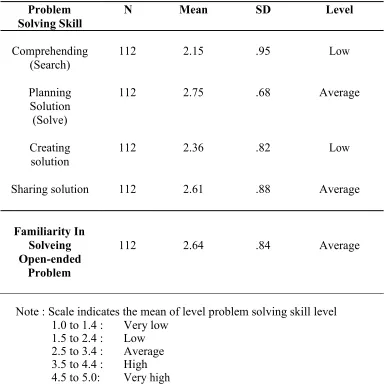
Table 2 Chemistry Problem Solving Skill & Familiarity In Solving Open-ended Problem
Problem N Mean SD Level
Solving Skill
Comprehending 112 2.15 .95 Low
(Search)
Planning 112 2.75 .68 Average
Solution (Solve)
Creating 112 2.36 .82 Low
solution
Sharing solution 112 2.61 .88 Average
Familiarity In
Solveing 112 2.64 .84 Average
Open-ended Problem
Note : Scale indicates the mean of level problem solving skill level 1.0 to 1.4 : Very low
1.5 to 2.4 : Low 2.5 to 3.4 : Average 3.5 to 4.4 : High 4.5 to 5.0: Very high
_______________________________________________________________
Chemistry problem solving ability test was used as an instrument to measure the level of scientific knowledge and problem solving skills. The performance of the test was categorized into three level (low, average and high) based on their score mark as indicated in Table 1. The result showed that 25.9% (29) respondents are high achiever, 53.6% (60) and 20.5 %(26) are average and low achiever respectively (N=112). Therefore, the overall level of problem solving skills and scientific knowledge among the school students are average.
planning solution (mean 2.75,S.D 0.68) and sharing the solution (mean 2.61, S.D 0.88) of the problem(mean 2.61, S.D 0.88).
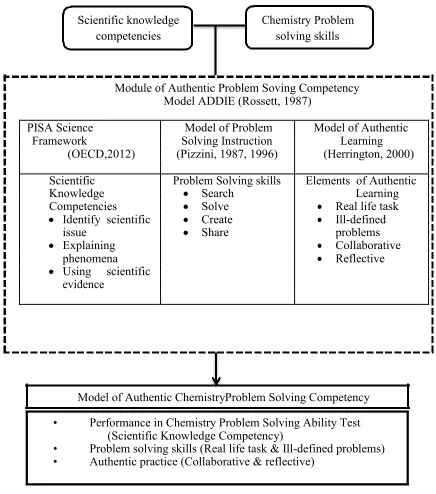
The questionnaire also gave a feedback about the familiarity of respondent in solving the open-ended problem (non-routine and real life). It is found that level of familiarity to solve this type of problem is average (mean 2.64, S.D 0.84). Hence, based on the research gap with this supportive data from the preliminary study, a conceptual framework for this research was developed as illustrated in Figure 1.
Scientific knowledge Chemistry Problem
competencies solving skills
Module of Authentic Problem Soving Competency Model ADDIE (Rossett, 1987)
PISA Science Model of Problem Model of Authentic
Framework Solving Instruction Learning
(OECD,2012) (Pizzini, 1987, 1996) (Herrington, 2000)
Scientific Problem Solving skills Elements of Authentic
Knowledge Search Learning
Competencies Solve Real life task
Identify scientific Create Ill-defined
issue Share problems
Explaining Collaborative
phenomena Reflective
Using scientific evidence
Model of Authentic ChemistryProblem Solving Competency
• Performance in Chemistry Problem Solving Ability Test (Scientific Knowledge Competency)
• Problem solving skills (Real life task & Ill-defined problems) • Authentic practice (Collaborative & reflective)
Figure 1 Conceptual Framework for Model of Authentic Chemistry Probem Solving Competency
competency will be determined based on the performance in post Chemistry problem solving ability test, problem solving skills practiced in solving open-ended problem (real life and ill- defined). Collaborative and reflective are two element in the authentic learning practice that contribute the process in developing the problem solving competency among students. The independent variables are selected based on the research gap that formulated from the literature review and verified by the results from the preliminary study.
6.0 Discussion
Problem
Chemistry Student’s prior solving skills Problem knowledge and (Higher Order solving
experience Thinking competency
Skills)
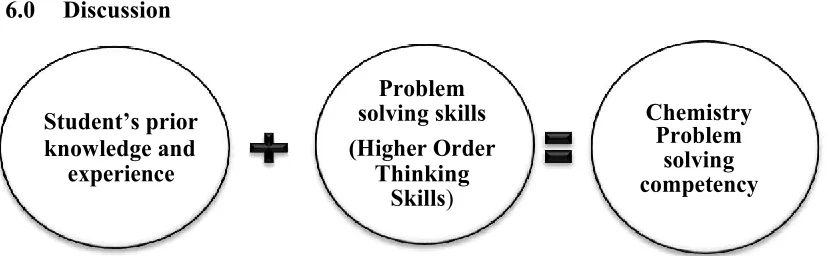
Figure 2 Variables in Chemistry problem-solving competency Source: (Suraiyaet. al,2015)
For this study, Chemistry problem solving competency is determined by the student’s prior knowledge, experience and problem solving skills which, they are applying to solve the the chemistry problem solving ability test (CPSAT) as illustrated in Figure 2. Performance of respondent in the Chemistry problem solving ability test is a predictor for problem solving competency since it is involve the cognitive process of respondent to solve the problem based on their knowledge, ability and application of problem solving skill due to familiarity to the problem.
This conceptual framework include that authentic learning environment will help to promote interest based understanding by leading the students to relate their knowledge, experience and skill with real life context. This approach is essential for the educators to consider as prior knowledge of students and connectedness of such knowledge with real-world activities is quintessential in solving open-ended problems. Conventional teaching and learning style focus on the delivery of knowledge and skills rather than creating an active, authentic, meaningful and innovative learning approach (Jaber and Bou Jaude, 2012). Conventional class setting is more teacher-centred and aims to deliver the knowledge to the students in such a way which may help students apply this knowledge to answer questions in the examination.
7.0 Conclusion
This authentic learning practice will assist to promote students with higher order thinking skills to solve open-ended problems of real life as well as academic life. It is expected that authentic learning will help to improve Chemistry problem solving competency. This authentic learning practice (Herrington, 2000) will be incorporated with a model of problem-solving instruction (Pizzini et. al, 1987, 1996) and Programme for International Student Assessment (PISA) Science Framework (OECD, 2012) in order to develop an effective and meaningful “Model of Authentic Chemistry Problem-solving Competency”.
References
Akram, M., Surif, J. Bin, and Ali, M. (2014). Conceptual Difficulties of Secondary School Students in Electrochemistry. Asian Social Science, 10(19), 276–281.
Ary, D., Jacob, L. C., & RAzavieh, A. (1990). Introduction to research in education (4th ed.). Orlando, FL: Holt, Rinehart and Winston, Inc.
Bojczuk, M., (1982). Topic difficulties in O-and A-level chemistry. SSR, 64: 545-551. Boži, M., & Tramullas, M. T. E. (2014). Engineering practice : teaching ill-structured
problem solving in an internship-like course, (April), 721–726.
Gabel, D. (1998). The complexity of Chemistry and implication for teaching. International Handbook of Science Education . Netherlands: Kluwer Publishers, 233–248.
Gayon, P (2008), The Problem Solving Ability of High School Chemistry Students and Its Implication in Redifining Chemistry Education (Abstract). CoSMEd 2007. Philphines.Book of Abstracts
Goodson, L., and Rohani, F. (1998). Higher Order Thinking Skills • Definition • Teaching Strategies • Assessment. Thinking, 18, 458
Heyworth, R.M. (1999). Procedural and conceptual knowledge of expert and novice students for the solving of a basic problem in chemistry. International Journal of Science Education, 21,195-211
Herrington, J., & Oliver, R. (2000). An instructional design framework for authenticlearning environments. Educational Technology Research andDevelopment,48(3), 23-48.
Herrington, J. (2000). An Instructional Design Framework for Authentic Learning Environments, 48(3).
Herrington, J., & Reeves, T. C. (2003). Patterns of engagement in authentic online learning environments. Australian Journal of Educational Technology,19(1), 59-71
Herrington, J. (2006). Authentic e-learning in higher education: Design principles for authentic learning environments and tasks, World Conference on E-Learning in Corporate, Government, Healthcare, and Higher Education, Chesapeake
Jonassen, D. H., (1997). “Instructional design models for well-structured and ill-structured problem-solving learning outcomes.”Educational Technology Research and Development, 45, 65-90.
Johnstone, A. H. (1993). “Introduction”. In: Wood, C. and Sleet, R. (Eds). Creative Problem Solving in Chemistry. London, The Royal Society of Chemistry.
Kim, M., & Tan, H. T. (n.d.). International Journal of Science A Collaborative Problem-solving Process Through Environmental Field Studies, (August 2014), 37–41.
Lee, T.T. & Kamisah, (2010). Construction of Interactive Multimedia Modules with Pedagogical Agents (IMMPA) in Learning Electrochemistry: Analysis of Needs. Paper Presented at Prosiding Kolokium Kebangsaan Pasca Siswazah Sains dan Matematik 2010, Universiti Pendidikan Sultan Idris, 22 December.
Lombardi, B. M. M., and Oblinger, D. G. (2007). Authentic Learning for the 21st Century : An Overview. Learning, 1, 1–7.
Overton, T., and Potter, N. (2005). Open ended problem solving and the influence of cognitive factors on student success, 75–80.
Summary of the final report Key Competencies for a Successful Life and a Well-Functioning Society, OECD Publishing.
The Organisation for Economic and Development (OECD) (2009), PISA 2006 Technical Report, OECD Publishing.
Pizzini, E. (1987). Project STEPS: Science Textbook Extensions through Problem Solving. Washington, DC: National Science Foundation.
Pizzini, E.L., Shepardson, D.P., & Abell, S.K. (1989). A rationale for and the development of a problem solving model of instruction in Science Education. Science Education, 73(5), 523-534.
Prins, G.T. (2010). Teaching and Learning of Modelling in Chemistry Education. Authentic Practices as Contexts for Learning. CD-ß Press. Netherlands.
Rule, A. C (2006) Editorial: The Components of Authentic Learning. Journal of Authentic Learning, 3(1), 1-10
Scottish Qualification Authority (2010). Chemistry Open-ended Questions Support Materials. Scotland: Learning and Teaching Scotland.
Surif, J., Hasniza, N., and Mahani. (2012). Conceptual and Procedural Knowledge in Problem Solving, 56(Ictlhe), 416–425.
Surif, J., Ibrahim, N. H., and Dalim, S. F. (2014). Problem Solving: Algorithms and Conceptual and Open-ended Problems in Chemistry. Procedia - Social and Behavioral Sciences, 116, 4955–4963
Author(s):
Suraiya Muhamad [email protected]
Department of Educational Sciences, Mathematics and Multimedia Creative Faculty of Education, Universiti Teknologi Malaysia, Johor Bahru, Johor, Malaysia.
Jamalludin Harun [email protected],
Department of Educational Sciences, Mathematics and Multimedia Creative Faculty of Education, Universiti Teknologi Malaysia, Johor Bahru, Johor, Malaysia.
Johari Surif
Department of Educational Sciences, Mathematics and Multimedia Creative Faculty of Education, Universiti Teknologi Malaysia, Johor Bahru, Johor, Malaysia.
Noor Dayana Abd Halim [email protected]
Department of Educational Sciences, Mathematics and Multimedia Creative Faculty of Education, Universiti Teknologi Malaysia, Johor Bahru, Johor, Malaysia.
Muhammad Umar Khan [email protected]