Designing an Efficient Image
Encryption-Then-Compression System with Haar and Daubechies
Wavelet
Harmanpreet Kaur Aujla, Rajesh Sharma
Computer Science, Punjab Technical University Jalandhar, India
Abstract— Nowadays there is development in the multimedia and network technologies. That’s why the privacy and security becomes the major issues since the multimedia is transmitted openly over the network .so that Along with privacy and security, the space of s storage is also an important point that can’t be missed. So that, provide the privacy and security to the multimedia, encryption work as the similarly of root to reduce the storage space compression can be used. Reduction size also reducing the time taken for transmission. In many practical experiments, image encryption to be conducted prior to image compression. This has to be the problem, how to design a pair of image encryption and compression algorithms such that compressing the encrypted images can still be efficiently performed. In this research work, we design the algorithm and implement an efficient image encryption -compression system. The proposed image encryption method is operated with random permutation method which is shown to be providing reasonably high level of security. We also have implement the new kind of image compression algorithm using Haar and Daubechies Wavelet Transform can be used to efficiently compress the encrypted image. Moreover, the compression approach applied to encrypted image is proved more efficient in terms of Compression Ratio (CR), Mean Square Error (MSE), Peak Signal to Noise Ratio (PSNR). For the implementation of this proposed work we use the Image Processing Toolbox under MATLAB software.
Keywords—ETC, Haar Wavelet and Daubechies Wavelet.
I.INTRODUCTION
The development of multimedia and network technologies, the security of multimedia application becomes more and more important, when the multimedia data are transmitted over open networks more and more frequently. Moreover, reliable security is necessary to content protection of digital images and videos. Encryption Techniques for multimedia data needs has to be specifically designed to protect multimedia content and fulfill the security requirements for a particular multimedia application. For example, the real-time encryption of an entire video stream using classical ciphers requires heavy computation due to the large amounts of data involved, but many multimedia applications require security on a much lower level, that can achieved using selective encryption that leaves some perceptual information after encryption. Government private business, and military, a mass great deal of confidential images about their patient (in Hospitals), geographical areas (in research), enemy positions (in defense), financial-status. Most of these information are
now collected and stored on electronic computers and transmitted across network to other computer, if this confidential images about enemy positions ,patient ,and geographical areas fall into the wrong hands, After than such a breach of security could lead to lots of war , wrong treatment etc. Protecting confidential images is an ethical and legal requirement. We store information in computer system in the form of files. Files are considered or defined as a basic entity for keeping the information. Then the problem of securing image data or information on computer system can be defined as the problem of securing file data. It is worldwide accepted fact that securing file data is very important, in today’s computing environment. Good encryption makes a source look completely random, previous or traditional algorithms are unable to compress encrypted data. For this reason, traditional systems make sure to compress before they encrypt. We are using the concept of public key encryption, for the encryption and decryption of image. In this public key’s of sender and receiver is known to both but private key’s are kept secret. Neither the security nor the compression efficiency will be sacrificed by performing compression in the encrypted domain. Consider an application scenario in which a
delegated by Charlie, who can be typically has abundant computational resources. A big challenge within such Encryption-then-Compression (ETC) framework is that compression has to be conducted in the encrypted domain, as Charlie does not defined and access to the secret key K. This type of ETC system is demonstrated in Figure. The possibility of processing encrypted signals directly in the encrypted domain has been receiving increasing attention in recent years. At the first, it seems to be infeasible for Charlie to compress the encrypted data, since no signal structure can be exploited to enable a traditional compressor. Although counter-intuitive, Johnson showed that the stream cipher encrypted data is compressible through the use of coding with side information principles, without compromising either the compression efficiency or the information-theoretic security. In addition to the theoretical findings, also proposed practical algorithms to losslessly compress the encrypted binary images. Schonberg later investigated the problem of compressing encrypted images when the underlying source statistics is unknown and the sources have memory. By applying LDPC codes in various bit-planes and exploiting the inter / intra correlation, Lazzeretti and Barni presented several methods for lossless compression of encrypted gray scale/color images.
II. HAAR WAVELET
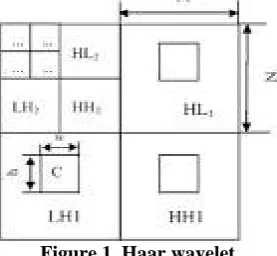
In mathematics, the Haar wavelet is a sequence of rescaled "square-shaped" functions which together form a wavelet family or basis. The Wavelet analysis scheme is similar to Fourier analysis in that it allows a target function over an interval to be represented in terms of anorthonormal function basis. The Haar is sequence now recognized as the first known wavelet basis and extensively used as a teaching example in the theory of wavelets. The Haar wavelet is a certain sequence of functions. It is now recognized as the first known wavelet. This sequence was proposed in 1909 by Alfred Haar.
Figure 1. Haar wavelet
Haar technique is used these functions to give an example of a countable orthonormal system for the space of square integrable functions on the real line. The study of the wavelets, and even the term of “wavelet", did not come until much later. The Haar wavelet is also easier way to possible wavelet. Some of technical disadvantage of the Haar wavelet is that it is not continuous, and there not differentiable.
Haar transform or Haar wavelet transform has been used as an earliest example for orthonormal wavelet transform with
compact support. The Haar wavelet family for x ϵ [0, 1] is
defined as follows:
Here and .
In these formulae integer m = 2j, j = 0, 1, … J indicates the
level of the wavelet; k = 0, 1, … m− 1 is the translation
parameter. Maximal level of resolution is J and 2Jis denoted
as M = 2J. The index i in is calculated from the
formula i = m + k+ 1; in the case of minimal
values m = 1, k = 0 we have i = 2. The maximal value
of i is i = 2M = 2J+1. It is assumed that the value i = 1
corresponds to the scaling function for which h1(x) = 1 in
[0, 1]. It must be noticed that all the Haar wavelets are orthogonal to each other:
III. DAUBECHIES WAVELET TRANSFORM
The Daubechies wavelets are not defined in terms of the resulting scaling and wavelet functions; in fact, that they are not possible to write down in closed form. The graphs below are generated using the cascade algorithm, a numeric technique consisting of simply inverse-transforming [1 0 0 0 0 ...] an appropriate number of times. Daubechies orthogonal wavelets D2-D20 resp. db1-db10 is commonly used. The index number refers to the number N of coefficients. Each wavelet has a multiples of zero moments or vanishing moments equal to half the number of coefficients. For example, D2 (the DAUBECHIES wavelet), D4 has two and has one vanishing moment etc. A vanishing moment limits the wavelets ability to represent polynomial behaviour or information in a signal. For example, the D2, one moment, easily encodes polynomials to one coefficient, and constant signal components. D4 encodes polynomials with two coefficients, i.e. constant and linear signal components; and D6 encodes 3-polynomials, i.e. constant, quadratic signal and linear components. This ability to encode signals is nonetheless subject to the phenomenon of scale leakage, and the lack of shift-invariance, which arise from the discrete shifting operation (below) during application of the transform. Sub-sequences which represent linear, quadratic (for example) signal components are treated differently by the transform depending on whether the points align with even- or odd-numbered locations in the sequence. The lack of the important property of shift-invariance, has led to the development of several different versions of a shift-invariant (discrete) wavelet transform.
There are some parameters given which is useful in our implementation.
A. MSE:
Mean Squared Error is essentially a signal fidelity measure. The goal of signal fidelity, measure is to compare two signals by providing a quantitative score that describes the degree of similarity/fidelity or, the level of error/distortion between them and conversely,. Usually, it assume that one of the signals is a pristine original, while the other one is contaminated or distorted by errors. The mean square error (MSE) between the signals is given by the following formula:
MSE = (1/N)Σi|x(i)- e(i)|2 (4)
Here x and e are encrypt to watermarked audio signals respectively and N is the number of samples in the audio signal.
B. PSNR
Embedding this extra data must not degrade human perception about the object. Namely, the watermark should be “invisible” in a watermarked image or “inaudible” in watermarked digital music. Evaluation of the imperceptibility is that usually based on an objective measure of quality, called peak signal to noise ratio (PSNR), or a subjective test with specified procedures. The PSNR values can be obtained using following formula:
PSNR = 20log10 (PIXEL_VALUE/√MSE) (5)
IV.OBJECTIVE
In this thesis, we propose ‘designing an Efficient Image Encryption-Then-Compression System with HAAR and DAUBECHIES Wavelet Transform’. The main objective of the project is to discuss the properties which help to transmit the secret message or information over a network without any modifications.
The characteristics of information are following: 1) Availability
2) Accuracy 3) Authenticity 4) Confidentiality 5) Integrity
Our objective is to develop a high performance compression system. The design of such system mainly consists in the optimization of the following attributes:
The compression ratio, used to quantify the reduction in image-representation size produced by a compression algorithm. It is defined as the ratio of the size of the compressed signal to that of the initial signal.
The accuracy with which the compressed signal can be recovered at the receiver. Different Efficient techniques are to be developed to minimize the impact of compression on the image. We use Image Compression using Encryption
Then Compression with Haar and DAUBECHIES wavelet thus providing two tier compressions. Even if image is tampered with our compressed
image doesn't get distorted and thus our purpose is fulfilled.
Better PSNR and compression ratio results of Encryption Then Compression with Haar and DAUBECHIES wavelet.
V.EXPERIMENTAL RESULT
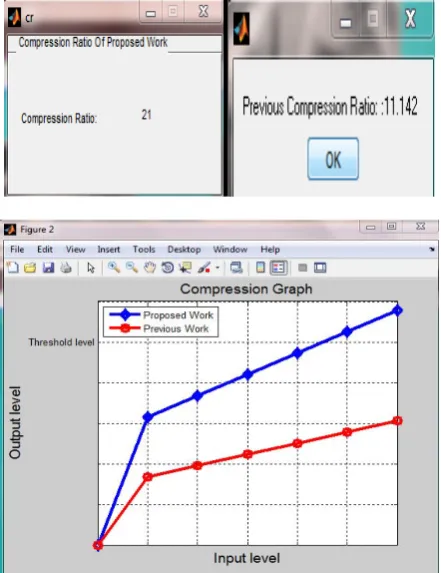
In this phase, present results are better of the experiments to corroborate the success of the proposed model.
Figure 2: Compression Graph
Figure 3: MSE Graph
Figure 4: PSNR Graph
Figure 5: Entropy Graph
Figure 6: BER Graph
VI.CONCLUSION
ACKNOWLEDGMENT
Thanks to my Guide and family member who always support, help and guide me during my dissertation. Special thanks to my father who always support my innovative ideas.
REFERENCES
[1] R. C. Gonzalez and R. E. Woods, Digital Image Processing 2/E. Upper Saddle River, NJ: Prentice-Hall, 2002.
[2] J. J. Ding and J. D. Huang, “Image Compression by Segmentation and Boundary Description,” June, 2008.
[3] G. K. Wallace, 'The JPEG Still Picture Compression Standard', Communications of the ACM, Vol. 34, Issue 4, pp.30-44.
[4] M. Campista, P. Esposito, I. Moraes, L. H. Costa, O. C. Duarte, D. Passos, C. V. de Albuquerque, D. C. Saade, and M. Rubinstein, outing metrics and protocols for wireless mesh networks,ǁ IEEE Netw., vol. 22, no. 1, pp. 6–12, Jan.–Feb. 2008.
[5] N. C. Fernandes, M. D. D. Moreira, and O. C. M. B. Duarte, ―An efficient filter-based addressing protocol for auto configuration of mobile ad hoc networks,ǁ in Proc. IEEE INFOCOM, Apr. 2009, pp.2464–2472.
[6] P. B. Velloso, R. P. Laufer, O. C.M. B. Duarte, and G. Pujolle,
―Trust management in mobile ad hoc networks using a scalable maturity based model,ǁ IEEE Trans. Netw. Service Manage. vol. 7, no. 3, pp. 172–185, Sep. 2010.
[7] D. Passos and C. V. N. Albuquerque, ―A joint approach to routing metrics and rate adaptation in wireless mesh networks, in Proc. IEEE INFOCOM Workshops, Apr. 2009, pp. 1–2.
[8] S. Biswas and R. Morris, ―ExOR: Opportunistic multi-hop routing for wireless networks,ǁ in Proc. ACM SIGCOMM, Aug. 2005, pp. 133–143.
[9] Mitra, Y. V. Subba Rao, S. R. M. Prasanna, “A New Image Encryption Approach using Combinational Permutation Techniques” [10] Xinpeng Zhang, “Lossy Compression and Iterative Reconstruction for Encrypted Image” IEEE transactions on information forensics and security, vol. 6, no. 1, march 2011.
[11] Daniel Schonberg, Stark C. Draper, Chuohao Yeo, Kannan Ramchandran, “Towards Compression of Encrypted Images and Video Sequences”
[12] Ibrahim Fathy El-Ashry, “Digital Image Encryption” A Thesis Submitted for The Degree of M. Sc. of Communications Engineering.
[13] D. Schonberg, S. C. Draper, C. Yeo, K. Ramchandran, “Toward compression of encrypted images and video sequences” IEEE Trans. Inf. Forensics Security, vol. 3, no. 4, pp. 749–762, Dec. 2008. [14] D. Slepian and J. K. Wolf, “Noiseless coding of correlated
information sources,” IEEE Trans. Inform. Theory, vol. IT-19, pp. 471–480, July 1973.
[15] A.Wyner and J. Ziv, “The rate-distortion function for source coding withcside information at the decoder,” IEEE Trans. Inform. Theory, vol. IT-22,cpp. 1–10, Jan. 1976.
[16] S. S. Pradhan and K. Ramchandran, “Distributed source coding using syndromes (DISCUS): Design and construction,” IEEE Trans. Inform. Theory, vol. 49, pp. 626–643, Mar. 2003.
[17] T. M. Cover and J. A. Thomas, Elements of Information Theory. New York: Wiley, 1991.
[18] M.W. Marcellin and T. R. Fischer, “Trellis coded quantization of memory less and Gauss-Markov sources,” IEEE Trans. Commun., vol. 38, pp. 82–93, Jan. 1990.
[19] G. Ungerboeck, “Channel coding with multilevel/phase signals,” IEEE Trans. Inform. Theory, vol. IT-28, pp. 55–67, Jan. 1982. [20] C. E. Shannon, “Communication theory of secrecy systems,” Bell
Syst. Tech. J., vol. 28, pp. 656–175, 1949.