Face Recognition
AJAY KUMAR SBSSTC, FEROZEPUR
Ms. Navdeep Kaur Assistant professor DEPARTMENT OF ECE
SBSSTC, FEROZEPUR
Abstract: Biometric technology is the technology which helps in identifying an individual by using some fixed statistical techniques. These techniques are based on the physiological or behavioural traits. There are different techniques which are supported by the biometric such as iris recognition, finger print recognition, gait recognition, ear pattern, face recognition and many more. Every technique has its own advantages and disadvantages. The research on which we focussed is sorely based on the face biometric. The different biometrics is present by which the security can be improved such as iris scan, finger scan, palm/hand print, gait, ear pattern face recognition, many more. Face biometric offers the possibility of identifying an individual, without any person’s assistance and does not require an expert for interpreting the identification correlation results. In this paper different techniques are deliberated here. There are different techniques which are used for classification such as neural network, PCA and SVM.
Keywords: Biometrics, face, ear, recognition, neural network, gait, SVM, PCA
1. INTRODUCTION
Face recognition is one kind of biometric technology that can be used to monitor people without their interaction. Controlled environments such as banks, military installations and even airports need to be secure these days. And can able to identify threats and provide access to only authorized users. Biometrics methods are those which are used to identify a person on the basis of their either physical or behavioural characteristics. There are two different types of Biometric features namely; static feature and dynamic feature. The static features are those which are required for characterizing finger print, hand print, iris and retina scan, face recognition, when in fact dynamic features are those which are required for characterizing the voice, signature, typing patterns, many more. The essential goal of face recognition is to identify a person despite of obstruction from clothing and background (moving or stagnant). The advantages of face biometric involve the fact that there is no requirement of user’s cooperation; also the sensor can be situated remotely. Take an example for identifying a terrorist in a busy Airport Terminal is one of the eminent applications of face biometric and also in security applications (homeland, military), it is very imperative and substantial to know what is happening in distinct areas, acclimate the monitoring process to recognizing a person, and acknowledge to the emergencies.
FACE RECOGNITION
Facial recognition systems are computer-based security systems that are able to automatically detect and identify human faces. Face Recognition consists of a set which involve two tasks: Face Identification: Given a face image that belongs to a person in a database, tell whose image it
is. Face Verification: Given a face image that might not belong to the database, verify whether it is from the person it is claimed to be in database.
Fig 1: Face Biometric for Recognition
Face Recognition Technology includes; Analyzing facial Characteristics, Storing features in a database and then using them to identify users. Firstly, face recognition system has to identify a face of human and then extract it from the rest of the image. After that, the system calculates the nodal points on the face (distance between the eyes, the shape of the cheekbones) and many distant discernible features. Hence in the end, such nodal points are correlated to those nodal points which are estimated from the pictures stored in a database so as to achieve a match.
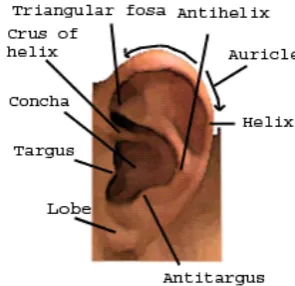
EAR RECOGNITION
In the ear pattern recognition the same camera is used which is utilised for the recognition through face biometric. The researchers gave a slightest scrutiny towards the recognition through ear patterns rather than other biometric techniques.
Earlier some researchers have started considering the complication related to computations of ear image recognition. The research show that ear pattern recognition is pertinent to a great extent.
A lot of researches have been made to specify that the anatomy of outer ear is different and not change by increasing in age. While it has not been proved that every person ears are different.
GAIT RECOGNITION
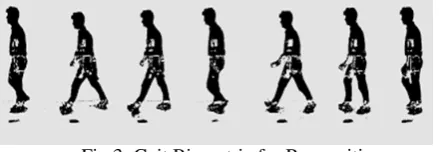
A particular way or manner of moving on foot is known as GAIT Rand the system which used Gait for identifying a person is known as Gait Recognition System. Gait recognition is a rising biometric innovation which includes individuals being recognized through the investigation while they walk. It has been pulled in enthusiasm as a technique for ID on the grounds that it is not obtrusive and does not oblige the subject's participation.
Fig 3: Gait Biometric for Recognition
The gait as a biometric is a mainly used a new territory of study in which the domains of workstation vision. Gait recognition could be utilized from a separation that making it appropriate to recognizing the culprits at a wrongdoing scene [12]. It is utilized to imply the identity of a single person from a feature succession of the subject strolling. System will identify the individual who is unauthorized and then compare the gait feature of illegitimate with the stored sequences in the database and identify him.
2. WORK SO FAR
A literature survey goes further the search for information and involves the identification and articulation of relationships among the literature and our research field. While the form of the literature review may vary with different types of studies, the basic purposes remain constant:M. Singh, S. Nagpal, R. Singh, “On Recognizing Face Images with Weight and Age Variations” [1] they proposed an algorithm which utilizes neural network and random decision forest to encode age variations across different weight categories. They prepared a database WhoIsIt (WIT) which contains 1109 images from 110 individuals with age and weight variations. [2] G. Guo, G. Mu, and K. Ricanek, “Cross-age face recognition on a very large database: The performance versus age intervals and improvement using soft biometric traits”. They proposed a novel technique based on PCA, EBGM and SOFT. MORPH-II databases are used on which all the experiments are performed.
U. Park, Y. Tong and A.K. Jain, “Age-invariant face recognition” [3]. The authors proposed a technique in which 3D shapes and texture spaces from 2D images are implemented. They have used three databases namely, FG-NET, MORPH Album 1 and BROWNS. Result shows that they obtain approx 66 percent of accuracy in case when MORPH Album 1 database is used. [4]G. Mahalingam and C. Kambhamettu, “Age invariant face recognition using graph matching”. In this research paper the authors used an approach based on Gaussian mixture model and graph
technique. They used a database named FG-NET and perform two experiments, one in which age is from (18-69) years and second is from (0-69) years.
[5] T. Xia, J. Lu, and Y. P. Tan, “Face recognition using an enhanced age simulation method”. The authors use age simulation: filling algorithm on the FG-NET database. [6] Z. Li, U. Park, and A. K. Jain, “A discriminative model for age invariant face recognition”. In this paper, they proposed a technique which in based on SIFT and LBP with MFDA. They use two databases, FG-NET and MORPH Album 2 and compare the result obtained. MORPH Album 2 gives approx 83 percent accuracy whereas FG-NET gives 47.5 percent.
F. Juefei-Xu, K. Luu, M. Savvides, T. D. Bui, and C. Y. Suen, “Investigating age invariant face recognition based on periocular biometrics” [7]. The technique used by the authors in this paper is WLBH, UDP: periocular region. They obtained 100 percent accuracy result on FG-NET database. [8] S. Wang, X. Xia, Y. Huang, and J. Le, “Biologically-inspired aging face recognition using C1 and shape features”. They proposed an algorithm ‘C1-S’ based on HMAX model and shape features. They obtain approx 34 percent accuracy result on the FG-NET database. [9] C. Chen, W. Yang, Y. Wang, S. Shan, and K. Ricanek, “Learning Gabor features for facial age estimation”. In this paper the authors used Gabor features for estimating facial age on a person. The used a database named UIUC PAL and calculate the age estimation mean absolute error of about 6 years. [10] D. Yadav, M. Vatsa, R. Singh, and M. Tistarelli, “Bacteria foraging fusion for face recognition across age progression”. The authors proposed a Bacteria Foraging Fusion algorithm and obtain the results on two databases named FG-NET and IIIT-D. They perform two experiments namely oldest probe and youngest probe on both the databases.
3. TECHNIQUES USED
NEURAL NETWORK
A neural network is a computing framework which consists of massively parallel interconnection of flexible neural processors and because of its parallel quality it can execute computations at a very high rate as compared with the previous techniques and because of its adaptive nature, it can acclimate to variations in the data and learn the attributes of the inputted signal. The output is fed from one node to another one in the network and the final decision is made which depends on the interaction of all nodes. There are various approaches available for training of neural networks. NN architectures can be further classified as, FF (feed forward) and FB (feedback) networks. In the OCR systems, the most common neural networks used are the MLP of the feed forward network.
Multi-layer Neural Network
PRE-PROCESSING: Pre-processing stage is that stage which involves all the operations that are performed on capture image to produce a clean character image that is suitable for cropping and segmentation stage. Edge operation is performed on each character to find the edge of each character. Then dilation is done to make the character larger by adding pixels around its edges.
CROPPING: In the cropping operation the pre- processed image is performed so that the each character in an image can be tightly fit in a square box that is equal in size to the width and height of the characters.
SEGMENTATION: In this stage, an image of sequence of character is disintegrated into sub-images of individual character. Here, the pre-processed input image is divided into individual characters by assigning a number to each character using a labelling process. The labelling gives the information regarding the no. of characters in the image. Each individual character is uniformly resized into 70X50 pixels. This resized image is used as the input to the NN. POST-PROCESSING: This stage is the final stage of the system for recognition. It shows the result i.e. the corresponding recognized characters in the structured text form by calculating equivalent ASCII value using recognition index of the sample test.
The classification phase is the decision making stage of the system for recognition. A FF Back propagation neural network is used for classification and recognition of the characters. The 3500 pixels derived from the resized character in the segmentation stage form the input to the classifier. The neural classifier consists of two hidden layers besides an input layer and an output layer. The hidden layer uses log sigmoid activation functions and output layer is a competitive layer as one of the characters is required to be identified at any point in time. The total number of neurons in structured text from by calculating equivalent ASCII value using recognition index of the test samples.
SVM (SUPPORT VECTOR MACHINE)
SVM is a classification method which was introduced by Vapnik in the year 1992. This classifier is mainly used in bioinformatics and other disciplines due to its many advantages like highly accurate, can process the high-dimensional data such as gene expression. It belongs to the general category of kernel methods. A kernel method depends on the data obtained through dot-products. In this case, kernel function is used which computes a dot product in possibly high dimensional feature space. There are two advantages
First, it has the ability to generate non-linear decision boundaries. Second, by using kernel functions the user is allowed to apply a classifier to data with no obvious fixed-dimensional vector space representation, examples of such data in bioinformatics are sequence, either DNA or protein, and protein structure, etc.
The main aim is to provide the user with an instinctive understanding of the choices regarding which kernel is to be used and provide guidelines related to general usage. SVM has been used successfully in many real-world problems like gait recognition, text categorization, image
classification, bioinformatics i.e. for Protein classification, Cancer classification etc. And SVM has its successful application in hand-written character recognition.
PCA (PRINCIPAL COMPONENT ANALYSIS)
In this approach, firstly the principal components is obtained and then these components are used as transformation matrix for the transformation of training set images and test images to PCA space. Each and every pixels of an image are taken row by row from top to bottom and then they again converted to row vector which contain the intensity values or grey scale of that image. By concatenating these row vectors a single matrix is transformed. Every image is depicted by row in that matrix. Two separate matrices are transformed for test image set and training image set. Both the training and test images are undergone this same process.
After this the covariance matrix is calculated for training set images in which image is depicted by each row and pixel position is depicted by columns. Covariance between two variables will be positive if both the variables vary above their expected value but if one varies above its expected value and second diversify below its expected value then there will be negative covariance. For calculating the covariance;
, μ μ
1,2,3 … … .
where E is the mathematical expression and μ , and x is training image matrix. If the order of matrix x is (m x n), where n represents columns for number of pixels per image and m represents rows to represent number of images. Then the order of new resulted covariance matrix is (n x n).
Transformation to the PCA space: The resulting matrix A is formed by sorting the eigenvectors used as a transformation matrix to transform the images to the PCA space. This is done by substituting the values in the formula given below;
Where P expresses a vector representing image and states the mean value of each pixel position of all training set images. The calculated vector y is the image which is transformed to PCA space. That is defined as principal component transform. Now all the images in the training set are transformed into the PCA space. With the help of the above transformation, we consider a new test image t which helps us in identification of training set. Same transformation is applied to test image.
The vector r is the mapping of that image to the PCA space.
Dimensionality reduction: The size of eigenvector matrix is (n x n), we conclude that there are n eigenvectors (where n is the number of pixel per image) and by transformation to PCA space we got a n dimensional space. To compress that space, its dimensionality has to be decreased or reduced and for this we can take the top k eigenvectors corresponding to top k highest eigen values which will help in transforming matrix . Calculate the size of the transformation matrix.
For example, suppose the size of an image in the database is 70×40 that is there are 2800 pixels per image. After the transformation to PCA space and the reduction in dimensionality, the size of the image of new reduced transformation matrix, will approx 1400 pixel per image which is half of 2800.
This is the main process that is pursued in all the experiments where PCA transformation is used.
SURF (SPEEDED UP ROBUST FEATURES)
SURF algorithm is the advanced version of Scale-Invariant Feature Transform, having a greater promotion in real-time. This matching algorithm is applied for recognizing object and tracking target. SURF algorithm is the feature point extraction algorithm. It is purposed by Bay H, Tuytelaars T, and Gool L V in 2006. SURF algorithm depends upon two parts: Feature Point Detection and Feature Invariant Point Descriptor.
SURF descriptors are used to generate informative feature vectors. One of the main advantages of SURF is that it quickly computes distinctive descriptors. SURF descriptors are invariant to some common image transformations like image rotation, viewpoint, change in scale, illumination changes. SURF outperforms or is comparable to existing schemes in terms of repeatability, distinctiveness, and robustness, with much faster performance. This algorithm describes the interest point detector and descriptor. The detector locates the interest points in the image, and the descriptor describes the features of the interest points and constructs the feature vectors of the interest points.The most valuable property of an interest point detector is its repeatability. The repeatability expresses the reliability of a detector.
4. RESULTS AND DISCUSSION
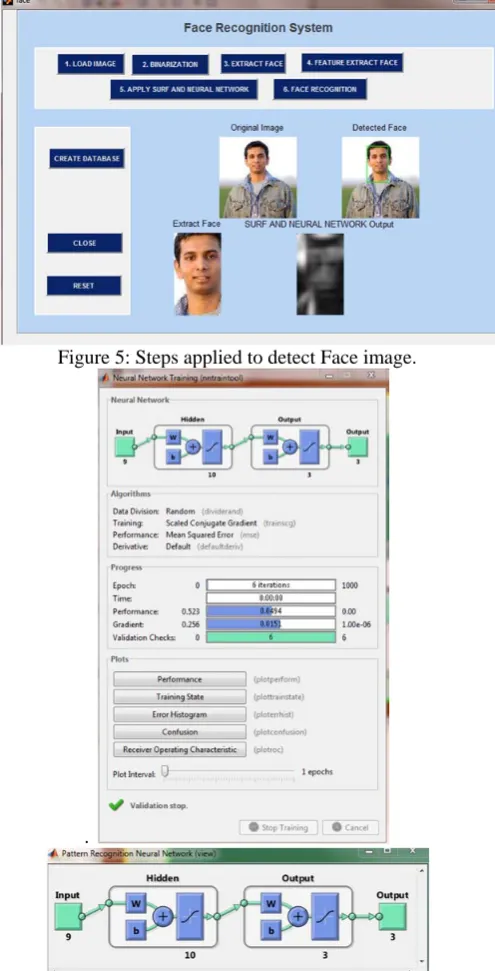
Thissection presents the results of the proposed work. The following figures show the result of the Enhanced Face Matching Technique based on SURF and Neural Network. This technique gives better results as compared to previous techniques.
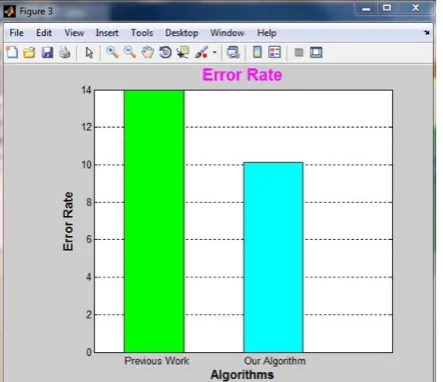
After obtaining all the necessary terms results are displayed. The proposed Face Detection algorithm is more accurate and assures quality of result. Face Detection doesn't degrade the quality of image. Face Detection algorithm has enhanced performance and has better Error Rate result.
Figure 4: Opening GUI.
Figure 5: Steps applied to detect Face image.
.
Figure 6: NN Training Tool result or pattern recognition tool result.
Figure 8: Graph showing comparison results of Error Rate of proposed algorithm with previous.
Figure 9: Comparison of Error Rate between Previous and proposed algorithm.
5. CONCLUSION
The explosive growth of image data leads to the need of research and development of Image Processing. Recognition by using biometrics is currently a very important area of research in the area of multimedia databases. In this paper we have discussed different approaches based on face, gait, ear and different biometrics.
Different algorithms can be used for enhancing accuracy in the recognition of an individual and for reducing the complexity of the system and minimizing the execution time.
ACKNOWLEDGMENT
Thank you to my guide and family member for their immense support, help and guidance during my dissertation. I am very thankful to my friends who always supported me in my brilliant and inventive ideas.
REFERENCES
[1] M. Singh, S. Nagpal, R. Singh and M. Vatsa, “On Recognizing face
images with weight and age variations” in Proc. IEEE Digital Object
Identifier, vol. 2, 2014.
[2] G. Guo, G. Mu, and K. Ricanek, ``Cross-age face recognition on a very large database: The performance versus age intervals and
improvement using soft biometric traits,'' in Proc. 20th Int. Conf.
Pattern Recognit., Aug.2010, pp. 3392-3395.
[3] U. Park, Y. Tong, and A. K. Jain, ``Age-invariant face recognition,'' IEEE Trans. Pattern Anal. Mach. Intell., vol. 32, no. 5, pp. 947954, May 2010.
[4] G. Mahalingam and C. Kambhamettu, ``Age invariant face
recognition using graph matching,'' in Proc. 4th IEEE Int. Conf.
Biometrics: Theory Appl. Syst., Sep. 2010, pp. 17.
[5] T. Xia, J. Lu, and Y.-P. Tan, ``Face recognition using an enhanced
age simulation method,'' in Proc. IEEE Vis. Commun. Image
Process., Nov. 2011, pp. 14.
[6] Z. Li, U. Park, and A. K. Jain, ``A discriminative model for age
invariant face recognition,'' IEEE Trans. Inf. Forensics Security, vol.
6, no. 3, pp. 10281037, Sep. 2011.
[7] F. Juefei-Xu, K. Luu, M. Savvides, T. D. Bui, and C. Y. Suen, ``Investigating age invariant face recognition based on periocular
biometrics,'' in Proc. Int. Joint Conf. Biometrics, Oct. 2011, pp. 17.
[8] S. Wang, X. Xia, Y. Huang, and J. Le, ``Biologically-inspired aging
face recognition using C1 and shape features,'' in Proc. 5th Int. Conf.
Intell.Human-Mach. Syst. Cybern., vol. 2. Aug. 2013, pp. 574577. [9] C. Chen, W. Yang, Y. Wang, S. Shan, and K. Ricanek, ``Learning
Gabor features for facial age estimation,'' in Proc. 6th Chin. Conf.
Biometric Recognit., 2011, pp. 204213.
[10] D. Yadav, M. Vatsa, R. Singh, and M. Tistarelli, ``Bacteria foraging
fusion for face recognition across age progression,'' in Proc. IEEE
Conf. Comput. Vis. Pattern Recognit. Workshops, Jun. 2013, pp. 173179.
[11] N.K Narayanan,V.Kabeer, “Face recognition using nonlinear
feature parameter and artificialneural network,” International journal of computer intelligence systems, 3(5), 566-574.
[12] D. Tan, K. Huang, S. Yu, and T. Tan, “Uniprojective features for Gait recognition”, the 2nd International Conference on Biometrics, 2007.
[13] Ajay Kumar, Chenye Wu, “Automated Human Identification Using Ear Imaging”, Department of Computing, The Hong Kong Polytechnic University, June 2011.