Efficient Generic Zero-Knowledge Proofs from
Commitments
Samuel Ranellucci? ??, Alain Tapp, and Rasmus Zakarias? ?? 1 Department of Computer Science, Aarhus University
{samuel,rwl}@cs.au.dk
2 DIRO, Universit´e de Montr´eal, Canada, [email protected]
Abstract. Even though Zero-knowledge has existed for more than 30 years, few generic constructions for Zero-knowledge exist. In this paper we present a new kind of commitment scheme on which we build a novel and efficient Zero-knowledge protocol for circuit satisfiability. We can prove knowledge of the AES-key which map a particular plaintext to a particular ciphertext in less than 4 seconds with a soundness error of 2−40. Our protocol only requires a number of commitments proportional to the security parameter with a small constant (roughly 5).
1
Introduction
Zero-knowledge was introduced in 1985 by Goldwasser, Micali and Rackoff in their seminal paper [12] introducing the IP hierarchy for interactive proof sys-tems and the concept of Zero-knowledge complexity.
Informally, a Zero-knowledge argument is an interactive protocol that allows a Prover to persuade a Verifier of the validity of some NP statement using knowledge of some hidden witness. Essentially, the Verifier should learn nothing more than the fact that the Prover knows a witness that satisfies the statement. One motivating example is that of graph isomorphism: the NP statement here is that two graphs are isomorphic. The witness is a permutation held by the Prover permuting one graph into the other. One obvious way for the Prover to convince the Verifier would be to send the permutation. However, this reveals much more information than the one bit of information to be conveyed, namely whether the graphs are isomorphic or not. Zero-Knowledge proofs are interactive proof systems ensuring that the Verifier learns only this information and nothing more.
?The authors acknowledge support from the Danish National Research Foundation
and The National Science Foundation of China (under the grant 61061130540) for the Sino-Danish Center for the Theory of Interactive Computation, within part of this work was performed; and from the CFEM research center, supported by the Danish Strategic Research Council.
Following this ground breaking work, [1] showed that for any relation that can be proven by an interactive proof systems, it can also be proven in Zero-knowledge. Thus, the potential for applications of Zero-knowledge are expansive. A large body of work has shown that specialized efficient constructions for spe-cific NP relations are possible. However, even though Zero-knowledge has existed for almost 30 years, generic constructions for Zero-knowledge are very few. More-over, the generic constructions that do exist, use the relatively impractical Karp reductions [15] to NP-complete languages [11].
Generic constructions for Zero-knowledge are starting to emerge. The recent line of work starting with [14] focus on the novel idea of using garbled circuits for Zero-knowledge proofs of generic statements. This line of work was continued by Frederiksen et al. in [9] where they build specialized garbling schemes tailored for Zero-knowledge proofs. The garbling approach communicates at least one symmetric encryption per And-gatein the circuit. Similary, for security param-eter κand circuit size n our protocol exhibit worst case complexity O(nκ). In contrast to the garbling approach, our protocol only requires a small constant of bits by And gate (roughly 5). On the other hand, we have [13] with worst case complexity O(n) when the Prover uses the Scalable Multiparty computa-tion technique from [8]. However this construccomputa-tion is quite involved and even 9 years after its publication no implementation is provided yet3. Naturally for
large enough circuits [13] will be faster than our construction. Yet we boldly conjecture that our scheme, given its smaller constants, out performs their (in terms of execution time) construction for practical application sized circuits like AES (∼40K gates).
Another main selling point for our construction is that it is conceptually sim-ple: only an understanding of the notion for commitments and XOR-sharing are necessary to master it. Also, we demonstrate that our construction is practical by presenting an implementation which exhibit small running times. In partic-ular we present an example application where the Prover proofs knowledge of an AES-encryption-key encrypting a particular public plain-text to a particular public cipher-text. To sum up, our protocol is no novelty in terms of asymptotic complexity, however we emphasize that the concrete constants are small, its construction is conceptually simple (an advantage when selling it to non-crypto experts) and it takes only a moderate effort to implement.
2
Contributions
In this paper, we present a novel approach for achieving generic Zero-knowledge proofs. Similar to the line of work using garbled circuits, our construction uses the idea of proving knowledge of a satisfying assignment for a circuit. However our construction differs from the garbling approach in several ways. Our construction is very simple and clean using only one primitive, a commitment scheme. Our construction is similar to [17] which over a field Fhas complexityO(|F|n) for a
field of size|F|> κ. Their approach operates on a gate by gate basis. As our field is smallZ2 we bundle the entire circuit together obtaining a string of sizeO(n)
and prove all gates in one go with soundness 14 and then we repeat 2κtimes. For a simple construction our scheme can be instantiated in the Random Oracle Model which is also rather efficient. However this introduces the extra assumption of the Random Oracle. Recent work on commitments in the standard model proves to be even more efficient and adds no additional assumptions, see the PKC 2015 paper in [4] (improving on [7]). Using their scheme makes our construction gets extremely efficient, since it only relies on encoding for a linear code like Reed Solomon which can be done efficiently using the FFT-transform. In a bit more detail, we take a similar approached to the one used in [2,6]. They use Xor operations over individually committed bits to prove statements. We employ strings in our construction, using a novel way of committing to bit-strings that enables Zero-knowledge proofs of linear relations. In particular we present efficient protocols for proving equality and inequality of bits in a string given two regular commitments to the Xor sharing of that string. From this we build protocols for circuit satisfiability where a Prover proves to a Verifier that he has knowledge of a witness wthat satisfies the circuit. The Prover does this by committing to a truth assignment of all gates in the circuit along with some additional information. Then he proves relationships (corresponding to the gates of the circuit) between bits in the committed string.
By the hiding property of the commitment the Verifier learns nothing about the inputs to the circuit. In the end the Prover essentially opens the output bit of the circuit by proving that the output bit of the circuit committed to is one and this is essentially the only new information that the Verifier learns.
For a circuit of sizenwithιinput gates,αand gates andβ linear gates our construction communicates 4α+β bits of data with soundness one-quarter. To form a secure protocol with security 2−κ, we repeat our construction 2κtimes realizing a protocol with communication complexityO(κn). We emphasize once again that the constants involved are small.
3
Commitment with Linear proofs
In this section, we define a commitment scheme which allows a Prover to prove linear relationships between bit-positions within a string he has committed to. These relationships include equality and inequality. From the (in)equality proofs we build a protocol for proving that a set of bit positions xor to a particular value. The proofs are complete and Honest-Verifier Zero-knowledge. The soundness only holds with probability one-half. We will use the notation xom(m) to say that a Prover commits to a messagemallowing him to conduct proofs of linear relations between individual bit positions inm.
then the committed value is revealed. This implies that the soundness of the proofs cannot be improved.
In the following we are going to work on strings, therefore we need a bit of notation. Then follows our xor-commitment scheme.
Notation For anl-bit stringmwe denotemithe i’th bit ofm. When a message
m is xor-shared, we denote m0 and m1 the xor-shares of m = m0
⊕m1. We
sometimes combine these notations and takem0
i to mean the i’th bit of the 0’th share ofm and similarly form1
i. Informally, we say two distributionsU and V areindistinguishableif for anyxsampled from eitherU orV at random and for all probabilistic polynomial time Turing machines A, running A on x making it guess on which distribution x belongs to is correct with probability 12. For formal formulation and a detailed treatment of indistinguishability we refer the reader to [5].
Commitment scheme supporting linear proofs We will now give the details of our commitment scheme supporting linear proofs. Our scheme relies on any classical commitment scheme from the literature with the desired Hiding and
Bindingproperties, we denote itcom(). In following we describe how wecommit
to messages andopenour commitments.
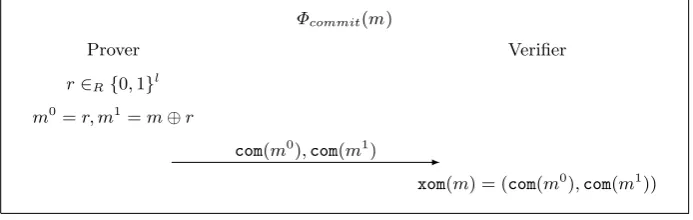
To commit to a stringm ∈ {0,1}l we first choose a string r
∈ {0,1}l uni-formly at random and setm0 =r and m1 =m
⊕r. Then we commit to both strings using the classical commitment scheme to formxom(m) = (com(m0),com(m1)).
To open anxom(m) entirely we open both classical commitments and reveal
m. The commitment protocol is depicted in Figure 1.
Φcommit(m)
Prover Verifier
r∈R{0,1}l
m0=r, m1=m ⊕r
com(m0),com(m1)
xom(m) = (com(m0),com(m1))
Fig. 1.Commit
3.1 Partial opening
3.2 Properties with xom(·)
We give here a set of theorems stipulating important but strait forward facts regarding XOR shared strings.
Theorem 1. For a given string m∈ {0,1}l andk
∈ {0,1}let Vk be the
distri-bution on strings
mk |m=m0⊕m1, m0=r, r∈R{0,1}l
Vk is indistinguishable from the uniform distributionU on{0,1}l.
Proof. The proof follows trivially fromrbeing chosen uniformly at random.
Definition 1. We say a bit string m0
∈ {0,1}l looks independent of another
string m if the distribution from whichm0 was drawn is indistinguishable from the uniform distributionU on {0,1}l.
Theorem 2. If two bit positionmiandmj are equal for a stringm=m0⊕m1
then existsδ such thatδ=m0
i ⊕m0j =m1i ⊕m1j.
Proof.
0 =mi⊕mj=mi0⊕m0j⊕m1i ⊕m1j⇒m0i ⊕mj0=m1i ⊕m1j def
= δ.
Theorem 3. For two bit positionsmiandmjthe view(δ, mk)looks independent
of mas long asm1−k stays hidden.
Proof. By Theorem 1.mk is independent ofm andδ=mk
i ⊕mkj, thus no new information is revealed.
Theorem 4. For two bit positions mi and mj, ifmi 6=mj then there exists
such that =m0
i ⊕m0j = 1⊕m1i ⊕m1j.
Proof.
1 =mi⊕mj=mi0⊕m0j⊕m1i ⊕m1j ⇒m0i ⊕mj0= 1⊕m1i ⊕m1j def
= .
Theorem 5. For two bit positions mi andmj the view(, mk) is independent
if m as long asm1−k stays hidden.
Proof. Again by Theorem 1mkis independent ofm. Ifk= 0 then=m0
i⊕m0jin which casecan be perfectly simulated from what is already revealed. Similarly ifk= 1 then, = 1⊕m1
i ⊕m1j which can be perfectly simulated too.
4
Zero Knowledge with weak soundness
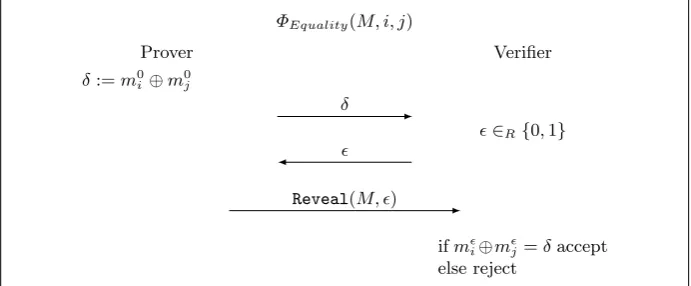
In our first result we show how to do an honest Verifier zero knowledge equality proof between two bit positions of a stringmgivenxom(m). The basic idea is as follows: we will exploit Theorem 2 saying that if the bits mi and mj are equal then there exists a δ such that m0
i ⊕m0j = m1i ⊕m1j =δ. On the other hand, if mi 6= mj by Theorem 4 then no such δ exists. The protocol is depicted in Figure 2.
Informally, observe that by Theorem 3 the view (δ, mb
i, mbj) looks independent of the value ofmiandmj as long as (mi1−b, m1j−b) stay hidden. Forcompleteness we observe that if the statement is true e.g.mi=mjthenδ=mib⊕mbj, b∈ {0,1} and the Verifier accepts. For soundness consider the first step of the protocol: the Prover will revealδ. This reveals no information and forces a cheating Prover to prepare to answer ab0 such thatmb0
i ⊕mb
0
j 6=δ. Then the Verifier will select a
bat random for which the Prover can only reply correctly ifb=b0. This ensures
that a cheater gets caught with probability one-half. The soundness is evident since any challenge can be easily answered. It is Zero-knowledge since the values of (δ, mb
i, mbj) are independent of the bits mi andmj.
4.1 Protocol for equality
In this Section we formally prove the protocol in Figure 2 Honest Verifier zero knowledge with soundness 12. For a string m ∈ {0,1}l let M = xom(m) = (com(m0),com(m1)), we show how to prove for a giveni, jthat mi=mj.
ΦEquality(M, i, j)
Prover Verifier
δ:=m0
i⊕m0j
δ
∈R{0,1}
Reveal(M, )
ifm i⊕m
j=δaccept
else reject
Fig. 2.Protocol for proof of Equality given anxom(m) to a messagem. More precisely, theM={m0, m1,(com(m0),com(m1))
}given as input is taken to mean that the Prover already committed to a messagemand the Verifier received the commitment.
Proof. We showcompleteness, soundnessandHonest Verifier Zero knowledge.
Completeness:
To show completeness, we show that an honest Verifier will be convinced by an honest Prover. Therefore, assuming mi=mj, we consider two cases:
case 1: if m0
i =m0j thenm1i =m1j in which case δ= 0 =m0i ⊕m0j =m1i ⊕m1j and thus the check the Verifier make is true for both choices of and thus he accepts.
case 2: if on the other hand m0i 6=m0j then m1i 6=m1j in which case δ = 1 =
m0
i⊕m0j =m1i⊕m1j and the Verifier accepts. These cases are exhaustive assuming that mi=mj.
Soundness:
To show soundness holds with probability one-half, we consider a cheating Prover and show that an honest Verifier accepts with probability at most one-half. That is, lets assume mi 6= mj and consider a Prover try to convince the Verifier otherwise. If m0
i 6= m0j then m0i ⊕mj0 6= m1i ⊕m1j and therefore for any δ ∈ {0,1}there exists a valuesuch that the Verifier will not accept by Theorem 4. Therefore, such a cheater is detected with probability 1/2.
Honest Verifier Zero-Knowledge:
To prove Zero Knowledge for a Verifier, we give a simulator that generates the view (com(m0,com()1), δ, mb) which is indistinguishable from a real execution.
SimulatorMVEq∗
1 Pickm, r∈R{0,1}ls.t.mi=mjand setm
0=r, m1=m ⊕m0. 2 Computeδ←m0
i⊕m0j and outputC= (com(m0),com(m1), δ)
3 Accept to receive the∈ {0,1} 4 Open the commitmentcom(m).
Fig. 3.Simulator for equality
Consider the simulator in Figure 3. We argue that the view generated is indistinguishable from a real execution by noticing that it performs the exact same steps as an honest Prover does. From this, we conclude that the view (com(m0),com(m1), δ, mb) is indistinguishable from a real execution.
It follows that the above Zero-knowledge proof is for a quite trivial statement, namely that there exists a stringmsuch thatmi =mj. We will use this primitive as a building block in more complicated proofs as we shall see shortly.
4.2 Parallel equality proofs
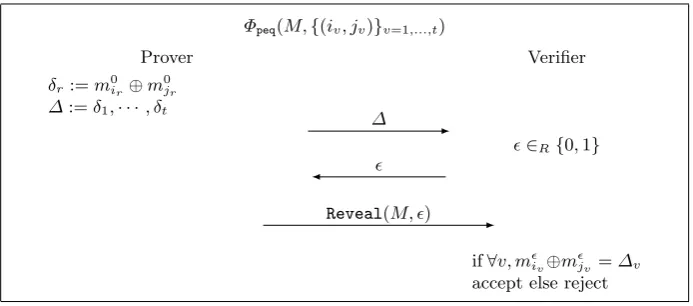
of positions equal with soundness one-half. We summarise the construction for parallel equality in Figure 4.
Φpeq(M,{(iv, jv)}v=1,...,t)
Prover Verifier
δr:=m0ir⊕m
0
jr
∆:=δ1,· · ·, δt
∆
∈R{0,1}
Reveal(M, )
if∀v, m iv⊕m
jv =∆v
accept else reject Fig. 4.Parallel Equality
As before we take M = {m0, m1,(com(m0),com(m1))} as input to mean
an XOR commitment already happened beforehand. For the paired index set
I ={(ir, jr)}r=1,...,t we generate theδr and send a string ∆=δ1, ..., δt rather than one bit, to the Verifier. Also, the Verifier now checks t positions one for each bit in∆.
Following the same reasoning as for the equality protocol in Figure 2 our protocol for parallel equality in Figure 4 is also Honest Verifier Zero Knowledge with soundness one-half. The proof is omitted here as a later proof will show something even stronger.
4.3 Proof of inequality
The proof of inequality is very similar to the equality proof. The main difference is that there exists a such that for anyb ∈ {0,1},=mb
i⊕mbj⊕b instead if theδ=m0
i ⊕m0j as before. We put the protocol and its proof in Appendix C.
4.4 The Linear Zero Knowledge proof
In the previous sections we have seen how to do equality and inequality proofs of bits in a committed message. We can combine these two in one protocol to convince our Verifier that a set of bit positions XOR to a particular value, which covers equality and inequality as special cases.
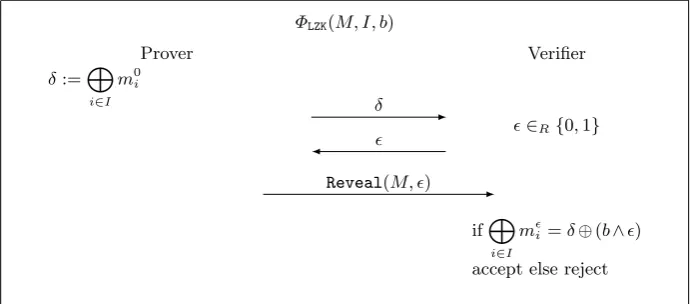
Now motivated we describe a protocol for convincing a Verifier that a set of bit-position will XOR to a particular value. As before the Prover commits to a message m producing M = {m0, m1,(com(m0),com(m1))}. Additionally the
I, and the second will be the expected value,b, that the bit positionsmi, i∈I are supposed to XOR to. More precisely, our protocol shall prove:
(M i∈I
mi) =b
This captures our previous protocols for (in)equality. E.g. we see that equality is covered by putting two elements in the set and setting the expected value to 0. By expecting a one instead we have inequality. In addition, by only putting a single index in the set, it is a proof thatmi is equal to the given expected value without revealing anything else. Essentially we can open a single bit position in this way. Figure 5 below depicts our protocol for proving the XOR relation between bit positions.
ΦLZK(M, I, b)
Prover Verifier
δ:=M
i∈I
m0
i
δ
∈R{0,1}
Reveal(M, )
ifM
i∈I
mi =δ⊕(b∧)
accept else reject
Fig. 5.Linear Zero-knowledge
Theorem 7. The Linear Zero-knowledge protocol in Figure 5 is Honest Verifier Zero-knowledge.
Proof. We showCompleteness,Soundness error one halfandHonest verifier zero knowledge.
b= 0:
0 = (M i∈I
mi) =
M
i∈I
(m0i ⊕m1i) ⇒
M
i∈I
m0i =
M
i∈I
m1i =δ
Becauseb= 0 our Verifier checks that
δ=Mi∈Imi =
M
i∈Im0i =
M
i∈Im1i Thus the Verifier accepts.
b= 1:
We are proving odd parity in this case, that is the bit positions mi, i ∈ I has an odd number of one bits. Thus there is no commonδbetween the XOR ofm0
i andm1
i, i∈I in similarity to the inequality we have: 1 = (L
i∈Imi) =
L
i∈I(m0i ⊕m1i) ⇒
L
i∈Im0i = 1⊕
L
i∈Im1i =δ That is whether δ= 1⊕L
i∈Imi is now dependent on and the fact that we are proving odd parity, b= 1. Hence our Verifier now checks:
δ= (Mi∈Imi)⊕(b∧) And accepts.
Soundness Assuming the claim is false, L
i∈Imi 6=b, our cheating Prover will attempt to convince the Verifier otherwise. We will show such a Prover succeeds with probability one half.
Sending theδ=L
i∈Im0i ⊕0 to the Verifier the Prover can reply correctly only for one0
∈ {0,1}, namely if
δ= (b∧0)⊕Mi∈Im
0
i.
Thus with probability one half the Verifier sends 6=0 in which case sending m (to satisfy the commitment inM) the Verifier sees an inconsistency withδ and aborts. Thus by case analysis we have established that the cheating Prover is caught with probability one half.
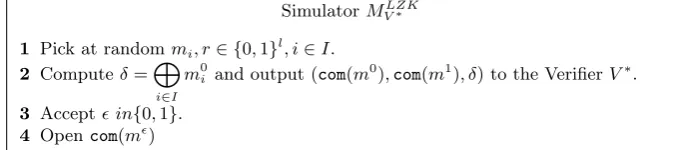
SimulatorMLZK V∗
1 Pick at randommi, r∈ {0,1}l, i∈I.
2 Computeδ=M
i∈I
m0
i and output (com(m0),com(m1), δ) to the VerifierV∗.
3 Accept in{0,1}. 4 Opencom(m)
Fig. 6.Simulator for Linear Zero Knowledge
is computationally hiding then the output distribution of our simulator is com-putationally indistinguishable from the uniform distribution on the set of strings of the same length.
Motivated by our parallel proofs for (in)equality in the previous section we give a protocol for packing multiple Linear Zero Knowledge proofs (LZK’s) to-gether at no extra cost still using only one commitment. It is depicting in Figure 7 which in more details is a protocol showing how to pack multiple LZK proofs together into one protocol still using only one xom(·). Formally, we pack t in-stances of the LZK protocol into one protocol taking a set of pairs of indices and expected values. As with parallel equality we now send a string∆=δ1, ..., δt rather than a single bit in the first step of the protocol. Also, the Verifier checks
t sets of indices againstt expected values.
ΦPLZK(M,{(Iv, bv)|Iv⊆ {1, . . . , l}, bv∈ {0,1}}v=1,...,t)
Prover Verifier
δr:=
M
i∈Ir
m0
i
∆:= (δ1, . . . , δt) ∆
∈R{0,1}
Reveal(M, )
if∀v,
L
i∈Ivm
iv =∆v⊕(bv∧)
accept else reject
Fig. 7.Parallel Linear Zero-knowledge
Theorem 8. The protocol in Figure 7 is Honest Verifier zero knowledge with soundness error 12
Completeness We show the Verifier accepts if both Prover and Verifier are hon-est. By Theorem 8 the Verifier accepts for eachδi. Thus he accepts for∆
Soundness The Prover cheats in at least one bit position and by Theorem 8 he get caught with probability one half. As bit positions are independent the Prover only decreases his success probability by cheating in multiple positions. Thus we conclude we have soundness one error probability one half.
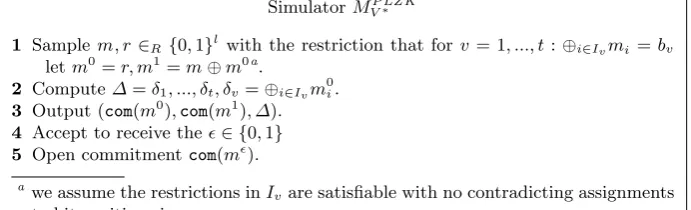
Honest Verifier Zero Knowledge We give a simulator producing the values the Verifier sees distributed perfectly as in our protocol in Figure 7.
SimulatorMP LZK V∗
1 Samplem, r∈R {0,1}l with the restriction that forv= 1, ..., t:⊕i∈Ivmi=bv
letm0=r, m1=m ⊕m0a.
2 Compute∆=δ1, ..., δt, δv=⊕i∈Ivm
0
i.
3 Output (com(m0),com(m1), ∆). 4 Accept to receive the∈ {0,1} 5 Open commitmentcom(m).
awe assume the restrictions inI
vare satisfiable with no contradicting assignments
to bit positions inm.
Fig. 8.Simulator for Linear Zero Knowledge
5
And-proof
In this section, we wish to be able to prove that for an xom(m) to a string m
and for three indices (i, j, k) of the string, it holds thatmi∧mj =mk. This will be done by using a helper triple of values that will be made explicitly for this purpose.
To construct such a proof, we will exploit the following relationship:
x∧y=z if and only ifz=M aj(x, y,0).
b= 0 b= 1 Cheating Prover
Decision Tree
= 0 = 1 = 0 = 1
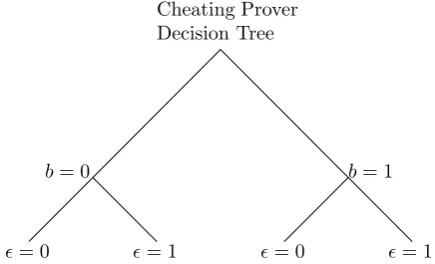
Fig. 9. Overview of the choices a cheating Prover will have in the And-protocol in Figure 10: he can prepare to respond correctly for one choice of bbut not the other. Also, for the equality proofs he can prepare to respond correctly for one of values in thechallenge. Thus in three of four cases the cheating Prover wins.
The proof that this protocol is Honest Verifier Zero-knowledge follows from a later proof where we where we combine all our constructs to prove circuit satisfiability. First we will describe a circuit notation before getting to that.
5.1 Circuit notation
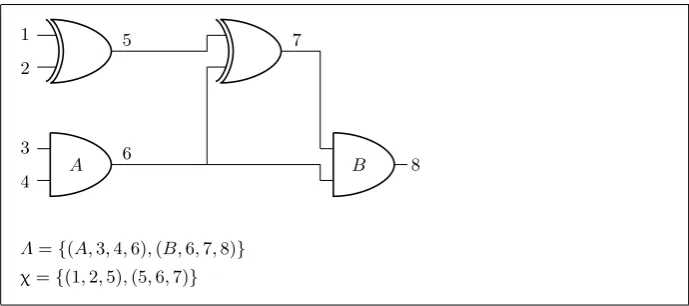
In this section, we define a circuit notation which is convenient for our zero-knowledge proofs. We consider circuit over the AN D, XOR basis. Indices will be used to identify wires, we assume the description C of a circuit includes a public index set I enumerating the wires. When there is a fork in the circuit, the input of the fork and the outputs of the fork will share the same index. Each pair of wires which are not forked will have different indices. The Xor gates will be represented as a triple of values where the first two values will be the index of the input wires and the third will be the index of the output wire. An And gate will consist of 3 indices, the first and second values will be the input wires and the third value will be the index of the output wire.
We denotel the number of wires andαas the number of and gates.
5.2 The Protocol for circuit satisfiability
Our main result and protocol for circuit satisfiability is given in Figure 12 and we give proof of that the protocol is Complete, Sound and Honest Verifier Zero-knowledge in this Section. In the following Section 6 we show this protocol when repeated multiple times realize the Universally Composable Secure. Thus the observant reader may find that the protocol presented here could be simpler while still achieving Honest Verifier Zero-knowledge.
ΦPMul(M, i, j, k, i
0
, j0, k0)
P rover V erif ier
b b∈R{0,1}
If b = 0:
ΦTriplet
π∈RS3 s.t.
(e, f, g) =π(i0, j0, k0) =⇒ (me, mf, mg) = (mi, mj,0)
π
(e, f, g)←π(i0, j0, k0) (e, f, g)←π(i0, j0, k0)
S← {({i, e},0),({j, f},0),({g},0)}
ΦPLZK(M, S)
If b = 1:
ΦMajority
µ∈RS3 s.t.
(e, f, g) =µ(i0, j0, k0) =⇒ (me, mf, mg) = (z, z,·)a
µ
(e, f, g)←µ(i0, j0, k0) (e, f, g)←µ(i0, j0, k0)
S← {({k, e},0),({k, f},0)}
ΦPLZK(M, S)
a µ is assigned a permutation that takes the majority of zeros or onesz
in the triplet (mi, mj, mk0) and places that value in the first two entries
of the tripletµ(mi, mj, mk0) = (z, z,·). The last entry can be any value
ensuring there is always a choice to be made here.
Fig. 10.Multiplication protocol
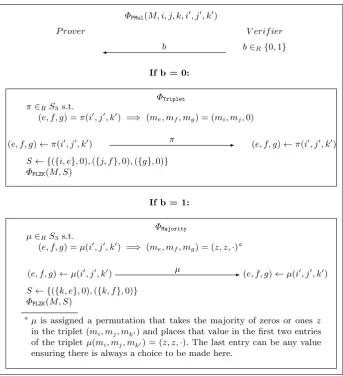
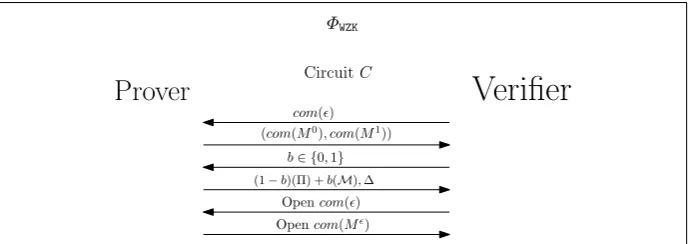
XOR gates. Essentially the Verifier commits to her challenge, then the Prover communications a set of permutations, one for each And-gate, and also prepares a set of linear relationS to be proven in parallel. In the end all the relation in
S are proven usingΦPLZK.
A B
4 3 1 2
5
6
7
8
Λ={(A,3,4,6),(B,6,7,8)}
χ={(1,2,5),(5,6,7)}
Fig. 11.Circuit representation example
of the permuted triple equal the output of the And gate. The helper triple is appended to the string.
The Prover xor-commits to this string. Then, the Verifier will decide which test to perform for the And-gates. That is, the Verifier flips a coin deciding whether to check if the associated helper triple (to each And gate) is a valid permutation of its input with the value 0 or if at least two of those values are equal to the value of the output (of the And gate). The Prover
will reveal the appropriate permutations and they will add the appropriate lin-ear tests to the setS verifying the selected property (permutation or majority equals output bit) for each And-gate. We will then insert the linear tests for Xor relations into the setS. The tests added to theSare all proved in parallel at once using ΦPLZK. The challenge used will be the value which the Verifier committed to at the beginning of the protocol.
In full detail our protocol for circuit satisfiability goes as in Figure 12.
5.3 Generating the set S
This Section describes how the setSof linear relations in the last step of protocol
ΦWZK is carried out given the previous steps has taken place, see Figure 12. The setSdepends only on the structure of public circuitCand is generated by both parties. For each gate inC indexed byh∈[l] we letih, jh, khbe the indices into the stringM (andmas it is a prefix ofM) corresponding to the two input bits and output bit respectively. Also, if his an And-gate there exists an r (think therth And-gate) for the helper triple such that (l+ 3r, l+ 3r+ 1, l+ 3r+ 2) denote the indices inM for the helper triple corresponding toh. Also we abuse our notation a bit and take (er, fr, gr) = µr(Ml+3r, Ml+3r+1, Ml+3r+2) to be
the concrete bit values (not indices) for the majority permutation. We proceed generatingS as follows based on the type of gatehis4:
ΦWZK
Prover
CircuitCVerifier
(1−b)(Π) +b(M),∆ Opencom() Opencom(M)
(com(M0), com(M1)) com()
b∈ {0,1}
Initialize The Prover and Verifier takes as input a circuitC of size|C|=α+β
withαAnd-gates andβlinear gates. The circuit will have exactly one output bit. The Prover takes additionally awitnessxwhich is a satisfying assignment to the circuit input gates.
Verifier The Verifier samples challenges , b∈R {0,1}uniformly at random, for
the equality proofs that follows. The Verifier commits to sending com() to the Prover.
Prover [ evaluation ]The circuit C has an ordering of its wires such that for each indexi∈I miuniquely defines a particular wire. Thus using his witness
xthe Prover generates the string m =m0...ml−1 and sets m a prefix of M. That isMi=mifori∈[l].
Prover [ helper triple ]For And-gatesr= 0, ..., a−1 we have (mir, mjr, mkr)
s.t. mir ∧mjr = mkr. The Prover selects a random permutation πr ∈ S3
and creates a helper triple (Ml+3r, Ml+3r+1, Ml+3r+2) =πr(mir, mjr,0). Let
Π denote this set of permutationsΠ ={πr}r=0,...,a−1.
Prover [ majority permutation ]Also, the Prover find a Majority permuta-tionµr such that if (er, fr, gr) =µr(Ml+3r, Ml+3r+1, Ml+3r+2) thenmkr =er
and also mkr = fr
a. Let
M denote this set of majority permutations M={µr}r=0,...,a−1.
Prover When Prover has formedM=m(π0(mi0, mj0, mk0), ..., πa−1(mia−1, mja−1
, mka−1)) of lengthLhe selects a stringr∈ {0,1}
L uniformly at random and
create M0 = r, M1 = M
⊕r. Then he invokes the Ideal functionality FCOM
twice, sending an Xor commitment (com(M0),com(M1)) to the Verifier. Verifier Sendsbin clear to the Prover.
Prover Ifb= 0 he sendsΠ to the Verifier, ifb= 1 he sendsM.
Prover — Verifier Both run the protocol in Figure 7 with
M,com(M0),com(M1) and the set S =
{(Ir, br)}r=0,...,l as inputs with a
twist: the Verifier will also open his challenge towhen sending it in step 2 and the Prover checks the commitment and aborts if the open operations fails. See Section 5.3 on howS is generated.
aFor the honest Prover such a permutation exists cf. the discussion in Section 5
Fig. 12.Zero-knowledge with Soundness one-half.
And gate The gate athis an And gate we add either{({ih, l+ 3r},0),({jh, l+ 3r+1},0),({kh},0)}or ({kh, ar},0),({kh, br},0) depending on whetherb= 0 orb= 1 in the Verifier challenge.
6
Weak Zero-knowledge
In this section we show our main protocol, in Figure 12, is Honest Verifier Zero-knowledge
Theorem 9. ΦWZK is Honest Verifier Zero-knowledge.
Proof. We show completeness, soundness and zero-knowledge for the protocol in Figure 12.
Completeness We will invoke ΦPLZK in Figure 7 in the end thus if we prove the setS ={(Ir, br)}r=1,...,l is conflict free (e.g. for no i, j we prove mi =
mj∧mi6=mj) and stipulates the structure ofC completeness follows from Theorem 8. We proceed in the structure of C. For each gate indexed by
hwe have correspondingmih, mjh, mkh. If hpoints at the rth And gate it
holds that mih ∧mjh = mkh and regardless the choice of b ∈ {0,1} the
Verifier accepts. To see this considerb= 0: We add{({ih, l+ 3r},0),({jh, l+ 3r+ 1},0),({kh},0)}toS. That is, we check that (mih, mjh,0) =πr(Ml+3r, Ml+3r+1,0) which is correct by construction ofM. If on the other handb= 1
we add toS = ({kh, ar},0),({kh, br},0) checking that (mi, mj,0) = (z, z,·) for z = M aj(π(mih, mjh,0) = mkh which succeeds because the Prover is
honest and actually does input an And gate. For Xor gates we add to the setS, ({ih, jh, mkh},0) checking that the output bit and the two input wires
of an Xor gate XOR to zero. Conflict freeness follows fromC being a valid circuit and the construction ofS follows the structure ofC.
b= 0 b= 1 Cheating Prover Decision Tree
= 0 = 1 = 0 = 1
Soundness For a cheating Prover we show that he convinces the Verifier with probability at most 3
4. For Xor gates soundness 1
2 trivially follows from
The-orem 8. Consider the rth And gates in C indexed by h we have mih ∧ mjh6=mkh and the Prover will try to convince the Verifier otherwise. Since mih∧mjh 6=mkh both conditions (m
i, mj,0) = (z, z,·) and (mih, mjh,0) = πr(Ml+3r, Ml+3r+1,0) will not hold at the same time. However the Prover can prepare the auxiliary triple (Ml+3r, Ml+3r+1, Ml+3r+2) such that he
to convince the Verifier and in the other case he needs to cheat the equality test which from Theorem 8 he can do with probability one-half. Asbis cho-sen independent and uniformly at random the probability that a cheating Prover convinces a Honest Verifier is three quarters.
Zero-knowledge See the simulator in Figure 13. By the hiding property of the commitment scheme the Verifier cannot distinguish the commitments sent by the Prover from the simulated ones. The∆will have the same distribution as in the real execution by the random choice ofm. The distribution on the string M is going to be uniformly distributed as in the real protocol but may have inconsistent bits if the Prover fails both guess onb andthus we rewind. Also if there is any Xor gates inCand the0guess failed we rewind.
Otherwise the Honest Verifier will accept and the conversation is distributed as in the real case.
SimulatorMVW ZK∗
Wait for commitment The Simulator acceptscom(). Message The simulator picks0, b0
∈R{0,1}andm∈ {0,1}l. It then generates a
stringM =mand for each And gate index byhit randomly picks a permuta-tionπr adds a helper triple it can answer forb0: ifb0= 0 it prepares for the
per-mutation test (Ml+3r, Ml+3r+1, Ml+3r+2) = πr(mih, mjh,0) otherwise it
pre-pares for the majority test (Ml+3r, Ml+3r+1, Ml+3r+2) =µr(πr(mih, mjh,0)).
It outputs (com(M0),com(M1)). And challenge The simulator acceptsb.
Permutations and∆ The simulator builds the set S following the structure of
C usingm as the string. However as there is no proper witness in m, some gate(s) will be inconsistent in the sense that for gateh,mihmjh6=mkh. For
inconsistent gates the simulator build δi = ⊕i∈Ihm
0
i )⊕(bh∧0). Thus the
Verifier accepts for0. Notice the number of inconsistent gates increases if the guessb0onbwas wrong with all the tests for the And gates. Because now he has to provideπr or µr which are inconsistent with the helper triples. However if
we get theb=b0 these gates will be successful regardless ofby construction. Xor challenge The simulator accepts.
rewind? If bothb 6=b0 and 6=0 then simulator rewindsV∗ to the beginning. Also if the guess onwas wrong and there is anyXorgates inCthe simulator rewinds.
Open The Simulator opensM.
7
Zero-knowledge for circuit satisfiability
To elevate our Weak Zero-knowledge protocol to have less soundness error we run multiple instances of the Weak protocol in parallel. We show that for security parameterκwe can construct a Universally Composable Secure protocol in the framework by Canetti [3]. We follow the style and flavour of UC advocated in [5]. We give the ideal functionality we which to realize in Figure 14.
FZK
(witness,C,w,sid)
(proven,C,sid)
–
Fig. 14.Zero Knowledge Functionality
ΦZK
Prover
CircuitCVerifier
(1−b)(Π) +b(M),∆ Opencom() Opencom(M)
(com(M0), com(M1)) com()
b∈ {0,1} id
id
The Prover and the Verifier run the zero-knowledge protocol with weak soudnessk
times. The verifier accepts if he accepted in each instance.
Fig. 15.Universally Composable Secure Protocol for Zero Knowledge
Theorem 10. ΦZK securely realizesFZK in theFCOM hybrid model for any static, active adversary.
Proof. We construct a simulator SZK such that every poly-time environment Z
cannot distinguish between the real protocol system FCOM composed withΦZK or
FZKcomposed with SZK. The Simulator will play the role of the honest party. We
Verifier. SZK will determine which to run when the environment Z stipulates
which player is corrupt.
7.1 Corrupt Prover
The simulator proceeds in two steps.
First, the simulator runs each instance of the weak zero-knowledge protocol in parallel: He sends the committed message for the commitment of the challenge to the environment. The simulator awaits the commit messages for each of the xor-commitments. The simulator then selects a random bit which selects the permutation or majority test, records it and sends it to the environment. The simulator records the value sent to him for the given test. The simulator then selects a random∈R {0,1} and sends a reveal command for the commitment functionality for the given . The simulator awaits that the environment sends the reveal command intended for theM. The simulator then records if a given instance would result in a verifier accepting or rejecting.
Second, if for any instance, a verifier would reject. The simulator aborts. Otherwise, he scans each instance looking for one where the substring associated to the circuit contains a valid assignment to the circuit which has output one. If no witness is found the simulator aborts. The simulator selects one of those inputs and feeds it to FZK. This completes the description of the simulator.
We will proceed to show that SZK◦FZK stat
≡ ΦZK ◦FCOM. We can see that
the messages sent by the verifier to the prover in the real world are perfectly indistinguishable from those sent by the simulator to the environment. The only thing the environment can use to distinguish between these two cases is the output. Now there are three cases, when an abort occurs due to rejection in an instance, when a valid witness is provided for one of the instances and finally when no witness is provided. When an abort occurs due to a failed test, the probability that this view would have been generated is the same in both worlds. The same applies when a witness is provided in one of the xor-commitments. The only case that the views are distinguishable is when the environment passes each instance without providing a valid witness. Fortunately, by soundness of the weak zero-knowledge protocol, this only occurs with negligible probability. Thus, we have that the views are statistically indistinguishable.
7.2 Corrupt Verifier
same in both the real and ideal world. As a result, the real and ideal worlds are indistinguishable. An overview of the Simulator is given in Figure 17.
SP rover W ZK
FW ZK
Z
The SimulatorSP rover
ZK creates the view a corrupt Prover sees for the environment
Z which is indistinguishable from the real protocol execution, while providing the input of the Prover to the ideal functionality.
Initialize Upon receiving a circuitCfrom the environment the Simulator samples
∈R{0,1}
Commit The simulator honestly commits tocreatingcom().
Prover commits The environment provides commitmentscom(M0) andcom(M1) to the simulator. By extractability of the ideal commitment functionality FCOM
the messageM =M0
⊕M1is computed bySP rover ZK .
Follow protocol After this step the simulator complete the protocol with the environment.
Invoke Ideal FZK with witnesswwhich is a prefix ofM. The ideal functionality
SV erif ier W ZK
FW ZK
Z
The SimulatorSV erif ier
ZK creates the view a corrupt Verifier sees for the
environmentZ which is indistinguishable from the real protocol execution given the (proven, C, pid) output from the ideal functionality.
Initialize Upon receiving (proven, C, sid) from the ideal functionality the Simu-lator computesL=l+ 3α, where lis the number of wires inC and αis the number of And-gates inC.
Accept Challenge Commitment Upon receivingcom() from the environment, the simulator stores . The simulator picks M
∈R {0,1}L, and to
gener-ate a ∆ = δ1, ..., δl string that it can answer it does the following: First it
generates the set S = {(Iv, bv)}v−1,...,l as in Section 5.3. Then it computes
δv=Li∈IvM
i ⊕(bv∧). The simulator setM1−= 0L.
Commit The Simulator sends (com(M0),com(M1)) to the environment.
Completes the protocol The simulator completes the protocol with the envi-ronment.
Fig. 17.Simulator in case of the corrupted Verifier
8
Empirical studies
The protocol has been implemented in C for fine grained control over the Big-Oh constants. The implementation is available at
http://tinyurl.com/om6vvh6
Our test setup is two machines acting as Prover and Verifier connected on a GigaBit ethernet network of our department. Our machines has 8 GigaBytes of memory and Intel(R) Core(TM) i7-3770K CPU @ 3.50GHz with 8 cores.
Our primary benchmark application is that of AES. We have an optimized AES-circuit5 with 6800 And-gates and 26816 linear gates taking 50 ms with
soundness one-half. Communication complexity is 4 bits per And-gate and 1 bit per linear gate for soundness one quarter. Below we see execution time increase with the number of And-gates.
9
Conclusions
We have presented an information theoretic construction extending commit-ments to zero knowledge proofs. We show that when our construction builds 5 Thanks to Nigel Smart and his team at Bristol,
0 50 100 150 200 250 300 350
0 20000 40000 60000 80000 100000 120000 140000 160000 180000
Execution time (ms)
Size of test Circuit with only And-gates RTZ Zero Knowledge protocol, soundness 1/2
'perf.dat'
on top of a UC-secure commitment scheme it is UC-secure. The flavor of sup-ported proofs are circuit satisfiability. The statement to be proven is a circuit for which the Prover knows a satisfying assignment for the input gates. On the theoretical side our scheme exhibits small constants in addition to the underlying commitment scheme.
We have an implementation of our scheme using UC commitments in the Random Oracle Model, where the oracle is implemented by SHA-512. We can prove knowledge of an AES-key encrypting a particular plaintext to a particular ciphertext in less than 500 milliseconds with soundness error 1
240.
Acknowledgement
References
1. Michael Ben-Or, Oded Goldreich, Shafi Goldwasser, Johan H˚astad, Joe Kilian, Silvio Micali, and Phillip Rogaway. Everything provable is provable in zero-knowledge. InAdvances in Cryptology-CRYPTO 88, pages 37–56, 1988.
2. Gilles Brassard, David Chaum, and Claude Cr´epeau. Minimum disclosure proofs of knowledge. Journal of Computer and System Sciences, pages 156–189, 1988. 3. Ran Canetti. Universally composable security: A new paradigm for
cryp-tographic protocols. Cryptology ePrint Archive, Report 2000/067, 2000. http://eprint.iacr.org/.
4. Ignacio Cascudo, Ivan Damg˚ard, Bernardo Machado David, Irene Giacomelli, Jes-per Buus Nielsen, and Roberto Trifiletti. Additively homomorphic UC commit-ments with optimal amortized overhead. InPublicKey Cryptography PKC 2015 -18th IACR International Conference on Practice and Theory in Public-Key Cryp-tography, Gaithersburg, MD, USA, March 30 - April 1, 2015, Proceedings, pages 495–515, 2015.
5. Roanld Cramer, Ivan Damg˚ard, and Jesper Nielsen. Secure Multiparty Computa-tion and Secret Sharing. Cambridge University Press, 1st edition, July 2015. 6. Claude Cr´epeau, Jeroen van de Graaf, and Alain Tapp. Committed oblivious
trans-fer and private multi-party computation. InAdvances in Cryptology—CRYPT0 95, pages 110–123. Springer, 1995.
7. Ivan Damg˚ard, Bernardo Machado David, Irene Giacomelli, and Jesper Buus Nielsen. Compact VSS and efficient homomorphic UC commitments. InAdvances in Cryptology - ASIACRYPT 2014 - 20th International Conference on the The-ory and Application of Cryptology and Information Security, Kaoshiung, Taiwan, R.O.C., December 7-11, 2014, Proceedings, Part II, pages 213–232, 2014.
8. Ivan Damg˚ard and Yuval Ishai. Scalable secure multiparty computation. In Cyn-thia Dwork, editor,Advances in Cryptology - CRYPTO 2006, volume 4117 of Lec-ture Notes in Computer Science, pages 501–520. Springer Berlin Heidelberg, 2006. 9. Tore Kasper Frederiksen, Jesper Buus Nielsen, and Claudio Orlandi. Privacy-free garbled circuits with applications to efficient zero-knowledge. Cryptology ePrint Archive, Report 2014/598, 2014. http://eprint.iacr.org/.
10. O. Goldreich, S. Micali, and A. Wigderson. How to play any mental game. In
Proceedings of the Nineteenth Annual ACM Symposium on Theory of Computing, STOC ’87, pages 218–229, New York, NY, USA, 1987. ACM.
11. Oded Goldreich, Silvio Micali, and Avi Wigderson. Proofs that yield nothing but their validity or all languages in np have zero-knowledge proof systems. Journal of the ACM (JACM), 38(3):690–728, 1991.
12. S. Goldwasser, S. Micali, and C. Rackoff. The knowledge complexity of interactive proof systems. SIAM Journal of Computing, pages 186–208, 1989.
13. Yuval Ishai, Eyal Kushilevitz, Rafail Ostrovsky, and Amit Sahai. Zero-knowledge from secure multiparty computation. In Proceedings of the thirty-ninth annual ACM symposium on Theory of computing, pages 21–30. ACM, 2007.
14. Marek Jawurek, Florian Kerschbaum, and Claudio Orlandi. Zero-knowledge using garbled circuits: how to prove non-algebraic statements efficiently. In2013 ACM SIGSAC Conference on Computer and Communications Security, CCS’13, Berlin, Germany, November 4-8, 2013, pages 955–966, 2013.
16. Joe Kilian. A note on efficient zero-knowledge proofs and arguments. InProceedings of the twenty-fourth annual ACM symposium on Theory of computing, pages 723– 732. ACM, 1992.
17. MichaelO. Rabin, Yishay Mansour, S. Muthukrishnan, and Moti Yung. Strictly-black-box zero-knowledge and efficient validation of financial transactions. In Ar-tur Czumaj, Kurt Mehlhorn, Andrew Pitts, and Roger Wattenhofer, editors, Au-tomata, Languages, and Programming, volume 7391 ofLecture Notes in Computer Science, pages 738–749. Springer Berlin Heidelberg, 2012.
A
Reproducing our empirical studies
We have implemented our protocol described in Figure 12 for Weak Zero-knowledge. The implementation can be found at
http://tinyurl.com/om6vvh6
A.1 Software structure
The software project is written from scratch using only few dependencies on the system like some libstdc functionality. We do this in order to have fine grained control of the performance of our program. The structure is as follows:
platformInside the platform directory we have all the OS/HW dependent code
commonInside common we have library code needed to implement the proto-col, including network management inCArenaand data-structures in project ds.
empiricalZK holds two projects: RTZ14 which is the code for protocol de-scribed in this paper.IKOS will later be populated with an efficient imple-mentation of the MPC in the HEAD idea which is in its infant stage right now. We wish to publish a comparison between IKOS and RTX14 (this pro-tocol) in a follow up paper.
All projects are GNU Auto-Make/Conf projects producing a static library and some also an executable. Each project defines a configuration item with version control for maintenance.
A.2 Dependencies
The code is written with in C for speed and portability. It includes work by Nayuki Minase published at http://www.nayuki.io/page/fast-sha2-hashes-in-x86-assembly.
The build system on FreeBSD 10, OSX and GNU Linux requires: GNU Bash 4.3.11(2)
Automake 1.14 Autoconf 2.69
Or on Windows 8/10 a working Community version of Visual Studio Express 2013 or later is required.
A.3 Getting the Source
Install git on your system and do
git clone http://tinyurl.com/om6vvh6
A.4 Building from Source code, FreeBSD, Linux and OSX
On these systems building the source is done by changing directory to where you have checked out the source and locating thebuild.shscript.
user@host $ ./build.sh release
Will build the prover executable in empiricalZK/rtz14/linux/src/prover.
A.5 Building from Source code, Windows 8/10
On Windows we have a test solution that as a bi-product of running the test
pro-grams also produces the prover.exe in empiricalZK/rtz14/win64/rtz14/Release/prover.exe. You can run this executable from a Command Prompt invoking it with no
argument to see your options and for running it providing arguments to do a Zero-knowledge proof.
A.6 Reproducing our results
Our benchmark application is proving knowledge of a particular AES key given a public plaintext and ciphertext. The structure of the circuit we prove to satisfy is depicted in Figure 18. The circuit includes public constant assignments for the plaintext and the Prover convinces the Verifier that he has knowledge of an Aes-Key encrypting this particular plaintext to a ciphertext built into the circuit. That is, our binary AES is extended with the top-triangle on Figure 18 which is a small comparison circuit with public constants stipulating the expected ciphertext and comparing with the output of the AES circuit (the larger triangle below it). In the end all the Verifier learns is that the prover has a witness
w making the (public) circuit true, thus encrypting the given plaintext to the expected ciphertext.
Our lab computers has the following specifications: CPU: i7-3770K CPU @ 3.50GHz with 8 cores Mem: 8Gb of Ram
Net: Gigabit LAN
OS: 3.13.0-59-generic #98-Ubuntu SMP Fri Jul 24 21:05:26 UTC 2015 x86_64 x86_64 x86_64 GNU/Linux
for both Verifier and Prover. On the machine intended for the Prover do
./rtz14 -circuit ../test/AES -witness 00000000000000000000000000000000 -port 2020
plaintext key/witness
Comparison circuit epilog checking for the expected ciphertext. One bit of out-put to be proven 1 in the end.
AES Circuit The one bit output the Verifier learns
Fig. 18.A modified binary AES circuit for proving knowledge of a key encrypting a particular plaintext to a particular ciphertext.
0 1 1 0 0 1 1 0 1 0 0 1 0 1 1 1 1 1 0 1 0 0 1 0 0 0 1 0 1 0 1 1 1 1 1 1 0 1 1 1 0 1 0 1 0 0 0 1 0 0 1 1 0 1 0 0 1 1 0 1 1 1 0 0 0 0 0 1 0 0 0 1 0 0 1 1 0 0 1 0 0 1 0 1 1 1 1 1 1 0 0 1 1 0 1 0 0 1 0 1 0 0 1 1 0 0 1 0 1 1 0 0 1 1 0 1 0 1 0 0 0 1 1 1 0 1 0 0
To start the Verifier you need the ip address of the Prover, assuming it is xxx.yyy.zzz.wwwexecute the following on the Verifier Machine:
./rtz14 -circuit ../test/AES -port 2020 -ip xxx.yyy.zzz.www
B
Concrete example: ZK-proof that (
x
1∧
x
2)
⊕
(
x
3⊕
x
4)
is satisfiable
We will give an example here where a Prover proves in Zero-knowledge that he knows a satisfying assignment for the circuit (x1∧x2)⊕(x3⊕x4). In fact the
steps illustrated by this example is those ofΦP M ul in Figure 10. We will abuse notation a bit for a cleaner presentation. Openings of all protocols invoked in the follow should be pick up and done in the very end. That is, when we invoke e.g. the protocol for equality thexomcommitment is opened. However this should in a real execution be postponed to the very end for the proof of the entire circuit.
B.1 Step 1:
Generate a string a stringwof length n+ 3a. All bit positions in this string are set to⊥initially. Recallnis the number of input wires and gates all together in the circuit.ais the number of and gates are present in the circuit. We will need the Prover to commit to some helper triples for each and gate. As we have 4 input wires, 3 gates one of which are an and gate we have our stringwof length 10, as n= 7 anda= 1.w= (⊥,⊥,⊥,⊥ ⊥,⊥,⊥,⊥,⊥,⊥).
B.2 Step 2: Generate satisfying assignment with output one
In the first step, the Prover generates a satisfying assignment for the circuits. In essence he selects a valid assignment for the circuit which outputs 1. Input these values in the string.
– x5=x1∧x2
– x6=x3⊕x4
– x7=x5⊕x6
– x1= 1, x2= 1, x3= 0, x4= 0
– x5= 1, x6= 0
– x7= 1
– foreachi∈ {1, . . . ,7},wi ←xi
w= (1,1,0,0,1,0,1,⊥,⊥,⊥)
As there is one And gate in the circuit we have left room for at one helper triple, that what the three⊥are placeholders for.
B.3 Step 3: Append permutation of inputs for And gates and include permutations in set
In the second step, for each And triple, the Prover generates a random permuta-tionπ. The only And triplet is of the form (p, i, j, k) = (1,1,2,5) wherepis the index of the And triple,i, jare the indices of the input operands to the And gate andkis where the result is. That is the Prover prepares to convince the Verifier of the And relationshipm1∧m2=m5 by appending a random permutation as
– supposeπwas randomly selected to beπ(1,2,3) = (2,3,1)
– (d1, d2, d3)←(2,3,1) =π(1,2,3)
– (wz+d1, wz+d2, wz+d3) =wz+2, wz+3, wz+1←(w1, w2,0)
– µwill be chosen such thatµ(1,2,3)∈ {(2,3,1),(3,2,1)}
– Prover setsΠ ←Π·(c, π)
– Prover setsP ←P·(c, µ)
w= (1,1,0,0,1,0,1,1,1,0)
B.4 Step 4: use commitment with linear proofs to commit to circuit and helper triples
In the third step, the Prover xor commits to this constructed message w with the circuit and the helper triples. That is he appliesΦcommit(w) such that both Prover and Verifier obtain:
– W =xom(w) := (com(w0), com(w1))
B.5 Step 5: Permutation test selection
In this step, the Verifier selects which permutation test will be used for the multi-plicative proof. In particular, will the Verifier check that (mn+1, mn+2m, mn+3)
is a permutation of (m1, m2,0) or that a received permutationp∈S3, such that
for d1, d2, d3 := π(1,2,3) that such that m5 = mn+d1 ∧m5 = mn+d2. In this case, it would bem5=m10,m5=w9 (sincem(1,2,3) = (3,2,1))
– The Verifier selects which test to do
B.6 Step 6: Prover circuit commitment
This step combines the first part of the equality test for the and triples and the equality tests. The Prover will reveal the δ for the different proofs of equality. This forces -due to the proof of equality- a dishonest Prover to decide which challenge he can’t respond to. If we think of this protocol as a sigma protocol, this is the point where the Prover has finished committing to his values.
1. If triplet challenge was selected
2. The Prover sends the permutation πof (w1, w2,0)
3. The Prover and Verifier now executesΦEq(W,1,9)ΦEq(W,2,10)ΦZeq(W,8). If all three tests passes the Verifier accepts.
1. If the Majority challenge was selected 2. Prover sends µe.g. say (2,3,1) to Verifier.
3. Now since the helper triple is in index 8,9,10 this permutation translates into the triple (w9, w10, w8)
B.7 Step 6: The linear gates
We still need the Prover to prove the two Xor gates in the circuit. That is we need to provew0
3⊕w04⊕w60=w31⊕w14⊕w16and thatw05⊕w06⊕w70=w15⊕w61⊕w17.
This can be done using the generalized equality boxΦLZK(W,{(I1,0),(I2,0)})
whereI1={3,4,6}andI2= 5,6,7.
Recall the circuit is public and at this point the Prover has shown the rela-tionships between bit positions of the circuit encoded inw. Thus the Verifier is convinced thatw10 will hold the result.
B.8 Step 7: The final step
C
Inequality protocol and proofs
M =xom(m) = (com(m0),com(m1)) Prover inequality between two bits of the
committed string.
ΦInequality(M, i, j)
Prover Verifier
δ:=m0
i⊕m0j
δ
∈R{0,1}
Reveal(M, )
if v⊕m
i ⊕mj = δ
accept else reject Fig. 19.Inequality
C.1 Zero-knowledge
Completeness: Sincemi
6
=mi, we can see that
case 1: ifmi
0=m
j
0thenmi16=mj1in which case= 0 =mi0⊕m
j
0=mi1⊕m1j⊕1.
case 2: ifmi
06=m
j
0thenmi1=mj1in which case= 1 =mi0⊕m
j
0=mi1⊕m1j⊕1.
Soundness: ifx=y thenmi
0⊕m
j
0=mi1⊕m1j and therefore for any value of
there exists a value vsuch that the Verifier will not accept. As such a cheater is detected with probability 1/2.
Honest Verifier Zero-Knowledge: To prove the protocol is zero-knowledge for a Verifier we give the description of a simulatorMVN eq∗ that generates a view
(δ, mb) indistinguishable from a real execution.
SimulatorMN eq V∗ (i, j)
1 Pick at randomm, r∈ {0,1}l, mi
6
=mj.
2 Computeδ=m0
i⊕m0j and output (com(m0),com(m1), δ) to the VerifierV∗.
3 Accept in{0,1}. 4 Opencom(m)
The Simulator follows the protocol with no knowledge of a particular witness