Multi-frame Super Resolution using Locally
Bilateral Variation
Pallavi Kulkarni1, Prof. B.S. Patil2
PG Student [VLSI], Dept. of ECE, PVPIT Engineering College, Pune, Maharashtra, India1
Assistant Professor, Dept. of ECE, PVPIT Engineering College, Pune, Maharashtra, India2
ABSTRACT: Super resolution (SR) reconstruction refers to the process of combining a sequence of under-sampled and degraded low-resolution (LR) images in order to produce a single high-resolution (HR) image. The LR input images are assumed to portray slightly different views of the same scene. In broad sense, super-resolution techniques attempt to improve the spatial resolution by incorporating into the final result the additional new details that are revealed in each LR image. The basic assumption for super-resolution processing is that some LR images contain novel and non-redundant information about the scene details.
Although the concept of SR reconstruction already exists for more than a decade, relatively little attention was given to SR reconstruction of moving objects. Moving objects are often interesting parts in image sequences. In many surveillance applications, the most interesting are dynamic events consisting of changes occurring in the scene such as moving persons or moving objects. This paper proposes ways to improve the quality of the output high resolution image using regularization factors which will help in sharpening the edges and managing the smooth regions using bilateral total variation which is locally adapted and consistency of gradients. The combination of proposed regularization provides superior results as seen in experimental results.
KEYWORDS: Super Resolution, Multi frame super resolution, regularization.
I.INTRODUCTION
In most digital imaging applications, high-resolution images or videos are usually desired for later image processing and analysis. The desire for high resolution stems from two principal application areas: improvement of pictorial information for human interpretation; and helping representation for automatic machine perception. Image resolution describes the details contained in an image, the higher the resolution, and the more image details.
The image details (high-frequency bands) are also limited by the optics, due to lens blurs (associated with the sensor point spread function (PSF)), lens aberration effects, aperture diffractions, and optical blurring due to motion. Constructing imaging chips and optical components to capture very high-resolution images is prohibitively expensive and not practical in most real applications, e.g. widely used surveillance cameras and cell phone built-in cameras. Besides the cost, the resolution of a surveillance camera is also limited in the camera speed and hardware storage. In some other scenarios such as satellite imagery, it is difficult to use high resolution sensors due to physical constraints. Another way to address this problem is to accept the image degradations and use signal processing to post-process the captured images, to trade off computational cost with the hardware cost. These techniques are specifically referred to as Super-Resolution (SR) reconstruction.
Super-Resolution (SR) are techniques that construct high-resolution (HR) images from several observed low-resolution (LR) images, thereby increasing the high-frequency components and removing the degradations caused by the imaging process of the low-resolution camera. The basic idea behind SR is to combine the non-redundant information contained in multiple low-resolution frames to generate a high-resolution image.
There are several major steps in super-resolution reconstruction: registration, warping, blurring, motion cancellation, and merging the converted LR frames into a final HR image. Registration is the process of determining where sampled
LR sample values to the HR resolution. The images are processed to remove blur and noise. Finally the warped, processed LR images are merged to form the HR image.
Most of the explored SRR algorithms consist of the three stages (Fig. 1). These steps can be implemented separately or simultaneously according to the reconstruction methods adopted. First, the SRR algorithm receive several low-resolution corrupted images as the inputs. Then the registration or estimation process estimate the relative shifts between LR images compared to the reference LR image with fractional pixel accuracy. Obviously, accurate sub-pixel motion estimation is a very important factor in the success of the SRR algorithm. Since the shifts between LR images are arbitrary, the registered HR image will not always match up to a uniformly spaced HR grid. Thus, non-uniform interpolation is necessary to obtain a uniformly spaced HR image from a composite of non-uniformly spaced LR images. Finally, image restoration is applied to the up-sampled image to remove blurring and noise.
Fig.1 Basic Structure of Super-Resolution Reconstruction
Two main approaches to SR have been studied and developed in the in the recent years.
•Single super-resolution: Single-image SR is the problem of estimating an underlying HR image, given only one observed LR image. In this case, it is assumed that there is no access to the imaging step so that the starting point is a given LR obtained according to some known or unknown conventional imaging process.
•Multi frame image super-resolution: The Basic premise for increasing the spatial resolution in multi-frame SR techniques is the availability of multiple LR images captured from the same scene. Multi-frame SR methods work effectively when several LR images contain slightly different perspectives of the scene to be super-resolved, i.e. when they represent different looks at the same scene. In this case, each image is seen as a degraded version of an underlying HR image to be estimated, where the degradation processes can include blurring, geometrical transformations, and down-sampling.
II.MULTI FRAME SUPER RESOLUTION
Broadly speaking, multi-frame SR algorithms can be classified according to three main approaches followed:
Interpolation Approach:
This approach is the most intuitive method for SR image reconstruction. The three stages presented in Fig. 2 are performed successively in this approach:
(i) Estimation of relative motion, i.e., registration
(ii) Non uniform interpolation to produce an improved resolution image;
(iii) De-blurring process. This method has low computation and can be used in the real-time system but the degradation models are limited, therefore, this algorithm can apply on few applications.
Frequency Domain Approach:
Regularization:
Typically, the SRR algorithm is an ill-posed problem due to an insufficient number of LR images and ill-conditioned blur operators. Procedures adopted to stabilize the inversion of ill-posed problem are called regularization. In this section, deterministic and stochastic regularization approaches for SRR algorithm are presented. Traditionally, constrained least squares (CLS) and maximum a posteriori (MAP) SR image reconstruction methods are introduced.
III.PROPOSED SYSTEM
The proposed work focuses on retaining the edges and flat regions as sharp and smooth in high resolution image being constructed as resultant super resolved image. In this method locally adaptive bilateral total variation (LABTV) operator acts as regularization constraint which maintains the smoothness of reconstructed image. To further improve the reconstructed image, gradient error is introduced. To improve the robustness of the method adaptive Lp norm is used to measure the locally adaptive bilateral total variation (LABTV).
The improved high resolution image is then processed using adaptive filtering aiming to improve the quality of the image by further reducing the noise.
Below flow graph shows the steps being flowed to implement the proposed method.
IV.SYSTEM IMPLEMENTATION
To obtain a stable super resolution method specific regularization is imposed on the observation model which forms a relationship between high resolution image and its corresponding low resolution image.
values. The solution also contains the gradient error term which aims to maintain the consistency between the gradient of estimated HR image and that of original LR images.
The bilateral total variation model depends on the weighting coefficients α, which in turn affects the High Resolution image. A locally adaptive bilateral total variation having small α on edges and large α on smooth regions yield the desirable results. It aims at preserving the edges and controlling the noise.
This regularization depends on pixels and their shift. It also has adaptive weighting coefficient matrix consisting weighing coefficients.
Proposed method also uses Lp norm (1 < P < 2) over pixels.
Proposed adaptive regularization estimates norm parameter p and weighting coefficients from initially reconstructed high resolution image. Proposed method also considers uniformity of gradient between input LR image and HR image being reconstructed.
To improve the performance of proposed method Adaptive filter is used which helps in attain higher signal to noise ratio. This adaptive filter finds the correct coefficient matrix using weight training. Such derived coefficient then acts as the initial weight matrix in noise removal and cancellation process.
V. RESULT AND DISCUSSION
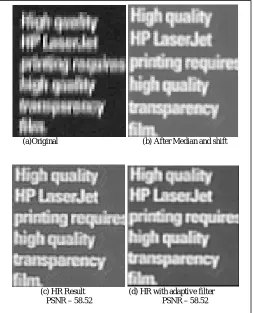
Various low resolution images are considered for evaluating the results of proposed method. Below are some of sample input images and their corresponding results provided by proposed algorithm.
Experimental results show that algorithm is providing visually effective results implying noise reduction and along with edge preserving and maintaining smooth region.
(a)Original (b) After Median and shift
(c) HR Result (d) HR with adaptive filter PSNR – 58.52 PSNR – 58.52
VI.CONCLUSION
In this paper we propose a method which makes use of Locally Adaptive Bilateral Variation as regularization term which is measured with adaptive Lp norm. Gradient consistency is considered while forming the solution. With proposed method we are staring this long journey towards in the vast domain of Super Resolution. Experiment results show the super resolved images as output with higher quality and resolution factors. This method can be further extended for video sequences.
This framework can be extended in various ways to achieve progress in various image processing applications. The immediate work that can be carried forward will be applying the multi frame resolution framework to video input rather than fixed number of fixed images and then observing the visual changes and improvement offered. This computation can be further extended in remote sensing and medical imaging filed to achieve utmost resolution factor.
REFERENCES
[1] R. Tsai, T. Huang, Multi-frame image restoration and registration, in: Advances in Computer Vision and Image Processing, vol. 1, no. 2, JAI Press Inc., Greenwich, CT, 1984, pp. 317–339.
[2] S. Lertrattanapanich, N.K. Bose, High resolution image formation from low resolution frames using Delaunay triangulation, IEEE Transactions on Image Processing 11 (12) (2002) 1427–1441.
[3] N. Nguyen, P. Milanfar, An efficient wavelet-based algorithm for image super resolution, in: Proceedings of International Conference on Image Processing, vol. 2, Vancouver, BC, Canada, 2000, pp. 351–354.
[4] H. Stark, P. Oskoui, High resolution image recovery from image plane arrays, using convex projections, Journal of the Optical Society of America A 6 (11) (1989) 1715–1726.
[5] A.J. Patti, Y. Altunbasak, Artifact reduction for set theoretic super resolution image reconstruction with edge adaptive constraints and higher-order interpolants, IEEE Transactions on Image Processing 10 (1) (2001) 179–186.
[6] X. Zhang, E.Y. Lam, E.X. Wu, K.K. Wong, Application of Tikhonov regularization to super-resolution reconstruction of brain MRI image, in: Lecture Notes in Computer Science, vol. 4987, 2008, pp. 51–56.
[7] S. Farsiu, M.D. Robinson, M. Elad, P. Milanfar, Fast and robust multi- frame super resolution, IEEE Transactions on Image Processing 13 (10) (2004) 1327–1344.
[8] XuelongLi, YantingHu, XinboGao, DachengTao, BeijiaNing, “A multi-frame image super-resolution method” Signal Processing vol 90 pp.405–414, 2010
[9] Chuen-Yau Chen, Chih-Wen Hsia, “Adaptive Filter Based on TDBLMS Algorithm for Image Noise Cancellation” IEEE pp.671–674, 2010 [10] P. Milanfar, Super-Resolution Imaging. Boca Raton, FL, USA: CRC Press, 2010.