Available online:
http://edupediapublications.org/journals/index.php/IJR/
P a g e | 14Design and Analysis of Detection and Rectification of Distorted
Fingerprints
1
Erupula NagaRaju, 2 P.Ashok kumar
1
M.Tech student, Dept of CSE, Vijaya Engineering college, , Ammapalem, Khammam,Telangana, India
2
Assosciate professor, Dept of CSE,Vijaya Engineering college, , Ammapalem, Khammam,Telangana, India
Abstract:In this paper, we encouraged novel algorithms to determine and correct skin distortion centered on a single fingerprint image. Distortion detection is demonstrated as a two-class classification situation, for which the registered ridge orientation map and period map of a fingerprint are precious because the feature vector and a SVM classifier is knowledgeable to behave the classification mission. Distortion rectification (or equivalently distortion field estimation) is analyzed as a regression quandary, the place the input is a distorted fingerprint and the output is the distortion area. To simplify this difficulty, a database (referred to as reference database) of various distorted reference fingerprints and matching distortion fields is constructed within the offline stage, and then within the on-line stage, the closest neighbor of the input fingerprint is deliberate within the reference database and the an identical distortion area is used to change (Convert) the input fingerprint right into a normal fingerprints.
Keywords- Elastic distortion of fingerprints, SVM classifier, and Distortion detection.
I. INTRODUCTION
Over the last forty years there has been a rapid developmentin automatic fingerprint recognition technologies. Yet, therestill exist challenging research problems in this field, forinstance,
recognizing low quality fingerprints.
Fingerprintmatcher is very sensitive to quality of image as seen inFVC2006 [3], where the matching accuracy of the samealgorithm varies significantly for different databases due todissimilarity in image quality. The difference between theresult in
accuracies of plain, rolled and latent
fingerprintmatching is even greater as seen in technology evaluationsconducted by the NIST. Fingerprint recognition systems canbe classified into two types- a positive system and a negativesystem. A positive recognition system is the one in which
theuser is cooperative and wishes to be identified. For instancephysical access control systems. In a negative recognitionsystem the user(e.g. criminals) is not cooperative and avoidsidentification, for instance identifying persons in watch lists.In a positive recognition system, low quality will lead to falserejection of legitimate users and will lead to inconvenience.Whereas, in a negative recognition system, the consequencesof low quality will be much more serious as malicious usersmay intentionally reduce their fingerprint quality to avoiddetection . In fact, it has been observed in many cases thatthe criminals have attempted to avoid identification
bysurgically altering or burning their
fingerprints.Hence it is of utmost importance to
address the problem fornegative fingerprint
recognition system by detecting lowquality
fingerprints and improving their quality, to avoidfalse non-matches or false matches. Degradation in quality
offingerprint can geometric or photometric.
Photometricdegradation is caused by non-ideal skin conditions, dirtysensor surface, complex mage background etc. Whereasgeometric degradation occurs due to skin distortion.Photometric degradation has been widely addressed alongwith evaluation and enhancement algorithms . But the issueof geometric degradation has yet not received sufficientattention and so we aim to attend to this problem.Detection of
distorted fingerprint is viewed as a
Available online:
http://edupediapublications.org/journals/index.php/IJR/
P a g e | 15Fig 1- Examples of 10 distortion types in Tsinghua DF database
To extract a meaningful vector, we register the fingerprintsin a fixed coordinate system.. For this, we use a multireference based fingerprint registration approach. Referencefingerprints are prepared in the offline phase and registeredin online phase. A reference fingerprint is registered basedon the center of its finger and corresponding direction. Forthose
fingerprints whose core points can be
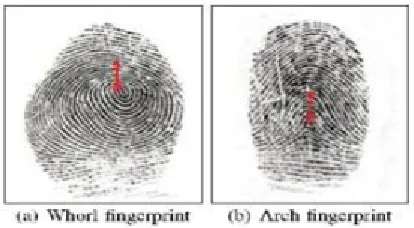
accuratelydetected by a Poincare index based method, the pointwhich is the upper core point is used as the finger center. Forarch fingerprints and those fingerprints whose upper corepoints cannot be detected correctly, we will manuallyapprox. and fix the center point. Finger direction is definedto be vertical to finger joint and will be manually marked forall fingerprints. Since the reference fingerprints wereregistered inthe offline stage, manual working is acceptable. Fig.2 showsthe finger center and direction for two referencefingerprints.
Fig 2- The centre (indicated by red circle) and direction(indicated by red arrows) of two fingerprints
Online Fingerprint Registration
Input fingerprint is registered in the online the stage byextracting the features like orientation map and period map.The online registration mainly depends on upper core pointof the input fingerprint. Therefore there is a possibility oftwo cases such when the upper core point is detected andother when the upper core
point is not detected.If we don’t get the upper core point , then whole finger printis taken into consideration so as to find the pose information.If we get the upper core point , then we align the upper corepoint to the center point of reference fingerprints. Afterdetecting the upper core point , finally we register the twoimportant features of fingerprint to the fixed coordinatesystem by using the obtained pose information.
II. RELATED WORKS
Due to the importance of recognizing distorted fingerprints, Researchers have proposed a number of methods and severalfingerprint matching approaches. Few of them are as follows:
Xinjian Chen, Jie Tian suggested Algorithm based on Normalized Fuzzy Similarity Measure for Distorted FingerprintsMatching. This paper suggests a novel algorithm, normalized fuzzy similarity measure (NFSM), to handle the nonlineardistortions. The proposed algorithm consists of two main steps. In the first step, the template and input fingerprints werelined up. In this process, the local topological structure matching was presented to amend the robustness of globalalignment. In the second step, the method NFSM was presented to compute the similarity betwixt the template and inputfingerprints.
In Luo’s method, an uncertain bounding box was used during the matching process. The process is
robust tononlinear deformations betwixt the
fingerprint images. However, the distortion among the fingerprints from the same fingerare captured from the Cross Match sensor is too large. In order to endure matching minutiae pairs that are further obscurebecause of distortions, the size of the bounding boxes has to be increased. However, as a side effect, it gives a very highprobability for those non matching minutiae pairs to get paired, which
results in a higher false acceptance rate.
Thesuggested algorithm was assessed on fingerprints databases of FVC2004.
Available online:
http://edupediapublications.org/journals/index.php/IJR/
P a g e | 16Fernando Alonso-Fernandez and Javier Ortega-Garcia, proposed a relative study of Fingerprint Image-Quality EstimationMethods. In this work, existing approaches have been divided into three parts. First, those that uses local features of theimage. Second, those that use global features of the image. Third, those that address the problem of quality assessment as aclassification problem. Local and global image features are extracted utilizing different sources: direction field, Gabor filterresponses, power spectrum, and pixel intensity values. They have also
tried a selection of fingerprint image–
qualityestimation algorithms. The consequence of low-quality samples in the verification performance is also studied for a widelyavailable minutiae-based fingerprint matching system. Experimental results show high correlation betwixt genuine scoresand quality, whereas almost no correlation is encountered betwixt impostor scores and the quality measures. As a finalresult, the highest betterment when rejecting low-quality samples is obtained for the purpose of false rejection rate at agiven false acceptance rate. High correlation is found betwixt quality measures in most cases. However, differentcorrelation values are obtained depending on the sensor.
Disadvantage of this system: they suggest that quality measures work differently with each sensor. Due to their differentphysical principles, some quality measures could not be suitable for a certain kind of sensor.
Jianjiang Feng, Jie Zhou proposed work for Orientation Field Estimation for Latent Fingerprint
Enhancement. In this case,identifying latent
fingerprints is of critical importance for law enforcement agencies to arrest criminals and terrorists. Theimage quality of latent fingerprints is much lower, with complex image background, unclear ridge structure, and evenoverlapping patterns as compared to live-scan and inked fingerprints. A
robust orientation field estimation algorithm
isessential for enhancing and recognizing poor quality latent. However, conventional orientation field approximationalgorithms, which can process most live-scan and inked fingerprints, do not provide satisfactory results for most latent. Webelieve that a major limitation of conventional algorithms is that they do not utilize anterior knowledge of the ridge
structure in fingerprints. Invigorated by spelling correction techniques in natural language processing, we suggest a novelfingerprint orientation field estimation algorithm based on anterior knowledge of fingerprint structure.
III. THE PROPOSED APPROACH
The Proposed scheme was estimated at two levels ofplane: finger level and subject level. At the finger level,we analyze the performance of distinguishing betweennatural and changed fingerprints. At the
subject level,we guess the performance of
discrimination betweensubjects with natural
fingerprints and those withaltered fingerprints.
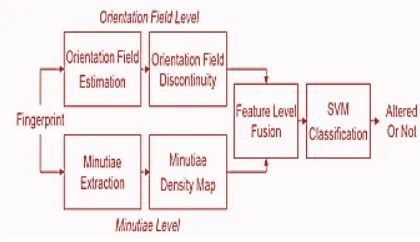
The proposed algorithm is based on the
uniquenesstake out from the orientation field and details toperform or satisfy the three required necessities formodification detection algorithm: 1) speedyoperational time, 2) Huge true positive rate at smallfalse positive rate, and 3) Ease of integration into AFIS.
Fig 3. Flow of System
A. Detection of Altered Fingerprints
Normalization:An input fingerprint image which is supplied isnormalized by cutting a rectangular region of the inputimage fingerprint, which is situated at the center of thefingerprint and associated along with the longitudinaldirection of the fingerprints, using the NIST BiometricImage Software (NBIS). This step assures that thefeatures take out in the following steps are invariantwith respect to conversion and rotation of finger.
Available online:
http://edupediapublications.org/journals/index.php/IJR/
P a g e | 17method. The startingorientation field is smoothed moderating filter, pursueby modest the orientations in pixel blocks. Aforeground mask is produced by measuring thedynamic range of gray values of the fingerprint imagein local blocks and morphological method for fillingholes and eliminating isolated blocks is achieved.
Orientation Field Approximation: The orientation field is near by a polynomialmodel to obtain.
Feature Extraction:The error map is calculated as the absolutedifference between and used to build the featurevector.
Analysis of Minutiae Distribution:In this method, a minutia in the fingerprintinvolves the ridge personality such as ridge ending orridge junction. Almost all the fingerprint detectionsystems use minutiae for matching. The irregularityobserved in
orientation field also celebrated thatminutiae
distribution of altered fingerprints frequentlychange from that of natural fingerprints. On thebeginning of minutiae take out from a fingerprint bythe open
source minutiae extractor in NBIS, a
minutiaethickness map is collected by using the Parzen windowmethod including uniform kernel function.
IV. CONCLUSION
In thisdistorted fingerprint detection and rectification paperwe described a novel distorted fingerprint detectionand rectification algorithm. For distortion detection,the brink orientation map and period map of afingerprint are desirable as the feature vector and aSVM classifier is skilled to categorise the enter fingerprintas distorted or average. (no longer distorted). For distortionrectification an in depth neighbor regression process is usedto terminate the distortion area from the deliver enterdistorted fingerprint and then the reverse of thedistortion discipline is used to translate the distortedfingerprint into a common one (un-distorted). Theexperimental outcome on FVC2004 DB1, Tsinghua DFdatabase, and NIST SD27 database suggests that thescheduled algorithm can broaden the recognitionrate of distorted fingerprints radically.
REFERENCES
[1]Prof. Bere S.S. and Mr. Ganesh V. Kakade, “Identifyand Rectify the Distorted Fingerprints”, InternationalJournal on Recent and Innovation Trends inComputing and Communication” Volume: 3 Issue: 12.
[2]D. Maltoni, D. Maio, A. K. Jain, and S. Prabhakar,Handbook of Fingerprint Recognition, 2nd ed. Berlin,Germany: Springer-Verlag, 2009.
[3] A. Juels and B. S. K. Jr., “Pors: proofs ofretrievability forlarge files,” in ACMConference onComputer and Communications Security, P. Ning, S.D. C. di Vimercati, and P. F. Syverson, Eds. ACM, 2007,pp. 584–597.
[4] G. Ateniese, R. D. Pietro, L. V. Mancini, and
G.Tsudik, “Scalable and efficient provable
datapossession,” in Proceedings of the 4th
internationalconference on Security and privacy in communicationnetowrks, SecureComm, 2008, pp. 1– 10.
[5] C. C. Erway, A. K¨upc¸ ¨u, C. Papamanthou, and R.Tamassia, “Dynamic provable data possession,” in
ACM Conference on Computer and
CommunicationsSecurity, E. Al-Shaer, S. Jha, and A. D. Keromytis, Eds.ACM, 2009, pp. 213–222.
[6]H. Shacham and B. Waters, “Compact proofs ofretrievability,” in ASIACRYPT, ser. Lecture Notes inComputer Science,J. Pieprzyk, Ed., vol. 5350. Springer,2008, pp. 90–107.
[7]Q. Wang, C.Wang, J. Li, K. Ren, and W. Lou,“Enabling public verifiability and data dynamics forstorage security in cloud computing,” in ESORICS, ser.Lecture Notes in Computer Science, M. Backes and P.Ning, Eds., vol. 5789. Springer, 2009, pp. 355–370.
[8]N. K. Ratha, K. Karu, S. Chen, and A. K. Jain, “AReal- Time Matching System for LargeFingerprint Databases,” IEEE TPAMI, vol. 18, no. 8,pp. 799– 813, 1996.
[9] A. M. Bazen and S. H. Gerez,
Available online:
http://edupediapublications.org/journals/index.php/IJR/
P a g e | 18Modelling of ElasticDeformations,” Pattern
Recognition, vol. 36, no. 8, p.1859–1867, 2003.
[10] Z. M. Kovacs-Vajna, “A Fingerprint
VerificationSystem Based on Triangular Matching and DynamicTime Warping,” IEEE TPAMI, vol. 22, no. 11, pp. 1266–1276, 2000.
BOIDATA
Erupula NagaRajucurrently pusuing his
M.Tech(cyber forensic &information security) from
Vijaya Engineering College, Ammapalem,
Khammam,Telangana, India.
P.Ashok Kumar completed his M.Tech(CSE) in