
ECC-Based Non-Interactive Deniable Authentication with
Designated Verifier
Yalin Chen1,*Jue-Sam Chou2
1
Institute of Information systems and applications, National Tsing Hua University [email protected]
2Department of Information Management, Nanhua University *: corresponding author Tel: 886-5-2721001
Abstract
Recently, researchers have proposed many non-interactive deniable
authentication (NIDA) protocols. Most of them claim that their protocols possess full
deniability. However, after reviewing, we found that they either cannot achieve full
deniability, or suffer KCI or SKCI attack; moreover, lack efficiency, because they are
mainly based on DLP, factoring problem, or bilinear pairings. Due to this observation,
and that ECC provides the security equivalence to RSA and DSA by using much
smaller key size, we used Fiat-Shamir heuristic to propose a novel ECC-based NIDA
protocol for achieving full deniability as well as getting more efficient than the
previous schemes. After security analyses and efficiency comparisons, we confirmed
the success of the usage. Therefore, the proposed scheme was more suitable to be
implemented in low power mobile devices than the others.
Keyword: deniable authentication protocol, Fiat-Shamir heuristic, perfect
zero-knowledge, key compromise impersonation attack, voting systems
1. Introduction
People have paid much attention in several security features such as, integrity,
confidentiality, non-repudiation, and authentication when communicating over the
Internet. Recently, the deniability has gotten more attractive since it can protect
personal privacy, which is often required in business activities. For example, in an
auction, a bidder may not expect his bid’s content revealed. Even, he may wish nobody knew his participation and thus can deny his attendance. This is called the content’s sourcedeniability. Further, if a protocol can let people deny both the content and its source, we call it afully deniable authentication (FDA) protocol. Up
to now, there are many FDA schemes [1-21, 28, 32-34] proposed. They include two
types: (1) Interactive deniable authentication (IDA) protocol, and (2) Non-interactive
deniable authentication (NIDA) protocol. Among them, [1-5, 11, 12, 14, 28, 33] are
type (1) protocols and [6-10, 13, 15-21, 32, 34] are type (2) protocols. NIDA
using only one pass. However, after examining previous NIDA protocols, we found
that they either have security vulnerabilities or cannot achieve full deniability. We
described this in Section 2. Subsequently, in Section 3, we proposed a fully deniable
NIDA protocol based on the Fiat-Shamir heuristic [22]. Fiat-Shamir heuristic can
produce a non-interactive proof (signature) on the sender’s message. However, the proof unforgeability prevents the receiver from simulating. This makes Fiat-Shamir
heuristic cannot let the sender denies what he sent, because from [1-3], we see that
receiver’s “un-simulatability”implies sender’s “un-deniability”. To overcome the problem, we modify it by replacing the one-way hash function with ECC-based
ElGamal encryption (ELG_Enc) to produce the random-looking challenge. When simulating, the simulator can recover any pre-chosen random challenge by ElGamal decryption. Besides, for attaining better efficiency, our design used of the elliptic
curve cryptosystem. After security analyses and performance comparisons, we found
that our scheme not only possessed the security properties: SKCI resistance, and
deniability, but also was more efficient than the other schemes. Thus, the combination
of Fiat-Shamir heuristic with ECC-based Elgamal encryption provides a better choice
in designing an NIDA protocol.
The rest of this article is organized as follows. In Sec. 2, we introduce the
Fiat-Shamir heuristic on which our scheme bases and then give a literature review on
some previous works. In Sec. 3, we propose our protocol. The analyses of its
deniability are discussed in Sec 4. And its security analyses and performance
comparisons with other related works are described in Sec 5. Finally, a conclusion is
given in Sec. 6.
2. Background and related work
In this section, we describe the used notations in Section 2.1, introduce
Fiat-Shamir heuristic in Sec. 2.2, and finally review the related works in Sec. 2.3.
2.1 Definitions of used notations:
p,q: two large primes satisfyingq|(p-1),
G1,: an additive group of orderqon an elliptic curve,
G2,: a multiplicative group of orderq,
P: a primitive element ofG1,
g: the generator ofG2,
xi: useri's private key,
Yi: useri's public key, which equals togxiin DLP scheme orxiPin ECC,
H2: a one-way hash function mapping fromG1G1toZq,
H3: a one-way hash function mapping from {0, 1}*toG1,
e: a pairing function mapping fromG1G1toG2,
auth: a message authenticator,
E: an adversary
2.2 Fiat-Shamir heuristic
In 1986, Fiat and Shamir [22] suggest a heuristic means for designing a secure
digital signature scheme which enables a user to prove his identity and authenticate
his message (but doesn’t deal withdeniability) by using the following two steps:
(1) Choose a secure 3-pass identification scheme, e.g., Schnnor’s identification scheme [23] in which the output transcript in each round is denoted as
(commitment, challenge, response), where commitment and response are the first and third flows from the prover to the verifier, and challenge the second from verifier to prover.
(2) According to the identification scheme chosen, the signer first generates the
commitment, then hashes it with message m to produce the challenge, and finally computes the response. That is, when signing on messagem, the signer produces an acceptable transcript (commitment, challenge, response) as the signature, where the challenge equals
H
(commitment, m) andH
is a cryptographic hash function.The Fiat-Shamir heuristic is an efficient way in building non-interactive
zero-knowledge proofs. Such constructions are provably secure based on
cryptographic hash functions in the random oracle model [24-26].
Suppose that a signer with private/public (SK /PK) key pair x/ g–x, where x
R
Zq, adopts Schnorr Identification Scheme and performs the two steps. He signs on messagemby computing commitmentt=gk, challengech=
H
(t,m), and responses=k+SK* ch, wherekis a randomly chosen number, to form the signature (t,s), which
can be publicly verifiable by checking whethert=gs(PK)H(t||m)holds or not.
2.3 Literature review of deniable authentication protocols
As mentioned earlier, there are two types of deniable authentication protocols: (1)
IDA protocol, and (2) NIDA protocol. We review some of them below.
(1). IDA protocols
concurrent zero-knowledge proof. Their study permits a sender (S) to authenticate a message m for a receiver (R), but a third party cannot verify the authentication. In other words, it does not permit Rto convince a third party that Shas authenticated m
to him. In the same year, Aumann and Rabin [2] propose another deniable
authentication protocol based on factoring. They stipulated that if R can simulate all the communications between himself and S, then S can deny the communications. In 2006, Raimodo et al. [3] define an authentication and key exchange protocol to be
deniable if R’s view can be simulated by an efficient machine (called the simulator) which doesn’t know S’s secret key. Here, a simulator can construct the transcripts without relying on deducingS’s secret key (from the corresponding public key), and
R’s view means all the information R obtained by participating in the protocol. In addition, they also propose the notions of“partial deniability”and“full deniability”. The former is used in SIGMA protocol [11] which adopts non-repudiable signature
for authentication; and the latter used in SKEME protocol [12] which adopts an
encryption-based method for the same purpose. In the partial deniability definition,S
can deny only the content of a message. In afully deniable one, he can further deny
the message’s source (except for the content).
In 2004, Boyd and Mao [5] point out that the two properties, deniability and KCI
attack prevention, conflict in Boyd et al.’s shared-secrecy based IKE protocol [4]. Because once the secret key of a party, say A (or B), has been compromised, the attacker can impersonateB (or A) to talk with A(orB). This is exactly what the KCI attack means [27]. Chouet al.[28] exemplify such a KCI attack. In 2008, Li et al. [14] apply the deniable property in an electronic voting protocol. However, they assume
that the system can simulate the voting for any voter. This is unreasonable. Since, if
the system is not equitable, it can impersonate any voter. Consequently, the vote result
cannot convince anyone. Conversely, if the system is equitable, it’s unnecessary for the system’s voting for any voter. In other words, the application in [14] is impractical. In 2013, J. Kar [33] proposed an ID-based IDA protocol. However, we found E can pretend S to send R ~Qs
’
(= EΠpub(as’P||T’)). R will authenticate E unconsciously. In
other words, their protocol cannot work correctly.
(2) NIDA protocols
Because non-interactive protocols have the advantage of communication
efficiency, many researchers propose deniable authentication protocols of this kind
[6-10, 13, 15-21, 32, 34]. In this type, a message with its proof is sent to a receiver in
only one pass. The receiver then uses this proof to verify the authenticity of both the
message and its sender. But afterward, the sender can deny to a third party that he sent
sending emails or signing documents. However, we found that they either suffer KCI
attack, SKCI attack, or losingfull deniability(Hereafter, we use the term deniability
to stand for full deniability). In the following, we introduce the two attacks: KCI and
SKCI. Then, roughly describe the main frames of some relevant NIDA schemes.
(a) KCI attack
KCI is a security notion which means that the loss of a user’s secret would enableE to impersonate any party to communicate to the user [27]. According to this definition, we know that there are two possible ways for E to launch such attack on an IDA protocol performed; for example, E compromises S’s (or R’s) private key and then impersonates R (or S) to communicate with S (or R). For a one-pass NIDA protocol, only one KCI attack launching is possible; E
compromisesR’s private key, and impersonatesSto authenticate another message
m'toR.
(b). SKCI attack
In 2004, Shao [6] propose a NIDA scheme using generalized ElGamal signature.
In the scheme, Alice randomly choosestZq, computesk=YB t
(modp),r=H(k),
s = t﹣xA.r (mod q), and auth = H(k||m), and then sends (r, s, auth, m) to Bob.
After receiving (r, s, auth, m), Bob computes k' = (gsYA r
)xB and verifies whether
both r = H(k') and auth = H(k'||m) hold. However, in 2006, Lee et al. [10] point out Shao’s scheme has a vulnerability that once the session key k has been compromised, the attacker can use arbitrary message m' to form a valid auth' = H2(k||m') and thus impersonate Alice to send Bob (r,s,auth',m'). Bob would then
be fooled, because Bob will extract k from (r,s) by computingk' = (gsYA r
)xB and
hence verifyauth' as valid. We denote such an attack as SKCI attack. Below, we define SKCI attack inDefinition 1.
Definition 1. SKCI (session key compromise impersonation) attack means if
the receiver discloses part of the shared secret (between the sender and the receiver) to a third party, the third party can then use the leaked information to impersonate the sender by generating a proof on an arbitrary message to be successfully verified by the receiver.
After describing the meanings of both SKCI and KCI attacks, in the following, we
roughly describe the main frames of relevant NIDA schemes and their vulnerabilities.
(c) Related NIDA protocols
Except for its SKCI attack suffering (found by Lee et al.’s [10]), this study also found the scheme lacks the deniability property since nobody other than
Alice can efficiently compute the signature swhen given r. Although, Bob could
computek'= (gs'YA r'
)xBby randomly choosings'andr', the equation r'=H(k') can
be hardly satisfied for a secure hash function [23]. Since the probability is
negligible for the hash value of k' to be equal to a pre-defined value r'. This demonstrates the undeniability of Shao’s scheme.
.Caoet al.’s scheme [9]
In 2005, Cao et al.[9] propose a Weil pairing ID-based NIDA protocol. In the protocol, there exists a TA (Trust Agent) with a private/ public key pair sZq /
Ppub= sP. It computes Alice’s public∕private key pair QA= H3(IDA)∕SA= sQA andBob’spublic∕private key pairQB=H3(IDB)∕SB=sQB. When Alice wants to send a message m with its authenticator to Bob, she computes Y = ê(tPpub+SA,
tP+QB), k= H(Y, IDA), and auth =H(k||m), and then sends Bob (IDA,t,auth, m), where t is a timestamp. After receiving the message flow, Bob can extract Y =
ê(tP+QA, tPpub+SB), because he and Alice had pre-shared a secrecy e(P+QA,
P+QB)s. From [5], we see this scheme suffers the KCI attack. Since if E compromisedBob’sprivatekeySB, he can impersonate Alice to send Bob (IDA,t',
auth', m') for another message m', by computing Y' = ê(t'P+QA, t'Ppub+SB), k' =
H(Y', IDA), and auth' = H(k'||m'), where t' is a timestamp. As a result, E successfully fools Bob to accept his message m'. Therefore, scheme [9] suffers SKCI attack.
.Two Lu and Cao’s schemes [7, 8]
In 2005, Lu and Cao [7] propose an NIDA scheme based on Weil pairing. In
the scheme, Alice randomly chooses tZq, computes r = H1(e(P, P)t), s
= Yr
x r
t
s
, and auth = H2(ê(P, P)t, m), and sends (r, s, auth, m) to Bob. After
receiving (r, s, auth, m), Bob extracts the session key k by using the session parameters (r,s),Bob’sprivatekey,and Alice’spublickey, i.e.k = ê(s,xr-1(rP+Ys))
= ê(P,P)t.
Meanwhile, Lu and Co [8] also proposed an NIDA scheme based on factoring
in which when Alice wants to send a message with its authenticator to Bob, she
transmits (s, b1, b2, c, a1, a2, auth, m), where (s, b1, b2)isAlice’ssignatureon
random nonce r and (c, a1, a2) is the result of r encrypted by using Bob’spublic
key.Afterreceiving Alice’smessage,Bob decrypts(c, a1, a2) to obtain r and
is sent from Alice.
However, in 2006, Lee et al. [10] point out that both Lu and Cao’s schemes suffer SKCI attack. In addition, this study also found the two schemes lack the
deniabilityproperty. Because in study [7], if the receiver transformss intos’, the transformed (r,s’, MAC) cannot pass the verification since r is not equal toe(s’,
xr-1(rP+Ys)). And in work [8], for any given r, nobody other than Alice can efficiently compute r’s signature (s, b1,b2) due to the difficulty of factoring [29].
That is, when Bob reveals (s,b1,b2,r) to a third party, Alice cannot deny that she
sent (s,b1,b2,c,a1,a2,auth,m) to Bob.
.Leeet al.’s scheme [10]
For patching the vulnerability ofSKCIin schemes [6, 7, 8], Leeet al.propose a deniable authentication scheme [10] by using ElGamal signature. In the scheme,
Alice randomly chooses t, computesr = gt (modp),s =H(m)x
A+ tr(modq),k= (YB)
s
(modp), andauth =H(k||m), and sends (m,r,auth) to Bob. Bob can extract the session key by computingk' = (YA
H(m)
rr)xB(=kmodp) and then verify whether
auth = H(k'||m) holds. However, we found if E compromised Bob’slong-term private key xB, he can successfully impersonate Alice to communicate with Bob by randomly choosing r', computing k' = (YA
H(m')
(r')r')xB(mod p) and auth' =
H(k'||m'), and sending Bob (m',r', auth'). Bob would accept this forged message (m',r',auth') unconsciously. It, therefore, suffers the KCI attack.
.Lu et al.’s scheme [13]
In 2007, Lu et al. [13] propose an improvement on [8] by including the identities of both communicating parties. However, the improvement still lacks
the deniability property, because Alice has to generate the signature (s,b1,b2,r)
on r. It’s well known that nobody other than Alice can efficiently compute the signature.
.Shi and Li’s scheme [19]
In 2005, Shi and Li propose an identity-based deniable authentication protocol
[19]. In the scheme, S first sends (U,δ,MAC,M) to R, R then verifies whether
both Verify(δ,Qs, KR)=True and MAC=H(KR||M) hold. They claim their protocol is deniable, but we found it suffers SKCI attack. For that ifKR(= Ks) is revealed to E, and E intercepts the message flow (U,δ,MAC,M), he can use another messagem’to computeMAC’=H(KR||m’)and send receiver the message flow (U,
signatureδ.
.Harn and Ren’s work [17]
In 2008, Harn and Ren propose a fully deniable authentication service for
E-mail applications [17]. Although, they claim that their scheme is fully deniable,
on the contrary, we found it at most can be termed as a partially deniable scheme
when the underlying scheme is ElGamal signature. Because the space cardinalities
of both σ and C are different from the ones in the existential forgery. That means, it isn’t perfect zero-knowledge and thus not a fully deniable protocol (which we will prove in claim 1 of Section 4.1). Moreover, using the existential
forgeability to provide deniability is impractical, because signature algorithms
suggest signing on the message digest rather than on the message directly.
.Meng’s work [18]
In 2009, Meng [18] apply an NIDA protocol to voting systems and claim that
their scheme is deniable. However, it suffers SKCI and KCI attacks, because ifK
is revealed to E, and E intercepts the message flow (Sput, MAC, M), he can use another messagem’to compute MAC’=hash(K||m’)and send (Sput,MAC’,m’) to the receiver. The receiver will be fooled. As for KCI attack, ifEhas the receiver’s private key RPR,he can compute K’=[(Sput)hash(m’)]RPR and masquerade as the sender to send the receiver (Sput,MAC’,m’), the receiver will then be fooled.
.Wang et al.’s scheme [15]
In 2009, Wang et al. [15] propose an NIDA scheme based on designated verifier proofs. They claim that their scheme is deniable and unforgeable.
However, this study found ifEobtained messageMand its authenticator Authen = (w,gr,c,s) in the simulation phase, he can randomly pick (α,β,s), compute c' =
gα,A=gs(y1p)
-β
,B =hs(y2p)
-β
andc=H(M,c',A,B), and finally computew=β-c
and gr = gα-w/ y1v. Thus, E can successfully simulate (forge) the transcript Authen=(w,gr, c, s), without the real value of r, to pass the designated verifier’s verification.
.Five recent NIDA protocols [16, 20-21, 32, 34]
In 2011, Youn et al. [16], Zhang et al. [20], Shao et al. [21], and Hwang et al.
[32] each proposes an NIDA protocol based on trapdoor commitment, generalized
Elgamal signature, ECDLP and Schnorr signature scheme, respectively. Among
them, though [16, 20] have the deniability, they suffer KCI attack. In addition, we
multiplicative and additive operations on a point group of an elliptic curve;
scheme [32] has the deniability but suffers KCI and SKCI attacks. About the KCI
attack in [32], if E compromised xB, he can impersonate Alice to send Bob
V’=H1(gk’||m’||R’||yB), S’= gk’.YAV’, K’=H2(S’)xB, C’=EK’(m’||R’). As for SKCI attack, if E compromised K and intercepted (C, V, S), he can decrypt C to obtain
m||Rand send Bob (C’, V’,S’), where C’=EK(m’||R’), V’=H1(gk’||m’||R’||yB), and
S’= gk’.YAV’, to pass Bob’sauthentication.
Most recently in 2013, J. Kar et al. [34] proposes an NIDA protocol using the
generalized ECDSA signature scheme . However, their scheme has the KCI and
SKCI attacks, because once Eobtained Bob’ssecretdb, he can impersonate Alice to send Bob(U’, MAC’(={ (H(M’)Qa+r’U’)}.db), M’), and thus be authenticated successfully. Meanwhile, if E got the common secret α1 and knows U(=kP)and
rfrom the transferred message, where r= x1mod n and x1=(U)x, he can compute
rUQb. From the equation, E knows H(M)daQb=α1-rUQb. He then can compute
H(M)-1to multiply theequation’sboth sidesand obtaindaQb. By using this value and choosing a random k’, E computes U’= k’P and subsequently knows r’. Therefore, he can compute α1’=H(M)’daQb+ r’k’Qband send (U’, MAC’, M’) to Bob. Unconsciously, Bob will accept.
From the above-mentioned, we know that there still lacks a secure and efficient
NIDA protocol. Therefore, in Section 3, we based on Fiat-Shamir heuristic [22] to
propose an NIDA protocol, attempting to satisfy demand security features and get
more efficiency than the other NIDA protocols. In Section 4, we prove that an NIDA
protocol is deniable if and only if it is perfect zero-knowledge [23]. Our protocol can
produce a receiver-simulatable non-interactive proof. It allows the designated R to simulate the real transcripts performed between S and himself. Such a design is similar to Jakobsson et al.’s “designated verifier proof”[30] that the designated verifier can always use his trapdoor to simulate any transcript initiated by S. Unfortunately, we found our scheme still suffers KCI attack. Hence, we doubt if an
NIDA protocol inevitably suffers this attack. Regrettably, the answer is true. We prove
this in Theorem 5 of Section 5.
3. The proposed scheme
Next followings are the details of our scheme, which is also illustrated in Fig. 1.
There exists a CA (Certificate Authority) to certify a user’s public keyYu=−xuP, where −xuZqis the user’s private key, and P is the base point of G1. When Alice
wants to authenticate message m to Bob, they cooperatively perform the following
respectively, and the plaintext mis mapped by a hash function H3to a point M(=(m1,
m2))G1, where m1 and m2 denote the x-coordinate and y-coordinate of M,
respectively.
Alice’s part
(1) Randomly chooses kRZq, and computes M =H3(m), TB = kYB, and the
commitment T=kP.
(2) Generates a random-looking challenge, CH, by applying ECC-based ElGamal encryption toN, whereN = M+R+TB= (n1,n2) andRis a random point inG1. For
encryptingN, she performs the followings: (a) randomly choosesrRZq,
(b) computesV=rP,W=rYB,
C=N+ W, and
CH= ELG_Enc(N) = (V,C).
(3) Computesresponse,rsp=k+ (-xA)*H2(CH) (modq).
(4) Computes hash value,h=H1(R).
(5) Sends (m,T,CH,rsp,h) to Bob.
Bob’s part
After receiving (m,T,CH,rsp,h), Bob does the following. (1) Verifies whether
T=rsp.P-H2(CH) .YA. ..…. (E1) If E1 does not hold, Bob rejects.
(2) DecryptsCH(= (V,C)) by using his private key,−xB, obtainingN'. That is, computes
W’=−xB.V, ……(E2-1)
N'=C- W’. ……(E2-2)
(3) ComputesM=H3(m),TB=−xBT,R'=N' −M−TB, and verifies the following equation
h=H1(R'). ……(E3)
accepts. equals, it If ), ' ( ? verifies . , ' ' extracts . , -), ( , ' ' V, -' computes . , ' obtain to decrypts . aborts. hold, t doesn' equation the If , ) ( ? verifies . . ) ( and ), (mod ) ( ), (V, ) (V, ) ( , , V , ), ( , , .computes . and , chooses randomly . -: key public -: key private Bob -: key public -: key private Alice 1 3 2 1 2 3 1 R H h T M N R T x T m H M W C N x W N CH Y CH H P rsp T CH, rsp, h T m R H h q CH H x k rsp W N C T R M ELG_Enc CH rY W rP T R M N m H M kY T P k T G R Z k r P x Y x P x Y x B B B B A A B B B B B q B B B A A A , ,
Fig1. The proposed NIDA protocol
4. Deniability analysis
In this section, we introduce the concept of perfect zero-knowledge for relating it
to the deniability property of NIDA protocols. We claim that an NIDA protocol is
deniable if and only if it is perfect zero-knowledge. After that, we inspect the
deniability of our protocol by using this claim.
4.1 Deniability for an NIDA protocol
From [1-3], we saw that “un-simulatability”of the receiver’s view implies the sender’s “un-deniability”. However, we thought this definition on deniability is not enough. Examining the simulator in the NIDA schemes [6, 7, 8], we found that it
reuses the signatures appeared in the real transcripts to compose the simulated ones.
However, a signature has the undeniable characteristic. We, therefore, considered
these schemes undeniable. That is, the sender cannot deny his participation in the
protocol. Accordingly, we used perfect zero knowledge to inspect whether an NIDA
protocol has the simulatability. Perfect zero knowledge [23] indicates that two
their corresponding probability distributions are the same. For more clarity, we use
perfect zero knowledge to rephrase the deniability of a NIDA protocol as follows.
Let λbe an NIDA protocol in which sender S can send a message m with its
proof to receiverR and all messages transferred in a round make up a transcript. We
denote the set of all possible valid transcripts forR(actually running λwithS) as
V
R. Assume that an efficient machine called simulator, SIM, can createV
R by input R’s private key as if it were from the real protocol run (withS). If we denote the set of allpossible transcripts produced bySIMas
V
SIM, then we claim λis deniable if and only if it is perfect zero-knowledge. That is,V
R =V
SIM, and for anyT
RV
R there exists aT
SIMV
SIM, satisfyingT
R=T
SIMand Pr[T
R] = Pr[T
SIM]. We prove the related claims as follows.Claim 1.λis deniable iff it is perfect zero-knowledge.
Proof: For “<=”, it is obvious, because the indistinguishability between
V
R andV
SIM makes Sdeny any transcript of λ. Next we prove“=>”by contraposition. That is, if an NIDA protocol does not have the perfect zero-knowledge property,then it is undeniable. Without loss of generality, suppose that there exists a
valid transcript
T
and its probability distribution inV
Ris different from the one(
T
) inV
SIMwith a non-negligible probability. Then,Scannot denyT
, because with non-negligible advantage, one can determine from which set,V
R orV
SIM,T
comes. We prove the claim.Claim 2.λ issimulatableiffitisdeniable.
Proof:For“<=”,we prove this by contraposition. If the receiver cannot simulate one of the transcripts, then this transcript must come from the real protocol run
under the sender’s cooperation. That is, the sender cannot deny his participation in generating the transcript. Next, weprove“=>”.Thisdirectly comes from the deniability definition in [3]. We have thus proven the claim.
4.2 The deniability of our protocol
In this section, we used Claim 1 to inspect the deniability of our protocol. Before
that, we proved our protocol to be perfect zero-knowledge by using three moves: (I)
construct an efficient SIM to generate a valid transcript, (II) analyze the cardinality
and probability distributions for spaces
V
SIM andV
R, respectively, and (III) show that(I) Construct an efficientSIM.
Assume that Alice and Bob execute the protocol honestly and generate a
transcript, (T, CH,rsp, h) for message m. In the following, we construct an efficient simulatorSIMto forge this transcript. On input the public parameters (q,G1,P,H1,H2,
H3), messagem, Alice’s public keyYA, Bob’s public keyYB, and Bob’s private key−xB,
SIMdoes the following steps.
Step 1. Randomly chooses rsp',r'RZq, andC'RG1.
Step 2. ComputesV'= r'P,W’=−xBV’,N'= C'- W’
Step 3. SetsCH' =(V',C'), and computesT'=rsp'.P-H2(CH') .YA.
Step 4. ComputesM=H3(m), TB'=−xBT',R'=N'−M−TB' andh'=H1(R').
Step 5. Outputs (T',CH',rsp',h') for messagem.
It is obvious that this forged (simulated) transcript (T',CH',rsp',h') is valid and
SIMruns efficiently.
(II) Analyze the cardinality and probability distribution for spaces
V
SIMandV
R,respectively.
(II.A). Analyze space
V
SIMConsidering the given simulated transcript,
T
SIM= (T',CH',rsp',h')V
SIMform, the occurance probability can be determined by the randomly chosen elementsrsp'RZq, andV',C'RG1. Since fromSIM’scomputations, we can see that
(i) CH'is formed byV' andC' in which V'= r’P, andC' is a random poin t in G1. Hence, th e cardinality |CH'| i s q2.
(ii) T'is computed fromrsp'andCH'(|T'| hence i s q3),
(iii) BecauseTB’=−xBT’,whenT'is obtained, with Bob’s private key,TB’can be determined as well.
(iv) Since h'=H1(R') (R'=N'−M−TB'),N'=C'-W', andW’=−xBV’, whenrsp',
C', and V' are determined,CH',T',TB', N'andR' can all be determined as well. Thus,h' (=H1(R')) is also determined.
In short, the space cardinality of
V
SIMforM, |V
SIM|, isq3.Hence, under uniform distribution of the random parameters, the occurrence
probability of any simulated transcript
T
SIMV
SIMisPr[
T
SIM] = (1/q3).(II.B) Analyze space
V
RConsider a real transcript
T
R = (T, CH, rsp, h)V
R for message m. The cardinality is determined by the random numbersk, rRZq, and random pointRRG1.|
V
R| =q3.Hence, under the uniform distribution of the random parameters, the occurrence
probability of any real transcript
T
RV
RformisPr[
T
R] = (1/q3).(III) Show that
V
RandV
SIMare identical.From (II), we see that |
V
R| = |V
SIM|, and their probability distributions ofV
R andV
SIM are the same. Hence, to show the perfect zero-knowledge property of our protocol, we need to prove that for anyT
RV
R, we can find aT
SIMV
SIM, such thatT
R=
T
SIM. That is, given m’sT
R = (T,CH (=(V,C)), rsp,h)V
R, find its correspondentT
SIM= (T',CH' (=(V',C')), rsp',h')V
SIM, satisfyingT
R =T
SIM. For this purpose, we can do as follows.(i) Sincer',rsp'andC'can be arbitrarily chosen bySIM(as done in [I]’s Step 1) and |
V
R|=|V
SIM|, when givenT
R there must exist a transcriptT
SIM inV
SIM satisfyingr'=r,rsp'=rsp, andC'=C.(ii) Once V' (= r’P) and C' have been determined, the values of N'
(=(C’-W’)=(C’-(-xB)V’), T'(=rsp'.P-H2(CH') .YA), andTB’(=−xB T’) can all be determined as well.
(iii) Under determinedN'andTB', the valueR'(=N'−M−TB'), which is equal to
Rin the transcript, can be uniquely determined.
From the above stated, we found a transcript (T',CH'(=(V',C')), rsp',h') which
equals to
T
R and bel on gs toV
SIMwith the same probability distribution. Therefore, we proved that our protocol possesses perfect zero-knowledge property. According toClaim 1, we concluded that our protocol is deniable.
5. Security analyses and comparisons
In this section, we first show the security analyses and then make comparisons with
other works in the aspects of security and performance in section 5.1 and 5.2,
respectively.
5.1 Security analyses
We examined our protocol by using some properties which an NIDA protocol
demands. By using Theorem 1 through Theorem 4, we show that our scheme
possesses correctness, unforgeability, authenticability, and SKCI resistance,
respectively. Theorem 5 indicated that the deniability property of an NIDA protocol
Theorem 1. (Correctness) The proposed scheme is correct.
Proof: When Alice follows the protocol, equation E1 (verified by Bob) will hold since
rsp.P-H2(CH) .YA= (k+(-xA)*H2(CH)) .P-H2(CH) . (−xA.P) =kP=T. Similarly, from the following three deductions
(1) W’=−xB.V=−xB. (rP) =r. (−xBP) =rYB, (2) ELG_Dec(CH) =N'= C’- W’,
(3) R'=N' −M−TB=N −M−TB=R,
we can see that equation E3,h=H1(R'), holds as well
Theorem 2. (Unforgeablity) With a negligible probability, E could produce a
transcript to be successfully verified by Bob.
Proof: Although in Fiat-Shamir heuristic, the non-interactive proof generated can
hardly be forged without sender’s private key, our modified version leaves a trapdoor for the receiver to generate (forge) a valid one. In our modification,
without sender’s private key, the only possible way for E to forge m’s transcript is to simulate the receiver. However, without receiver’s private key −xB,E cannot decrypt the random challenge(ciphertext), CH'(=(V',C')=(r'P,
N'+(−xB)V’)= ( V', (M +R' +TB' )+ (−xB)V’), for producing a valid pair (R',
TB'(= −xBT)) in plaintext N'(=M+R'+TB') to satisfy ELG_Enc(N') = CH'. Therefore, we concluded that the probabilityEcould produce a valid transcript is less than breaking the ElGamal cryptosystem. Since if ElGamal
cryptosystem is broken and E thus obtains N', he cannot extract R' to obtain value h without the knowledge of−xB.
Theorem 3. (Authenticity) As long as Alice follows our protocol honestly, Bob can
authenticate both Alice and her sent message.
Proof: When Alice follows the protocol honestly, the parameters T, CH=(V, C), rsp,
and h in the message flow would be generated correctly. Obviously, on receiving the message flow, Bob can use Alice’s public key YA to verify equation E1 successfully. Then, decryptsCH by his secret key,obtaining N', as equation E2 illustrates. After this, he can compute R'=N'-M-TB and hence
verify equation E3 successfully. It means that the authentications of both
Theorem 4. The proposed scheme can resist SKCI attack.
Proof: Because our scheme doesn’t require both communicating parties to compute a session key for generating the MAC-based authenticator as a proof (which
occurs in the previous works often). Thus, our work is free from SKCI attack.
Theorem 5. If a non-interactive authentication (NIA) protocol is deniable, then it
inevitably suffers from KCI attack.
Proof: For there is only one message flow in an NIDA protocol, the possible KCI
attack is pretending Alice to communicate with Bob. i.e.Ecompromises Bob’s private key and impersonates Alice to communicate with Bob. We prove this
theorem by contraposition. That is, if an NIA protocol can resist KCI attack,
then it does not have the deniability property. AssumeE knows Bob’s private key but cannot impersonate Alice to communicate with Bob, which implies
that some component of a real transcript produced by Alice cannot be forged
byE. That means, even with Bob’s private key, the unforgeable component of the actual transcript cannot be efficiently produced by a simulator. Therefore,
from Claim 2, the protocol does not have the deniability property. We prove
the theorem.
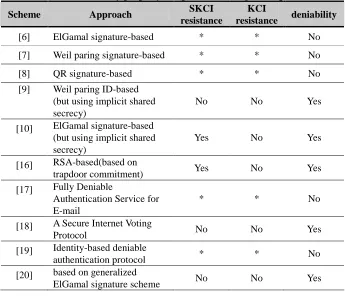
Table 1: security property comparisons among NIDA protocols
Scheme Approach SKCI resistance
KCI
resistance deniability
[6] ElGamal signature-based * * No
[7] Weil paring signature-based * * No
[8] QR signature-based * * No
[9] Weil paring ID-based (but using implicit shared secrecy)
No No Yes
[10] ElGamal signature-based (but using implicit shared secrecy)
Yes No Yes
[16] RSA-based(based on
trapdoor commitment) Yes No Yes
[17] Fully Deniable
Authentication Service for E-mail
* * No
[18] A Secure Internet Voting
Protocol No No Yes
[19] Identity-based deniable
authentication protocol * * No
[32] based on Schnorr signature
scheme No No Yes
[34] using generalized ECDSA
signature schemes No No Yes
Ours ECC-based Yes No Yes
*: means don’t care, because it lacks deniability
5.2 Performance Comparisons
From Table 1, we see that our protocol and [10, 16] are competitive in the
aspects of required security properties. Therefore, Table 2 makes efficiency
comparisons only among them, in the aspects of both computational and
communication cost. Schemes [10, 16] are designed from ElGamal signature and
RSA, respectively, while ours from modified Fiat-Shamir heuristic. Moreover, for
efficiency consideration, we implement our protocol by using elliptic curve
cryptography and thus make it more efficient in both computational and
communication cost than the others. We can see the outcome in Table 2. It results
from [31] which states that one exponentiation multiplication (EXP) is about 255
times the cost of a 1024-bit modular multiplication (MM) and one ECC-point
multiplication (ECC-mul) is about 29 MM. In addition, the proposed protocol requires
two and one ECC-mul for Elgamal encryption and decryption, respectively. Hence,
for the same security level, our scheme requires only 253 MM in computational cost
and 800 bits in communication size; whereas scheme [10] needs 1275 MM in
computation and 1184 bits for communication and [16] requires 1020 MM in
computation and 1344 bits for communication.
Table 2: a performance comparison among schemes [10, 16] and ours
Scheme Sender’s computation
Receiver’s computation
Total computation
Size in communication
[10] 510 MM
(2 EXP + 2 H)
765 MM
(3 EXP + 2 H) 1275 MM 1184 bits
[16] 510 MM
(2 EXP + 2H)
510 MM (2 EXP + 2H)
1020 MM 1344 bits
Ours 116 MM
(4ECC-mul + 3H)
116 MM
(4 ECC-Mul + 3H) 232MM 800 bits
MM: 1024-bit modular multiplication,EXP:gkmodp, where |q| is 160 bits, |hash| is 160 bits, and |p| 1024 bits,
ECC-mul: ECC point multiplication,H: hash, 1EXP≒255MM, 1ECC-mul≒29MM, Sym-Encr denotes symmetric encryption, and Sym-Dec symmetric decryption
6. Conclusion
Among them, schemes [6, 7, 8, 17, 19] cannot achieve deniability. Schemes [9,
10, 16, 18, 20, 32, 34] although can achieve deniability; however, suffer either
SKCI attack or KCI attack. For avoiding the drawbacks, we proposed a novel
ECC-based NIDA protocol by modifying Fiat-Shamir heuristic. After comparing,
it shows that our scheme can achieve full deniability and attain better efficiency
than [10, 16] which are competitive to ours in the three demand security features.
In addition, we proved the equivalence of perfect zero knowledge and deniability
for an NIDA protocol in Claim 1. According to this argument, we showed our
protocol is deniable. Moreover, we also proved that our scheme has
unforgeability, authenticability, and SKCI resistance by Theorem 2 through 4.
We doubted if an NIDA protocol inevitably suffers KCI attack. Unfortunately,
Theorem 5 confirms this suspecting.
From the works shown in Table 2, we concluded that the proposed scheme
outperforms schemes [10, 16] in both computational and communication cost.
Therefore, our research was more suitable to be applied in real applications, e.g.,
a secure Internet voting system.
Reference
[1] C. Dwork, M. Naor, A. Sahai, “Concurrent zero-knowledge, ”Proceedings of
30th ACM STOC’98, 1998, 409–418.
[2] Y.Aumann,M.Rabin,“Efficientdeniableauthentication oflong messages,”Int. Conf. on Theoretical Computer Science in HonorofProfessorManuelBlum’s 60th birthday, http://www.cs.cityu.edu.hk/dept/video.html. April 20–24, 1998. [3] Mario Di Raimondo, Rosario Gennaro and Hugo Krawczyk, “Deniable
Authentication and Key Exchange, ”ACM CCS'06, October, 2006, Alexandria, Virginia, USA.
[4] C. Boyd, W. Mao, K. Paterson, “Deniable authenticated key establishmentfor Internet protocols, ”11th International Workshop on Security Protocols, Cambridge (UK), April 2003.
[5] C. Boyd & W. Mao, “Key agreement using statically keyed authenticators, ”Applied Cryptology and Network Security (ACNS’04), LNCS 3089, 248–262.
[6] Z. Shao, “Efficient deniable authentication protocol based on generalized ElGamal signature scheme, ”Computer Standards & Interfaces 26 (5), 2004, 449–454.
[7] R. Lu, Z. Cao, “A new deniable authentication protocol from bilinear pairings,”Applied Mathematics and Computation 168 (2), 2005, 954–961.
factoring,”Computer Standards & Interfaces 27 (4), 2005, 401–405.
[9] Tianjie Cao , Dongdai Lina and Rui Xue, “An efficient ID-based deniable authentication protocol from pairings, ”Proceedings of the 19th International Conference on Advanced Information Networking and Applications (AINA’05), IEEE, 2005.
[10] Wei-Bin Lee, Chia-Chun Wu and Woei-Jiunn Tsaur, “A novel deniable authentication protocol using generalized ElGamal signature scheme, ”
Information Science, 2006.
[11] H. Krawczyk, “SIGMA: The SIGn and MAc approach to authenticated Diffie-Hellman and its use in the IKE protocols,”In D. Boneh, editor, Advances in Cryptology–Crypto 2003, LNCS 2729, 400–425.
[12] H. Krawczyk, “SKEME: a versatile secure key exchange mechanism for Internet,”IEEE SNDSS ’96, IEEE Press 1996, 114–127.
[13] Rongxing Lu and Zhenfu Cao, “Erratum to “Non-interactive deniable authentication protocol based on factoring”, ”ComputerStandards& Interfaces 27 (2005) 401–405,”Computer Standards & Interfaces 29, February, 2007, 275. [14] Chun-Ta Li, Min-Shiang Hwang and Chi-Yu Liu, “An electronic voting protocol
with deniable authentication for mobile ad hoc networks, ”Computer Communication 31(10), June 2008, 2534–2540.
[15] Bin Wang and ZhaoXia Song,“A non-interactive deniable authentication scheme based on designated verifier proofs, ”Information Sciences 179(6), March 2009, 858–865.
[16] Taek-Young Youn, Changhoon Lee and Young-Ho Park, “An efficient non-interactive deniable authentication scheme based on trapdoor commitment
schemes,”Computer Communications 34(3), March 2011, 353–357.
[17] Lein Harn and Jian Ren, “Design of Fully Deniable Authentication Service for E-mail Applications, ”IEEE Communications Letters 12(3), March 2008, 219–221.
[18] Bo Meng,“A SecureInternetVoting ProtocolBased on Non-interactive Deniable Authentication Protocol and Proof Protocol that Two Ciphertexts are Encryption
of the Same Plaintext,”Journal of Networks 4(5), July 2009, 370–377.
[19] Y. Shi and J. Li, “Identity-based deniable authentication protocol, ”IET ELECTRONICS LETTERS 41(5), 3rd March 2005
[20] Yuan Zhang, Qiuliang Xu, and Zhe Liu, “A new non-interactive deniable authentication protocol based on generalized ElGamal signature scheme, “Proc. in 13th IEEE Joint International Computer Science and Information Technology Conference (2011).
based on Elliptic Curve Discrete Logarithm Problem, “Energy Procedia 11 (2011), 1018–1025.
[22] A. Fiat and A. Shamir, “How to prove yourself: practical solutions of identification and signature problems, ”Advance in Cryptology –Proceeding of CRYPTO’86, LNCS 263, 186–194.
[23] D. R. Stinson,Cryptography Theory and Practice, 1995, CRC press.
[24] R. Gennaro, “Using non-interactive proofs to achieve independence efficiently and securely, ”Massachusetts Institute of Technology Technical Report: TM-515, 1994.
[25] M. Blum, A. DeSantis, S. Micali, and G. Persiano, “Noninteractive zero-knowledge, ”SIAM Journal of Computing, 20(6), December 1991, 1084–1118.
[26] J. Groth and S. Lu,“A non-interactive shuffle with pairing based verifiability, ”
ASIACRYPT 2007, LNCS #4833, 2008.
[27] S. Blake-Wilson, D. Johnson, and A. Menezes, “Key agreementprotocolsand their security analysis,”In Sixth IMA International Conference on Cryptography and Coding,LNCS #1355, 1997, 30–45.
[28] J. S. Chou, Y. Chen, and J. C. Huang, “An ID-Based Deniable Authentication Protocol on pairings,”http://eprint.iacr.org/2006/335, 2006.
[29] Wenbo Mao, Modern Cryptography: Theory and Practice, Prentice Hall PTR, 2003.
[30] M. Jakobsson, K. Sako, and R. Impagliazzo, "Designated verifier proofs and
their application, "Advance in Cryptology – Proceeding of EUROCRYPT’96, LNCS 1070, 143–154.
[31] Jue-Sam Chou, Yalin Chen and Tsung-Heng Chen, “An efficient session key generation for NTDR networks based on bilinear paring, ”Computer Communication 31(14), September 2008, 3113–3123.
[32] Shin-Jia Hwang and Yun-Hao Sung, “Confidential deniable authentication using promised signcryption, “The journal of System and Software, 84 (2011), 1652-1659
[33] Jayaprakash Kar, “ID-based Deniable Authentication Protocol based on Diffie-Hellman Problem on Elliptic Curve, ”International Journal of Network Security, Vol.15, No.1,PP.295-302, Jan. 2013
[34] J. Kar, D. M. Alghazzawi, and S. H. Hasan, “A novel non-interactive deniable authentication protocol using generalized ECDSA signature schemes with
![Table 2: a performance comparison among schemes [10, 16] and ours](https://thumb-us.123doks.com/thumbv2/123dok_us/7897585.1310879/17.595.113.483.536.658/table-performance-comparison-schemes.webp)
