
KDM Security in the Hybrid Framework
Gareth T. Davies∗and Martijn Stam
Department of Computer Science, University of Bristol, Merchant Venturers Building, Woodland Road,
Bristol, BS8 1UB, United Kingdom.
{gareth.davies, martijn.stam}@bristol.ac.uk
Abstract
We study the natural question of how well suited the hybrid encryption paradigm is in the con-text of key-dependent message (KDM) attacks. We prove that if a key derivation function (KDF) is used in between the public (KEM) and symmetric (DEM) part of the hybrid scheme and this KDF is modelled as a random oracle, then one-wayness of the KEM and indistinguishability of the DEM together suffice for KDM security of the resulting hybrid scheme. We consider the most general scenario, namely CCA attacks and KDM functions that can call the random oracle. Although the result itself is not entirely unsuspected—it does solve an open problem from Black, Rogaway, and Shrimpton (SAC 2002)—proving it is considerably less straightforward; we develop some proof techniques that might be applicable in a wider context.
Keywords:KDM Security, Hybrid Encryption, KEM/DEM, Public Key Encryption.
∗
Contents
1 Introduction 3
1.1 Our contribution. . . 3
1.2 Related Work. . . 4
2 Preliminaries 5 2.1 Notation. . . 5
2.2 Public Key and Hybrid Encryption . . . 5
2.3 Key Dependent Message (KDM) Security . . . 7
2.3.1 Alternative Definitions and Special Cases. . . 8
3 IND-KDM-CCASecurity of Hybrid Encryption 8 3.1 Restricted KDM Security of the DEM . . . 8
3.2 Hybrid Encryption isIND-KDM-CCASecure (in the ROM). . . 9
4 Separation Results 17 4.1 Writing Acar et al.’ses2as a KEM and DEM . . . 18
4.2 Writing Cash et al.’sΠCPAas a KEM and DEM . . . 19
5 Conclusions and Open Problems 20
A Standard Security Notions for KEMs and DEMs 24
B IND-PKDM-CCAis Equivalent toIND-CCA 25
1
Introduction
When performing public key encryption (PKE) for large messages, it is often desirable to separate the encryption into two parts: public key techniques to encrypt a one-time symmetric key, and symmetric key techniques to encrypt the message. This type of encryption is commonly referred to as hybrid en-cryption. Hybrid encryption can be found in abundance in practice as it combines the benefits of flexible key management possible in the public key setting with the efficiency of symmetric encryption. Cramer and Shoup [27] were the first to capture hybrid encryption in a formal framework and their terminol-ogy is now commonly accepted: the public part of the algorithm is known as the key encapsulation mechanism (KEM), while the symmetric part, where the message is actually encrypted, is known as the data encapsulation mechanism (DEM). The main theorem of Cramer and Shoup (regarding hybrid encryption) is that the security properties of the KEM and the DEM can be regarded independently of each other. Loosely speaking, if any secure KEM is combined with any secure DEM, then the resulting public key encryption scheme is automatically secure. This theorem comes in two flavours, one for IND-CPA and one for IND-CCA2 security. Later works [39,36,2] looked at rebalancing the security properties of the KEM and the DEM such that the composition still guarantees IND-CCA2 security.
While, for good reasons, IND-CCA2 security has become the de factosecurity notion for public key encryption (so much so that we do not feel the need to elaborate on its definition here), there are situations where even this strongest of notions [14] is too weak. Particularly problematic is a situation where private keys themselves end up being encrypted. This is far from an academic question and the problem of secure encryption in the presence of key-dependent messages is becoming increasingly rele-vant. Applications of KDM security arise in disk encryption systems such as BitLocker [19], axiomatic security proofs [1,4] and anonymous credential systems [24].
Encryption that is secure against key-dependent inputs was first studied by Abadi and Rogaway [1], who studied security proofs for protocols and showed how security is given by a reduction if no key-cycles exist in the protocol. Circular security was defined by Camenisch and Lysyanskaya [24] in the context of anonymous credentials. A more thorough treatment of key-dependent message (KDM) se-curity was given by Black, Rogaway, and Shrimpton [18], who provided definitions of KDM sese-curity for both the public key and symmetric key setting. They proved that in the symmetric setting it is easy to achieveIND-KDM-CPAsecurity in the random oracle model. For the public key setting they recall a simple scheme in the random oracle model [16], which they conjecture to be KDM secure but to the best of our knowledge, no proof of this has appeared in the literature. The scheme neatly fits the hybrid encryption framework, where the key encapsulation takes a random protokeyrand applies a trapdoor one-way permutation to encapsulate it. At the same time, r is hashed (giving an ephemeral key) and XORed with the message (so the DEM is a one-time pad).1 Thus a natural question arises: how well suited is the hybrid encryption paradigm in the context of key-dependent message attacks?
1.1 Our contribution.
Although many efforts have been made to study the security of PKE schemes under key-dependent messages, we provide the first treatment of hybrid encryption in this context. Before describing our result in detail, let us take a step back and look at the problem of KDM-secure hybrid encryption from a general perspective. For the standard (IND-CPAandIND-CCA) definitions it was possible to separate the security concerns of the KEM and the DEM. In a KDM setting it will be (a function of) the private key of the KEM that is encapsulated by the DEM using an ephemeral symmetric key. Intuitively, this can mean two things: either the appearance of the KEM’s private key as input to the DEM ruins the normal separation of concerns, or the use of a freshly generated ephemeral key magically nullifies the key dependency. While it has been shown that KDM security does not follow from standard security definitions [3,26], no explicit hybrid counterexamples have been given so far.
1
It turns out constructing these counterexamples is relatively easy, implying that also in the hybrid setting dedicated constructions and proof methods are necessary to meet the strong KDM definition. Acar et al. [3] and Cash et al. [26] consider n-circular security and present schemes that fit standard security definitions, yet fail catastrophically in the presence of 2-cycles. In Section 4 we show that these schemes can be cast in the hybrid framework (in a way similar to how ElGamal encryption can be regarded as a hybrid encryption scheme) resulting in secure KEMs and DEMs, yet their combination is insecure in the presence of 2-cycles (due to the earlier works). We also show that the scheme of Acar et al. is not even secure against 1-cycles, whereas we suspect that the Cash et al. is under a suitable squared-Diffie-Hellman assumption. We even conjecture that the Cash et al. scheme is fully single-key KDM-secure in the generic group model (augmented with a pairing), which can be used to provide a black box separation between single query and multi query IND-KDM security notions (although breakdown of the standard hybrid is known, we are not aware of a prior explicit separation).
Our main result is presented in Section 3, where we consider the security of hybrid encryption schemes against key-dependent message attacks in the random oracle model. We show that if the key derivation function KDF is modelled as a random oracle, then a one-way secure (µOW-CCA) KEM and an indistinguishable (IND-CCA) DEM combine to form a PKE scheme that is (IND-KDM-CCA) secure against key-dependent message attacks, provided that the key-dependency does not involve the message length (this is a standard assumption). For our result, we make a distinction between KEMs for which there exists an efficient key-encapsulation–encapsulated-key checking oracle or not. Somewhat surprisingly, the former category gives a significantly tighter reduction, even though it means the KEM is weaker in some sense (in particular, it cannot beIND-CPAsecure).
Although intuitively the random oracle would serve as a formidable barrier between the KEM and the DEM, removing any correlation, the proof turns out more involved than one might at first expect. To give a taster of the challenges, when reducing to a KEM security property, the simulation of valid DEM ciphertexts can be problematic without knowing the underlying message. If the DEM ciphertexts are uniformly distributed (over the randomness of the key) regardless of the message, simulation is easy (in particular, this observation suffices to prove the Black et al. scheme passively KDM secure). However, for arbitrary DEMs such simulation is not guaranteed and requires another game hop (to where a fixed message is encrypted). Luckily this does not lead to a circularity (where a DEM hop requires a KEM hop to set up, which itself requires a DEM hop to go through etc.).
Indeed, in our proof, we use the well-known identical-until-badtechnique in a way similar to Dent’s analysis ofIND-CCAsecure KEMs in the random oracle model [28]. However, a crucial innovation in our proof is a novel use of the “deferred analysis” technique of [31] to analyse thebadevent: it turns out that we need to bound the events in two different games, but in one of these, the key-dependency hinders the usual approaches. Our solution is to move the analysis of thebadevent to the other game, where the analysis is considerably easier. In contrast with the original deferred analysis, the probability of the events changes, so we need to account for this game-hop separately.
Technically even more challenging is the reduction to the DEM’s indistinguishability, since the key dependency function needs to be mapped to a message for the DEM. A complication arises in that an adversary making multiple challenge queries could let the message to-be-encrypted by the DEM depend on prior, ephemeral DEM keys. We introduce a new security notion for the DEM that captures this type of key dependency (namely on past keys only) and show that is equivalent to standard IND-CCA. Moreover, we show how to map key dependency functions in the PKE world to this restricted set of key dependency functions in the DEM world by modelling the random oracle as a pseudorandom function. Thus, rather bizarrely, our security bound for KDM security of hybrid encryption includes a PRF term, despite there not being a PRF in the construction itself.
1.2 Related Work.
Efforts in the area of KDM security have focused on either positive results giving circular secure schemes, or negative impossibility results. On the positive side, Boneh et al. [19] gave KDM-CPA
al. [23] to aKDM-CCAscheme. Many other positive results have also been presented [40,4,35,9,10, 37,41]. Many public key schemes have been proposed of a number theoretical nature, where the class of functions for which KDM security can be proven is related, typically in some algebraic sense, to the scheme itself (see [12,20,21,6] and the references contained therein).
There have also been negative results, and in particular Haitner and Holenstein [34] showed the impossibility of obtaining KDM security based on standard assumptions and using standard techniques, and also separation results of Acar et al. [3] and Cash et al. [26].
In [7] a comparatively efficient scheme is given based on the LWE/LPN problems. Recent work has also looked at circular security in the context of point obfuscation [25], identity-based encryption [5] and bit-encryption [44]. The development of fully homomorphic encryption by Gentry [32] utilises encryption of the secret key under the corresponding public key, and recent work of Brakerski and Vaikuntanathan has looked at KDM security with FHE in more detail [22]. In the symmetric setting, recent work has focused on authenticated encryption [15], and Bellare et al. [13] describe ciphers that can securely encipher their own keys. In [47] Unruh presents a new definition,PROG-KDMsecurity, which combines KDM security and key corruptions in the same definition.
2
Preliminaries
2.1 Notation.
Ifxis a string then|x|denotes the length ofx, andx||ydenotes the concatenation of stringsxandy. If
Sis a finite set then|S|is its cardinality ands←−$ Sdenotes pickingsuniformly at random fromS. A property of a boolean variable, which we will call aflag, is that oncetrueit staystrue. Boolean flags are assumed initialized tofalse. The adversary, which we regard as code of a program, makes calls to the oracles, taking as input values from some finite domain associated to each oracle.
In our proofs we will make extensive use of the game-hopping technique. To do this we use the notation of Bellare and Rogaway [17] and the ideas of Shoup [46]. The adversary and game outputs can be regarded as random variables. We writePrGA = 1for the probability that the game output is 1 when we run game Gwith adversary A. Games Gi andGj are identical until badif their code
differs only in statements that follow the setting of Boolean flagbadtotrue. We will use the following, fundamental lemma of game playing [17]:
Lemma 2.1. LetGi,Gjbeidentical untilbadgames, and letAbe an adversary. Then
Pr
GAi = 1−PrGAj = 1≤Pr
GAj setsbad .
Definition 2.2. [Pseudorandom functions] LetF :I × D → Rbe a family of functions from domain
Dto rangeRindexed by seedsI.
Forx∈ I we letFx(y) :D → Rbe defined byFx(y) =F(x, y) ∀y∈ D.
LetF un[D,R]be the set of all functions fromDtoR. SetD={0,1}λfor some security parameter
λ.
Then the PRF advantage of an adversaryAattackingF is given by
AdvPRFF,A(λ)def= Prhx←− I$ :AFx(·)= 1i−Prhg←−$ F un[{0,1}λ,R] :Ag(·)= 1i. (1)
2.2 Public Key and Hybrid Encryption
We briefly recall the syntax of a public key encryption scheme PKE, consisting of four algorithms
Hyb.Pg(1λ)
parsKEM←KEM.Pg(1λ)
parsDEM ←DEM.Pg(1λ)
return(parsKEM,parsDEM)
Hyb.Kg(pars)
(pk,sk)←KEM.Kg(parsKEM)
return(pk,sk)
Hyb.Enc(pars,pk, m) (K, C)←KEM.encappk() hK ←KDFpars,pk(K)
ψ←DEM.EnchK(m) return(C, ψ)
Hyb.Dec(pars,sk, C, ψ) K←KEM.decapsk(C) hK ←KDFpars,pk(K)
m←DEM.DechK(ψ) returnm
Figure 1:Construction of a hybrid cryptosystemHyb.
length measure) and outputs a ciphertext; decryptionDectakes as input the private key and a purported ciphertext and returns a message in{0,1}∗ or some designated error symbol⊥. The standard security
notions for public key encryption are indistinguishability (IND) under chosen plaintext attacks (CPA), respectively chosen ciphertext attacks (CCA). We refer to e.g. Bellare et al.[14] for formal definitions.
A popular way of constructing public key schemes is through the use of hybrid encryption, consist-ing of a key encapsulation mechanismKEM = (KEM.Pg,KEM.Kg,KEM.encap,KEM.decap), a data encapsulation mechanism (DEM) DEM = (DEM.Pg,DEM.Enc,DEM.Dec), and often a key deriva-tion funcderiva-tionKDF as compatibility layer in between, as depicted in Fig.1. We use the termprotokey to describe the input to the KDF (above denoted K). The individual components have the following properties.
• The KEM’s parameter and key generation work as for a public key encryption scheme. Key encapsulationKEM.encaptakes a public key and returns both a keyK∈ KKEMand an encapsu-lationC thereof. Key decapsulationKEM.decaptakes as input a private key and a purported key encapsulation and returns a key inKKEMor some designated error symbol⊥.
• Data encapsulationDEM.Enctakes a message m ∈ {0,1}∗ and a symmetric key inKDEMand outputs an encryptionψ. A data decapsulationDEM.Dectakes a message encapsulationψand a symmetric key inKDEMand outputs the messagemor error symbol⊥.
• A key derivation functionKDFis a deterministic algorithm implementing a mapping fromKKEM
toKDEM. Note that in addition to some keyKthe algorithm takes as inputKEM.pkandDEM.pars (in order to determineKKEMandKDEM).
As a notational convention, we omit parameters and implicitly assume that they are fed to every algo-rithm, and we write key inputs as subscripts except in cases where the operation really is on the key. In the single user setting, we often write(pk,sk) ←Gen(1λ)as shorthand for running parameter and key generation in one go.
While hybrid encryption has been in widespread use ever since the advent of public key cryptosys-tems, the first formalisation of the paradigm was given by Cramer and Shoup [27]. They gave security definitions ofIND-CPAandIND-CCAsecurity for both the KEM and the DEM part and proved that in the standard model, where the key derivation function only needs to be (close to) balanced, the public key cryptosystem inherits security from its constituent parts, e.g.IND-CCAsecurity for both the KEM and the DEM part is a sufficient condition to obtain anIND-CCAsecure hybrid PKE scheme. Since then efforts have been made [39,36,2] to investigate how weakening the individual security notions impacts on the security of the PKE scheme. We refer to the above-mentioned articles for general security notions for KEMs and DEMs; in AppendixAwe list the two notions,µOW-CCA(where theµindicates there can be multiple key pairs in the game) andIND-CCA, that are relevant for this paper.
The eventCollKEM(qLR, λ), paramaterised by the number of oracle queries the adversary makes and the security parameter, implies a collision in the ephemeral key output by the KEM, which is extremely unlikely to occur (if it were, this would also adversely affect the KEM’s one-wayness).
function to encapsulate a protokeyr that is subsequently hashed to arive at derived keyH(r)(this is the same KEM as mentioned in the introduction). He shows several elegant, generic KEM constructions that areIND-CCAsecure based on fairly minimal assumptions on the encryption scheme used to encrypt the protokey. For instance, in the example above security is attained if the trapdoor function is one-way secure even in the presence of an oracle that checks whether a ciphertext is a valid ciphertext or not (i.e., the actual range of the trapdoor function is easily recognizable by the adversary), which Dent callsOW-CPA+security. If the KEM is constructed from arandomizedpublic key cryptosystem, security based on one-wayness is proven, provided that there is an efficient plaintext-ciphertext checking oracle, that, when given a message and ciphertext pair, correctly determines whether the ciphertext is an encryption of the message or not.
Our results are reminiscent of that of Dent, however whereas he exploits Cramer–Shoup’s com-position theorem and only explicitly considered the construction of secure KEMs that incorporate the KDF, we (necessarily) look at hybrid encryption as a whole and our emphasis will be on construct-ing secure hybrid cryptosystems from a KEM treatconstruct-ing the KDF separately. Thus where Dent used a public key encryption scheme to arrive at a protokey, we use a proper key encapsulation mechanism. As a consequence, our framework is on the one hand more general then Dent’s (e.g. we can deal with Diffie–Hellman type KEMs more easily), yet on the other we are likely to run into similar technicalities. In particular, we see a dichotomy in the KEMs depending on the availability of a key-encapsulation– encapsulated-key checking oracleKEM.Checkpk(C, K)that, on input a key encapsulationCand
pur-ported encapsulated (proto) keyK decides whetherKEM.decapsk(C) = K or not. This leads to the following two types of KEMs, and each type will give a different reduction in the security analysis further on:
• InTYPE-1KEMs there is an efficient checking oracleKEM.Checkpk(C, K). This class
encom-passes all schemes that determine the encapsulationC deterministically based on the keyK, in-cluding the usual schemes based on trapdoor permutations/functions. Diffie–Hellman type KEMs in a pairing-based setting (where DDH is easy) can also be part of this class. (Looking ahead, in the security proof when an adversary makes a queryH(K)to its random oracle, the checking ora-cle allows the reduction to determine whether thisKcorresponds to some challenge encapsulation C.)
• InTYPE-2KEMs there is no efficient checking oracle. This class contains allIND-CPAsecure KEMs. (Again looking ahead, the lack of a checking oracle means that the reduction will need to guess whether a queryH(K)corresponds to a challenge ciphertext or not, leading to a less tight reduction.)
2.3 Key Dependent Message (KDM) Security
The first formal definition of KDM security was given by Black et al. [18]. They define a KDM ana-logueIND-KDM-CPAof the establishedIND-CPAsecurity notion. Simply put, an adversary submits as challenge a functionϕand receives either an encryption ofϕ(sk)or of a dummy message0|ϕ(sk)|. Ca-menisch et al. [23] introduced the “active” versionIND-KDM-CCAsecurity as a natural blend between
IND-CCA andIND-KDM-CPA, and this is the version we will focus on. There can be multiple keys in the system and, contrary to standardIND-CPA security, for theIND-KDMsecurity notions it is not possible to reduce (e.g. by hybrid argument) to a single key or single query.
ExpINDPKE-,KDMA -CCA[Φ]-b(λ):
pars←Pg(1λ)
t←0
FL← ∅ sk←()
b0 ← ANew,LRb,Dec(pars) returnb0
New():
t←t+ 1
(pkt,skt)←Kg(pars) Appendskttosk returnpkt
LRb(ϕ, i):
ifϕ6∈Φ(pars,pk, i)then return
m1←ϕ(sk)
m0←0|m1| ˜
Cb ←Encpki(mb) FL←FL∪ {( ˜Cb, i)} returnC˜b
Dec(C, i):
if(C, i)∈FLthen return
m←Decski(C) returnm
Figure 2: The generalIND-KDM-CCAexperiment for public key encryption. The bitb is hard-wired into the Left-or-Right oracle LRb and determines whether a key-dependent message or a dummy is
encrypted and returned toA. Removing oracleDecyields theIND-KDM-CPAexperiment.
Our syntax also differs from that of Black et al. as we make a distinction between parameter and key generation, which is not uncommon in multi-user settings. Since ϕimplements a function from a Cartesian product of secret key spaces to the message space and these spaces can depend on the parameter generation (e.g. which cyclic group is used for DLP based systems), the security experiment incorporates a check thatϕis syntactically valid (however, we will henceforth drop explicit mention of it).
Definition 2.3. LetPKE= (Gen,Enc,Dec)be a public key encryption scheme (with security parameter λ). LetΦbe a collection of circuits that map a (number of) secret key(s) to an element in the message space. Then theIND-KDM-atk[Φ]advantage of an adversaryAagainstPKErelative to key-dependent message attacks for circuit classΦandatk∈ {CPA,CCA}is defined by
AdvINDPKE-,KDMA -atk[Φ](λ)def=
PrhExpINDPKE-,KDMA -atk[Φ]-1(λ) = 1i−PrhExpINDPKE-,KDMA -atk[Φ]-0(λ) = 1i
where the experimentExpINDPKE-,KDMA -CCA[Φ]-b(λ)is given in Fig.2, and removing the decryption oracle yields experimentExpINDPKE-,KDMA -CPA[Φ]-b(λ).
2.3.1 Alternative Definitions and Special Cases.
We will use variants of this definition in this paper but will retain this format for consistency. A special case of KDM security is the 1-cycle case of the wider field of circular security, a framework in which a scheme remains secure under a so-called ‘key-cycle’, where we have a cycle of public/secret key-pairs
(pki,ski)fori= 1, ..., t, and eachskiis encrypted underpk(imodt)+1.
Backes et al. [10,9] used a different framework where the adversary does not have direct access to the results of encryptions but instead can instruct the system to create keys, perform encryptions and other operations etc. with the subsequent capacity to learn part of the system’s state. This is a poten-tially stronger framework (see also Dent [29]) reminiscent of work on cryptographic APIs (e.g. [38]). The latest such definition (the PROG-KDM security definition provided by Unruh [47]) also allows for corruptions, but it is not easy to see how it can be satisfied in a non-programmable random oracle setting (let alone the standard model). In this work we will contend ourselves with the easier (and weaker) notion based on the original work by Black et al.
3
IND-KDM-CCA
Security of Hybrid Encryption
3.1 Restricted KDM Security of the DEM
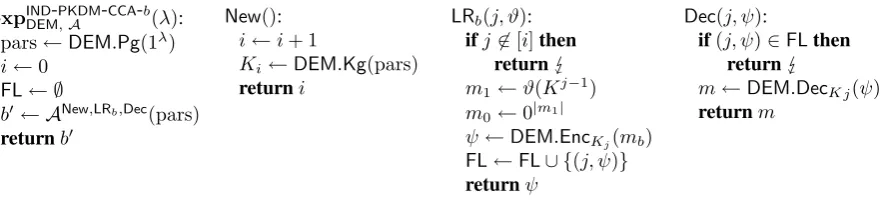
argument one can show that this restricted form of KDM attacks is not all that useful to an attacker—the notion is in fact equivalent toIND-CCAsecurity (see AppendixB).
ExpINDDEM-PKDM,A -CCA-b(λ):
pars←DEM.Pg(1λ) i←0
FL← ∅
b0 ← ANew,LRb,Dec(pars) returnb0
New():
i←i+ 1
Ki←DEM.Kg(pars) returni
LRb(j, ϑ): ifj6∈[i]then
return
m1←ϑ(Kj−1)
m0←0|m1|
ψ←DEM.EncKj(mb) FL←FL∪ {(j, ψ)}
returnψ
Dec(j, ψ):
if(j, ψ)∈FLthen return
m←DEM.DecK j(ψ) returnm
Figure 3: TheIND-PKDM-CCAsecurity experiment for data encapsulation mechanism DEM. Here ϑ(Ki−1)indicates the functionϑcan depend on all keys in range{K0, ..., Ki−1}.
3.2 Hybrid Encryption isIND-KDM-CCASecure (in the ROM)
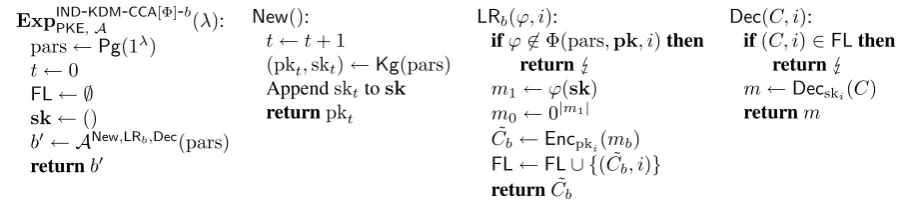
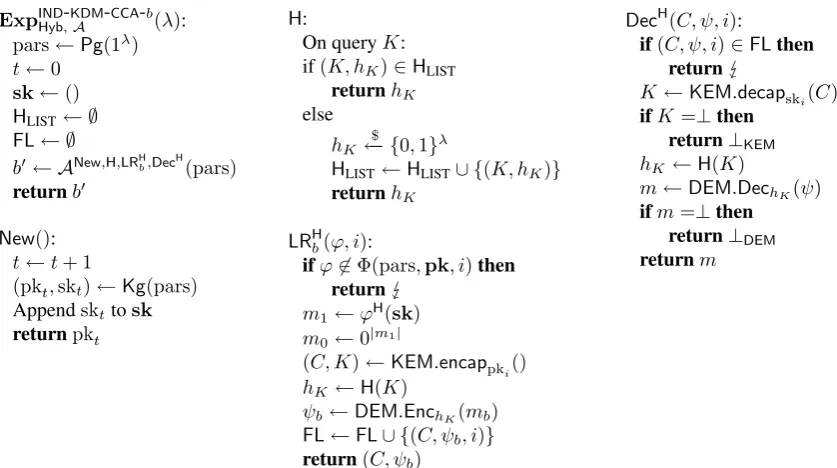
LetHyb= (Hyb.Gen,Hyb.Enc,Hyb.Enc)be a hybrid encryption scheme and letAbe an adversary. In the hybrid setting there are two types of keys present: the private key of the KEM and the ephemeral key for the DEM, where knowledge of the private KEM key leads to immediate recovery of the ephemeral key. When we regardHybas a public key encryption scheme in the context of key-dependent messages, it follows from Fig.1 that it is on the private key of theKEM that key-dependent messages (that are input to theDEM) will depend. For concreteness, in Fig.4we have expanded Fig.2in the context of hybrid encryption where the key derivation function is modelled as a random oracle. The forbidden list
FLensures that the adversary cannot trivially win.
We show that any KEM/DEM system that has aTYPE-1µOW-CCAKEM and anIND-CCADEM gives aIND-KDM-CCA[Φ]secure hybrid encryption scheme provided that the key derivation function
KDF is modelled as a random oracle, and the functions inΦcan call the random oracle. By this we mean that when modelled as circuits,ϕ∈Φcan have gates that explicitly call the random oracle. Here, theµindicates that there is a choice of multiple targets to invert. Recall that our modelling of functions inϕ∈ Φas circuits implicitly implies thatϕis length-regular, meaning that given pkandϕ, one can uniquely determine the length of ϕ(sk) (this is the same restriction as made by Black et al. [18] and Backes et al. [9]). This result is formalized in Theorem3.1. In TheoremC.1we provide an analogous, but significantly less tight result forTYPE-2KEMs.
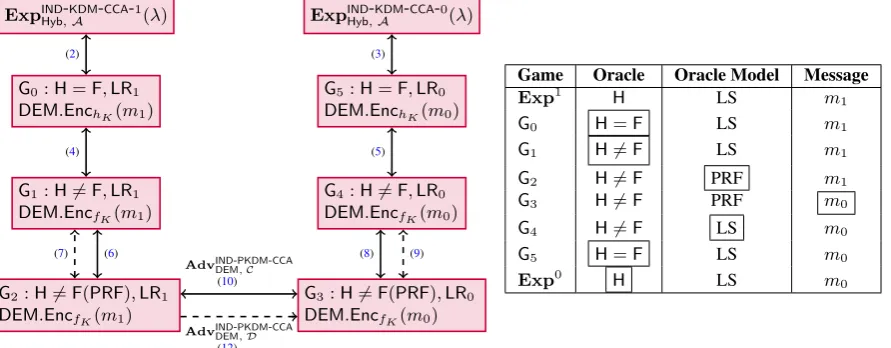
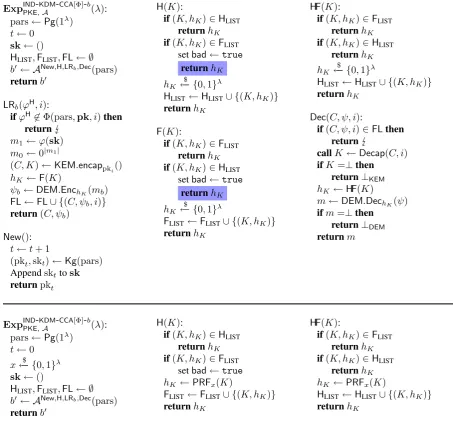
Proof intuition. In our proof we make use of the game-playing technique [46, 17] and introduce a sequence of games, as described in Fig. 5, and the games themselves are specified in Fig. 6. Apart from the simple, syntactical transitions (2) and (3), there are five game-hops to bound A’s advantage distinguishingExpINDHyb,-KDMA -CCA-1(λ)andExpINDHyb-,KDMA -CCA-0(λ). These are denoted with solid lines. Here (4) and (5) are identical-until-badhops. The ‘Forbidden List’FLensures that the adversary cannot win trivially. We definebadto be the event that the adversary queries the random oracle on a protokey Kpreviously used by the left-or-right oracle.
So far, this is all standard fair: use the security of the KEM to decouple the key encapsulated by the KEM and the one used by the DEM (where Dent [28] used the samebadevent in his analysis of
ExpINDHyb-,KDMA -CCA-b(λ):
pars←Pg(1λ)
t←0 sk←()
HLIST← ∅
FL← ∅
b0 ← ANew,H,LRHb,DecH(pars)
returnb0
New():
t←t+ 1
(pkt,skt)←Kg(pars) Appendskttosk returnpkt
H:
On queryK: if(K, hK)∈HLIST
returnhK else
hK
$
←− {0,1}λ
HLIST←HLIST∪ {(K, hK)} returnhK
LRHb(ϕ, i):
ifϕ6∈Φ(pars,pk, i)then return
m1←ϕH(sk)
m0←0|m1|
(C, K)←KEM.encappk i() hK ←H(K)
ψb←DEM.EnchK(mb) FL←FL∪ {(C, ψb, i)} return(C, ψb)
DecH(C, ψ, i):
if(C, ψ, i)∈FLthen return
K←KEM.decapsk i(C) ifK=⊥then
return⊥KEM
hK ←H(K)
m←DEM.DechK(ψ) ifm=⊥then
return⊥DEM
returnm
Figure 4: TheIND-KDM-CCAindistinguishability experiment made explicit for multi-key hybrid en-cryption in the random oracle model. The adversary is allowed to query deen-cryptions of the challenge ciphertexts under different public keys than the ones generated byLRb, and this restriction is dealt with
by the listFL.
KDM functions that call the random oracle, it could in principle submit functions that decrypt past key encapsulations and, with the help of the random oracle, turn them in past DEM keys (effectively, the KDM function can cause the event that would normally have triggeredbad). Since the reduction does not know the actual DEM keys being used, it suddenly finds itself in a tight spot and a direct hybrid argument (to get rid of past DEM keys) does not seem to work.
Our solution is to leverage the newly introduced IND-PKDM-CCA notion. Since we model the KDM functions as circuits, it turns out to be possible to describe a compiler that turns a KDM function against the PKE into one against the DEM. There is however one further complication. For the public key scheme, we model the hash function as a random oracle andthe KDM function has access to the random oracle. Yet, for the DEM scheme there is no random oracle present, which would suggest that the KDM function in the DEM world should not depend on one either. Moreover, it is not possible to predict on which values the KDM function would call the random oracle. Thus, when the random oracle is implemented by the reduction using lazy sampling, though it could hard-code the hash list so far into the circuit, the simulation might fail once fresh values are requested. To handle this, we (partly) model the random oracle as a pseudorandom function (rather than using lazy sampling). This provides the reduction a succinct description of theentirerandom oracle and it can safely embed the key to the pseudorandom function in the circuit used in theIND-PKDM-CCAgame. The introduction of a PRF requires two additional hops (6) and (8).
The bounding of eventbadis relatively easy on them0-side of the diagram, as one does not need to
know the KEM’s private keyskin order to simulate the data encapsulations: badis bounded inG3 by
AdvµKEMOW,-CCAB . However, on them1-side of the diagram it is less obvious how to bound thebadevent,
since it is not possible to simulate the key-dependent values. The solution is to move thebadevent from them1-side to them0-side using the separate hop (12), which bounds the difference betweenPr[bad]
in gamesG2andG3. This incurs a secondAdvDEMIND-PKDM,C -CCAterm to the bound.
G0:H=F,LR1
DEM.EnchK(m1)
G1:H6=F,LR1
DEM.EncfK(m1)
G5:H=F,LR0
DEM.EnchK(m0)
G4:H6=F,LR0
DEM.EncfK(m0)
ExpINDHyb,-KDMA -CCA-1(λ) Exp
IND-KDM-CCA-0 Hyb,A (λ)
G2:H6=F(PRF),LR1
DEM.EncfK(m1)
G3:H6=F(PRF),LR0
DEM.EncfK(m0)
(4)
AdvINDDEM,-PKDMC -CCA
(10)
(2) (3)
(5)
(8) (9) (7) (6)
AdvINDDEM,-PKDMD -CCA
(12)
Game Oracle Oracle Model Message
Exp1 H LS m1
G0 H=F LS m1
G1 H6=F LS m1
G2 H6=F PRF m1
G3 H6=F PRF m0
G4 H6=F LS m0
G5 H=F LS m0
Exp0 H
LS m0
Figure 5: Diagrammatic overview of the game hopping structure of proof that anµOW-CCA TYPE-1
secure KEM and anIND-CCAsecure DEM yield aIND-KDM-CCAsecure hybrid scheme in the random oracle model. The games are defined formally in Fig.6, here the boxes indicate the gameGiand which
oracles comprise the game. The transitions are labelled by the equations in the proof. The table indicates which oracle is used to handleA’s calls, how we model the random oracle (LS denotes lazy sampling) and which message is encrypted. The boxed items indicate where a change occurs in the hop from one game to another.
Interpretation. When it comes to hybrid schemes, our result is very general. Indeed, it even gener-alizes the work by Dent [28] (restricted to IND-CPA-security) as we can deal with key encapsulation schemes where the protokey is derived from the randomness in a hard-to-invert fashion. For instance, if Gpis a cyclic group of orderpwith generatorg, an obvious Diffie–Hellman inspired KEM would pick
private keyx∈Z∗
p, set public keygxand compute a key encapsulation by generating a randomr∈Z∗p,
releasing gr as the encapsulation of K = grx. Our theorems can deal with this situation (where the
KEM isTYPE-1iff DDH is easy inGp), but it is not covered by the KEMs given by Dent.
Black et al. [18] suggest the use of a variant of TDP-KEM combined with a one-time pad as a KDM-secure public key scheme in the random oracle model. Here TDP-KEM is shorthand for trapdoor-permutation-KEM, where the public and private key of the KEM match that of the trapdoor permutation and key encapsulation takes a randomK in the domain of the trapdoor permutation, applies the per-mutation to encapsulate and outputsH(K)as ephemeral key, or, in the hybrid model with explicit key derivation function (Fig.4) the KEM would outputKas ephemeral protokey.
As a result of our theorem, if we restrict this scheme to any fixed-size message length, security is guaranteed. Strictly speaking, for arbitrary length messages, we would need to allow signalling of (an upper bound on) the message length to the random oracle so it can output the required number of bits. This is primarily a syntactical issue that we did not feel sufficiently important to incorporate into our main framework. Since TDP-KEM has an obvious checking oracle, we regard our Theorem3.1settling the problem left open by Black et al.
Theorem 3.1. LetHybbe a hybrid PKE scheme (Fig.1) with aTYPE-1KEM, with the key derivation function modelled by a random oracle. LetΦbe any set of functions, including those which have random oracle access. LetF be a family of pseudorandom functions. Then for any adversaryAcallingLRat mostqLRtimes, there exists algorithmsBandC(of comparable computational complexity) such that
AdvHybIND,-KDMA -CCA[Φ](λ)≤2AdvµKEMOW,-CCAB (λ)+2AdvDEMIND-PKDM,C -CCA(λ)+2CollKEM(qLR, λ)+4AdvPRFF,A(λ).
This theorem, combined with TheoremB.1, yields the following corollary relating to standard defi-nitions.
Corollary 3.2. As above, and letnbe the number of DEM keys in the system, then:
Proof. [of Theorem3.1]
We recall that Fig. 4 contains a description of the security games ExpINDHyb,-KDMA -CCA-b(λ) that are obtained by specifying the general PKEIND-KDM-CCAgames for hybrid encryption where the key derivation function is modelled by a random oracleH. (For simplicity, we omit explicit mention of the classΦin the description of the security experiments.) As is customary, we use lazy sampling to define
H’s behaviour, maintaining a listHLISTof query pairs(K, hK)produced byHso far.
ExpINDPKE-,KDMA -CCA[Φ]-b(λ):
pars←Pg(1λ)
t←0 sk←()
HLIST,FLIST,FL← ∅
b0 ← ANew,H,LRb,Dec(pars) returnb0
LRb(ϕH, i):
ifϕH6∈Φ(pars,pk, i)then
return
m1←ϕ(sk)
m0←0|m1|
(C, K)←KEM.encappk i() hK ←F(K)
ψb←DEM.EnchK(mb) FL←FL∪ {(C, ψb, i)} return(C, ψb)
New():
t←t+ 1
(pkt,skt)←Kg(pars) Appendskttosk returnpkt
H(K):
if(K, hK)∈HLIST
returnhK if(K, hK)∈FLIST
setbad←true
returnhK
hK
$
←− {0,1}λ
HLIST←HLIST∪ {(K, hK)} returnhK
F(K):
if(K, hK)∈FLIST
returnhK if(K, hK)∈HLIST
setbad←true
returnhK
hK
$
←− {0,1}λ
FLIST←FLIST∪ {(K, hK)} returnhK
HF(K):
if(K, hK)∈FLIST
returnhK if(K, hK)∈HLIST
returnhK
hK
$
←− {0,1}λ
HLIST←HLIST∪ {(K, hK)} returnhK
Dec(C, ψ, i):
if(C, ψ, i)∈FLthen return
callK←Decap(C, i)
ifK=⊥then return⊥KEM
hK←HF(K)
m←DEM.DechK(ψ) ifm=⊥then
return⊥DEM
returnm
ExpINDPKE-,KDMA -CCA[Φ]-b(λ):
pars←Pg(1λ)
t←0
x←− {$ 0,1}λ
sk←()
HLIST,FLIST,FL← ∅
b0 ← ANew,H,LRb,Dec(pars) returnb0
H(K):
if(K, hK)∈HLIST
returnhK if(K, hK)∈FLIST
setbad←true hK ←PRFx(K)
FLIST←FLIST∪ {(K, hK)} returnhK
HF(K):
if(K, hK)∈FLIST
returnhK if(K, hK)∈HLIST
returnhK
hK←PRFx(K)
HLIST←HLIST∪ {(K, hK)} returnhK
Figure 6: Security games used for proof Theorem3.1. GamesG2 andG3 are described below the line,
with all items the same as above apart from these changes. GamesG0 andG5 correspond to the code
including the highlighting, implying thatH=F(as far as I/O behaviour is concerned). GamesG1−G4
haveH6=Fas two independently sampled random oracles. GamesG2andG3model the random oracle
as a PRF, rather than using lazy sampling. GamesG0,G1andG2correspond tob= 1, whereas Games
G3,G4andG5correspond tob= 0.
In the game there are four distinct places where queries toHcould be made. Firstly, the adversary
Acan make directHqueries; any query to the oracleLRb will require one ‘direct’ call toHfor the key
derivation and may include a number of indirect calls as part of the specified functionϕ; and finally as a decryption query for key derivation. For the purpose of our game-hopping approach, we need to be able to make a clear distinction between these cases. To this end, we introduce two additional oracles:Fand
HF. OracleHFsynchronises with items that are added to lists for bothHandF. By ensuring thatF,H
andHFimplement the same random oracle (i.e. are functionally equivalent, exhibiting exactly the same input/output behaviour), the changed games are equivalent to the original security experiments.
In Fig.6,G0corresponds to such a modified, yet equivalent game, in this case forb= 1. Theb= 0
sibling game is calledG5. In both these games the oraclesHandFeach maintain their own list,HLIST,
respectivelyFLIST, yet control code ensures(a)that these two lists can not containKoverlap in the sense
that no triple(K, hK, h0K)can exist for which both(K, hK)∈HLISTand(K, h0K)∈FLISTand(b)that
the oraclesHandFwill look up elements from the other oracle’s list, thus ensuring synchronisation. As a result of this design, FandHare functionally equivalent to each other in the games G0 andG5,
implying that from an adversary’s point of viewG0 is equivalent toExpHybIND-,KDMA -CCA-1(λ), or
Pr
G0A= 1
=PrhExpINDHyb,-KDMA -CCA-1(λ) = 1i . (2)
Similarly we claim thatG5is equivalent toExpHybIND-,KDMA -CCA-0(λ), so
Pr
G5A= 1
=PrhExpINDHyb,-KDMA -CCA-0(λ) = 1i . (3)
We proceed by a more interesting hop, where we makeFandHindependent. The oraclesFandHare modified such that when a query is made to one oracle (sayH) that has previously been queried to the other (F) then a fresh value is still created (and added toHLIST). Moreover, in this case the flagbadis
set totruefirst. This is described in Fig.6, where the newG1 corresponds to theb= 1case andG4to
theb= 0case. By syntactical inspection,G0andG1are identical up to the point at which the flag is set,
enabling application of the fundamental lemma of game-hopping:
Pr
G0A = 1
− Pr
G1A = 1
≤Pr[AsetsbadinG1] (4)
and in a similar veinG4 andG5are identical until bad, so
Pr
G4A= 1
− Pr
G5A= 1
≤Pr[AsetsbadinG4] . (5)
(To bound the difference between games G4 andG5 a standard hop involving the KEM’s IND-CCA
advantage is an alternative.)
The hop between the key-dependent scenario and the non-key-dependent world will be problematic later on due to the fact that ifϕcalls the random oracle, the simulation cannot correctly answer these queries since it does not know the values of the DEM keys in the system, only their indices. To counter this we add two additional hops in which we use a PRF rather than lazy sampling to model our random oracle. We regard theϕthat acts onsk(of the KEM) as a circuit, with some gates that call the RO. Thus there is a (one-to-one) mapping fromϕcircuits (which act on sk) toϑcircuits (that act on the DEM keys). We assume that there is some kind of ‘safe storage’ of all DEM keys. In this manner it is possible to track the past RO queries that are made by theseϑfunctions.
TheseHgates will have some inputs, and will check if the input string corresponds to someHLIST
entry, or anFLIST entry. If it is an F query, then assign a Ki to some of the output wires (since the
game does not know theKibut it can use them). The issue, however, is that ifAgives a circuitϕthat
makes anHquery in a gate, and subsequently makes anotherHquery then theHLIST lists will not be
synchronised.
To counter this, considerHas a pseudorandom functionPRF:{0,1}λ× K
DEM→ {0,1}λchosen from some PRF-secure function familyF, parameterised by some seedx ∈ {0,1}λ, rather than using
lazy sampling. DenotePRFx(K)as being the PRF applied to inputK and seedx. The gates forHnow store theFLIST, and when calls toFare made we can wire up the correspondingKi values. When the
random oracle from lazy sampling (LS) to using a PRF. The difference betweenA’s advantage against
G1and its advantage againstG2is bounded byA’s advantage in breaking the PRF:2
PrG1A = 1
−PrG2A = 1
≤ AdvPRFF,A(λ) (6)
Pr[AsetsbadinG1]−Pr[AsetsbadinG2] ≤ AdvPRFF,A(λ) (7)
and likewise the difference betweenA’s advantage againstG3 and its advantage againstG4 is bounded
by the PRF advantage:
PrG3A = 1
−PrG4A = 1
≤ AdvPRFF,A(λ) (8)
Pr[AsetsbadinG4]−Pr[AsetsbadinG3] ≤ AdvPRFF,A(λ) (9)
Now we are in a position to consider the hop between games G2 andG3. In game G2 the response
from the Left-or-Right oracle is given to the adversary by LR1, resulting to an encryption of m1 =
ϕ(sk)inExpHybIND,-KDMA -CCA-1(λ), whereas in gameG3, the Left-or-Right oracle is implemented byLR0,
leading to an encryption of m0 = 0|ϕ(sk)| (as in ExpHybIND,-KDMA -CCA-0(λ)). To show that games G2
and G3 are distinguishable only with small probability we introduce an adversary C that attacks the
IND-PKDM-CCAproperty of the DEM, and show that as long as the DEM is secure in this respect, then the output of the games is indistinguishable. More precisely,
PrG2A= 1
−PrG3A= 1
≤AdvINDDEM-PKDM,C -CCA(λ) (10)
The consequence of F and H being independently sampled oracles is that in games G2 and G3 the
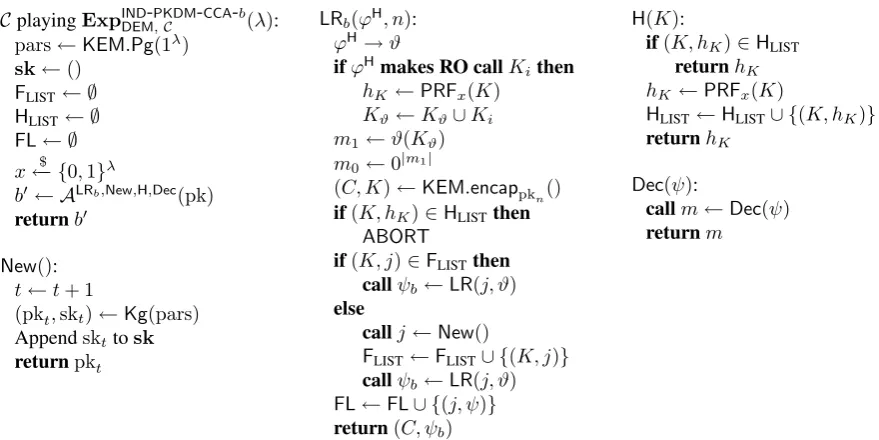
encapsulated key and the key used for the DEM are effectively decoupled (as the adversary has no direct access to F). This decoupling allows us to use a DEM hop to prove equation (10), as shown by the reduction in Fig. 7. In the game thatC plays, it runs Aas a black-box that returns a valid ϕ, thenC
creates messagesm0 andm1 in the same way that theLRb oracle does in the other games. However,
where in the games G2 andG3 there was an explicit oracle Fthat provided linkage between a key K
output by theKEMand its corresponding keyhK actually used by theDEM, in the simulationC uses
its own oracles to create the keyshKin theIND-PKDM-CCAexperiment it itself is playing. To do this,
we need to move the functionϕthat acts on the KEM secret keys to the functionϑ, that acts upon DEM keys. The setKϑcontains all the DEM keys that are currently in the system. To simulate the DEM hop
we need to make sure that theϑcircuit in theIND-PKDM-CCAgame is consistent with the circuit that acts on all of the DEM keys in the system in the PKE game. Every timeAmakes anFquery in its PKE game we need to add that key to the set of keys thatϑcan act upon.
In this decoupled scenario, reductionC generates the(pk,sk) pairs itself. The seed of the PRF is then ‘hardwired’ into the gates ofϑso whenA’s KDM function makes a RO call, it is dealt with by this setup. This allows the simulation to go through withoutCactually knowing which valuesKiare queried
to the RO. The messagesm1andm0 are then ‘created’ just as they are inA’sLRqueries. NowDcalls
its own oraclesLR,NewandDec(in theIND-PKDM-CCAgame) and returns a pair(C, ψb)asAwould
have expected.
The LRoracle in the simulation translates theϕinto aϑ. If this function makes an oracle callKi,
the simulation checksHLISTfor an entry containingKi, and if present returns the correspondinghK. If
the value is onFLISTthen the simulation will know the index of the key but not the value itself, and thus
aPRFgate can be called to retrieve the correspondinghK. If it is on neither list, simply initiatePRFon
Ki.
Since the adversaryAhas no direct access toFthis indirect simulation ofFis perfect. As a result, if
Cis inExpDEMIND-PKDM,C -CCA-1(λ)thenAwill behave towardsCexactly as it would do inG2, and similarly
ifCis inExpDEMIND-PKDM,C -CCA-0(λ)thenAwill behave as inG3, proving (10).
2
CplayingExpINDDEM-,PKDMC -CCA-b(λ):
pars←KEM.Pg(1λ)
sk←()
FLIST← ∅
HLIST← ∅
FL← ∅
x←− {$ 0,1}λ
b0 ← ALRb,New,H,Dec(pk) returnb0
New():
t←t+ 1
(pkt,skt)←Kg(pars) Appendskttosk returnpkt
LRb(ϕH, n):
ϕH→ϑ
ifϕHmakes RO callK ithen
hK←PRFx(K)
Kϑ←Kϑ∪Ki
m1←ϑ(Kϑ)
m0←0|m1|
(C, K)←KEM.encappk n() if(K, hK)∈HLISTthen
ABORT
if(K, j)∈FLISTthen
callψb←LR(j, ϑ) else
callj←New()
FLIST←FLIST∪ {(K, j)}
callψb←LR(j, ϑ) FL←FL∪ {(j, ψ)}
return(C, ψb)
H(K):
if(K, hK)∈HLIST
returnhK
hK←PRFx(K)
HLIST←HLIST∪ {(K, hK)} returnhK
Dec(ψ):
callm←Dec(ψ)
returnm
Figure 7:Description of reductionCused to prove(10). WhenCrunsA, it needs to create an environ-mentExpHybIND-,KDMA -CCA. It makesNewqueries and specifies the public key indexnin itsLRb queries.
The messagesm0 andm1and alsoCandKare ’created’ just as they are in normalLRb, whereashK
is virtually set to whatever value is used in the gameCitself is playing byC’s calls toNew,LRandDec (fromExpINDDEM-PKDM,C -CCA). Note thatCneed not knowhKfor this simulation.
All that remains is bounding the probability of the badevent in games G2 andG3, followed by a
collection of the various terms into a single bound on the advantage.
The analysis of thebadevent in gameG3 is easiest, as here the adversary is given an encryption of
a zero string which is clearly not key-dependent (since the adversary directly specifies its length). By simple code-inspection, it emerges thatAcan set the flagbadtotruein two places inG3: either in a
direct oracle query toHon aK that has already been queried toFby LR0; or if LR0 callsF on aK
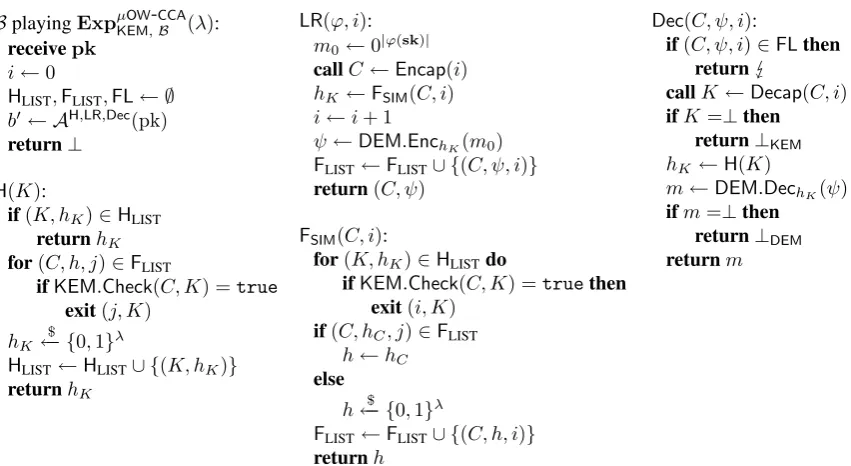
that has previously been queried toHdirectly byA. Intuitively, the former constitutes a break against the one-wayness of theKEM, and the latter should just be very unlikely (although we actually bound it by a break as well to avoid the need for an additional assumption on the wayK as output byKEMis distributed). Fig.8shows the reductionBfor which
Pr[AsetsbadinG3]≤AdvKEMµOW,-CCAB (λ) +CollKEM(qLR, λ) (11)
First we observe that if Enc (internally) creates a pair (C, K) and (C0, K0) satisfyingK = K0 yet C 6=C0 the simulation will with high probability produceF(K) 6= F(K0), indicating that in that case it is not perfect. However, the event that such a pair is created by aKEMought to be small. We define
CollKEM(q, λ)as the probability this happens inqqueries to the encapsulation oracle.
In order to simulate correctly, we require that the reductions can make as manyNewcalls asAcan. To do this we can simply set an upper bound on the number ofNewcalls thatAmakes, and then restrict the number of calls the reductions can make by this figure.
If a collision as above does not happen thenBcreates a perfect simulation ofG3as long asbadis not
set. Moreover, at the very point a query is made that would have causedbadto be set inG3, the reduction
Buses itsKEM-checking oracleKEM.Checkto detect thatbadwas set and retrieves the corresponding keyK, plus the index of theEncquery this key belongs to.
As a technical aside, to simulate G3 the reduction needs to answer the adversaryA’sLR0 queries.
SinceAgives outϕand expects an encryption of0|ϕ(sk)|, it is necessary (in order to simulate correctly) forBto learn|ϕ(sk)|without knowingsk. Here the length regularity condition is required: givenpk
andϕ, we can determine|ϕ(sk)|and thus simulateLR0.
The analysis of the badevent in G2 is more problematic and a direct approach (as done for G3)
BplayingExpµKEMOW,-CCAB (λ): receivepk
i←0
HLIST,FLIST,FL← ∅
b0← AH,LR,Dec(pk)
return⊥
H(K):
if(K, hK)∈HLIST
returnhK for(C, h, j)∈FLIST
ifKEM.Check(C, K) =true
exit(j, K) hK
$
←− {0,1}λ
HLIST←HLIST∪ {(K, hK)} returnhK
LR(ϕ, i):
m0←0|ϕ(sk)|
callC←Encap(i) hK ←FSIM(C, i)
i←i+ 1
ψ←DEM.EnchK(m0) FLIST←FLIST∪ {(C, ψ, i)}
return(C, ψ)
FSIM(C, i):
for(K, hK)∈HLISTdo
ifKEM.Check(C, K) =truethen exit(i, K)
if(C, hC, j)∈FLIST
h←hC else
h←− {$ 0,1}λ
FLIST←FLIST∪ {(C, h, i)}
returnh
Dec(C, ψ, i):
if(C, ψ, i)∈FLthen return
callK←Decap(C, i)
ifK=⊥then return⊥KEM
hK←H(K)
m←DEM.DechK(ψ) ifm=⊥then
return⊥DEM
returnm
Figure 8:Description of reductionBused to prove(11). WhenBrunsA, it needs to create an environ-mentExpINDHyb-,KDMA -CCA. The line “exit(j, K)” indicates thatBat that point terminates runningAand
returns(j, K)to its own environment (as guess forKj). As long asEnc(internally) does not create a
pair(C, K)and(C0, K0)withK=K0yetC 6=C0the simulation is perfect.
Shoup [31]. Rather than analysing thebadevents inG2, we will defer the analysis toG3 (for which we
already have a bound). However, it is not at all evident that in the hopG2 toG3the probability thebad
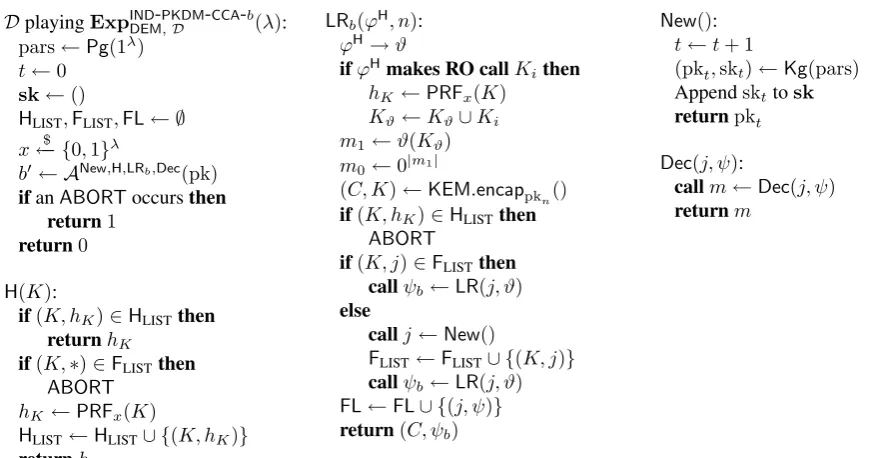
flag is set stays the same (as was the case for the deferred analysis by Gennaro and Shoup). Indeed, it is unlikely to be the case, however we are able to show that the difference between the two bad events from occurring is bound byIND-PKDM-CCAadvantage of an adversaryD(as described in Fig.9) against the DEM, or
Pr[AsetsbadinG2]−Pr[AsetsbadinG3]≤AdvINDDEM-PKDM,D -CCA(λ). (12)
Similarly to the analysis of (10), it is necessary to translate the function ϕinto aϑ, and align the simulated queries correctly. We set this up so that thebadevent in the security games corresponds toD
causing anABORTin the reduction.
1. If Dis in gameIND-PKDM-CCA-1 then, unlessABORToccurs, this is a perfect simulation of
G2forA.
2. If Dis in gameIND-PKDM-CCA-0 then, unlessABORToccurs, this is a perfect simulation of
G3forA.
3. DwillABORTiff the eventbadoccurs in (either)G2(orG3).
Consequently we have
Pr[AsetsbadinG2] = Pr
h
DseesABORTinExpIND-PKDM-CCA-1i Pr[AsetsbadinG3] = Pr
h
DseesABORTinExpIND-PKDM-CCA-0
i .
Since by construction (and definition) we also have
Pr
h
DseesABORTinExpIND-PKDM-CCA-b
i
=Pr
h
ExpIND-PKDM-CCA-b= 1
DplayingExpINDDEM-,PKDMD -CCA-b(λ):
pars←Pg(1λ)
t←0 sk←()
HLIST,FLIST,FL← ∅
x←− {$ 0,1}λ
b0← ANew,H,LRb,Dec(pk) ifanABORToccursthen
return1
return0
H(K):
if(K, hK)∈HLISTthen
returnhK if(K,∗)∈FLISTthen
ABORT
hK ←PRFx(K)
HLIST←HLIST∪ {(K, hK)} returnhK
LRb(ϕH, n):
ϕH→ϑ
ifϕHmakes RO callK ithen
hK←PRFx(K)
Kϑ←Kϑ∪Ki
m1←ϑ(Kϑ)
m0←0|m1|
(C, K)←KEM.encappk n() if(K, hK)∈HLISTthen
ABORT
if(K, j)∈FLISTthen
callψb←LR(j, ϑ) else
callj←New()
FLIST←FLIST∪ {(K, j)}
callψb←LR(j, ϑ) FL←FL∪ {(j, ψ)}
return(C, ψb)
New():
t←t+ 1
(pkt,skt)←Kg(pars) Appendskttosk returnpkt
Dec(j, ψ):
callm←Dec(j, ψ)
returnm
Figure 9: Description of reductionDused to prove (12). When Druns A, it needs to create an en-vironmentExpINDHyb-,KDMA -CCA. The messagesm0 andm1 and alsoC andK are ‘created’ just as they
are in normalLRb, whereashK is virtually set to whatever value is used in the gameDitself is
play-ing byD’s calls to New, LR andDec(fromExpDEMIND-PKDM,D -CCA). The number of keypairs Dcan ask for is upper-bounded by the number ofNewqueriesAmakes. Note thatDneed not knowhK for this
simulation.
and so our claim (12) follows. Finally we put all of the above together and arrive at the claimed bound .
AdvINDHyb-,KDMA -CCA[Φ](λ) =
˛ ˛ ˛Pr[Exp
IND-KDM-CCA-1
Hyb,A (λ) = 1]−Pr
h
ExpIND-KDM-CCA-0 Hyb,A (λ) = 1
i˛ ˛ ˛ = ˛ ˛ ˛Pr ˆ
G0A= 1˜−PrˆG5A= 1˜
˛ ˛
˛ [by (2),(3)]
=
˛ ˛ ˛Pr
ˆ
G0A= 1˜−PrˆG1A= 1˜+PrˆG1A= 1˜−PrˆG2A= 1˜+PrˆG2A= 1˜
-Prˆ G3A= 1
˜
+Prˆ G3A= 1
˜
−Prˆ G4A= 1
˜
+Prˆ G4A= 1
˜
−Prˆ G5A= 1
˜˛˛ ˛
≤ ˛˛ ˛Pr
ˆ G0A= 1
˜
−Prˆ G1A= 1
˜
+AdvPRFF,A(λ) +Pr
ˆ G2A= 1
˜
−Prˆ G3A= 1
˜
+AdvPRF
F,A(λ) +Pr
ˆ G4A= 1
˜
−Prˆ G5A= 1
˜˛˛
˛ [by (6), (8)]
≤
˛ ˛
˛Pr[AsetsbadinG1] ˛ ˛
˛ +Pr[AsetsbadinG4] + [by (4), (5)]
+AdvINDDEM-PKDM,C -CCA(λ) + 2AdvPRFF,A(λ) [by (10)]
≤ ˛˛
˛Pr[AsetsbadinG2] +Adv
PRF
F,A(λ)
˛ ˛
˛+Pr[AsetsbadinG3] +Adv
PRF
F,A(λ)+ [by (7), (9)]
+AdvINDDEM-PKDM,C -CCA(λ) + 2AdvPRFF,A(λ)
≤ 2Pr[AsetsbadinG3] +AdvINDDEM-PKDM,C -CCA(λ) +AdvINDDEM-PKDM,D -CCA(λ) + 4AdvPRFF,A(λ) [by (12)]
≤ 2AdvINDDEM-PKDM,C -CCA(λ) + 2Adv
µOW-CCA
KEM,B (λ) + 2CollKEM(qLR, λ) + 4AdvPRFF,A(λ). [by (11)]
4
Separation Results
results relating the full schemes follow from the original papers (and we refer to the original papers for full details and proofs).
By inspection, it also easy to see that both KEMs areIND-CPAsecure under the SXDH assumption and that the DEMs are one-timeIND-CPAsecure, assuming a key derivation function is pseudorandom. The reason the schemes nonetheless fail to fall under our framework, is that the key derivation function is only applied to part of the key. Indeed, it is the other part of the key (and how it is used by the DEM) that has been carefully crafted by the original authors to ensureCYC-insecurity. As a result, these existing counterexamples also serve as proof that the KEM–DEM frameworkper sedoes not provide any ‘leverage’ when it comes to increasing resistance against key-dependent message attacks.
4.1 Writing Acar et al.’ses2 as a KEM and DEM
Acar et al. [3] present schemes that are IND-R-secure (indistinguishable from random) if the SXDH problem is hard, yet notCYC-secure. LetGSbe a group scheme for which SXDH is hard. The original paper shows es2 = (es2.Pg,es2.Kg,es2.Enc,es2.Dec,es2.MsgR,es2.CtxtR), an asymmetric scheme.
The paper also presents a symmetric scheme but our focus will be ones2. The decryption keys are in the
message space.
Lemmas 3 and 4 of [3] prove this scheme to beIND-R-secure but notCYC-secure. We will now cast this scheme in a hybrid framework and comment on the security properties. Fig.10details hybrid scheme
Hyb1 = (Hyb1.Pg,Hyb1.Kg,Hyb1.KEM.encap,Hyb1.DEM.Enc, .Hyb1.KEM.decap,Hyb1.DEM.Dec)
which is a straightforward adaptation of thees2scheme. The KEM part generates keys that are uniform
over the keyspace, however it is important to note that the keyspace of the DEM part depends onpars, so we must allow some joint parameter generation between the KEM and the DEM. The changes from the original scheme are only cosmetic, and as a result the security properties of the original scheme, namelyIND-R-secure yet KDM- andCYC-insecure still hold.
The KEM as described by us is IND-CPAsecure under the SXDH assumption: parameters, public key, key encapsulation and encapsulated key form two independent DDH instances in each of the groups, so replacing any of these (in particular the keys) with unrelated random elements from the same group will go unnoticed (assuming SXDH). The DEM is deterministic, and hence it can clearly not be multi-time secure. However, it is one-multi-time secure: For every T1 and m2, there is a unique Ω1 such that
T1= Ωm1 2, indicating thatm2is information-theoretically hidden givenT1and similarly form1andT2;
moreover, ifH is a balanced function, thenm1+H(. . . , Z1)operates as a perfect one-time pad. Thus
the DEM is perfectly one-time secure ifH is a balanced function. IfHis a pseudorandom generator, security degrades to one-timeIND-CPAsecurity.
As an aside, while Acar et al. noted the scheme was insecure against 2-cycles, they did not remark on 1-cycles. It is easy to see that security also breaks down in this case: If ϕ(sk) = ϕ(x1, x2) =
(x1, x2)then an adversary can disinguish the encryption of(m1, m2) = (x1, x2): T1 =g1x1u1/x2 and
T2=gx22u2/x1 soe(T1, T2) =e(g1, g2)x1u1x2u2/x1x2 =e(g1, g2)u1u2 =e(U1, U2)so the adversary can
Hyb1.Pg(1λ) Hyb
1.DEM.Enc(pars,pk, K,(m1, m2))
(p,G1,G2,GT,e, g1, g2) $
←−GS(1λ) (Z
1, Z2,Ω1,Ω2)←K
pars←(p,G1,G2,GT,e, g1, g2) T1←Ω 1/m2
1 ; T2←Ω 1/m1
2
returnpars c1←m1+H(pars,1, Z1)
c2←m2+H(pars,2, Z2)
ψ←(T1, T2, c1, c2)
Hyb1.Kg(pars) returnψ
x1, x2 $ ←−Z∗
p
X1←gx11 ; X2←g2x2 Hyb1.KEM.decap(pars,sk, C) sk←(x1, x2) ; pk←(X1, X2) (x1, x2)←sk ; (Y1, Y2, U1, U2)←C
return(pk,sk) Z1←Y1x1; Z2←Y2x2 Ω1←U1x1 ; Ω2←U2x2
K←(Z1, Z2,Ω1,Ω2)
Hyb1.KEM.encap(pars,pk) returnK (X1, X2)←pk ; y1, y2, u1, u2
$ ←−Z∗p
Y1←g
y1
1 ; U1←gu11 ; Z1←X
y1
1 Hyb1.DEM.Dec(pars, K, ψ)
Y2←g
y2
2 ; U2←gu22 ; Z2←X
y2
2 (T1, T2, c1, c2)←ψ Ω1←X1u1; Ω2←X2u2 (Z1, Z2,Ω1,Ω2)←K
C←(Y1, Y2, U1, U2) m1←c1−H(pars,1, Z1)
K←(Z1, Z2,Ω1,Ω2) m2←c2−H(pars,2, Z2)
return(C, K) return(m1, m2)
Figure 10:Hybrid schemeHyb1based ones2 of [3]. KEM isIND-CPAif DDH inG1 holds.
4.2 Writing Cash et al.’sΠCPAas a KEM and DEM
The encryption scheme of Cash et al. [26]ΠCPA = (ΠCPA.Pg,ΠCPA.Kg,ΠCPA.Enc,ΠCPA.Dec), also uses asymmetric bilinear groupse:G1×G2 →GT of prime orderp, and assumes thatG1andG2are
distinct and that the DDH assumption holds in both (aka the SXDH assumption). The scheme includes functionsencode:M → {0,1}l(λ)anddecode:{0,1}l(λ)→ M, which denote an invertible encoding
scheme, where l(λ)is the polynomial length of the encoded message. LetF :GT → {0,1}l(λ) be a
pseudorandom generator.
The authors show that this scheme isIND-CPAsecure, however when given a circular encryption of two keys, an adversary can distinguish another ciphertext with probability1/2. In fact, with probability 1/2 over the coins used in key generation, the adversary can recover both secret keys. In the appendix of the full version of their paper, the authors give another scheme that isIND-CPAsecure without using the ‘group-switching’ technique, and experiences catastrophic collapse in the presence of a 2-cycle, with even higher adversarial success probability.
Fig.11details hybrid schemeHyb2 = (Hyb2.Pg,Hyb2.Kg,Hyb2.KEM.encap,Hyb2.DEM.Enc, Hyb2.KEM.decap,Hyb2.DEM.Dec) which is a straightforward casting of the ΠCPA scheme. in the hybrid framework. Let us see what we can say about the relevant security properties. Again, the changes are only cosmetic, the (in)security properties of the original scheme, namelyIND-CPA-secure yetCYC-insecure carry over without reserve. Here we consider the security of the KEM and the DEM as defined by us. The DEM is secure for arguments similar to those used for the Acar et al. scheme: it is one-timeIND-CPAsecure provided thatF is a pseudorandom generator.
By construction, if β = 0the KEM part takes place primarily in G1, whereasβ = 1 there is a
symmetric move toG2. Consequently, we only need to analyse the KEM security forβ = 0and theβ=
1follows by symmetry. Forβ = 0, we have that(g1, C1, Y2, K2)forms a DDH tuple; if we substitute
~
Y1 =g1x1forY1and inverseRthrough the pairing resulting inR~ =e(R, g2)and letC˜2 =R. ~~ Y1
r
(all this only makes the adversary’s life easier) then the same holds for the tuple(g1, ~Y1, ~R,C˜2/ ~R). We conclude
that the KEM (forβ = 0) is one-way secure if the CDH assumption holds inG1and andIND-CPAif
the DDH assumption holds (inG1).
decision Diffie Hellman (SDDH) [11] assumption holds in both groups the scheme seems 1-cycle secure and we conjecture that the scheme is actually fully single-keyIND-KDM[Φ]secure in the Generic Group Model [45] (adapted to the asymmetric pairing setting).
Hyb2.Pg(1λ) Hyb
2.DEM.Enc(pars,pk, K, M)
(p,G1,G2,GT,e, g1, g2) $
←−GS(1λ) (β, Y
1, Y2)←pk ; (α, m1, m2)←M pars←(p,G1,G2,GT,e, g1, g2) (K1, K2)←K
returnpars I←F(K1)⊕encode(M)
C4←I
ifβ= 0:
Hyb2.Kg(pars) C3←K2m2.g
m2
1
x1, x2 $ ←−Z∗
p; β
$
←− {0,1} ifβ= 1:
Y1←e(g1, g2)x1 C3←K2m2
ifβ = 0: ψ←(C3, C4)
Y2←g1x2 returnψ
ifβ = 1:
Y2←g2x2 Hyb2.KEM.decap(pars,sk, C) sk←(β, x1, x2) ; pk←(β, Y1, Y2) (β, x1, x2)←sk ; (C1, C2)←C
return(pk,sk) ifβ= 0:
R←(C2/e(C1, g2)x1) ; K2←C1x2
Hyb2.KEM.encap(pars,pk) ifβ= 1:
(β, Y1, Y2)←pk R←(C2/e(g1, C1)x1) ; K2←C1x2
r←−$ Z∗p; R
$
←−GT K1←R; K←(K1, K2)
C2←R.Y1r; K1←R; K2←Y2r returnK
ifβ = 0:
C1←g1r Hyb2.DEM.Dec(pars, K, ψ)
ifβ = 1: (C3, C4)←ψ; (K1, K2)←K
C1←g2r M0←F(K1)⊕C4
C←(C1, C2) ; K←(K1, K2) M ←decode(M0)
return(C, K) returnM
Figure 11: Asymmetric scheme Hyb2 based on ΠCPA of Cash et al. [26]. Message space is M = {0,1} ×Z∗
p×Z∗p thusm1andm2must be non-zero, these values can be included in the message space
by proper encoding. The ciphertext space isGβ+1×GT×Gβ+1× {0,1}l(λ). Note thatY
2may be either
inG1orG2depending on the structure of the public key.
5
Conclusions and Open Problems
As stated, our result is very general as it incorporates active attacks, and allows KDM functions that call the random oracle. The proof method incorporates the use of a PRF and the non-standardIND-PKDM-CCA
notion of security on the DEM (notably, a notion equivalent to IND-CCA). In the scenario where the adversary’s KDM functionscannotcall the random oracle, direct reductions toIND-CCAsecurity of the DEM are possible, however there is an additionalbadevent caused when there exists(C, i)and(C0, i0)
such thatKEM.decapski(C) =KEM.decapsk
i0(C
0) =Kand the adversary manages to decapsulate to a
previously seen protokey, without triggering the forbidden listFL. It is consequently possible to bound both of thebadevents together.
Once we move to the scenario where functions can call the random oracle, it is necessary to consider how the adversary could exploit this issue. First of all the adversary makes an arbitrary LR query, receiving an encryption under some protokeyK1 encapsulated inC1. It then makes anotherLRquery,
this time submitting a function that depends on theK1 used in its previous query, receiving (C2, ψ2).
Then a decryption query of the formm0 ← Dec(C1, ψ2)does not fall on the forbidden list and could
security notion such asIND-CCA.
The natural open problem that arises from this work is consideration of KDM security of the hybrid framework in the standard model. The main goal is to develop a composition theorem, with or without a KDF, that states standard, individual security notions for the KEM and the DEM to yield a KDM secure hybrid system, with security against passive and active attacks.
Acknowledgments
We would like to thank Pooya Farshim for his contribution to initial discussions, and Bogdan Warinschi for ideas and input throughout. In addition, we would like to thank the anonymous conference reviewers for their comments and suggestions.
References
[1] Abadi, M., Rogaway, P.: Reconciling two views of Cryptography (the Computational Soundness of Formal Encryption). J. Cryptology 15(2), 103–127 (2002) Cited on page3.
[2] Abe, M., Gennaro, R., Kurosawa, K., Shoup, V.: Tag-KEM/DEM: A new Framework for Hybrid Encryption and a new Analysis of Kurosawa-Desmedt KEM. In: Cramer, R. (ed.) EUROCRYPT. Lecture Notes in Computer Science, vol. 3494, pp. 128–146. Springer (2005) Cited on pages 3 and6.
[3] Acar, T., Belenkiy, M., Bellare, M., Cash, D.: Cryptographic Agility and its Relation to Circular Encryption. In: Gilbert [33], pp. 403–422 Cited on pages3,4,5,18, and19.
[4] Adão, P., Bana, G., Herzog, J., Scedrov, A.: Soundness of Formal Encryption in the Presence of Key-Cycles. In: di Vimercati, S.D.C., Syverson, P.F., Gollmann, D. (eds.) ESORICS. Lecture Notes in Computer Science, vol. 3679, pp. 374–396. Springer (2005) Cited on pages3and5.
[5] Alperin-Sheriff, J., Peikert, C.: Circular and KDM Security for Identity-Based Encryption. In: Fischlin et al. [30], pp. 334–352 Cited on page5.
[6] Applebaum, B.: Key-Dependent Message Security: Generic Amplification and Completeness. In: Paterson [42], pp. 527–546 Cited on page5.
[7] Applebaum, B., Cash, D., Peikert, C., Sahai, A.: Fast Cryptographic Primitives and Circular-Secure Encryption based on Hard Learning Problems. In: Halevi, S. (ed.) CRYPTO. Lecture Notes in Computer Science, vol. 5677, pp. 595–618. Springer (2009) Cited on page5.
[8] Ateniese, G., Camenisch, J., Hohenberger, S., de Medeiros, B.: Practical group signatures without random oracles. IACR Cryptology ePrint Archive 2005, 385 (2005) Cited on page17.
[9] Backes, M., Dürmuth, M., Unruh, D.: OAEP is secure under Key-Dependent Messages. In: Pieprzyk, J. (ed.) ASIACRYPT. Lecture Notes in Computer Science, vol. 5350, pp. 506–523. Springer (2008) Cited on pages5,8, and9.
[10] Backes, M., Pfitzmann, B., Scedrov, A.: Key-Dependent Message Security under active attacks - BRSIM/UC-Soundness of Symbolic Encryption with Key Cycles. In: CSF. pp. 112–124. IEEE Computer Society (2007) Cited on pages5and8.
[11] Bao, F., Deng, R.H., Zhu, H.: Variations of Diffie-Hellman Problem. In: Qing, S., Gollmann, D., Zhou, J. (eds.) ICICS. Lecture Notes in Computer Science, vol. 2836, pp. 301–312. Springer (2003) Cited on page20.
[13] Bellare, M., Cash, D., Keelveedhi, S.: Ciphers that securely encipher their own keys. In: Chen, Y., Danezis, G., Shmatikov, V. (eds.) ACM Conference on Computer and Communications Security. pp. 423–432. ACM (2011) Cited on page5.
[14] Bellare, M., Desai, A., Pointcheval, D., Rogaway, P.: Relations among notions of security for Public-Key Encryption schemes. In: Krawczyk, H. (ed.) CRYPTO. Lecture Notes in Computer Science, vol. 1462, pp. 26–45. Springer (1998) Cited on pages3and6.
[15] Bellare, M., Keelveedhi, S.: Authenticated and Misuse-Resistant Encryption of Key-Dependent Data. In: Rogaway [43], pp. 610–629 Cited on page5.
[16] Bellare, M., Rogaway, P.: Random oracles are practical: A paradigm for designing efficient pro-tocols. In: Denning, D.E., Pyle, R., Ganesan, R., Sandhu, R.S., Ashby, V. (eds.) ACM Conference on Computer and Communications Security. pp. 62–73. ACM (1993) Cited on page3.
[17] Bellare, M., Rogaway, P.: The security of triple encryption and a framework for code-based game-playing proofs. In: Vaudenay, S. (ed.) EUROCRYPT. Lecture Notes in Computer Science, vol. 4004, pp. 409–426. Springer (2006) Cited on pages5and9.
[18] Black, J., Rogaway, P., Shrimpton, T.: Encryption-scheme security in the presence of Key-Dependent Messages. In: Nyberg, K., Heys, H.M. (eds.) Selected Areas in Cryptography. Lecture Notes in Computer Science, vol. 2595, pp. 62–75. Springer (2002) Cited on pages3,7,9, and11.
[19] Boneh, D., Halevi, S., Hamburg, M., Ostrovsky, R.: Circular-Secure Encryption from Decision Diffie-Hellman. In: Wagner, D. (ed.) CRYPTO. Lecture Notes in Computer Science, vol. 5157, pp. 108–125. Springer (2008) Cited on pages3and4.
[20] Brakerski, Z., Goldwasser, S.: Circular and Leakage Resilient Public-Key Encryption under Sub-group Indistinguishability - (or: Quadratic Residuosity strikes back). In: Rabin, T. (ed.) CRYPTO. Lecture Notes in Computer Science, vol. 6223, pp. 1–20. Springer (2010) Cited on page5.
[21] Brakerski, Z., Goldwasser, S., Kalai, Y.T.: Black-box circular-secure encryption beyond affine functions. In: Ishai, Y. (ed.) TCC. Lecture Notes in Computer Science, vol. 6597, pp. 201–218. Springer (2011) Cited on page5.
[22] Brakerski, Z., Vaikuntanathan, V.: Fully Homomorphic Encryption from Ring-LWE and security for Key Dependent Messages. In: Rogaway [43], pp. 505–524 Cited on page5.
[23] Camenisch, J., Chandran, N., Shoup, V.: A Public Key Encryption scheme secure against Key De-pendent chosen plaintext and adaptive chosen ciphertext attacks. In: Joux, A. (ed.) EUROCRYPT. Lecture Notes in Computer Science, vol. 5479, pp. 351–368. Springer (2009) Cited on pages 5 and7.
[24] Camenisch, J., Lysyanskaya, A.: An efficient system for non-transferable Anonymous Creden-tials with optional anonymity revocation. In: Pfitzmann, B. (ed.) EUROCRYPT. Lecture Notes in Computer Science, vol. 2045, pp. 93–118. Springer (2001) Cited on page3.
[25] Canetti, R., Kalai, Y.T., Varia, M., Wichs, D.: On symmetric encryption and Point Obfuscation. In: Micciancio, D. (ed.) TCC. Lecture Notes in Computer Science, vol. 5978, pp. 52–71. Springer (2010) Cited on page5.
[26] Cash, D., Green, M., Hohenberger, S.: New definitions and separations for Circular Security. In: Fischlin et al. [30], pp. 540–557 Cited on pages3,4,5,19, and20.
![Figure 10: Hybrid scheme H y b 1 based on e s 2 of [3]. KEM is I N D -C P Aif DDH in G1 holds.](https://thumb-us.123doks.com/thumbv2/123dok_us/7901789.1311749/19.595.130.463.68.340/figure-hybrid-scheme-based-kem-aif-ddh-holds.webp)
![Figure 11: Asymmetric scheme,in H y b 2 based on ΠC P Aof Cash et al. [26]. Message space is M={0 1} ×Z∗p× Z∗p thus m1 and m2 must be non-zero, these values can be included in the message spaceby proper encoding](https://thumb-us.123doks.com/thumbv2/123dok_us/7901789.1311749/20.595.139.459.121.450/figure-asymmetric-message-included-message-spaceby-proper-encoding.webp)
