ISSN 2348 – 7968
Efficient Detection & Prevention of Sybil Attack in VANET
Harsimrat KaurP 1
P
, Preeti BansalP 2
P
1
PChandigarh engineering collage, Mohali, Punjab, India
Email id: [email protected]
ABSTRACT
The security in VANET has become a significant and active topic within the research community. In spite of the several attacks aimed at specific nodes in VANET that have been uncovered, some attacks involving multiple nodes still receive little attention. Moreover, it might also have to do with the fact in which no survey or taxonomy has been done to clarify the characteristics of different multiple node attacks. This paper addresses the aforementioned gap by providing a proper definition and categorization of Sybil attacks in VANET. In the proposed work GA have been used with fitness function optimization. Genetic Algorithm can be used to devise elementary principles for traffic in networks. Initially we, deploy a network according to our need, then display Sybil attack on the network and check some specific parameters value on such attack on the network which are given as network load, throughput, packet delivery ratio and end delay. Then we, introduce genetic algorithm for optimization of fake nodes then again check the value on the basis of some specific parameters. And in last compare the results of both i.e. network having Sybil attack without GA and network having Sybil attack with GA. As we compare their results we got that after introducing Genetic Algorithm for optimization in network it gives much better results as compared to previous one. In this, we also compare our results with previous existing technique to show the enhancement we have done through our thesis. The whole simulation will take place in MATLAB environment.
Keywords: VANET, Security, Genetic Optimization Algorithm
1.
Introduction
Vehicular Ad-Hoc Network is a definite sort of Mobile Ad-Hoc Network which offers message communication amongst [1,2,3]:
(1) Nearby vehicles and
(2) Nearby roadside equipment’s.
VANETs are one type of method to apply Intelligent Transportation System, which is a method designed for conveying data as well as communication technology in the direction of carrying infrastructure as well as vehicles [4,5]. The aforementioned is grounded on IEEE 802.11p standard meant for Wireless Access intended for Vehicular Environment (WAVE). These networks have no static infrastructure, in addition to they depend on themselves for executing any kind of network functionality [6].
Safekeeping of vehicular networks is still principally a discovered part. VANET, existence as a wireless network, take over altogether kind of the security dangers which is a wireless framework has to contract with. VANET safekeeping is dangerous for the reason that a poorly premeditated Vehicular
Adhoc Network is susceptible to network assaults, also this know how to compromise the security of drivers [7,8]. A security framework must guarantee which of the broadcast originates commencing a reliable source as well as it is not a meddled en-route through any other sources. It must also incursion a balance with confidentiality as for executing security as well as privacy composed in a framework is inconsistent [9].
There are many sorts of possible assaults on Vehicular Adhoc Networks [10, 11]. This one is vital in which Vehicular Adhoc Network security ought to be skilled of managing each of the single type of assault [12,13]. But Sybil attack is one of the major attack that has been found these days. Sybil attack is a kind of security risk when a hub in a system guarantees various characters [16].
system) is deceived into believing that an attacking PC has a disproportionally vast impact [15]. Correspondingly, an attacker with numerous personalities can utilize them to act maliciously, by either taking data or disturbing correspondence.
Sybil attacks have showed up in numerous situations, with wide usage for security, well being and trust. For instance, a web survey can be fixed utilizing various IP locations to present countless. A few organizations have likewise utilized Sybil attack to increase better appraisals
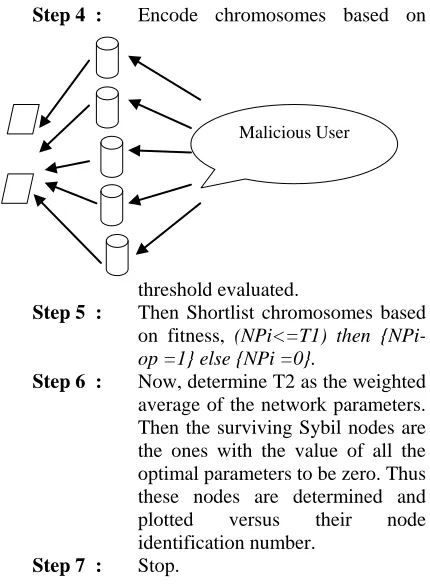
Fig. 1 Sybil Attack
In this paper, Sybil attack prevention has been proposed using genetic algorithm. The rest of the paper is organised as Section 2 gives the detailed explanation of Sybil attack prevention in VANET. Section 3 contains the results and evaluation in MATLAB and finally Section 4 contains conclusion and future scope.
2.
Detection of sybil attack using genetic
algorithm
This is the methodology for detection of Sybil attack followed by the framework flow chart:
Step 1 : Start
Step 2 : Get the network parameters from the given VANET system. Each chromosome is then evaluated for a fitness function by considering the various network parameters.
Step 3 : Calculate threshold T1= average (NPi). Then the threshold is determined by calculating the average of the individual network parameters. Then the fitness criterion for each every network parameter is determined
Where, T1 = First Threshold
NPi = Network Parameter such as network delay, throughput for I = 1, 2, 3….N. N= Total no of nodes in the network.
Step 4 : Encode chromosomes based on
threshold evaluated.
Step 5 : Then Shortlist chromosomes based on fitness, (NPi<=T1) then {NPi-op =1} else {NPi =0}.
Step 6 : Now, determine T2 as the weighted average of the network parameters. Then the surviving Sybil nodes are the ones with the value of all the optimal parameters to be zero. Thus these nodes are determined and plotted versus their node identification number.
Step 7 : Stop.
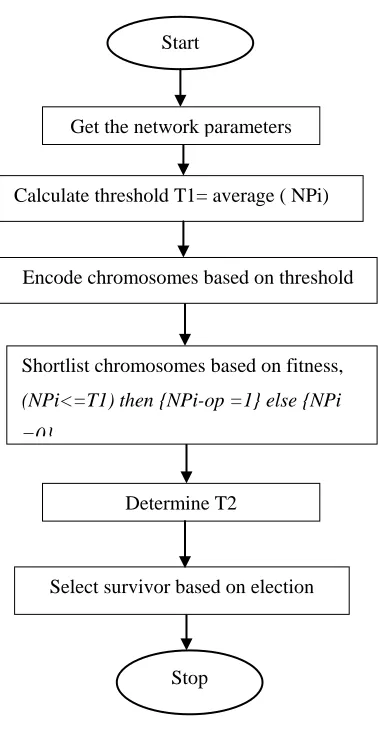
Below flowchart is the proposed methodology to prevent Sybil attack in the network. The very first step is the collection of network parameters like no. of nodes, no. of rounds, network length, and network width. After that network deployment takes place that shows the transmission of data packets from source to destination. After that detection of Sybil nodes takes place in the network. After this parameter evaluation in Sybil attack takes place. Then apply genetic algorithm to optimize these parameters so that Sybil attack prevention takes place. In the end again parameter evaluation has been done while optimizing with genetic algorithm. Optimization has been done using combination of thresholding and fitness function.
ISSN 2348 – 7968
Fig. 2: Flowchart of Proposed Work
3.
Analysis and evaluation
Sybil attack prevention and detection takes place by deploying the network using parameters like no. of nodes, no. of rounds, network length, and network width using 20 nodes. Length vs breadth of the network, the channel (CH) captures the routing information from the initiator (source node) and then sends the data from the source to destination node. Various used parameters are described below.
a. Throughput
Throughput is the number of packets sent over the network in given time. Throughput is the average rate of successful messages delivered over a communication channel. Unit: bits per second (bps).
b. Packet delivery Ratio
It is defined as the ratio of data packets received by the destinations to those generated by the sources.
PDR = (packets sent – packet dropped) / total packets sent
.
Fig.4: Throughput with Sybil Attack
In this figure we can see the throughput of the network with Sybil attack. The average throughput decreases with the no. of Sybil attackers increases.
Fig.5: Packet delivery with Sybil Attack
It is the ratio of packets that are successfully delivered to a destination compared to the number of packets that have been sent. Above figure shows the delivery ratio with Sybil nodes has been decreased.
0 5 10 15 20 25 30 35 40
2 3 4 5 6 7 8
NODES MOBILITY
T
HRO
G
HP
UT
THROGHPUT WITH SYBIL ATTACK
SYBIL ATTACK
0 5 10 15 20 25 30 35 40
0 10 20 30 40 50 60
NODES MOBILITY
PAC
KET
D
EL
IVER
Y
PACKET DELIVERY WITH SYBIL ATTACK
SYBIL ATTACK Calculate threshold T1= average ( NPi)
Shortlist chromosomes based on fitness,
(NPi<=T1) then {NPi-op =1} else {NPi
=0}
Encode chromosomes based on threshold
Determine T2
Select survivor based on election Start
Stop
Fig.7: Throughput with Genetic Algorithm
The Sybil attacker nodes causes decrease in the throughput of the network. It is because number of collisions is more in system and it is optimized using GA algorithm as shown above.
Fig.9: Packet delivery ratio using GA optimization
Above figure shows the delivery ratio with GA optimization. It is the ratio of packets that are successfully delivered to a destination compared to the number of packets that have been sent.
Fig.11: Comparison between throughput with Sybil attack and GA- optimization.
Above figure shows that the GA Optimization throughput is somewhat higher than without GA due to presence of Sybil attack. Total data from the source to the receiver more than the time it takes until the recipient receives the last packet.
Fig.13: Comparison between Packet delivery ratio with Sybil Attack and with GA- Optimization
Above figure shows the comparison of packet delivery ratio with or without Sybil nodes in addition to GA. It has been seen that packet delivery ratio increases due to addition of GA, as it has been decreased by Sybil attack in network.
4.
Conclusion & future scope
VANETs is quiet unsafe as well as susceptible to numerous attacks so there is necessity of a dependable, proficient as well as a protected protocol which can be able to quickly organized and also utilize dynamic routing technique. Peer-to-peer systems play an ever-increasingly important part of our daily lives. However, most of the peer-to-peer
0 5 10 15 20 25 30 35 40
0 5 10 15 20 25 30 NODES MOBILITY T HRO UG HP UT THROGHPUT-GA GA OPTIMIZATION
0 5 10 15 20 25 30 35 40
-10 0 10 20 30 40 50 60 NODES MOBILITY PAC KET D EL IVER Y PACKET DELIVERY-GENETIC GA OPTIMIZATION
0 20 40
2.5 3 3.5 4 4.5 5 5.5 6 6.5 7 7.5 NODES MOBILITY T HRO G HP UT
THROGHPUT WITH SYBIL ATTACK
SYBIL ATTACK
0 20 40
0 0.5 1 1.5 2 2.5 3 3.5 4 4.5 5 NODES MOBILITY E ND DE L A Y END DELAY-GA GA-OPTIMIZATION
0 20 40
-60 -40 -20 0 20 40 60 NODES MOBILITY PAC KET D EL IVER Y
PACKET DELIVERY WITH SYBIL ATTACK
SYBIL ATTACK
0 20 40
ISSN 2348 – 7968
systems are vulnerable to Sybil attacks. In order to design more efficient and practical Sybil defenses, we proposed an implementation based on Genetic algorithm. In this thesis, the issues related to security like Sybil attack has been reviewed. Then an Intrusion Detection System (IDS) especially for Sybil attacks is implemented using Genetic Algorithm, and then tested with networks of varied node configurations. The algorithm will be tested for more number of nodes and the performance analysis will be done in terms network load, throughput of the algorithm as the node number is increased. It is concluded that Sybil attack prevention is achieved at greater rate when GA has been used. Future scope lies in the use of the hybridization of Genetic algorithm with other routing protocols like AODV or DSDV. As they are also vulnerable to this type of attacks.
5.
References
[1] J. R. Douceur, (2002)” The Sybil attack”, In Proceedings of the International Workshop on Peer to Peer Systems, pp. 251–260. [2] J. Newsome, E. Shi, D. Song, and A. Perrig,
(2004)“The Sybil attack in sensor networks: Analysis and defences", In Proceedings of International Symposium on Information Processing in Sensor Networks, pp. 259– 268.
[3] F. Anjam, P. Mouchtaris, (2007)“Security For Wireless Ad Hoc Networks”, Proc. Intersience Publishing, IEEE.
[4] Wang. Yu, “Using Fuzzy Expert System based on Genetic Algorithm for Intrusion Detection System”, IEEE , pp. 201-224, April 2009.
[5] Wei Li, “Using Genetic Algorithm for Network Intrusion Detection”, IEEE, pp.1-8, 2010.
[6] Crosbie, Mark, and Gene Spafford. 1995. “Applying Genetic Programming to Intrusion Detection.” In Proceedings of 1995 AAAI Fall Symposium on Genetic Programming, pp. 1-8. Cambridge, Massachusetts, 1995.
[7] AnupGoyal and Chetan Kumar, “ GA-NIDS: A Genetic Algorithm based Intrusion Detection System”, 2010.
[8] YutengGuo, Beizeng Wang, Xingxing Zhao,
XiaobiaoXie, Lidalin and QindaZhou,“Feature Selection based on Rough Set and modified Genetic programming for Intrusion Detection”, In 33 ICRTIT-2012 proceedings of 5th International Conference of Computer
Science and Education, IEEE, August 2010, China.
[9] Harley Kozhushko, “Intrusion Detection: Host Based and Network-Based Intrusion Detection Systems”, Independent Study, 2003.
[10] S. Capkun, J. P. Hubaux, and L. Buttyan, “Mobility helps peer-to-peer security,” IEEE Trans. Mobile Comput., vol. 5, no. 1, pp. 43–51, Jan. 2006.
[11] C. Piro, C. Shields, and B. N. Levine, “Detecting the Sybil attack in mobile ad hoc networks,” in Proc. Securecomm Workshops, 2006, pp. 1–11.
[12] K.S. Sujatha, V. Dharmar. R.S. Bhuvaneswaran, “Design of genetic algorithm based IDS for MANET”, Conference: Recent Trends In Information Technology (ICRTIT), IEEE, pp.28-33, 2012.
[13] P. Michiardi, R. Molva. "Simulation-based Analysis of Security Exposures in Mobile Ad Hoc Networks". European Wireless Conference, 2002.
[14] Istikmal ; Sch. of Eng., Telkom Univ., Bandung, Indonesia ; Leanna, V.Y. ; Rahmat, B.in “comparison of proactive and reactive protocol in manet”
[15] Ahmed Sherif, MahaElsabrouty. Amin Shoukry, “A Novel Taxonomy of Black-Hole Attack Detection Techniques in Mobile Ad-hoc Network (MANET)”, IEEE, pp: 346-352, 2013.
[16] Chen Chen, Xin Wang, Weili Han, and Binyu Zang. A Robust Detection of the Sybil Attack in Urban VANETs. In ICDCS Workshops, pages 270–276. IEEE Computer Society, 2009.
[17] Grover, J., Gaur, M. S. and Laxmi, V. (2010) A Novel Defense Mechanism against Sybil Attacks in VANET. Proceedings of the 3rd international conference on Security of information and networks, pp.249– 255,ACM, New York, NY, USA.
[18] Y. Hao, Y. Cheng, C. Zhou and W. Song, “A distributed key management framework with cooperative message authentication in VANETs,” IEEE J. Select. Areas Commun., Mar. 2011.