Improving Network Lifetime in MANET Using VGDRA
Gagandeep kaur*, Gurbahar Singh*
*Depar t me nt Of Co mp ut er Sci ence and Inf or mat i on Tech nol o gy Ba ba Banda Si n gh Bahad ur
En gi neeri n g C ol l ege , Fat eh garh Sahi b Mangat 20 05 gurl een@ gmai l .co m
Abstract
A virtual grid based dynamic routes adjustment scheme for mobile sink based wireless sensor networks was introduced in recent times. Routing is defined as moving of information from source to destination. In this proposed work the cluster head is selected after energy of the current cluster head is utilized, in this case a threshold value is set. The problem of straight line communication is also considered, as the sink is kept mobile the nodes that are far away from the sink consume more energy and time for communication process as the distance between the sink and node is quite large so to resolve the problem a rechargeable node employed at the centre of the grid. This node is used for the direct straight line communication with the sink thus consuming the less amount of energy as these are rechargeable nodes. By using this routing concept, the energy of the system will be decreased that will result in increasing the life time and the stability of the network. Therefore this method of routing is considered to be better and more efficient than the traditional algorithm of routing.
Keywords: Routes reconstruction ; energ y effi ci enc y; MANET; wi rel ess senso r net works.
1. Introduction
A wireless sensor network (WSN) sometimes called a wireless sensor and actor network. The WSN is built of "nodes" – from a few to several hundreds or even thousands, where each node is connected to one sensors. The cost of sensor nodes is similarly variable, ranging from a few to hundreds of dollars, depending on the complexity
of the individual sensor nodes. Size and cost constraints on sensor nodes result in corresponding constraints on resources such as energy, memory, computational speed and communications bandwidth. The topology of the WSNs can vary from a simplestar networkto an advancedmulti-hopwireless mesh network. The propagation technique between the hops of the network can beroutingorflooding.
Routing is the process of selecting best paths in a network. In the past, the term routing was also used to mean forwarding network traffic among networks. A host or a router has a routing table with an entry for each destination, or a combination of destinations, to route IP packets. The routing table can be either static or dynamic. A static routing table contains information entered manually. The administrator enters the route for each destination into the table. A dynamic routing table is updated periodically by using one of the dynamic routing protocols such as RIP, OSPF, or BGP. Whenever there is a change in the Internet, such as a shutdown of a router or breaking of a link, the dynamic routing protocols update all the tables in the routers automatically.
routing protocol used inside an autonomous system. It is a very simple protocol based on distance vector routing. In link state routing, if each node in the domain has the entire topology of the domain the list of nodes and links, how they are connected including the type, cost (metric), and condition of the links (up or down)-the node can use Dijkstra's algorithm to build a routing table. OSPF divides an autonomous system into areas. An area is a collection of networks, hosts, and routers all contained within an autonomous system. An autonomous system can be divided into many different areas. All networks inside an area must be connected.
In multicast communication, there is one source and a group of destinations. The relationship is one-to-many. In this type of communication, the source address is a unicast address, but the destination address is a group address, which defines one or more destinations. The group address identifies the members of the group. Multicast Distance Vector Routing Unicast distance vector routing is very simple. Multicast routing does not allow a router to send its routing table to its neighbors. The idea is to create a table from scratch by using the information from the unicast distance vector tables.
Distance vector and link state routing are both intradomain routing protocols. They can be used inside an autonomous system, but not between autonomous systems. These two protocols are not suitable for interdomain routing mostly because of scalability. It also creates heavy traffic because of flooding. There is a need for a third routing protocol which we call path vector routing. Path vector routing proved to be useful for interdomain routing. The principle of path vector routing is similar to that of distance vector routing. In path vector routing, there is one node in each autonomous system that acts on behalf of the entire autonomous system. Multicast link state routing is a direct extension of unicast routing and uses a source-based tree approach. Although
unicast routing is quite involved, the extension to multicast routing is very simple and straightforward.
2. Related Work
Routing is defined as moving of information from source to destination. Along the way, at least one intermediate node is encountered. It can be referred as medium for sending packets from source and destination. Previously the routing was done on the basis of the minimum distance from the sink. Later the virtual gridding protocol was introduced. A number of mobile nodes may exist in each grid. In traditional approach the cluster head is selected only once in the start of the communication after that the cluster head remain static but due this when the cluster head node died the communication stopped. This decrease the efficiency of the network. Another major problem of using this traditional protocol is that the node that are located far from the sink choose long route for the communication , that results in increase in the distance and the energy consumption was more.. So there is a need to find some solution for the problem for the efficient routing in the network.
this paper, a hybrid routing protocol (APTEEN) which allows for comprehensive information retrieval. The nodes in such a network not only react to time-critical situations Such a network enables the user to request past, present and future data from the network in the form of historical, one-time and persistent queries respectively. The performance of these protocols and observe that these protocols are observed to outperform existing protocols in terms of energy consumption and longevity of the network.
In NEADD, a Novel Aware Data Dissemination scheme for randomly deployed wireless sensor networks was suggested in [3]. The proposed scheme is energy-efficient for handling both sink and source mobility. NEADD relies on virtual grid-based infrastructure for data dissemination from multiple mobile sources to multiple mobile sinks. Furthermore a diagonal forwarding algorithm for query and data forwarding which ensures that only one dissemination node forwards the query and data at a time. In NEADD, alternate dissemination nodes are selected in advance during grid construction process and minimum threshold energy level is defined for dissemination nodes. As soon as the energy of a dissemination node reaches to the minimum threshold value, it is replaced by an alternate dissemination node. Cho J. et al. [4] This paper suggests a routing protocol that can achieve an efficient data transmission from source to the mobile sink node without interruption by using location based virtual grid.
Dattatray S. Waghole et al. [5] In Wireless Sensor Networks hop by hop and Multi-hop communication is done. A data packet is send to the sink node via hop to hop or Multi-hop communication. Important Parameters like congestion, energy, Average End-to-End Delay consider at the time of data packets communication from one node to sink node. Many times due to congestion above mention parameters Average End-to-End Delay will be
increased and energy also loss at the instance of communication. Initial aim of this paper is reduce average End-to-End Delay using Movable Mobile Sink in uniform Random Wireless Sensor Network. In this paper there solve energy consumption, congestion and Average End-to – End Delay problem for collection of data packets in the network. In WSN we may exploiting mobility of sink to increase the network lifetime and balance the node energy dissipation. For efficient working of sensor network, by minimizing the route reconstruction cost and energy level, survey highlights variety of data collection and data dissemination schemes in [6]. Survey highlights many routed schemes to be named few novel routing schemes like Virtual Grid based Dynamic Route Adjustment (VGDRA), Virtual Circle Combined Straight Routing (VCCSR).But each scheme has its own advantages and disadvantages.
Virtual grid based Two-Tier Data Dissemination (TTDD) in [7] proactively constructs a uniform per source node virtual grid structure spanning the entire sensor field. For data collection, the mobile sink floods its local grid cell where the query packet makes use of all the disseminating points along the virtual grid till it gets to the source node. During query dissemination process, a reverse path is also established for data reporting to the mobile sink. TTDD although avoids the flooding of the sink’s topological updates, however, the per source virtual grid construction undermines the network lifetime.
and disadvantages. Analysis on Data Collection with Multiple Mobile Elements in Wireless Sensor Networks was suggeseted Liang He et.al in [9]. A potential problem with this approach is the scalability, and a straightforward solution is to employ multiple mobile elements to collect data collaboratively. In this paper, the network where multiple homogeneous mobile elements are available is modeled as an M/G/c queuing system, and insights on the data collection performance are obtained through theoretically analyzing the measures of the queue. In addition, a heuristic formula to determine the optimal number of mobile elements is proposed based on this model.
It employs HEED [10] for clustering in which priority is given to residual energy level of nodes for electing the CH nodes. The multi-hop clustering is a good approach to minimize the number of clusters, on the other hand, root node which is the centerpiece in routes adjustments generates early energy depletion which reduces the network lifetime. In EEGBDD, a Novel Aware Data Dissemination scheme for randomly deployed wireless sensor networks. The proposed scheme is energy-efficient for handling both sink and source mobility in [11] EEGBDD relies on virtual grid- based infrastructure for data dissemination from multiple mobile sources to multiple mobile sinks. Furthermore we proposed a diagonal forwarding algorithm for query and data forwarding which ensures that only one dissemination node forwards the query and data at a time. Virtual Circle Combined Straight Routing (VCCSR) scheme was introduced by Chen et al. [12] which is a converge-cast tree algorithm. It forms a virtual structure containing virtual circles and straight lines. A set of nodes are chosen as cluster heads along these virtual circles and straight lines, which forms a virtual backbone network. Xiaocong Jin et al. [13] This paper presents TIGHT, a geographic routing protocol for cognitive radio mobile ad hoc networks. TIGHT
offers three routing modes and allows secondary users to fully explore the transmission opportunities over a primary channel without affecting primary users (PUs). Yasir Faheem et al. [14] Mobile sink Wireless Sensor Network (MSWSN) has recently received a lot of attention from the research community. Its appealing characteristics of providing longer network lifetimes, delay optimizations and the flexibility to adapt dissemination strategies according to applications' requirements have proved to be more efficient. Numerous mobile sink based data dissemination strategies have been proposed. This work presents state of the art literature review on MSWSN data dissemination strategies. Issues and flexibilities that did not exist with static sink WSN have been discussed. A classification of available data dissemination strategies and their pros and cons has been discussed.
3. Virtual Grid Routing
Scheme
stability of the network. The methodology of the proposed work is described below:-
Step 1: First of all the network parameters will be initialized like network area, number of nodes to be deployed and the energy parameters like initial energy of nodes, transmission energy, reception energy, data aggregation energy etc.
Step 2: Then multiple gridding of the network will be done and nodes will be deployed in that multiple grids.
Step 3: Next step after the deployment of the node is to deploy the mobile sink, this mobile sink will move around the network and communication is done.
Step 4: Now, the election of the Clusterhead of each grid is done , the Clusterhead selection is done on the basis of the energy of node in the cluster . then node that is having the maximum energy in the cluster is selected as the cluster head
Step 5: After this the rechargeable node is deployed in the grid and then the communication is done , if the Clusterhead is near to the rechargeable node then the data is transferred from the Clusterhead to rechargeable node .
Step 6: If Clusterhead is away from the rechargeable node, then the sink and Clusterhead communication is done.
Step 7: In this step the calculation of the energy is done, and finally the calculation of the performance parameters is done. These performance parameter shows the performance of the network.
Thes e are the m ai n st eps t aken for our propos ed s chem e which will reduce th e rout es reconst ructi o n cost of sens or nodes. Energ y m odel is us ed for reducing energ y cons umpti on of nodes. It wil l also improve li fet ime and reduces cost consumption.
4. Result Analysis
In this section, we present the simulation results using Mat lab 7.10.0.499(R2010a) version. The area of 200*200 dimensions is taken with 15 nodes in each cluster. Area is divided into 16 equal sized clusters and 1500 rounds are taken. A mobile sink moves around the sensor field counter clockwise. Initially all the sensor nodes have uniform energy reserve of 1 mJ. Furthermore, we considered nodes energy consumption in transmission (Tx) and receiving (Rx) modes only which are computed using Equation 1 and 2 respectively.
Tx = (Eelect × K) + (Eamp×K ×d2) (1)
Rx= Eelect × K (2)
In Equation 1 and 2, K is message length, Eelect is energy dissipation of nodes and Eamp is energy dissipation by the transmitter amplifier to control the channel noise. In our technique, we took Eelect =50 nJ, and Eamp =10 nJ/bit/m2 and K =8*2 bits.
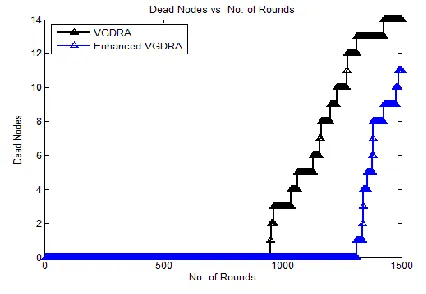
4.1 Network Life Time
Fig. 1 Network Life Time (Dead nodes) vs no. of rounds
4.2 Alive Nodes Vs Number of Rounds
More alive nodes contribute to the increase in network life time. Table 2 and Figure 2 show the number of nodes alive in the network with the increase in number of rounds. we show the simulation results of number of alive nodes. At round 1500, number of alive nodes are 1 in VGDRA whereas this number has increased to 4 in case of Enhanced VGDRA. Greater the number of alive nodes greater is the lifetime of network.
Table 2 Network Life Time with Number of Alive nodes
No. of Rounds
VGDRA Enhanced VGDRA
0-500 15 15
500 -1000 12 15
1000 -1500 1 4
Fig.2 C omparing the alive nodes vs no. of rounds
4.3 Stability Period (First Node Dead)
Fig.3 Dead round vs First node dead
4.4 En ergy of Netw ork Commun icati on Fig.4 s hows the com parison of energ y of our Enhanced VGDRA s chem e with virt ual gri d routing schem e. It is shown that energ y consumption i n Enhance d VGDRA s chem e is ver y l es s than the virt ual gri d routing schem e because of improvement i n distance of networ k comm uni cation.
Fig.4 C omparing energ y of net work comm uni cation
5. Conclusion and Future Scope
The path of transfer of data between the source and the destination is termed as Routing. For efficient network the routing protocol that is used
should consume less energy, and less distance. In this propose work the rechargeable nodes are introduced. Form the results obtained it is concluded that the thus proposed protocol is better and more efficient than the traditional routing protocol. The energy consumption of the nodes is decreased and the network life time is increased. The results obtained by using proposed method are considered to be efficient and better than the traditional algorithm. In future this method of routing can be further enhanced to obtain more efficient results by enhancing route selection method. In future this technique can be further enhanced. The selection of the route should be done in the more efficient way so that the energy consumption of the network is reduced and the life time of the network is improved.
References
[1] Abdul Waheed Khan, Abdul Hanan Abdullah, Mohammad Abdur Razzaque, and Javed Iqbal Bangash, “GRID ROUTING: A Virtual Grid-based dynamic routes adjustment scheme for mobile sink-based wireless sensor networks,IEEE Sensors Journal, Vol. 15, No. 1, January 2015.
[2] A. Manjeshwar ; D. P. Agrawal (2002) “APTEEN: A Hybrid Protocol for Efficient Routing and Comprehensive Information Retrieval in Wireless Sensor Networks∗”, IEEE, Proceedings of the International Parallel and Distributed Processing Symposium (IPDPSí02).
[3] Awadhesh kumar Dr. Neeraj Tyagi , Prabhat Singh , Vinay Kumar (April, 2013) “A Novel Energy Aware Data Dissemination Routing Protocol for WSN,” IJAIEM, Volume 2, Issue 4, April 2013.
landmark based on virtual grid in wireless sensor network”, IEEE, pp 1-3.
[5] Dattatray S. Waghole, Vivek S. Deshpande (March, 2013) “Reducing Delay Data Dissemination Using Mobile Sink in Wireless Sensor Networks”, IJSCE, Volume-3, Issue-1, pp 305-308.
[6] Dinu Gopal and Dr. Suriyakala C D (July, 2015) “A Survey on Performance Comparison of Virtual Structure based Data Dissemination Schemes in WSN,” JNCET, Volume 3, Issue 1.
[7] H. Luo, F. Ye, J . Cheng, S. Lu, and L. Zhang, “TTDD: Two -tier dat a diss eminati on i n l arge -s cal e wirel ess sensor networks, ” Wirel es s Netw. , vol . 11, nos . 1 –2, pp. 161 –175, J an. 2005.
[8] Jin Wang, Xiaoqin Yang, Zhongqi Zhang, Bin Li and Jeong-Uk Kim (2014) “A Survey about Routing Protocols with Mobile Sink for Wireless Sensor Network”, International Journal of Future Generation Communication and Networking Vol.7, No.5 (2014), pp.221-228.
[9] Liang He , Jianping Pan , and Jingdong Xu (December 2011) “Analysis on Data Collection with Multiple Mobile Elements in Wireless Sensor Networks
[10] O. Younis and S. Fahmy, “HEED: A h ybrid, energ y-effici ent, dis tri but ed clus tering approach for ad hoc sensor networks,” IEEE Trans. Mobile Comput., vol. 3, no. 4, pp. 366 –379, Oct . 2004.
[11] Singh, P; Ravi Kumar ; Vinay Kumar (Feb, 2014) “An energy efficient grid based Data Dissemination routing mechanism to mobile sinks in Wireless Sensor Network,” Issues and Challenges in Intelligent Computing Techniques
(ICICT), 2014 International Conference on, Pp 104-109.
[12] T.-S. Chen, H. -W. Ts ai, Y. -H. Chang and T. -C. Chen, “Geographi c converge cast using mobil e si nk i n wireless sensor networks,” Comput. Commun., vol. 36, no. 4, pp. 445 –458, Feb. 2013.
[13] Xiaocong Jin, Rui Zhang, Jingchao Sun and Yanchao Zhang (August,2014) “TIGHT: A Geographic Routing Protocol for Cognitive Radio Mobile Ad Hoc Networks,” Wireless Communications, IEEE Transactions , Volume:13 , Issue: 8 ,Pp 4670 – 4681.