Mitigation of Rayleigh Backscattering in
Wavelength Division Multiplexing Passive
Optical Network Based on WS-ASK
Modulation
Vikas Kumar Mishra1, Prof. Bramha S. Tripathi2, Prof. Ambikesh P. Gupta3
M.Tech Scholar Department of ECE, Bhopal Institute of Technology, Bhopal, Madhya Pradesh, India 1
Assistant Professor Department of ECE, Bhopal Institute of Technology,Bhopal, Madhya Pradesh, India 2
Assistant Professor Department of ECE, Bhopal Institute of Technology,Bhopal, Madhya Pradesh, India 3
ABSTRACT: A novel integration scheme from time-division-multiplex passive optical network (TDMPON) to
wavelength-division-multiplex PON (WDM-PON) using differential Quadreture phase-shift keying (DQPSK) for the downstream signal and wavelength-shifted amplitude-shift keying (WS-ASK) for the upstream signal is illustrated. The migration scheme does not change the existing fiber infrastructure. An optical filter is preinstalled at the optical networking unit (ONU) to select the desirable downstream wavelength for the WDM-PON and simultaneously demodulate the downstream DQPSK signal. Signal remodulation is used to generate the upstream signal by reusing the downstream wavelength. In the ONU, by wavelength shifting the upstream optical spectrum with respect to the downstream optical spectrum, the Rayleigh backscattering (RB) interference beat noise affecting the upstream signal can be significantly mitigated. The optimum bandwidth for the downstream DQPSK demodulation is analyzed.
KEYWORDS: WS-ASK, optical fiber, WDM-PON, DQPSK modulation.
I. INTRODUCTION
II. PROPOSED ARCHITECTURE
Shows the experimental setup of the projected WDM-PON victimization downstream DQPSK with optical filtering and upstream WS-ASK signals. A CW signal made by a distributed feedback optical maser (CW) at frequency of 193.1 THz and power of 0 dBm was commenced a part modulator (IM) to supply the 40-Gb/s pseudorandom binary sequence (PRBS) 2-8 -1 DQPSK downstream signal. The downstream signal was then commenced the ONU via associate degree optical circulator, a 20-km commonplace single mode fiber (SMF), and a fiber splitter. At the WDM-ONU, the ability of the downstream signal was divided into 2 halves by a 3-dB fiber splitter. Half the downstream signal was demodulated by victimization associate degree optical band pass filter and received by a 10-GHz PIN photoreceiver (Rx). The information measure of the band pass filter was set at regarding ten gigahertz to induce associate degree optimum demodulated DQPSK signal per Fig 1. The out-of-band suppression was regarding fifty decibel. Another half the downstream signal was commenced a commercially out there MZM, that is additionally known as differential construction phase-shift keying (DQPSK) modulator. it absolutely was electrically driven by a 10-GHz RF up-converted two.5-Gb/s NRZ signal at PRBS 2-8 -1 in-phase and quadrature-phase severally to the 2 electrodes within MZM. By correct dominant the time delay and also the bias of the third conductor, a single-sideband carrier suppressed raise (also known as WS-ASK) signal is generated. The optical spectra of the CW, downstream DQPSK, and re-modulated upstream WS-ASK signals at totally different points of the network square measure enclosed within the insets in Fig. 1 are able to observe that the upstream WS-ASK signal can give a wavelength shift of ten gigahertz far from the middle wavelength for Rb mitigation.
Figure.1.Experimental setup of the proposed WDM-PON. Insets: Optical spectra at different points of the network.
III. RESULT & DISCUSSION
Input Power influence on BER in WDM-PON
This simulation is performed to find the suitable input power of the CW laser. Recommended BER is 10-10 (BER < 10
-10
Figure 2. log10 (BER) dependence on simulated input power WDM-PON system
Also it is clear that BER decreases as input power increases, it is known that the error occurs as the power of the received signal exceeds the threshold power level, for instant; the power level is 0 dB and the transmitted power is 5 dB, so if the received power is -2 dB (due to absorption, reflection or noise power), then the receiver detects an error. So that the increased input power reduce the BER shown in figure 2.
Input Power influence on Q-factor in WDM-PON
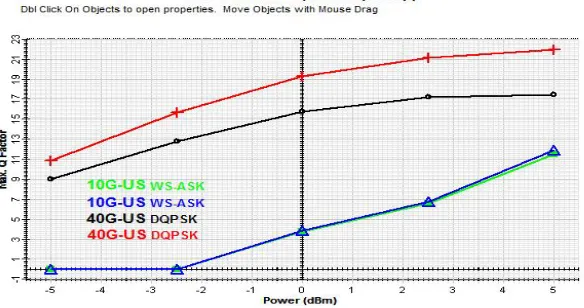
The parameter Q-factor was the evaluation of modulation formats for WDM-PON network. Q-factor can determinate quality signal. The quality signal by this parameter is calculated according signal to noise ratio [8]. All noises, nonlinearities and dispersions are included in Q-factor calculation. These effects negatively influence quality signal and they increase bit error rate. The interpretation of Q-factor is simple, higher value means higher quality signal [8]. This simulation is performed to find the suitable input power of the CW laser. Recommended Q factor is 4-5 (Q < 5). As a first step we set the range of input power from -5 dBm to 5 dBm to show the system behavior, and then we plot the Q curves with input power from -5 dBm to 5 dBm, it is clear from Figure 3 that the Q curves of the back 2 back stage are a inferior than those of downlink stage, it is 12 dB apart. Also it is clear that Q factor increases as input power increases, it is known that the error occurs as the power of the received signal exceeds the threshold power level, for instant; the power level is 2.5 dB and the received Q value goes to above the threshold level shown in figure 3. The aim of this simulation was to point at the fact, when Bit Error Rate BER affects on modulation formats with increasing link distance. BER is affected by noises, nonlinearities and dispersions.
Link distance influence on BER in WDM-PON
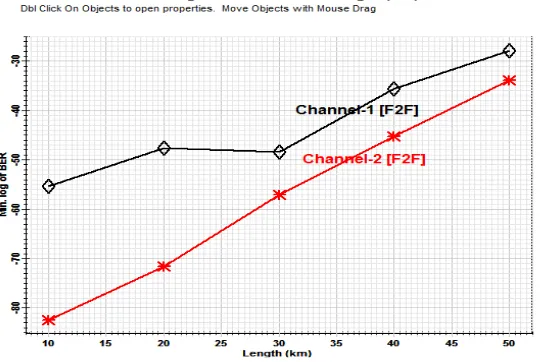
The value of BER represents a ratio between a numbers of bit errors bEdivided by the total number of transferred bits during time interval t. The value of BER in telecommunication systems should be in range 10-9 – 10-12 [3] [8]. How it is seen in Fig. 4, the BER is very low and for WDM-PON traffic by bit rate 10 Gb·s-1 with modulation formats NRZ. For example NRZ-DPSK, the BER gradually increases with increasing distance of simulated link from 10 km to 50 km. However, these modulations are resistant to BER increasing to this level which would be caused increasing of wrong detected bits (ISI). But BER behaves different for modulation formats.
Figure 4. log10 (BER) dependence on simulated link distance in WDM-PON system.
For NRZ modulation, the BER is very low up to distance 50 km, then the BER value increases, correct bit detection makes worse in detector illustrated in figure 4.
The comparative Analysisis of Previous and Reported results are shown in following table.
TABLE-I
Fiber Length(
km) Parameter
Simulated Result
Previous Reported Result
10
Max. Q
Factor 23.199 23.123
Min. BER 8.72E-130 8.72E-134
25
Max. Q
Factor 18.3286 18.3386
Min. BER 1.06E-74 1.08E-72
50
Max. Q
Factor 15.5386 15.3386
IV. CONCLUSION
We have proposed a integration technique from TDM-PON to WDM-PON in which not only the fiber infrastructure is remains same but also the optical MUX/DEMUX functionalities are exempted. DQPSK and WS-ASK were used for the downstream and upstream signals, respectively. An optical filter was preinstalled at the ONU to select the desirable downstream wavelength for the WDM-PON and simultaneously demodulate the downstream DQPSK signal. In the ONU, a MZM was used to generate the upstream WS-ASK for signal remodulation and RB mitigation. Experimental results showed that the upstream remodulated WS-ASK can provide error-free SMF transmission under 32 splits and up to 64 splits, whereas the conventional NRZ cannot provide error-free transmission.
REFERENCES
1. Emsia, Q. T. Le, M. MalekizandiD. BriggmannI. B. Djordjevi,F. Ku¨ ppers”WDM–TDM NG-ON Power Budget Extension by Utilizing SOA in the Remote Node” Volume 6, Number 2, April 2014.
2. Jan Latal, Jan Vitasek, Petr Koudelka, Petr Siska, Radek Poboril, Lukas Hajek, Ales Vanderka, and Vladimir Vasinek “Simulation of Modulation Formats for Optical Access Network Based on WDM-PON” ICTON 2014.
3. W. Chow, C. H. Yeh,“Using Downstream DPSK and Upstream Wavelength-Shifted ASK for Rayleigh Backscattering Mitigation in TDM-PON to WDM-TDM-PON Migration Scheme” Volume 5, Number 2, April 2013 IEEE.
4. Jing Xu, Ming Li, and Lian-Kuan ChenRayleigh “Noise Reduction in 10-Gb/s Carrier-Distributed WDM-PONs Using In-Band Optical Filtering” JOURNAL OF LIGHTWAVE TECHNOLOGY, VOL. 29, NO. 24, DECEMBER 15, 2011.
5. Fei Xiong, Wen-De Zhong and Hoon Kim “A Broadcast-Capable WDM Passive Optical Network Using Offset Polarization Multiplexing” JOURNAL OF LIGHTWAVE TECHNOLOGY, VOL. 30, NO. 14, JULY 15, 2012.
6. Jacklyn D. Reis, Darlene M.Neves, and António L. Teixeira Analysis of Nonlinearities on Coherent Ultradense WDM-PONs Using Volterra Series JOURNAL OF LIGHTWAVE TECHNOLOGY, VOL. 30, NO. 2, JANUARY 15, 2012
7. Suhas Bhandare, Abhay Joshi and Donald Becker, “Optical Coherent Receiver With a Switchable Electrical Dispersion Compensator for 10 Gb/s DPSK Transmission up to 300 km of SSMF in Metro Optical Networks” JOURNAL OF LIGHTWAVE TECHNOLOGY, VOL. 28, NO. 1, JANUARY 1, 2010.
8. João J. O. Pires, and Luís G.C. Cancela, “Estimating the Performance of Direct-Detection DPSK in Optical Networking Environments Using Eigenfunction Expansion Techniques” JOURNAL OF LIGHTWAVE TECHNOLOGY, VOL. 28, NO. 13, JULY 1, 2010.
9. Juan José Martínez, Juan Ignacio Garcés Gregorio, Alicia López Lucia, Asier Villafranca Velasco, Juan Carlos Aguado, and María Ángeles Losada Binué “Novel WDM-PON Architecture Based on a Spectrally Efficient IM-FSK Scheme Using DMLs and RSOAs” JOURNAL OF LIGHTWAVE TECHNOLOGY, VOL. 26, NO. 3, FEBRUARY 1, 2008.
10. W. Chow and C. H. Yeh, BMitigation of Rayleigh backscattering in 10-Gb/s downstream and 2.5-Gb/s upstream DWDM 100-km long-reach PONs,[ Opt. Exp., vol. 19, no. 6, pp. 4970–4976, Mar. 2011.