Round-Optimal Secure Multiparty Computation
with Honest Majority
Prabhanjan Ananth1, Arka Rai Choudhuri2, Aarushi Goel2, and Abhishek Jain2
1
Massachusetts Institute of Technology, USA, [email protected]
2
Johns Hopkins University, USA,
{achoud,aarushig,abhishek}@cs.jhu.edu
Abstract. We study the exact round complexity of secure multiparty computation (MPC) in the honest majority setting. We construct several
round-optimaln-party protocols, tolerating anyt <n
2 corruptions. 1. Security with abort:We give the first construction of two round
MPC for general functions that achieves security with abort against
maliciousadversaries in the plain model. The security of our protocol only relies on one-way functions.
2. Guaranteed output delivery: We also construct protocols that achieve security with guaranteed output delivery: (i)Against fail-stopadversaries, we construct two round MPC either in the (bare) public-key infrastructure model with no additional assumptions, or in the plain model assuming two-round semi-honest oblivious trans-fer. In three rounds, however, we can achieve security assuming only one-way functions.(ii) Againstmaliciousadversaries, we construct three round MPC in the plain model, assuming public-key encryp-tion and Zaps.
Previously, such protocols were only known based on specific learning assumptions and required the use of common reference strings. All of our results are obtained via general compilers that may be of independent interest.
1
Introduction
MPC with Honest Majority. In this work, we study the exact round com-plexity of MPC in thehonest majoritysetting, where an adversary may corrupt up totparties out ofn= 2t+1 total parties. We seek to construct round-optimal protocols in the plain model without any trusted setup assumptions.
The study of MPC in the honest majority model was initiated in the works of [6,10]. We recall the main security notions that have been studied over the years in this model:
• Security with Abort:In this notion, an adversary may learn the function output but prevent the honest parties from doing so by prematurely aborting the protocol. This is the most well-studied notion in the dishonest majority setting, where four rounds are known to be necessary for security against malicious adversaries [16,27]. Interestingly, this lower bound does not hold in the honest majority setting, which opens doors to achieving this notion in fewer rounds.
• Guaranteed Output Delivery: This notion guarantees that the honest parties always learn the function output (computed over the inputs of “ac-tive” parties) even if some parties prematurely abort the protocol. A relax-ation of this notion, referred to as fairness, guarantees that either all the parties learn the output or no one does.
It is well known that fairness and guaranteed output delivery are impossible to realize for general functions in the dishonest majority setting [11]. In the honest majority setting, however, these notions are indeed possible (see, e.g., [6,12]).
Our Questions. We now summarize the state of the art results for the afore-mentioned security notions and state our motivating questions. We refer the reader to Section1.2 for a more comprehensive survey of prior work.
We first focus on security with abort. Ishai et al. [26] constructed two round protocols in a “super” honest majority model where a malicious adversary can corrupt up to t6 n3 parties (see also [24,29] for efficiency improvements when n= 3,t= 1). Their protocol achieves a weaker notion ofselective security with abort, where the adversary can choose which honest parties learn the output. This is necessary since their protocol only uses private channels.
We ask whether it is possible to handle the optimal corruption threshold of t < n
2 in two rounds (which are known to be optimal [23]), while also achieving standard notion of security with abort (with the additional use of broadcast):
Q1:Does there exist a two round MPC protocol in the plain model that achieves security with abort against anyt < n
a dishonest majority of corruptions. We ask whether it is possible to construct two-round (semi-honest) MPC with honest majority, from weaker assumptions:
Q2:Does there exist a two round MPC protocol for general computations in the plain model against any t < n2 corruptions, based only on one-way functions?
We next consider the stronger notion of guaranteed output delivery. In this setting, Gennaro et al. [18] established the impossibility of two round protocols against t> 2 malicious adversaries in the plain model. More recently, Gordon et al. [21] established the impossibility of two round protocols over broadcast channel (but no private channels) against fail-stop3 adversaries in the common
reference string (CRS) model. Put together, these works leave open the pos-sibility of achieving guaranteed output delivery against fail-stop adversaries in two rounds using private channels in the plain model or just using broadcast channels in the bare public-key (BPK) model.4
Q3:Does there exist a two round MPC protocol that achieves guaranteed output delivery against anyt < n2 fail-stop corruptions?
In the broadcast-only model, Gordon et al. [21] also constructed a three round protocol with guaranteed output delivery toleratingt < n2 fail-stop corruptions.5 Their protocol, however, requires the use of a CRS and its security is based on the learning with errors assumption. To achieve security against malicious adver-saries, they compile their protocol with non-interactive zero-knowledge (NIZK) proofs [8,15]. Their work leaves open the possibility of constructing three round protocols in the plain model, based on general assumptions:
Q3:Does there exist a three round MPC protocol over broadcast channel that achieves guaranteed output delivery against anyt < n2 malicious corruptions
based on general assumptions, in the plain model?
1.1 Our Results
In this work, we resolve all of the aforementioned questions in the affirmative. Below, we elaborate upon our results in more detail. Unless mentioned otherwise, all of our results are in theplain model, and do not require any trusted setup. Security with Abort. We construct two-round MPC for general computations that achieves security with abort against any minority of malicious corruptions, based on one-way functions.
3
A fail-stop adversary behaves like a semi-honest adversary, except that it may choose to abort at any point (on all the communication channels) based on its view. 4
The BPK model was proposed in [9] where, prior to the start of the protocol, every player is required to declare a public key and store it in a public file. Since no assumptions are made on whether or not the public keys deposited are unique or “bad”, this is considered a weaker model than the standard PKI model.
5
Theorem 1 (Informal).Assuming one-way functions, there exists a two round MPC protocol for general circuits that achieves security with abort against any
t < n2 malicious corruptions.
We emphasize that our protocol in the above theorem only makesblack-box
use of one-way functions. In order to prove the above theorem, we devise a gen-eral compiler that “compresses” an arbitrary polynomial round MPC protocol (that may use both broadcast and private point-to-point channels) that achieves security with abort against any minority of malicious corruptions [10,6] into a two round MPC protocol. Our compiler builds upon the recent beautiful work of Garg and Srinivasan [17] who construct two-round UC secure MPC with dishon-est majority from two-round UC secure oblivious transfer, in the CRS model. Indeed, our compiler can be viewed as an honest-majority analogue of their work (in the plain model).
Guaranteed Output Delivery. We next turn our attention to constructing protocols with guaranteed output delivery. We first consider security against
fail-stop adversaries. In this case, we devise a round-preserving compiler that accepts any two-round semi-honest MPC protocol with a “delayed-function” property6 and outputs a new protocol that achieves guaranteed output delivery
against non-rushing fail-stop adversaries. If the underlying protocol tolerates semi-malicious7corruptions, then the resulting protocol achieves security against
rushing, semi-malicious fail-stop adversaries. Our compiler only requires the use of one-way functions.
Theorem 2 (Informal). Assuming one-way functions, there exists a general compiler that transforms any two round semi-honest (resp., semi-malicious) MPC protocol with delayed-function property into a two-round protocol that achieves guaranteed output delivery against non-rushing fail-stop (resp., rushing, semi-malicious fail-stop) adversaries.
Our compiler yields the following two kinds of protocols: (i) Protocols in the plain model that use onlyprivatechannels, if the underlying protocol only uses broadcast channels. (ii) Protocols in the (bare) public-key model that only use
broadcastchannels, if the underlying protocol uses private channels. We note that in the latter case, the use of BPK model is necessary due to the impossibility result of [21].
By applying our compiler from theorem2 on a variant of the protocol from Theorem 1 that achieves delayed-function8 property, we obtain the following result in the BPK model:
6 Roughly, a two-round MPC protocol satisfies the delayed-function property if the first round messages of the honest parties are computed independent of the function and the number of parties.
7
A semi-malicious adversary is similar to a semi-honest adversary, except that it may choose its input and randomness arbitrarily [1].
8
Corollary 1 (Informal). There exists a two round MPC protocol over broad-cast channels in the BPK model that achieves guaranteed output delivery against any t < n2 (semi-malicious) fail-stop corruptions.
Furthermore, the above protocol can also be easily modified to obtain a three round protocol in the plain model based only on one-way functions .
Next, by applying the compiler from Theorem2on a delayed-function variant of the semi-honest protocol from [17] (that only uses broadcast channels, unlike the protocol in Theorem1), we get the following result:
Corollary 2 (Informal). Assuming the existence of honest (resp., semi-malicious), two-round oblivious transfer, there exists a two round MPC protocol over private channels that achieves guaranteed output delivery against anyt < n 2
fail-stop (resp., semi-malicious fail-stop) corruptions in the plain model.
We next consider security againstmalicious adversaries. We devise another compiler that accepts any two-round MPC protocol with guaranteed output de-livery against semi-malicious fail-stop adversaries and outputs a three-round pro-tocol that achieves guaranteed output delivery against malicious adversaries. The main tool used in our compiler is a new notion of multi-verifier zero-knowledge
(MVZK) proofs, which may be of independent interest. Briefly, an MVZK pro-tocol is a multiparty interactive propro-tocol between a single prover and multiple verifiers where the soundness and zero knowledge properties only hold when a majority of the parties are honest. An MVZK must also achieve astrong com-pletenessproperty such that the honest verifiers always accept the proof given by an honest prover even if some of the verifiers (who constitute a minority) are dishonest.
Theorem 3 (Informal).Assuming public-key encryption and two round delayed-input9 multi-verifier zero-knowledge arguments, there exists a general compiler
that transforms any two round MPC protocol with guaranteed output delivery against semi-malicious fail-stop adversaries into a three round protocol with guaranteed output delivery against malicious adversaries.
Our compiler only requires broadcast channels, and is therefore optimal in the number of rounds, in keeping with the impossibility result of [21]. We next give a simple construction of delayed-input MVZK arguments based on Zaps [14] (i.e., two round witness indistinguishable proofs), following the construction of NIZKs in the multi-CRS model [22]. Then, applying our compiler on the protocol from Corollary 1, we obtain the following result:
Corollary 3 (Informal). Assuming Zaps and public-key encryption, there ex-ists a three round MPC protocol over broadcast channels that achieves guaranteed output delivery against any t < n2 malicious corruptions.
1.2 Related Work
Concurrent Work. We were notified of a concurrent and independent work [3] who also investigate the problem of round-optimal MPC with guaranteed out-put delivery. They construct three-round protocols against malicious adversaries based on LWE, dense cryptosystems and Zaps.
Prior Work. Over the years, the round complexity of MPC has been ex-tensively studied both in the honest majority and dishonest majority settings. Here, we focus on the honest majority setting and refer the reader to [2] for a comprehensive survey of the literature in the dishonest majority setting.
The study of constant-round MPC was initiated by Beaver et al. [4]. They constructed such protocols against malicious adversaries in the honest majority setting using pseudorandom generators (PRGs). Damg˚ard and Ishai [13] later achieved a similar result by making only black-box use of PRGs.
In a seminal work, Ishai and Kushilevitz [25] constructed two round and three round semi-honest MPC protocols that toleratet6 n3 andt < n2 corruptions, re-spectively. Subsequently, Ishai et al. [26] constructed two round protocols against t 6 n3 malicious corruptions, achieving selective security with abort. More re-cently, Ishai et al. [24] and [29] constructed simpler two round protocols forn= 3 parties that tolerate any single, malicious corruption.
While the work of [6] already achieved fairness, several subsequent works also achieve guaranteed output delivery (see, e.g., [12] for references). We highlight a few results in this regime. Damg˚ard and Ishai [13] constructed a three round MPC protocol with guaranteed output delivery fort < n5. Ishai et al. [26] con-structed a two round protocol with guaranteed output delivery using only private channels for the special case of t = 1, n>5. Further, they also constructed a two-round protocol in the client server model, withnclients andm >2 servers, that tolerates a single corrupted client andt6 n
5 colluding servers. Subsequently, Asharov et al. [1] constructed five round protocols with guaranteed delivery for t < N/2, assuming learning with errors (LWE) and NIZKs. More recently, Ishai et al. [24] constructed several protocols with guaranteed output delivery for the case of t = 1 and n = 4: a two round statistically secure protocol for linear functionalities, a two round computationally secure protocol for general func-tionalities with guaranteed output delivery from injective one-way functions, and a two round unconditionally secure protocol for general functionalities with guaranteed output delivery in the preprocessing model. Gordon et al. [21] con-structed a three round protocol with guaranteed output delivery in the CRS model with broadcast-only messages assuming LWE and NIZKs.
achieve guaranteed output delivery against (non-rushing) fail-stop adversaries in the CRS model.
2
Preliminaries
In our constructions, we make use of some well studied primitives like garbled circuits[31] andthreshold secret sharing[30]. While garbled circuits with selec-tive security suffice for our application in section4, we requireadaptive garbled circuitsin section 5. An adaptively secure garbled circuit is one where the ad-versary first gets to see a garbling for any circuit of his choice. After seeing this garbled circuit, he can adaptively choose an input and obtain labels correspond-ing to that input. For our application, the online complexity (i.e., size of input wire labels) is not important; as such it suffices to use one-time pads with Yao’s garbled circuits as suggested in the work of Bellare et al. [5] to obtain adaptively secure garbled circuits from one-way functions. We refer the reader to [5] or the full version of our paper for a formal definition of this primitive.
We use various notions of security for secure multiparty computation (MPC) in our constructions. Apart from the standard notion ofsecurity with abortthat guarantees correctness of output of the honest parties (when the adversary does not prematurely abort), we also consider a relaxed notion of security called
privacy with knowledge of output [26]. The only difference from the definition for security with abort is that in the ideal world, on receiving outputs from the trusted party, the adversary can choose the output it wants to send to the honest parties. It is easy to see that this is a weaker notion since the correctness of output for the honest parties is no longer guaranteed. A formal definition of this can be found in the full version of our paper, or in [26]. We also consider security with guaranteed output delivery against both fail-stop and malicious adversaries.
For our application in section 5, we also consider MPC protocols with a
delayed function property, i.e., protocols where the first round messages of all parties are independent of the function and the number of parties in the protocol.
3
Definitions
In this section, we define some new notions that we consider in this work.
3.1 Multiparty Oblivious Transfer Protocol
A multiparty oblivious transfer (OT) protocol consists of n-parties, where one of the partiesPn is the receiver and every other partyP1, . . . , Pn−1 is a sender. Sender Pi has inputs mi,0, mi,1 and the receiver R has a private input σ1. At the end of this protocol every party learns only{mi,σ1}i∈[n−1].
is completely fine. On the other hand, we will insist that if the second round of the protocol is not executed the receiver privacy is maintained. We should also point out that we have given a general definition, but this can be appropriately modified to let only the receiver obtain the output by setting every other party’s output to be⊥.
We consider protocols that have both broadcast and private messagesmB and mpriv. But for convenience of notation we denote this asm:= (mB, mpriv). When we say such a message is sent, we indicate thatmB is sent by broadcast andmpriv is sent privately.
We consider a variant of the multiparty OT protocol, which we shall denote asmultiparty homomorphic oblivious transfer protocol. In this variant there is a special designated senderSb(=Pn−1) with an additional inputσ2. At the end of the protocol, every party learns only{mi,σ1⊕σ2}i∈[n−1]. The regular multi-party
OT can be thought of as a special mode of the homomorphic oblivious transfer where the additional input from this special designated sender is ignored (or set to 0). Hence, it is convenient to formally define the homomorphic notion of the multiparty OT, but we shall use both these notions:
Definition 1 (Multiparty Homomorphic OT Protocol). A two round
1-out-of-2 multiparty homomorphic oblivious transfer protocol OT= OTR1,OT
b
S 1, OTS1,OT2,OT3
is an interactive protocol between n parties, where one of the parties is the receiver, one of the parties is a special designated sender and the others are senders. The sender partiesPi fori∈[n−1]have inputsmi,0, mi,1∈
{0,1}λ, the receiver partyPn has an input bitσ1∈ {0,1}, and the special
desig-nated sender Pn−1 has an additional inputσ2∈ {0,1}.
First round. The parties compute their first round messages as follows:
– Receiver:
otn[j]1→n,n−1 j∈[n]←OT R
1(σ1)whereotn[j]1→n,n−1refers to the
message that the partyj receives from the receiver (partyPn). The subscript
→ n, n−1 denotes that the designated special sender is Pn−1 while the
receiver isPn.
– Special sender:
otn−1[j]1→n,n−1 j∈[n] ←OT
b
S
1((mn−1,0, mn−1,1), σ2).The
notation is almost identical to the previous case, but the notation here iden-tifies this as a message from the special sender (partyPn−1).
– Senders:Each partyi∈[n−2]computes
oti[j]1→n,n−1 j∈[n]←OT S
1(mi,0, mi,1).
The notation is almost identical to the previous case, but the notation here identifies this as the message from the corresponding sender (partyPi).
Each party sends Pj its corresponding message. Thus, at the end of the first
round each party Pj has oti[j]1→n,n−1 i∈[n]
Second Round. Each partyPi computes their second round message oti[⊥]2→n,n−1←OT2
otj[i]1→n,n−1 j∈[n]
. Here by⊥we denote that the
Output Computation. Every party computes the output as follows
{mei}i∈[n−1]
:=OT3oti[⊥]2→n,n−1 i∈[n]
We require the following properties from the protocol:
1. Correctness: For every σ1, σ2 ∈ {0,1}, and sender input messages ∀i ∈ [n], b ∈ {0,1} mi,b ∈ {0,1}
λ
, Pr∀i ∈ [n−1] mei =mi,σ1⊕σ2
= 1 where the randomness is over the coins used to compute the first and second round messages of the protocol.
2. Security:We consider two notions of security depending on whether or not the second round of the protocol is executed:
– Privacy. If the protocol terminates at the end of the first round, then the notion of privacy is satisfied;
– Privacy with Knowledge of Outputs against Malicious Minor-ity:If the second round is executed (by the honest parties at least), then for any PPT adversaryAcontrolling a minority set of the parties, there exists a PPT simulatorSim= (SimOT,ExtOT)satisfying the security
no-tion of privacy with knowledge of outputs (defined in2).
The role of the extractor ExtOT is to extract the adversary’s input from
its first round messages. On the other hand, the role of the SimOT is to
generate the transcript for the protocol.
Instantiation. The multiparty homomorphic oblivious transfer protocol with inputs ({mi,b[`]}i∈[n−1],b∈{0,1},`∈[λ], σ1, σ2), whereσ1, σ2, mi,b[`]∈ {0,1}, can be thought of as a vector of degree 2 polynomials inF2:∀i∈[n−1], `∈[λ] mi,0[`]· (1 +σ1+σ2) +mi,1[`]·(σ1+σ2).The work of Ishai, Kushilevitz and Paskin [26] gives us an explicit construction for such a degree 2 polynomial computation protocol:
Theorem 4 ([26]).Forn= 2t+ 1, wheret is the number of corrupted parties, there exists a 2 round protocol that computes a vector of polynomials of degree 2 and satisfies statisticalt-privacy with knowledge of outputs.
We note that the original stated lemma in [26] requires |F| > n, but this
condition can be relaxed to computing polynomials inF2if we can construct a 2-multiplicative (2t+ 1, t) linear secret sharing scheme that is pairwise verifiable (see [26] for details). In fact, [26] discusses how to construct such a scheme, which in turn suffices for our notion of the multiparty homomorphic OT.
3.2 Multi-Verifier Zero Knowledge Proof System
with a very high probability. The verifiers should not learn anything aboutwin either case.
Consider n verifiers, where t can be corrupted. For completeness, t 6 n, for soundness, t 6 n−1, and for ZK, t 6 n. Note that in the extreme case, the definition subsumes the standard ZK definition since all the verifiers can be combined into one. In our constructions, we will focus on the honest-majority case, where for soundness,t6 n−21 and for ZK,t6 n2. For our constructions, we require a two round multi-verifier zero knowledge protocol that satisfies delayed input property, i.e., first round messages of both the prover and verifier and second round messages of verifier are independent of the statement.
A formal definition of this primitive is as follows:
Definition 2 (Two Round Multi-Verifier Zero Knowledge).A two round multi-verifier zero-knowledge proof system associated with an NP relation Ris an interactive zero-knowledge protocol with a proverPandnverifiersV1, . . . , Vn.
The prover and the verifiers hold an instancexof the languageL(R)defined by the relationR. The prover also holds a stringw∈ {0,1}λ. It can be defined as a tuple ofP P T algorithmsmvzk:= (P1
mvzk,V1mvzk,P2mvzk,V2mvzk,Verifymvzk). – pMsg1←P1mvzk(1λ):P1mvzk takes the security parameterλas input and
out-puts first round messages of the prover.
– vMsg1i ← V1
mvzk(1λ, i): V1mvzk takes the security parameter λ and index i of
the verifier as input and outputs first round messages of the verifier.
– pMsg2 ← P2
mvzk(trans 1
mvzk, x, w): P 2
mvzk takes the first round transcript of mvzk,trans1
mvzk:= (pMsg
1,{vMsg1
i}i∈[n]), the statementxand the witnessw
as input and outputs second round messages of the prover.
– vMsg2i ←V2mvzk(i,trans 1 mvzk):V
2
mvzk takes indexi of the verifier and the first
round transcript of mvzk, trans1mvzk := (pMsg1,{vMsg1i}i∈[n]) as input and
outputs second round messages of the verifier.
– b:=Verifymvzk(i,{transr
mvzk}r∈[2], x):Verifymvzk takes indexi of the verifier,
the entire transcript of the protocol and the statementxas input and outputs a bitb.
We want the multi-verifier zero-knowledge proof system to satisfy the following properties:
1. Completeness:For everyn.u.PPT adversaryAthat corrupts up tot ver-ifiers, letH ⊂[n]be the set of honest verifiers, then for everyx∈ L(R)and for all honest verifiersVi, wherei∈H,
Pr[Verifymvzk(i,{transrmvzk}r∈[2], x) = 1] = 1
2. Soundness:For every adversaryA controlling the prover (P∗)and uptot
verifiers, letH ⊆[n] be the set of honest verifiers, then for everyx /∈ L(R)
and for all honest verifiersVi wherei∈H,
Pr[Verifymvzk(i,{transrmvzk}r∈[2], x) = 1]6µ(λ)
We require a slightly stronger notion of soundness, where soundness holds, even if an adversarial prover is allowed to choose the statement after looking at the first round messages of honest verifiers.
3. Zero-Knowledge: For every n.u. PPT adversary A, that corrupts upto
t verifiers, let H ⊆ [n] be the set of honest verifiers, then there exists a PPT SimulatorSimmvzk:= (Sim1mvzk,Sim
2
mvzk), s.t., for every x∈ L(R), w∈
R(x),z∈ {0,1}∗ and a negligible functionµ(.),
|Pr[ExpZKA,Sim
mvzk(1
λ,0) =1]−Pr[ExpZK
A,Simmvzk(1
λ,1) =1]| 6µ(λ)
where the experimentExpZK
A,Simmvzk(1
λ,b) is defined as follows:
(a) The adversaryAgets(pMsg1,{vMsg1i}i∈H), which are computed as
fol-lows:
– If b= 0:pMsg1←P1 mvzk(1
λ),{vMsg1
i}i∈H ← {Vmvzk1 (1 λ, i)}
i∈H – If b= 1:(pMsg1,{vMsg1i}i∈H)←Sim1mvzk(1λ, H).
(b) The adversaryA sends{vMsg1i}i /∈H and specifies x, wand gets (pMsg2,{vMsg2i}i∈H), which are computed as follows:
– If b= 0:pMsg2←P2
mvzk(trans 1
mvzk, x, w),{vMsg 2 i}i∈H←
{V2
mvzk(i,trans 1
mvzk)}i∈H.
– If b= 1:(pMsg2,{vMsg2i}i∈H)←Sim2mvzk(H,trans1mvzk, x).
(c) The adversary outputs a bit b0, which is the output of the experiment.
If the soundness property only holds against polynomial-time adversaries, then we refer to the above system as anargumentsystem.
In the full version, we provide a construction of multi-verifier ZK arguments based on Zaps. Our protocol is based on the multi-CRS NIZK construction of [22], with some changes to achieve the strong completeness property.
4
Security with Abort against Malicious Adversaries
Overview. We start by providing an overview of our construction. Our starting point is the recent beautiful work of Garg and Srinivasan [17].
Recap of [17].Garg and Srinivasan [17] constructed two-round maliciously secure MPC against dishonest majority based on any two-round OT in the CRS model with some specific security properties (that we discuss below). At a high level, their protocol works by compiling a multi-round maliciously secure protocol of a very specific syntactic structure (where each round only consists of a single bit broadcast by one party to all the other parties), which they refer to as a
conforming protocol, into a two round protocol using OT.
At a high level, OT is used to transmit garbled circuit labels for a single input (that corresponds to a message in the underlying conforming protocol) to an evaluator. Loosely speaking, a “speaker” party in any round of the under-lying conforming protocol sends a receiver’s OT message in the first round of the two-round protocol. The receiver’s message is computed using as input the bit b which is supposed to be broadcast in the underlying protocol. Note that these messages are not actually known in the first round, so the “speaker” party actually prepares multiple OT messages. Every other party (unaware of this bit ahead of time) computes the OT protocol message with the two labels for its own garbled circuit as its sender input. At a later point, when the message bit is broadcast, the OT receiver also reveals the randomness used to compute the appropriate first OT message. This enables an evaluator, different from the re-ceiver, to obtain the appropriate labels for each garbled circuit and then evaluate them correctly.
However, this release of the randomness used to compute the OT receiver messages creates a problem during simulation against a rushing adversary since a simulator, who computes an OT receiver message on behalf of an honest party, does not know what inputs to use. For this reason, the compiler in [17] requires the ability to equivocate receiver’s randomness.
Challenges.We face some challenges in adopting the template of [17] to achieve our goal of constructing a maliciously secure two-round MPC protocol in the honest majority setting from one-way functions. We highlight a couple of them below.
– Issue #1. Replacing Oblivious Transfer: If we have any hope of basing our construction on one-way functions, we first need to figure out how to replace the oblivious transfer protocols in [17] for the honest majority setting. Note that the oblivious transfer protocols are used in two places in [17]: (i) in the interactive secure MPC protocol and, (ii) in the transformation of conforming protocols into two-round secure MPC protocols. We handle both (i) and (ii) separately.
– Issue #2. Private Channels:We first handle (i) by starting with a interactive secure MPC protocol in the honest majority setting. The existence of such a protocol achieving perfect security is known in literature [10,6]. However such protocols, in addition to broadcast channels, inherently use private channels – every pair of parties has a channel designated to them such that any communication on this channel cannot be observed by an external entity. However, the approach of [17] starts with an interactive secure MPC protocol that uses only broadcast channels. Hence, we need to modify their approach that will enable us to handle private channels in the underlying interactive secure MPC protocol.
As the name suggests, this notion is a multiparty protocol where only three of the parties have inputs and the rest of the parties have no inputs. These three parties are termed as sender, receiver and designated sender. The sender10, has
inputs (m0, m1), receiver has input a bitσ1and the designated sender has input a maskσ2. At the end of the protocol, every party receives the outputmσ1⊕σ2.
We can also consider a weaker notion where the designated sender does not supply any input and we term such a notion as multiparty OT (in particular, not homomorphic). In this case, every party receivesmσ1.
We can use this protocol to replace the oblivious transfer protocols in the transformation from conforming protocols to two-round secure MPC protocols. Moreover this protocol can be instantiated from two-round perfectly secure MPC protocols for quadratic polynomials [10,6]11. To see how this can be used to
solve the issue of private channels, we make the following modifications to the framework of [17].
– We start with an interactive perfectly secure MPC protocol that uses only broadcast channels in the pre-processing setting. By pre-processing, we mean that the parties can exchange information with each other over private chan-nels before seeing any input. Once pre-processing phase is over, the parties receive the inputs in the online phase and during this phase, they perform secure computation only using broadcast channels. Such a protocol can be achieved by starting with an perfectly secure protocol without pre-processing but using private channels: the parties can exchange one-time pads (of suit-able length) in the pre-processing phase to emulate the private channels in the online phase. In particular, whenever a partyPihas to send a message to another partyPj, it encrypts its message using the one-time padPj sent to Pi during the online phase. We transform such a interactive MPC protocol into a conforming protocol in the pre-processing setting.
– To transform a conforming protocol in the pre-processing setting into a two-round protocol, the main challenge we encounter is to get rid of the pre-processing phase. Specifically, every party in the two-round protocol is required to commit to all its actions (corresponding to the conforming pro-tocol) in the first round. This is not possible if we start with a conforming protocol in the pre-processing setting since the actions of the parties depend on the output of the pre-processing phase which cannot be computed before the first round in the two-round protocol. This is where we crucially use the homomorphism property of the multiparty homomorphic OT protocol.
Malicious Security.While the use of multiparty homomorphic OT protocol can be used to achieve a semi-honest secure two-round MPC protocol in the honest majority setting, we need additional mechanisms to prove security against
mali-10For simplicity, we explain the main ideas using just a single sender. We use a gener-alized version with multiple senders.
cious adversaries. We start by incorporating the equivocation mechanism inside our multiparty homomorphic protocol.
Equivocation Instead of using an OT protocol that explicitly allows for ran-domness equivocation, we achieve a similar effect from the fact that an honest receiver’s input in the multiparty OT protocol is not fixed in the adversary’s view when it can corrupt only a minority of parties.
Given a maliciously secure multiparty homomorphic OT protocol satisfying these properties, one could obtain the required compiler following the above strategy. However, we do not know of such a protocol in only two rounds.
Towards this, we note that the work of Ishai, Kushilevitz and Paskin [26] construct a two round protocol for degree 2 polynomial computation, in the honest majority setting. While their protocol does not achieve full malicious security, it achieves a weaker notion they refer to as privacy with knowledge of outputs. Roughly, this notion is similar to standard malicious security, except that it does not guarantee correctness of outputs received by the honest parties. In particular, the adversary can explicitly set the output of the honest parties to any value of its choice (in this sense, it “knows” the honest party outputs). Since a multi-party OT can be represented as a degree 2 polynomial computation, a two-round multi-party OT protocol achieving this weaker security notion can be obtained from [26].
Our main insight is that this weaker notion of multiparty homomorphic OT can still be used to obtain our desired compiler. In the protocol by Garg and Srinivasan [17] , it is essential that OT security holds against malicious receivers that attempt to equivocate their receiver bit. It would seem that in our weaker model, since the adversary can set the output to be a value of its choice, it could potentially change the output from saymb tom1−b, wherebwas its input to the OT protocol. This would completely break simulation since the adversary could essentially equivocate its input, and thus the guarantees of the protocol in [17] would no longer apply. This is where we use the knowledge of output property of the protocol, i.e. the output that the honest parties receive is known to the adversary. In the case of the OT protocol, when the sender is honest, an ideal world adversary receives onlymbandm1−b remains hidden. Thus the output of honest parties forced by the adversary are independent ofm1−b. This does not stop the adversary to from setting it to a random value. However, since messages mb and m1−b correspond to wire keys of a garbled circuit, we can rely on the security of the garbling scheme which ensures that a garbled circuit cannot be evaluated unless the evaluator has one of the keys.
4.1 Conforming Protocols
Let Φ be an n-party deterministic MPC protocol with honest majority. Let
Pre-processing Phase:For each (i∈[n]) ,partyPicomputes the following: (zi,bvi)←pre(1
λ, i, x
i). The randomized algorithmpretakes as input, the index i of the party, its input xi and outputs zi ∈ {0,1}
`/n
and vbi ∈ {0,1} `
. bvi is private information, that it retains with itself. We require that bvi[k] = 0 for all k ∈ [`]\ {(i−1)`/n,· · ·, i`/n}. zi is a public value that is broadcast to every other party in the protocol.
Each party Pi additionally samples masks rk→i for all k ∈ [n]\ {i} of ap-propriate length (to be discussed shortly). The mask rk→i is sent privately to Pk.
Computation Phase:The computation phase can be viewed as a series of T actionsΦ1, . . . , ΦT. Each actionΦr, for t ∈[T], can be parsed as tuple of 5 indices,Φt= (i∗, j∗, f, g, h), wherei∗∈[n], j∗∈[n]∪ {⊥}, andf, g, h∈[`]. Since Φis a deterministic protocol,Φ1, . . . , ΦT, are known to each party in advance.
– For all j ∈ [n]\ {i}, Ij→i ={h| Φ·(j, i,·,·, h)}, and Ii := ∪j∈[n]\{i}Ij→i12. Hence, for eachk∈[n]\ {i},rk→i ∈ {0,1}|Ik→i|. From eachrk→i, we want to refer to the bit inrk→i that is associated with the indexh. This is achieved by defining the following functionrk→i(h) :=rk→i[ρ(h)], where ρ(h) is the index ofhinIk→i. We are able to do so because we are treating as an ordered set.
– We now create the vectorv∈ {0,1}`from bvand masksrk→i.
vi[k] :=
b
v[k] ifk∈ {(i−1)`/n,· · · , i`/n}
rπ(k)→i[k] ifk∈Ii
0 otherwise
where π(k) is j such that k ∈ Ij→i. We simply update bv to include the mask bits at the appropriate position. It is important to note that these updates make sense only if for every ithe sets Ij→i are disjoint. This will indeed be enforced in the conforming protocol (see below).
Let For eachi∈[n], partyPi does the following: Sets,sti= (z1||. . .||zn)⊕vi
Foreacht∈ {1, . . . , T}, 1. ParseΦtas (i∗, j, f, g, h)
2. Ifi=i∗, computesti[h] =NAND(sti[f],sti[g])⊕ri→j(h) (whereri→j(h) = 0 ifj=⊥) and broadcaststi[h]⊕vi[h] to all other parties.
3. Else, updates sti[h] to the bit value received fromPi∗.
We require each action Φt, for t ∈ [T], to update a unique position h in the state. More specifically, ∀t, t0 ∈ [T] such that t 6= t0, if Φt = (., ., ., ., h) and Φt0 = (., ., ., ., h0), then h6=h0. Additionally, for every party Pi we require that
a bit at indexhsent privately to a partyPj is not used as a input to a NAND computation by Pi. Formally, ∀t ∈ [T] if Φt = (i, j,·,·, h) where j 6=⊥ then 12
We abuse notation slightly and consider each Ij→i to be an ordered set, ordered
@t0 ∈[t, T] such that Φt0 = (i,·, h,·,·) orΦt0 = (i,·,·, h,·). We denote Ai ⊂[T]
be set of rounds in which partyPi sends a bit.
We note that the non-repetition ofhensures that for everyi, kthe setsIi→k are disjoint.
Output Phase: For eachi∈[n], partyPi outputspost(sti)
Transformation to a Conforming Protocol. LetΠbe an n-party determin-istic MPC protocol with honest majority. Let P ={P1, . . . , Pn} be the parties in the protocolΠ. Let each partyPihave inputxi∈ {0,1}
m
. We want to trans-form this protocol Π to a conforming protocolΦ, while preserving its security and correctness. We allow the protocol Π to use both broadcast and private channels.
We can assume w.l.o.g. that only a single bit is communicated by one party in each round of Π. This can trivially be achieved by increasing the round complexity of the protocol. As discussed, this bit can be broadcast or sent to a specific party. Since only a single bit is communicated in each round by one party, the message complexity in this case is equivalent to the round complexity. Let the message/round complexity of Π after increasing the round complexity be p. Let Cr be the circuit computed in round r ∈ [p]. Again we can assume without loss of generality that this circuit is only composed ofNANDgates with fan-in two and eachCr is composed ofqNANDgates.
We now describe how to transform Π into a conforming protocol Φ. There areT =pq rounds inΦ. Let`=mn+pq and`0 =pq/n
– pre(1, xi) :
1. Samplesri← {0,1} m
andsi←({0,1} g−1
||0)p/n. 2. Outputzi:=xi⊕ri||0`
0
andvi := 0`/n||. . .||ri||si||. . .||0`/n
– comp:={Φ1, . . . , ΦT}: As specified in the transformation above, each round r∈ [p] inΠ is expanded into q actions in Φ. Each of these actions {Φt}t, wheret∈ {(r−1)q+ 1, . . . , rq}is a singleNANDcomputation. For eacht,Φt is set as (i∗, j∗, f, g, h).f, g are the locations insti∗ that thetthNANDgate
in Cr is computed on. h is the first location in sti∗ amongst the locations
(i∗−1)`/n+m+ 1 to i`/n that has not been updated before. For t ∈ {(r−1)q+ 1, . . . , rq−1},j∗:=⊥, and fort=rq,j∗is set to be the recipient of the bit in the roundrofΠ. If the bit is to be broadcast in roundrofΠ, j∗is set to⊥.
– post(i,sti) Party Pi gathers messages sent by other parties in Π from the finalsti and runs the output phase ofΠ to output the output.
The changes in the conforming protocol, and the transformation is to ac-commodate underlying protocols that use both broadcast and private channels. The conforming protocol in [17] relies on the underlying protocol to use only broadcast channels.
4.2 Our Compiler
Building Blocks. The main primitives required in this construction are:
1. A maliciously secure conforming protocol Φwith honest majority. 2. A garbling scheme (Garble,Eval) for circuits.
3. A 2 round Multiparty Homomorphic Oblivious Transfer Protocol that works in the honest majority setting.
Theorem 5. Assuming maliciously secure conforming protocol Φ, secure gar-bling scheme(Garble,Eval)and a 2 round multiparty homomorphic OT protocol the two round protocol Π described below achieves security with abort against any t < n2 malicious corruptions.
We instantiate the underlying MPC protocol with an information-theoretic honest majority MPC protocol such as [10,6]. Further, our compiler makes only black-box use of one-way functions.
While we describe our complier for malicious adversaries using both broad-cast and private channels, it is easy to see that our protocol is secure against semi-honest adversaries that use only private channels.
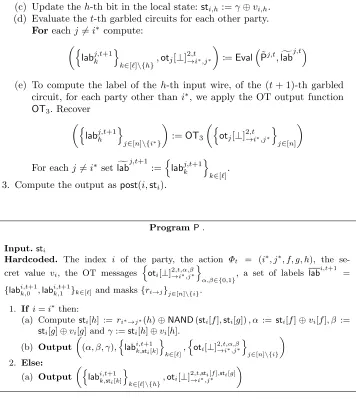
Protocol. LetP ={P1, . . . , Pn}be the set of parties in the protocol and let
{x1, . . . , xn}and {er1, . . . ,ern}be their respective inputs and randomness. Next, we describe the protocolΠ in detail:
Round 1. Each partyPi does the following:
1. Run the pre-computation phase to compute (zi, vi): (zi,bvi,)←pre(1 λ, i,(x
i,eri)). Sample masks{rj→i}j∈[n]\{i} of appropriate length and construct vi as in the conforming protocol (see subsection 4.1). Broadcast zi and send each rj→i toPj.
2. Foreach roundt∈[T]: – ParseΦtas (i∗, j∗, f, g, h)
– If Piis the speaker, i.e.,i=i∗, we compute the first round OT receiver messages. Specifically, for eachα, β∈ {0,1}:
n
oti[j]1,t,α,β→i∗,j∗
o
j∈[n]
←OTR1 (vi,h⊕NAND(vi,f⊕α, vi,g⊕β)).
In the case that j∗ =⊥, this is the regular OT (without the special designated sender). SendPj its corresponding message.
– it computes the sender OT messages. First, it generates labels for the t-th round: nlabi,tk,0,labi,tk,1o
k∈[`] ← Gen(1
λ). Next, it computes the OT messages:∀α, β∈ {0,1}
– ifi=j∗,
n oti[j]
1,t,α,β
→i∗,j∗
o
j∈[n]
←OTSb
1
labi,th,r
i∗ →i(h),lab
i,t
h,1⊕ri∗ →i(h), ri ∗→i(h)
13
– else,noti[j] 1,t,α,β
→i∗,j∗
o
j∈[n]
←OTS1labi,th,0,labi,th,1 where his the index specified byΦt.
Sendnoti[j] 1,t,α,β
→i∗,j∗
o
α,β∈{0,1} to partyPj.
Round 2. Each partyPi does the following:
1. Set state.The local state is defined assti:= (z1||. . .||zi||. . .||zn)⊕vi 2. Foreacht fromT to 1,
(a) Parse Φtas (i∗, j∗, f, g, h)
(b) Compute the second round OT messages as follows:
∀α, β∈ {0,1}, oti[⊥] 2,t,α,β
→i∗,j∗ ←OT2 n
otj[i] 1,t,α,β
→i∗,j∗
o
j∈[n]
(c) Compute the garbled circuit as
˜
Pi,t←Garble
P
i, Φt, vi, n
oti[⊥] 2,t,α,β
→i∗,j∗
o
α,β∈{0,1},lab
i,t+1
,{ri→j}j∈[n]\{i}
,
n labi,tk,bo
k∈[`],b∈{0,1}
.
where the programPis defined inFigure 1.
3. Broadcast the garbled program, and the keys to the first circuit:
{P˜i,t} t∈[T],
n labi,1k,st
i,k
o
k∈[`]
to every other party.
Evaluation. To compute the output of the protocol, each party Pi does the following:
1. For eachj∈[n], letlabf j,1
:=nlabj,1k o
k∈[`] be the labels received from party Pj at the end of Round 2.
2. Foreacht from 1 toT do: (a) Parse Φtas (i∗, j∗, f, g, h)
(b) Evaluate thet-th garbled circuit received from partyi∗
(α, β, γ),labf i∗,t+1
,oti∗[⊥]2,t →i∗,j∗
:=Eval
˜ Pi∗,t,labf
i∗,t
13
The labels are ordered such that when σ1⊕σ2 =ri∗→i(h)⊕γ, the selected label
(c) Update theh-th bit in the local state:sti,h:=γ⊕vi,h. (d) Evaluate thet-th garbled circuits for each other party.
Foreachj6=i∗ compute:
n
labj,t+1k o
k∈[`]\{h},otj[⊥]
2,t
→i∗,j∗
:=EvalP˜j,t,labf j,t
(e) To compute the label of the h-th input wire, of the (t+ 1)-th garbled circuit, for each party other thani∗, we apply the OT output function OT3. Recover
n
labj,t+1h o
j∈[n]\{i∗}
:=OT3
n
otj[⊥]2,t→i∗,j∗
o
j∈[n]
For eachj 6=i∗ set labf j,t+1
:=nlabj,t+1k o k∈[`]
. 3. Compute the output aspost(i,sti).
Program P. Input.sti
Hardcoded. The index i of the party, the action Φt = (i∗, j∗, f, g, h), the se-cret value vi, the OT messages noti[⊥]2→i,t,α,β∗,j∗
o
α,β∈{0,1}, a set of labels lab i,t+1
=
{labi,tk,0+1,labi,tk,1+1}k∈[`]and masks{ri→j}j∈[n]\{i}.
1. If i=i∗then:
(a) Compute sti[h] :=ri∗→j∗(h)⊕NAND(sti[f],sti[g]), α :=sti[f]⊕vi[f], β :=
sti[g]⊕vi[g] andγ:=sti[h]⊕vi[h].
(b) Output
(α, β, γ),nlabi,tk,st+1
i[k] o
k∈[`]
,noti[⊥]2→i,t,α,β∗,j∗ o
j∈[n]\{i}
2. Else: (a) Output
n
labi,tk,sti+1[k]o
k∈[`]\{h},oti[⊥]
2,t,sti[f],sti[g] →i∗,j∗
Fig. 1: ProgramP
Correctness. An important property of the protocol is that ∀i, j ∈ [n] and k ∈ `, we have sti[k]⊕vi[k] = stj[k]⊕vj[k]. This is denoted by a value st∗, which we shall refer to as theglobal invariant. In addition, the transcript of the execution in the computation phase is denoted by Z∈ {0,1}T. Correctness of the protocol in [17] follows from this global invariant property and the structure ofvi.
In this case, every Pi for i ∈ [n]\ {j} sets their respective state sti[h] to be ri→j⊕δwhereδis the computation of the NAND functionality, andri→jis the mask selected byPj. From the structure ofvi, for everyi∈[n]\ {j}, vi[h] = 0. On the other hand,Pj updates its state to bestj[h] =δ, but from the structure ofvj, we havevj[h] =ri→j. Thus this maintains the global invariant,∀i, j∈[n] andk∈`, we havesti[k]⊕vi[k] =stj[k]⊕vj[k].
In addition, sincePj knowsvj[h] in the first round, it can compute the OT receiver message in the first round to subsequently use positionhin the protocol. But this is not true forPi, which is why we incorporate the process of “copying” the bit sent to get around this issue (seesubsection 4.1).
The proof of our construction can be found in the full version of our paper.
4.3 Achieving Function-Delayed Property
A conforming protocolΦis defined by computation steps oractions Φi, . . . , ΦT where T is the total number of rounds of this conforming protocol. The pre-processing phase in [17] depends only onT, and is otherwise independent ofΦ. We shall leverage this fact to construct protocols for functions that require at most T rounds in the conforming protocol. The function itself can be decided after the pre-processing phase, but must be fixed prior to the computation phase. An action for a given round t is denoted by a five-tuple (i, f, g, h), where i∈[n], j∈[n]∪ {⊥}f, g, h∈[`]. Given that the state is of length`14, there can be at most n·(n+ 1)·`3 actions. While there are further restrictions on the choices of (f, g, h), we are satisfied with a loose upper bound. When we compress the protocol, as in [17] , we seem to run into a problem since we send messages for the computation phase in the first round of the compressed protocol, prior to the function being decided.
To account for this, we compute first round OT messages for all possible actions in each round.
For instance, partyPi computes receiver OT messages as follows:∀j∈[n]∪
{⊥}, f, g, h∈[`],∀α, β∈ {0,1} oti,j,f,g,h1,t,α,β ←OTR1 (vi,h⊕NAND(vi,f⊕α, vi,g⊕β)) Similarly Pi computes the first round OT messages when it takes the roles of the special designate sender, and the sender. These OT messages are indexed by the tuple (i, j, f, g, h). Thus for each roundt, there are 4·n·(n+ 1)·`3 (poly-nomially many) first round OT messages that are computed. These are sent to the respective parties in the first round.
By the second round, when the parties are creating the garbled circuit they are aware of the functionΦbeing computed. Let the action in thet-th round be (bi,bj,f ,bbg,bh). Thus, when partyPiis preparing its garbled circuit, it will compute its second round OT message accordingly.
While we have described how to achieve the function delayed property in our protocol, the same ideas hold for the protocol in [17]. In fact, we will use the function delayed property of both our protocol, and that of [17] to achieve
14
subsequent results. Further discussion, and the security sketch can be found in the full version.
5
Guaranteed Output Delivery: Fail-Stop Adversaries
In this section we describe a general compiler to get a two-round MPC proto-col with guaranteed output delivery against semi-malicious fail stop adversaries, from any 2 round semi-malicious MPC protocol that satisfies the delayed func-tion property and only uses broadcast channels.
Overview. A semi-malicious fail stop adversary may choose to abort at any point in the protocol. To achieve security with guaranteed output delivery, we want to implement a mechanism that enables the honest parties to continue the execution, even if some parties abort prematurely. In a two-round protocol, a corrupted party might choose to abort either in the first round or in the second round. If a party aborts in the first round, the honest parties should be able to alter the functionality and continue execution while ignoring its input. However, if a party only aborts in the second round, we cannot ignore its input because such a protocol would clearly not be secure.15Let us say that a party is “active”, if it does not abort in the first round. In order to achieve guaranteed output delivery, we need to make sure that the honest parties have sufficient information about the input of all the active parties (in some encoded manner) by the end of the first round, so that even if an active party aborts in the second round, the honest parties can still include its input in the computation of the output.
Let us first focus on adversaries who only abort in the first round. In order to give the honest parties enough liberty to modify the functionality in case some parties abort, a secure protocol with guarantee of output must have a delayed function property, namely, where the first round message of an honest party is independent of the function and the number of parties. Indeed, for this reason, our starting point is a two-round semi-malicious protocol with delayed function property.
In order to handle adversaries who abort in the second round, our main idea is to require each party to send, in the first round itself, a garbled circuit of an
augmentedsecond-round next-message function. This augmented next-message function takes a list of active and inactive parties as input and computes second round messages for the appropriate functionality (namely, where the inputs of the inactive parties are set to some default values). To enable the honest parties to continue execution in the second round, we also require each party to send (t+1, n) secret shares of all the labels for its garbled circuit over private channels (in particular, each party only receives one of the shares for each label). At the end of the first round, each party prepares of list of active and inactive parties based on who aborted the protocol. In the second round, each party simply 15
broadcasts the appropriate shares for each garbled circuit, based on its list of active and inactive parties. Since we use a (t+ 1, n) secret sharing scheme, even if some parties abort in the second round, the honest parties have sufficient information to compute the output.
Finally, we remark that our techniques can be seen as a generalization of the techniques used by Gordon et. al. in [21], who constructed a three round protocol with guaranteed output delivery using threshold fully homomorphic encryption with special properties. In contrast, we develop a general compiler using only one-way functions.
5.1 Our Construction
Building Blocks.The main primitives required in this construction are:
1. A two-round semi-malicious MPC protocolΦ, with delayed function property that only uses broadcast channels.
2. An adaptive garbling scheme (AdapGarble,AdapEval) for circuits.
3. A threshold secret sharing scheme. We denote this bySS(Share,Reconstruct).
Next, we establish some notations that are used in our construction.
Active Parties. For any two-round semi-malicious protocolΦ, we say that a party is ’active’ in an execution ofΦ, if it does not abort in the first round. Let active∈ {0,1}n be ann−bit binary string that denotes which parties are active in the last round of the protocol. For each i∈ [n], we setactivei := 1, if party Pi is active andactivei:= 0 otherwise.
Augmented Next Message Function. Let Φ be a 2 round MPC protocol that supports delayed function property (i.e, where the first round messages of each honest party is independent of the function). LetMsgjΦ(i, xi,transjΦ−1;ri) be the next message function for roundj. It takes as input, party indexi, it’s input xi, previous round transcripts transjΦ−1 and randomness ri. Delayed function property ensures that Msg1Φ(·,·,·;·) is independent of the function F that the MPC computes and onlyMsg2Φ(·,·,·;·) depends on it.
We define an ’augmented’ second round next message function, that additionally takes a list of active parties (active) in the protocol as input, and computes the second round messages. More specifically, this augmented next message function has the functionF and default inputs for all parties hard coded inside it. Given a listactive, it substitutes the actual input of an inactive party with this default input inFand computes the second round messages. We denote this augmented second round next message function byAugMsg2Φ(i, xi,trans1Φ,active;ri). Theorem 6. LetΦbe any two-round semi-honest (resp., semi-malicious) broad-cast channel MPC protocol with delayed function property,(AdapGarble,AdapEval)
be an adaptively secure garbling scheme for circuits and SS(Share, Reconstruct)
A few corollaries of the above theorem are in order:
• The protocol from theorem 5 (with the function-delayed property) can be easily transformed into a protocol that only uses broadcast channels in the BPK model [9]. Applying the compiler from theorem 6 to this protocol, we obtain a two-round broadcast-channel MPC protocol in the BPK model that achieves guaranteed output delivery against anyt < n2 (semi-malicious) fail-stop corruptions.
• The semi-honest construction from [17] can be modified to support the function-delayed property as discussed in section 4.3. Applying the com-piler from theorem6 to this modified construction, we obtain a two round MPC protocol over private point to point channels, that achieves guaran-teed output delivery against anyt < n2 non-rushing fail-stop (resp., rushing, semi-malicious fail-stop) corruptions in the plain model, based on two round semi-honest oblivious transfer.
We now describe our protocol in detail. For simplicity, we describe a compiler that uses both broadcast and private channels. But since this protocol is only secure against fail-stop adversaries, it can be easily modified to work only using private channels in the plain model. If the underlying protocol works in the (bare) public key model, then the compiler can be modified to work only using broadcast channels. We specify these modifications in the protocol description.
Protocol. Let P = {P1, . . . , Pn} be the set of parties in the protocol. Let
{x1, . . . , xn}be their respective inputs and{r1, . . . , rn} be their respective ran-domness used in the underlying protocolΦ. If the underlying program assumes existence of the BPK model, then let {pk1, . . . ,pkn} and {sk1, . . . ,skn} be the respective public and secret keys of the parties. Letλbe the security parameter.
Round 1. Each partyPi does the following in the first round:
1. Computes the first round messageΦ1i using its inputxi and randomnessri, i.e.,Φ1
i :=Msg 1
Φ(i, xi,⊥;ri)
2. Computes an adaptive garbling of the augmented second round next message function AugMsg2Φ[i, xi;ri](·,·) with it’s index i, input xi and randomness ri hardcoded inside it. This function only takes the first round transcript (trans1
Φ) and the listactiveas input, i.e., (NMF]i,{lab
w,b
i }w∈[inp],b∈{0,1})←AdapGarble(1λ,AugMsg2Φ[i, xi;ri]), whereinpis the length of input toAugMsg2Φ[i, xi;ri].
3. Uses a threshold secret sharing scheme to compute (t+ 1, n) shares of the in-put labels, i.e.,{labw,bi,1, . . . ,labi,nw,b}w∈inp,b∈{0,1}←Share(1λ,{labw,bi }w∈inp,b∈{0,1})
4. Broadcasts Mi1:= (Φ1i,NMFi] ) to all other parties.
5. Sends{labw,bi,j}w∈inp,b∈{0,1}to partyPj(forj∈[n]\{i}) over private channels. (In the BPK model, the message for party Pj is encrypted underpkj and then sent over the broadcast channel.)
1. Forj from 1 ton:
(a) If partyPj sent its first round messages, parseMj1 as (Φ1j,NMF] j
) and setactivej:= 1
(b) If partyPj aborts in the first round, setΦ1j := 0`, where` is the length of each party’s first round message inΦand set activej := 0
2. Setstrans1 Φ:={Φ
1 j}j∈[n].
3. In the BPK model, it decrypts the encrypted labels sent by other parties using its secret keyski.
Round 2. Each partyPi does the following in the second round: 1. It setsz=trans1
Φ||active.
2. For each garbled circuit {NMF]j}j∈[n], it sends shares for the key and the labels corresponding toactive andtrans1
Φ i.e.,Mi2 :={lab w,z[w]
j,i }w∈[inp],j∈[n]. We assume thatlabtrans1Φ||active
j,i =⊥for a partyPj that aborts in the second round.
Output Phase. LetYbe the set of anyt+ 1 parties that send first and second round. messages. Each partyPi does the following:
1. Forj∈Y:
(a) Parse Mj2as {labk,jw,z[w]}w∈[inp],k∈[n]
(b) If activej = 1, reconstruct the input labels and evaluate the garbled circuit, i.e.,{labw,z[w]j }w∈[inp]:={Reconstruct({lab
w,z[w]
j,k }k∈Y)}w∈[inp]and Φ2
j :=AdapEval(NMFj] ,{lab w,z[w]
j }w∈[inp]) 2. LetAbe the set of ‘active’ parties in the protocol.
3. Runs the output phase ofΦ,OutΦ({Φ2j}j∈A) to learn the output.
Remark. The above compiler can also be modified to get a three-round pro-tocol in the plain model only assuming one-way functions. This main idea is to divide the first round messages of the above compiler into two. More specifically, the parties exchange their first round messages ofΦ(which may include private channel messages) in the first round. In the second round, each party Pi com-putes an adaptive garbled circuit on the augmented second round next message function AugMsg2Φ[i, xi,transΦ,i1 ;ri](.) of Φ, that has it’s index i, input xi, it’s first round transcripttrans1
Φ,i and randomnessri hard wired inside it. Since the first round messages are already hard-wired, this garbled circuit only takes the list of ‘active’ parties as input. Each party also secret shares all the input labels to this garbled circuit. The third round proceeds similar to the second round in the above compiler, with the only difference that all the parties who participate in the first two rounds constitute the list of ‘active’ parties. Instantiating this modified compiler with the protocol from theorem5(with the function-delayed property), we get the following corollary:
6
Guaranteed Output Delivery: Malicious Adversaries
In this section we describe a general compiler to get a three-round malicious MPC protocol with guaranteed output delivery in the plain model from our two round semi-malicious MPC protocol with guaranteed output delivery.
Overview In order to compile our semi-malicious protocol from the previous section into a maliciously secure one, we use the standard “commit-and-prove” methodology of [20], where the adversary initially commits to his input and ran-domness and then gives a zero-knowledge proof of “honest behavior” together with each round of the underlying semi-malicious protocol. We note, however, that implementing this methodology in the setting of guaranteed output de-livery requires extra care. In particular, we need to ensure that all the honest parties have aconsistent view of which parties aborted in a given roundsince the behavior of an honest party in the next round depends upon this view.
Note that if the underlying semi-malicious protocol uses private channels, then a party may need to prove different statements to different parties in order to establish honest behavior, and in particular, the statement being proven by partyito partyjmay not be known to another partyk. This presents a problem in ensuring that the honest parties have consistent views (of the form as discussed above). Therefore, as a first step, we transform the two-round semi-malicious protocol into a three-round protocol that only uses broadcast channels, using public-key encryption. However, if the underlying semi-malicious protocol works in the (bare) public key model and only uses broadcast channels, we can trans-form this two-round semi-malicious protocol into a three-round semi-malicious protocol in the plain model by exchanging public keys in the first round.
Next we note that zero-knowledge proofs with black-box simulation are known to require at least four rounds [19]. To overcome this lower bound, and in or-der to obtain a three round maliciously secure protocol, we leverage the fact that we are in the honest majority setting. Towards this, we define a new no-tion of multi-verifier zero-knowledge (MVZK) proofs. Briefly, an MVZK proof system is an interactive multiparty protocol between a prover and multiple ver-ifiers. Similar to standard ZK, we require MVZK to achieve soundness and zero knowledge properties. In particular, we require the soundness property to hold as long as the honest verifiers constitute a majority. Similarly, we require ZK property to hold as long as the honest prover and the honest verifiers, together constitute a majority. In order to use MVZK in our setting, we also require a “strong completeness” property which guarantees that any set of dishonest verifiers (who constitute a minority) cannot prevent the honest verifiers from accepting a proof from an honest prover.
MVZK (that achieves strong completeness) from Zaps, following the construc-tion of multi-CRS NIZKs by Groth and Ostrovsky [22]. We then use this MVZK to implement our compiler.
6.1 Our construction
Building Blocks. The main primitives required in this construction are:
1. A two-round MPC protocol Π that achieves guaranteed output delivery against semi-malicious fail-stop adversaries. LetMsgjΠ(i, xi,{transΠk}k∈[j−1];ri) be the next message function for roundj. It takes as input, index iof the party, it’s inputxi, previous round transcripts{transkΠ}k∈[j−1]and random-nessri.
2. A threshold secret sharing scheme. We denote this bySS:= (Share,Reconstruct). 3. Two-round delayed-input multi-verifier zero-knowledge arguments
mvzk:= (P1 mvzk,V
1 mvzk,P
2 mvzk,V
2
mvzk,Verifymvzk). 4. A public-key encryption schemeE:= (Gen,Enc,Dec)
Theorem 7. Let Π be a two-round MPC protocol with guaranteed output de-livery against semi-malicious fail-stop adversaries,(AdapGarble,AdapEval)be an adaptively secure garbling scheme,mvzk:= (P1mvzk,V1mvzk,P2mvzk,V2mvzk,Verifymvzk)
be a delayed-input MVZK argument system and E := (Gen,Enc,Dec)be a PKE scheme. Then there exists a general compiler that transforms Π into a three round protocol with guaranteed output delivery against malicious adversaries.
Applying the compiler from theorem7to the two-round BPK model protocol from Section 5, we get a three round protocol based on Zaps and public-key encryption. Next, we describe the protocol in detail:
Protocol. Let P ={P1, . . . , Pn} be the set of parties in the protocol and let
{x1, . . . , xn}be their respective inputs. Letλbe the security parameter. Round 1. Each partyPi does the following in the first round:
1. Generates a key pair for the public key encryption scheme, i.e., (pki,ski) := Gen(1λ;qi)
2. Computes the first round prover message of MVZK and verifier messages for all other parties, i.e.,pMsg1,i←Pmvzk(1λ) and
{vMsg1,ji }j∈[n]\i← {Vmvzk(1λ, i)}j∈[n]\i 3. Broadcasts M1
i := (pki,pMsg 1,i
,{vMsg1,ji }j∈[n]\i) to all other parties.
At the end of Round 1. Each PartyPi fori∈[n] does the following:
1. Forj from 1 ton:
(a) If Party Pj sends its first round messages, parseMj1 as (pkj,pMsg1,j,{vMsg1,kj }k∈[n]\j)
2. Forj from 1 ton, settrans1,jmvzk:= (pMsg1,j,{vMsg1,jk }k∈[n]\j).
Round 2. Each partyPi does the following in the first round: 1. Computes the first round message Π1
i using its inputxiand randomnessri, i.e.,Π1
i :=Msg 1
Π(i, xi,⊥;ri)
2. Uses a threshold secret sharing scheme to compute (t+ 1, n) shares of Xi= (xi, ri), i.e.,{Xi,1, . . . , Xi,n}:=Share(1λ, Xi;si)
3. For eachj ∈[n], it encrypts the shareXi,j under public keypkj, i.e.,ci,j:= Enc(pkj, Xi,j;ti,j)
4. Proves the following:
(a) The public keypkiwas honestly generated AND
(b) Each ciphertextci,j is an honestly computed encryptionAND
(c) The first round messages ofΠ are computed honestly using the inputxi and randomness ri that were honestly secret shared and each of these shares were honestly encrypted.
Using the language:
L={(Πi1,{pkj}j∈[n],{ci,j}j∈[n])| ∃(xi, ri, si, qi,{ti,j}j∈[n]) s.t. ((pki,·) =Gen(1λ;qi))AND(Πi1=Msg
1
Π(i, xi,⊥;ri)) AND({Xi,j, . . . , Xi,n}:=Share(1λ, Xi;si))
AND({ci,j}j∈[n]:={Enc(pkj, Xi,j;ti,j)}j∈[n]))} It computes second round prover messages ofmvzkas follows:
LetYi = (Πi1,{pkj}j∈[n],{ci,j}j∈[n]) andWi = (xi, ri, si, qi,{ti,j}j∈[n]), i.e., pMsg2,i←Pmvzk(trans1,imvzk, Yi, Wi)
5. Computes second round verifier messages of mvzk for all other parties for the same language, i.e.,{vMsg2,ji }j∈[n]\i ← {Vmvzk(i,trans
1,j
mvzk)}j∈[n]\i 6. Computes another set of first round prover message of MVZK and verifier
messages for all other parties, i.e.,pMsg]1,i←Pmvzk(1λ) and{vMsg] 1,j
i }j∈[n]\i←
{Vmvzk(1λ, i)}j∈[n]\i 7. Broadcasts M2
i := (Πi1,{ci,j}j∈[n],pMsg2,i,{vMsg 2,j
i }j∈[n]\i,pMsg] 1,i
,
{vMsg]1,ji }j∈[n]\i) to all other parties.
At the end of Round 2. Each party does the following: 1. Forj from 1 ton:
(a) If Party Pj sent its first and second round messages, parse Mj2 as (Πi2,{cj,k}j∈[n],pMsg
2,j
,{vMsg2,ki }k∈[n]\j,pMsg] 1,j
,{vMsg]1,ki }k∈[n]\j) (b) ElsesetpMsg2,j,pMsg]1,j :=⊥and{vMsg2,kj ,vMsg]1,kj }k∈[n]\j :=⊥ 2. Forj from 1 ton:
(a) Set Yj := (Πj1,{pkk}k∈[n],{cj,k}k∈[n])