Earthquake Resistant Analysis of Circular Elevated Water Tank with
Different Bracings in Staging
Manish N. Gandhi1, Ancy Rajan2
1
PG STUDENT Department of Applied Mechanics, Maharashtra Institute Of Technology Pune , Maharashtra, India
2
Professor, Department of Applied Mechanics, Maharashtra Institute Of Technology Pune , Maharashtra, India,
Abstract
From the very upsetting experiences of few earthquakes in India, R.C.C. elevated water tanks were heavily damaged or collapsed. This was might be due to the lack of knowledge regarding the proper behavior of supporting system of the tank due to the earthquake effect and also due to improper geometrical section of staging. The main of this study is to understand the behavior of different staging pattern in bracing to strengthening the conventional type of staging, to give better performance during earthquake. Equivalent static analysis for staging with different types of bracing system applied to the staging of elevated circular water tank in zone V is carried out using STAAD Pro. Comparison of base shear and maximum displacement in X, Y &Z direction of circular water tank is done.
Different model is used for calculating base shear and maximum displacement for staging with cross bracing, staging with diagonal bracing, staging with K-type bracing, staging with V- type bracing staging with chevron bracing and alternate cross bracing in staging, alternate K- type bracing in staging, alternate V-type bracing in staging alternate diagonal bracing in staging and alternate chevron bracing in staging.
Keywords: Elevated water tank, Staging, Bracing, Earthquake Resistance,
1. Introduction
Water is human basic needs for daily life. Sufficient water distribution depends on design of a water tank in certain area. An elevated water tank is a large water storage container constructed for the purpose of holding water supply at certain height to pressurization the water distribution system. Many new ideas and innovation has been made for the storage of water and other liquid materials in different forms and fashions. There are many different ways for the storage of liquid such as underground, ground supported, elevated etc. Liquid storage tanks are used extensively by municipalities and industries for storing water, inflammable liquids and other chemicals. Thus Water tanks are very important for public utility and for industrial structure. Water tanks are very important components of lifeline. They are critical elements in municipal water supply, fire fighting systems and in many industrial facilities for storage of water. In
water tanks. Such tanks are quite vulnerable to damage in earthquakes due to their basic configuration involving large mass concentrated at top with relatively slender supporting system. When the tank is in full condition, earthquake forces almost govern the design of these structures in zones of high seismic activity. It is important to ensure that the essential requirement such as water supply is not damaged during earthquakes. In extreme cases, total collapse of tanks shall be avoided.
2. Literature Review
To provide a detailed review of the literature related to earthquake resistant analysis of elevated RCC circular liquid storage tank in its entirety would be difficult to address in this chapter. A brief review of previous studies on the application of the different methods to the analysis of liquid storage tanks is presented is this section. This literature review focuses on recent contributions related to analysis of liquid storage tanks, past efforts, most closely related to the needs of the present work
.
2.1
Earthquake ResistantDetailed review of the literature related to earthquake resistant analysis of RCC Tank
1. Asari Falguni & Prof. M.G.Vanza in their paper “Structural Control System for Elevated Water Tank’’ (2012), has thrown light on the results of an analytical investigation of the seismic response of elevated water tanks using fiction damper. In This paper, the behavior of RCC elevated water tank is studied with using friction damper (FD). For FD system, the main step is to determine the slip load. In nonlinear dynamic analysis, the response of structure for three earthquake time history has been carried out to obtain the values of tower drift base shear and acceleration Time Period. These values are compared with original structure. Results of the elevated tank with FD are compared to the corresponding fixed-base tank design and indicate that friction damper is effective in reducing the tower drift, base shear, time period, and roof acceleration for the full range of tank capacities. The obtained results shows that performance of Elevated water tank with FD is better than without FD
2. Hasan Jasim Mohammed in his paper
“Economical Design of Water Concrete Tanks”(2011), studied application of optimization method to the structural design of concrete rectangular and circular water tanks, considering the total cost of the tank as an objective function
with the properties of the tank that are tank capacity, width and length of tank in rectangular, water depth in circular, unit weight of water and tank floor slab thickness, as design variables. A computer program has been developed to solve numerical examples using the Indian IS: 456-2000 Code equations .The results shown that the tank capacity taken up the minimum total cost of the rectangular tank and taken down for circular tank. The tank floor slab thickness taken up the minimum total cost for two types of tanks. The unit weight of water in tank taken up the minimum total cost of the circular tank and taken down for rectangular tank.
2.2
Supporting System (Staging)Detailed review of the literature related to supporting system of RCC Tank
2.
Durgesh C Rai in his report “Performance of Elevated Tanks in Mw 7.7 Bhuj Earthquake of January 26th, 2001” (2003), describes about the performance of elevated tanks in bhuj earthquake of January 26th 2001. The current designs of supporting structures of elevated water tanks are extremely vulnerable under lateral forces due to an earthquake and the Bhuj earthquake provided another illustration when a great many water tank staging’s suffered damage and a few collapsed. The more popular shaft type staging’s suffer from poor ductility of thin shell sections besides low redundancy and toughness whereas framed staging’s consist of weak members and poor brace-column joints. A strength analysis of a few damaged shaft type staging’s clearly shows that all of them either met or exceeded the strength requirements of IS: 1893-1984, however, they were all found deficient when compared with requirements of the International Building Code. IS:1893-1984 is unjustifiably low for these systems which do not have the advantage of ductility and redundancy and are currently being underestimated at least by a factor of 3 and need an upward revision of forces immediately.
3. Methodology
3.1
STAAD pro.v8iSTAAD.Pro.v8i is the most popular structural engineering software product for 3D model generation, analysis and multi-material design. It has an intuitive, user-friendly GUI, visualization tools, powerful analysis and design facilities and seamless integration to several other modeling and design software products. For static or dynamic analysis of bridges, containment structures, embedded structures (tunnels and culverts), pipe racks, steel, concrete, aluminum or timber buildings, transmission towers, stadiums or any other simple or complex structure, STAAD.Pro has been the choice of design professionals around the world for their specific analysis needs.
3.2
Seismic Coefficient MethodIt is well known method for determining seismic forces. Purpose of finding seismic forces the country has been divided into 4 seismic zones. In earlier code of 1984, there were five zones, in revised code, zone 1&2 are merged and it called zone 2. Therefore factor zones II, III, IV, and V
for calculation forces due to Earthquake following coefficient quantities are required,
Ah = design horizontal seismic coefficient & given by
Ah = Z/2 * I/R * Sa/g (3.2.1)
Where,
Z - Zone factor (Given In Table 2, Page No: 14 In IS: 1893-2002)
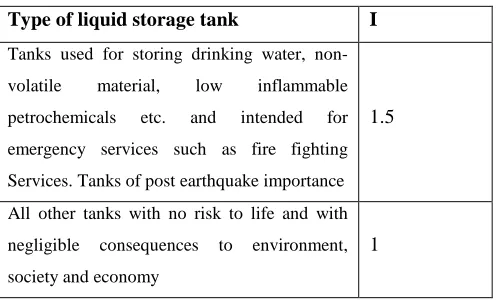
I - importance factor depending upon functional use of structure given by hazardous consequences of its failure post earthquake functional needs, historical value or economical importance (Table No 6, Page No 18 In IS: 1893-2002)
R- response reduction factor depending on perceived seismic damage performance of the structure characteristic by ductile or brittle deformation, however the ratio(I/R) shall not be greater than 1( Given In Table 7, Page No : 23 In IS:1893-2002)
Sa/g – average response acceleration coefficient.
The total design lateral forces or design seismic base shear ( VB ) along any principal direction shall be
determine by the following formula
VB = Ah * W
(3.2.2)
VB = design seismic base shear
W = seismic weight of building. (As per 7.4.2 in IS: 1893-2002)
Table 1 – Importance factor, I
Type of liquid storage tank I
Tanks used for storing drinking water,
non-volatile material, low inflammable
petrochemicals etc. and intended for
emergency services such as fire fighting
Services. Tanks of post earthquake importance 1.5
All other tanks with no risk to life and with
negligible consequences to environment,
society and economy
In this thesis the seismic coefficient method used in STAAD Pro.V8i to calculate the displacement at top and bottom node of tank is explored. Comparison of displacement of RCC elevated water tanks for different combinations of bracings patterns in staging is carried out. Eighteen models are used and earthquake analysis was carried out for all models for empty , half filled and full conditions of circular water tank in STAAD pro. The displacement calculated and comparison is done.
Staging without inclined bracing
Staging with cross bracing
0 20 40 60 80 100 120 140 160 180 200
B
a
se s
h
ea
r(
k
N
)
Types of bracing patterns
0 5 10 15 20 25 30
C
o
nve
nt
io
na
l b
ra
c
ing
cr
o
ss
b
raci
n
g
c
he
vr
o
n b
ra
c
ing
d
iag
o
n
al
b
raci
n
g
k
-t
y
p
e
b
raci
n
g
v
-t
y
p
e
b
raci
n
g
D
is
p
la
cem
en
t(
m
m
)
Types of bracing pattern
X DIRECTION
Y DIRECTION
4. Conclusions
1. Parametric study is carried out by using different patterns of bracings in staging of an elevated water tank. base shear for different bracing pattern it is clear that the base shear value, reduces for alternate bracing pattern in staging. This is apparent because of the reduction of overall stiffness of the structure.
2. From the observations made above it can be concluded that Cross Bracing in staging most effective in reducing Displacement due to lateral loading reducing displacement effectively by 81.09 % in X direction and 92.98 % in Z direction from that of structure without bracings.
3. From the comparision between displacement for different bracing system and displacement for different alternate bracing it is conclude that cross bracing pattern gives the minimum value of displacement.
.
References
[1.] Asari Falguni, Prof. M.G.Vanza, (2012) “Structural Control System for Elevated Water Tank” International journal of advanced engineering research and studies e-issn2249–8974, IJAERS/Vol. I/ Issue III/April-June, 2012/325-328.
[2.] Hasan Jasim Mohammed,(2011) “Economical Design of Water Concrete Tanks” European journal of scientific research ISSN 1450-216x vol.49 no.4 (2011), pp. 510-520 Euro journals publishing, inc. 2011
[3.] Arun Kumar, (2006) “Ductility Analysis of R.C.C.(O.H.T) Design as Per IS:3370(Part-II)” M-Tech Thesis.
[4.] Durgesh C. Rai and Bhumika Singh, (2004) “Seismic Design of Concrete Pedestal Supported Tanks”13th World Conference on Earthquake Engineering Vancouver, B.C, Canada August 1-6, 2004 Paper No. 230.
[5.]
Ayazhussain M. Jabar and H. S. Patel, (2012) “Seismic Behavior of RC Elevated Water Tank under Different Staging Pattern and Earthquake Characteristics”. International journal of advanced engineering research and studies e-issn2249– 8974, IJAERS/Vol. I/ Issue III/April-June, 2012/293-296First Author Manish N. Gandhi with B.E. in Civil Engineering pursuing M E (Structure) from Savitri Phule Pune University (SPPU). The paper is submitted for the award of ME Structure.