Preliminary Studies on Reuse of Industrial Solid
Waste- Case Study
Ravina Telang1 and Dr. Sampath Kumar M.C2
1
Research Scholar-Environmental Engineering, Department of Civil Engineering, BMS College of Engineering, Bengaluru, Karnataka, India
2
Professor-Department of Civil Engineering, BMS College of Engineering, Bengaluru, Karnataka, India
Abstract
In many of the optical product manufacturing industry, lenses for eyeglass are manufactured which are made up of polymer. So, the major component of waste generated in such type of industry is the polymer powder waste. Polymer is generally considered as inert material, it requires millions of years to decompose. The waste generated by this type of industries causes harmful effect on environment. The purpose of the study is to determine the Characteristics of waste generated and to find a suitable way to reuse the waste as filler in blending Wood Plastic Composite (WPC). Characterization of waste was carried out by SEM and XRD analysis. The sample was analyzed for the following parameters pH, conductivity, density, moisture content, solubility and the mechanical properties such as tensile strength and flexural yield were determined. It was found that the waste can be reused as partial filler material in blending WPC.
Keywords: SEM, XRD, Wood Plastic Composite, Polycarbonate, Polypropylene, Wood fiber, Coupling Agent, mechanical properties.
1. Introduction
Polymer is generally considered as inert material, it requires millions of years to decompose. Waste polymer powder is being used for land fill or it is incinerated. Today, discarded waste polymer has become a substantial burden on the landfills throughout the world and incineration though reduces the volume of waste and occupies less space, it causes atmospheric pollution. In many of the optical product manufacturing industry, lenses for eyeglass are manufactured which are made up of polymer. So, the major component of waste generated in such type of industry is the polymer powder waste. The waste generated by these type of industries causes harmful effect on environment.
Therefore, recycling or reuse of polymer waste is one of the best ways to reduce the impact of environmental damage caused by waste. This study includes Characterization of the waste and study on reuse of waste as partial filler material in blending WPC. By this the negative impact on environment can be reduced.
2. Material and Methodology
The polymer sample used in this study was taken from one of the optical products manufacturing industry representative samples were taken. Waste was characterized by Scanning Electron Microscopy (SEM) and X-Ray Diffraction (XRD) analysis. Physical and chemical properties were carried out on the sample as per the standards. In order to study the effects of adding polycarbonate (PC) on the physical and mechanical properties of Wood Plastic Composite (WPC); composites were blended at varying wood content for 20% and 30%, varying polycarbonate content for 10% and 20%, varying Polypropylene (PP) content for 45%,55% and65% using coupling agent(CA) Maleic Anhydride Grafted Polypropylene (MAPP). Coupling agent concentration was kept at 5% to the weight of wood and 1% of additives (wax and Titanium dioxide). Formulations used for making composites are shown in the table 1.
2.1 pH Value:
The test method followed is as per IS:3025 (Part II)–1983. pH value was determined by using pH meter. pH values give whether the sample is acidic or alkaline in nature.
2.2 Conductivity, Density:
The test was carried by referring IS method.
2.3 Moisture content:
2.4 SEM and XRD:
Morphology and composition of waste was determined by SEM and XRD analysis.
2.5 Wood sieving:
Untreated latana wood was purchased from the local market. It was ensured that the wood material free from any defects and fungal mould growth. The wood material was converted into chips using small scale wood chipper. The chips were dried in an oven for about 24 hours at 1050c and then pulverized to fine particles. The wood powder was then used for compounding of latana wood plastic composite
Table 1: Formulations for composites preparation
Polycarbonate Polypropylene Wood fiber
Coupling agent
10% 65% 20% 5%
10% 55% 30% 5%
20% 55% 20% 5%
20% 45% 30% 5%
2.6 Preparation of composite:
Compounding of latana wood plastic composites was done using a 28mm co-rotating twin screw extruder. The extruder had six heating barrels. Temperature profile was kept from 150oc to 165oc throughout the experiments. The srew design and temperature profile of different section is shown in figure 1. Extruder system was started with pure pp at 110 rpm. After reaching steady conditions, feed was replaced with the pre mixed mixture of pp granules, wood powder, coupling agent, polycarbonate and additive. The product was recovered as strands of composite, passed through the water bath and subsequently fed to palletizer to obtain 3mm length granules. Palletized granules were oven dried at 85oc for about 24 hours. Composite granules were then injection molded according to ASTM standards for determining the mechanical properties.
Fig. 1: Screw design and temperature profile of different
2.7 Sample preparation:
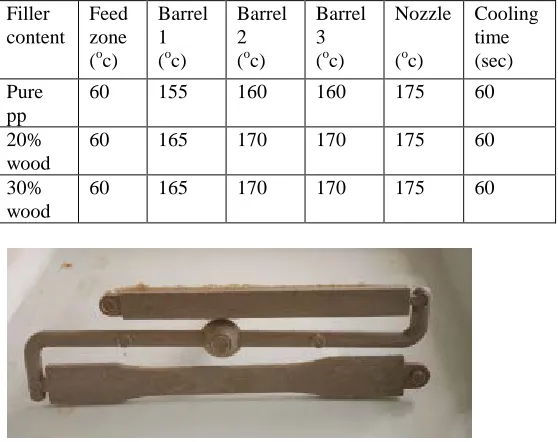
Composites were moulded into standard ASTM type specimen (ASTM D638 for tensile and D790 for flexural tests) using 60 ton L & T Demag make microprocessor controlled, closed loop injection molding machine. The temperature profile for moulding for composites are shown in table 2. The injection pressure was set at 80 bars and injection speed was set at 100 mm/s.
The prepared samples were left for cooling for about 24 hours before testing.
Table 2: Injection moulding parameters for moulding composite
Filler content
Feed zone (oc)
Barrel 1 (oc)
Barrel 2 (oc)
Barrel 3 (oc)
Nozzle
(oc)
Cooling time
(sec)
Pure pp
60 155 160 160 175 60
20% wood
60 165 170 170 175 60
30% wood
60 165 170 170 175 60
Fig. 2: Injection molded tensile and flexural strength specimen
2.8 Mechanical testing:
Mechanical tests (tensile and flexural) were performed using an universal testing machine (model AGIS10, 10 KN). Tensile tests were conducted in accordance with ASTM D638-94b, using specimen type 1 (dimension- 164.08mm
mm 12.8mm 6.68mm for each tests five replicates were tested.
3. Results and Discussion:
Table 3: Physical and chemical properties of waste sample
Form Amorphous
Colour White
pH 7
Conductivity 69 microsemin
Density 1.3 g/cm3
Moisture Content 36.3%
Solubility in distilled water Not soluble Solubility in 1N HCL Not soluble Solubility in 1N H2SO4 Not soluble Solubility in 1N NaOH Partially soluble
Fig.3: SEM Analysis of waste
SEM images of sample
It was found that the waste is in amorphous form.
XRD Analysis
From the graph we can say that the waste contains compound made of carbon and oxygen
EDAX (Energy Dispersive Analysis X-Ray) Analysis
Result of EDAX:
Weight% and atomic% of various elements present in the sample is determined.
Table 4: tensile strength of the prepared sample (10% PC, 65% PP, 20% Wood and 5% CA)
Tensile strength (N/mm2)
Chord (N/mm2)
Mean 24.3530 1407.80
Standard deviation
0.74446 15.3992
Table 5: tensile strength of the prepared sample (10% PC, 55% PP, 30% Wood and 5% CA)
Tensile strength (N/mm2)
Chord (N/mm2)
Mean 26.5284 1755.53
Table 6: tensile strength of the prepared sample (20% PC, 55% PP, 20% Wood and 5% CA)
Tensile strength (N/mm2)
Chord (N/mm2)
Mean 21.4282 1544.41
Standard deviation
1.32753 93.7998
Table 7: tensile strength of the prepared sample (20% PC, 45% PP, 30% Wood and 5% CA)
Tensile strength (N/mm2)
Chord (N/mm2)
Mean 24.7795 1915.22
Standard deviation
1.35084 113.569
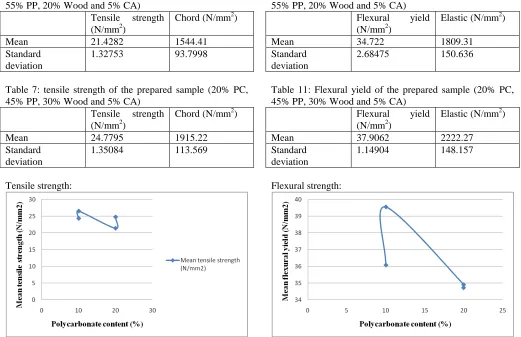
Tensile strength:
Inference: The above graph shows the variation of tensile strength (N/mm2) with varying in polycarbonate content (%). As the percentage of PC was increased there was decrease in tensile strength. It was found that at 10% PC, 55% PP, 30% Wood and 5% CA there was increase in tensile strength (26.5284 N/mm2).
Table 8: Flexural yield of the prepared sample (10% PC, 65% PP, 20% Wood and 5% CA)
Flexural yield (N/mm2)
Elastic (N/mm2)
Mean 36.0768 1506.50
Standard deviation
0.43875 58.5820
Table 9: Flexural yield of the prepared sample (10% PC, 55% PP, 30% Wood and 5% CA)
Flexural yield (N/mm2)
Elastic (N/mm2)
Mean 339.5512 2102.03
Standard deviation
0.43128 125.521
Table 10: Flexural yield of the prepared sample (20% PC, 55% PP, 20% Wood and 5% CA)
Flexural yield (N/mm2)
Elastic (N/mm2)
Mean 34.722 1809.31
Standard deviation
2.68475 150.636
Table 11: Flexural yield of the prepared sample (20% PC, 45% PP, 30% Wood and 5% CA)
Flexural yield (N/mm2)
Elastic (N/mm2)
Mean 37.9062 2222.27
Standard deviation
1.14904 148.157
Flexural strength:
Inference: The above graph shows the variation of flexural yield (N/mm2) with varying in polycarbonate content (%). As the percentage of PC was increased there was decrease in flexural yield. It was found that at 10% PC, 55% PP, 30% Wood and 5% CA there was increase in flexural yield (39.5512N/mm2).
4. Conclusions
References
[1] CPCB manual for characteristic analysis of solid waste. [2] Konya, R. S Zitte, L. F. Ugwulor, “Characterization of wastes
and their recycling potentials; A case study of East-West Road, Port Harcourt” J. Appl. Sci. Environ. Manage. June 2013 Vol. 17 (2) 233-238
[3] Amey Kale, N. Raghu, H.P. Natu, Pankaj Aggarwal, Shakti Chauhan, “Effect of grafting yield and molecular weight of m-TMI-grafted-PP on the mechanical properties of wood fiber filled polypropylene composites” Journal of Applied Polymer Science 133(46) · August 2016
[4] Charudatta P. Thosar, Dr.M. Husain, “Reuse of plastic waste as replacement of sand in concrete” International Journal of Innovative Research in Science, Engineering and Technologh, volume 6, special issue 1, January 2017.