Write-Only Oblivious RAM based
Privacy-Preserved Access of Outsourced
Data
Lichun Li, Anwitaman Datta
School of Computer Engineering, Nanyang Technological University Singapore
Email: {lcli, anwitaman}@ntu.edu.sg Abstract
Oblivious RAM (ORAM) has recently attracted a lot of interest since it can be used to protect the privacy of data user’s data access pattern from (honest but curious) outsourced storage. This is achieved by simulating each original data read or write operation with some read and write operations on some real and dummy data items. This paper proposes two single-server write-only ORAM schemes and one multi-server write-write-only ORAM scheme, which simulate write-only the write operations and protect only the write pattern. The reduction of functions however allows to build much simpler and efficient (in terms of communication cost and storage usage) write-only ORAMs. Write-only ORAM can be used in conjunction with Private Information Retrieval (PIR), which is a technique to protect data user’s read patterns, in order to protect both write and read patterns. Write-only ORAM may be used alone too, when only write patterns need protection. We study two usage scenarios: (i) data publishing/sharing: where a data owner shares the data with others, who only consume the published information. Data consumers should not have write access to the outsourced data, and thus cannot use ORAM to protect their read patterns in this scenario. To hide access patterns from the outsourced storage, the data owner can use ORAM to write data, and data consumers use PIR to read data. Alternatively, for some applications, a data consumer can trivially download all data once or regularly, and neither the data owner nor data consumers mind that the outsourced storage learns such read pattern. Compared with using traditional ORAM, using the simpler write-only ORAM here produces much less communication cost and/or client-side storage usage. Our single-server write-only ORAM scheme produces lower (typically one order lower) communication cost with the same client-side storage usage, or requires much less (typically at least one order less) client-side storage to achieve the same level of communication cost than the best known single-server full functional ORAM schemes do. Compared with the best known multi-server ORAM scheme, our write-only ORAM schemes have lower (typically one order lower) communication cost, or achieve the same communication cost with the same client-side storage usage in single-server setting. (ii) the data owner’s personal use: Our write-only ORAM schemes combined with PIR can be used as building blocks for some existing full functional ORAM schemes. This leads to the reduction of the communication costs for two full-functional ORAM schemes by the factors ofO(logN)andO(√logN×log logN), whereN is the maximum data item count. One of these resulting schemes has a communication cost ofO(l), wherelis data item length. This is typically one order lower than the previous best known ORAM scheme’s cost, which is O(logN ×l). The other resulting scheme also achieves O(logN×l)
communication cost, but its client-side storage usage is several orders lower than the best known single-server ORAM’s.
I. INTRODUCTION
accessing dummy data items (dummy items for short) or unnecessary real data items, re-encrypting a data/dummy item into a different ciphertext after accessing it, and obliviously shuffling real and dummy data items. From the view of the adversary observing the software’s memory access, whether a simulated operation is read or write is indistinguishable. ORAM also hides individual data item’s access frequency and the linkage between the simulated operations operating on the same data item. Here, the CPU executing the software’s operations and the CPU’s internal storage, i.e. registers, are considered secure. The adversary can’t see the data in CPU.
In recent years, ORAM has attracted a lot of research interest, e.g. [2–5], since it can protect the privacy of data user’s data access pattern from the honest but curious outsourced storage. The confidentiality of the data user’s data in outsourced storage can be protected by encryption. But sometimes encryption is not enough to protect privacy as data access pattern could leak sensitive information [2]. Suppose that operations on certain data items is always followed by a specific stock action of the user. Then a curious server can predict the user’s stock action by monitoring its data access pattern. In [6–8] it is further elaborated how access pattern may leak sensitive information.
This paper is focused on ORAM’s outsourced storage usage instead of software protection usage. In ORAM’s outsourced storage usage, the data user’s node plays the roles of “software” and “CPU”, while the outsourced storage plays the role of “memory”. In the literature and this paper, such a user node is called ORAM client (client for short), and such an outsourced storage is called ORAM server (server for short).
PIR (Private Information Retrieval), first proposed in [9], is another technique used to protect data user’s privacy of read patterns from honest but curious outsourced storages. PIR allows users to retrieve a data item from a database without letting the database server know which item is being retrieved. Such a privacy primitive is used in diverse settings including patent databases [10], pharmaceutical databases [10], email systems [11], e-commerce [12], P2P file sharing systems [13], etc. to hide an user’s interest/profile.
Motivation. This paper proposes write-only ORAM, and discusses how to use it with/without PIR to protect data access pattern. Existing ORAM schemes are all full functional, which can simulate both write and read operations of standard non-oblivious RAM. In another word, existing ORAM schemes can hide the access (write/read) pattern of simulated operations and the type (write or read) of any simulated operation. This paper’s write-only ORAM simulates only write operations, and protects only write patterns. As far as we know, this is the first work on write-only ORAM. The reduction of functions allows us to build simpler ORAM with better performance. Compared with the best known full functional ORAM schemes, this paper’s write-only ORAM schemes have lower (typically one order lower) communication cost, or require much less (typically at least one order less) client-side storage to achieve the same level of communication cost. Write-only ORAM can be used in three situations: 1) If only write pattern needs protection, write-only ORAM can be used alone; 2) If read and write patterns need protection but operation type doesn’t need protection, write-only ORAM and PIR can be used; 3) If access pattern and operation type need protection, full functional ORAM can be built based on write-only ORAM and PIR. Write-only ORAM is useful in the below two scenarios, which contain these situations.
and data consumer’s read pattern respectively. Alternatively, for some applications, a data consumer that needs all data can trivially download all the data from the outsourced storage once or regularly. Therefore, a possible data sharing solution is: the data owner uses ORAM to write (add or update) data at the outsourced storage; data consumers use PIR to retrieve data from the outsourced storage, or trivially download all data from the outsourced storage. Compared with using full functional ORAM, using the simpler write-only ORAM with lower cost here is better. For some applications, the data owner may need to read data items from outsourced storage too. If the data owner doesn’t mind to expose its operation type (read or write), it can use PIR to retrieve data items or download all data items trivially like a data consumer. Otherwise, one should use full functional ORAM which can be achieved by composing write-only ORAM and PIR differently, as discussed next.
• The second scenario is outsourced storage for the data owner’s own use, or when multiple parties own and collaborate over the data, and even the type of operation (read or write) is confidential, i.e., a fully functional ORAM is needed. Both read and write operations are carried out by data owner(s), and full functional ORAM is used to protect access pattern. Based on write-only ORAM, two kinds of full functional ORAM can be built: (a) full functional ORAM built by directly combining write-only ORAM with PIR; (b) full functional ORAM built by combining write-only ORAM with PIR and using it as a building block in [4, 5]’s ORAM frameworks. Compared with traditional full functional ORAM, these two new kinds of full functional ORAMs make a tradeoff of computational cost for communication cost and client-side storage usage. We focus on full functional ORAM (b) in this paper, because ORAM (b)’s computational cost is lower than ORAM (a)’s. We use write-only ORAM and PIR as a building block to improve two full functional ORAM schemes [4, 5]. By using write-only ORAM and PIR in [4] and [5]’s ORAM frameworks, the communication cost can be reduced by a factor ofO(√logN×log logN)andO(logN)respectively whereN denotes the maximum number of data items the ORAM system can store.
Contributions. The main contributions of this paper are as follows:
(i) Two novel single-server write-only ORAM schemes (basic write-only and advanced write-only ORAM) and a multi-server write-only ORAM scheme are proposed. The advanced single-server as well as the multi-server schemes leverage on the basic scheme. The advantages of advanced write-only ORAM depend on proper optimization of parameters, and is explored in the paper. Though write-only ORAM is simpler than traditional full functional ORAM, this paper’s contribution (i) is not trivial. New algorithms and new data organizations are used to realize efficient designs. Moreover, our design supports multiple ORAM clients and concurrent access, which is atypical in most existing full functional ORAMs.
(ii) This paper studies and improves the method of supporting PIR clients in ORAM. This method is not only useful for write-only ORAM in above two scenarios, but also needed if using full functional ORAM and PIR together in the data sharing via outsourced storage scenario.
(iii) We demonstrate how a full functional ORAM can be directly build based on write-only ORAM and using write-only ORAM as a building block.
II. BACKGROUND ANDRELATEDWORK
A. Oblivious RAM
Most ORAM schemes are single-server schemes. Very few schemes, e.g. [20], are multi-server schemes, that assumekindependent and non-colluding outsourced servers.
In Table I we list the best traditional ORAM schemes that we have identified. In this table and the rest of this paper, N denotes the maximum number of data items the system is designed to store at any time, and l is the data item length in bits. The last ORAM scheme in table [20] is the best multi-server scheme, while the other schemes are single-server ones. Among traditional fully functional ORAM schemes, they have the lowest communication costs under different levels of storage usages.
Table I
TRADITIONALORAM
scheme client storage server storage amortized communication/computational cost [3, 16, 17]* O(N1/r
×l) O(N×l) O(logN×l)
[4]** O(logN×N+l) O(logN×N×l) O(logN×√logN×log logN×l) [18] O((logN)
2/logl ×l)
O(N×l) O((logN)2/logl
×l+ logN×l)
O(logN×l)
[19] O(l) O(N×l) O((logN)2/log logN
×l)
[20]*** O(l) O(N×l) O(logN×l)
* r is a small constant.
** [4] has two ORAM constructions. This result is achieved by its basic ORAM construction. *** This is a two-server (and also the best multi-server) ORAM scheme.
B. Private Information Retrieval (PIR)
Broadly, there are two kinds of PIR techniques — itPIR (information-theoretic PIR) and cPIR (computational PIR), providing unconditional and computational hardness based privacy respec-tively. The privacy in cPIR is guaranteed subject to computational bounds on the server, while all communication efficient itPIR schemes are multi-server based, and assume that not all the servers collude together. Neither cPIR nor itPIR require that the data items in the database are encrypted. In cPIR, the user’s PIR client encrypts the wanted data item’s position in the database, and sends the encrypted position as a query to the database server; the database server computes an answer using the encrypted position and all the data items in the database; the client decrypts the answer and obtains the desired data item. There is no single-server itPIR scheme apart the trivial one, i.e., downloading the whole database. Efficient multi-server itPIR schemes can be built under the conditions that each server holds a replication of the database and not all servers collude. A multi-server itPIR scheme is called a t-private k-server itPIR scheme if it requires k (k > 1) database servers and resists up to t (k > t ≥ 1) colluding servers. Suppose a database has N data items, a t-private k-server itPIR works in the following way: the user’s PIR client uses the position of the wanted data item to generatekqueries, and sends each server a query; each server computes an answer using its received query andO(N) data items in the database, and sends the answers to the client; the client recovers the wanted data item from received answers. Any t or less servers together can’t learn any non-trivial information of the wanted data item’s position from their received queries. In most itPIR schemes, a secret sharing scheme is used to generate shares from the secret position, and each share is a query [21, 25].
GPU [39] were proposed to improve PIR’s performance and make it practical for bigger databases. The parallelization of cloud computing can be exploited in this paper’s outsourced storage scenarios, and some cloud providers like Amazon also provide virtual machines with GPU.
Compared with traditional ORAM, PIR has lower communication cost in most cases for the outsourced data sharing and outsourced storage for data owner scenarios (where database size is at most a few PB, and individual data item size is at least a KB) considered in this paper. The communication costs of most PIR schemes are betweenO(logN+l) andO(N+l). [23]’s cPIR scheme can achieveO(logN+l)communication cost. Normally, in the scenarios considered in this paper,O(logN+l) =O(l). Quite a few PIR schemes like [21, 22] can achieve a communication cost of O(N1/d+l), where d ≥ 1. For many typical setting of N and l, most of these PIR
schemes can make O(N1/d) ≤ O(l), and achieve a communication cost of O(l). For example,
suppose N = 242 and l= 214 (2KB). The database size is 8PB. Then N1/d≤l if d≥3, which
can be easily achieved by some schemes. For example,ddepends onkandt, e.g.d×t+ 1 =kin two of [21]’s itPIR schemes (main PIR protocol and binary PIR protocol). For another example, ddepends on N, e.g. d=O(log logN) in [22]. So the best communication cost of PIR is O(l)
in many cases. In this paper, we care more about the comparison between the communication costs of traditional full functional ORAM and PIR when PIR is used with write-only ORAM to improve [4, 5]’s ORAM schemes. As introduced later in Section III and elaborated in Section VII, in this usage, PIR is used to retrieve data items from a partition of the database containing O(√N) or O(logN) data items instead of from the whole database. For a 1PB database with 1KB data item size, the partition size is at most several GB or hundreds of KB respectively, and the database partition can be viewed as a much smaller database. Then it’s much easier to achieve O(l) communication cost for many PIR schemes. Therefore, in this paper, we useO(l) as PIR’s communication cost when evaluating the overall communication cost of our designs.
In this paper, write-only ORAM may be used with single-server or multi-server PIR to protect access pattern. Please note that a single-server ORAM scheme can be used with a multi-server PIR scheme though they require different number of servers. A multi-server PIR scheme requires that each server has a replication of the database. The ORAM client can run a single-server ORAM scheme in one server, and synchronize the changes of the database to every other server. Similarly, a multi-server ORAM scheme may be used together with a single-server PIR scheme. However, server PIR scheme is computationally more efficient than a single-server one. If using multi-server ORAM scheme, multi-multi-server PIR scheme should be chosen over single-multi-server PIR scheme. The details of using write-only ORAM and PIR together will be given later.
C. Combining ORAM with PIR
Most trusted-hardware-assisted PIR schemes [26–29] are based on ORAM. These schemes share the same basic principle. A trusted coprocessor at the database server works as a representative of the PIR client. The trusted coprocessor uses ORAM to read the data item wanted by the PIR client from the server’s storage obliviously, and returns the data item to the PIR client. Compared with PIR schemes without trusted hardware, these schemes have lower computational and communication costs. In this paper, we use normal PIR with write-only ORAM, and don’t require trusted hardware at the server side. Also, the PIR discussed in this paper except this paragraph is normal PIR without trusted hardware.
The ORAM scheme in [4]’s is improved by [30] using PIR and PIR-writing [31] as building blocks in [4]’s ORAM framework. PIR-writing can update a data item without letting the database server knowing which data item is updated. PIR-writing utilizes homomorphic encryption to modify every data item’s ciphertext, and only one data item’s plaintext is updated. [30] improves the communication cost toO((logN)3+ (logN)2×l) withO(l) client-side storage. Inspired by [30], we further improve upon [4] by using PIR and write-only ORAM as building blocks in [4]’s ORAM framework, and reduce communication cost to O(logN ×l) with O(l+N1/r×logN)
client-side storage.r is a small constant here. Compared with using PIR-writing, using write-only ORAM produces less computational cost.
III. OVERVIEW OFWRITE-ONLYORAM SCHEMES
A. System Setting
The outsourced storage, i.e. the ORAM server, is considered honest but curious. The input of an ORAM client or a group of ORAM clients is a sequence of data operations (simulated data operations), and the i-th operation is denoted as (opi, qi, xi). opi is the type of data operation,
which could be read or write. A read operation retrieves the value of the data item indexed qi,
while a write operation sets the value of the data item indexedqi toxi. A full functional ORAM
system is considered secure if, for any two equal-length sequences of data operations, which sequence is chosen by the ORAM client(s) as input is computationally indistinguishable for the ORAM server(s). In contrast, like the name suggests, in write-only ORAM the data operation type is always write. Thus to say, both full functional and write-only ORAM hide individual data item’s access frequency and the linkage between the simulated operations operating on the same data item. Full functional ORAM also hides the type of any data operation, which our write-only ORAM operations do not. The ORAM server however knows how many operations are executed during any time period.
In contrast to most existing works in the literature which consider single ORAM client and single ORAM server, our approach supports the possibility of data consumers’ non-ORAM clients, multiple ORAM clients and multiple ORAM servers. In such a setting, the (write-only) ORAM mechanisms do not prevent the data consumers’ clients from learning about the data owner’s write pattern since they have access to read the data, and thus they can repeatedly read the whole data to identify the differences. Likewise, when multiple ORAM clients collaboratively mutate a collection of data, they can (as well as need to) also see what changes are being made by others. (For example, the data owner is a company and the ORAM clients of multiple employees access the data stored in the ORAM server.) However, a data consumer can hide its read pattern from everyone by using PIR.
Finally, for the case of multiple ORAM servers, our scheme requires that not all servers collude. More specifically, the multi-server scheme can be characterized as a t-private k-server scheme (t < k), which is secure only if at most tof all the k servers collude.
B. Design Overview
Our basic write-only ORAM has a very simple structure containing two storage areas. In contrast, the most efficient traditional ORAMs have aO(logN)-tier pyramid structure or a O(logN)-level tree structure. To support PIR in ORAM, an additional table named slot mapping table containing the mappings from item indices to locations is maintained additionally. The slot mapping table design is based on [15], to which we make two major modifications to reduce the client-side storage usage for maintaining this table.
basic write-only ORAM. We optimize the bucket count to reduce client-side storage usage in different configurations of maximal data item countN and item lengthl. The advanced write-only ORAM also needs to maintain a table named bucket mapping table containing the mappings from item indices to bucket numbers. The bucket mapping table is maintained at the client-side as if there is only a single ORAM client. If there are multiple ORAM clients, the table is maintained at the server-side as an additional basic write-only ORAM.
The multi-server write-only ORAM also builds on the basic write-only ORAM, but uses a different oblivious merge mechanism to update values of data items. Basic write-only ORAM uses an oblivious merge algorithm based on a recently proposed oblivious sort algorithm [44]. Giving the assumption that not all servers collude, the multi-server write-only ORAM adopts a low-cost multi-server oblivious merge based on oblivious remove and oblivious scramble.
Compared with traditional ORAMs, the amortized communication costs in write-only ORAMs are lower. In traditional ORAMs, oblivious shuffle is the most costly operation performed after every oblivious read/write operation to hide the positions of the data items being accessed. In contrast, in write-only ORAMs, oblivious merge is the most costly (but less costly than oblivious shuffle) operation, and it is used to update data items obliviously with new written values. The simpler structure and less costly oblivious merge makes write-only ORAM’s amortized communication cost of oblivious write lower than traditional ORAM’s amortized cost of oblivious access, assuming a given size of storage space.
Based on write-only ORAM, two kinds of full functional ORAMs can be built: (a) full functional ORAM built by directly combining write-only ORAM with PIR; (b) full functional ORAM built by combining write-only ORAM with PIR and using it as a building block in [4, 5]’s ORAM frameworks. In full functional ORAM (a), a read operation of a data item can be simulated by using PIR to retrieve the data item and a following oblivious write of a dummy data item. Similarly, a write operation of a given data item can be simulated by using PIR to retrieve a random item and a following oblivious write of the target data item.
One can also use write-only ORAM and PIR as building blocks to improve two full functional ORAM frameworks [4, 5]. Both frameworks proposed ORAMs containing multiple buckets, but [4]’s bucket is a full functional ORAM storing at most O(logN) data items, while [5]’s bucket is a full functional ORAM storing at most O(√N) data items. By reusing [4] and [5]’s ORAM frameworks and implementing their buckets based on write-only ORAM and PIR, the communica-tion cost is reduced by a factor ofO(√logN×log logN) andO(logN) respectively. To combine their ORAM frameworks and our write-only ORAM, we make slight modifications to write-only ORAM and [4]’s ORAM framework.
evaluate how data operation throughput and data access latency are affected. We provide a back of the envelope estimation below based on the performance data reported in the literature, but defer any further experimental work for the future.
Since the database size in most experiments reported by the ORAM and PIR literatures is not more than 1TB, let’s assume the database size is 1TB in the performance estimation. To the best of our knowledge, ObliviStore [35] is the fastest oblivious RAM implementation for outsourced storage to date. Performance tests on a 1TB database with 4KB sized data items stored in a commodity machine (the ORAM server) yielded throughput and response latency of 364 KB/s and 196ms respectively. Recall that a bucket of [4] and [5]’s ORAMs store O(logN) and O(√N)
items respectively. As shown in [5, 45], the constants inO(logN) andO(√N) can be lower than 2 and 3 in practice. We can reasonably assume [4] and [5]’s bucket sizes are 6×logN ×l and
4×√N×l respectively considering the storage expansion of using write-only ORAM. Thus, for 1TB database with 4KB sized data items, [4] and [5]’s bucket sizes are 672KB and 256MB. For the 1TB database with 1MB sized data items, [4] and [5]’s bucket sizes are 80MB and 4GB. To generate a response to a PIR request, a server of full functional ORAM (b) would need to process all data in a bucket. Performance study [36] showed that a commodity machine’s database processing speed in the fastest itPIR scheme [9] is 1GB/s or more depending on the database size and memory size. Likewise, [39] tested several cPIR schemes in three kinds of commodity machines with GPU. Among these cPIR schemes, Gentry and Ramzan’s scheme [23] is the most desirable one with a data processing speed of 187.5KB/s. Though the speed of [38]’s scheme is faster, [38]’s scheme is less communication efficient than the best traditional ORAM. ([38] is still a good option for outsourced data sharing scenario.) The outsourced storage can use multiple commodity machines to parallelize and speed up the database processing. Using these figures, we extrapolate that the outsourced storage can use an acceptable number of machines to achieve acceptable throughput and response latency. We may estimate PIR’s performance in our full functional ORAM from [40] and [41] too. [40]’s showed that the average query time of [42]’s itPIR scheme is lower than 1 second when a PIR server is a cloud with 320 machines and the database size is 4GB. [41] tested its cPIR scheme using 20 Amazon instances. It took a PIR client about 3 minutes to retrieve a 1MB sized data item from a 10GB database. If the bucket size is small or more machines are used, [41]’s cPIR scheme could have an acceptable performance compared with traditional ORAM’s performance.
C. Our Results
Our write-only ORAM schemes’ communication costs and storage usages are shown in Table II, III and IV. Compared with basic write-only ORAM, advanced write-only ORAM requires less client-side storage usage to achieveO(l)communication cost whenO(N×logN)< O(N1/r×l).
Compared with single-server write-only ORAMs, multi-server write-only ORAM can achieveO(l)
communication cost with less client-side storage usage whenO(l+N)< O(N1/r×l). We show the
communication costs, computational costs and storage usages of two write-only ORAM based full functional ORAMs using [4] and [5]’s ORAM frameworks in Table V. We can see that our results are better than traditional full functional ORAM in terms of communication cost and client-storage usage.
Table II
BASIC WRITE-ONLYORAM
client storage server storage amortized communication cost
oblivious write PIR read
supporting trivial O(l) O(N×l) O(logN×l)
download only O(N1/r
×l) O(N×l) O(l)
supporting PIR O(l)* O(N×l) O(√N×(logN)2) O(√N
×logN) and trivial download O(l+N1/r
×logN) O(N×l) O(logN×(l+√N)) O(l+√N×logN)
O(N1/r
×l) O(N×l) O(l+√N×logN) O(l+√N×logN)
r≥2andris a small constant.
* This row’s costs are under the condition ofO(l)< O(N1/r
×logN). IfO(l)≥O(N1/r
×logN), please check the next row.
Table III
ADVANCED WRITE-ONLYORAM
PIR
case client storage server storage amortized communication cost
support oblivious write PIR read
no 1 O(N×logN) O(N×l) O(l)
2 O(N×logN+l) O(N×l) O(l)
yes 1 O(N×logN) O(N×l) O(l+
√
N×logN) O(l+√N×logN) 2 O(N×logN+l) O(N×l) O(l+√N×logN) O(l+√N×logN) case 1: There are multiple ORAM clients andN ≥l.
case 2: There is only one ORAM client orN < l.
the assumption of not all servers colluding. Compared with the traditional single-server ORAMs achieving this cost, our single-server ORAM can achieve this cost with much less client-side storage usage (O(l) only), or use at most the same client-side storage usage (O(N1/r ×l)) to achieve lower communication cost (O(l)). Therefore, our single-server write-only ORAM reduces communication cost by a factor oflogN or client-side storage usage by a factor ofN1/r. Typically, communication cost and client-side storage usage can be reduced by one order and several orders respectively. For example, if N = 230 and r = 3, logN = 30 and N1/r = 1024. Write-only ORAM and traditional ORAM can use the same way to support PIR in the data sharing scenario. If using O(N1/r ×logN) (or O(logN)) client-side storage to support PIR, the communication costs of both write-only ORAM and traditional ORAM will be increased byO(√N×logN) (or O(√N×(logN)2)).
For the outsourced storage used by the data owner, the full functional ORAM schemes using
Table IV
MULTI-SERVER WRITE-ONLYORAM
PIR support client storage server storage amortized communication cost
oblivious write PIR read
no O(N+l) O(N×l) O(l)
yes O(N+l) O(N×l) O(l+√N×logN) O(l+√N×logN)
Table V
FULL FUNCTIONALORAMUSING WRITE-ONLYORAMAS A BUILDING BLOCK
client storage server storage amortized comm. cost amortized comp. cost
[5]’s ORAM framework O(√N×l+N×logN) O(N×l) O(l) O(√N×l)
[4]’s ORAM framework O(l+N1/r
write-only ORAM as a building block can be used. As shown in Table V, the first scheme improves communication cost to O(l), and the second scheme achievesO(logN ×l) communication cost, which is equal to the best communication cost of single-server and multi-server traditional ORAMs. As shown in Table I, traditional single-server ORAM schemes achieving this communication cost require at leastO(N1/r×l) client-side storage usage. In contrast, the second scheme uses O(l+
N1/r×logN) client-side storage, which typically is several orders lower.
IV. BASIC SINGLE-SERVER WRITE-ONLYORAM
A. Preliminaries
Similar to most full functional ORAM schemes, this paper’s single-server and multi-server write-only ORAM schemes are based on the following assumptions. The maximum number of data items in the outsourced storage, i.e. server, is N. During the use of the outsourced storage, data items may be added or deleted. Thus, at any given time, the actual data count is equal to or less than N. Data items’ indices, i.e. IDs, are in {1,2, ...N}, and all data items have same length: l bits. The server won’t tamper stored data, or tampering will be detected using techniques like MAC (Message Authentication Code) and signature.
Furthermore, as in full functional ORAM schemes, dummy items are used to hide access pattern, and data/dummy items uploaded to the server are encrypted with a semantically secure probabilistic encryption [43] scheme and therefore two encrypted copies of the same item look different. The server cannot identify whether these two copies correspond to the same item or not.
B. Construction
As shown in Figure 1, the server-side storage contains two areas: a main part and a write cache. Both areas have N slots, and each slot can store one encrypted data item or dummy item. All items in the main part and the write cache are encrypted. The main part is always filled with items so that the server cannot tell the actual data item count in the main part. There may beN or less data items in the main part, and the remaining items, if any, are dummy items. Dummy items are used to hide data item count and access pattern from the server. At the beginning, the ORAM client initializes the main part by uploading N encrypted items to it. These N items include all data items outsourced at the beginning and maybe some dummy items for hiding current data item count. Some meta data of an item, e.g. data item index, item type (real data item or dummy item) and freshness level, are encrypted and stored along with the item’s content. Freshness level is optional. It will be introduced later. The ORAM client can determine whether an item in the main part is a data item or dummy item only after decrypting it, and accordingly get the item’s index and freshness level if the item is a data item. The write cache stores recently written data items. The write cache is empty at the beginning. Every time the ORAM client does an oblivious write operation, it uploads an encrypted data item, and the item is put in the first empty slot in the write cache.
If the write cache is full after writing a data item, the ORAM client does an oblivious merge: it obliviously updates the main part with the recently written data items in the write cache, and empties the write cache. After the oblivious merge, newly added data items are put in the main part, and the outdated data items in the main part are replaced with the most updated data items. Please note that the server cannot detect whether an item’s plaintext has changed or not after the oblivious merge because every item’s ciphertext changes due to use of a semantically secure probabilistic encryption scheme.
C. Oblivious Merge Algorithms
Nslots filled with encrypted items.
D7 D7 ...
Main part
Write cache
N slots D2
A write operation inserts an encrypted item in the first empty slot in write cache. V
V D1 D3 D5 D6 D7
N slots. Each slot stores an encrypted data item or dummy item.
... ...
Main part Write cache
Nslots are empty at the beginning. Each slot can store an encrypted item.
V V
Initialization
ORAM client ORAM server’s storage
Nitems include all the data items outsourced at the beginning and maybe some dummy items.
UploadN encrypted items to fill the main part.
ⱶ ⱶ
ORAM client
Oblivious write
ORAM server’s storage
Nslots filled with encrypted items.
D7 D7 ...
Main part
Write cache
Write cache is full before oblivious merge. V
V
update main part with new/updated data items in write cache
ORAM server’s storage before oblivious merge
D2 D1 D7 D6 D1 D3
Updated main part
(updated: D1, D3, D6, D7 …; newly added: D2…) Main part
Write cache
Write cache is empty after oblivious merge. V
V ORAM server’s storage after oblivious merge
...
Oblivious merge
Di
ⱶ
Data item indexed i
Dummy item
...
...
...
ⱶ
D1 D3 D5 D6 D7 ⱶ ⱶ ⱶ
D1 D3 D5 D6 D7 ⱶ ⱶ ⱶ
D3 D5 D6 D7 ⱶ
D1 D2 ⱶ
Figure 1. Basic write-only ORAM
in most cases. When the basic write-only ORAM is used as a building block in other ORAM schemes, the trivial oblivious merge may be used.
The ORAM client does the oblivious merge based on oblivious sort by following steps, and a toy example is shown in Figure 2.
server can’t learn any data item’s freshness level. Because every scanned item is re-encrypted with a semantically secure probabilistic encryption scheme, the server can’t learn any scanned item’s type.
• Second, the client sorts the items in the server using a data-oblivious external-storage sort algorithm. In our case, the outsourced storage is the “external-storage”. We use [44]’s oblivious sort algorithm. After sorting, items of the sorted list are in the order that: 1) data items before dummy items; 2) the data item with smaller index before the data item with bigger index; 3) for data items with the same index, items with higher freshness levels are before items with lower freshness levels.
• Third, the client scans the sorted list, removes tags, and replaces outdated data items with dummy items. The client detects outdate items by comparing adjacent items’ indices and freshness levels. If two items have the same index, the item with lower freshness level is outdated. The client scans the sorted list from head to tail. The client downloads items in the list one by one to scan. If current scanned item is a data item, the client compares current scanned item’s index and freshness level with last scanned item’s index and freshness level. If current scanned item is an outdated data item, the client uploads a new dummy item to the server. Otherwise, the client re-encrypts the current item, and uploads it.
• Fourth, the client sorts all items again obliviously. [44]’s oblivious sort algorithm is used again here. After sorting, items are in the order that data items are before dummy items.
• Fifth, the client asks the server to put the first N items of the sorted item list in the main part.
It’s easy to find out that each of above steps is oblivious and above oblivious merge algorithm is secure. The second and fourth steps are the most costly parts of the oblivious merge based on oblivious sort. Under the assumption of l ≥ (logN)ε (ε > 0 is a small constant), [44]’s oblivious sort algorithm produces following communication cost for sorting a list of N items: O(N×logN×l)if usingO(l)client-side storage ;O(N×r×l) =O(N×l)if usingO(N1/r×l)
client-side storage. Here,r ≥1andr is a small constant can be omitted inO(N×r×l). Normally, l≥(logN)ε stands. It’s also acceptable to choose a value for r that makesr ≥2. In this paper, we assume r ≥ 2, which will simplify the analysis of costs. The most computationally costly operations in the oblivious merge are decrypting downloaded items and encrypting items to be uploaded. So, the communication and computational costs are the same in the second and fourth steps. Both costs of the other steps are O(N ×l), which is less than the cost of the second and fourth steps. Therefore, the oblivious merge’s communication and computational costs are both: O(N×logN×l) if usingO(l)client-side storage;O(N×r×l) =O(N×l)if usingO(N1/r×l)
client-side storage. Here,r ≥2 andr is a small constant, which can be omitted inO(N×r×l). If the ORAM client has O(N ×l) storage space, it can do a trivial oblivious merge locally. First, the client downloads all items, and picks the most updated data items. Second, the client re-encrypts the picked data items, and uploads them to the server. Third, if the number of uploaded data items is less than N, the client creates one or some dummy items, and uploads the dummy item(s) to the server to make uploaded item count be N. The server will put all received items in the main part. A client havingO(N×l) storage space is usually not practical. However, when the basic write-only ORAM is used as a building block in other ORAM schemes, this trivial oblivious merge may be useful.
D1 D1(7) D1(4) D1(0)
D1
D7
Nslots filled with encrypted items. (N=8)
D7 D7
Main part Write cache
Write cache is filled with Nitems before oblivious merge.
Step 1: tag freshness level
Before oblivious merge
D2 D1 D7 D6 D1 D3
D3 D5 D6 D7 ⱶ ⱶ
D3 D5 D6 D7 ⱶ
D1 D2
D7(1) D7(2)
Main part Write cache
Step 2: oblivious sort
After step 1
D2(3) D1(4) D7(5) D6(6) D1(7) D3(8) D3(0) D5(0) D6(0) D7(0) ⱶ ⱶ
Step 3: replace outdated data items with dummy items; remove tags
After step 2
D7(2) D7(1)
D2(3) D7(0)
D1(0) D3(8) D3(0) D5(0) D6(6) D6(0) D7(5) ⱶ ⱶ
2N= 16 sorted items
Step 4: oblivious sort
After step 3
D2 D3 D5 D6 ⱶ ⱶ
2N= 16 items
ⱶ ⱶ ⱶ ⱶ ⱶ ⱶ
ⱶ ⱶ
ⱶ ⱶ ⱶ
Di (j) Data item indexed i with freshness level j
2N= 16 sorted items
ⱶ ⱶ ⱶ
Step 5: fill main part with first Nitems; empty write cache
Temporary server-side space for oblivious merge
Temporary server-side space for oblivious merge
Temporary server-side space for oblivious merge After step 4
(updated: D1,D3, D6, D7 ; newly added: D2; unchanged: D5)
Updated main part Write cache
Write cache is empty after oblivious merge. After step 5
ⱶ
ⱶ
ⱶ
ⱶ ⱶ
ⱶ
D3 D5 D6 D7 ⱶ
D1 D2 ⱶ
Figure 2. A toy example of oblivious merge based on oblivious sort
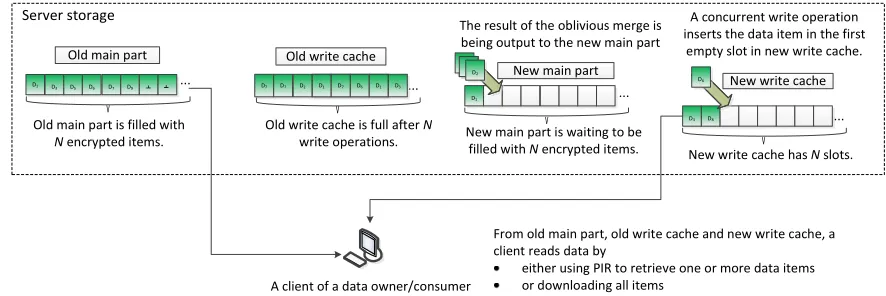
the data owner or a data consumer. A data reader may retrieve data items using PIR, or download all data items directly. Concurrent PIR reads will use PIR to retrieve data items from the old main part, old write cache and new write cache. A concurrent read of all data items will download all items in the old main part, old write cache and new write cache directly. When the oblivious merge is done, items in the old main part and old write cache will be deleted.
D. Key Sharing for Data Consumers and Multiple ORAM Clients
D1 D3 D5 D6 D7 D9 V
Old main part is filled with
N encrypted items.
...
D3 D8 ...
Old main part
New write cache
New write cache has N slots. A concurrent write operation inserts the data item in the first
empty slot in new write cache.
Old write cache is full afterN
write operations. ... Old write cache
D1
New main part is waiting to be filled with N encrypted items. ... New main part
D6
The result of the oblivious merge is being output to the new main part Server storage
A client of a data owner/consumer
From old main part, old write cache and new write cache, a client reads data by
either using PIR to retrieve one or more data items or downloading all items
V V
V
D7 D7 D2 D1 D7 D6 D1 D3 ⱶ ⱶ
D2
Figure 3. Concurrent read and write during an obvious merge
shared among ORAM clients too. The simplest way of managing and sharing keys is using the same key for all items like most ORAMs and pre-sharing the key like [16]. Alternative, [15]’s way can be used. [15] uses different keys for different items, and considers access control when sharing keys. By control the access to keys, the data owner can control which data items are accessible to a specific data consumer. Please refer to [15] for the details.
E. Analysis
During either an oblivious write operation or an oblivious merge, from the perspective of the server, the ORAM client’s behaviors are independent of the data item being written and the data items been written before. The server does not know the index of any data item being written or having been written. The server cannot find the linkage between two write operations writing on the same data item. The server does not know if a given data item is updated more frequently than other items.
This write-only ORAM uses O(N ×l) server-side storage. The communication and compu-tational costs of an oblivious write are both O(l). If the client-side storage usage is O(l), the communication/compuatational cost of an oblivious merge isO(N×logN×l). If the client-side storage usage is O(N1/r×l), the communication/compuatational cost of an oblivious merge is O(N ×l). An oblivious merge is performed after every N oblivious writes. So the amortized communication and computational costs of an oblivious write are both: O(l) when client-side storage is O(N1/r ×l); O(logN ×l) when client-side storage is O(l). Here, r ≥ 2 and r is a small constant.
F. Supporting PIR Clients
1) Maintaining Data Item Location for PIR Clients
method after two major modifications for reducing client-side storage usage, and summarize the modified method as below.
(1,1) (2,2) (3,-1) (4,3) (5,-1) (6,-1) (7,4) (8,5)
N encrypted entries.
The i-th Entry: mapping from data item index i
to location or -1 (if no this item). ...
(8,33) (3,34) ...
Slot mapping table
Cache for updating one entry
√N slots for encrypted entries. (5,35)
After writing a data item, the ORAM client updates an entry by inserting the updated entry in the cache.
V
V
Cache for updating the whole table
V
After an oblivious merge of data items, the ORAM client insertsNentries for new main part’ items to the cache.
A temporary cache of N slots.
...
(6,9)
PIR client: data item 8's position is 33 Retrieve the 8th
entry from the
table with PIR Download all entries in
the cache
(8,5)
(6,9) (1,1)
(8,33) (3,34) (5,35)
When a cache is full, the ORAM client obliviously merge entries in that cache to the slot mapping table.
Figure 4. Slot mapping table for supporting PIR clients
As shown in Figure 4, the slot mapping table and two caches are maintained in the ORAM server. The original design of [15] has only one cache: the cache of √N slots for updating one entry. We add a cache ofN slots for updating the whole table. After an oblivious write of a data item, the ORAM client inserts the updated entry of the data item in the cache for updating one entry. To lookup a data item’s location, the PIR client not only retrieves the item’s entry in the table using PIR, but also downloads all entries in the cache for updating one entry. Then the amortized communication cost of a PIR read on a data item isO(l+√N×logN). If the cache is full after inserting√N entries, the ORAM client obliviously merges the entries in the cache and slot mapping table. In [15]’s original design, the ORAM client also stores a local slot mapping table with updated entries, and uploads the entries of the local table to replace the entries in the remote table. We make a modification to reduce client-side storage usage here: the client doesn’t store a local slot mapping table; the client does an oblivious merge based on oblivious sort, which is the same as the oblivious merge algorithm for data items in Section IV-C. To enable concurrent read/write during the oblivious merge, an additional empty cache can be used for concurrent writes, and concurrent reads can retrieve entries from the slot mapping table, the full cache and the additional cache. This is very similar to the way of enabling concurrent read/write of data items. Another modification we make is the update of slot mapping table during an oblivious merge of data items. The server uses a cache ofN entries for the update. During an oblivious merge of data items,N data/dummy items are put in the new main part. The client inserts the entries of these N items in this cache. If an item is a dummy item, a dummy entry for the dummy item is inserted. After the cache is full, the client does an oblivious merge to update the slot mapping table with entries in the cache. Again, this oblivious merge is based on oblivious sort, which is the same as the oblivious merge algorithm for data items in Section IV-C. Then communication and computational costs of an oblivious merge of entries are both:O(N×r×logN) =O(N×logN)if usingO(N1/r×logN)
An oblivious merge of slot mapping entries is performed after every √N oblivious ORAM writes and during every oblivious merge of data items. Recall that the amortized communication cost of an oblivious write without sharing slot mapping table is: O(l) when client-side storage is O(N1/r×l);O(logN×l) when client-side storage isO(l). Normally,N1/r×l > N1/r×logN. Then, if sharing the slot mapping table, the amortized communication cost of an oblivious write is increased to:O(l+√N×logN)when client-side storage isO(N1/r×l);O(logN×(l+√N))when client-side storage is O(l+N1/r×logN);O(logN×l+√N×(logN)2) =O(√N×(logN)2)
when client-side storage is O(l) and l’s order of magnitude is lower than N1/r×logN’s. r≥2
andr is a small constant here. The computational cost of retrieving a data item and a slot mapping table entry with PIR areO(N×l)andO(N×logN)respectively. Normally,N×l≥N×logN. So the amortized computational cost of retrieving a data item with PIR is stillO(N×l).
2) Multi-server PIR Support
Multi-server PIR requires that each storage has the exact replication of the database. In another word, at any given position of the database, every server stores the same item. To use ORAM and multi-server PIR together, every server needs to store the identical encrypted item at the same position. The ORAM client can run the single-server write-only ORAM in one server, and synchronizes the changes of the database to every other server. Then, to use with a k-server PIR, the communication cost of ORAM is increased at mostktimes.k is regarded as a small constant. The communication cost is proportionally increased, but the order of magnitude thus stays the same.
V. ADVANCEDSINGLE-SERVER WRITE-ONLYORAM
A. Construction
Using O(N1/r×l) bits client-side storage, basic write-only ORAM can achieve an amortized
communication cost ofO(l)bits. Advanced write-only ORAM can also achieveO(l)bits amortized communication cost by employing basic only ORAM as a building block. Advanced write-only ORAM requires less client-side storage usage to achieve this cost when O(N ×logN) < O(N1/r×l). Here, r≥2 and r is a small constant.
Bucket 2
...
D8 V
Bucket 1 Bucket K-1 Bucket K
Optional write-only ORAM for bucket mapping table K buckets : Each bucket is a
basic write-only oblivious RAM
1. choose a random bucket, write the data item to its write cache
ORAM client Server-side storage
2. update (item index, bucket No.) mapping
(8,2)
As shown in Figure 5, the server-side storage contains K buckets (K < N), and each bucket is a basic write-only ORAM that can store at mostB data items. So the bucket size isO(B×l)
bits. The values of K and B depend on N and l, which will be discussed later. A table named bucket mapping table containing the mappings from item indices to bucket numbers is maintained at the client-side or server-side. The table has N entries, and the i-th entry stores the i-th data item’s bucket number. If the i-th data item does not exist, the i-th entry stores a special number (e.g. -1) indicating the non-existence of the data item. If there is only one ORAM client, the table is maintained at the client-side. Otherwise, as shown in Figure 5, all table entries are maintained at the server-side in an additional basic write-only ORAM. An entry contains a data item index and a bucket number. Then the entry size isO(logN + logK) =O(logN) bits, and the ORAM size (server-side storage for the ORAM) isO(N ×logN) bits.
In advanced write-only ORAM, an ORAM client obliviously writes a data item to the outsourced storage by following steps. First, it encrypts the data item locally with a semantically secure probabilistic encryption scheme. Second, it chooses a bucket uniformly at random, and oblivious writes the data item to the bucket ORAM. Third, it updates the data item’s bucket number in a table named bucket mapping table, which stores the mappings from all data items’ indices to their bucket numbers.
If the bucket mapping table is maintained in a basic write-only ORAM at the server side, an ORAM client can utilizeO(N×logN)client-side storage do a trivial oblivious merge of this basic write-only ORAM locally. Then the amortized communication cost of updating bucket mapping table is O(logN), which is less than O(l) normally. So updating the data item’s bucket number won’t increase the amortized communication cost of writing data item no matter the bucket mapping table is maintained at client-side or server-side.
The client does a bucket’s oblivious merge based on oblivious sort when the bucket’s write cache is full. If a basic write-only ORAM haveB data items, O(B1/r×l)client-side storage is required to do an oblivious merge and achieveO(l) amortized communication cost. However, a bucket is not just a basic write-only ORAM. To do an oblivious merge of a bucket, additional client-side storage and operations are also needed to detect and remove outdated data items in the bucket. The bucket mapping table is maintained for detecting outdated items. The client can lookup the bucket mapping table to see if all versions of the i-th data items in a bucket are outdated. If the i-th data item’s bucket is not the current bucket, all versions are outdated. Otherwise, one of these versions is the most updated, which is determined by their freshness levels. If there is only one ORAM client, the bucket mapping table can be maintained at the client-side storage. Otherwise, the bucket mapping table should be shared via the ORAM server, and the client downloads the table before doing an oblivious merge. The bucket mapping table’s size is O(N ×logN) bits. So the client-side storage usage is O(N ×logN +B1/r×l). An oblivious merge of a bucket
is performed after every B writes to the bucket. Then downloading the bucket mapping table increases the amortized communication cost of data item writing byO(N/B×logN). Therefore, the amortized communication cost of writing a data item is: stillO(l) if the bucket mapping table is maintained at the client side;O(l+N/B×logN) otherwise. In the case that a bucket’s main part will be overflowed after an oblivious merge, the client concurrently inserts each overflowed data item to a random chosen bucket by doing an oblivious write. As discussed below,B is set to a proper value to make overflow rare.
B. Parameter Optimization
most data items has O(N/K) data items with high probability if N ≥ K×logK. So we must choose K’s value to make N ≥ K×logK. As analyzed above, if the bucket mapping table is maintained at the client side,O(l)amortized communication cost can be achieved. However, if the bucket mapping table is shared at the server for multiple clients, the amortized communication cost isO(l+N/B×logN). In that case, we must make O(l)≥O(N/B×logN) =O(K×logN)
to achieveO(l) amortized communication cost. Therefore, to meet our goal, following conditions must be met: 1)N ≥K×logK; 2)B =O(N/K); 3)O(l)≥O(K×logN) if there are multiple ORAM clients. Below, we show how to chooseK’s value to meet these conditions.
• If there are multiple ORAM clients andN ≥l, we chooseK’s value as the maximal integer that can make l≥K×logN. AsN ≥l ≥K×logN > K×logK, B’s value can be set toO(N/K). Therefore, the client-side storage usage isO(N ×logN + (N/K)1/r ×l). As O(l) =O(K×logN), we got O((N/K)1/r×l) = O((N/(l/logN))1/r ×l) =O(N1/r × l(r−1)/r×(logN)1/r)< O(N×logN). Then the client-side storage usage isO(N×logN). AsO(l)≥O(K×logN), the amortized communication cost of an oblivious write is O(l). • Otherwise, if there is only one ORAM client orN < l, we chooseK’s value as the maximal
integer that can make N ≥ K×logN. So B’s value can be set to O(N/K) = O(logN). Therefore, the client-side storage usage isO(N×logN+(logN)1/r×l). Normally,(logN)1/r
can be viewed as a small constant. Then the client-side storage usage isO(N ×logN +l). BecauseO(l) ≥O(N)≥O(K×logN), the amortized communication cost of an oblivious write is O(l) no matter there is only one ORAM client or not.
The communication cost and storage usage after optimization are as follows. The amortized communication cost of an oblivious write is O(l). The server-side storage usage is O(N ×l). If there are multiple ORAM clients and N ≥ l, the client-side storage usage is O(N ×logN). Otherwise, the client-side storage usage isO(N×logN +l).
C. Security Analysis
All the operations in advanced only ORAM are oblivious. Each bucket is a basic write-only ORAM. If the bucket mapping table is maintained at the server side, table entries are stored in a basic write-only ORAM. Operations on any bucket or the bucket mapping table at the server side are oblivious. The types of performed operations (write or oblivious merge) and the operated buckets’ numbers are independent of the sequence of written data items’ indices. Any two write operation sequences with the same length are indistinguishable to the server.
D. Supporting PIR Clients
Supporting PIR clients in basic write-only ORAM and advanced write-only ORAM are the same. The ways of maintaining data item location and supporting multi-server PIR are the same. In basic write-only ORAM, a mapping table called slot mapping table storing data item locations is maintained. Please note that, in advanced write-only ORAM, we use only one slot mapping table for all buckets instead of maintaining a separate table for each bucket. This table stores the mapping from data item indices to their exact locations in advanced write-only ORAM. The size of the slot mapping table is still O(N×logN).
As discussed in Section IV-F, the amortized communication cost of a PIR read is O(l+√N×
logN). Section IV-F also shows that the amortized communication cost of an oblivious write is increased by O(√N ×logN) if using O(N1/r ×logN) client-side storage to support PIR
clients. r ≥ 2 and r is a small constant. So, to support PIR, the amortized communication cost and client-side storage usage are increased byO(√N×logN)andO(N1/r×logN) respectively.
O(l+√N ×logN), and client-side storage usage’s order of magnitude is not increased. The computational costs of retrieving a data item and a data item’s location with PIR are O(N ×l)
andO(N×logN) respectively. Normally, N ×l≥N×logN. So the amortized computational cost of retrieving a data item with PIR is O(N ×l).
VI. MULTI-SERVER WRITE-ONLYORAM
In the outsourced data sharing scenario, as proposed by [15],t-privatek-server itPIR can be used with ORAM to hide data access pattern, wherek > t≥1. Recall that the use oft-privatek-server itPIR requireskoutsourced storages, e.g. storages provided byk cloud providers, and the number of colluding storages are no more thant.t-privatek-server itPIR also requires that each storage has the exact replication of the database. In another word, at any given position/address of the database, every server stores the same item. As discussed in Section II-B and IV-F, single-server ORAM scheme can be used with multi-server PIR scheme: the ORAM client runs a single-server write-only ORAM scheme in one server, and synchronizes the changes of the database to every other server. Alternatively, giving the assumption that the number of colluding storages are no more than t, we can design at-private k-server write-only ORAM scheme, and use it witht-private k-server itPIR.
In this section, we design a multi-server write-only ORAM scheme based on the basic single-server write-only ORAM. Compared with basic write-only ORAM, this multi-single-server write-only ORAM has lower client-side storage usage whenO(l+N)< O(N1/r×l). This ORAM’s
client-side storage usage is also lower than advanced write-only ORAM’s. In addition to being used with multi-server PIR, multi-server write-only ORAM may also be used in the case that data consumers download all data items trivially.
ORAM client
k=3servers provided by third parties.t=2or less servers collude.
3rd server 1st server
2nd server
Step 4(1) scramble items
from 1stserver & output
result to 2ndserver
Ste p1-3
rep lace outdate
d items with du
mm
y items Step 5
scram
ble ite
msfro
m
3rdse
rver, d
iscard
Ndu
mmy
items
, and
outpu
t res
ult to
1stse
rver.
Step 4(2) scramble items
from 2nd server & outputs
result to 3rdserver
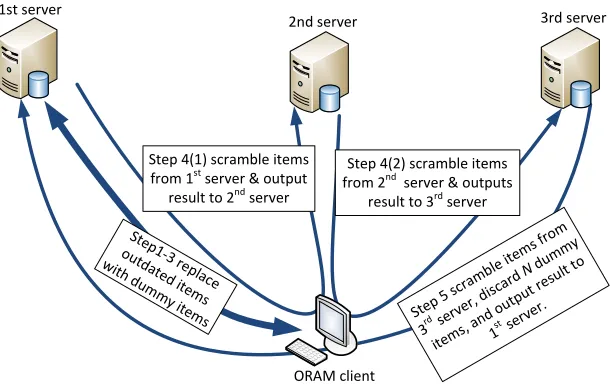
Figure 6. Oblivious merge in multi-server write-only oblivious RAM
servers to do an oblivious merge. Suppose the server running ORAM is indexed 1. The client chooses othert servers randomly. We index these servers from2 tot+ 1. As illustrated in Figure 6, the ORAM client does the oblivious merge based on oblivious remove and oblivious scramble by following steps. In these steps, items are encrypted with a semantically secure probabilistic encryption scheme.
• First, the client creates a bitmap ofN bits. The bitmap is initialized as all zeros. The bitmap is used to detect outdated data items. Let’s call this bitmap detective bitmap.
• Second, the client scans the write cache of the first server from tail to head, replaces outdated data items with dummy items. If data consumers use PIR, to keep every server’s database identical and allow concurrent PIR read, the client operates on a copy of the write cache in a temporary space of the server instead of the write cache. Because the cache is scanned from tail to head, more recently written data items in the write cache are scanned before less recently written data items. During the scan, if a data item indexediis found, the client checks the i-th bit of the detective bitmap. If the i-th bit is zero, which means the data item is the most updated version of thei-th data item, the client sets thei-th bit as 1. Then client re-encrypts the data item, and puts it back to its slot in the write cache. If thei-th bit of the detective bitmap is 1, which means a more updated i-th data item exists, the client puts a dummy item back to the data item’s slot in the write cache.
• Third, the client scans the main part of the first server, replaces outdated data items with dummy items. If data consumers use PIR, to allow concurrent PIR read, the client operates on a copy of the main part in the server instead of the main part. The client detects and replaces outdated data items by utilizing the detective map, which is very similar to that in the second step. During the scan, if a data item indexediis found, the client checks thei-th bit of the detective bitmap. If the i-th bit is zero, the client sets the i-th bit as 1. Then the client re-encrypts the data item, and puts it back to its slot in the main part. If the i-th bit of the detective bitmap is 1, the client puts a dummy item to the data item’s slot in the main part.
• Fourth, the client scrambles all itemst times utilizingt+ 1servers. The client downloads the items in the first server’s main part and write cache one by one in a random order. After the second and third steps, all data items in the downloaded items are the most updated. During the download, the client re-encrypts the downloaded items, uploads them to the second server, and removes uploaded items from local storage. Then onlyO(l)client-side storage is required in this step. The uploaded items are stored in a temporary space in the second server. After all items being uploaded to the second server, the first scramble is finished. Using the same way, the client scrambles the items uploaded to the second server, and uploads the result of the second scramble to the third server. Using the same way, the client scrambles the items t−2 times more, and eventually the result is stored in a temporary space in the (t+ 1)-th server.
• Fifth, the client scrambles all items in the(t+ 1)-th server, and outputs data items to the first server. The client downloads the items in the(t+ 1)-th server, which have been scrambledt times, in a random order. During the download, the client re-encrypts downloaded data items, uploads them to the first server, and removes uploaded items and dummy items from local storage. The uploaded items are put in the new main part of the first server. If data item count is less thanN, the client also uploads one or more new dummy items to fill the new main part during the upload of data items. The data item count can be measured during the second and third step, and stored with a counter of⌈logN⌉ bits. If data consumers use PIR, the change of the ORAM is also synchronized to other servers by the client.
data items are kept in their original positions before the oblivious merge. No information about the write pattern leaks in the first three steps because the ORAM client’s behaviors are independent of the write pattern. In the fourth and fifth step, items in the database are scrambled t+ 1 times. Aftert+ 1scrambles, updated data items and maybe some dummy items are outputted to the first server as the result of the oblivious merge, andN dummy items of the(t+ 1)-th scramble’s result are discarded. By observing the upload speed of outputting the oblivious merge’s result, the first server learns information about positions of updated data items and dummy items in the(t+ 1)-th scramble’s result. If the first server can correlate the items before and after the t+ 1 scrambles by colluding with some servers, it knows information about updated data items’ positions before oblivious merge and write pattern. However, if no more thantservers collude, no server can learn the information. The i-th server can correlate the items before and after the i-th scramble only. If any t of the k servers collude, they can correlate at most t scrambles’ input items and output items, but can’t correlate the items before and aftert+ 1scrambles. Therefore, if colluding server count is no more thant, the oblivious merge is secure.
The client-side and server-side storage usages are O(N +l) and O(N ×l) bits respectively.t andk are small integers, and viewed as constants in this paper. Then the communication cost of an oblivious merge isO(N×l). An oblivious merge is performed after every N oblivious writes. So the amortized communication cost of oblivious write is O(l).
Supporting PIR clients in multi-server write-only ORAM is the same as that in single-server write-only ORAM. To support PIR, the amortized communication cost is increased by O(√N ×
logN) using additionalN1/r×logN client-side storage usage. This is the same as the case in the basic write-only ORAM. So, to support PIR, the amortized communication cost of oblivious write is increased toO(l+√N×logN)and client-side storage is O(N+l+N1/r×logN) =O(N+
l). The same as the basic write-only ORAM, in multi-server write-only ORAM, the amortized communication and computational costs of PIR read are O(l+√N ×logN) and O(N ×l)
respectively.
VII. FULLFUNCTIONAL ORAMUSING WRITE-ONLYORAMAS ABUILDINGBLOCK
[4] and [5] proposed ORAMs containing multiple buckets. [4]’s bucket is a full functional ORAM storing at mostO(logN)data items, while [5]’s bucket is a full functional ORAM storingO(√N)
data items. We can view their designs as frameworks using other full functional ORAM schemes as building blocks. Most traditional full functional ORAM schemes and our write-only ORAM schemes (together with PIR) can be used to implement these buckets with slight modifications. Using our write-only ORAM and PIR as a build block in [4] and [5]’s ORAMs, the communication cost can be reduced, and the increased computational cost could be acceptable or even negligible for many reasonable values ofN and l.
[4] and [5]’s bucket ORAM is a bit different from normal full functional ORAM. [4] and [5] require a bucket ORAM to provide oblivious read-and-remove primitive and add primitive instead of read primitive and write primitive. The oblivious read-and-remove primitive can read and remove a real data item or a dummy data item from a bucket, while the oblivious add primitive can add a real data item or a dummy data item to a bucket. It is not required to hide an primitive’s type. Building [4]’s bucket ORAM and [5]’s bucket ORAM based on write-only ORAM and PIR are similar but not exactly the same. We make slight modifications to [4]’s ORAM framework and our write-only ORAM. Next, we describe how to build bucket ORAM based on write-only ORAM for [5] and [4] separately.
A. Using Write-only ORAM in [5]’s ORAM Framework
later. Locally, the client also maintains a data location table, which contains each data item’s exact location. A read/write operation of a data item indexediis simulated by the following steps. First, the client looks up the data location table locally to get the i-th data item’s location. Second, if the i-th data item is in a local queue, the client removes the data item from the queue. Third, the client performs an oblivious read-and-remove operation on a bucket. The client performs a read-and-remove operation on the i-th data item’s bucket to get the data item if it exists in the server. Otherwise, the client performs a read-and-remove operation on a random bucket to read a dummy item. Fourth, if the client has obtained the most updated data value of thei-th data item, the client chooses a random bucket for thei-th data item, and puts thei-th data item with its value in the bucket’s queue. If the simulated operation is a write operation, the data value is given by the operation. Otherwise, the data value is read from a local queue in the second step or a bucket in the third step. Fifth, the client updates the i-th data item’s location in the data location table unless the simulated operation is a read operation and the i-th data item is not found.
To prevent queues becoming full, the client carries out a background eviction process continu-ously. An eviction process may remove a data item from a bucket’s queue, and add the item to the bucket using the oblivious add primitive. An eviction process may add a dummy item obliviously to a bucket so as to hide that the bucket’s queue is empty. To hide access pattern, [5] designed several eviction algorithms to schedule eviction processes.
We choose to use our basic write-only ORAM to build the bucket ORAM in [5]’s ORAM framework. As the client has enough storage space to store a bucket’s items locally, the client can download all items in a bucket, and do the oblivious merge locally. There is no need to use the more complicated advanced write-only ORAM here. In the bucket ORAM based on basic write-only ORAM and PIR, the ORAM client is both a write-only ORAM client and a PIR client. Because the client already maintains each data item’s location locally in [5]’s design, there is no need to maintain write-only ORAM’s slot mapping table. To read-and-remove a data item from a bucket ORAM, the client first looks up the data item’s location inside the bucket locally, and then retrieves the data item from the bucket using PIR. For our write-only ORAM, there is no need to do an explicit remove because our ORAM can detect outdated data items by looking up the data location table. To read-and-remove a dummy item from a bucket ORAM, the client simply retrieves a random item (data item or dummy item) using PIR. To add a data item or dummy item to a bucket ORAM, the client simply does an oblivious write by putting the item in the bucket’s write cache. The amortized communication and computational costs of a read-and-remove operation on a bucket are both O(l), while the amortized communication and computational costs of an add operation on a bucket are O(l) and O(√N×l) respectively.
During an oblivious read/write, a read-and-remove operation and an add operation are performed. Using write-only ORAM and PIR to build the buckets in [5]’s ORAM framework, the amortized communication cost of an oblivious read/write is O(l), and the amortized computational cost is O(√N ×l). If using traditional full functional ORAM to build buckets, the best amortized communication and computational costs are bothO(logN ×l). We can see that using write-only ORAM makes a tradeoff of computational cost for communication cost. What values of N andl can make this tradeoff worthy needs further work to find out.
B. Using Write-only ORAM in [4]’s ORAM Framework