Software for Lossless Compression Using DCT
and Wavelet-Based Image Compression
Technique Using MATLAB
Er. Harinder Dingra1, Er. Rashmeet Kour2, Hilal Ahmad Dar3, Haroon Rashid3
Assistant Professor, Department of Electronics, Government College of Engineering and Technology, Jammu, India1
Lecturer, Department of Electronics, Government College of Engineering and Technology, Jammu, India2
U.G. Student, Department of Electronics, Government College of Engineering and Technology, Jammu, India3
ABSTRACT: With the improvement in image quality, size of the image file also increases. Due to speed limitation of the Internet, it takes more time to upload good-quality images that are of bigger sizes. The cameras nowadays come with more megapixels to capture better quality pictures. Mobile manufacturers need algorithms in their cameras that enable storing the images in reduced sizes without degrading their quality. As a result of storage limitations, image compression plays a significant role in the transmission and storage of image data. The main aim of image compression is to represent an image in the fewest number of bits without losing the essential information within the original image. Image compression removes the redundancy or unnecessary repetitive details in the file and stores or transmits data in an efficient form. There are algorithms for data compression, but they come along with a reduction, called losses, of vital information contained in the file. Lossless image compression keeps the same information as the original file. Our paper compares data compression by DCT and Wavelet-Based compression techniques using the MATLAB based software. It was found that DCT technique preserved the quality of the data file much more than Wavelet-based compression.
KEYWORDS: Image Compression, DCT, MATLAB, Redundancy, Image Quality, Data Transfer, Wavelet, Daubechies, Threshold, Joint Photographic Experts Group (JPEG), Discrete wavelet transform (DWT)
I. INTRODUCTION
Image compression is defined as reducing the amount of data required to represent a digital image [1]. However, an image contains a large amount of information, which increases the storage, processing and transmission difficulties. Thus, image compression becomes essential [2]. There are two ways of image compression viz, lossy and lossless compression. Whenever the exact reconstruction of an image is not required, lossy image compression algorithms can be used. These algorithms are usually based on transform methods. In recent years, a considerable effort has been made to design image compression methods aiming to obtain a good quality of decompressed images even at very low bit rates. Due to the great use of digital information, image compression becomes indispensable in the efficient image storage, transmission, and processing [3]. The goal of image coding is to reduce the bit rate for signal transmission or storage while maintaining acceptable image quality for different purposes.
II. RELATED WORK
JPEG was the first international image compression standard for a continuous-tone image. The JPEG baseline system is based on DCT [5]. The DWT has recently emerged as a powerful technique for image compression because of the multi-resolution property [6]. The advantage of using DWT over the DCT is that the DWT projects high detailed image components onto shorter basis functions with higher resolution [7]. While lower detail components are projected onto larger basis functions, which correspond to narrower sub-bands, establishing a trade-off between time and frequency resolution [8].
III.IMAGE COMPRESSION
Image compression reduces the amount of information required to represent a digital image. It is a process intended to yield a compact representation of an image, thereby reducing the image storage transmission requirements. Every image will have redundant data. Redundancy means the duplication of data in the image. The duplication may be repeating pixels across the image or pattern. The image compression occurs by taking benefit of redundant information in the image. Image compression is achieved when one or more of these redundancies are reduced or eliminated. In image compression, three basic data redundancies can be identified and exploited. Compression is achieved by the removal of one or more of the following three basic data redundancies.
A. Inter-PixelRedundancy:
In an image, neighbouring pixels are not statistically independent. It is due to the correlation between the neighbouring pixels of an image. This type of redundancy is called Inter-pixel redundancy or spatial redundancy. Inter-pixel redundancy can be eliminated by predicting a pixel value based on the values of its neighbouring pixels. The original 2-D array of pixels is generally mapped into a different format such as an array of differences between adjacent pixels. If the original pixels of the image can be reconstructed from the transformed data set, the mapping is said to be reversible.
B. Coding Redundancy:
It is done with the help of codewords of different lengths that match the information of the source, like an image or a processed version of its pixel values. This coding is reversible and mostly implemented using lookup tables (LUTs). Examples include that of Huffman codes and the arithmetic coding.
C. Psycho Visual Redundancy:
The human eye responds with different sensitivity to various incoming visual information, some pieces being more important than others. This redundancy is employed by most of the image compression algorithms, such as the Discrete Cosine Transform (DCT) based algorithm.
IV.PRINCIPLES OF COMPRESSION
The number of bits required to represent the information in an image can be reduced by removing the redundancy present in it. There are three types of redundancies:
(i) spatial redundancy, which is because of the correlation or dependence between neighbouring values of pixels; (ii) spectral redundancy, which is because of the correlation between different colour planes or spectral bands; (iii) Temporal redundancy, which is because of correlation between different frames in images.
The relative data redundancy (RD) of the original image can then be defined as: RD=1-1/CR
Three possibilities arise here:
(1) If n1=n2, then CR=1 and hence RD=0 which implies that original image does not contain any redundancy. (2) If n1>>n1, then CR→∞ and hence RD>1 which implies considerable amount of redundancy in the original image.
(3) If n1<<n2, then CR>0 and hence RD→-∞ which indicates that the compressed image contains more data than original image.
A. Discrete Cosine Transform: Discrete Cosine Transform separates images into different parts according to their frequencies [9]. The important frequencies are used to retrieve the image during decompression while the less important frequencies are discarded through quantization [10]. DCT has the following advantages over other input dependent transforms:
(1) It can be implemented using a single IC;
(2) It has the ability to pack most of the information in least coefficients;
(3) It minimizes blocking artefact that results when boundaries between sub-images become visible.
The forward 2D_DCT transformation is given by the following equation: C(u,v)=D(u)D(v) ∑ ∑ f(x,y) cos[(2x+1)uπ/2N]cos[(2y+1)vπ/2N] where u, v=0, 1, 2, 3……….… N-1
The inverse 2D-DCT transformation is given by the following equation: f(x,y)= ∑ ∑ D(u)D(v) D(u,v) cos[(2x+1)uπ/2N]cos(2y+1)vπ/2N] where D(u)=(1/N) ^1/2 for u=0
D(u) = (2/N) ^1/2 for u=1, 2, 3……., (N-1)
Proposed DCT Algorithm: The following is a general overview of the JPEG process:
The image is divided into 8×8-pixel blocks.
From left to right, top to bottom, the DCT is applied to each of the block. Through quantization, each block is compressed.
The array of compressed blocks is stored in a reduced amount of space.
Whenever needed, the image can be reconstructed through decompression, the inverse Discrete Cosine Transform (IDCT) algorithm.
B.Discrete Wavelet Transform: Another method of breaking down signals that has gained considerable popularity in recent years is the use of wavelets. Decomposing a signal in terms of its frequency content using sinusoids results in an excellent resolution in the frequency domain, down to the individual frequencies [11]. A sinusoidal wave can theoretically last forever. Therefore, individual frequency components do not give any temporal resolution. In other words, the time resolution of the Fourier series representation is not at par. In a wavelet representation, we have represented our signal in terms of functions that are localized both in time and frequency [12].
Recently, wavelets gained popularity in image processing, specifically in coding applications [13]. Firstly, wavelets are efficient in representing nonstationary signals because of the adaptive time-frequency window. Also, they have high energy compaction and decorrelation efficiency and, blocking artefacts, and mosquito noise are reduced. Finally, the wavelet basis functions match the human visual system characteristics which result in a better image representation., DWT uses a more optimal set of functions to represent sharp edges than DCT algorithms. Wavelets are finite as opposed to sinusoidal functions which are not finite. In DWT, the whole image undergoes wavelet transformation, then the actual encoding is applied on the complete wavelet coefficients, as shown in Figure 1. Although the blocking artefact problem is overcome by this method, it is not possible to encode the image during the transform stage.
original signal, which means local errors will not affect the entire transformation. The wavelet transform is best suited for non-stationary signals, such as brief signals and signals with required components at different scales.
V. EXPERIMENTAL RESULTS
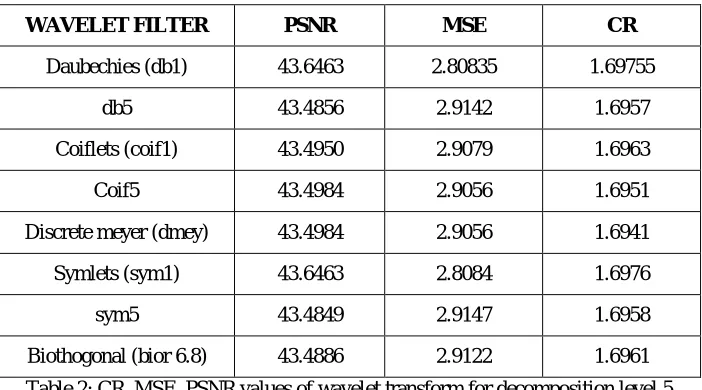
Table 1 and 2 show the values of PSNR, MSE and CR for different coefficients of wavelet filter at decomposition level 1 and 5 respectively. PSNR represents Peak-signal to Noise Ratio, MSE represents mean squared error while CR represents the compressed ratio of an image.
WAVELET FILTER PSNR MSE CR
Daubechies (db1) 43.7044 2.77105 1.69673
db5 43.4926 2.90948 1.69361
Coiflets (coif1) 43.4954 2.90761 1.69544
Coif5 43.4860 2.9139 1.6946
Discrete meyer (dmey) 43.4939 2.9086 1.6941
Symlets (sym1) 43.7044 2.7710 1.6967
sym5 43.4921 2.9098 1.6939
Biothogonal (bior 6.8) 43.4894 2.9116 1.6950
Table 1: CR, MSE, PSNR values of wavelet transform for decomposition level 1
WAVELET FILTER PSNR MSE CR
Daubechies (db1) 43.6463 2.80835 1.69755
db5 43.4856 2.9142 1.6957
Coiflets (coif1) 43.4950 2.9079 1.6963
Coif5 43.4984 2.9056 1.6951
Discrete meyer (dmey) 43.4984 2.9056 1.6941
Symlets (sym1) 43.6463 2.8084 1.6976
sym5 43.4849 2.9147 1.6958
Biothogonal (bior 6.8) 43.4886 2.9122 1.6961
Table 2: CR, MSE, PSNR values of wavelet transform for decomposition level 5
Fig. 1 shows lossless compression of an image of original size of 108.934 kb and its compressed version with 48.5166 kb size using DCT technique in MATLAB.
Fig. 1: Lossless Image Compression in MATLAB in DCT Mode.
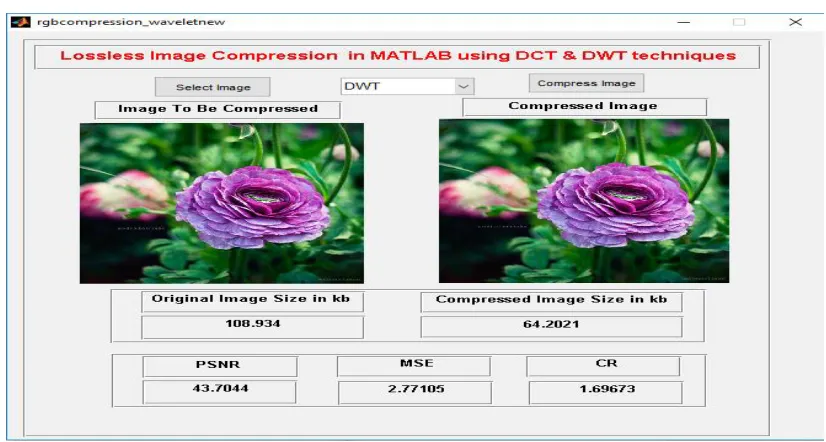
Fig. 2 shows lossless compression of an image of original size of 108.934 kb and its compressed version with 64.2021 kb size using DWT technique in MATLAB.
Fig. 2: Lossless Image Compression in MATLAB in DWT Mode
IV.CONCLUSION
reconstruct the original image whenever needed, a feature that is not available in DWT technique. The algorithm developed by the authors for image compression is less complicated than the available conventional algorithms. Moreover, to compress an image by different methods a user has to create two different programmes separately but, our algorithm clubs both DCT and DWT techniques into a single program which is both economical and time-saving.
REFERENCES
[1] Sayood, K., “Introduction to Data Compression”, Morgan Kaufmann Publishers, 2nd Edition, 2000.
[2] Mallat, S., Falzon, F., “Understanding Image Transform Codes”, Roc. of the SPIE Aerospace Conference Orlando, April 1997.
[3] Mukherjee, A., Ranganathan, N., Bassiouni, M., "Efficient VLSI designs for data transformation of tree-based codes", Circuits and Systems IEEE Transactions on, vol. 38, pp. 306-314, 1991, ISSN 0098-4094.
[4] Watson, A. B., “Image Compression Using the Discrete Cosine Transform”, Mathematica Journal, Vol. 4, No. 1, pp. 81, 1994.
[5] Ding, J.J, Lin, P.Y, Pei, S.C, Wang, Y.H, "The Two-Dimensional Orthogonal DCT Expansion in Triangular and Trapezoid Regions and Modified JPEG Image Compression ", VCIP
[6] Benaissa, M., Bassou, A. Beladgham, M., Lakhdar, A., "Performance Study of the Association TCM-UGM/STBC to Reduce Transmission Errors of JPEG Images," International Journal of Communications, Network and System Sciences, Vol. 4 No. 6, pp. 388-394, 2011.
[7] Wang, C., Zhang, W. J., “Adaptive Reduction of Blocking Artifacts in DCT Domain for Highly Compressed Images”, IEEE Transactions on Consumer Electronics, 2004, Vol. 50, No. 2, pp. 647-654.
[8] Singh, S., Kumar, V., Verma, H. K., “Reduction of Blocking Artifacts in JPEG Compressed Images”, Elsevier, Volume 17, Issue 1, pp. 225-243, [9] Rao, K. R., Yip, P., “Discrete Cosine Transform: Algorithms, Advantages and Applications”, San Diego, CA: Academic, 1990.
[10] Britanak, V., Yip, P., Rao, K. R., “Discrete Cosine and Sine Transforms”, New York: Academic, 2007.January 2007.
[11] Bo, L., Zhaorong, Y., “Image Compression Based on Wavelet Transform” IEEE publication on 2012 International Conference on Measurement, Information and Control (MIC)
[12] Yan, H., Yang, W., "A Watermarking Algorithm Based on Wavelet and Hadamard Transform for Color Image", Journal of Software Engineering and Applications, Vol. 6, No. 3B, pp. 58-61, 2013