An Experimental Investigation on
Compressed Stabilized Interlocking
Earth Block
Lohith M S1,Chinmayi A R1 ,Vainika M U1, Damodar N1,Chetan K M2
U G. Student, Department of Civil Engineering, Rajeev Institute of Technology, Hassan, Karnataka, India1
Assistant Professor, Department of Civil Engineering, Rajeev Institute of Technology, Hassan,
Karnataka, India2
ABSTRACT: Conventional bricks are the most elementary building materials for houses construction. However, the rapid growth in today’s construction industry has obliged the civil engineers in searching for a new building technique that may result in even greater economy, more efficient and durable as an alternative for conventional brick. These changes have led to improved constructability, performance, and cost as well. Several interlocking bricks has been developed and implemented in building constructions and a number of researches had studied the manufacturing of interlocking brick and its structural behaviour as load bearing and non load bearing element. This project aims to review the development of interlocking bricks and its structural behaviour. This paper also gives the results of an experimental investigation in which the compressive strength, water absorption, acid resistance test, carbonation. In this work we got the max compressive for 10%cement with 10%GGBS CSEB and also the acid resistance capacity is good and depth of carbonation is less for 10%ceement and 10% GGBS CSEB.
KEYWORDS: CSEB, compressive strength, water absorption, acid resistivity, depth of carbonation.
I. INTRODUCTION
Housing is one of the basic human needs and is usually ranked third after food and clothing. In most developing countries housing is inadequate and the housing backlog has been increasing rapidly. One key reason for housing inadequacy is the increase in population due to the high pace of urbanisation and socio-economic factors that include the rise in prices of land and building materials, Those classified as poor are the majority and they cannot afford proper housing. The outcome of this can be seen by the poor quality of the houses of this majority in both urban and rural environments.
is very cost effective, energy efficient (excellent thermal properties and low energy input required for production), environmentally friendly, and safe, these are the qualities which are particularly relevant and important with the ever growing need for increased awareness to reduce energy consumption world-wide. Production techniques had been developed so as to achieve better quality block and reduce production costs.
PROPERTIES OF EARTH COMPRESSED STABILIZED MUD BLOCKS:
Causes no direct environmental pollution during the whole life cycle.
No binding material is required.
Less water absorption.
High durability.
Good aesthetic view.
Eco friendly.
Economy.
II. MATERIALS AND METHODOLOGY
MATERIALS USED
Red soil, clay, cement, water, GGBS, lime if needed.
CEMENT
Cement is a vital component for soil-stabilized bricks, enhancing both strength and durability. Cement, an expensive element, can be kept down to the range of 3 to 10 % of the mix without compromising performance. Ordinary Portland cement of 53 grade is used in our work.
RED SOIL
Red soil is a type of soil that develops in a warm temperature, moist climate under mixed forest. It contains huge amount of iron oxides and hence the colour of the soil is red.
CLAY
Locally available natural clay is used in our work. 40% clay is used to manufacture the stabilized interlocking .blocks.
GGBS
GGBS is the byproduct obtained from steel industry. In our work we have used this GGBS as a partial replacement for OPC. This GGBS is white finely powdered material and it is finer than cement.
Water
LABORATORY TEST RESULTS
Cement
Table 1: Physical properties of Cement
SL NO CHARACTERISTICS RESULTS SPECIFICATIONS
1 Specific gravity 3.12 IS:2720[part 3]
2 Standard consistency 29% IS:4031[26-33%]
3 Fineness 4.5% Not more than 10%
4 Initial setting time 35min IS:4031[>30min]
Red Soil
Table 2: Physical properties of Red soil
SL NO PROPERTIES TEST RESULT
1 Specific gravity 2.60
3 Fineness modulus 3.02
GGBS
Table 3: Physical properties of GGBS
SL NO PROPERTIES TEST RESULT
1 Specific gravity 2.82
2 % particles retained on 90µ sieve -
IV. TESTS ON CSEB
The various tests are conducted to know the performance of CSEB by partial replacement of cement by GGBS 1. Compressive strength test
2. Water absorption test
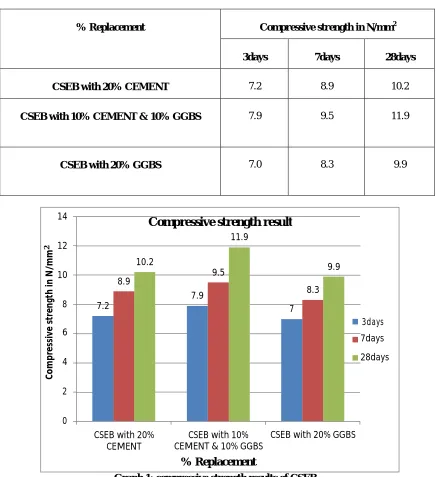
COMPRESSION STRENGTH TEST RESULTS:
Table 4: Compressive strength test result of CSEB
% Replacement Compressive strength in N/mm2
3days 7days 28days
CSEB with 20% CEMENT 7.2 8.9 10.2
CSEB with 10% CEMENT & 10% GGBS 7.9 9.5 11.9
CSEB with 20% GGBS 7.0 8.3 9.9
Graph 1: compressive strength results of CSEB
14
Compressive strength result
11.9 12 9.9 10 8.9 8.3
8 7.2 7
3days 6
7days
4 28days
2
0
CSEB with 20% CEMENT
CSEB with 10% CEMENT & 10% GGBS
% Replacement
WATER ABSORPTION TEST RESULTS
Table 5: Water absorption test result of CSEB
%Replacement
Initial dry weight
W1 in kg
Wet weight W2 in
kg
%water
absorption
CSEB with 20% CEMENT
12.780 12.910 1.01
CSEB with 10% CEMENT & 10%
GGBS
12.800 12.900 0.78
CSEB with 20% GGBS
12.810 12.930 0.94
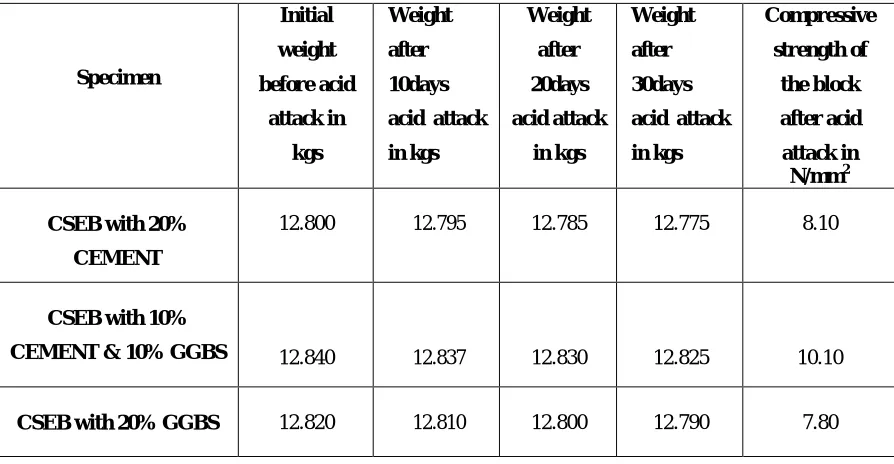
ACID RESISTANCE TEST RESULTS
Table 6: Acid resistance test result of CSEB
Specimen Initial weight before acid attack in kgs Weight after 10days
acid attack
in kgs Weight after 20days acid attack in kgs Weight after 30days
acid attack
in kgs Compressive strength of the block after acid attack in N/mm2
CSEB with 20%
CEMENT
12.800 12.795 12.785 12.775 8.10
CSEB with 10%
CEMENT & 10% GGBS 12.840 12.837 12.830 12.825 10.10
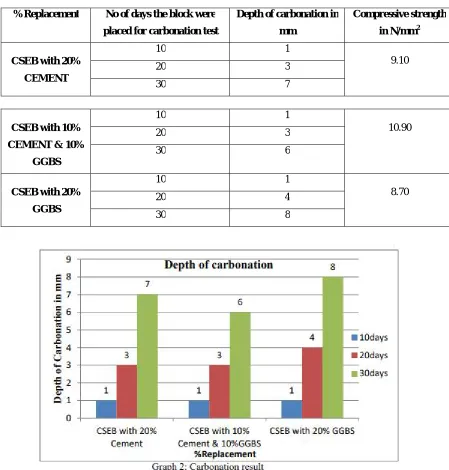
DEPTH OF CARBONATION TEST RESULTS:
Table 7: Carbonation test result of CSEB
%Replacement No of days the block were
placed for carbonation test
Depth of carbonation in
mm
Compressive strength
in N/mm2
CSEB with 20%
CEMENT
10 1
9.10
20 3
30 7
CSEB with 10%
CEMENT & 10%
GGBS
10 1
10.90
20 3
30 6
CSEB with 20%
GGBS
10 1
8.70
20 4
V. CONCLUSION
Following broad conclusions can be made from the experimental study on CSEB
1. Compressive strength of the compressed stabilized interlocking earth blocks are more compared to 1st class
table mould burnt bricks.
2. Among the three replacements, i.e., CSEB with 20% cement, CSEB with 10%cement & 10% GGBS and
CSEB with 20% GGBS, the second replacement, i.e., CSEB with 10% cement & 10% GGBS give more
compressive strength.
3. In the present study, it can be observed that acid resistance strength is less for 1st class table mould burnt
bricks compared to CSEB.
4. Depth of carbonation is also more for 1st class table mould burnt bricks compared to CSEB.
5. CSEB absorbs less water due to the absence of pores and voids. Hence the percentage of water absorption
is less in CSEB compared to 1st class table mould burnt bricks.
REFERENCES
1) Abhinandan.R.Gupta and Deshmukh S.K, “Interlocking brick design- Paradigm for sustainable construction, IJRASET, Volume 03, Issue 01, 2015, pages 257-264.
2) Bansal Deepak, “Sustainable dry interlocking block masonry construction”, 15th International Brick and Block Masonry Conference, Brazil, 2012.