ISSN(Online): 2319-8753 ISSN (Print): 2347-6710
International Journal of Innovative Research in Science,
Engineering and Technology
(A High Impact Factor, Monthly, Peer Reviewed Journal) Visit: www.ijirset.com
Vol. 7, Issue 6, June 2018
A Secure Scheme against Replication Attack
for Heterogeneous Sensor Networks
Amruta Gaikwad, Prof. Rachana Satao
Dept. of Computer Engineering, Savitribai Phule Pune University, SKNCOE, Pune, India
ABSTRACT: Heterogeneous sensor networks (HSNs) comprise of few effective Top of the line sensors (H-sensors) and a significant number of Low-end sensors (L-sensors). HSNs are susceptible against H-sensors replication assault. In this paper, a plan against the assault is proposed. The system investigation and reenactment outcomes demonstrate that the plan can enhance systems' strength against H-sensors replication assault as contrasted and existing related plans. The contribution work is, select distributed network use Pareto Optimal solution for multi-objective optimization problem. Restricted nearby data using a client can choose another system device with high channel capacity and low blocking probability by using the proposed scheme.The trial comes about demonstrate that the proposed plot promotes the total throughput what's more, lessen the likelihood of pairwise key foundation between replication H-sensors and ordinary L-sensors.
Catchphrases Heterogeneous Sensor systems, H-sensors replication assaults, ace slaver display, EQ technique, multi-objective optimization
I. INTRODUCTION
Heterogeneous sensor systems (HSNs), which include few H-sensors (e.g., PDAs) and a considerable number of L-sensors (e.g., the MICA2-Spot), have pulled in much consideration because of their better execution and adaptability contrasted andhomogeneous sensor systems. In HSNs, H-sensors are accountable for sending information to the Base station (BS). In this way, they are helpless against experience the ill effects of various sorts of assaults; a standout amongst the most well-known assaults is replication assault. This assault once being started effectively, HSNs will be liable to the accompanying dangers: 1. L-sensors will pick these replication hubs as group heads and present their information to them; 2. These replication hubs can speak with ordinary H-sensors in the systems, and can fashion a lot of false information. This false information is sent to the BS, which not just squanders power and data transfer capacity of H-sensors, yet additionally gives the BS a chance to make wrong judgments.
To enhance the mystery of HSNs, over the latest couple of years, distinctive pairwise key dispersion plans utilizing symmetric key calculations have been produced. In the AP-D conspire uses topsy-turvy pre-appropriation key (AP) methodology, before arrangement, a L-sensor and a H-sensor arbitrarily select keys from an expansive key pool without substitution, individually. After organization, two hubs can set up a pairwise key if the quantity of regular keys between them is more prominent than or equivalent to 1. In AP-L, the key pool of L-sensors is a subset of H-sensors. The CSS-SH plot improves the strength by misusing two dimensional in reverse key chains building disjoint and affiliation key pools. Everything considered, in the plans, sensors and L-sensors share a similar key pool; and sensors are expected to take an interest in the foundation of shared keys between them. Subsequently, replication H-sensors can without much of a stretch build up pairwise keys with ordinary hubs by utilizing bargained keys. Along these lines, in HSNs, new plans against H-sensor replication assault must be produced.
ISSN(Online): 2319-8753 ISSN (Print): 2347-6710
International Journal of Innovative Research in Science,
Engineering and Technology
(A High Impact Factor, Monthly, Peer Reviewed Journal) Visit: www.ijirset.com
Vol. 7, Issue 6, June 2018
of the changed augmentation issue in polynomial time and direct space. The arrangement of the changed expansion issue is a Pareto Ideal aftereffect of the first multi-target enhancement issue.
Motivation:
The SS-H plan's strength against H-sensors replication assault can be assessed from the accompanying two perspectives:
1.The likelihood that replication H-sensors can set up imparted keys to ordinary H-sensors. 2.The likelihood that duplicated H-sensors can set up imparted keys to a L-sensor.
Objectives:
1.To reduce the computational overhead and network traffic. 2.To enhance strength of H-sensor replication assault.
3.Network determination ought to be to choose an elite system gadget and abstain from being blocked.To select the network, maximizes the channel capacity and minimizes the blocking probability.
1. Confidential multiuser communication with multi hops wireless communication.
II. EXISTING SYSTEM
In heterogeneous sensor networks, H-sensors are accountable for sending information to the Base station (BS). Hence, they are helpless against experience the ill effects of different assaults; a standout amongst the most widely recognized assaults is replication assault. This assault once being propelled effectively, HSNs will be liable to the accompanying dangers: 1. L-sensors will pick these replication hubs as group heads and present their information to them; 2. These replication hubs can speak with ordinary H-sensors in the systems, and can manufacture a lot of false information. This false information is sent to the BS, which not just squanders power and transmission capacity of H-sensors, yet additionally gives the BS a chance to make wrong judgments. Consequently by concentrate the current two plans in detail we arrived at the finish of investigation that the accompanying elements are stayed unnoticed by numerous specialists.
HSNs are helpless against H-sensors replication assault.
In AP-D, AP-L and CSS-SH, H-sensors and L-sensors share a similar key pool. Further, a foe can undoubtedly effectively dispatch replication H-sensors assault by catching L-sensors.Doesn't guarantee that high energy/resources nodes always be chosen as cluster-head
Doesn't control the number and even situation of group heads Sensor hubs are vitality basic.
III. REVIEW OF LITERATURE
A. Secret Scheme
ISSN(Online): 2319-8753 ISSN (Print): 2347-6710
International Journal of Innovative Research in Science,
Engineering and Technology
(A High Impact Factor, Monthly, Peer Reviewed Journal) Visit: www.ijirset.com
Vol. 7, Issue 6, June 2018
heterogeneous sensor hubs. There are three stages in the system to set up match astute keys between the sensor hubs: (an) instatement, (b) coordinate key setup, and (c) (discretionary) way key setup. Diagnostic models are created to assess the execution of the plan regarding availability, dependability and versatility. Favorable circumstances are: A remote sensor system can accomplish higher key network and higher versatility. Increment the dependability of system. In static HSNs [4], a constant secure plan is proposed in view of two-dimensional in reverse key chains. In the plan, capable sensors don't should be outfitted with alter safe equipment. CSS-SH has three stages: key pre-dissemination, shared key foundation, and way key foundation. In CSS-SH, after the common key foundation stage, keys from the key pool spared in a hub are hashed. Favorable circumstances are: To apply two dimensional in reverse key chains strategy to HSNs, n disjoint and interrelated key pools are developed. Increment the execution in nonstop security, developing disjoint and interrelated key pools is a straightforward and reasonable strategy. In [5] paper, going for constant secure in MDSNs, we propose a persistent secure plan in view of two-dimensional in reverse hash key chain strategy. The security and execution examination demonstrates that the proposed conspire accomplishes high nearby availability with a low stockpiling overhead, and has higher system strength against hub trade off as contrasted and the plans in for MDSNs. Focal points are: High nearby availability, low stockpiling overhead and high system strength.
Handover Scheme:
In the paper [6], think about the handover estimation of a nonexclusive portable cell coordinate with a self-assertive number of base stations. Plan a bound together structure for the system investigation and enhancement. The piece concentrates on the stochastic displaying and addresses its key probabilistic occasions, in particular: 1) appropriate handover target discovered; 2) benefit disappointment; 3) handover estimation activating; and 4) handover estimation withdrawal. Focal points are: to diminish terminal's battery utilization. In [7] paper, proposes a system choice technique for vertical handoff. The Software-Defined Network (SDN) controller chooses systems for mobiles in three stages: introduction, ask for grid development and system choice. The proposed plot guarantees that, a portable will exchange to the most proper system and no more suitable time. Favorable circumstances are: decreases the quantity of vertical handoffs, and boosts the general QoS altogether. A suitable programmed organize choice (ANS) component [8], ready to constantly choose the best access arrange, is required. This comprises on always observing any sort of accessible access systems, naturally choosing and changing to the best one, as the system that expands the clients' nature of experience considering their inclinations and also the terminal and system conditions. ANS is a multi-measurement basic leadership issue which can be fathomed by finding a suitable complex exchange off between perhaps clashing criteria. In this paper, proposes an investigative model to catch the inclinations of end-clients. Focal points are: Automatic chooses the best remote access organize. In [9] paper, outline another, proficient, and multi-target answer for handover from the source eNB to target eNB/HeNB in rising LTE frameworks. A HeNB (femtocell) is thought to be on the limit between the source eNBs (macrocell) under thought and its neighboring eNBs/HeNBs. Approaching and active handovers can utilize the data transfer capacity of the HeNB, as long as the handover area is secured by the HeNB, and an accessible FDCH can be found in this HeNB. Points of interest are: Reduces the blocking probabilities of both new and handover sessions. It gives shorter postponements and bettergoodputs. Disadvantage is due to unnecessary handovers decrease the performance. In [10] paper has displayed another structure for downlink cell organize investigation. It is altogether more tractable than the conventional matrix based models, and seems to track (and lower bound) a genuine organization about as precisely as the customary network display (which upper limits). Advantages are: It provides straightforward and tractable expectations of the SINR conveyance in a cell arrange and exact. The scope and rate are effectively adjusted to incorporate recurrence reuse. Base station participation influences scope and rate.
ISSN(Online): 2319-8753 ISSN (Print): 2347-6710
International Journal of Innovative Research in Science,
Engineering and Technology
(A High Impact Factor, Monthly, Peer Reviewed Journal) Visit: www.ijirset.com
Vol. 7, Issue 6, June 2018
Signal Generator, Digital to Analog Converters (DAC) and Reconstruction Filters, Modulator, Preamplifier and Power Amplifier, and also RF Front-end parts. The WCDMA flag is made in three primary advances: spreading, scrambling and beat forming. Focal points are: To upgrade the general framework execution, framework displaying is the basic apparatus to designate framework spending plans with exact examination, and in this manner, limit outline cycles and decrease an opportunity to advertise. The significant oddity of IEEE 802.11g [13] is support of four diverse physical layers that join the arrangement of IEEE 802.11a information rates together with in reverse similarity to the old IEEE 802.11 and IEEE 802.11b details. The new highlights of the IEEE 802.11g standard are: The arrangement of four distinctive physical layers. The required help of the short introduction write. The ERP arrange characteristic. Recently characterized security systems that arrangement with interoperability perspectives.The CTS-to-self instrument. Points of interest are: the IEEE 802.11g standard will turn into the most generally acknowledged one in high-information rate WLAN. The CTS-to-self instrument is more productive in clear channel conditions. Be that as it may, less hearty than the RTS/CTS component against concealed terminals. In [14] paper, focus on the client organize determination choice for non-constant information applications, which represents an extensive number of the new information administrations being produced. The client driven technique proposed in this paper depends on an expanding the client's anticipated purchaser surplus while limiting the information delays. [15] Paper proposes a novel fluffy rationale (FL)- based basic leadership calculation for VHO, which is equipped for consolidating the benefits of the two plans to accomplish astounding handover as far as bundle exchange delay for every one of the cases considered here. The quality of FL in taking care of dubious and clashing choice measurements is abused. Focal points are diminish in parcel exchange delay, and henceforth, a superior QoS can be gotten by performing appropriate VHO between the two media.In [16] paper, Wireless Multimedia Sensor Network supporting wide variety of the applications in the modern era motivates researchers to investigate various routing techniques. This paper investigates the state of art of research on routing techniques in WMSN and effect of mobility on these routing issues. Routing is a key factor which allows us to improve system performance in terms of various parameters like packet loss, delay and energy saving. We pointed out how recent work is implemented and incorporating dynamic plans and mobility factor in current work can enhance the capability of the WMSN [17]. Advantages are: The bandwidth utilization should be efficiently managed by multipath routing or by multichannel communication. The system is reliable means the ability to deliver data to the destination with minimum packet loss. The network can reduce the network failure and coverage problem effectively.
IV. PROPOSED SYSTEM
In this paper, a safe plan against H-sensors replication assault, specifically SS-H, is proposed. Primary commitments of our plan are abridged as takes after: 1. Another protected correspondence show, specifically ace slaver display, is made, and is acknowledged utilizing new two-measurement in reverse key chains; 2. Another technique, to be specific EQ, for setting up pairwise key between a L-sensor and a H-sensor is exhibited.
In HSNs, H-sensors fill in as group heads and shape bunches around them [3]. The development of groups is as per the following: Each L-sensor chooses a H-sensor whose Hello message has the best flag quality as its bunch head, and records other H-sensors from which it has gotten Hello messages, will fill in as reinforcement group heads for the situation that the group head comes up short.
In SS-H, we make utilization of the accompanying suppositions:
1.Only a set number of L-sensors might be bargained by an aggressor amid the brief timeframe time of the key foundation between L-sensors.
2.BS and H-sensors won't be bargained by an aggressor.
The Fig.1 demonstrates the framework design of heterogeneous remote system which comprises of Base Stations, bunches, group heads as H-sensors and L-sensors how to convey each other.
Ace Slaver display:
ISSN(Online): 2319-8753 ISSN (Print): 2347-6710
International Journal of Innovative Research in Science,
Engineering and Technology
(A High Impact Factor, Monthly, Peer Reviewed Journal) Visit: www.ijirset.com
Vol. 7, Issue 6, June 2018
Key pool: The key pool, comprises of two-dimensional in reverse hash key chains, is separated into two sections. One is key pool of H-sensors, and the other is key pool of L-sensors which comprises of two sections: a moment dimensional age key pool and an ordinary key pool.
Fig.1 Proposed System Architecture
Our contribution of this paper is, to create Distributed Network Selection Scheme (DNSS) for heterogeneous wireless network. In DNSS, clients are isolated into two classes: non-handoff and handoff clients. In our plan, a handoff client can't discover a network gadget which precisely gives maximal channel capacity and minimal blocking probability simultaneously either. By solving the maximization problem, a handoff client can choose another network device. We will prove that this selected new network gadget is a Pareto Optimal arrangement of the first multi-target enhancement issue.
Advantages of Proposed System:
1. Only a predetermined number of L-sensors might be bargained by an assailant amid the brief timeframe time of the key foundation between L-sensors.
2. BS and H-sensors won't be bargained by an assailant.
3. EQ technique is utilized to enhance strength of H-sensor replication assault.A user can select a new network device with high channel capacity and low blocking probability.
4. Computation and memory complexity is small.
V. MATHEMATICAL MODEL
A. Two-dimensional backward key chain:
The strategy for developing a two-dimensional in reverse key chain is as follows: 1. A retrogressive key chain, whose length is n, is created by an age key as follows:
= ℎ , = , 1≤ ≤ −1 (1)
2. A forward key chain, whose length is L, is created by an age key as follows:
( , )
ISSN(Online): 2319-8753 ISSN (Print): 2347-6710
International Journal of Innovative Research in Science,
Engineering and Technology
(A High Impact Factor, Monthly, Peer Reviewed Journal) Visit: www.ijirset.com
Vol. 7, Issue 6, June 2018
B. Dijkstra's algorithm: FunctionDijkstra(Graph, source): Make vertex set Q
For every vertex v in Graph //Initialization dist[v] ← INFINITY //Unknown separation from source to v
prev[v] ← UNDEFINED //Previous node in ideal way from source add v to Q //All nodes at first in Q (unvisited hubs)
dist[source] ← 0 //Distance from source to source
WhileQisn't unfilled:
u← vertex in Q with min dist[u] // Select source node to begin with
expel u from Q
for each neighbor v of u:/where v is still in Q.
alt ← dist[u] + length(u, v)
in the event that alt <dist[v] //A shorter way to v found dist[v] ← alt
prev[v] ← u
Return dist[], prev[]
C. Distributed Network Selection Plan for Handoff User Algorithm:
Input: accessible network device set at time t ( ), number of channels , bandwidth per channel , number of handoff and non-handoff clientsΓ ( ) and Γ ⊝ ( ),gotten flag control ( ),commotion interference controln ( ) and essential transmission capacity necessityγ .
Output: network selection outcome ( ).
Process:
Step 1: max=0, index=0; Step 2: for∀a A ( )do
Step 3: Calculate the channel capacity q ( ).
Step 4: Estimate the blocking probability p ( ) Step 5:ifq ( )≥ γ then
Step 6: Calculate the throughput ( )
Step 7: if ( )≥ then
Step 8: ( )→ then
Step 9: the file of the chose network device index = i; Step 10: fori=1;i≤|A ( )|; i++ do
Step 11:ifi==index then
Step 12: the chose network device isa , ( ) = 1;
Step 13: else
Step 14: ( ) = 0;
ISSN(Online): 2319-8753 ISSN (Print): 2347-6710
International Journal of Innovative Research in Science,
Engineering and Technology
(A High Impact Factor, Monthly, Peer Reviewed Journal) Visit: www.ijirset.com
Vol. 7, Issue 6, June 2018
VI. EXPERIMENT RESULT
Experimental evaluation is done to compare the proposed system with the existing system for evaluating the performance. The simulation platform utilized is fabricated utilizing Java system (adaptation jdk 7) on Windows stage. The framework does not require a particular equipment to run; any standard machine is fit for running the application. The below table contains the laboring parameters.
TABLE I SIMULATION PARAMETERS Parameter value
Network size 7000m*500m Number of sensor nodes 50,70,100 Propagation type Round Trip Routing type DSR Packet size 32 Bit Channel Wireless
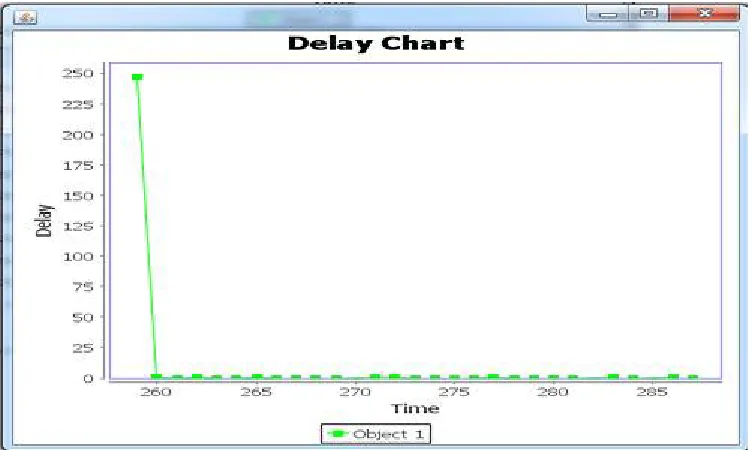
The evaluation results are carried out considering 50, 70, 90 and 100 nodes respectively. We have considered several sources and single sink nodes assuming low end sensors and high end sensors respectively. The parameters considered for evaluation are delay, overhead, throughput, bundle conveyance proportion and parcel misfortune proportion
ISSN(Online): 2319-8753 ISSN (Print): 2347-6710
International Journal of Innovative Research in Science,
Engineering and Technology
(A High Impact Factor, Monthly, Peer Reviewed Journal) Visit: www.ijirset.com
Vol. 7, Issue 6, June 2018
Fig.3. Similar diagram of throughput for heterogeneous sensor network
ISSN(Online): 2319-8753 ISSN (Print): 2347-6710
International Journal of Innovative Research in Science,
Engineering and Technology
(A High Impact Factor, Monthly, Peer Reviewed Journal) Visit: www.ijirset.com
Vol. 7, Issue 6, June 2018
Fig.5. Comparative graph of packet loss ratio (PLR) for heterogeneous sensor network
By observing the above graph we can conclude that the proposed system gives better results as compared to the existing system in terms of various parameters calculated. The delay has reduced to considerable amount in spite of considering the multiple sources and single sink scenario. The system gives better throughput and packet delivery ratio for multiple sources. The packet delay ratio and packet loss ratio can be decreased to an considerable amount in case of multiple sources. The PDR and throughput results are not upto the expectations but they can be further improved. But the overall results are impeccable.
V. CONCLUSION AND FUTURE WORK
In this paper, ace slaver demonstrate is connected in conveyed arrange, is made, and is recognized utilizing another two-measurement in reverse key chain. Also, EQ procedure is presented. Examination and reenactment exhibit that the ace slaver model can keep replication H-sensors from speaking with typical H-sensors regardless of what number of L-sensors are traded off and the EQ methodology can on a very basic level decline the likelihood of pairwise key foundation between replication H-sensors and standard L-sensors.In view of constrained nearby data, a handoff client can choose another network device with high channel capacity and low blocking probability by using the proposed scheme. Moreover, the computation and memory complexities of the proposed scheme are relatively small. The future work comprised of implementing the system with heterogeneous wireless network with high-end and low-end sensors energy. The system can also be implemented in secure data transformation.
REFERENCES
[1] K. Xu, X. Hong, M. Gerla, “An ad hoc network with mobile backbones,” in: ICC 2002, New York, NY, April 2002.
[2] X. Du, Y. Xiao, M. Guizani, et al., “An effective key management scheme for heterogeneous sensor networks,” ad hoc networks, vol. 5, no. 1,
pp. 24-34, 2007.
[3] K. Lu, Y. Qian, M. Guizani, et al, ”A Framework for a Distributed Key Management Scheme in Heterogeneous Wireless Sensor Networks,”
ISSN(Online): 2319-8753 ISSN (Print): 2347-6710
International Journal of Innovative Research in Science,
Engineering and Technology
(A High Impact Factor, Monthly, Peer Reviewed Journal) Visit: www.ijirset.com
Vol. 7, Issue 6, June 2018
[4] B. Zhou, J. Wang, S. Li, et al., "A Continuous Secure Scheme in Static Heterogeneous Sensor Networks", IEEE Communicatons Letters, vol.
17, no. 9, pp. 1868-1871, 2013.
[5] S. Li, B. Zhou, J. Dai, et al. “A secure scheme of continuity based on two-dimensional backward hash key chains for sensor networks,” IEEE
Wireless Communications Letters, vol. 1, no. 5, pp. 416-419, 2012.
[6] V. M. Nguyen, C. S. Chen, and L. Thomas. A unified stochastic model of handover measurement in mobile networks. Networking, IEEE/ACM
Transactions on, 22(5):1559–1576, 2014.
[7] A software-defined network based vertical handoff scheme for heterogeneous wireless networks. In Global Communications Conference
(GLOBECOM), 2014 IEEE, pages 4671– 4676. IEEE, 2014.
[8] Q. T. Nguyen-Vuong and et al. Multi-criteria optimization of access selection to improve the quality of experience in heterogeneous wireless
access networks. IEEE transactions on vehicular technology, 62(EPFLARTICLE-182868):1785–1800, 2013.
[9] Abhishek Roy, Jitae Shin, and NavratiSaxena. Multi-objective handover in lte macro/femto-cell networks. Communications and Networks,
Journal of, 14(5):578–587, 2012.
[10] J. G. Andrews, F. Baccelli, and R. K. Ganti. A tractable approach to coverage and rate in cellular networks. Communications, IEEE
Transactions on, 59(11):3122–3134, 2011.
[11] C. Liu and et al. A two-step vertical handoff decision algorithm based on dynamic weight compensation. In Communications Workshops (ICC),
2013 IEEE International Conference on, pages 1031–1035. IEEE, 2013.
[12] C. W. Liu. Modeling 3g/wcdma/hsdpa handset transmit system. Microwave Product Digest, 2007.
[13] D. Vassis and et al. The ieee 802.11 g standard for high data rate wlans. Network, IEEE, 19(3):21–26, 2005.
[14] O. Ormond, P. Perry, and J. Murphy. Network selection decision in wireless heterogeneous networks. In Personal, Indoor and Mobile Radio
Communications, 2005. PIMRC 2005. IEEE 16th International Symposium on, volume 4, pages 2680–2684. IEEE, 2005.
[15] J. Hou and D. O’brien. Vertical handover-decision-making algorithm using fuzzy logic for the integrated radio-and-ow system. Wireless
Communications, IEEE Transactions on, 5(1):176–185, 2006.
[16] Borawake-Satao R, Prasad R. Comprehensive survey on effect of mobility over routing issues in wireless multimedia sensor networks.
International Journal of Pervasive Computing and Communications. 2016 Nov 7;12(4):447-65.
[17] Borawake-Satao R, Prasad R. Mobility Aware Path Discovery for Efficient Routing in Wireless Multimedia Sensor Network. InProceedings of