Defensive
Operations
Little minds try to defend everything at once, but sensible people look at the main point only; they parry the worst blows and stand a little hurt if thereby they avoid a greater one. If you try to hold everything, you hold nothing.
8-1. Army forces defend until they gain sufficient strength to attack. Defen-sive operations defeat an enemy attack, buy time, economize forces, or de-velop conditions favor-able for offensive op-erations. Alone, defensive operations normally can-not achieve a decision. Their purpose is to create conditions for a counter-offensive that allows Ar-my forces to regain the initiative. Although of-fensive operations are usually required to achieve decisive results, it is often necessary, even advisable at times, to defend. Commanders de-fend to buy time, hold terrain, facilitate other operations, preoccupy the enemy, or erode enemy resources.
Frederick the Great
CONTENTS
Purposes of Defensive Operations 8-1 Characteristics of Defensive Operations 8-2
Preparation 8-2
Secu rity 8-2
Disru ption 8-3
Massing Effects 8-3
Flexibility 8-3
Types of Defensive Operations 8-3
Mobile Defense 8-4
Area Defense 8-5
Retrograde 8-5
Defensive Operations Within the
Operational Framework 8-8
Decisive Operations in the Defense 8-9 Shaping Operations in the Defense 8-11 Sustaining Operations in the
Defense 8-12
Considerations for Nonlinear
Defensive Operations 8-12
Conducting Defensive Operations 8-12 Planning for Defensive
Operations 8-13
Preparing for Defensive Operations 8-15 Executing Defensive Operations 8-16
The Impact of Technology 8-18
PURPOSES
OF DEFENSIVE OPERATIONS
8-2. The purpose of defensive operations is to defeat enemy attacks. Defend-ing forces await the attacker's blow and defeat the attack by successfully de-flecting it. Waiting for the attack is not a passive activity. Army commanders seek out enemy forces to strike and weaken them before close combat begins.
operations. Operational-level defensive operations normally include offensive, stability, and support operations.
8-4. During force projection, defensive operations by in-theater or early ar-riving forces can maintain the operational initiative for joint or multinational forces. If conditions do not support offensive operations, initial-entry forces defend the lodgment while the joint force commander builds combat power. Initial-entry forces should include sufficient combat power to deter, attack, or defend successfully.
CHARACTERISTICS
OF DEFENSIVE OPERATIONS
8-5. Successful defenses are aggressive; they use direct, indirect, and air-de-livered fires; information operations (10); and ground maneuver to strike the enemy. They maximize firepower, protection, and maneuver to defeat enemy forces. Static and mobile elements combine to deprive the enemy of the initia-tive. The defender resists and contains the enemy. Defending commanders seek every opportunity to transition to the offensive.
8-6. While the fundamentals of the defense continue to apply to a modernized force, advanced technology systems modify the way commanders conduct de-fensive operations. Greater understanding of friendly and enemy situations and the fusion of command and control (C2); intelligence, surveillance, and reconnaissance (ISR); long-range precision fires; and combat service support (CSS) technologies make the mobile defense even more lethal and effective. Whenever practical, commanders of modernized forces use the mobile defense because it takes maximum advantage of Army force strengths.
8-7. An effective defense engages the enemy with static and mobile forces. It combines the elements of combat power to erode enemy strength and create conditions for a counterattack. Defenders seek to increase their freedom to maneuver while denying it to the attacker. The enemy falters as losses in-crease and the initiative shifts to the defender, allowing counterattacks. Counterattack opportunities rarely last long; defenders strike swiftly to force the enemy to culminate. Preparation, security, disruption, massing effects, and flexibility all characterize successful defensive operations.
PREPARATION
8-8. The defense has inherent strengths. The defender arrives in the area of operations (AO) before the attacker and uses the available time to prepare. Defenders study the ground and select positions that allow massing fires on likely approaches. They combine natural and manmade obstacles to canalize attacking forces into engagement areas. Defending forces coordinate and re-hearse actions on the ground, gaining intimate familiarity with the terrain. They place security and reconnaissance forces throughout the AO. These preparations multiply the effectiveness of the defense. Preparation ends only when defenders retrograde or begin to fight. Until then, preparations are con-tinuous. Preparations in depth continue, even as the close fight begins.
SECURITY
friendly locations, strengths, and weaknesses. They also inhibit or defeat en-emy reconnaissance operations. These measures provide early warning and disrupt enemy attacks early and continuously. Force protection efforts pre-serve combat power. Offensive 10 inaccurately portray friendly forces and mislead enemy commanders through military deception, operations security, and electronic warfare. These measures contribute to the defender's security.
DISRUPTION
8-10. Defenders disrupt attackers' tempo and synchronization with actions designed to prevent them from massing combat power. Disruptive actions at-tempt to unhinge the enemy's preparations and, ultimately, his attacks. Methods include defeating or misdirecting enemy reconnaissance forces, breaking up his formations, isolating his units, and attacking or disrupting his systems. Defenders never allow attackers to fully prepare. They use spoiling attacks before enemies can focus combat power, and counterattack before they can consolidate any gains. Defenders target offensive 10 against enemy C2 systems and constantly disrupt enemy forces in depth.
MASSING EFFECTS
8-11. Defenders seek to mass the effects of overwhelming combat power where they choose and shift it to support the decisive operation. To obtain an advantage at decisive points, defenders economize and accept risk in some areas; retain and, when necessary, reconstitute a reserve; and maneuver to gain local superiority at the point of decision. Defenders may surrender some ground to gain time to concentrate forces.
8-12. Commanders accept risk in some areas to mass effects elsewhere. Ob-stacles, security forces, and fires can assist in reducing risk. Since concen-trating forces increases the threat of large losses from weapons of mass de-struction (WMD), commanders use deception and concealment to hide force concentrations. They also protect their forces with air and missile defenses.
FLEXIBILITY
8-13. Defensive operations require flexible plans. Planning focuses on prepa-rations in depth, use of reserves, and the ability to shift the main effort. Com-manders add flexibility by designating supplementary positions, designing counterattack plans, and preparing to counterattack.
TYPES OF DEFENSIVE
OPERATIONS
8-15. All three types of defense use mobile and static elements. In mobile
de-fenses, static positions help control the depth and breadth of the enemy pene-tration and retain ground from which to launch counterattacks. In area de-fenses, commanders closely integrate patrols, security forces and sensors, and reserve forces to cover gaps among defensive positions. They reinforce posi-tions as necessary and counterattack as directed. In retrograde operations, some units conduct area or mobile defenses or security operations to protect other units that execute carefully controlled maneuver or movement rear-ward. They use static elements to fIx, disrupt, turn, or block the attackers. They use mobile elements to strike and destroy the enemy.
MOBILE DEFENSE
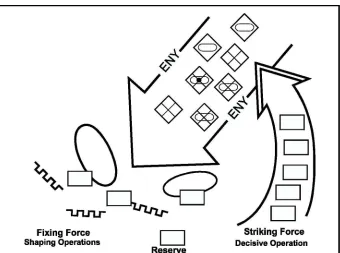
8-16. The mobile defense is a type of defensive operation that concen-trates on the destruction or defeat of the enemy through a decisive attack by a striking force (see Figure 8-1). A mobile defense requires de-fenders to have greater mobility than attackers. Defenders combine offensive, defensive, and delaying actions to lure attackers into positions where they are vulnerable to counterattack. Commanders take advantage of terrain in depth, military deception, obstacles, and mines while employing fires and maneuver to wrest the initiative from the attacker.
/~
~/~A
~~~
0~#
'-uuu-~
G
Fixing Force
Shaping Operations
D
Reserve
Striking Force
Decisive Operation
The striking force conducts the decisive operation in a mobile defense---a counterdefense---attdefense---ack from an unexpected direction. Minimum combat power is committed to fixing forces that shape the depth of the defense.
Figure 8-1. Mobile Defense
AREA DEFENSE
RETROGRADE
counterattacks as the enemy maneuvers against friendly positions. Striking forces are considered committed throughout the operation. They have one task: plan, prepare, and execute the decisive operation-the counterattack. Defenders draw attackers into terrain that enables the striking force to counterattack from an unexpected direction. They press the counterattack with overwhelming force and violence.
A striking force is a
committed force organ-ized to conduct the de-cisive attack in a mo-bile defense. It normal-ly comprises the maxi-mum combat power available to the com-mander at the time of the attack.
8-18. In planning a counterattack, commanders consider enemy options and the likely locations of possible follow-on forces. Commanders decide where to position the striking force, what routes and avenues of approach to use, what fire support is necessary, and what interdiction or attack on follow-on forces will isolate the enemy. They combine military deception and security opera-tions to render enemy reconnaissance ineffective.
8-19. In addition to the striking force, commanders designate a reserve, if forces are available. Reserves are uncommitted forces and may execute nu-merous missions. They give the commander flexibility. Reserves support fix-ing forces, ensurfix-ing that the defense establishes conditions for success of the counterattack. If the reserve is available after the commander commits the striking force, it exploits the success of the striking force.
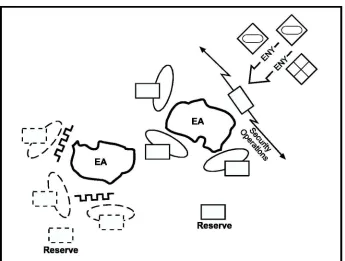
8-20. The area defense is a type of defensive operation that concen-trates on denying enemy forces access to designated terrain for a specific time rather than destroying the enemy outright (see Figure 8-2, page 8-6). The bulk of defending forces combine static defensive positions, engagement areas, and small, mobile reserves to retain ground. Keys to suc-cessful area defenses include effective and flexible control, synchronization, and distribution of fires. Area defenses employ security forces on likely en-emy avenues of approach. Commanders employ a reserve with priority to the counterattack. Other potential reserve missions include blocking enemy penetrations and reinforcing other portions of the defense. Area defenses can also be part of a larger mobile defense.
8-21. Area defenses vary in depth, design, and purpose according to the situation. Commanders deny or retain key terrain if the friendly situation gives no other option or friendly forces are outnumbered. Lower-echelon tac-tical units may position their forces in battle positions on suitable terrain. On occasion, commanders may use a strong point to deny key terrain to the en-emy and force his movement in a different direction. Constructing a strong point requires considerable time and engineer support.
Withdrawal
.- --.
. .
Reserve
D
Reserve
An area defense denies enemy forces access to specified terrain. Defending in depth, exploiting terrain advantages, and strong security forces characterize the area defense.
Figure 8-2. Area Defense
retrogrades as part of a larger scheme of maneuver to create conditions to regain the initiative and defeat the enemy. Retrogrades improve the current situation or prevent a worse situation from occurring. Operational-level commanders may execute retrogrades to shorten lines of communications (LOCs).
8-23. A withdrawal, a form of retrograde, is a planned operation in which a force in contact disengages from an enemy force. Withdrawals may involve all or part of a committed force. Commanders conduct withdrawals to preserve the force, release it for a new mission, avoid combat under undesirable conditions, or reposition forces. Enemy pressure mayor may not be present during withdrawals. At tactical echelons, withdrawing forces may be unassisted or assisted by another friendly force.
the main body to withdraw. Main body units may reinforce the security force if necessary. They will themselves delay or defend if the security force fails to slow the enemy.
8-25. Commanders plan for and employ air and ground reserves, indirect and missile counterfire, and air defenses. Corps and division reserves remain near main body units to assist withdrawing units by fire and maneuver, if needed. Corps and division reserves may execute spoiling attacks to disorganize and delay the enemy or to extricate encircled or decisively engaged forces.
8-26. Commanders use 10 and security operations when withdrawing to deny the enemy information and present false information. They avoid moving forces prematurely or revealing other actions that could signal their with-drawal plans. For example, relocating combat support (CS) and CSS facilities, emplacing obstacles, and destroying routes may signal a withdrawal. To seize the initiative, commanders direct offensive 10 that include measures to con-ceal withdrawal preparations.
8-27. Commanders dedicate resources and plan for future operations when withdrawing. The ability to conduct a timely withdrawal is especially de-pendent upon sufficient transport. CSS planners assist in developing courses of action and adjust sustaining operations to conform to the commander's de-cisions. A withdrawal ends when the force breaks contact and transitions to another operation. Forces may withdraw into a defended area and join its de-fense, withdraw into a secure area and prepare for future operations, or con-tinue away from the enemy in a retirement.
Delay
8-28. A delay is a form of retrograde in which a force under pressure trades space for time by slowing the enemy's momentum and inflicting maximum damage on the enemy without, in principle, becoming decisively engaged. Delays gain time for friendly forces
to--.
Establish defenses..
Cover defending or withdrawing units..
Protect friendly unit flanks..
Contribute to economy of force..
Draw the enemy into unfavorable positions..
Determine the enemy main effort.8-29. Commanders direct delays when their forces are insufficient to attack or conduct an area or mobile defense. A delay is also appropriate as a shaping operation to draw the enemy into an area for subsequent counterattack. Commanders specify the critical parameters of the delay:
.
Its duration..
Terrain to retain or deny..
The nature of subsequent operations.when-.
Enemy forces halt their attack. Friendly forces can then maintain con-tact, withdraw, or counterattack..
Friendly forces transition to the defense..
The delaying force completes its mission and passes through another force or breaks contact..
The friendly force counterattacks and transitions to the offense.8-31. Delaying units should be at least as mobile as attackers. Commanders take measures to increase friendly mobility and decrease enemy mobility. Open, unobstructed terrain that provides friendly force mobility requires major engineering efforts to hinder enemy mobility. Close or broken terrain slows the enemy but also makes it more difficult to maintain contact and may hinder friendly movement.
Retirement
8-32. A retirement is a form of retrograde in which a force not in contact with the enemy moves away from the enemy. Typically, forces move away from the enemy by executing a tactical road march. Retiring units organize to fight but do so only in self-defense. Retirements are usually not as risky as delays and withdrawals.
Risk in Retrograde
8-33. Retrogrades require firm control and risk management. They increase psychological stress among soldiers, who may see movement away from the enemy as a sign of defeat. Unless held in check, such concerns can lead to panic and a rout. Successful retrogrades require strong leadership, thorough planning, effective organization, and disciplined execution. Friendly troops move swiftly but deliberately. A disorganized retrograde in the presence of a strong enemy invites disaster. Commanders manage risk during retrogrades with these measures:
.
Avoiding decisive engagement. Reserves and massed indirect and joint fires can assist in accomplishing this..
Preparing plans to enhance rapid, controlled execution..
Denying the enemy information on unit movement..
Avoiding surprise with continuously updated intelligence..
Combining deception and delaying actions to prevent the enemy from closing in strength.DEFENSIVE OPERATIONS WITHIN THE OPERATIONAL
FRAMEWORK
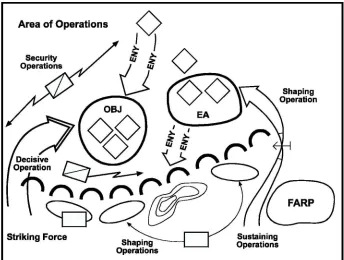
8-34. Commanders use the operational framework (AO, battlespace, and bat-tlefield organization) to conduct defensive operations (see Figure 8-3). Com-manders base their framework on METT-TC and an understanding of their battlespace. They conduct simultaneous and sequential decisive, shaping, and sustaining operations in depth by synchronizing their forces in time, space, resources, purpose, and action. Commanders may designate deep, close, and rear areas when conducting operations that are generally linear and
Area of Operations
Striking Force
Battlespace encompasses all things commanders must understand to apply combat power effectively.
Figure 8-3. Operational Framework in the Defense
8-35. Commanders deny enemy forces freedom of movement within the gaps formed by extended, noncontiguous AOs. They dominate their entire AO throughout the operation, assigning responsibility for unoccupied ground and allocating combat power. When commanders designate subordinate unit AOs
that are noncontiguous, they retain responsibility for portions of their AO not assigned to subordinates. Regardless of the proximity or separation of its elements, commanders see their defense as a continuous whole. They fight decisive, shaping, and sustaining operations as one action, synchronizing si-multaneous operations to accomplish a single purpose: defeating the attack and quickly transitioning to the offense.
DECISIVE OPERATIONS IN THE DEFENSE
8-36. The decisive operation in a defense defeats the enemy attack. In a mo-bile defense, the counterattack by the striking force is the decisive operation. The more commanders know about the enemy situation, the more they can weight the counterattack. In area defenses, defeating the enemy attack within engagement areas is the decisive operation. Commanders draw the enemy into engagement areas, where defenders destroy them using massed
fires, obstacles, and other assets.
8-37. Throughout the execution of mobile and area defenses, commanders designate a main effort and synchronize the battlefield operating systems
repeatedly to defeat an attack. If they correctly anticipate enemy actions, commanders can execute their plan for the decisive operation despite shifting the main effort. They always designate the decisive operation as the main ef-fort at the decisive point.
8-38. Reserves preserve commanders' flexibility and provide a hedge against uncertainty. Once, the reserve is committed, its operation becomes the main effort. If commanders commit their reserve, they should immediately desig-nate another from uncommitted forces or forces in less threatened areas. Commanders may employ reserves throughout the operation. Typical reserve missions include counterattacking, reinforcing, blocking, and destroying a penetration. Commanders avoid assigning tasks to the reserve other than those required to support planning and preparing for their be-prepared mis-sions. Reserves are best used to reinforce and expedite victory rather than prevent defeat. The concept of operations determines the reserve's primary mission. Unless otherwise delegated, the commander designating the reserve retains authority for its commitment.
Decisive Defensive Operations-Pusan,
Korea
By the end of August 1950, the North Korean People's Army (NKPA) occupied most of the Republic of Korea (ROK), less the Pusan pocket on the southeast portion of the peninsula. President Kim II Sung was amazed at the speed with which the NKPA had moved south, and he assembled 98,000 more troops to crush the Eighth Army. Precariously held, the Pusan pocket contained about 120,000 US and ROK soldiers. The operation became hundreds of large and small engagements marked by thousands of casualties.
The NKPA struck at numerous points along the perimeter, expending men and resources in an effort to create a penetration. But the line held and fresh United Nations (UN) forces arrived to bolster the defense. Sensing that an opportunity was slipping away, the NKPA attacked with increased intensity on 31 August 1950. Despite tremendous punishment by UN air force bombing and strafing, the North Koreans breached the defensive lines in several areas. The 24th Infantry Division counterattacked, while the 1st Cavalry Division and the 1st ROK Division held at Taegu. Two enemy divisions struck the 25th Infantry Division in a bloody fight that saw Sobuk Ridge change hands 13 times in less than a month. The line held despite US units giving ground or fighting in isolation. While the NKPA made impressive gains along the perimeter, the defense held and the ports remained open.
SHAPING OPERATIONS IN THE DEFENSE
8-39. Shaping operations executed simultaneously throughout the AO sup-port the conduct of the defender's decisive operation by upsetting the attacker's design. They selectively suppress or neutralize the enemy's BaS and disrupt his synchronization. 10 shape enemy perceptions and can influence the decision to attack. Fires contribute to shaping operations by attacking high-payoff targets and create conditions for successful decisive operations. Shaping operations in the defense
include--.
Countermobility and mobility operations..
Reconnaissance and security operations..
Aerial-delivered and long-range precision indirect fires..
Passages of lines (forward and rearward)..
Actions of fixing forces that shape to support the decisive operation..
Movements of units that directly facilitate other shaping operations and the decisive operation..
Actions by reserve forces before their commitment.8-40. Security forces perform critical functions in the defense. They secure gaps between defending units, protect the force from surprise, meet the leading enemy forces, strip away reconnaissance and security elements, re-port enemy strengths and locations, and help identify the enemy decisive op-eration. They harass and slow attacking forces to gain time and space for shaping enemy actions and protecting LaCs, headquarters, fire support units, and reserves.
Shaping Defensive Operations---2d SANG Brigade at Khafji
Defensive operations often have significant political implications. During the evening of 29 January 1991, the Iraqi 5th Mechanized Division launched several large probes across the Saudi Arabian border. Elements of the 2d Saudi Arabian National Guard (SANG) Brigade---a force accompanied by American advisors and a Marine air/naval gunfire liaison company-met them at the town of Khafji, Saudi Arabia. The Iraqis seized the town, cutting off two Marine reconnaissance teams, who evaded capture while continuing to call in air and field artillery support. The next day, the 2d SANG Brigade attempted to retake Khafji without success. However, on 31 January, the brigade attacked again, and by 1 February succeeded in clearing Iraqi resistance.
SUSTAINING OPERATIONS IN THE DEFENSE
8-41. Sustaining operations in the defense occur throughout the AO. Com-manders ensure freedom of action and continuity of the defense by conduct-ing CSS operations, rear area and base security, LOC maintenance, move-ment control, and terrain management.
8-42. Security for sustaining operations is a primary concern. Commanders organize forces and terrain to protect sustaining operations and retain free-dom of action. Commanders group forces performing sustaining operations into bases and base clusters for protection and security. Base and base clus-ters organize for self-defense. Commanders designate response forces and tactical combat forces (TCFs) to augment base cluster self-defense capabilities (see FM 3-90; FM 3-100.7).
8-43. Force projection operations present distinct security challenges for sus-taining operations. To protect combat power buildup, combat, CS, and CSS forces operate in the same area while establishing the initial lodgment. Forces conducting sustaining operations take increased active and passive self-protection measures until combat forces are available. Commanders as-sess threat capabilities, decide where and when to accept risk, and assign units to protect and sustain the force.
CONSIDERATIONS FOR NONLINEAR DEFENSIVE OPERATIONS
8-44. Commanders may conduct nonlinear defensive operations in contiguous and noncontiguous AOs. In both cases, defenders focus on destroying enemy forces, even if it means losing physical contact with other friendly units. Suc-cessful nonlinear defenses require all friendly commanders to understand the higher commander's intent and share a current common operational picture (COP). They also favor use of a battlefield organization based on decisive, shaping, and sustaining operations rather than deep, close, and rear areas. Noncontiguous defenses are generally mobile defenses; however, some subor-dinate units may conduct area defenses to hold key terrain or canalize at-tackers into engagement areas. Even mobile defenses that begin as linear op-erations often evolve into nonlinear operations. Area defenses are typically more linear operations because of their orientation on terrain.
8-45. Nonlinear defenses place a premium on reconnaissance and surveil-lance to maintain contact with the enemy, produce relevant information, and develop and maintain a COP. The defending force focuses almost exclusively on defeating the enemy force in depth rather than retaining large areas due to the size of the AO. All forces conducting nonlinear defenses require robust communications and sustainment capabilities. Noncombatants and the fluid-ity of nonlinear defensive operations require commanders to exercise judge-ment in clearing fires, both direct and indirect.
CONDUCTING
DEFENSIVE
OPERATIONS
deep into their AO and strike his flanks and rear. They use spoiling attacks if conditions favor them.
PLANNING FOR DEFENSIVE OPERATIONS
8-47. In planning a defense, operational commanders identify their own and the enemy's centers of gravity and related decisive points. They also identify the likely way the enemy will attack. Commanders estimate where the enemy will conduct his decisive operation and how to defeat it while maintaining the coherence of the defense. Operational commanders allocate resources and as-sign AOs to subordinate tactical units. They decide where and when to defend and generally match friendly strength to enemy strength.
8-48. Commanders consider the factors of METT-TC as they plan their de-fense. They choose defensive positions that force the enemy to make costly at-tacks or conduct time-consuming maneuvers to avoid them. Commanders plan 10 to gain information superiority. Information superiority allows com-manders to hide their intentions and deceive the enemy, while degrading the enemy's ability to synchronize his attack. Commanders plan defensive and counteroffensive operations in depth of time, space, and purpose.
Mission
8-49. The mission flows from the higher headquarters concept of operations. Commanders must understand how their defensive operation contributes to the success of the higher headquarters operation. The nature of the AO and subsequent missions affect the missions commanders assign to subordinates.
Enemy
8-50. Commanders and staffs estimate enemy offensive capabilities, vulner-abilities, and operational design. At tactical levels, commanders estimate en-emy strengths, weaknesses, and intent. They infer potential enemy courses of action and focus their estimates on the most dangerous and most likely of them. Commanders and units respect, but are not paralyzed by, enemy capa-bilities. Defending commanders view themselves and their AOs through the enemy commander's eyes and anticipate how he might attempt to seize ter-rain or destroy friendly forces.
8-51. Defending commanders conduct a thorough intelligence preparation of the battlefield (IPB) as part of their visualization. IPB enables commanders and staffs to anticipate the enemy's objectives and courses of action and helps determine what control measures to use. In particular, planners anticipate enemy use of indirect approaches and capability to attack friendly C2 and sustaining operations.
Terrain and Weather
8-53. Defenders analyze the terrain to decide where they can best kill the en-emy. Defending large AOs requires commanders to take risks and accept gaps. Smaller AOs may restrict maneuver and limit flexibility. Subordinate unit AOs should extend far enough toward the enemy to give commanders time to assess enemy capabilities and intentions, visualize the operation, de-cide on a course of action, and execute it. Operational-level commanders con-sider large-scale geographic features and choose the best terrain for defend-ing based on their mission. The geography should hinder operational mobility of large enemy formations and provide advantages for the operational fense. A defense lacks value if the enemy can readily bypass it, unless the de-fensive focus is to retain that terrain. Commanders also consider friendly LOCs. Geography determines LOC capacity and the size force LOCs can sup-port. Operational commanders commit significant resources to improve LOCs and friendly mobility, and to degrade enemy operational mobility.
8-54. The commander's personal reconnaissance is essential. Tactical com-manders focus on identifying probable enemy assembly areas, CSS disposi-tions, field artillery locations, and ground favoring an attack. They also de-termine the area most advantageous for the enemy decisive operation. Terrain characteristics may determine the shape of the defense. Tactical commanders seek positions that offer effective cover and concealment. The defending force exploits any aspect of terrain that can slow enemy momen-tum or make it difficult for the enemy to mass effects or conduct maneuver.
8-55. Defenders seek to engage attackers at points where the terrain places them at the greatest disadvantage. Defending commanders use manmade ob-stacles to improve natural obstacles; to fix, disrupt, turn, or block enemy movement; and to protect friendly positions and maneuver. Some terrain may be so significant to the defense that its loss would prove decisive. In such cases, commanders focus their plan on retaining it.
8-56. Weather and visibility affect how defenders use terrain. Commanders plan for the effects of adverse or limited visibility on weapons systems and optical and thermal devices. A plan that succeeds in clear conditions may be less effective during bad weather. Branches to the basic plan should address necessary modifications to the defense during periods of reduced visibility. Commanders and staffs need local tactical weather information as well as the more general theater-level forecasts.
Troops and Support Available
assault and attack helicopter capabilities, night combat experIence, long-range precision fires, intelligence, and battle command.
Time Available
8-58. The time available to prepare is a crucial factor. The defense is more ef-fective when time is available to plan decisive, shaping, and sustaining opera-tions; conduct reconnaissance and deliberately occupy positions; fortify the ground, plan fires, and install obstacles; coordinate maneuver, fires, and CSS; and rehearse. Commanders at all echelons manage their resources to prepare the best defense time allows. They establish priorities of support that focus work on the unit designated to conduct the decisive operation. They set pri-orities to focus units on the most important tasks.
8-59. Small units train to defend with minimal preparation when necessary; however, strong defenses take time to organize and prepare. To gain time for the main body to organize the defense, commanders may order a delay by a covering force or a spoiling attack by ground or air units. Lack of time and uncertainty about factors such as the enemy order of battle, main effort, and objectives may compel commanders to designate a larger reserve or accept greater risk. It may also determine the type of defense to be employed.
Civil Considerations
8-60. International law and moral imperatives require Army forces to con-sider the effects of operations on civilian populations. The defense of national boundaries may require operational commanders to defend in less depth than they would like. The presence of culturally, economically, and politically sig-nificant assets may limit the range of options. Counter mobility operations di-rected at economically important roads, railways, and bridges might be pro-hibited. When Army forces must damage areas that are important to civil-ians, they ensure that civilian leaders and populations understand why these actions are necessary.
8-61. AOs with large civilian populations often require a portion of the force to conduct support operations. Units may expend significant resources to evacuate endangered populations. Commanders implement restrictive fire support coordinating measures to protect civilian facilities and areas, consis-tent with rules of engagement (see FM 3-09). Army forces must consider ci-vilian movements when emplacing minefields.
PREPARING FOR DEFENSIVE OPERATIONS
8-62. Defensive preparations begin as early as possible and continue throughout the operation. Parallel planning facilitates simultaneous prepara-tion at all command levels. As staffs prepare plans, leaders conduct a per-sonal reconnaissance. There is no substitute for actually seeing and walking the defensive area. Commanders at all echelons integrate adjustments re-sulting from preparation activities. All echelons refine their plans in parallel.
Operations Just Cause, Desert Shield, and Uphold Democracy. Joint exer-cises are often operational-level rehearsals. Rehearsals allow subordinate commanders and staffs to review what they are required to do and when. They aid mutual understanding and promote synchronized actions. Rehears-als permit adjustments to the plan and refinement of responsibilities for ac-tions and contingencies at critical points in the operation.
8-64. The most important preparation activities
include-.
Conducting rehearsals..
Developing engagement areas..
Executing shaping 10, including military deception operations..
Taking force protection measures, to include strengthening air and missile defenses of critical assets..
Executing security operations..
Conducting reconnaissance and surveillance missions to collect infor-mation on the enemy andAO..
Preparing reserves..
Designating counterattack forces..
Organizing the force for movement and support..
Positioning forces in depth..
Improving terrain to favor the defender.EXECUTING DEFENSIVE OPERATIONS
8-65. Commanders consider several factors as they exercise battle command during defensive operations. Army forces conduct operations in depth; com-manders consider how best to employ their force throughout the AO. De-fending in depth may result in enemy penetrations or parts of the force be-coming encircled; commanders visualize how to deal with these situations. Elements of the force conduct sustaining operations throughout the AO; commanders make provisions for protecting them. If WMD are present, com-manders prepare the force to counter their effects. Finally, commanders visu-alize how they will use a counterattack to terminate the defense and transi-tion to offensive operatransi-tions.
Battle Command
8-66. Commanders position themselves at the critical place at the critical time. In the defense, this may include moving with the counterattacking force or locating with the committed reserve. Commanders should anticipate and provide for the means to exercise C2 on the move.
Operations in Depth
and track committed units. They determine the avenues of approach being used, identify the greatest threat, and gain time for the main body to act.
Enemy Penetrations
8-68. Commanders use all available means to contain or destroy enemy pene-trations. In an area defense, commanders block and eliminate penetrations as quickly as possible. In a mobile defense, commanders may allow a significant penetration to position attackers for destruction by the striking force. Com-manders shift their main effort to counter enemy actions and create condi-tions that favor the decisive operation. This may require adjusting bounda-ries, repeatedly committing and reconstituting reserves, and executing branches to the original plan.
Encirclements and Breakouts
8-69. Units may be unintentionally cut off from friendly forces. In that case, the senior commander among the encircled units assumes control of all encir-cled elements and assesses the defensive posture of the force. The commander rapidly reorganizes, consolidates, and determines whether the next higher commander wants the force to break out or defend in place. If the force can break out and that action meets the higher commander's intent, it does so be-fore the enemy has time to block escape routes.
8-70. To break out, the commander designates or organizes a force to create a penetration toward other friendly forces while the other encircled units con-tinue defending. When the penetration is created, the defending units break contact and follow the attacking unit to rejoin friendly forces. If the force cannot break out, it continues to defend while the commander coordinates a linkup with a relieving force.
Protecting Sustaining Operations
8-71. Uninterrupted sustaining operations ensure freedom of maneuver and continuity of operations. Threats to sustaining operations may require forces and facilities to reposition. Response forces from CSS and CS units are re-sponsible for countering threats from small tactical units. When response forces are insufficient, commanders may commit a TCF (see FM 90; FM 3-100.7). Because threats to sustaining operations can divert combat power from the decisive operation, commanders carefully weigh the need for such diversions against the possible consequences and decide where to accept risk.
Weapons of Mass Destruction
Counterattacks
8-73. Counterattacks seek to wrest the initiative from the attacker. Timing is critical. Executed too soon, a counterattack may expend resources needed later for a more urgent contingency. Executed too late, it may be ineffective.
8-74. Commanders anticipate circumstances that favor counterattacks and establish information requirements that help them determine when those cir-cumstances occur. To make these decisions wisely, commanders require rele-vant information about both friendly and enemy forces. Errors in computing movement and deployment times can upset the timing of the counterattack. Late or inaccurate reports about attackers can lead to executing too soon or too late. Training and experience, combined with effective information man-agement, give commanders the relevant information needed to make the right decisions.
Terminating the Defense
8-75. Attackers culminate through friction caused by their own maneuvers, losses, errors, exhaustion, skillful friendly defenses, and other factors. At that point, the initiative passes to the defender. Commanders then designate a counterattack as the decisive operation, finish destroying the enemy force, and transition to the offense.
THE IMPACT OF TECHNOLOGY
Stability
Operations
To defend and protect US national interests, our national military objectives are to Promote Peace and Stability and, when necessary, to Defeat Adversaries. US Armed Forces advance national security by applying military power as directed to help Shape the international environment and Respond to the full spectrum of crises, while we also Prepare Now for an uncertain future.
9-1. Combatant com-manders employ Army forces in stability oper-ations outside the US and US territories to promote and protect US national interests. Army forces are trained, equipped, and or-ganized to control land, populations, and situa-tions for extended peri-ods. The depth and breadth of Army force capabilities provide com-batant commanders im-portant, flexible options to meet theater opera-tional requirements.
9-2. Stability operations promote and protect US
national interests by influencing the threat, political, and information dimen-sions of the operational environment. They include developmental, coopera-tive activities during peacetime and coercive actions in response to crisis. Army forces accomplish stability goals through engagement and response. The military activities that support stability operations are diverse, continu-ous, and often long-term. Their purpose is to promote and sustain regional and global stability.
The National Military Strategy
1997
CONTENTS
Engagement and Response 9-2
Peacetime Military Engagement 9-2
Response 9-3
Characteristics of Stability Operations 9-4 Types of Stability Operations 9-6
Peace Operations 9-6
Foreign Internal Defense 9-8
Security Assistance 9-9
Humanitarian and Civic Assistance 9-10
Support to Insurgencies 9-10
Support to Counterdrug Operations 9-11
Combatting Terrorism 9-11
Noncombatant Evacuation
Operations 9-12
Arms Control 9-13
Show of Force 9-13
Considerations for Stability Operations... 9-14
~
+:i
tn
0 I
...
0 Q)
6j
...J
If deterrence fails, Army forces rapidly respond with tailored force packages to support the JFC's requirements for decisive land operations.
Peacetime Military Engagement
Peacekeeping Operations
SSC
Other SSC
Support Diplomacy
Peace Enforcement
Operations
Major Theater War
Peace Conflict War
Combatant commanders shape the strategic environment of their AORs to preempt or deter conflict. Army forces provide critical support to this effort.
Figure 9-1. The Army Role in Theater Engagement
ENGAGEMENT
AND RESPONSE
9-4. Engagement occurs in the context of the combatant commander's theater strategy (see Figure 9-1). Combatant commanders continually employ mili-tary forces to complement and reinforce other instruments of national power. Theater engagement plans (TEPs) provide frameworks within which combat-ant commands engage regional partners in cooperative military activities and development. Ideally, TEP activities remedy the causes of crisis before a situation deteriorates and requires coercive US military intervention.
PEACETIME MILITARY ENGAGEMENT
treaty partners or potential coalition partners. Peacetime military engagement activities are designed to support a combatant com-mander's objectives as articulated in the theater engagement plan. Combatant commanders synchronize their TEPs with country plans (pre-pared by US ambassadors) and internal defense and development strategies that support theater objectives. Army forces contribute to all three, usually as partners with host nation forces and in coordination with civil agencies.
9-6. Many countries do not invest in air and sea forces. However, almost all countries have armies or land-based paramilitary or police forces. Therefore, Army forces are ideally suited for PME with host nation land forces. Army forces are equally suited for contacting and positively influencing host nation civilian populations. The objectives of PME are
to---.
Open communications..
Increase interoperability..
Foster regional military professionalism..
Demonstrate by example the role of the military in a democracy.Reciprocal military-to-military contact is the primary method of executing PME. Examples include multinational training exercises, joint contact team programs, individual training exchanges, medical and engineer projects and exercises, and staff information exchanges. The reciprocity concept means all sides--US forces, host nation forces, and international partners--benefit.
9-7. Although developmental in nature, PME activities promote regional sta-bility. They are conducted (planned, prepared, executed, and assessed) like other stability operations. However, PME uses only cooperative actions to ac-complish combatant commander objectives. Successful PME activities pre-clude US forces from having to conduct coercive stability operations.
RESPONSE
9-8. When crises develop and the National Command Authorities (NCA) di-rect, combatant commanders respond. If the crisis revolves around external threats to a regional partner, combatant commanders employ Army forces to deter aggression and signal US commitment. Deploying Army forces to train in Kuwait is an example of this sort of response. If the crisis is caused by an internal conflict that threatens regional stability, US forces may intervene to restore or guarantee stability. Operation Restore Democracy, the 1994 inter-vention in Haiti, is an example. In other cases, regional stability requires Army force presence to guarantee postconflict agreements. Ongoing opera-tions in the Sinai and Bosnia exemplify this sort of stability operation. Sta-bility operations that respond to crises are smaller-scale contingencies and may include both developmental and coercive actions. Developmental actions enhance a host government's willingness and ability to care for its people. Co-ercive actions apply carefully prescribed force or the threat of force to change the security environment.
Rapid Response and Preclusion
need to deploy larger forces later. Effective intervention can also deny adver-saries time to set conditions in their favor or accomplish destabilizing objec-tives. Deploying a credible force rapidly is the initial step in precluding or blocking aggression. However, deployment alone will not guarantee success. Achieving successful preclusion involves convincing the adversary that the deployed force is able to conduct decisive offensive and defensive operations.
Presence and Deterrence
9-10. Sustained Army force presence promotes a secure environment in which diplomatic and economic programs designed to reduce the causes of
in-stability can flourish. Presence can take the form of forward basing, forward
deploying, or pre-positioning assets. Army forces can establish and maintain
a credible presence aslong as the NCA direct. Army force presence, as part of
a TEP, often keeps unstable situations from escalating into war.
9-11. Army forces are the cornerstone of theater deterrence. The sustained presence of strong, capable ground forces is the most visible sign of US com-mitment-to allies and adversaries alike. However, if deterrence fails, com-mitted forces must be agile enough to transition to combat operations. Ideally, deterrent forces should be able to conduct decisive operations immed-iately. However, if committed forces lack the combat power to conduct deci-sive operations, they conduct shaping operations while additional forces deploy.
Ongoing
Deterrence-Forward
Presence in Korea
The demilitarized zone that separates the Republic of Korea from North Korea remains the most densely armed space in the world. As part of a joint and multinational team, Army forces maintain stability through forward presence. To deter aggression, Republic of Korea and US forces prepare to fight and defeat any North Korean attack. Army forces include a numbered army headquarters with active and reserve component representatives, an infantry division, two aviation brigades, a Patriot air defense artillery battalion, and combat support and combat service support units. Annually, during exercise Ulchi Focus Lens, ROK and US forces use enhanced simulation methods to rehearse the theater defense campaign plan. Commanders and staffs have the opportunity to practice integrating forward-based forces with reinforcing units. Through forward presence, Army forces in Korea represent US intentions to deter war.
CHARACTERISTICS
OF STABILITY
OPERATIONS
9-12. Army forces conduct stability operations in a dynamic environment. Stability operations are normally nonlinear and often conducted in noncon-tiguous areas of operations (AOs). They are often time- and manpower-inten-sive. Commanders analyze each mission and adapt the operational
framework, elements of operational design, and factors of METT
-
TC to fit thepolitical end state can be more challenging than in situations requiring offen-sive and defenoffen-sive operations; achieving the end state may be just as difficult.
9-13. During all operations, commanders constantly assess the situation in terms of the application and interrelation of the factors of METT-TC. How-ever, stability operations often require commanders to apply METT-TC dif-ferently than they would when conducting offensive and defensive operations. The "enemy," for example, may be a set of ambiguous threats and potential adversaries. Even the mission may change as the situation becomes less or more stable. A mission can be as simple as conducting a briefing to host na-tion forces in a military-to military-exchange or as difficult as conducting combat operations to accomplish a peace enforcement mission. Stability may be threatened for a number of reasons, and an enemy may be difficult to de-fine or isolate. Depending upon the progress of the operation, the complexity of the mission may change quickly.
9-14. Different factors may be important when analyzing the terrain and the troops and support available in stability operations. What constitutes key ter-rain may be based more on political and social considerations than physical features of the landscape. The troops assigned or available to a commander could include nontraditional assets, such as host nation police units, con-tracted interpreters and laborers, or multinational forces. The level of inte-gration and cohesion of a force composed of diverse assets is a key considera-tion for mission success.
9-15. Time considerations normally are substantially different in stability op-erations. The goals of a stability operation may not be achievable in the short term. Success often requires perseverance, a long-term commitment to solv-ing the real problem. The achievement of these goals may take years. Con-versely, daily operations may require rapid responses to changing conditions based on unanticipated localized conflict among competing groups. Civil con-siderations are especially critical in stability operations. The civil population, host nation government, nongovernmental organizations (NGOs), and inter-national organizations can greatly affect achieving stability.
9-16. Stability operations are inherently complex and place great demands on small units. Small unit leaders are required to develop interpersonal skills---such as cultural awareness, negotiating techniques, and critical lan-guage phrases--while maintaining warfighting skills. They must also remain calm and exercise good judgment under considerable pressure. Soldiers and units at every level must be flexible and adaptive. Often, stability operations require leaders with the mental and physical agility to shift from noncombat to combat operations and back again.
TYPES OF STABILITY OPERATIONS
9-18. Army forces may conduct stability operations before hos-tilities, in crises, during hos-tilities, and after hostilities. Before hostilities, stability op-erations focus on deterring or preempting conflict. In a crisis, they may resolve a potential conflict or prevent escalation. During hostilities, they can help keep armed conflict from spreading and assist and en-courage partners. Following hostilities, stability operationscan provide a secure environment that allows civil authorities to reassume control. Army forces conduct 10 types of stability operations.
Types of Stability Operations
.
Peace operations.
Foreign internal defense.
Security assistance.
Humanitarian and civic assistance.
Support to insurgencies.
Support to counterdrug operations.
Combatting terrorism.
Noncombatant evacuation operations.
Arms control.
Show of forcePEACE OPERATIONS
9-19. Peace operations (PO) encompass peacekeeping operations (PKO) and peace enforcement (PEO) operations conducted to support diplomatic efforts to establish and maintain peace (see JP 3-07.3; FM 3-07.3). Army forces conduct PO to support strategic and policy objectives and their implementing diplomatic activities. Although the US reserves the right to conduct PO unilaterally, it will normally participate in PO under the sponsorship of the United Nations (UN) or another multinational organization.
9-20. As in other operations, commanders and staffs should continually as-sess the operation and prepare contingency plans. In PO, planning for possi-ble or likely transitions is especially important. Examples include transi-tioning from a US unilateral operation or multinational coalition to a UN-led coalition, from combat to noncombat operations, and from military to civilian control. Optimally, Army forces should not transition from one PO role to an-other unless there is a change of mandate or a political decision with appro-priate adjustments to force structure, rules of engagement (ROE), and other aspects of the mission.
Peacekeeping Operations
Stability Mission at Brcko
On 28 August 1997, US soldiers demonstrated considerable restraint during riots at Brcko, Bosnia. Early that day, forces loyal to Bosnian President Biljana Plavsic attempted to take control of local police stations and media centers. In the process, they clashed with supporters of suspected war criminal Radovan Karadzic. Soldiers from Task Force (TF) Eagle, part of the North Atlantic Treaty Organization Stabilization Force, arrived on the scene to preempt violence and protect UN civilian agencies and international police. While Karadzic's supporters looted the UN police station, other rioters assaulted International Police Task Force (IPTF) members and damaged 100 UN vehicles. The soldiers quickly moved through the agitated crowd to protect IPTF officers and UN property. The pro-Karadzic crowd surrounded the soldiers, threatening to kill them for allegedly taking sides with President Plavsic. Rioters attacked US soldiers with Molotov cocktails, nail-studded boards, rocks, and bricks. They broke the nose of one soldier and stabbed another in the arm. Army leaders ordered their soldiers not to fire on the frenzied crowd. Instead, Stabilization Force helicopters dropped tear gas to disperse the rioters. US forces then secured the wounded soldiers and police officers. The well-trained soldiers and leaders of TF Eagle exhibited disciplined, appropriate restraint under politically charged circumstances.
Peace Enforcement Operations
9-22. PEO apply military force, or threaten its use-normally pursuant to in-ternational authorization-to compel compliance with resolutions or sanc-tions designed to maintain or restore peace and order. Unlike PKO, PEO do not require the consent of all parties. PEO maintain or restore peace and support diplomatic efforts to reach a long-term political settlement. Operation Restore Hope in Somalia during 1992-93 was a peace enforcement operation. Army forces assigned a peace enforcement mission must be able to apply suf-ficient combat power for self-defense and to forcibly accomplish assigned tasks. Units must also be prepared to transition to PKO. PEO normally in-clude one or more of six subordinate operations:
.
Forcible separation of belligerents..
Establishment and supervision of protected areas..
Sanction and exclusion zone enforcement..
Movement denial and guarantee..
Restoration and maintenance of order..
Protection of humanitarian assistance.Operations in Support of Diplomatic Efforts
9-23. Army forces support diplomatic efforts to establish peace and order be-fore, during, and after conflicts. These operations include preventive
diplo-macy, peacemaking, and peace building (see JP 3-07.3). For example, Army
deployments, and security assistance. Army forces support to peace building involves the same activities as longer-term foreign internal defense (FID) op-erations. Military support of diplomatic activities improves the chances for success by lending credibility to diplomatic actions and demonstrating the re-solve to achieve viable political settlements.
FOREIGN INTERNAL DEFENSE
9-24. FID is participation by civilian and military agencies of one government in programs taken by another government to free and protect its society from subversion, lawlessness, and insurgency (see JP 3-07.1; FM 3-07). It involves all elements of national power and can occur across the range of military op-erations. FID is a primary program that supports friendly nations operating against or threatened by hostile elements. It promotes stability by helping a host nation establish and preserve institutions and facilities responsive to its people's needs. Army forces participating in FID normally advise and assist host nation forces conducting operations. FID is also a specified and signifi-cant mission for selected Army special operations forces (ARSOF) (see FM 3-05). However, FID requires joint planning, preparation, and execution to en-sure the efforts of all service and functional components are mutually supportive and focused. The categories of FID operations
are--.
Indirect support..
Direct support (not involving combat operations)..
Combat operations to support host nation efforts.Indirect Support
9-25. Indirect support emphasizes host nation self-sufficiency and builds strong national infrastructures through economic and military capabilities. Examples include security assistance programs, multinational exercises, and exchange programs. Indirect support reinforces host government legitimacy and primacy in addressing internal problems (see JP 3-07.1).
Direct Support (Not Involving Combat Operations)
9-26. Direct support (not involving combat operations) uses US forces to pro-vide direct assistance to the host nation civilian populace or military. Direct support includes civil-military operations (CMO), intelligence and communi-cations sharing, and logistics. Direct support does not usually involve trans-ferring arms and equipment, or training local military forces (see JP 3-07.1).
Combat Operations
9-28. Most FID activities focus on helping a host nation prevent an active
in-surgency from developing. If an insurgency already exists or preventive measures fail, FID focuses on eliminating, marginalizing, or reassimilating insurgent elements. The US provides military support to counterinsurgency efforts, recognizing that military power alone cannot achieve lasting success. US military power cannot, and will not, ensure the survival of regimes that fail to meet their people's basic needs. Military programs and US actions promote a secure environment in which to implement programs that elimi-nate causes of insurgencies and encourage insurgents to rejoin civil society. As with other FID actions, support to a counterinsurgency balances security with economic development to enhance or reestablish stability.
9-29. Army forces conduct support to counterinsurgencies within the context of the US ambassador's country plan and the host nation's internal defense and development strategy. The goal is to integrate all resources---civilian and military, public and private---so that host nation combat operations and de-velopment efforts complement each other. The intended result is measurable improvement in the economic, social, and political well-being of those sup-ported. Army forces can also assist in development programs by helping gov-ernmental and private agencies provide essential supplies and services.
9-30. Support to counterinsurgencies helps host governments deal with two principal groups: the insurgents and the people. Army forces help host gov-ernments protect the people from insurgent violence and separate them from insurgent control. These actions require persuasion, prosecution, and de-struction to attack insurgent leadership and organization. The goal is to deny insurgent organizations sources of personnel, materiel, funds, and intelli-gence. The fundamental cause of insurgent activities is widespread dissatis-faction with standing ethnic, religious, political, social, or economic conditions by some sizable portion of the population. For US military power to be effec-tive in supporting a counterinsurgency, the host government must address or revise its policies toward the disaffected portions of the population. There are few immediate, decisive results in military operations against insurgent forces. When results occur, they are short lived unless the host government acts just as decisively to address the problems that underlie the insurgency.
9-31. Army forces help the host government police, paramilitary, and mili-tary forces perform counterinsurgency, area security, or local security opera-tions. They provide advice and assistance in finding, dispersing, capturing, and destroying insurgent forces. Army forces emphasize training national, state, and local forces to perform essential defense functions. Their aim is to provide a secure environment in which development programs can take ef-fect, while respecting the rights and dignity of the people.
SECURITY ASSISTANCE
military training teams, maintenance support personnel and training, and related activities such as humanitarian de mining operations.
Foreign Internal Defense in EI Salvador
From 1979 until the early 1990s, the US recognized Central America as a region of primary security interest. US representatives sought to create lasting democratic change by assisting Latin American countries to revamp domestic policies, processes, and institutions through diplomatic, economic, and military influence. The Reagan administration used diplomacy and economic aid to promote democratic elections, initiate social and economic reforms, and end human rights abuses. A US military group assisted the EI Salvadoran army by establishing a facility for basic and advanced military training. The advisors, primarily ARSOF, also served with EI Salvadoran units to support small unit training and logistics. The advisors helped the EI Salvadoran military become more professional and better organized while advising in the conduct of pacification and counterguerrilla operations against the communist-backed Farabundo Marti National Liberation Front. Army forces supported US interests by creating a crack counterinsurgency force that fought the guerillas to a standstill and established the groundwork for a negotiated settlement.
HUMANITARIAN AND CIVIC ASSISTANCE
9-33. Humanitarian and civic assistance (HCA) programs consist of assis-tance provided in conjunction with military operations and exercises. By law (Title 10 US Code, section 401), HCA are authorized by the secretary of state and planned and appropriated in the Army budget. HCA must enhance the security interests of both the US and host nation and increase the operational readiness of the units and soldiers performing the mission. In contrast to humanitarian and disaster relief conducted under foreign humanitarian as-sistance operations, HCA are planned activities with specific budget limita-tions. HCA are limited to the following categories:
.
Medical, dental, and veterinary care for rural areas of a country..
Construction of rudimentary surface transportation systems..
Well drilling and construction of basic sanitation facilities..
Rudimentary construction and repair of public facilities..
Specified activities related to mine detection and clearance, including education, training, and technical assistance.SUPPORT TO INSURGENCIES
SUPPORT TO COUNTERDRUG OPERATIONS
9-35. In 1986, the president issued Na-tional Security Decision Directive 221 declaring drug trafficking a threat to national security. It is also a threat to the stability of many friendly nations. The Army participates in counterdrug operations under provisions of the national drug control strategy. Army forces may be employed in various oper-ations to support other agencies respon-sible for detecting, disrupting, inter-dicting, and destroying illicit drugs and the infrastructure (personnel, materiel, and distribution systems) of illicit drug trafficking entities (see JP 3-07.4).
Support to Counterdrug Operations
.
Detection and monitoring.
Host nation support.
Command, control, communications, and computers.
Intelligence, planning, combat service support, training and manpower support.
Research, development, and acquisition.
Reconnaissance 9-36. Army forces always conductcoun-terdrug operations in support of other US government agencies. These include the Coast Guard, Customs Service, Department of State, Drug En-forcement Agency, and Border Patrol. When conducted inside the US and its territories, they are domestic support operations. When conducted outside the US and its territories, counterdrug operations are considered stability op-erations. Army forces do not engage in direct action during counterdrug oper-ations. Units that support counterdrug operations comply with US and for-eign legal limitations concerning the acquisition of information on civilians and the conduct of law enforcement activities.
COMBATTING TERRORISM
9-37. Terrorism is the calcu-lated use of unlawful vio-lence or threat of unlawful violence to inculcate fear. It is intended to coerce or in-timidate governments or societies. Terrorists usually pursue political, religious, or ideological goals. Enemies who cannot compete with
Army forces conventionally often turn to terrorist tactics. Terrorist attacks often create a disproportionate effect on even the most capable conventional forces. Terrorist tactics from arson to employing weapons of mass destruction (WMD). Army forces routinely conduct operations to deter or defeat these attacks. Offensively oriented operations are categorized as counterterrorism; defensively oriented operations are antiterrorism.
Terrorist Tactics
.
Arson.
Hijacking.
Maiming.
Seizure.
Assassination.
Raids and am bushes.
Sabotage.
Hoaxes.
Bombing.
Kidnapping.
Hostage taking.
Use of WMDCounterterrorism
facilities outside the US and its territories. Counterterrorism is a specified mission for selected special operations forces that operate under direct control of the NCA or under a combatant command arrangement. Commanders who employ conventional forces against organized terrorist forces operating inside their AO are conducting conventional offensive operations, not counterter-rorism operations.
Antiterrorism
9-39. Antiterrorism is defensive measures used to reduce the vulnerability of individuals and property to terrorist attacks, to include limited response and containment by local military forces. Antiterrorism is a consideration for all forces during all types of military operations. Acts of terrorism against US forces may have a strategic impact (see JP 3-07.2; FM 3-07.2). Commanders take the security measures necessary to accomplish the mission and protect the force against terrorism. Soldiers are often most vulnerable during off-duty periods and in recreational locations. Soldiers and families that reside outside protected installations are ideal targets for terrorists. Commanders make every reasonable effort to minimize the vulnerability of their force to murder and hostage taking. Typical antiterrorism actions
include--.
Coordinating with local law enforcement..
Positioning and hardening of facilities..
Taking physical security actions designed to prevent unauthorized ac-cess or approach to facilities..
Taking crime prevention and physical security actions that prevent theft of weapons, munitions, identification cards, and other materials..
Establishing policies regarding travel, size of convoys, breaking of rou-tines, host nation interaction, and off-duty restrictions..
Providing for protection from WMD.NONCOMBATANT EVACUATION OPERATIONS
9-40. Noncombatant evacuation operations (NEOs) relocate threatened civil-ian noncombatants from locations in a foreign nation to secure areas (see JP 3-07.5). Normally, these operations involve US citizens whose lives are in danger either from the threat of hostilities or from a natural disaster. They may also include host nation citizens and third country nationals. Army forces, normally as part of a joint task force, conduct NEOs to assist and sup-port the Department of State. Removing noncombatant Americans and others from the threat of being killed or taken hostage provides humanitarian service. Relocating these potential targets expands options available to dip-lomatic and military authorities.