Efficient Identity-Based and Authenticated Key Agreement
Protocol
Yongge Wang
UNC Charlotte (USA), [email protected]
Abstract
Several identity based and authenticated key agreement protocols have been proposed in recent years and all of them have been shown to be non-secure. It remains an open question to design secure identity based and authenticated key agreement protocols. In this paper, we propose an efficient identity-based and authenticated key agreement protocol IDAK using Weil/Tate pairing. A security model for identity based key agreement protocol is established and the security properties of IDAK are proved in this model with random oracle. In particular, it is shown that the IDAK protocol possesses all characteristics that a secure key agreement should have.
1
Introduction
Key establishment protocols are one of the most important cryptographic primitives that have been used in our society. The first unauthenticated key agreement protocol based on asymmetric cryptographic techniques were proposed by Diffie and Hellman [11]. Since this seminal result, many authenticated key agreement protocols have been proposed and the security properties of key agreement protocols have been extensively studied. In order to implement these authenticated key agreement protocols, one needs to get the corresponding party’s authenticated public key. For example, in order for Alice and Bob to execute the NIST recommended MQV key agreement protocol [16, 22], Alice needs to get an authenticated public key gb for Bob and Bob needs to get an authenticated public keygafor Alice first, whereaandbare Alice and Bob’s private keys respectively. One potential approach for implementing these schemes is to deploy a public key infrastructure (PKI) system, which has proven to be difficult. Thus it is preferred to design easy to deploy authenticated key agreement systems. Identity based key agreement system is such an example.
In 1984, Shamir [28] proposed identity based cryptosystems where user’s identities (such as email address, phone numbers, office locations, etc.) could be used as the public keys. Several identity based key agreement protocols (see, e.g., [7, 13, 18, 23, 26, 27, 29, 32, 34]) have been proposed since then. Most of them are not practical or do not have all required security properties. Joux [14] proposed a one-round tripartite non-identity based key agreement protocol using Weil pairing. Then a feasible identity based encryption scheme IBE [6] based on Weil or Tate paring was designed.
For example, all these protocols are insecure against key revealing attacks and some of them do not have perfect forward secrecy property for session keys if both parties long term private keys are corrupted. Indeed, several of these protocols wereprovedto be secure in the Bellare-Rogaway security model for key agreement protocols and the proofs were found to be flawed later. For example, Chen and Kudla [7] proved that their protocol is secure in the Bellare-Rogaway [3] secure key agreement model. However, Cheng et al. [9] pointed out that the proof in [7] is flawed and their protocol is not secure against the key revealing attacks (the fundamental component in Bellare-Rogaway model).
Thus it remains to be an open problem to design efficient secure identity based and cated key agreement protocols. In this paper, we propose an efficient identity based and authenti-cated key agreement protocol achieving all security properties that an authentiauthenti-cated key agreement protocol should have. In addition, our protocol is designed for efficient implementation with pre-computations. Without pre-computation, our protocol is as efficient as (or more efficient than) existing identity based key agreement protocols.
The advantage of identity based key agreement is that non-PKI system is required. The only prerequisite for executing identity based key agreement protocols is the deployment of authenti-cated system-wide parameters. Thus, it is easy to implement these protocols in relatively closed environments such as government organizations and commercial entities.
There is an extensive literature on the security of key agreement protocols. Bellare and Ro-gaway [3] provided formalizations for certain symmetric-key cases. They introduced the model of an adversary in control over all communications, modelled session key revealing attacks, and suggested that the session key should be strongly secure in the sense of semantic security. Fiat and Shamir [12] introduced the random oracle model to analyze the security of cryptographic pro-tocols. The random oracle model has been further enhanced by Bellare and Rogaway [2]. We will show that in random oracle model, our IDAK is a secure authenticated key agreement pro-tocol in a security model based on Bellare-Rogaway model [3]. In a summary, our contributions of this paper include: (1) An efficient identity based and authenticated key agreement protocol. Without pre-computation, our protocol is at least as efficient as existing (including the non-secure ones) identity based key agreement protocols. With pre-computation, our protocol is very efficient and is suitable for resource constraint devices. (2) A security model for identity based key agree-ment protocols which is used to prove security properties for our IDAK protocol. (3) Practical considerations and application domain discussions of identity based key agreement protocols.
2
Bilinear maps and the bilinear Diffie-Hellman assumptions
2.1 Bilinear maps
In the following, we briefly describe the bilinear maps and bilinear map groups. The details could be found in Joux [14] and Boneh and Franklin [6].
1. GandG1 are two (multiplicative) cyclic groups of prime orderq.
2. gis a generator ofG.
3. ˆe:G×G→G1is a bilinear map.
A bilinear map is a mapˆe:G×G→G1with the following properties:
1. bilinear: for allg1, g2 ∈G, andx, y∈Z, we havee(gˆ 1x, g y
2) = ˆe(g1, g2)xy.
2. non-degenerate:e(g, g)ˆ 6= 1.
We say thatGis a bilinear group if the group action inGcan be computed efficiently and there exists a groupG1and an efficiently computable bilinear mapˆe:G×G→G1as above. Concrete
examples of bilinear groups are given in [14, 6]. For example, letGbe a subgroup of the additive group of the points of an elliptic curveEa,b/Fp andG1 be a subgroup of the multiplicative group
of a finite fieldFp∗2. Then the Weil pairing (respectively, Tate pairing) could be used to construct bilinear maps between these two groups. For convenience, throughout the paper, we view both
Gand G1 as multiplicative groups though the concrete implementation of G could be additive
elliptic curve groups.
2.2 Complexity assumptions
Throughout the paperefficientmeans probabilistic polynomial-time,negligiblerefers to a function
εkwhich is smaller than1/kc for allc > 0and sufficiently largek, andoverwhelmingrefers to
a function1−εk for some negligibleεk. Consequently, a function δk isnon-negligibleif there exists a constantcand there are infinitely manyksuch thatδk >1/kc. We first formally define
the notion of a bilinear group family and computational indistinguishable distributions (some of our terminologies are adapted from Boneh [5]).
Bilinear group familiesAbilinear group family Gis a set G = {Gρ}of bilinear groups Gρ =
hG, G1,ˆeiwhereρranges over an infinite index set,GandG1are two groups of prime orderqρ,
andeˆ:G×G →G1 is a bilinear map. We denote by|ρ|the length of the binary representation
ofρ. We assume that group and bilinear operations inGρ=hG, G1,eˆiare efficient in|ρ|. Unless
specified otherwise, we will abuse our notations by usingqas the group order instead ofqρin the
remaining part of this paper.
Instance generatorAnInstance Generator,IG, for a bilinear group family G is a randomized
algorithm that given an integerk(in unary, that is,1k), runs in polynomial-time inkand outputs some random indexρforGρ =hG, G1,eˆi, and a generatorgofG, whereGandG1are groups
of prime orderq. Note that for eachk, the Instance Generator induces a distribution on the set of indicesρ.
Bilinear Diffie-Hellman ProblemLetG={Gρ}be a bilinear group family andgbe a generator
forG, whereGρ = hG, G1,eˆi. The BDH problem inG is as follows: given hg, gx, gy, gzi for
some x, y, z ∈ Zq∗, compute e(g, g)ˆ xyz ∈ G1. A CBDH algorithm C for G is a probabilistic
polynomial-time algorithm that can compute the functionBDHg(gx, gy, gz) = ˆe(g, g)xyz inGρ
with a non-negligible probability. That is, for some fixedcwe have
Pr [C(ρ, g, gx, gy, gz) = ˆe(g, g)xyz]≥ 1
kc (1)
where the probability is over the random choices ofx, y, zinZq∗, the indexρ, the random choice ofg∈G, and the random bits ofA.
CBDH Assumption. The bilinear group family G = {Gρ} satisfies the CBDH-Assumption
if there is no CBDH algorithm for G. A perfect-CBDH algorithm C for G is a probabilistic polynomial-time algorithm that can compute the functionBDHg(gx, gy, gz) = ˆe(g, g)xyz inGρ
with overwhelming probability. Gsatisfiesthe CBDH-Assumption if there is no perfect-CBDH algorithm forG.
Theorem 2.1 A bilinear group familyG satisfies the CBDH-Assumption if and only if it satisfies
the perfect-CBDH-Assumption.
Proof. The fact that the CBDH-Assumption implies the perfect-CBDH-Assumption is trivial.
The converse is proved by the self-random-reduction technique (see [4, 20]). LetObe a CBDH oracle. That is, there exists ac > 0such that (1) holds withCreplaced withO. We construct a perfect-CBDH algorithmCwhich makes use of the oracleO. Giveng, gx, gy, gz ∈G, algorithmC
must computee(g, g)ˆ xyzwith overwhelming probability. Consider the following algorithm: select
a, b, c∈RZqand output
Ix,y,z,a,b,c=O(g, gx+a, gy+b, gz+c)·e(g, g)ˆ −(abz+abc+ayz+ayc+xbz+xbc+xyc).
One can easily verify that ifO(ρ, g, gx+a, gy+b, gz+c) = ˆe(g, g)(x+a)(y+b)(z+c), thenI
x,y,z,a,b,c= ˆ
e(g, g)xyz. Consequently, standard amplification techniques can be used to construct the algorithm
C. The details are omitted. 2
Consider Joux’s tripartite key agreement protocol [14]: Alice, Bob, and Carol fix a bilinear grouphG, G1,eˆi. They selectx, y, z ∈R Zq∗ and exchangegx, gy, andgz. Their shared secret
isˆe(g, g)xyz. Tototally breakthe protocol a passive eavesdropper, Eve, must compute the BDH function:BDHg(gx, gy, gz) = ˆe(g, g)xyz.
CBDH-Assumption by itself is not sufficient to prove that Joux’s protocol is useful for practical cryptographic purposes. Even though Eve may be unable to recover the entire secret, she may still be able to predict quite a few bits (less thanclogkbits for some constantc; Otherwise, CBDH assumption is violated) of information fore(g, g)ˆ xyzwith some confidence. Ife(g, g)ˆ xyxis to be the basis of a shared secret key, one must bound the amount of information Eve is able to deduce about it, givengx,gy, andgz. This is formally captured by the, much stronger, Decisional Bilinear Diffie-Hellman assumption (DBDH-Assumption)
Definition 2.2 Let{Xρ}and{Yρ}be two ensembles of probability distributions, where for each
ρbothXρandYρare defined over the same domain. We say that the two ensembles are
computa-tionally indistinguishableif for any probabilistic polynomial-time algorithmD, and anyc >0we have
for all sufficiently largek, where the probability is taken over allXρ,Yρ, and internal coin tosses
ofD.
In the remainder of the paper, we will say in short that the two distributionsXρandYρare com-putationally indistinguishable.
Let G = {Gρ} be a bilinear group family. We consider the following two ensembles of distributions:
• {Xρ}of random tupleshρ, g, gx, gy, gz,ˆe(g, g)ti, wheregis a random generator ofG(Gρ= hG, G1,ˆei) andx, y, z, tare randomly chosen fromZq.
• {Yρ}of tupleshρ, g, gx, gy, gz,ˆe(g, g)xyzi, wheregis a random generator ofGandx, y, z
are randomly chosen fromZq.
An algorithm that solves the Bilinear Diffie-Hellman decision problem is a polynomial time probabilistic algorithm that can effectively distinguish these two distributions. That is, given a tuple coming from one of the two distributions, it should output 0 or 1, and there should be a non-negligible difference between (a) the probability that it outputs a 1 given an input from{Xρ},
and (b) the probability that it outputs a 1 given an input from{Yρ}. The bilinear group familyG
satisfies the DBDH-Assumptionif the two distributions are computationally indistinguishable.
Remark. The DBDH-Assumption is implied by a slightly weaker assumption: perfect
-DBDH-Assumption. A perfect-DBDH statistical test forG distinguishes the inputs from the above{Xρ}
and{Yρ}with overwhelming probability. The bilinear group familyGsatisfies the perfect-DBDH-Assumptionif there is no such probabilistic polynomial-time statistical test.
3
The scheme IDAK
In this section, we describe our identity-based and authenticated key agreement scheme IDAK. Letkbe the security parameter given to the setup algorithm andIG be a bilinear group param-eter generator. We present the scheme by describing the three algorithms: Setup, Extract, and
Exchange.
Setup: For the inputk∈Z+, the algorithm proceeds as follows:
1. RunIGonkto generate a bilinear groupGρ={G, G1,eˆ}and the prime orderqof the two
groupsGandG1. Lethbe the co-factor of the group orderqforG(that is, the order of the
basing elliptic curve group forGisqh). IfGis not an elliptic curve group, thenhcould be defined similarly. Choose a random generatorg∈G.
2. Pick a random master secretα∈Zq∗.
3. Choose cryptographic hash functions H : {0,1}∗ → Gand π : G×G → Zq∗. In the security analysis, we viewHandπas random oracles.
The system parameter ishq, h, g, G, G1,ˆe, H, πiand the master secret key isα.
Extract: For a given identification stringID∈ {0,1}∗, the algorithm computes a generatorgID = H(ID)∈G, and sets the private keydID =gαIDwhereαis the master secret key.
Exchange: For two participants Alice and Bob whose identification strings are IDA andIDB
1. Alice selectsx∈RZq∗, computesRA=gxIDA, and sends it to Bob.
2. Bob selectsy∈RZq∗, computesRB=gIDBy , and sends it to Alice.
3. Alice computessA=π(RA, RB),sB=π(RB, RA), and the shared secretskABas
ˆ
e(gIDA, gIDB)(x+sA)(y+sB)hα = ˆe
gsB
IDB ·RB, g
(x+sA)hα IDA
.
4. Bob computessA=π(RA, RB),sB=π(RB, RA), and the shared secretskBAas
ˆ
e(gIDA, gIDB)(x+sA)(y+sB)hα = ˆe
gsA
IDA·RA, g
(y+sB)hα IDB
.
In the following sections, we describe a security model for identity based and authenticated key agreement protocol. Our model is based on Bellare and Rogaway [3] secure key agreement model. We then show that our IDAK protocol is secure in this model with random oracle plus DBDH-Assumption. In particular, our protocol achieves perfect forward secrecy property and security against key revealing attacks. In a summary, our protocol is more efficient compared with existing protocols and has better security properties.
We conclude this section with a theorem which says that the shared secret established by the IDAK key agreement protocol is computationally indistinguishable from a random value. In another word, if we assume that the adversary is passive and forward all messages exactly in the way it receives, then the agreed keys by entities achieve semantic security.
Theorem 3.1 Let G = {Gρ} be a bilinear group family, Gρ = hG, G1,eˆi, and g1, g2 be
ran-dom generators ofG. Assume that DBDH-Assumption holds forG. Then the distributionshg1, g2, gx
1, g y
2,ˆe(g1, g2)(x+π(g x
1,g
y
2))(y+π(g
y
2,gx1))hαiandhg1, g2, gx
1, g y
2,e(gˆ 1, g2)zhiare computationally
in-distinguishable, whereα, x, y, zare selected fromZq∗uniformly.
Before we give a proof for Theorem 3.1, we first prove two lemmas that will be used in the proof of the Theorem.
Lemma 3.2 (Naor and Reingold [20]) LetG={Gρ}be a bilinear group family,Gρ=hG, G1,eˆi, m be a constant, g be a random generator of G, and gˆ = ˆe(g, g). Assume that the DBDH-Assumption holds forGρ. Then the two distributionshR,(ˆgxiyjzl : i, j, l≤ m)iandhR,(ˆguijl : i, j, l ≤ m)i are computationally indistinguishable. HereRdenotes the tuple (g,(gxi, gyj, gzl : i, j, l≤m))andxi, yj, zl, uijlare randomly chosen fromZq.
Proof. Using a random reduction, Naor and Reingold [20, Lemma 4.4] (see also Shoup [31,
§5.3.2] showed that the two distributionshR,(gxiyj :i, j ≤m)iandhR,(guij : i, j ≤ m)iare
computationally indistinguishable. The proof can be directly modified to obtain a proof for this
Lemma. The details are omitted. 2
Lemma 3.3 LetG={Gρ}be a bilinear group family,Gρ=hG, G1,ˆei,gbe a random generator
ofG,ˆg= ˆe(g, g), andf1andf2be two polynomial-time computable functions. If the two
distribu-tionsX1 =hR,gˆf1(x),ˆgf2(x)iandY1 =hR,gˆz1,gˆz2iare computationally indistinguishable, then
the two distributionsX2 = hR1,gˆf1(x)+f2(x)i andY2 = hR2,gˆziare computationally
indistin-guishable, whereR= (g,(gxi : 1≤i≤m)),x = (x
1, . . . , xm), andxi, z1, z2, zare randomly
Proof. For a contradiction, assume that there is a probabilistic polynomial-time algorithmDthat distinguishes the two distributionsX2andY2with non-negligible probabilityδk. In the following
we construct a probabilistic polynomial-time algorithmD0to distinguish the two distributionsX
1
andY1. D0 is defined by lettingD0(R, X, Y) = D(R, X·Y)for allR, andX, Y ∈ G1. By
this definition, we havePr [Dr0(X1) = 1|R, r] = Pr [Dr(X2) = 1|R, r], for any fixed internal coin
tossesrofDandD0.
LetDDR,r ={X :Dr(R, X) = 1} andDD 0
R,r ={(X, Y) :D0r(R, X, Y) = 1}. By definition
of D0, we have DD0
R,r = {(X, Y) : X ·Y ∈ DDR,r}. It follows that |DD 0
R,r| = q|DDR,r| and Pr [D0
r(Y1) = 1|R, r] =|DD 0
R,r|/q2=|DDR,r|/q= Pr [Dr(Y2) = 1|R, r]. Thus we have
|Pr [D0(X
1) = 1]−Pr [D0(Y1) = 1]|
=
P
R,rPr[R, r]·(Pr [D
0
r(X1) = 1|R, r]−Pr [D0r(Y1) = 1|R, r])
=
P
R,rPr[R, r]·(Pr [Dr(X2) = 1|R, r]−Pr [Dr(Y2) = 1|R, r])
= |Pr [D(X2) = 1]−Pr [D(Y2) = 1]|
> δk.
Hence, D0 distinguishes the distributions X1 and Y1 with non-negligible probability δk. This
contradicts the assumption of the Lemma. 2
Proof of Theorem 3.1Letgˆ= ˆe(g, g).By Lemma 3.2, the two distributions
X =hg, gα, gx, gy,ˆghαxy,gˆhαxπ(gy,gx),gˆhαyπ(gx,gy),ˆghαπ(gx,gy)π(gy,gx)i and
Y =hg, gα, gx, gy,ˆghz10,ˆghz
0
2π(,gy,gx),ˆghz
0
3π(gx,gy),ˆghz
0
4π(gx,gy)π(gy,gx)i
are computationally indistinguishable assuming that DBDH-Assumption holds forG, wheregis a random generator ofGρ andα, x, y, z10, z20, z30, z40 ∈R Zq. Since π is a fixed function from GtoZq∗ andq is a prime, it is straightforward to verify that for any α, x, y ∈ Zq, gˆhz02π(gy,gx),
ˆ
ghz03π(gx,gy), andgˆhz
0
4π(gx,gy)π(gy,gx)are uniformly (and independently of each other) distributed overG. It follows that the distribution
Z =hg, gα, gx, gy,gˆhz1,gˆhz2,gˆhz3,gˆhz4)i
is computationally indistinguishable from the distributionY, wherez1, z2, z3, z4 ∈R Zq. ThusX
andZare computationally indistinguishable. The Theorem now follows from Lemma 3.3. 2
4
The security model
Our security model is based on Bellare and Rogaway [3] security models for key agreement pro-tocols with several modifications. In our model, we assume that we have at mostm ≤ poly(k)
protocol participants (principals): ID1, . . . ,IDm, wherek is the security parameter. The
proto-col determines how principles behave in response to input signals from their environment. Each principle may execute the protocol multiple times with the same or different partners. This is mod-elled by allowing each principle to have different instances that execute the protocol. An oracle
Πsi,j models the behavior of the principleIDicarrying out a protocol session in the belief that it is
time. EachΠs
i,j maintains a variableview(ortranscript) consisting of the protocol run transcripts
so far.
The adversary is modelled by a probabilistic polynomial time Turing machine that is assumed to have complete control over all communication links in the network and to interact with the principles via oracle accesses toΠsi,j. The adversary is allowed to execute any of the following queries:
• Extract(ID). This allows the adversary to get the long term private key for a new principle whose identity string isID.
• Send(Πsi,j, X). This sends messageXto the oracleΠsi,j. The output ofΠsi,j is given to the adversary. The adversary can ask the principleIDi to initiate a session withIDjby a query
Send(Πsi,j, λ)whereλis the empty string.
• Reveal(Πs
i,j). This asks the oracle to reveal whatever session key it currently holds.
• Corrupt(i). This asksIDito reveal the long term private keydIDi.
The difference between the queriesExtractandCorruptis that the adversary can useExtractto get the private key for an identity string of her choice whileCorruptcan only be used to get the private key of existing principles.
LetΠsij be an initiator oracle (that is, it has received aλmessage at the beginning) andΠsji0 be a responder oracle. If every message thatΠs
ij sends out is subsequently delivered toΠs 0
ji, with the
response to this message being returned toΠsij as the next message on its transcript, then we say the oracleΠsji0 matchesΠsij. Similarly, if every message thatΠsji0 receives was previously generated byΠsij, and each message thatΠsji0 sends out is subsequently delivered toΠsij, with the response to this message being returned toΠs0
jias the next message on its transcript, then we say the oracle Πsij matchesΠsji0. The details for an exact definition of matching oracles could be found in [2].
For the definition of matching oracles, the reader should be aware the following scenarios: Even though the oracle Πsij thinks that its matching oracle isΠsji0, the real matching oracle for
Πsij could be Πtji0. For example, ifΠsij sends a messageX toΠsji0 andΠsji0 replies withY. The adversary decides not to forward the messageY toΠs
ij. Instead, the adversary sends the message Xto initiate another oracleΠtji0 andIDi does not know the existence of this new oracleΠt
0 ji. The
oracleΠtji0 replies withY0 and the adversary forwards thisY0 toΠsij as the responding message for X. In this case, the transcript ofΠsij matches the transcript ofΠtji0. Thus we consider Πsij
andΠtji0 as matching oracles. In another word, the matching oracles are mainly based the message transcripts.
In order to define the notion of a secure session key exchange, the adversary is given an additional experiment. That is, in addition to the above regular queries, the adversary can choose, at any time during its run, a Test(Πsi,j) query to a completed oracle Πsi,j with the following properties:
• The adversary has never issued, at any time during its run, the query Extract(IDi) or
Extract(IDj).
• The adversary has never issued, at any time during its run, the queryReveal(Πs i,j).
• The adversary has never issued, at any time during its run, the queryReveal(Πs0
j,i) if the
matching oracleΠsj,i0 forΠsi,jexists (note that such an oracle may not exist if the adversary is impersonating theIDjto the oracleΠsi,j). The value ofsmay be different from the value of s0 since the adversary may run fake sessions to impersonate any principles without victims’ knowledge.
Letski,js be the value of the session key held by the oracleΠsi,j that has been established between
IDi andIDj. The oracleΠsi,j tosses a coinb ←R {0,1}. Ifb = 1, the adversary is givenski,js .
Otherwise, the adversary is given a valuerrandomly chosen from the probability distribution of keys generated by the protocol. In the end, the attacker outputs a bitb0. The advantage that the adversary has for the above guess is defined as
AdvA(k) =
Pr[b=b0]−1 2 .
Now we are ready to give the exact definition for a secure key agreement protocol.
Definition 4.1 A key agreement protocolΠis secure if the following properties are satisfied for
any adversary:
1. If two uncorrupted oracles Πsij andΠsji0 have matching conversations (e.g., the adversary is passive) and both of them are complete according to the protocolΠ, then both oracles will always accept and hold the same session key which is uniformly distributed over the key space.
2. AdvA(k)is negligible.
In the following, we briefly discuss the attributes that a secure key agreement protocol in the above model achieves.
• Known session keys. The adversary may useReveal(Πsi,j0)query before or after the query
Test(Πsi,j). Thus in a secure key agreement model, the adversary learns zero information about a fresh key for sessionseven if she has learnt keys for other sessionss0.
• Impersonation attack. If the adversary impersonatesIDj toIDi, then she still learns zero
information about the session key that the oracleΠsij holds for this impersonatedIDj since
there is no matching oracle forΠs
ij in this scenario. ThusAcan useTestquery to test this
session key thatΠsij holds.
• Unknown key share. IfIDi establishes a session key withIDl though he believes that he
is talking toIDj, then there is an oracleΠsij that holds this session keyskij. At the same time, there is an oracleΠs0
li0 that holds this session keyskij, for somei0 (normallyi0 = i).
During an unknown key share attack, the userIDjmay not know this session key. SinceΠsij
andΠsli00 are not matching oracles, the adversary can make the queryReveal(Πs 0
li0)to learn
this session key before the queryTest(Πsij). Thus the adversary will succeed for thisTest
• Key compromise impersonation resilience. If the entityA’s long term private key is com-promised, then the adversary could impersonate A to others, but it should not be able to impersonate others toA. Similar to other security models [3] for key agreement protocols, our model does not capture this property. However, we will give a separate proof that the IDAK key agreement protocol indeed has this property.
• Perfect forward secrecy. This property requires that previously agreed session keys should
remain secret, even if both parties’ long-term private key materials are compromised. Sim-ilar to other security models [3] for key agreement protocols, our model does not capture this property. However, we will give a separate proof that the IDAK key agreement protocol indeed has this property.
5
The security of IDAK
Before we present the security proof for the IDAK key agreement protocol, we first prove some preliminary results that will be used in the security proof.
Lemma 5.1 LetG={Gρ}be a bilinear group family,Gρ=hG, G1,ˆei,gbe a random generator
ofG, andπ :G×G→ Zqbe a random oracle. Assume DBDH-Assumption holds forGand let X andYbe two distributions defined as
X =hR, gβx0, gγy0,e(g, g)ˆ (x0+π(gβx0,gγy0))(y0+π(gγy0,gβx0))αβγ,ˆe(g, g)αβγi
and Y =hR, gβx0, gγy0,ˆe(g, g)(x0+π(gβx0,gγy0))(y0+π(gγy0,gβx0))t,e(g, g)ˆ ti
Then we have
1. The two distributionsX andYare computationally indistinguishable ifRis defined as
R=
g, gα, gβ, gγ, gx, gr, gA,eˆ
gx+βπ(gx,gA), gA·grπ(gA,g
x)α ,
α, β, γ, x, t, x0 are chosen fromZq∗ uniformly,gr =gγ orris either chosen fromZq∗
uni-formly,gAandgγy0are chosen fromGaccording to any probabilistic polynomial time com-putable ensembles of distributionG(gx, gr, gα, gβ, gγ, gβx0). Note that the distributions for
gAandgγy0 could be different.
2. For any constantm≤poly(k), the two distributionsX andYare computationally indistin-guishable ifRis defined as:
(g, gα, gβ, gγ,(gxi, grj, g
A,l)i,j,l≤m,(ˆe(gxi+βπ(g
xi,gA,l), g
A,l·grjπ(gA,l,g
xi))α :i, j, l≤m))
where α, β, γ, xi are uniformly chosen fromZq∗, rj are either chosen from Zq∗ uniformly orgrj = gγ, and g
A,l is chosen according to a polynomial time computable ensemble of
distributionG(gxi,grj,gα,gβ, gγ, gβx0 :i, j, l≤m).
3. For any constantm≤poly(k), the two distributionsX andYare computationally indistin-guishable ifR= (R1,R2), whereR1 is defined as theRin the item 2, andR2 is defined as:
whererjare either chosen fromZq∗uniformly orgrj =gγ,gA,iandgA,lare chosen
accord-ing to polynomial time computable ensembles of distributionG(gxi,grj,gα,gβ, gγ, gβx0, gγy0 :
i, j, l≤m)with the condition that “gA,i 6=gβx0 orgA,l 6=gγy0”. Note thatgA,iandgA,l
could have different distributions.
Proof.The Lemma could be proved using complicated version of the Splitting lemma by
Pointcheval-Stern [24] (see the proof of Theorem 7). In the following, we use the random reduction to prove the lemma.
1. For a contradiction, assume that there is a polynomial time probabilistic algorithmDthat distinguishes X and Y. We construct a polynomial time probabilistic algorithm Athat distin-guisheshg, gu, gv, gw, ˆe(g, g)aiandhg, gu, gv, gw,e(g, g)ˆ uvwiwithδk, where u, v, w, aare uni-formly at random inZq.
Let the input ofAbehg, gu, gv, gw,ˆe(g, g)˜ai, wherea˜is eitheruvwor uniformly at random inZq. A chooses uniformly at random c1, c2, c3, x, x0 ∈ Zq, sets gα = gc1u+c2, gβ = gv+c3, gγ = gw+c4, chooses uniformly at random r ∈ Zq or lets gr = gβ, chooses gγy0, g
A ∈ G
according to the distributions G(gx, gr, gα, gβ, gγ, gβx0) (the distributions forg
A ∈ Gandgγy0
could be different). Sincegx andgβx0 are uniformly chosen fromG, we may assume that the values ofπ(gx, gA)andπ(gγy0, gβx0) are unknown yet. Without loss of generality, we may
as-sume thatx+βπ(gx, gA) andy0 +π(gγy0, gβx0) take valuesc5 andc6 respectively, where c5
andc6 are uniformly chosen fromZq. In a summary, the value ofR could be computed from gu, gv, gw, c1, c2, c3, c4, c5 efficiently.Athen sets
ˆ
e(g, g)t˜= ˆe(g, g)c1˜a+c4(c1u+c2)(v+c3)+w(c1uc3+c1v+c2c3).
Acan computee(g, g)ˆ (x0+π(gβx0,gγy0))(y0+π(gγy0,gβx0))˜tusing the values ofˆe(g, g)˜t,x
0,π(gβx0, gγy0), c6. LetA g, gu, gv, gw,e(g, g)ˆ ˜a
=D( ˜X), whereX˜is obtained fromYby replacingtwitht˜and taking the remaining values as defined above.
Note that ifa˜ = uvw, then˜t = αβγ, and X˜ is distributed according to the distribution X. That is, α, β, γ, x, x0 are uniform inZq and independent of each other and of(u, v, w), (r, gA,
gγy0) is chosen according to the specified distributions. Otherwise,X˜ is distributed according to the distributionX, and˜t is uniform inZq and independent ofα, β, γ, x, x0, r, u, v, w, gA, gγy0.
Therefore, by definitions,
Pr [A(g, gu, gv, gw,ˆe(g, g)uvw) = 1] = Pr [D(X) = 1]
and Pr [A(g, gu, gv, gw,ˆe(g, g)a) = 1] = Pr [D(Y) = 1]
ThusAdistinguishes hg, gu, gv, gw,ˆe(g, g)ai andhg, gu, gv, gw,ˆe(g, g)uvwi withδk, whereais uniform at random inZq. This is a contradiction.
2. This part of the Lemma could be proved in the same way. The details are omitted.
3. Since “gA,i 6= gβx0 orgA,l 6= gγy0”, we may assume that the values ofπ(gA,i, gA,l)and
π(gA,l, gA,i)are unknown yet. By the random oracle property ofπ, this part of the Lemma could
be proved in the same way as in item 1. The details are omitted. 2
Theorem 5.2 Suppose that the functions H andπ are random oracles and the bilinear group
familyGsatisfies DBDH-Assumption. Then the IDAK scheme is a secure key agreement protocol.
Proof.By Theorem 3.1, the condition 1 in the Definition 4.1 is satisfied for the IDAK key
For a contradiction, assume that the adversaryAhas non-negligible advantageδk = AdvA(k)
in guessing the value ofbafter theTestquery. We show how to construct a simulatorS that uses
A as an oracle to distinguish the distributionsX andY in the item 3 of Lemma 5.1 with non-negligible advantage2δk(qE −2)2/q4E, whereqE denotes the number of distinctH-queriesthat
the algorithmAhas made. The game between the challenger and the simulatorS starts with the challenger first generating bilinear groups Gρ = hG, G1,eˆi by running the algorithmInstance
Generator. The challenger then randomly selectsα, β, γ, t∈Zqandb∈ {0,1}. The challenger
gives the tuplehρ, g, gα, gβ, gγ,ˆe(g, g)˜ti to the algorithmS wheret˜= αβγ ifb = 1and˜t = t
otherwise. During the simulation, the algorithmS can ask the challenger to provide randomly chosengxi.S may then choose (with the help ofAperhaps)g
A,laccording to a polynomial time
computable distributionG(gxi, grj, gα, gβ, gγ, gαx0 :i, j, l≤m)and sendsg
A,lto the challenger.
The challenger responds withˆe(gxi+βπ(gxi,gA,l), gA,l·grjπ(gA,l,gxi))α. At the end of the simulation,
the algorithmSis supposed to output its guessb0∈ {0,1}forb.
The algorithmSselects two integersI, J ≤qErandomly and works by interacting withAas follows:
Setup:AlgorithmSgivesAthe IDAK system parametershq, h, G, G1,e, H, πˆ iwhereq, G, G1,eˆ
are parameters from the challenger,Handπare random oracles controlled bySas follows.
H-queries: At any time algorithmAcan query the random oracleHusing the queriesExtract(IDi)
orGetID(IDi) =H(IDi). To respond to these queries algorithmSmaintains anHlistthat con-tains a list of tupleshIDi, gIDii. The list is initially empty. WhenAqueries the oracleHat a point IDi,Sresponds as follows:
1. If the queryIDiappears on theHlistin a tuplehIDi, gIDii, thenSresponds withH(IDi) = gIDi.
2. Otherwise, if this is the I-th new query of the random oracleH,S responds with gIDi = H(IDi) =gβ, and adds the tuplehIDi, gβito theHlist. If this is theJ-th new query of the random oracle,S responds withgIDi =H(IDi) = gγ, and adds the tuplehIDi, gγito the Hlist.
3. In the remaining case,S selects a randomri ∈ Zq, responds withgIDi = H(IDi) = gri,
and adds the tuplehIDi, griito theHlist.
π-queries: At any time the challenger, the algorithmA, and the algorithmScan query the random oracleπ. To respond to these queries algorithmS maintains aπlist that contains a list of tuples
hg1, g2, π(g1, g2)i. The list is initially empty. WhenAqueries the oracleπat a point(g1, g2),S
responds as follows: If the query(g1, g2)appears on theπlistin a tupleh(g1, g2), π(g1, g2)i, then
Sresponds withπ(g1, g2). Otherwise,S selects a randomvi ∈Zq, responds withπ(g1, g2) =vi,
and adds the tupleh(g1, g2), viito theπlist. Technically, the random oracleπcould be held by an
independent third party to avoid the confusion that the challenger also needs to access this random oracle also.
Query phase:Sresponds toA’s queries as follows.
For aGetID(IDi) query, S runs theH-queriesto obtain agIDi such thatH(IDi) = gIDi,
and responds withgIDi.
For anExtract(IDi)query for the long term private key, ifi = I ori = J, thenS reports
failure and terminates. Otherwise,S runs theH-queries to obtaingIDi = H(IDi) = gri, and
For aSend(Πs
i,j, X)query, we distinguish the following three cases:
1. X = λ. Ifi = I orJ, S asks the challenger for a randomRi ∈ G(note thatS does not
know the discrete logarithm ofRi with basegIDi), otherwiseS chooses a randomui ∈Zq∗
and setsRi = gui
IDi. S letsΠsi,j reply withRi. That is, we assume thatIDi is carrying out
an IDAK key agreement protocol withIDj andIDisends the first messageRi toIDj.
2. X 6= λand the transcript of the oracleΠsi,j is empty. In this case,Πsi,j is the responder to the protocol and has not sent out any message yet. Ifi=I orJ,S asks the challenger for a randomRi ∈G, otherwiseS chooses a randomui ∈Zq∗ and setsRi =gui
IDi. S letsΠsi,j
reply withRiand marks the oracleΠsi,jas completed.
3. X 6=λand the transcript of the oracleΠsi,j is not empty. In this case,Πsi,j is the protocol initiator and should have sent out the first message already. Thus Πsi,j does not need to respond anything. After processing the querySend(Πs
i,j, X), S marks the oracleΠsi,j as
completed.
For aReveal(Πs
i,j)query, ifi6=Iandi6=J,Scomputes the session keyskij = ˆe(g
π(Rj,Ri) IDj · Rj,d(ui+π(Ri,Rj))h
IDi ) and responds withskij, hereRj is the message received byΠsi,j. Note that
the messageRj may not necessarily be sent by the oracleΠs 0
j,ifor somes0since it could have been
a bogus message fromA. Otherwise,i=I ori=J. Without loss of generality, we assume that
i = I. In this case, the oracle ΠsI,j dose not know its private keygβα. Thus it needs help from the challenger to compute the shared session key. LetRI andRj be the messages thatΠsI,j has
sent out and received respectively.ΠsI,jgives these two values to the challenger and the challenger
computes the shared session keyskIj = ˆe
gπ(Rj,Ri)
IDj ·Rj, RIαhgπ(RI,Rj)αβh
.ΠsI,jthen responds withkIj.
For aCorrupt(i)query, ifi=I ori=J, thenSreports failure and terminates. Otherwise,
Sresponds withdIDi = (gα)ri =gαIDi.
For the Test(Πsi,j) query, if i =6 I orj 6= J, then S reports failure and terminates. Other-wise, assume that i = I andj = J. Let RI = gIDIuI be the message that Πsi,j sends out (note
that the challenger generated this message) and RJ = gIDuJJ be the message that Π s
i,j receives
(note thatRJ could be the message that the challenger generated or could be generated by the algorithm A). S gives the messages RI and RJ to the challenger. The challenger computes X = ˆe(g, g)(uI+π(RI,RJ))(uJ+π(RJ,RI))˜th and gives X toS. S responds with X. Note that if ˜
t=αβγ, thenXis the session key. Otherwise,Xis a uniformly distributed group element.
Guess: After theTest(Πsi,j)query, the algorithmAoutputs its guess b0 ∈ {0,1}. AlgorithmS
outputsb0 as its guess to the challenger.
Claim: IfSdoes not abort during the simulation thenA’s view is identical to its view in the real attack. Furthermore, ifSdoes not abort, thenPr[b=b0]−1
2
> δk, where the probability is over
all random coins used bySandA.
Gand is computationally indistinguishable from a random value beforeA’s view. Therefore, by definition of the algorithmA, we havePr[b=b0]−1
2
> δk. 2
Suppose A makes a total of qE H-queries. We next calculate the probability thatS does not abort during the simulation. The probability that S does not abort for Extract queries is
(qE −2)/qE. The probability thatS does not abort forCorruptqueries is(qE −2)/qE. The
probability thatS does not abort forTestqueries is2/qE2. Therefore, the probability thatS does not abort during the simulation is2(qE−2)2/q4E. This shows thatS’s advantage in distinguishing
the distributionsX andY in Lemma 5.1 is at least2δk(qE−2)2/qE4 which is non-negligible.
To complete the proof of Theorem 5.2, it remains to show that the communications between
S and the challenger are carried out according to the distributionsX andY of Lemma 5.1. For
aReveal(ΠsI,j)query, the challenger outputseˆ
gπ(Rj,RI)
IDj ·Rj, RαhI gπ(RI,Rj)αβh
to the algo-rithm S. Let RI = gx, Rj = gA, andgIDj = gr. Then x is chosen uniform at random from Zq,r is chosen uniform at random from Zq∗ when j =6 J orr = γ whenj = J, and the value
ofgA is chosen by the algorithm Aor by the algorithm S or by the challenger in probabilistic
polynomial time according to the current views. For example, if gA is chosen by the algorithm
A, thenAmay generategAas the combination (e.g., multiplication) of some previously observed
messages/values or generate it randomly. Thus, ignoring the co-factorh, the communication be-tween the challenger and the algorithmS duringReveal(ΠsI,j)queries is carried out according to the distributionsX andY of Lemma 5.1. The case forReveal(ΠsJ,j)queries is the same.
For theTest(ΠsI,J)query, the challenger outputsX = ˆe(g, g)(uI+π(RI,RJ))(uJ+π(RJ,RI))˜thto
the algorithmS, whereRI =gβuI andRJ =gγuJ. Letx0=uIandy0 =uJ. Thenx0is chosen
uniform at random fromZqand the value ofgγy0 is chosen by the algorithmAor by the challenger
in probabilistic polynomial time according to the current views. Similarly,Amay choosegγy0 as the combination (e.g., multiplication) of some previously observed messages/values. Ignoring the co-factorh, the communication between the challenger and the algorithmSduring theTest(ΠsI,J)
query is carried out according to the distributionsX andYof Lemma 5.1.
It should be noted that after theTest(ΠsI,J)query, the adversary may create bogus oracles for the participantsIDI andIDJ and send bogus messages that may depend on all existing
commu-nicated messages (including messages held by the oracleΠsI,J) and then reveal session keys from these oracles. In particular, the adversary may play a man in the middle attack by modifying the messages sent fromΠsI,J toΠsJ,I0 and modifying the messages sent fromΠsJ,I0 toΠsI,J. Then the oraclesΠsJ,I0 andΠsI,J are not matching oracles. Thus Acan reveal the session key held by the oracleΠsJ,I0 before the guess. In theR2 part in the distributionsX andY of Lemma 5.1, we have
the condition “gA,i 6= gβx0 orgA,l 6= gγy0” (this condition holds since the algorithmAhas not
revealed the matching oracles forΠsI,J). If both gA,i 6= gβx0 andgA,l 6= gγy0, then the oracle ΠsJ,I0 is a matching oracle forΠsI,JandAis not allowed to reveal the session key held by the oracle
ΠsJ,I0 . Thus, Ignoring the co-factorh, the communication between the challenger and the algorithm
Sduring theseTest(ΠsI,J)query is carried out according to the distributionsX andYof Lemma 5.1.
6
Perfect forward secrecy
In this section, we show that the protocol IDAK has the additional perfect forward secrecy prop-erty when both parties long term private keys are corrupted. That is, even if Alice and Bob lose their private keys dA = gIDα A and dB = g
α
IDB, the session keys established by Alice and Bob
in the previous sessions are still secure. In order to show this, it is sufficient to show that the two distributions
R,e(gˆ IDA, gIDB)(x+π(g x
IDA,g
y
IDB))(y+π(g
y
IDB,gxIDA))α
and (R,e(gˆ IDA, gIDB)z)
are computationally indistinguishable forR = (gαIDA, gαIDB, gIDAx , gyIDB)and uniform at random chosengIDA, gIDB, x, y, z, α. Consequently, it is sufficient to prove the following theorem.
Theorem 6.1 LetG ={Gρ}be a bilinear group family,Gρ =hG, G1,eˆi. Assume that
DBDH-Assumption holds forG. Then the two distributions
X = (g1, g2, gα1, g2α, gx1, g y
2,ˆe(g1, g2)xyα)
and Y = (g1, g2, gα1, g2α, g1x, g y
2,e(gˆ 1, g2)z)
are computationally indistinguishable for random choseng1, g2, x, y, z, α.
Proof. We use a random reduction. For a contradiction, assume that there is a polynomial
time probabilistic algorithmDthat distinguishes X andY with a non-negligible probability δk.
We construct a polynomial time probabilistic algorithm A that distinguishes (R,ˆe(g, g)t) and
(R,e(g, g)ˆ uvw)withδk, whereR= (g, gu, gv, gw)andu, v, w, tare uniformly at random inZq.
Let the input of A be (R,e(g, g)ˆ t˜), where ˜t is either uvw or uniformly at random in Z q. We
constructAas follows. Achooses randomc1, c2, c3, c4, c5 ∈ Zq and setsg1 = gc1, g2 = gc2, gα1 = guc1c3, gα
2 = guc2c3, g1x = gvc1c4, g y
2 = gwc2c5, and e(gˆ 1, g2)z˜ = ˆe(g, g)˜tc1c2c3c4c5. Let
AR,ˆe(g, g)˜t=D g1, g2, g1α, g2α, gx1, g y
2,e(gˆ 1, g2)z˜
.Note that if˜t=uvw, thenc1, c2, α, x, y
are uniform in Zq (and independent of each other and of u, v, w) and xyα = ˜z. Otherwise,
c1, c2, α, x, yare uniform inZq and independent of each other and ofu, v, w. Therefore, by the
definitions,
Pr [A(R,e(g, g)ˆ uvw) = 1] = Pr [D(X) = 1]
and PrA R,e(g, gˆ )t= 1= Pr [D(Y) = 1]
Thus A distinguishes hg, gu, gv, gw,e(g, g)ˆ ti and hg, gu, gv, gw,e(g, g)ˆ uvwi with δk. This is a
contradiction. 2
Though Theorem 6.1 shows that the protocol IDAK achieves perfect forward secrecy even if both participating parties’ long term private keys were corrupted, IDAK does not have perfect forward secrecy when the master secretαwere leaked. The perfect forward secrecy against the corruption ofαcould be achieved by requiring Bob (the responder in the IDAK protocol) to send
gyIDA in addition to the value RB = gIDBy and by requiring both parties to compute the shared secret asH(gIDAxy ||skAB)whereskAB is the shared secret established by the IDAK protocol.
7
Key compromise impersonation resilience
In this section, we show that the protocol IDAK has the key compromise impersonation resilience property. That is, if Alice loses her private keydA = gIDα A, then the adversary still could not
R,eˆ
gIDAx ·gπ(g x
IDA,RB)
IDA , RB·g
π(RB,gxIDA)
IDB
α
and (R,e(gˆ IDA, gIDB)z) are computationally
indistinguishable for R = (gαID A, g
x
IDA, RB), where gIDA, gIDB, x, z, α are chosen uniform at
random, and RB is chosen according to some probabilistic polynomial time distribution. Since
the value ˆe
gπ(g x
IDA,RB)
IDA , RB·g
π(RB,gIDx A)
IDB
α
is known, it is sufficient to prove the following
theorem.
Theorem 7.1 LetG ={Gρ}be a bilinear group family,Gρ =hG, G1,eˆi. Assume that
DBDH-Assumption holds forG. Then the two distributions
X =g1, g2, g1α, gx1, RB,eˆ
g1x, RB·g
π(RB,gx1)
2
α
and Y = (g1, g2, g1α, g1x, RB,e(gˆ 1, g2)z)
are computationally indistinguishable for random choseng1, g2, x, z, α, whereRBis chosen
ac-cording to some probabilistic polynomial time distribution.
Proof. Since g1x is chosen uniform at random, and π is a random oracle, we may assume that
RB ·g
π(RB,gx1)
2 is uniformly distributed over Gwhen RB is chosen according to any
probabilis-tic polynomial time distribution. Thus the proof is similar to the proof of Theorem 6.1 and the details are omitted. The theorem could also be proved using the Splitting lemma [24] which was used to prove the fork lemma. Briefly, the Splitting lemma translates the fact that when a subset A is “large” in a product space X ×Y, it has many large sections. Using the Split-ting lemma, one can show that ifDcan distinguish X andY, then by replaying Dwith differ-ent random oracleπ, one can get sufficient many tuples(g1, g2, g1α, g1x, RB, π1, π2) such that (1) π1(RB, g1x) 6 π2(RB, gx1); (2)Ddistinguishes X1 andY (respectivelyX2 andY) whenzis
uni-formly chosen but other values takes the values from the above tuple withπ1 (respectivelyπ2).
Since eˆg1x, RB·g
π1(RB,gx1)
2
α
/ˆeg1x, RB·g
π2(RB,gx1)
2
α
= ˆe(g1, g2)xα(π1(RB,g x
1)−π2(RB,gx1)).
Thus, for the above tuple, we can distinguish eˆ(g1, g2)xα from ˆe(g, g)z for random chosen z.
This is a contradiction with the DBDH-Assumption. 2
8
IDAK with key confirmation
The security Definition 4.1 in Section§4 for key agreement protocols does not provide the fol-lowing assurance to a userIDiduring a key agreement protocol: one oracleΠsij has been engaged
in a conversation and has successfully finished the protocol with a session key output. However, there may be no matching oracleΠsji0 existing at all (though according to the definition, the ad-versary learns zero information about the session key held byΠsij). In order to provide assurance against the above scenario, we study secure key agreement protocols with key confirmation in this section. First we slightly modify our matching oracle definition from Section§4. The definition of matching oracles in Section§4 does require all messages thatΠsij sends out should reach its matching oracleΠsji0 and vice versa. In this section, when we talk about matching oracles, we do not require the last message of the protocol to reach its destination. Indeed, in any protocol, the party who sends the last message flow cannot “know” whether or not its last message was received by its partner (see [3]).
LetNo-MatchingE(k)denote the event that, during the protocol execution against the
adver-sary, there exists an oracleΠs
1. Πs
ij has been engaged in a conversation and has successfully finished the protocol with a
session key output.
2. There is no matching oracleΠsji0 forΠsij existing.
3. The adversary has not compromised the long term keys forIDiandIDj.
Definition 8.1 A protocolΠ is a secure key agreement protocol with key confirmation ifΠis a
secure key agreement protocol and the probability ofNo-MatchingE(k)is negligible.
It is straightforward to observe that IDAK is not a secure in the sense of Definition 8.1. In this section, we design a secure key agreement scheme with key confirmation. We first briefly describe message authentication code. AMessage Authentication Code (see, e.g., [1]) is a deterministic polynomial time algorithmMAC(·)(·). To authenticate a messagemwith a keyK, one computes
the authenticated message pair(m, a) = (m,MACK(m)), wherea= MACK(m)is called the
tag on m. A MAC scheme is secure if the probability for an adversary to forge a tag afor a (not authenticated yet) messagemof the adversary’s choice under a randomly chosen key K is negligible. The adversary is allowed to make adaptive-message attacks. That is, the adversary can choose messagesm0 (different from the target message) and ask the MAC oracle to generate the authentication tag onm0under the target keyK. In the following, we describe the IDAK protocol with key confirmation and show that it is secure according to Definition 8.1.
TheSetupalgorithm is the same as that in IDAK protocol, in addition, we also need to choose
two additional random oraclesH1 andH2 (both will be used as key derivation functions), and a secure message authentication functionMAC(·)(·)(see, e.g., [1]).
TheExtractalgorithm for IDAKC is the same as that in IDAK protocol.
TheExchangealgorithm for IDAKC proceeds as follows:
ExchangeFor two participants Alice and Bob whose identification strings areIDAandIDB
re-spectively, the algorithm proceeds as follows.
1. Alice selectsx∈RZq∗, computesRA=gxIDA, and sends it to Bob.
2. (a) Bob selectsy∈RZq∗, computesRB=g y IDB.
(b) Bob computessA=π(RA, RB),sB=π(RB, RA), and the shared secretskIDAK as
ˆ
e(gIDB, gIDA)
(x+sA)(y+sB)hα = ˆegsA
IDA·RA, g
(y+sB)hα IDB
.
(c) Bob computesK1 =H1(skIDAK)andK2 =H2(skIDAK).
(d) Bob computesMACK2(IDB,IDA, RB, RA)and sends this together withRBto Alice.
3. (a) Alice computessA=π(RA, RB),sB=π(RB, RA), and the shared secretskIDAKas
ˆ
e(gIDB, gIDA)
(x+sA)(y+sB)hα = ˆe
gsB
IDB ·RB, g
(x+sA)hα IDA
.
(b) Alice computesK1 =H1(skIDAK)andK2=H2(skIDAK).
(c) Alice computesMACK2(IDA,IDB, RA, RB)and sends this to Bob.
Theorem 8.2 Assume that H, π, H1 and H2 are independent random oracles, MAC is a
Proof.By Theorem 5.2, IDAKC is a secure key agreement protocol. Thus we only need to show that the probability ofNo-MatchingE(k) =εkis negligible.
For a contradiction, assume that the adversary has a non-negligible advantage εk such that
there exists an oracle Πs
IJ that has been engaged in a conversation and has successfully
fin-ished the protocol with a session key output, but there is no matching oracleΠsJ I0 existing. We show how to construct a simulatorS that uses Aas an oracle to forge an authentication tag on an un-authenticated message m under an unknown random key with non-negligible advantage
εk(22k−1)(1−δk)(qE −2)(q2EqN −2)2/q7Eq3N22k, whereqE is the number ofH-queriesthat the simulation makes, qN is the maximum number of IDAKC key agreement sessions that the
algorithmAinitiates for each participant,δkis the probability that the adversary can compute the
session key of an un-revealed oracle. The game between the challenger and the simulatorSstarts with the challenger first choose a random keyK for the MAC scheme. During the simulation,
S can present messagesmto the challenger to get the MAC tag onm under this keyK (but the adversaryAis not allowed to ask the challenger for MAC tags). At the end of the simulation, the algorithmS is supposed to output a messagemand its guessafor the MAC tag onmunder the keyK. The algorithmS works by interacting withAas follows:
Setup:AlgorithmSselects uniformly at random system parametershq, h, G, G1,e, Hˆ ,H1,H2, πi
and gives it toA, whereH,H1,H2,andπare random oracles controlled byS as follows. These
random oracles could be queried bySorAduring the simulation. Meanwhile,Skeeps the master secret keyαin secret.
H-queries,π-queries,H1-queries, andH2-queries: They are the same as theπ-queriesin the
proof of Theorem 5.2. That is,S answers all distinct queries independently and randomly. Note thatH-queriesdefined here is different from that in the proof of Theorem 5.2.
Query phase (MAC forgery phase): S chooses three integers I, J ≤ n and s0 ≤ qN, and
responds toA’s queries as follows.
For an Extract(IDi) query, S runs theH-queries to obtaingIDi = H(IDi) and responds
withdIDi =gIDiα .
For aSend(Πsi,j, X)query, we distinguish the following three cases:
1. X = λ. In this case,Πs
i,j is the protocol initiator. S chooses a randomxi ∈ Zqand sets Ri =gxi
IDi.SletsΠsi,jreply withRi. That is, we assume thatIDiis carrying out an IDAKC
key agreement protocol withIDjandIDi sends the first messageRitoIDj.
2. X 6= λand the transcript of the oracle Πsi,j is empty. In this case, Πsi,j is the protocol responder and has not sent out any message yet. S chooses a random xi ∈ Zq and sets Ri =gxi
IDi.Sthen distinguishes the following two cases:
(a) i=Iandj=J ands=s0. Instead of running theH2-queriesto obtainK2i,j,Sasks
the challenger to generate the MAC tagasi,j for the messagem = (IDi,IDj, Ri, Rj)
whereRj is the random component received from the other oracle. S letsΠsi,j reply with(Ri, asi,j).
(b) i6=Iorj6=Jors6=s0.Scomputes the session keying materialskIDAKand runs the
H2-queriesto obtainK2i,j =H1(skIDAK).Scomputesasi,j = MACK2i,j(IDi,IDj, Ri, Rj)
3. X 6=λand the transcript of the oracleΠs
i,j is not empty. In this case,Πsi,j is the protocol
initiator or responder and should have sent out the first message already.Sthen distinguishes the following two cases:
(a) i = I andj = J ands = s0. If there is a matching oracleΠ s00 J,I for Π
s0
I,J, then S
aborts the simulation with failure. Otherwise, let asj,i be the received MAC tag for the message m = (IDj,IDi, Rj, Ri). S outputs asj,i as the guessed MAC tag for the messagem = (IDj,IDi, Rj, Ri)(Scan terminate the simulation now. However,
for easy analysis of the probability, we continue the simulation). S then asks the challenger whether this MAC tag is valid. If the challenger’s answer is yes,S marks
Πsi,jas completed/accepted and terminate the simulation. If the challenger’s answer is no,S marksΠs
i,j completed/rejected. Note that, according to the IDAKC protocol, if
the oracleΠsi,j is the protocol initiator, then it should send the message authentication tag to the responder as the last message. However, by the new definition matching oracles, this message does not matter.
(b) i6=I orj 6=J ors6=s0. IfΠsi,j is the protocol responder, thenSshould have
com-puted the shared secretK2i,j already. Scomputes the MAC tagasj,i = MACKi,j
2 (IDj,
IDi, Rj, Ri) whereRj is the random component received from the other oracle and compares this tag with the received tag. S marksΠsi,j as completed/accepted if the two tags are the same, and marks it completed/rejected if the two tags are different. For the case that Πsi,j is the protocol initiator,S computes the session keying mate-rial skIDAK and runs the H2-queries to obtain K2i,j = H1(skIDAK). S computes asi,j = MACKi,j
2 (IDi,IDj, Ri, Rj)and letsΠ
s
i,j reply withasi,j, whereRj is the
ran-dom component received from the other oracle.
For aReveal(Πsi,j)query, if “i=Iandj=J ands=s0” or “Πsi,jis the matching oracle for Πs0
I,J” thenSaborts the simulation. Otherwise, Scomputes the session keying materialskIDAK,
runs the H1-queries to getK1i,j = H1(skIDAK), and responds withK1i,j. For a Corrupt(i)
query, ifi=Iori=J, thenSaborts the simulation. Otherwise,Sresponds withdIDi =gIDiα .
Claim:IfSdoes not abort the simulation, thenA’s view is identical to its view in the real attack.
Proof of Claim:It is straightforward. 2
Suppose that the simulation process makes at most qE H-queries andqN be the maximum number of IDAKC key agreement sessions that the algorithm A initiates for each participant. We next calculate the probability thatS succeeds in forging an MAC tag on a message that the challenger has not authenticated.
We first calculate the probability that S does not abort the simulation. The probability that
S does not abort forSendqueries is (q2EqN −2)/qE2qN. The probability thatS does not abort
for Reveal queries is (qE2qN −2)/qE2qN. The probability that S does not abort for Corrupt
queries is(qE −2)/qE. Therefore, the probability thatS does not abort during the simulation is
(qE−2)(q2EqN−2)2/q5Eq2N.
If the algorithmAis successful during that simulation (the probability is at leastεk), then there is a completed/accepted oracle Πsi,j that has no matching oracle. Since there are at mostq2EqN
oracles during the simulation, the probability for this oracle to be the oracleΠs0
the probability that the oracleΠs0
I,J is marked as completed/accepted is at least
(qE−2)(q2EqN−2)2/qE5qN2
·εk· 1/q2EqN
=εk(qE −2)(qE2qN −2)2/qE7qN3.
If the oracleΠs0
I,J is marked as completed/accepted, thenS output a guessed valid MAC tag asJ,I for the message m = (IDJ,IDI, RJ, RI). We next calculate the probability that the chal-lenger has never been asked for the MAC tag on this message and the probability thatAdoes not guess correctly about the keying materials held by the oracleΠs0
I,J (that is, the probability that
the MAC tag is generated without knowing the secret key or asking the challenger to generate it). Since there is no matching oracle andAis not allowed to ask the challenger for MAC tags,A
generates this tagasJ,Iby one of the following three approaches: (1).Sasked the challenger to gen-erate the MAC tag for the messagem= (IDJ,IDI, RJ, RI)for another oracleΠs
0
J,I. SinceΠs 0 J,Iis
not the matching oracle forΠs0
I,J, the event in this case happens only with probability1/22k. Here
we assume that the messagesRI andRJ are allkbits long. (2). Aguessed correctly about the
session keying materialskIDAKfor the oracleΠsI,J0 and computed the MAC tagasJ,Iby herself. By
Theorem 5.2, this probability is bounded by some negligible valueδk. (3).Agenerated the MAC
tagasJ,I by random choice or by using other techniques (e.g., by using flaws in the MAC scheme). According to the security definition of MAC schemes, the forgery on the MAC tag is successful when the events in case (3) happens. Thus, by excluding the probabilities for the cases (1) and (2), the probability that MAC forgery experiment is successful under the condition that the oracle
Πs0
I,J is marked as completed/accepted is at least(1−(1/22k))(1−δk) = (22k−1)(1−δk)/22k.
In a summary, the probability thatS successfully forged the MAC code on the un-authenticated messagem= (IDJ,IDI, RJ, RI)is at least
εk(22k−1)(1−δk)(qE−2)(qE2qN −2)2/q7Eq3N22k
which is non-negligible sinceεkis non-negligible andδkis negligible. This completes the proof
of the Theorem. 2
9
Practical considerations and applications
9.1 The functionπ
Though in the security proof of IDAK key agreement protocol,πis considered as a random oracle. In practice, we can use following simplifiedπfunctions.
• πis a random oracle (secure hash function) fromG×GtoZ2∗dlogqe/c(e.g.,c= 2).
• Ifg1 = (xg1, yg1), g2 = (xg2, yg2)∈Gare points on an elliptic curve, then letπ(g1, g2) =
¯
xgmod2|xg|/2 wherex¯g = xg1 ⊕xg2. That is,π(g1, g2)is the exclusive-or of the second half parts of the first coordinates of the elliptic curve pointsg1andg2.
• πis a random oracle that the output only depends on the the first input variable or any of the above function restricted in such a way that the output only depends on the the first input variable. In another word,π:G→Zq∗.
have strong evidence that this is true. First, if we assume that the groupG2is a generic group in
the sense of Nechaev [21] and Shoup [30]. Then we can prove that Lemma 5.1 holds for the above
πfunctions. Secondly, if the distributionG(gx, gr, gα, gβ, gγ, gβx0)in Lemma 5.1 is restricted to the distribution:
{gf(x,r,α,β,γ,βx0,y):f is a linear function,yis a tuple of uniformly random values fromZ
q}.
Then we can prove that Lemma 5.1 holds for the aboveπfunctions. We may conjecture that the adversary algorithmAcan only generategA andgγy0 according to the above distribution unless
CDH-Assumption fails for G. Thus, under this conjecture (without the condition that G2 is a
generic group), the above list ofπfunctions can be used in IDAK protocol securely.
9.2 Performance
Our analysis in this section will be based on the assumption thatπis a random oracle (secure hash function) fromG×GtoZ2∗dlogqe/2. Since the computational cost for Alice is the same as that for Bob. In the following, we will only analyze Alice’s computation.
First, Alice needs to choose a random numberxand computegIDAx in the groupG. In order
for Alice to computesk = ˆegsB
IDB ·RB, g
(x+sA)hα IDA
, she needs to do1.5exponentiation inG, one multiplication inG, and one pairing. Thus in total, she needs to do2.5exponentiation inG, one multiplication inG, and one pairing.
Alternatively, Alice can compute the shared secret assk= ˆegsB
IDB ·RB, gIDAα
(x+sA)h
. Thus for the entire IDAK protocol, Alice needs to do1.5exponentiation inG(one forgxIDA and0.5for
gsB
IDB), one multiplication inG, one pairing, and one exponentiation inG1.
The IDAK protocol could be sped up by letting each participant do some pre-computation. For example, Alice can compute the values ofgxIDA,ghαIDA,gxhαIDA before the protocol session. During
the IDAK session, Alice can compute the shared secret as sk = ˆe
gsB
IDB ·RB, gxhαIDA·g sAhα IDA
which needs1exponentiation inG(0.5forgsB
IDB and0.5forg sAhα
IDA ),2multiplications inG, and
one pairing. Alternatively, Alice can compute the shared secret assk= ˆe
gsB
IDB ·RB, gIDhαA x+sA
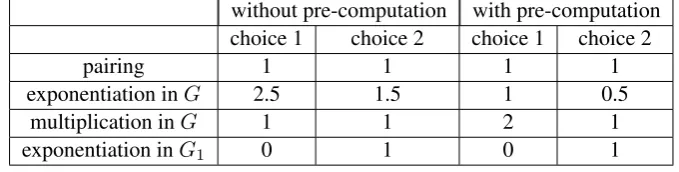
which needs0.5exponentiation inG, one multiplication inG, one pairing, and one exponentiation inG1. In a summary, Figure 1 lists the computational cost for Alice.
without pre-computation with pre-computation choice 1 choice 2 choice 1 choice 2
pairing 1 1 1 1
exponentiation inG 2.5 1.5 1 0.5
multiplication inG 1 1 2 1
exponentiation inG1 0 1 0 1
9.3 Escrow
In the IDAK key agreement protocol, one has to trust the trusted authority TA since TA has suf-ficient capability to impersonate any participants and to compute the agreed secrets for any key agreement sessions unless the shared secret is computed asH(gIDAxy ||skAB)as described in sec-tion§6. As mentioned in [6], identity-based systems have the natural property to be escrowed. For example, we assume that there aremTAs in the systems, each of them holding a partial master secretαi, and the master secret isα1+. . .+αm. Each participant could get her partial private
keygαi
IDfromTAiand compute her private key asg α1
ID· · ·g αm ID .
9.4 Applications
IDAK key agreement protocol could be used in all these environments that identity-based public parameters are deployed (e.g., these environments discussed in [6]). One of the most promising applications could be the VoIP environments. VoIP systems are become more and more popular. However, Internet environment is generally not as secure as the traditional phone networks. Eaves-dropping is dramatically easy in Internet environments than in traditional phone networks. Though VPN could be one of the potential tools that could be used to protect the VoIP systems, recent ex-periments show that there are many disadvantages for VPN based VoIP (the most important one is the delays in several routers which could worsen VoIP quality). On the other hand, we really do not expect each VoIP phone will get a public key certificate and each time when we make a phone call, we need to import the certificate for the target phone first. Identity based key agreement protocol provides a promising solution for VoIP systems. The public key for each phone could be based on its identity (e.g., the phone number). Each time, when we make a phone call, the two phones will use the IDAK protocol to establish a session key for conversation encryption/authentication. The public key for each phone could be “permanent” (e.g., based on the phone number) or temporary (e.g., based on the identity consisting of phone number and time-stamps).
9.5 One-pass IDAK and comparison with signcryption
In some case, one may need an off-line version for the IDAK protocol. For example, when Bob is not on-line or Bob has extremely limited computational resources. One-pass IDAK protocol could be used for these scenarios. For the one-pass IDAK protocol, theSetupandExtractalgorithms are the same as the IDAK protocol. TheExchangealgorithm proceeds as follows.
Exchange: For two participants Alice and Bob whose identification strings are IDA andIDB
respectively, the algorithm proceeds as follows.
1. Alice selectsx ∈R Zq∗, computesRA =gIDAx , and setsRB =gIDB. Alice then computes sA=π(RA, RB),sB =π(RB, RA), and the shared secretskAB as
ˆ
e(gIDA, gIDB)(x+sA)(1+sB)hα= ˆe
gsB
IDB ·RB, g
(x+sA)hα IDA
.
2. Alice sendsRAto Bob.
3. Bob setsRB =gIDB, computessA=π(RA, RB),sB =π(RB, RA), and the shared secret skBAas
ˆ
e(gIDA, gIDB)
(x+sA)(1+sB)hα = ˆegsA
IDA·RA, g
(1+sB)hα IDB