Fast Pseudo-Hadamard Transforms
Tom St Denis [email protected]
Abstract. We prove that the fast pseudo-Hadamard transform (FPHT) over a finite field has a bounded branch number. We shall demonstrate that the transform has an efficient implementation for various platforms compared to an equal dimension MDS code. We prove that when using a CS-Cipher[3] like construction the weight of any 2R trail is bounded for the case of an 8×8 transform. We show that the FPHT can also be combined with MDS codes to produce efficient transforms with half of the branch of a comparable sized MDS code. We present the FPHT-HASH one-way hash function which is constructed using a 32×32 FPHT which produces a 256-bit digest and processes the input at 24 cycles per byte with ISO C source code on an AMD Athlon XP processor.
Keywords. Pseudo-Hadamard Transform, Branch Analysis, One-Way Hash Function.
1
Introduction
An emerging block cipher and one-way hash function design construct is the Maximum Distance Separable (MDS) code. The goal of the MDS code is to promote a high branch through the linear components of the design to ensure a correspondingly low differential and linear “prop-ratio” [5]. Algorithms such as AES [1] and Whirlpool [2] are two prominent designs that employ this design construction. An MDS code of dimensionN×NrequiresO(N2) time to complete
which means while they offer excellent branch they do not scale well in terms of efficiency.
We present a proof that the branch of the fast pseudo-Hadamard transform (FPHT) is bounded by taking the approach of Daemen[5]. We present methods of implementing the FPHT that are faster than known methods of implementing MDS codes. We shall also demonstrate that MDS and FPHT codes can be combined to produce fast transforms with branch numbers much higher than the comparable dimension unmodified FPHT. We shall conclude with a concrete design based on the FPHT construction that achieves a very low cycle per byte processed.
2
Theory
2.1 Fast Pseudo-Hadamard Transform
At the foundation of these new results is the fast pseudo-Hadamard transform (FPHT) which was an idea originally employed in the SAFER [6] and SAFER+ [8] series of block cipher. It would be later changed into a fast four-point pseudo-Hadamard transform for the SAFER++ [7] block cipher in an attempt to raise the efficiency and strength of the underlying design. Stern and Vaudenay adopted their work on multi-permutations to the CS-Cipher [3] which also works on a similar principle of the FPHT.
In this paper we generalize the FPHT and prove that it has a bounded branch number when implemented over a finite field. We then show that the FPHT has several efficient means of implementation which make the design construct very flexible.
The FPHT can be characterized by a recursive linear transform defined by the relationship
Hn =
2·Hn−1 Hn−1
Hn−1 Hn−1
forn≥1
H0= 1 (1)
It is provably non-singular since the two vectorsh2,1iandh1,1iare linearly independent. Note that within this paper decimal matrix coefficients may be considered their equivalent polynomial overGF(2)[x] without loss of generality.
2.2 Branch Numbers
Originally defined in [5] the branch of a transform is the lowest sum of active inputs and outputs with respect to linear and differential cryptanalysis. The branch number only applies to linear transforms in any trivial sense. Let ||.||
represent the number of non-zero coordinates of a given vector. Then the branch
β of a linear transformy=f(x) :x ∈Fm→y∈Fk is defined as minimum of
||x||+||y||for all non-trivialx∈Fm.
The branch of the FPHT can be placed into three distinct categories. Letβn represent the branch of an×nFPHT matrix wherenis a power of two.
β1= 2 (by convention)
β2= 3
βn= 2·βn/4, n≥4
(2)
More specifically the exact branch of FPHTs forn >4 can be expressed as
βn= 2k+1 ifn= 22k
The proof of the previous equation shall come in three parts. First we shall proveβ2 is correct followed by β4 and finally generalβn.
Theorem 1. β2 is equal to three when H1 is defined over a field such that it is
non-singular.
Proof. If ||x|| = 2 then the proof is concluded as ||y|| must be at least one. If
||x|| = 1 then the input is either of the form h0, pi or hp,0i in which case the output is of the form hp, pi or h2p, pi respectively. Since p 6= 0 and therefore
2p6= 0 the output weight must be two. ut
Theorem 2. βn for n= 2k and k≥ 2is equal to 2·βn/4 when Hk is defined over a finite field such thatHk is non-singular and the “2” coefficient generates a multiplicative group of order greater thank.
Proof. We shall prove this theorem by first proving it for the case ofk= 2. Then we shall generalize the proof fork+t, t ≥1 by assuming the proof is true for
k+t−2. Since eventuallyk+t−2∈ {0,1,2}the proof is true by induction. To provek= 2 we shall delineate all four possible input weights and prove that their output weight sums to a minimum of four.
When||x||= 1 the output will be the single non-zero active input coordinate multiplied by the corresponding column of the transform. Therefore, ||y|| = 4 and gives a branch of five.
When ||x|| = 2 there are 4 2
= 6 ways to select active inputs. Since the transform has symmetry about the columns and rows there is really only one unique case to consider. To prove this case we shall consider theH2matrix and
thehp, q,0,0iinput vector.
H2=
4 2 2 1 2 2 1 1 2 1 2 1 1 1 1 1
(4)
The vector when multiplied againstH2producesh4p+ 2q,2p+ 2q,2p+q, p+qi
and by inspection at most two of those coordinates can be zero when p, q6= 0. Therefore, the minimum branch for this case is four.
When ||x|| ≥ 3 the output must allow for||y|| ≥ 1 since the transform is non-singular. This gives a branch of four in both cases and concludes the proof fork= 2.
Now we shall prove the theorem for the general case ofk≥2 by induction. For this proof we again consider the four possible input patterns by re-writing the FPHT in a more conventional form.
H =
A B B C B B C C B C B C C C C C
Where A = 4C and B = 2C for some non-singular FPHT C in the given field. Without loss of generality we shall assume thatA6=B,B 6=C andA6=C
since the “2” coefficient generates a sufficiently large multiplicative sub-group. As a consequence for anyHt witht less than the order of the group generated by p(x) the resulting matrix can be divided into four columns and rows such that it has the unique pattern shown above (eqn. 5).
Note that for this part of the proof we shall not assume thatCis of any given size except that it is of the form Ht for t ≥ 1. To make the rest of the proof easier we shall let “word” represent a subset of the input coordinates aligned with one of the four matrix terms.
When only one input word is active it is obvious that the branch is at least 4·βn/4since the output is simply the product of one of the columns of the matrix
and the non-zero input coordinate.
For the case of two active words we shall use the input vectorhp,0, q,0iand split the proof into two sections. First we consider the case ofp=qand finally
p6=q. If p=q thenpA6=qB since A6=B and this simply impliespA6=pB. Therefore, A contributes a branch of βn/4 to the output. Similarly pB 6= qC
sinceB 6=C which impliespB6=pC which contributes anotherβn/4 of branch.
When p6=q the logic is similar. pB+qB will contribute at most a branch of
βn/4and for any co-ordinate where they collide (recall this is in a finite field so
the characteristic is finite) they cannot collide inpA+qB sinceA 6= B. The same logic applies to the sumpC+qC. It is trivial to see that this similar logic applies to the vectorh0, p,0, qi, hp, q,0,0iandh0,0, p, qi.
The next case is of the input vectorhp, q, r,0i. The first outputpA+qB+rB
can contribute at most a branch ofβn/4. Collisions can be expressed as qB≈
pA+rB and simplified as qB/2 =qC ≈pB+rC which cannot collide in the same coordinates withpB+qC+rB (the third row). The same logic applies to the second and fourth row which contribute the otherβn/4branch. The logic for
the triple case applies to all four different permutations of the triple.
For the last case of the input vectorhp, q, r, sithe first row produces a branch of at mostβn/4 where collisions can be written assC≈pA+qB+rB. Like the
proof for the previous case this cannot collide in the same coordinates with the second row. The same logic applies to the last two rows as a pair.
For all four cases to be true we assume the branch for the k−2 case has been bounded. Since the bounds fork∈ {0,1,2}have been proven, the theorem
is clearly true for allk≥2. ut
Remark. Asymptotically an FPHT of dimensionn×n has a branch ofO(√n) whereas by comparison an MDS code would have a branch of exactlyn+ 1.
Corollary 3. In anHk transform fork≥2theHk−2sub-matrix can be replaced
with any complete non-singular transform and the resulting Hk shall be non-singular as well as have twice the branch of the2k−2×2k−2 transform.
If the input weight is zero, the output weight is zero. If the input weight is one than the output weight is always 2k for Hk. If the input weight x is less thanβk the output weight is at leastβk−xand otherwise the output weight is at least one.
Lemma 5. The FPHT over the ring of integers modulo2k (such as in [6, 8, 7]) cannot be counted in the same manner as theorem two provides.
Since two divides the modulus the transform allows input differences p to cancel out since it is possible that 2p≡0 forp6≡0. As a result for example, the
H3 as used in [6] has a branch of three.
h0,0,0,0,0,0,128,0i=H3(h128,128,0,0,0,0,0,0i) (mod 256) (6)
In the generic equation for the FPHT (eqn. 1) we cannot replace the “2” value with an odd number since the determinant will no longer be a unit in the ring. Therefore, there is no construction of the FPHT over the ring of integers modulo 2k where the branch is at least equal to the branch of the FPHT over a field.
2.3 Implementation
InO(nlog n) time. Any FPHT requires at mostO(nlogn) time to complete which scales nicely compared to an equal dimension MDS code which requires
O(n2) time. More specifically withO(n) space an FPHT requires onlyO(logn)
time to complete.
In hardware designs the actual transform is very efficient. Since only theH1
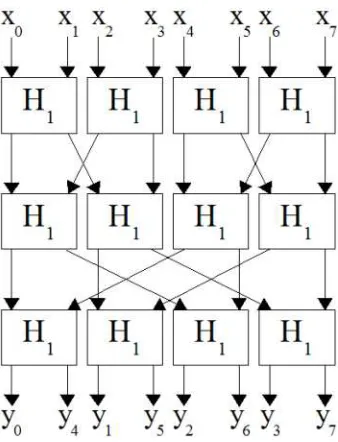
transform must be implemented directly (see Fig. 1) a trivial multiplication by
p(x) =xis all that is required. For example, theH5transform from our proposed
HASH function FPHT-HASH only requires 1600 XOR gates and would have a delay of approximately fifteen XOR gates.
In embedded software the transform can be implemented with the standard
H1transform using only log2(n)·2n table lookups and log2(n)·nXOR operations.
On the Intel 8051 8-bit processor using eight bit polynomials overGF(2)[x] such a transform would require exactly 4n·log2(n) cycles to complete. Using such a
construction on a hypothetical eight round substitution permutation network with a sixteen byte block size would imply that at least 2048 cycles, approxi-mately 2.04 milliseconds1
per block would be used by the linear transformation. Assuming a simple XOR key schedule along with a table driven non-linear sub-stitution along with an overhead of 32 cycles per round yields a theoretical cipher requiring approximately 2700 cycles per block yielding a throughput of 47,410 bits per second.
As a quick remark such a hypothetical design would only require a non-linear transform with a differential and linear profile maximums of 8
256 and 32
256to make
both differential and linear cryptanalysis provably impractical (requiring 2121
and 2146 texts respectively) over only six of the eight rounds.
Fig. 1.H3 as a three layer network.
Table Driven Another popular method of implementing linear transforms is with a table driven algorithm. Letζirepresent thei’th column of the transform. The transformy=Hk(x) wherex, y∈F2k
can be computed with the following equation.
y=
2k
−1
X
i=0
xi·ζi (7)
This is accomplished by pre-computing 2k tables with #F elements each.
T[i][j] =j·ζi,0≤i <2k,0≤j <#F (8) Now equation 7 can be re-written as
y=
2k−1
X
i=0
T[i][xi] (9)
This technique is traditionally used with MDS codes with an optimization applied for circulant codes. In the case of FPHT transforms there are more optimizations available. For example, Hk for k ≥2 can be implemented with only eight multiplications by Hk−2 transforms. A comparable MDS code (of
The optimizations can go further even if the table dimensions are fixed. For example,H5withH2 tables requires 20 unique multiplications compared to the
36 that would be required for an MDS, and so on.
Remark. The series of fast pseudo-Hadamard transforms over GF(2)[x]/v(x) have a distinct advantage over implementations that use the ring of integers (as in the case of [6, 8, 7]). In table driven implementations the former group allows a vector addition to be applied with a single XOR operation. The latter case cannot be implemented with a single addition as carries may propagate across coordinates of the summand.
Recently several processors have been given Single Instruction Multiple Data (SIMD) style instructions such as those of x86 series with MMX. “paddb” of the MMX instruction set, for instance, can add eight octets in parallel. It could be used to compute the SAFER linear transform with eight lookups and seven “paddb” instructions.
However, most processors do not have SIMD instructions and as a result the quickest way to implement a SAFER style FPHT is with the O(NlogN) approach. The benefit of the FPHT overGF(2)[x]/v(x) is clearly both the flex-ibility of implementation as well as the bounded branch number.
2.4 Modified Transforms
Lemma 6. Any non-singular completeHk−2 will do.
For a given Hk for k ≥ 3 any non-singular or specifically complete bijective 2k−2×2k−2 transform will do in the place ofH
k−2. By “complete” it is meant
that each output coordinate is a non-null function of every input coordinate. This observation includes the set of non-linear (2k−2, r)-multipermutations [10]
which would produce a transform with a branch of 2r.
For example, consider the case of [3] where a (2,3)-multipermutation is used in the place of theH1. According to theorem 2 all that is required is that the
the unique 4×4 (eqn. 5) pattern exist. As a result the branch of the transform is the same as a normalH3 FPHT. However, as noted by Vaudenay this approach
has much less linear structure. On the other hand using non-linear transforms in the place of Hk−2 transforms incurs an efficiency penalty on most modern
processors as table driven algorithms cannot be used.
Theorem 7. The FPHT H3 with a non-linear H1 transform has a 2R trail
weight of at least twelve.
Proof. For this proof we shall make use of the graph Fig. 1 and lemma 4. In this construction we shall replace the H1 transform with a (2,3)-multipermutation
where the two coordinates are first sent through a non-linear bijection and then through a non-singular 2×2 linear transform (such asH1).
Letx represent the number of active input coordinates and similarlyy the number of active output coordinates of the first round. For the second round we shall letz represent the number of active output coordinates when y input coordinates are active. In both cases ofy andz we shall assume the minimum possible values.
If there are x active inputs this means that in the first layer there must be at leastdx/2eactiveH1transforms. TheH1 has a branch of three which means
over the first two layers there must be at least 3dx/2eactive non-linear functions. The same logic applies to the last and first layer of the two adjacent rounds as well as to the last two layers of the second round withyandzrespectively. Over the two rounds the minimal trail weight can be expressed as
ρ= 3·(dx/2e+dy/2e+dz/2e) (10) The lowest value ofρoccurs forhx, y, zi=h2,4,2iin this case. ut
Remark. The CS-Cipher employs a slight modification in that they permute the order of the output coordinates. As a result the same trail pattern that causes a weight of twelve through the modified FPHT does not work in CS-Cipher.
Remark. The logic of the previous proof was applied to theH4 with a similarly
modifiedH1. The minimal two round weight was observed over all possible input
weights as being 24. This could applied to the CS-Cipher to extend the block size to 128 bits.
Using the same non-linear function and comparable key schedule the modified version of the CS-Cipher would only require four rounds before any differential or linear trail would provably fail. Therefore, it seems that the CS-Cipher is a scalable design in embedded software and hardware.
Lemma 8. Combining a smaller MDS transform with a larger FPHT results in a modified FPHT with higher branch.
An MDS code is a (n, n+ 1)-multipermutation and would be optimal for the construction in terms of the branch. The transform Hk for k ≥ 3 with a 2k−2×2k−2MDS code in the place of theH
k−2would yield an overall branch of
2k−1+2 by a simple extension of theorem 2. This modification yields a significant
improvement over the branch of an unmodified FPHT.
Dimension Branch of MDS Branch of Modified FPHT Branch of FPHT
16 17 10 8
32 33 18 12
64 65 34 16
ConsiderH4where theH2sub-matrices were replaced with 4×4 MDS
trans-forms. The MDS codes have a branch of five which means that the modifiedH4
would have a branch of ten instead of eight. If the coordinates of the input and output vectors were octets then on a 32-bit platform a total of three quadruples of tables are required for the unique square 4×4 sub-matrices of theH4. This
approach would require 12KB of memory, 32 table lookups and 37 XORs. Com-pared to an equal dimension MDS code which would require 32KB of memory, 64 table lookups and 60 XORs, the FPHT is nearly twice as fast and requires less than half of the memory.
3
FPHT-HASH
We have used the FPHT H5 to produce a fast one-way hash function. The
FPHT-HASH function compresses blocks of 512-bits and produces a digest 256-bits long. The input message is terminated with a one bit followed by enough zero bits to make the message length congruent to 448 modulo 512. The 64-bit representation of the length of the original message in bits is then appended. Every block of 512 bits is then sent through the compression function. All values are loaded and stored in little endian fashion.
3.1 Compression Function
The following pseudo-code describes the compression function. It accepts a mes-sage blockT0..15and internal stateS0..7and updates the state before completion.
The internal state is initially set toSi= 286331153·i. BothS andT are arrays of 32-bit words.
1. forx= 0 to 7 doLx←Sx 2. forx= 0 to 15 doWx←Tx
3. forx= 16 to 64 doWx←(Wx−16⊕Wx−14⊕Wx−8⊕Wx−3⊕x)
<<11
4. forx= 0 to 5 do
(a) fory= 0 to 7 doLy ←Ly⊕W16+8x+y (b) L←θ(γ(L))
5. forx= 0 to 7 doSx←Sx+Lx
In this design γ(x) which is the AES substitution box is applied to all 32 coordinates of the input simultaneously.θ(x) isH5over the fieldGF(2)[x]/(x8+
x4+x3+x2+ 1). The<<11 notation indicates a left cyclic rotation by eleven
bits.
3.2 Implementation
FPHT-HASH has been implemented on the AMD Athlon XP processor with ISO C source code2
. TheH5 has been implemented using tables for the four unique
4×4 transforms3
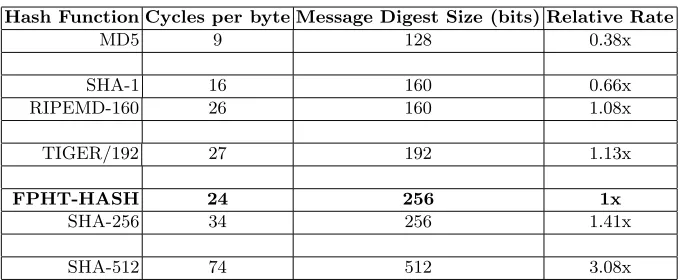
requiring a total of 16KB of memory. The Fig. 3 summarizes the speed of various hash functions (all written in portable C).
From the table it is evident that FPHT-HASH compares fairly well. The only design faster than itself is MD5 which produces a message digest half the size. In hardware the FPHT-HASH function scales nicely since theO(nlogn) based approach can be used reducing the time complexity to O(logn) and the space complexity toO(n).
Hash Function Cycles per byte Message Digest Size (bits) Relative Rate
MD5 9 128 0.38x
SHA-1 16 160 0.66x
RIPEMD-160 26 160 1.08x
TIGER/192 27 192 1.13x
FPHT-HASH 24 256 1x
SHA-256 34 256 1.41x
SHA-512 74 512 3.08x
Fig. 3.Comparison of Various One-Way Hash Functions.
3.3 Analysis
Non-Linear Transform γ The AES substitution box was chosen because it has a very low differential and linear profile. It was also readily available to prototype this design. The function has several fast hardware implementations which should render this design equally as efficient in software as hardware.
Linear Transformθ Theθtransform is theH5 transform. It has several fast
software implementations as well as a trivial implementation in hardware. The transform is complete in that every output coordinate is a function of all input coordinates. This promotes a very high level of diffusion. The transform also has a branch of 12 which allows the minimal trail weight to be bounded over two compositions of the transform.
The polynomialx8+x4+x3+x2+ 1 was chosen because it is irreducible
over GF(2)[x] and the polynomial p(x) = x is a primitive generator in the multiplicative sub-group.
3 The unique tables are for
Key Schedule The key schedule (step three) was designed to use all of the input in the first round and also make it hard to control the input in a mean-ingful manner. It is a simple LFSR generator with a rotation to further ensure higher diffusion of the key material. The purpose of the key schedule is to make differential trails less likely to succeed. Since the initial input state is fixed the attacker could create a differential trail of probability one through rounds where the input key were used verbatim. However, since the remaining round keys are a function of the input it is harder to ensure the probability one differential (it either exists or it does not).
In the case of this hash function we chose not to use the input key as verbatim at all. Instead we use the the linear mixing of the input through a LFSR with the key word number added in to prevent trivial slide attacks. For example, the first round keysW16..23 are a linear function of the inputW0..15 as well as the
first five generated keysW16..20. This construction is thought to make the design
resistant to related key attacks.
Differential and Linear Cryptanalysis Essentially FPHT-HASH is a 256-bit Substitution-Permutation Network applied in the Davies-Meyers mode (scheme 19 of [9]) to create a one-way hash function. TheH5 transform has a branch of
12 which means over the four rounds of the compression function there must be at least 24 active sboxes. As a result the best theoretical differential and linear trails would have a probability and bias of 2−6·24= 2−144and 2−4·24·223= 2−73
respectively.
It does not seem possible for a differential attack to cause a collision within the compression function faster than by the birthday paradox. We conjecture that FPHT-HASH offers 2128
time resistance to collision finding.
4
Conclusion
The FPHT has been analyzed with respect to its speed and security. The trans-form has a provably bounded branch value for any given dimension as well as a fast implementation which requires at mostO(NlogN) time to complete. We have also shown it is possible to join the FPHT and MDS to create a fast trans-form that has higher branch than the FPHT alone.
We have also shown a relatively simple one-way hash function which achieves a competitive (if not superior) processing throughput when compared to other well known published designs. We would like to thank Matthew Johnson of the University of Western Australia, Greg Rose of QUALCOMM Australia, Robert Gilmour, David Malan of Harvard University and Michael Gschwandtner of the University of Salzburg for valuable peer review.
References
[2] Paulo S.L.M. Barreto and Vincent Rijmen,The WHIRLPOOL Hashing Func-tion
[3] J. Stern and S. Vaudenay. CS-Cipher. In Fifth International Workshop on Fast Software Encryption, Berlin, Germany, March 1998. Springer-Verlag. [4] S.Vaudenay, “On the Security of the CS-Cipher”, Fast Software Encryption,
March 1999, Springer-Verlag, pp. 260-274
[5] J. Daemen. Cipher and hash function design: strategies based on linear and diferential cryptanalysis. PhD thesis, Katholieke Universiteit Leuven, March 1995
[6] J.L. Massey, “SAFER K-64: A Byte-Oriented Block-Ciphering Algorithm”, Fast Software Encryption, Cambridge Security Workshop Proceedings, Springer-Verlag, 1994, pp. 1–17.
[7] J.L. Massey, G.H. Khachatrian and Kuregian M.K. Nomination of SAFER++ as Candidate Algorithm for NESSIE. Available at www.cryptonessie.org. [8] J. Massey, G. Khachatrian, and M. Kuregian, “Nomination of SAFER+ as
Candidate Algorithm for the Advanced Encryption Standard (AES)”, NIST AES Proposal, 1998.
[9] B. Preneel, R. Govaerts and J. Vandewalle, “Hash Functions based on block ciphers: a synthetic approach.”, Crypto ’93, Springer-Verlag, 1993, pp. 368–378 [10] S. Vaudenay, “On the Need for Multipermutations: Cryptanalysis of MD4 and
SAFER”, LIENS - 94 - 23, November 1994
Appendix A - Test Vectors
The following are test vectors for FPHT-HASH.
""
d5 e9 5a a7 4d a3 9c 10 a9 ea 11 bd 22 49 a0 b3
be 67 e3 78 58 0d 72 f0 64 be 80 c5 3f c8 13 24
"abc"
b4 bd 4f ce cf 2f c3 c5 5d 1a 77 dd 2b 6e 6f 77
be bc 26 1b 1a b0 8e 32 1a 36 6a 66 3e f0 ad 3c
"The New Fast Pseudo-Hadamard Transform Hash Function."
b7 b9 be 3b 64 f7 2b ab 97 1f a7 71 3d ca d0 de
b1 1d ea 3e 67 39 5f cd 2b d9 d5 91 c9 5a 90 77
"aaaabbbb" x 12 times
43 27 10 2d e6 7b 49 f6 85 a4 12 e9 a9 7f 45 49
7a 9f 3d b3 d4 22 42 bb 93 cd c7 a0 97 55 b8 0f
This article was processed using the LA