ISSN (Print) : 2320 – 3765 ISSN (Online): 2278 – 8875
I
nternational
J
ournal of
A
dvanced
R
esearch in
E
lectrical,
E
lectronics and
I
nstrumentation
E
ngineering
(An ISO 3297: 2007 Certified Organization)
Website: www.ijareeie.com
Vol. 6, Issue 6, June 2017
Abnormality Extraction in Crowd
Payal P. Likhar, P.P.Gundewar
Department of Electronics and Telecommunication, MAEER’S MITCOE, Pune, India
Department of Electronics and Telecommunication, MAEER’S MITCOE, Pune, India
ABSTRACT: Abnormal activity detection is complex method specially in crowd. For man force finding abnormality is risky and difficult work. Many existing techniques are used to detect abnormality in crowd but not work properly. To address these problems, in this paper, a various techniques are used. Super Vector Machine (SVM) for simplification, wavelet transform for feature extraction. VIDEO surveillance equipment has been used for security purpose.
KEYWORDS: Abnormal Behavior Detection, Hypothesis, Video Surveillance, SVM.
I. INTRODUCTIONS
VIDEO surveillance equipment has been used for security purpose. Finding anomaly in a large number of people gathered in a disorganized way is difficult task.With the growth of population and rapid urbanization, the human activities are more and more frequent, so the security problem is one of the main problemsin public places.Gaoya Wang, Huiyuan Fu, Yingxin Liu proposed a new technique for the detecting real time anomaly based on adjacent flow location estimation. They use filter to remove noise present in the image and histogram for enhancing the image contrast. Cewu Lu presented a method based on inherent redundancy of video structures, they proposed an efficient sparse combination learning frame. Lu wang et al [9]proposed to use visual contexts based on scale and occlusion cues from detections at proximity to better detect pedestrians for surveillance applicationsWe present an algorithm to calculate accurate abnormality detection from computer vision, non linier pedestrians activity tracking and find unwanted activities. In this paper, we deal with an problem occurs during anomaly detection and proposed algorithm which find accurate and fast abnormal action occurs in crowed scenes. Our system uses algorithms like Optical flow for finding motion vector. Gradient for edge detection, wavelet transform for feature extractions, Histogram for enhancement, SVM for simplification.
II. OBJECTIVES
Because of increment in population detection of anomaly activity is very important part. But detecting these activities utilizing human exertion is exceptionally unsafe work. So for that utilizing this proposed framework the issue will settle.
The research aims towards solving the major problems of crime in crowded area. This system is used in anywhere for security purpose especially in mall, railway station, garden, movie theater, in traffic control, in no entry area etc.
III. LITERATURE SURVEY
ISSN (Print) : 2320 – 3765 ISSN (Online): 2278 – 8875
I
nternational
J
ournal of
A
dvanced
R
esearch in
E
lectrical,
E
lectronics and
I
nstrumentation
E
ngineering
(An ISO 3297: 2007 Certified Organization)
Website: www.ijareeie.com
Vol. 6, Issue 6, June 2017
They accomplish continuous video preparing of the real application prerequisites, along these lines it can be utilized as a part of handy applications, particularly during the time spent social public security.
Russell Stewart1 et al. [2]praposed another technique for objectdetection and exhibited its execution on the TUD Crossing furthermore, Brainwash datasets. The framework addresses the test of identifying different somewhat blocked occasions by disentangling a variable number of yields from rich moderate presentations of a picture. To deliver lucid arrangements of forecasts, they characterized a misfortune work reasonable for preparing our framework end to end. The approach keeps running at 15 outlines for every second on a present day GPU. It imagine that this approach may likewise demonstrate compelling in other forecast undertakings with structured outputs , for example people tracking and articulated posture estimation.
YoungJoonYoo et al. [3] author presented the novel way forecast calculation that considers the moving progression of co occurring objects. To tackle the issue, they initially planned two-layered probabilistic model to separate the significant development designs and their co-event assembles in a scene. Using the outcome from the proposed show, they have displayed a compelling way forecast technique. By broad subjective/quantitative examinations, we have demonstrated that our calculation can foresee the future ways of articles in complex scenes including many moving articles and evolving circumstances, for example, cross avenues with traffic lights.
The author [4] proposed a calculation to identify unusual occasions in swarmed scenes with worldwide edge scale. The strategy contains two fundamental methods: one is to register HMOFP of the info video grouping in light of the saliency outline optical stream field, the other is to use the online lexicon learning strategy to acquire the improved word reference on the premise of ideal preparing test set and figure the SRC estimations of testing outlines. The proposed strategy has been tried on UMN dataset with fulfilling comes about abnormal event detection.
Yie-Tarng Chen et al. [5] has built up another Kullback-Leibler Importance Estimation Procedure (KLIEP)-based plan for irregular discovery in swarmed scenes, which straightforwardly decides the proportion of the test and preparing densities, the significance, as opposed to these densities independently. In view of KLIEP, the significance for every element descriptor of the 3D shapes can be resolved, from which the inconsistency occasions can be recognized. Hanhe Lin et al. [6] have proposed a novel system to identify odditiesin group scenes. By keeping the KKT conditions fulfilled for the augmented informational collection, their approach viably upgrades one-class SVMs models in an online manner. The online calculation alongside the utilization of a sliding window can adjust to new examples and overlook out of date examples in the meantime. Palatable execution is picked up for the recognition of both worldwide and neighborhood peculiarities utilizing benchmark datasets.
Jingling Liu et al. [7] have addressed an approach for the People Detection in Crowded Scenes by Context-driven Label Propagationproposes a novel way to deal with enhance individual’s discovery in swarmed scenes by investigating relevant signs. The approach models individual’s co operations through a setting diagram, by means of fascination and shock assembled up on both geometric and meaningful gestures accessible in swarmed situations. Relevant possibilities are logically spread by mark proliferation, with the end goal that relevantly perfect human theories get fortified by getting positive possibilities amid the engendering while false cautions are contained due to being invalidated by contextual incompatibility
Vijay Mahadevan et al.[8] work shows the comparision of the various techniques and The outcomes demonstrate that the MDT-based inconsistency discovery outflanks all different methodologies. The distinction in execution is more articulated in the inconsistency restriction assignment, showing that the rest of the methodologies might appreciate great discovery rates in the oddity location errand due to fortunate hits. Unmistakably, notwithstanding when spatial and transient discovery plans in view of optical stream are joined (SF-MPPCA), they don't perform well
Lu Wang et al.[9] presented the endeavor scale earlier and impediment examination to recognize people on foot in swarmed scenes. Scale earlier at every picture area is evaluated in light of data gave by neighboring recognitions, and the certainty score of every discovery is refined by its consistency with the evaluated scale earlier. Neighborhood impediment investigation is proposed to encode impediment data into recognition certainty scores, which encourages the final fast detection cluster based Non-Maximum Suppression (NMS).
ISSN (Print) : 2320 – 3765 ISSN (Online): 2278 – 8875
I
nternational
J
ournal of
A
dvanced
R
esearch in
E
lectrical,
E
lectronics and
I
nstrumentation
E
ngineering
(An ISO 3297: 2007 Certified Organization)
Website: www.ijareeie.com
Vol. 6, Issue 6, June 2017
Yuan Yuan et al. [11] work address the issue of anomaly detection in activity scenes from a driver's point of view, which is imperative to self-governing vehicles in savvy transportation frameworks. So as to handle three primary troubles brought on by the versatile camera, this work depicts movement extent and introduction separately, and by measuring the variation from the norm of these two viewpoints at the same time in conjunction with an adaptively weighted joining, the proposed technique can lighten the impact of the perpetually changing scene and camera development. In particular, another movement descriptor is exhibited to speak to the movement size and introduction by figuring a histogram individually. It performs superior to THOOF, which just depicts the movement introduction data. Bayesian model is used in this system. Sparse reconstruction is use for configurationally changes.
IV. SYSTEM ARCHITECTURE
A. BLOCK DIAGRAM
Fig 1: block diagram of System
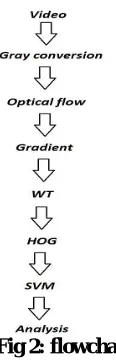
The input to the system is in video format In particular, given a video arrangement, moving pixels are recognized with an edge contrast strategy. Keeping in mind the end goal to decrease the computational complexity, spatio- temporal blocks that don't contain any moving pixels are prohibited. For the rest of the pieces, we speak to protest appearance with spatial subsidiaries in even and vertical bearings, and depict movement data by optical stream at every area. At last, factual components, for example, histogram of situated angle (HOG) and HOF, are calculated and consolidated together to represent video events.
B. FLOWCHART
Fig 2: flowchart
ISSN (Print) : 2320 – 3765 ISSN (Online): 2278 – 8875
I
nternational
J
ournal of
A
dvanced
R
esearch in
E
lectrical,
E
lectronics and
I
nstrumentation
E
ngineering
(An ISO 3297: 2007 Certified Organization)
Website: www.ijareeie.com
Vol. 6, Issue 6, June 2017
an image sequence. Event is described. Wavelet transform is used for feature extraction. WT calculate features like Entropy, Energy, Homogeneity, correlation and contrast .These steps are done on training phase as well as on testing phase. Combining both the result and after that we use classifier. Support Vector Machine (SVM) is used for classification. It classify two different classes, classes are normal and abnormal. SVM compare test set and model. After that it separate the abnormal event and normal event with the help of unique classes and display it.
V. IMPLEMENTATION RESULT
The below figure shows the confusion matrix.
Frame Detected Normal and abnormal
Frame Detected 823 177
Normal and abnormal 109 8
Figure 3(F). Visualize the final result with confusion matrix. The numbers in the bottom side of the matrix give the overall accuracy. We achieved the final accuracy of 96.48% as shown in fig. 3(F) above.
The manual calculations are given below:- No of Data set Frames: - 1000
Positive (P):-843 Negative (N):- 123
Accuracy= = = 96.48%
True positive rate = = = 82.3%
True negative rate = = = 19.1%
Fig 3: Input Image
ISSN (Print) : 2320 – 3765 ISSN (Online): 2278 – 8875
I
nternational
J
ournal of
A
dvanced
R
esearch in
E
lectrical,
E
lectronics and
I
nstrumentation
E
ngineering
(An ISO 3297: 2007 Certified Organization)
Website: www.ijareeie.com
Vol. 6, Issue 6, June 2017
Fig 5: Gradient of that Image
Fig 6: Optical flow of given image
Fig 7: Detecting moving action and analysis result
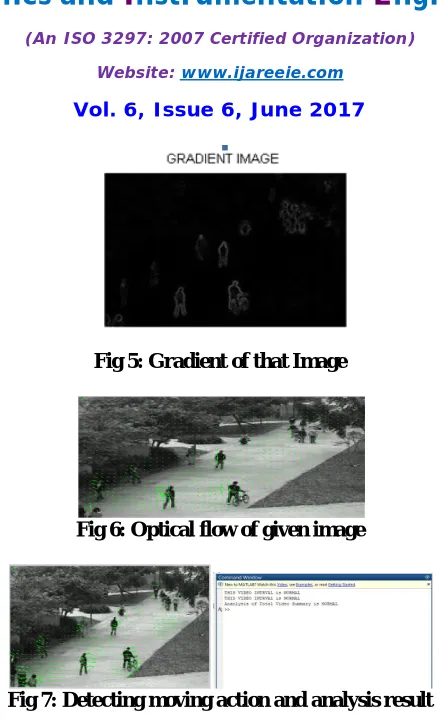
Above figures shows processing of our work. Image taken as input image as shown in figure 3. Pre processing is done on that image. Filtration, image conversion colour image to gray image for better image processing purpose shown in figure 5. For plotting image and calculating moving vectors optical flow algorithm is used as shown in figure 6. In figure 7 moving activity and result analysis is shown.
VI. CONCLUSION
We have presented an abnormal event detection method. This method is more accurate and fast. This paper present an novel method to detect anomaly based on SVM. Normal event are detected from training phase and abnormal event from testing phase. By comparing testing and training videos result we conclude on is video is normal or not. This system used algorithms like SVM, HOG, Wavelet Transform etc. for better result.
REFERENCES
[1] Gaoya Wang, Huiyuan Fu, Yingxin Liu, “Real time abnormal crowd behavior detection based on adjacent flow location estimation”, Beijing University of Posts and Telecommunications, Beijing 100876, China, 4 Pages ,2015
[2] Russell Stewart1, Mykhaylo Andriluka1,2, and Andrew Y. Ng1 “End-to-end people detection in crowded scenes IEEE Conference on Computer Vision and Pattern Recognition,” 2016
[3] YoungJoonYoo, Kimin Yun, Sangdoo Yun, JongHee Hong, HawookJeong and Jin Young Choi “Visual Path Prediction in Complex Scenes with Crowded Moving Objects,” Perception and Intelligence Lab., School of ECE, ASRI, Seoul National University2Samsung Electronics Co., Ltd2016 IEEE Conference on Computer Vision and Pattern Recognition,2016.
[4] Ang Li, Zhenjiang Miao, Yigang Cen, Tian Wang and viacheslavVoronin, “Histogram of maximal Optical Flow Projection for Abnormal Events Detection in Crowded scenes”, International journal pf distributed sensor networks,Vol.2015,Article ID40941,11 pages,2015.
[5] Yie-Tarng Chen, Wen-Hsien Fang, Chih-Yuan Lee, and Kai-Wen Cheng “Abnormal Detection in Crowded Scenes via KernelBased Direct Density Ratio Estimation” Department of Electronic and Computer Engineering National Taiwan University of Science and Technology,2015 [6] Hanhe Lin Jeremiah D. Deng Brendon J. Woodford “Anomly Detection In Crowd Scenes Via Online Adaptive One-Clsssupport Vector” Machines Department of Information Science, University of Otago, IEEE 978-1-4799-8339-1/15/$31.00 ©2015
ISSN (Print) : 2320 – 3765 ISSN (Online): 2278 – 8875
I
nternational
J
ournal of
A
dvanced
R
esearch in
E
lectrical,
E
lectronics and
I
nstrumentation
E
ngineering
(An ISO 3297: 2007 Certified Organization)
Website: www.ijareeie.com
Vol. 6, Issue 6, June 2017
[8] Vijay MahadevanWeixin Li Viral BhalodiaNunoVasconcelos “Anomaly Detection in Crowded” ScenesDepartment of Electrical and Computer Engineering University of California, San Diego,2010.
[9] Lu Wang LishengXu Ming-Hsuan Yang “Pedestrian Detection In Crowded Scenes Via Scale And Occlusion Analysis”
[10] MohammadrezaYavari and Maozhen Li “Parallelizing Abnormal Event Detection in Crowded Scenes with GPU” Department of Electronic and Computer Engineering, Brunel University London Uxbridge, UB8 3PH, UK Maozhen Li and Siguang Li The Key Laboratory of Embedded Systems and Service Computing Tongji University Shanghai, 200092, ChinaMan Qi Department of Computing Canterbury Christ Church University Canterbury,Kent, CT1 1QU, UK