
A Novel Spatial Modulation Scheme Using
Trellis Code
Reshna Chandrasekhar
1, Mercy George
2PG Student [ACIS], Dept. of ECE, Mar Baselios Institute of Technology and Science, Nellimattom, Kerala, India1
Assistant Professor, Dept. of ECE, Mar Baselios Institute of Technology and Science, Nellimattom, Kerala, India2
ABSTRACT:In this fast growing modern era of wireless communication we need modulation schemes that have minimum power and bandwidth requirements but has high efficiency. There was a great boost in spectral efficiency with the advent of Multiple-input-multiple output systems (MIMO).This system still had certain drawbacks like high complexity and hardware cost. So we needed an even more efficient scheme and hence came to the concept of Spatial modulation. In this modulation scheme multiple antennas are considered as additional constellation points that carry information bits. Only one antenna is active at a time and the antenna index is also transmitted along with the information bits. This antenna index is encoded using trellis code which is a new concept. Hence this modulation scheme is termed as Trellis coded spatial modulation. The performance of TCSM is compared with other modulation schemes to show that it is better efficiency.
KEYWORDS:
spatial modulation, trellis coded modulation, MIMO
.I.INTRODUCTION
Due to increasing data rates in modern era wireless communication systems is now a very challenging field. The spectrum or bandwidth available to the service providers is often limited. The power requirements are also to be cut down to as low as possible to achieve better energy efficiency. Thus, the designers for wireless systems face a two-part challenge, increased data rates and performance improvement with little or no increase in bandwidth and power. The main disadvantage with error correcting codes is bandwidth expansion. So for a band limited system such as a telephone system, use of error correcting codes is difficult. In order to use bandwidth efficiently without increasing power, a new method called trellis coded modulation can be used. It is a method which combines the error correction and modulation functions of the communication system, to achieve better gains in system performance. In TCM, the bandwidth expansion is not required because it uses the same symbol rate and power spectrum. The main differences are the introduction of a redundancy bit and the use of a constellation with double points. The main idea of TCM modulation is to partition the symbols into different sets of same size and in each set the distance between the symbols should be maximized. When the signals are transmitted over the wireless communication channel the main problem is that it experiences fading and so the error performance of the system degrades. In order to achieve high capacity and to avoid fading, multiple antenna elements can be used at both the transmitter and receiver of a wireless system. This leads to the development of a multiple transmit-receive architecture called Bell Labs Layered Space-Time Architecture (BLAST). One main type of BLAST is V-BLAST (vertical BLAST). In this the information bit stream is divided into many sub streams and then it is modulated and transmitted through the channel using same bandwidth. At the receiver the reverse operation is performed. When the number of transmit antenna increases then the data rate also increases. The function of the receiver is to nullify the effect of inter channel interference between the transmitted symbols. In MIMO system all the antennas will be active at both the transmitter and the receiver of a wireless system. In MIMO system the complexity, power and the cost of hardware is increased.
SM. This novel method is known as Trellis Coded Spatial Modulation (TCSM).By using these method antennas is partitioned into different sets of equal size and in each set the distance between the antenna pair is maximized. Different modulation schemes like BPSK,4-QAM and 16-QAM are tested to know which one has better performance. The performance of TCSM is then evaluated in AWGN and kronecker channels. The BER curve for TCSM model, VBLAST, SM and Alamouti are then evaluated for different modulation schemes.
II.
TRELLIS CODE AND SPATIAL MODULATIONWhen data is transmitted through a wireless channel, errors are introduced in it and channel coding is used to remove these errors and recover the actual data that is transmitted perfectly at the receiver. Channel coding is performed by adding redundant parity bits to the data to be transmitted. Using simple channel coding schemes, only error detection is possible while error correction is also possible using more advanced channel coding schemes. Thus, the need for retransmission is eliminated as well as higher reliability is also achieved. In the proposed system, TCM is applied to the antenna index of the input and the remaining input bits are modulated and transmitted through the channel. At the receiver Viterbi decoding is performed and evaluated its error performance.
1. Trellis coded modulation
Trellis coding is an error correcting technology in modern digital communication system. The word trellis denotes the use of trellis (also called convolutional) codes. With TCM it can be said that there is no bandwidth expansion but signal set expansion. For conventional systems with convolutional codes, the free Hamming distance is an important figure of merit, but with TCM the free Euclidean distance between signal points is more important. Generally, the choices of coding and signal constellation do not take place separately.TCM combines the functions of a convolutional coder of rate R = k / k + 1 and a M-ary signal mapper that maps M = 2^kinput points into a larger constellation of M = 2^k+1 constellation points. The bits given to the convolution encoder is used to select the subset and the bits uncoded are used to select the signals from subsets. First, the trellis diagram of the convolutional code must be found. Distance properties of the TCM system can be analyzed through the trellis diagram. The Viterbi algorithm is used for decoding. The Viterbi algorithm decodes the convolutional code by selecting the most likely path through the trellis, which represents the received code sequence and is associated with given received information sequence.
2. Spatial Modulation
III.PROPOSED SCHEME
The proposed scheme combines trellis coded modulation and spatial modulation, and forms new system models i.e. trellis coded spatial modulation. The main idea is to apply a bandwidth efficient modulation technique to the antenna constellation points of spatial modulation (SM). The aim is to improve SM performance in various channel conditions. In this mainly AWGN and Kronecker channels are used. Also the performance of TCSM for various modulation schemes is evaluated. In this mainly BPSK and 4-QAM are used currently. As a future extension 16-QAM is also to be compared.
Figure 1: Block diagram for proposed TCSM system
The TCSM system model is shown in Fig 1.In this assume there are four transmit antennas (Nt=4) and four receive
antennas (Nr=4).First the information bits are generated and the input bits at each time instant are grouped as the row
vectors of the matrix x(t).The first step is to split the matrix into two matrixes i.e. q1(n) and q2(n) where q1(n) represents
the antenna index and q2(n) represents the information bits. The first matrix q1(n) maps the bits into antenna
constellation points and the second matrix q2(n) maps the bits into signal constellation points. In this modulation used is
BPSK (phase shift keying) and 4-QAM (quadrature amplitude) and the second matrix is mapped into corresponding constellation points, where each element in this matrix corresponds to the symbol that is transmitted from one antenna at one time instant. The first matrix, q1(n), is then used to select the transmit antenna which is active. Before mapping
the bits in the first matrix to the spatial constellation points (the transmit antenna indexes), the bits are given to a TCM encoder. Consider the spacing between the antennas are equal and the output of the TCM encoder is used to select the antenna which is active. The first matrix q1(n) is transformed into another matrix l(n) by giving the output to an
encoder.
The SM mapper operates on both l(n) and q2(n) matrices creating the output matrix. Each column of the output matrix
is transmitted at a single time instant from the active transmit antennas over AWGN channel H(n). Then the signal transmitted will be received. Assume the channel and the noise are independent and identically distributed (iid) entries according to Gaussian distribution. In this AWGN channel model is considered along with many modulation types. At the receiver, the transmitted bits should be decoded. For that the optimum SM decoder is used to estimate the transmitted symbol ˜q2(n) and the transmitted antenna index ˜l(n).The estimated antenna number is de-mapped to the
IV. CHANNEL MODEL
A channel is mainly used for transmitting information. The capacity of the channel is measured by its bandwidth in Hz or its data rate in bits per second. The word channel refers to the medium between the transmitting antenna and the receiving antenna. When the signal is transmitted from the transmitter antenna to the receiver antenna, the characteristics of the wireless channel changes. These characteristics depend upon the distance between the two antennas, the path that the signal follows and the environment surrounding the path. At the receiver, the received sample vector on the receive antennas can be expressed as, y=Hx+n where channel matrix is denoted by H. One of the important models is AWGN channel model. In this noise will be added additively and the impairment to communication is a linear addition of wideband or white noise with a constant spectral density and a Gaussian distribution of amplitude.
MIMO (Multiple Inputs Multiple Outputs) system uses multiple antennas at the transmitters and receivers. By using this technique data rate can be increased. In this, corresponding to every antenna, there will be a RF chain and this will increase the complexity and power consumption. As the number of antenna increases numbers of RF chains will also increase. The main architectures of MIMO is VBLAST and Alamouti system model and is discussed below.
1. V-BLAST SYSTEM MODEL
To achieve high capacity, BLAST architecture can be used. Bell Laboratories Layered Space-Time (BLAST) is a transceiver architecture that contributes spatial multiplexing over multiple wireless communication systems. Such systems have multiple antennas at both the transmitter and the receiver in an effort to exploit the many different paths between the two in a highly-scattering wireless environment. The BLAST scheme de-multiplexes a user data stream into a number of sub streams that are equal to the number of transmission antennas. By implementing V-BLAST algorithm, the diversity gain is increased and the bit error rate (BER) performance is improved. The MIMO system is assumed to undergo flat fading channel.
5.2. ALAMOUTI SYSTEM MODEL
Alamouti introduced a new transmit diversity scheme, known as Alamouti scheme. In this scheme it uses two transmit antennas and any number of receiving antennas (Nr ) and it has a maximum diversity order of 2Nr.Since it transmits two
symbols after every two time periods, Almaouti scheme has the rate of unity. In the Alamouti space-time encoder, information bits are grouped and in each group there will be m information units and then it is modulated, where m=log M .Then, the encoder takes a block of two modulated symbols x1 and x2 in their respective time intervals and maps
them to the transmit antennas according to a code matrix. In the first time slot, the first and second antenna transmits the symbol x1 and x2. In second time slot –x2*and x1* will be transmitted from the first and second antenna. Here
grouping two symbol s-means there will be two time slots to send two symbols. Hence, there is no change in the data rate. At the receiver maximal ratio receiver combining (MRRC) is used.
V. RESULT AND DISCUSSION
The proposed method is tested on MATLAB R2014a, to justify the effectiveness of the proposed scheme. In order to simulate the proposed TCSM idea, the average BER is plotted versus the average SNR at each receiver input. The simulation settings are given below,
1) The number of transmitting and receiving antennas are selected and different modulation schemes such as BPSK and 4-QAM are used.
2) Then it is passed through different channels like AWGN and Kronecker channel with different values of SNR. 3) At the receiver end, they were demodulated, and decoded to extract the transmitted messages
.
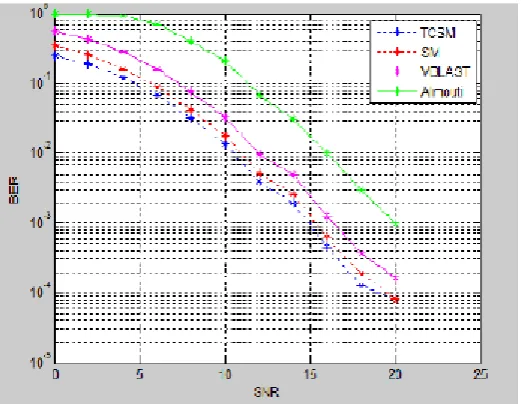
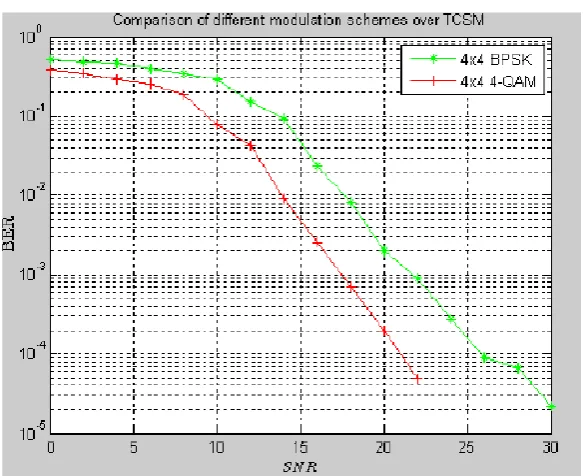
shown in figure 2 and figure 3.In figure 4, 4-QAM and BPSK modulation scheme comparison is shown and modulation order is increased for 4-QAM is better than BPSK.
Figure 2: Performance comparison in AWGN channel
Figure 4: Performance comparison of various modulation schemes
VI. CONCLUSION
Here, a new bandwidth efficient coding technique for spatial modulation is implemented. This scheme consists of trellis coded modulation scheme that is applied to the antenna index of spatial modulation. Trellis coded modulation is a method which improves the noise immunity of digital transmission systems without expansion of bandwidth or reduction of data rate. Here we have a communication channel presented using the combination of convolution coding and one of the selected modulation schemes. The combined effect of Spatial Modulation and Trellis coding is compared with VBLAST, Alamouti and SM systems. It is found that the trellis coded spatial modulation offers significant advantages in BER compared to V-BLAST, Alamouti and SM systems. Also the BER curve of TCSM for different modulation schemes is obtained. This is an ongoing project and we need to compare it with many other modulation schemes to show that TCSM is the most efficient scheme in modern communication system.
REFERENCES
[1] Bernard Sklar, “Digital Communications: Fundamentals and Applications”, Prentice Hall.
[2] Shu Lin and Daniel J. Costello, Jr.,“Error control coding: Fundamentals and Applications”, Prentice Hall
[3] G. Ungerboeck, “Channel coding with multilevel/phase signals,”IEEEJ.Inf.Technol., vol. 28, no. 1, pp. 55–67, 1982.
[4] Calderbank,R. and J.E.Mazo,”A New Description of Trellis Codes”,IEEE Transactions onInformationTheory,November1984,30(6),pp.784-791 [5] E. Biglieri et al., “Introduction to Trellis-coded modulation Application” McMillian Newyork,1991
[6] S. Benedetto et alii, “Performance Evaluation of Trellis Coded modulation Schemes”, IEEE Proceedings,2003
[7] E. Telatar, "Capacity of Multi-Antenna Gaussian Channels,"European Transaction Telecommunication, vol. 10, no. 6, pp.558-595, November/December 1999.
[8] S. Loyka and G. Tsoulos, "Estimating MIMO System Performance Using the Correlation Matrix Approach," IEEE CommunicationsLetters, vol. 6, no. 1, pp. 19-21, January 2002.
[9] By Marco Di Renzo, HaraldHaas,AliGhrayeb, Shinya Sugiura, Senior Member IEEE, “SpatialModulation for GeneralizedMIMO: Challenges, Opportunities,and Implementation”, Proceedings of the IEEE, Vol. 102,No. 1, January 2014.
[10] A.F. Molisch and M. Z. Win, “MIMO systems with antenna selection,"IEEEMicrow. Mag., vol. 5, no. 1, pp. 46-56, Mar. 2004

![(E) 4 [(3,5 Dimethylphenyl)iminomethyl] 2 methoxy 3 nitrophenol](data:image/gif;base64,R0lGODlhAQABAIAAAP///wAAACH5BAEAAAAALAAAAAABAAEAAAICRAEAOw==)