RELIABILITY MODEL ASSORTMENT AND
FAILURE PARAMETER GROUPING FOR
MAINTENANCE ANALYSIS OF HYDRO POWER
PLANTS: A REVIEW
Sunil Chaturvedi
1, Prof.K.K. Jain
2Department of Mechanical Engineering, National Institute of Technical Teachers Training and
Research, Bhopal (M.P), INDIA.
ABSTRACT
Hydro power generation is one of the most successful renewable energy resources for the production electrical energy without any environmental hazard and presently it providingmore than 86% of all electricity generated by renewable sourcesworldwide and accounts for about 20% of world electricity.Maintenance and operation of a hydro power plant is very complicated and the process to calculate and analyzing its compatibility and reliability is very important. The availability and reliability of power plant can be evaluated by taking into account different failure parameter, namely failure rate (λ), repair rate (µ), MTTR, MTTF, MTBF. Reliable and durable operation of any power plant or system depends upon maintenance. The error in any a single sub unit can affect the annual performance and efficiency of power generation. Proper selection of reliability model and various failure parameter help to decrease repair cost, identifying sensitive equipment’s to be replaced and probable errors can be removed that improve availability of power at low cost as per given input, and allow a fair step towards energy independence of local community. Reliability model selection plays a key role in the cost-effectiveness of systems. Therefore the sole purpose of this study is intended to provide improved criteria for future proposal and serves as a basis for generation expansion planning of hydro power plants.
Keywords: hydro power plant, Reliability models, Reliability/failure parameters, Reliability
approach
I. INTRODUCTION
In today’s technological world nearly everyone depends upon the continued functioning of a wide arrangement
continuous power supply to consumer without failure. If once the any one of the plants machinery/equipment fails even for few days the generation of power will shut down and it directly involves capital (loss of huge capital) and no power supply to consumer which also involves the loss of money from the consumers. The failure of individual machinery/equipment or whole plants again and again required some maintenance action which directly influenced on the cost of power generation and power supply to the customers per unit. Therefore our intention must be to increase the performance, efficiency and the system must be reliable. Let us discuss some model which describes the nature of probability of failure, probability of survival (Reliability) of the system.
II. RELIABILTY MODELS
The following are the model which is helpful to evaluate the reliability distribution function.
2.1 Time to Failure Models
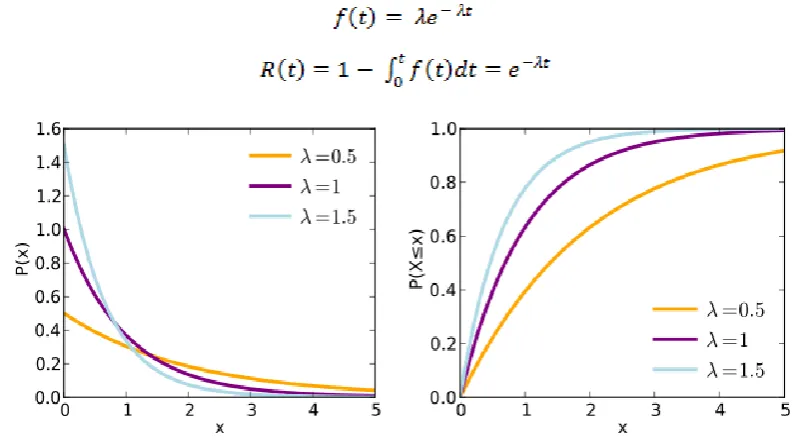
(a)The Exponential Model: - The exponential distribution, the most basic and widely used as reliability prediction formula, models machines with the constant failure rate. The Exponential Model is used during the ‘Useful Life’ period of an item’s life, i.e., after the ‘Infant Mortality ‘phase before Wear out begins. The
probability distribution function is written as:
Fig. 1 Reliabilityexponential distribution function model
(b)The Weibull Model: - The exponential distribution is often limited in applicability due to the memory less property. The Weibull distribution (Weibull 1951) is a generalization of the exponential distribution and is commonly used to represent fatigue life, ball bearing life, and vacuum tube life. The Weibull distribution is exceptionally flexible and suitable for modeling component lifetimes with unpredictable hazard rate functions and for representing various types of engineering applications.The Weibull distribution has the great advantage in reliability work that by adjusting the distribution parameter. It can make to fit many life distributions. The Weibull reliability function is:
Where β is shape parameter and α is scale parameter or characteristic life. It is the life at which 63.2 of the
population will have failed.
Fig.2 Reliability Weibull distribution function model
(c)The Normal (or Gaussian) Model: -
Normal distribution plays an important role in classical statisticsowing to the Central Limit Theorem. In reliability engineering, the normal distribution primarily applies to measurements of product susceptibility and external stress. This two- parameter distribution is used to describe systems in which a failure results due to some wear out effect for many mechanical systems. The normal distribution function is:
Where µ is the location parameter equal to the mean. The mode and median are coincide with the mean as the probability distribution function is symmetrical, and σ is the scale parameter equal to the standard deviation.
Fig.3 Reliability Normal distribution function model
with its applications in maintainability engineering, is able to model failure probabilities of repairable systems and to model the uncertainty in failure rate information. The log normal density function is given by
Where µ&σ = the mean and standard deviation of the ln data.
Fig.4 Reliability Log-Normal distribution function model
2.2 Discrete Event Models
(a) The Binomial Model: -
The binomial distribution is one of the most extensively used discrete randomvariable distributions in reliability and quality assessment. It has applications in reliability engineering, e.g., when one is dealing with a situation in which an event is either a success or a failure. The pdf of the distribution is given by.
Where n = number of trials. x= number of successes. p= single trial probability of success.
The reliability function, R(x), (i.e., at least x out of n items are good) is given by
(b)The Poisson Model: -
Although the Poisson distribution is used in a similar manner to the binomialdistribution, it is used to deal with events in which the sample size is not known. This is also a discrete random variable distribution whose pdf is given by
x= is the number of events. In other words, P(X=x) is the probability of exactly x failures occurring in time t.
Therefore, the reliability Poisson distribution, R(k) (the probability of k or fewer failures) is given by
This distribution can be used to determine the number of spares required for the reliability of standby redundant systems during a given mission.
2.3 Reliability Technique or Method
Method of evaluation of reliability techniques they are categories by two approach 1)Analytical 2)Simulation. Analytical approaches gives information about mathematical modeling & evaluate reliability indices by mathematical solution. Whereas simulation technique gives information about to estimates the reliability indices by simulating the actual process & random behavior of the system (like Monte Carlo). Many tasks, techniques and analyses are specific to particular industries and applications. Commonly these include:-
•Failure mode and effects analysis (FMEA) •Reliability Hazard analysis
•Reliability Block Diagram analysis •Fault tree analysis
•Root cause analysis •Sneak circuit analysis •Accelerated Testing •Reliability Growth analysis •Weibull analysis
•Thermal analysis by Finite Element Analysis (FEA) and / or Measurement
•Thermal induced, shock and vibration fatigue analysis by FEA and / or Measurement •Electromagnetic analysis
•Statistical interference •Boolean algebra
•Avoidance of Single Point of Failure
•Functional Analysis (like Function FMEA) and functional Failure Analysis (FHA or FFA) • Markovian analysis approach
•Predictive and preventive maintenance: Reliability Centered Maintenance (RCM) analysis •Testability analysis
•Failure diagnostics analysis (normally also incorporated in FMEA) •Human error analysis
•Operational Hazard analysis / •Manual screening
III. LITERATURE REVIEW
Adam Baharum,Faris Mahdi Alwan,and Saad Talib Hasson et al.[1] In this work he is presenting an algorithm for estimating the performance of high-power station connected in series, parallel, and mixed series –parallel with collective factor failures caused by any part of the system equipment. The objective of this work are to increase the life lifetime of the station and reduce sudden station failures. In this work data analysis was performed using the most valid distribution of the Weibull distribution with scale parameter α=1.3137 and shape parameter β=94.618. This analysis revealed that the reliability value decreased by 2.82% in 30 days. The result
of this work can be used for the maintenance of power system models and preventive maintenance model for power systems.
Ungji Kwon, Trungtinh Tran, Sangheon Jeong, Bo Shi, Jaeseok Choi et al. [2] In this paper he is presenting a practical method of probabilistic reliability evaluation of KOREA Power system by using the Probabilistic Reliability Assessment (PRA) program and Physical and Operational Margins (POM).this work is case study to compute the Probabilistic Reliability Indices (PRI) by applying the above method. PRA & POM take large number of contingency in load stimulations and combines them with practical method of characterizing the effect of the availabilities & effectiveness of generators,line & transformers. In this paper he is simulating to above analyze the condition of the system under these constraints that are voltage violation, overload violation and voltage stability violation. The result shows of reliability indices are different type with other method.
Farshad Khosravi, Naziha Ahmad Azli, Ebrahim Babaei et al.[3] Some paper have introduced the modeling methods for reliability production of transferring distribution parts at the power system but in this work for the first time he is presenting the analysis of reliability indices for all parts of generation unit (Thermal power plants) by using the new method of modeling. In this work he is calculating the unit indices in different states of power limitations and power not supplied can be calculated. It can be also calculated the total average of annual not supplied energy on the basis of occurred different errors.
Manjit verma, Amit Kumar, Yaduvir Singh et al. [4] In this paper he describes a fault tree technique based on generalized fuzzy numbers to a possibility distribution of reliability indices for power system are used. In this paper, the fault-tree incorporated with the generalized trapezoidal fuzzy number and minimal cut sets approach is used for reliability assessment of power systems and us by using this approach fuzzy system reliability can be analyzed in a more flexible and intelligent manner. In this work he has been constructed fault for gas power plant and due to uncertainty all the collected data are represented by generalized trapezoidal fuzzy number.
M. VALDMA, M. KEEL, H. TAMMOJA, K. KILK et al. [5] In this work he is evaluating the reliability principle of electric power generation in a power system including thermal and wind power plants. In this work he is recommended uncertain probabilistic models of reliabilities besides of classical probabilistic model. This work is based on reliability studies of oil shale power plants and unit. In this work the power output by wind power plants is treated as non-stationary random process. This case study is done on pakri wind pork and wind power plant of Denmark.
available in the period. To improve the performance indices of the point he has been suggested such as training of operation and maintenance. Personal regularly improvement in O & M practices proper spare parts inventory etc. This developed performance indicator to evaluate the performance indices and outage cost for the station can also be applicable to other power station elsewhere.
Mr. S. S. Hirve, Dr. Mrs. S. R. Deshmukh et al. [7] Since wind speeds vary from month to month and second to second, the amount of electricity produced by wind can varies constantly so the main objective of this work is to study the concept of capacity availability of wind turbine for maximum utilization of resources. This work shows excellent potential as a form of contribution to conventional power generation systems. In this work he is using wind turbine model and probability theory. Capacity availability for wind power estimation which forms an important input to proper resource utilization along with the probability of wind turbine. I this work the most commonly used analytical method for calculating reliability indices are- Markov process, the capacity outage probability table, loss of load probability (LOLP), loss of load expectancy(LOLE), loss of energy expected(LOEE). Another method used for reliability evaluation is Monte Carlo Simulation.
Shikha Bansal, S.C. Agarwal & Kuldeep Sharma et al. [8] In this work he is computing the terminal reliability of milk powder manufacturer plant based on minimizing Boolean expression technique for system of multistate elements. In this work he is developing Boolean reliability models was considered on the basis of logic, algebra of groups of incompatible events and classical logic and probabilistic method. The milk powder consists of four subsystems A, B, C, D viz. storage, hot plates, evaporator, dryer arranged in series. Sub system A&C has two units in standby with perfect switching, sub system B has two unit in parallel redundancy and sub system D has one unit. The reliability and MTTF have been evaluated for these systems and the failure rate is considered to be exponentially distributed.
Apoorva Kulakarni, Sharada Prasad C.R. et al. [9] The main objective of this project is to develop a method to evaluate the reliability of output power obtained from wind electric conversion system. The approach used for this work involves the simplified reliability model for wind energy conversion system. In this methodology four factors are calculated which are wind availability factor, constant power output factor, variable power output factor and factor for mechanical failure. To determine these factor Wiebull distribution are used and to plot the sensitivity graph for the several key parameter MATLAB are used.
Adamu Murtala Zungeru, Adegboye Babatunde Araoye, Bajoga Buba Garegy et al. [10] In this paper (work) his aimed at evaluating the reliability performance of Kainji hydro electric power station of Nigeria. Here the adopted approach are used for reliability evaluation are based on the frequency and duration (F & D). To set the reliability parameters which quantify the generating unit reliability are computed for each unit using the annual outage duration and then overall station reliability is evaluated by the convolution of the generation and load models using the F&D. There are total eight units and Kaplan turbines are using of the installed capacity of 760 MW.
IV. CONCLUSIONS
condition which will be very helpful to plan some required maintenance action before the occurrence of systems failure. In this paper I am discussing only the reliability distribution model and the approach/technique listed above which can be frequently employed to evaluate the reliability parameters and can also be used to compare the results. These calculated data base can also be used for further plant expansion. The result of this work will published in the main paper soon.
REFERENCES
[1] Adam Baharum, Faris Mahdi Alwan, and Saad Talib Hasson.A Case Study of Reliability and Performance of the Electric Power Distribution Station Based on Time between Failures.Hindawi Publishing Corporation Mathematical Problems in Engineering Volume 2013, Article ID 583683,6 pages.
[2] Jungji Kwon, Trungtinh Tran, Sangheon Jeong, Bo Shi, Jaeseok Choi.A study on probabilistic reliability evaluation of Korea power system by using PRA.
[3] Farshad Khosravi, Naziha Ahmad Azli, Ebrahim Babaei. A New Modeling Method for Reliability Evaluation of Thermal Power Plants. 2010 IEEE International Conference on Power and Energy (PECon2010), Nov 29 - Dec 1, 2010, Kuala Lumpur, Malaysia.
[4] Manjit Verma, Amit Kumar, Yaduvir Singh. Power System Reliability Evaluation Using Fault-Tree Approach Based on Generalized Fuzzy Number. ISPACS, Volume 2012, Year 2012 Article ID jfsva-00106, 13 pages.
[5] M. VALDMA, M. KEEL, H. TAMMOJA, K. KILK. RELIABILITY OF ELECTRIC POWER GENERATION IN POWER SYSTEMS WITH THERMAL AND WIND POWER PLANTS. Oil Shale, 2007, Vol. 24, No. 2 Special ISSN 0208-189X pp. 197–208 © 2007 Estonian Academy Publishers. [6] S.O. Oyedepo, R.O. Fagbenle, S.S. Adefila, S.A. Adavbiele. Performance evaluation and economic
analysis of a gas turbine power plant in Nigeria.
[7] Mr. S. S. Hirve, Dr. Mrs. S. R. Deshmukh. Evaluation of Reliability Indices and Cost worth Analysis for Generating Power Plants. International Journal of Engineering Research & Technology (IJERT) Vol. 2 Issue 12, December – 2013 ISSN: 2278-0181.
[8] Shikha Bansal, S.C. Agarwal & Kuldeep Sharma.EVALUATION OF RELIABILITY FACTORS USING BOOLEAN FUNCTION TECHNIQUE IN MILK POWDER MANUFACTURING PLANT. IJRRAS 4 (4) September 2010.
[9] Apoorva Kulakarni, Sharada Prasad C.R. Reliability Evaluation of Wind Power Plant Using Matlab. ISSN 2278 –0211.
[10] Adamu Murtala Zungeru, Adegboye Babatunde Araoye, Bajoga Buba Garegy. Reliability Evaluation of Kainji HydroElectric Power Station in Nigeria. Journal of Energy Technologies and Policy. ISSN 22243232 (Paper) ISSN 22250573. Vol.2, No.2, 2012.
[11] R. C. Okonkwo. Thermal power stations' reliability evaluation in a hydrothermal system. Nigerian Journal of Technology, Vol. 18, No. 1, September 1997.
[13] Mahendra Sahu and Amol Barve. Reliability and Availability Evaluation of Hydro Power Station. International Journal on Emerging Technologies 4(2):89-93 (2013).
[14] Jasbir Singh, Mr.Ram Avtar Jaswal. Evaluation of reliability parameter of thermal power plant by BFT. International journal of advanced engineering Technology. E-ISSN 0976-3945.