Review of Resource Allocation in Non-Orthogonal Multplie Access
System
Deepali Deshmukh
1Prof. Nitesh Kumar
21
M. Tech Scholar
2Assistant Professor
1,2Department of Electronics and Communication
1,2
SIRT, Bhopal, India
Abstract— Developing the wireless interface techniques represents one of the ways to enhance the capacity of future networks to meet the predicted high mobile data demand. In 4G networks, orthogonal multiple access is used as the wireless interface technique and proved its effectiveness against multi-path fading and achieving high system throughput. Recently, non-orthogonal multiple access (NOMA) is presented for upcoming generation i.e 5G, as a promising radio access scheme for further capacity enhancement and to accommodate the future traffic demand. Keywords: 5G, Resource Allocation, NOMA, Orthogonal
I. INTRODUCTION
Long Term Evolution (LTE) is a Fourth Generation 4G wireless broadband technology developed by the 3rd Generation Partnership Project (3GPP), an industry trade group. 3GPP was established in 1998 thereby started working on the radio, core network, and service architecture of a globally applicable Third Generation (3G) technology specification. 3G is specified by European Telecommunications Standards Institute (ETSI) and 3GPP within the framework defined by the International Telecommunication Union (ITU) standard known as International Mobile Telecommunication 2000 (ITU-200). Even though 3G data rates were already real in theory, initial systems like Universal Mobile Telecommunications System (UMTS) did not immediately meet the IMT-2000 requirements in their practical deployments. Hence the standards needed to be improved to meet or even exceed them. The combination of High Speed Downlink Packet Access (HSDPA) and the subsequent addition of an enhanced dedicated channel, also known as High Speed Uplink Packet Access (HSUPA), led to the development of the technology referred to as High Speed Packet Access (HSPA+) or, more informally, 3.5G. LTE got its name because it represents the next step (4G) in a progression from GSM, a second-generation (2G) wireless network standard, to UMTS, the third-generation 3G technologies based upon GSM (Global System for Mobile Communication) standard. 4G LTE provides significantly higher peak data rates than the earlier 3GPP technologies, The highest theoretical data rate is 50 Mbps in uplink and with Multiple input multiple output (MIMO) the rate can be as high as 100 Mbps in the downlink with reduced latency, scalable bandwidth capacity, short round trip delay and backwards compatibility with existing GSM and UMTS technology. Unlike its predecessor technologies, however, LTE’s upper layers use TCP/IP, enabling all traffic such as data, voice, and video and messaging to be carried over all-IP networks.
A. OFDM-MIMO in Wireless Communication
MIMO technology has recently emerged as a new paradigm to achieve very high bandwidth efficiencies and large data
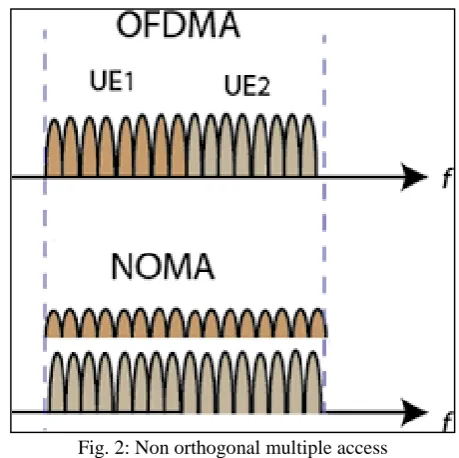
[image:1.595.305.550.334.495.2]rates in modern wireless communications. Conventional MIMO is a cellular wireless technology which enables the use of multiple transmitting and receiving antennas to transfer more data in less time. A MIMO channel is implemented in a wireless link between M transmits and N receive antennas. It consists of M x N elements that represent the MIMO channel coefficients. NOMA is to use the power domain for multiple access, whereas the previous generations of mobile networks have been relying on the time/frequency/code domain. Take the conventional orthogonal frequency-division multiple access (OFDMA) used by 3GPP-LTE as an example. A main issue with this orthogonal multiple access (OMA) technique is that its spectral efficiency is low when some bandwidth resources, such as subcarrier channels, are allocated to users with poor channel state information (CSI).
Fig. 1: MIMO- OFDM in 4G LTE
Fig. 2: Non orthogonal multiple access
Now the concept of non-orthogonal multiple access (NOMA) method for the upcoming 5G networks. All of the current cellular networks implement orthogonal multiple access (OMA) techniques such as time division multiple access (TDMA), frequency division multiple access (FDMA) or code division multiple access (CDMA) together. However, none of these techniques can meet the high demands of future radio access systems.
B. NOMA in Beyond 4G LTE Communication
The characteristics of the OMA schemes can be summarized as follows. In TDMA, the information for each user is sent in non-overlapping time slots, so that TDMA-based networks require accurate timing synchronization, which can be challenging, particularly in the uplink. In FDMA implementations, such as orthogonal frequency division multiple access (OFDMA), information for each user is assigned to a subset of subcarriers. CDMA utilizes codes in order to separate the users over the same channel. NOMA is fundamentally different than these multiple access schemes which provide orthogonal access to the users either in time, frequency, code or space. In NOMA, each user operates in the same band and at the same time where they are distinguished by their power levels. NOMA uses superposition coding at the transmitter such that the successive interference cancellation (SIC) receiver can separate the users both in the uplink and in the downlink channels.
NOMA was proposed as a candidate radio access technology for 5G cellular systems. Practical implementation of NOMA in cellular networks requires high computational power to implement real-time power allocation and successive interference cancellation algorithms. By 2020, the time that 5G networks are targeted to be deployed, the computational capacity of both handsets and access points is expected to high enough to run NOMA algorithms.
II. LITERATURE REVIEW
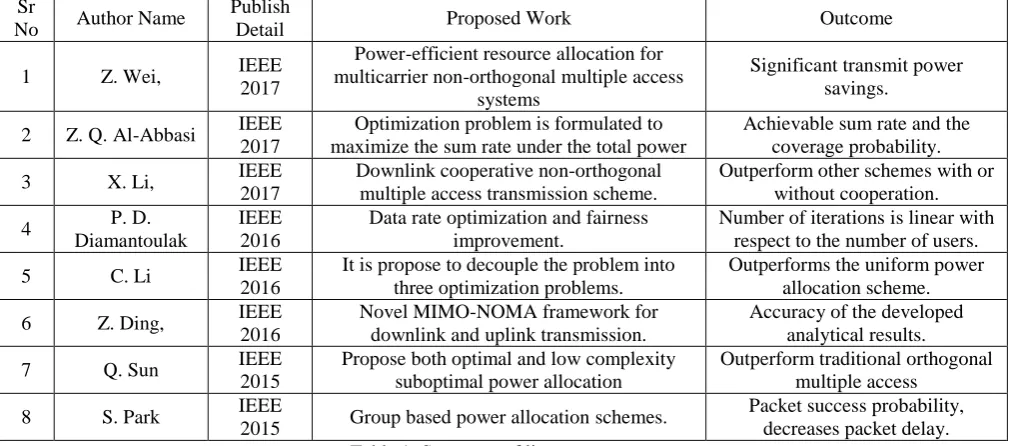
Z. Wei et al., [1] In this work ,we study power-efficient resource allocation for multicarrier non-orthogonal multiple access systems. The resource allocation algorithm design is
formulated as a non-convex optimization problem which jointly designs the power allocation, rate allocation, user scheduling, and successive interference cancellation (SIC) decoding policy for minimizing the total transmit power. The proposed framework takes into account the imperfection of channel state information at transmitter and quality of service requirements of users. To facilitate the design of optimal SIC decoding policy on each subcarrier, it is define a channel-to-noise ratio outage threshold. Subsequently, the considered non-convex optimization problem is recast as a generalized linear multiplicative programming problem, for which a globally optimal solution is obtained via employing the branch-and-bound approach. The optimal resource allocation policy serves as a system performance benchmark due to its high computational complexity.
Z. Q. Al-Abbasi et al., [2] Non-orthogonal multiple access (NOMA), which has attracted a lot of attention recently due to its superior spectral efficiency, could play a vital role in improving the capacity of future networks. In this WORK,a resource allocation scheme is developed for a downlink multi-user NOMA system. An optimization problem is formulated to maximize the sum rate under the total power and proportional rate constraints. Due to the complexity of computing the optimal solution, it is develop a low complexity sub-optimal solution for a two-user scenario and then extend it to the multi-user case by proposing a user-pairing approach as well as a number of power allocation techniques that facilitate dealing with a large number of users in NOMA system. Simulation results support the effectiveness of the proposed approaches and show the close performance to the optimal one. In addition, it is propose a new hybrid multiple access technique that combines the properties of NOMA and the orthogonal frequency division multiple access.
X. Li, et al., [3] In this correspondence, a downlink cooperative nonorthogonal multiple access transmission scheme is considered in the multicarrier scenario, where the user equipment (UE) with strong channel conditions acts as a relay to help the UE with weak channel conditions. A joint optimization of subcarrier pairing and power allocation is formulated as a mixed-integer nonconvex problem, with the objective to minimize the transmit power of the base station and the relay (strong UE) under the quality of service requirements of both UEs. it is first explore the inherent property of power allocation for a single subcarrier pair. Then, in light of the property, it is employ the Lagrange dual method and the Hungarian algorithm, in an asymptotically optimal manner, to solve the joint subcarrier pairing and power allocation problem. Numerical results show that our proposed algorithm outperforms other schemes with or without cooperation.
Furthermore, it is propose an efficient greedy algorithm, which is suitable for the practical implementation of the time-sharing strategy. The simulation results illustrate that the proposed scheme outperforms the baseline orthogonal multiple access scheme. More specifically, it is shown that the NOMA offers a considerable improvement in throughput, fairness, and energy efficiency. Also, the dependence among system throughput, minimum individual data rate, and harvested energy is revealed, as well as an interesting tradeoff between rates and energy efficiency. Finally, the convergence speed of the proposed greedy algorithm is evaluated, and it is shown that the required number of iterations is linear with respect to the number of users.
C. Li, et al., [5] Non-orthogonal multiple access (NOMA) is expected to be a promising multiple access technique for future wireless networks. In this letter, considering a cellular downlink NOMA system, it is use game theory to model the interaction between the base station and multiple users as a Stackelberg game. The base station, which acts as the leader of the Stackelberg game, chooses a price on per transmitted power allocated to each user to maximize its own revenue. Each user chooses an optimal power to maximize its utility after the base station sets prices. The revenue function of the base station is ultimately expressed as a non-convex function of the power allocation among multiple users. it is aim at solving the revenue maximization problem. it is propose to decouple the problem into three optimization problems and employ alternating optimization algorithm to solve the problem. Simulation results show the proposed price-based power allocation scheme outperforms the uniform power allocation scheme.
Z. Ding et al., [6] The application of multiple-input multiple-output (MIMO) techniques to nonorthogonal multiple access (NOMA) systems is important to enhance the performance gains of NOMA. In this WORK,a novel MIMO-NOMA framework for downlink and uplink transmission is proposed by applying the concept of signal alignment. By using stochastic geometry, closed-form analytical results are developed to facilitate the performance evaluation of the
proposed framework for randomly deployed users and interferers. The impact of different power allocation strategies, namely fixed power allocation and cognitive radio inspired power allocation, on the performance of MIMO-NOMA is also investigated. Computer simulation results are provided to demonstrate the performance of the proposed framework and the accuracy of the developed analytical results.
Q. Sun, et al., [7] Non-orthogonal multiple access (NOMA) is expected to be a promising multiple access technique for 5G networks due to its superior spectral efficiency. In this letter, the ergodic capacity maximization problem is first studied for the Rayleigh fading multiple-input multiple-output (MIMO) NOMA systems with statistical channel state information at the transmitter (CSIT). it is propose both optimal and low complexity suboptimal power allocation schemes to maximize the ergodic capacity of MIMO NOMA system with total transmit power constraint and minimum rate constraint of the weak user. Numerical results show that the proposed NOMA schemes significantly outperform the traditional orthogonal multiple access scheme.
S. Park et al., [8] To improve the packet success probability, random linear network coding (RLNC) based on non-orthogonal multiple access (NOMA) for multicast services was employed in wireless downlink networks where a source superposes multiple coded packets before transmitting these packets to multiplexing groups of receivers in a power domain. Using a successive interference cancellation (SIC) and a Gauss-Jordan elimination process, receivers can recover their original packets. it is derive expressions for the total packet success probability for the case of NOMA (or OMA) with (or without) RLNC, and propose group based power allocation schemes in order to improve performance with a low overhead. Through the results of simulations, it is verify our derivations and show that RLNC based on NOMA improves the packet success probability and decreases the packet delay.
Sr
No Author Name
Publish
Detail Proposed Work Outcome
1 Z. Wei, IEEE
2017
Power-efficient resource allocation for multicarrier non-orthogonal multiple access
systems
Significant transmit power savings.
2 Z. Q. Al-Abbasi IEEE 2017
Optimization problem is formulated to maximize the sum rate under the total power
Achievable sum rate and the coverage probability.
3 X. Li, IEEE
2017
Downlink cooperative non-orthogonal multiple access transmission scheme.
Outperform other schemes with or without cooperation.
4 P. D.
Diamantoulak
IEEE 2016
Data rate optimization and fairness improvement.
Number of iterations is linear with respect to the number of users.
5 C. Li IEEE
2016
It is propose to decouple the problem into three optimization problems.
Outperforms the uniform power allocation scheme.
6 Z. Ding, IEEE
2016
Novel MIMO-NOMA framework for downlink and uplink transmission.
Accuracy of the developed analytical results.
7 Q. Sun IEEE
2015
Propose both optimal and low complexity suboptimal power allocation
Outperform traditional orthogonal multiple access
8 S. Park IEEE
2015 Group based power allocation schemes.
[image:3.595.46.554.519.742.2]III. OFDM VS NOMA
In OFDMA technique BS (Base Station) shares its resources by transmitting to UEs at different time instants and frequencies. OFDMA allocates subchannels and time slots to the users based on desired bandwidth or data rate. Each of the subchannels are mapped with few number of subcarriers after permutations and hence OFDMA is robust against fading. The technologies such as Mobile WiMAX, LTE, LTE-advanced and 5G uses OFDMA technique for resource sharing.
OFDM Makes efficient use of the spectrum by allowing overlap. By dividing the channel into narrowband flat fading subchannels, OFDM is more resistant to frequency selective fading than single carrier systems are. Eliminates ISI and IFI through use of a cyclic prefix. Using adequate channel coding and interleaving one can recover symbols lost due to the frequency selectivity of the channel. Channel equalization becomes simpler than by using adaptive equalization techniques with single carrier systems. It is possible to use maximum likelihood decoding with reasonable complexity. OFDM is computationally efficient by using FFT techniques to implement the modulation and demodulation functions. Is less sensitive to sample timing offsets than single carrier systems are. Provides good protection against cochannel interference and impulsive parasitic noise.
Limitation of OFDM is signal has a noise like amplitude with a very large dynamic range, therefore it requires RF power amplifiers with a high peak to average power ratio. It is more sensitive to carrier frequency offset and drift than single carrier systems are due to leakage of the DFT.
The NOMA is a multiple access technique employed in 5G cellular wireless network. The main function of NOMA is to serve multiple UEs (User Equipments) using single 5G-NB (Node B or Base Station). It serves multiple users on same time/frequency resources. There are two main techniques employed in NOMA for multiple access.
Power domain: Here NOMA achieves multiplexing based on different power levels.
Code domain: Here NOMA achieves multiplexing based on different codes.
Transmit side: NOMA uses superposition coding at the transmitter end. The different power levels have been assigned to users. As shown in the figure-1, Base Station transmits superposed signals to User#1 and User#2. Here User#2 uses high gain and User#1 uses low gain as shown.
Receive side: NOMA uses SIC (Successive interference cancellation) technique to retrieve data of both the users. At receiver, User#2 (Strong User) substracts signal of user#1 through SIC and later decodes its own signal. User#1 (Weak User) treats signal of User#2 as noise and decodes its own signal directly.
Sr
No. Specifications NOMA OFDMA
1 Full form Non-Orthogonal Multiple
Access
Orthogonal Frequency Division Multiple Access
2 Spectrum Efficiency Higher Lower
3 Capacity (Number of
users/cell) More Less
Table 2: NOMA vs OFDMA
IV. CONCLUSION
In this paper, the contribution of MIMO-OFDM in 4G LTE wireless technologies discussed. The use of multiple antennas at both ends of a wireless link (multiple input multiple output (MIMO) technology) has recently been demonstrated to have the potential of achieving extraordinary data rates in 4G-LTE. Orthogonal frequency division multiplexing significantly reduces receiver complexity in wireless broadband systems. The use of NOMA technology for beyond 4G LTE wireless technologies proposed by many researchers, therefore seems to be an attractive solution for enhancement of users with sum rate of future broadband wireless systems
REFERENCES
[1] Z. Wei, D. W. K. Ng, J. Yuan and H. Wang, "Optimal Resource Allocation for Power-Efficient MC-NOMA With Imperfect Channel State Information," in IEEE Transactions on Communications, vol. 65, no. 9, pp. 3944-3961, Sept. 2017.
[2] Z. Q. Al-Abbasi and D. K. C. So, "Resource Allocation in Non-Orthogonal and Hybrid Multiple Access System With Proportional Rate Constraint," in IEEE Transactions on Wireless Communications, vol. 16, no. 10, pp. 6309-6320, Oct. 2017.
[3] X. Li, C. Li and Y. Jin, "Joint Subcarrier Pairing and Power Allocation for Cooperative Nonorthogonal Multiple Access," in IEEE Transactions on Vehicular Technology, vol. 66, no. 11, pp. 10577-10582, Nov. 2017.
[4] P. D. Diamantoulakis, K. N. Pappi, Z. Ding and G. K. Karagiannidis, "Wireless-Powered Communications With Non-Orthogonal Multiple Access," in IEEE Transactions on Wireless Communications, vol. 15, no. 12, pp. 8422-8436, Dec. 2016.
[5] C. Li, Q. Zhang, Q. Li and J. Qin, "Price-Based Power Allocation for Non-Orthogonal Multiple Access Systems," in IEEE Wireless Communications Letters, vol. 5, no. 6, pp. 664-667, Dec. 2016.
[6] Z. Ding, R. Schober and H. V. Poor, "A General MIMO Framework for NOMA Downlink and Uplink Transmission Based on Signal Alignment," in IEEE Transactions on Wireless Communications, vol. 15, no. 6, pp. 4438-4454, June 2016..
[7] Q. Sun, S. Han, C. I and Z. Pan, "On the Ergodic Capacity of MIMO NOMA Systems," in IEEE Wireless Communications Letters, vol. 4, no. 4, pp. 405-408, Aug. 2015.
Networks," in IEEE Communications Letters, vol. 19, no. 7, pp. 1273-1276, July 2015.
[9] J. Choi, "Non-orthogonal multiple access in downlink coordinated two-point systems", IEEE Commun. Lett., vol. 18, no. 2, pp. 313-316, Feb. 2014.