Detection and Neutralizing Multiple Spoofing Attackers using PRR and
IAT
N. Saraspriya
1C. Prakash Narayanan
2B. Sakthivel
31
PG Scholar
2Assistant Professor
3Head of Dept.
1,2,3
Department of Computer Science & Engineering
1,2,3
P.S.V College of Engineering & Technology, Krishnagiri, TN, India
Abstract— DDOS assault is the primary issue in all impromptu situation i.e. in MANAT and in remote sensor systems. In the Paper has an interruption identification framework in remote sensor organize which utilizes the peculiarity interruption location framework in which IDS utilizes two interruption recognition parameters, parcel gathering rate (PRR) and entomb landing time (IAT). In any case, just these two parameters are not totally adequate for interruption identification in remote sensor organize and in MANET. On the off chance that we likewise add different parameters into it to make it works all the more precisely. In our proposition we utilize diverse interruption recognition parameters in versatile Ad hoc arranges. We accept that a versatile specially appointed system contains at least two than two cell phones that are convey from each other through moderate hubs, every hub contain steering table, in our proposition we utilize AODV directing convention in all typical module assault module and IDS (interruption location framework) for counteractive action through assault. In this paper we reproduce the three distinctive condition comes about ordinary time, Attack time and IDS module. The versatility and adaptability brought by remote system made it conceivable in numerous applications. Among all the contemporary remote systems, Mobile Ad hoc Network (MANET) is a standout amongst the most vital and interesting applications. On the in opposition to conventional system design, MANET does not require a settled system framework; each and every hub fills in as both a transmitter and a beneficiary. Hubs discuss straightforwardly with each other when they are both inside a similar correspondence extend. Else, they depend on their neighbors to hand-off messages. The self-arranging capacity of hubs in MANET made it prominent among basic mission applications like military utilize or crisis recuperation. In any case, the open medium and wide dissemination of hubs make MANET powerless against malignant aggressors. For this situation, it is critical to create productive interruption identification components to shield MANET from assaults. In this paper, we propose and actualize another interruption discovery framework uniquely intended for MANETs. This venture is produced by utilizing Dotnet as Front end.
Key words: MANET, EAACK, Digital Signature, GADE,
IDOL
I. INTRODUCTION
With constantly developing advancement, people jump at the chance to have information on their fingertips wherever - at whatever time along these lines growing in the usage of remote frameworks. MANET one of the promising development in remote frameworks organization has parts like component configurability, negligible exertion of course of action. MANET does not require a changed base.
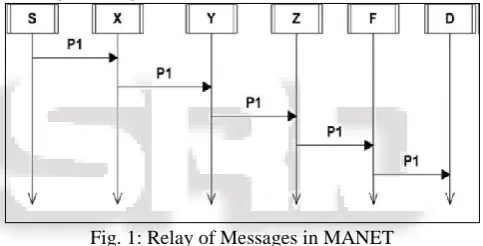
[image:1.595.307.549.342.465.2]MANET is continuously configurable framework in which centers set up courses among themselves to transmit bundles. Without getting help of settled structure MANET shapes self-outlining framework by social affair of versatile centers. Transmitter and beneficiaries both are set up in a MANET center point, so center point can go about as a Router and a Host meanwhile. There are two circumstances concerning topology in MANET. At first, single-skip framework where center points within the radio correspondence degree can clearly talk with each other; Second, Multi-bounce framework where centers outside each the achieve must depend on upon some unique center points to hand-off messages. In like manner acting like a Router to hand-off messages to various center points outside each other's degree need to rely upon some unique centers to exchange messages.
Fig. 1: Relay of Messages in MANET
II. RELATED WORK
A. Watchdog
[image:2.595.49.284.195.244.2]Watch pooch was proposed to improve the throughput of framework with the nearness of pernicious center point. It works for perceiving dangerous center point by consistently tuning in to its next skip transmission. If the accompanying bounce fails to hand-off the package ahead within certain time span, it brings about increase of frustration counter. Also, if dissatisfaction counter outperforms a specific cutoff regard, it reports framework as escaping hand.
Fig. 2: Operation in Watchdog
If the next hop fails to relay the packet ahead within certain period of time, it results in increment of failure counter. Furthermore, if failure counter exceeds a specific threshold value, it reports network as misbehaving. Watchdog scheme fails in the following:
1) Ambiguous collisions 2) Receivers collisions 3) Limited transmission power 4) False misbehaviour report 5) Partial dropping
B. Twoack
[image:2.595.313.546.297.411.2]TWOACK is neither a change nor a Watch-canine based arrangement. Expecting to decide the beneficiary effect and obliged transmission control issues of Watch-puppy, TWOACK distinguishes acting devilishly interfaces by perceiving every data groups transmitted over each three nonstop centers en route from the source to the goal. Interminable supply of a package, each center point along the course is required to send back a certification package to the center point that is two bounces a long way from it down the course. TWOACK is required to manage coordinating traditions, for instance, Dynamic Source Routing (DSR).
Fig. 3: TWOACK scheme
The working method of TWOACK is shown figure, center point a first advances package 1 to center point B, and a while later center point B propels Packet 1 to center C. Right when center point C gets Packet 1, as it is two hops a long way from center A, center point C is obliged to deliver a TWOACK bundle, which contains talk course from center point A to center C, and sends it back to center point A. The recuperation of this TWOACK package at center A demonstrates the transmission of Packet 1 from center point A to center C is productive.
Other-wise, if this TWOACK bundle isn't got in a predefined day and age, the two center points B and C are
represented poisonous. TWOACK arrangement successfully comprehends the beneficiary crash and obliged transmission control issues posed by Watchdog. On the other hand, the insistence technique required in each bundle transmission strategy incorporated a great deal of bothersome framework overhead. Due to the limited battery control nature of MANETs, such abundance transmission methodology can without a lot of an extend spoil the life compass of the entire framework.
C. AACK
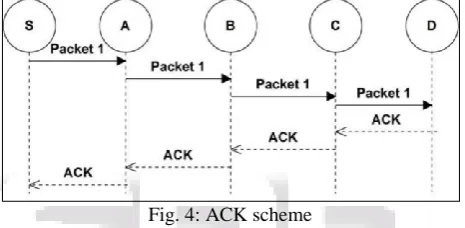
It is a cross breed arrange for which uses TWOACK for insistence. AACK is confirmation based net-work layer arrange for which includes a mix of plans called TACK (like TWOAACK) and end-to-end certification design called Acknowledgment. Appeared differently in relation to TWOACK, AACK by and large diminishes net-work overhead, while still prepared to keep up or level out-shimmer a similar framework throughput. In AACK, first the data transmit from source to goal.
Fig. 4: ACK scheme
Right when the goal gets a package it is required to send back a certification package to source in the contrary course of the data distribute. Within the foreordained day and age if the source gets the certification package, at that point the bundle transmission is viably. Something different, the source will change to TACK design by sending a TACK divide. This creamer design exceptionally reduces framework action however is as yet not ready to adjust up to false wrongdoing report and produced assertion.
D. Detecting Satirizing Assaults in Versatile Remote Environment
Remote framework engages an aggressor to go up against the presence of one of the contraption existing in framework easily. This structure proposes a methodology for perceiving satirizing ambush in convenient remote condition. structure develop the DEMOTE sys-tem which use of Received Signal Strength(RSS) takes after assembled after some time without the data of spatial impediment of the remote center point, utilizes brief prerequisite to anticipate the best RSS. This system does not require any movements or joint effort from remote device other than package transmission. By test from an office building condition system show that DEMOTE achieves aerating and cooling pastor ambush recognizable proof in both sign space and moreover physical space using impediment.
E. Detecting and Localization Wireless Spoofing Attacks
[image:2.595.48.287.505.627.2]utilizing in order to cartoon gather examination. Moreover, the structure consolidates the ambush discoverer with continuous inside restriction system which is also prepared to limit the places of the aggressors using point based counts. The structure has evaluated our procedure through examination using both Wi-Fi framework and furthermore ZigBee framework. Their result exhibits that it is possible to recognize remote disparaging with both high area rate and low false positive rate.
III. SYSTEM DESCRIPTION
The EEAACK framework will comprise of taking after strategies, model or components for interruption discovery and restriction.
A. ACK
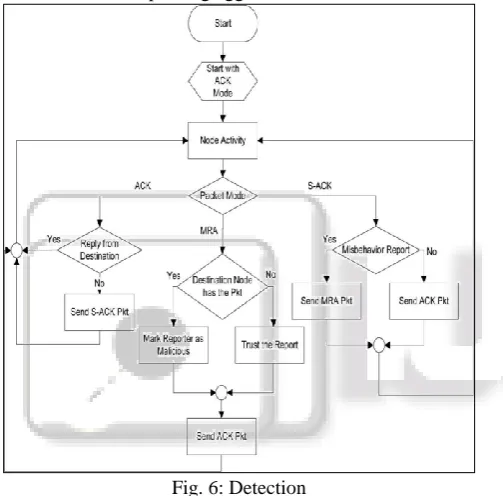
ACK is just a conclusion to end attestation design. It goes about as a crossbreed design in EEAACK. Right when there are no escaping hand center points the transmission from source to goal is viable. By then goal sends an assertion package to source inside predefined time basic, by and large source will change to S-ACK mode.
B. S-ACK
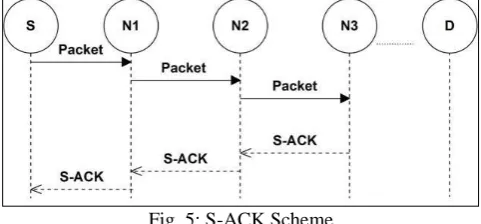
Source sends S-ACK package in the point of distinguishing getting into devilishness center points in the course. S-ACK sends certification back to source after the package comes to progressive three centers ahead the course. The third center point required to send a S-ACK attestation to first center point. S-ACK mode supports straightforward area of getting unruly center points in the region of beneficiary effect and limited power for transmission.
[image:3.595.46.287.541.653.2]N1, N2, N3 are three consecutive centers. N1 sends S-ACK data bundle to N2 which is next in the course and N2 exchanges it to N3. Exactly when N3 gets the S-ACK data allocate perceives N2 with S-ACK assertion package and N2 perceives back to N1. If N1 doesn't get the confirmation within a particular time it will report N2, N3 as toxic center points by delivering a terrible direct report. This underhandedness report is sent back to the Source. To affirm this report the source changes itself to MRA mode.
Fig. 5: S-ACK Scheme
C. MRA
Bad conduct Report Analysis (MRA)[12] is an arrangement to avow inconvenience making report created in S-ACK mode. This report might be a false one as aggressor may intrude in S-ACK design delivering a false awful direct report. In this way, this may trade off in order to realize obliteration of framework guiltless center points. In MRA the source will check with the goal whether the goal center point have gotten the missing bundle through a substitute
course. MRA mode is begun by checking neighborhood data base of sender for getting al-conditional course to goal; by and large source uses Dynamic Source Routing system for alternative course. Once the goal gets the MRA package, it differentiates the MRA distribute the area learning base to affirm if the re-ported package was gotten by it. If got, at that point it in-structures the source that the inconvenience making report is false else it is considered as a good 'ol fashioned report.
IV. DIGITAL SIGNATURE
All the above plans rely upon confirmation. These attestations could be questionable and must be checked for their authenticity. We use propelled check with a particular true objective to keep up uprightness of the system. If we don't use mechanized mark the above discussed 3 designs will be de-fenceless. We can use DSA or RSA figurings to execute propelled check designs.
A. GADE
GADE stays for Generalize Attack Detection Model. It is ambush recognizable proof strategy used as a piece of our structure. There are two phases: First, attack acknowledgment; second, choose number of aggressors. Aggressors utilize transmission power of 10db to send groups, while extraordinary center point uses 15db trans-mission compel level saw by qualities in Received Signal Strength. RSS is a property associated with zone in physical space. The parodying attacker used transmission power of 10 dB to send bundles, while the primary center point used 15 dB transmissions compel levels. System watched that the curve of Dm under the unmistakable transmission drive level developments to the benefit demonstrating greater Dm esteems. Structure watches this differentiation between constrain levels and distinguishes strike reasonably in GADE display.
GADE utilizes pack examination for attack acknowledgment. RSS readings from remote center points may shift and they should be grouped together. The gathering examination for strike revelation, System demonstrates the Receiver Operating Characteristic curves of using Dm as a test estimation to perform ambush area for both the 802.11 and the 802.15.4 net-works. The acknowledgment rate and false positive rate for the two frameworks under differing limit settings. The results are enabling, showing that for false positive rates under 10 percent, the ID rate are over 98 for every penny when the utmost is around 8 db. Despite when the false positive rate goes to zero, the acknowledgment rate is still more than 95 for every penny for the two frameworks.
gatherings among K potential gatherings of a data set. The twin-pack show is used for imperativeness figuring. The advantage of Silhouette Plot is that it is reasonable for evaluating the best bundle. Despite the fact that the System Evolution procedure performs well under troublesome cases, for instance, when there exists imperceptibly covering amidst gatherings and there are smaller clusters close greater bundles.
[image:4.595.307.552.66.129.2]The arrangement data assembled in the midst of the logged off getting ready stage, we can additionally upgrade the execution of thwart mining the amount of ridiculing aggressors. Moreover, given a couple of estimation methods open to recognize the amount of aggressors, for instance, System Evolution and SILENCE, structure can join the characteristics of these schedules to achieve a higher area rate. This part explores Support Vector Machines to gather the amount of the spoofing aggressors.
Fig. 6: Detection
B. IDOL
[image:4.595.47.299.262.510.2]Consolidated disclosure and Localization Framework IDOL framework used to keep different aggressors. Symbol adequately perceives aggressors using unmistakable transmission control instrument. The standard method for averaging RSS readings can't separate RSS readings from assorted territory and in this way isn't sensible for restricting the attackers. This framework uses RSS medoids returned from SILENCE as information to confinement computations to assess the places of gatecrashers. With a particular true objective to gainfully execute IDOL we use taking after computations: RADAR-gridded: For constraining adversaries this figuring uses RSS readings and nearest neighbor organizing technique in single space, to limit the aggressor. Zone Based Probability: ABP solidifies sign guide. Exploratory range is part into typical cross section to equal size cooling cording to RSS scrutinizing looked for that particular system. Bayesian Networks: BN utilizes sign to partition expansion show (multilateration) to restrict the assailant.
Fig. 7: Working of BN
V. CONCLUSION
Package Dropping and Identity based attacks have constantly been essential perils to MANET. In this paper, we proposed a totally arranged structure named E-EAACK in a general sense in-tended for MANET and made it viable in examination to different acclaimed instruments. It is like manner overcomes the issues in MANET, for instance, limited transmission control, authorities' crash and false awful direct report. We also propose the use of RSS based spatial relationship associated with each center point that is hard to taint for recognizing character based strikes. Our system can do both, recognize the attack and pick the amount of trespassers and reject them.
REFERENCES
[1] L. Buttyan and J. P. Hubaux, Security and Cooperation in Wireless Networks. Cambridge, U.K.: Cambridge Univ. Press, Aug. 2007.
[2] G. Jayakumar and G. Gopinath, Ad hoc mobile wire-less networks rout-ing protocolA review, J. Comput. Sci., vol. 3, no. 8, pp. 574582, 2007.
[3] S. Marti, T. J. Giuli, K. Lai, and M. Baker, Mitigat-ing routing misbe-haviour in mobile ad hoc networks, in Proc. 6th Annu. Int. Conf. Mobile Comput. Netw., Boston, MA, 2000, pp. 255265.
[4] K. Liu, J. Deng, P. K. Varshney, and K. Balakrishnan, An acknowledgment-based approach for the detection of routing misbe-haviour in MANETs, IEEE Trans. Mobile Comput., vol. 6, no. 5, pp.536550, May 2007. [5] T. Sheltami, A. Al-Roubaiey, E. Shakshuki, and A.
Mahmoud, Video transmission enhancement in pres-ence of misbehaving nodes in MANETs, Int. J. Multi-media Syst., vol. 15, no. 5, pp. 273282, Oct. 2009 [6] D. Faria and D. Cheriton, Detecting Identity-Based
At-tacks in Wireless Networks Using Signalprints, Proc. ACM Workshop Wireless Security (WiSe), Sept. 2006. [7] Q. Li and W. Trappe, Relationship-Based Detection of
Spoofing-Related Anomalous Traffic in Ad Hoc Net-works, Proc. Ann. IEEE Comm. Soc. on IEEE and Sensor and Ad Hoc Comm. and Networks (SECON), 2006.
[8] Y. Chen, W. Trappe, and R.P. Martin, Detecting and Localizing Wireless Spoofing Attacks, Proc. Ann. IEEE Comm. Soc. Conf. Sensor, Mesh and Ad Hoc Comm. and Networks (SECON), May 2007.
[9] P. Bahl and V.N. Padmanabhan, RADAR: An in-Building RF-Based User Location and Tracking Sys-tem, Proc. IEEE INFOCOM, 2000.
[11]Y. Chen, J. Francisco, W. Trappe, and R.P. Martin, A Practical Approach to Landmark Deployment for In-door Localization, Proc. IEEE Intl Conf. Sensor and Ad Hoc Comm. and Networks (SECON), Sept. 2006. [12]EAACK A Secure Intrusion-Detection System for