Classification of EMG based Diseases using Fuzzy Logic
at Second Level
Babita Pandey
Lovely Professional University School of Computer ApplicationPhagwara, Punjab
Heena
Lovely Professional University School of Computer Application
Phagwara, Punjab
ABSTRACT
Intelligent diagnosis systems plays very important role in the medical field and particularly in diagnosis and classification of neuromuscular diseases (NMD). In such a field where uncertainty is always present, classical techniques of classification show a lack of efficiency thus leading to erroneous results. Fuzzy logic proved to be a suitable method for classification problems, particularly in NMDs. This paper aims to present a fuzzy logic based system for the classification of seven types of neuromuscular diseases at first level and classification of eight types of muscular dystrophy diseases at second level. The obtained results have shown good performance of the designed classifier.
Keywords
Intelligent diagnosis system, neuromuscular diseases, fuzzy logic, classification.
1.
INTRODUCTION
Neuromuscular disease (NMD) is caused by muscular abnormality. These diseases are progressive in nature therefore their early diagnosis is very difficult. Some of the NMD are also not curable in the final stage. Therefore, we need a diagnostic method that accurately diagnoses the NMD in their early stage. Although a number of conventional and intelligent methods such as: heuristic methods, artificial neural networks (ANN), data mining (DM), case base reasoning (CBR), rule base reasoning (RBR) [1,2,3,9] are available for the diagnosis of NMD but they have their own limitations. Classical techniques of classification applied on bio-signal signals reveal inefficiency because of their badness of quality induced by the complex psychological and physiological state of the patients during recording besides the lack of accuracy of the used equipment [4]. Apart from this, the interpretation of bio signals by specialists is relatively hard and subjective because in some cases abnormalities cannot be distinguished easily due to ambiguity and blurriness. The problem of bad quality can be handled by the use of adequate noise filtering techniques [4].The problem of interference of classes can be solved through the integration of intelligent methods such as ANN-CBR. But still, the problem of uncertainty and imprecision of the knowledge in NMDs cannot be solved with classical or intelligent technique. Fuzzy logic proved to be a suitable method for solving such problems [6]. Apart from the above the problem is that most of the literature depicts the classification of NMD only in two or three classes [5,6]. The objective of this paper is to develop a fuzzy logic based system for the classification of seven types of neuromuscular diseases (NMD)at first level: muscular dystrophy (MD), ploymyositis (PO), endocrine myopathy (EM), metabolic myopathy (MM), neuropathy (N),
(learning disability, hearing disability etc), motor parameters (difficulty in walking etc), psychological parameters (fatigue, anxiety etc.) and EMG parameters such as: amplitude, duration, phase etc and eight muscular dystrophy diseases at second level: duchenne muscular dystrophy(DMD),Becker muscular dystrophy(BMD),Congenital muscular dystrophy (CMD), Emery–Dreifuss muscular dystrophy(EDMD), Facioscapulohumeral muscular dystrophy (FSH), Limb-girdle muscular dystrophy (LGMD),myotonic muscular dystrophy (MMD)and Oculopharyngeal muscular dystrophy (OPMD).The rest of the paper is organized as follows. Section 2 covers the neuromuscular diseases and muscular dystrophy with their sign and symptoms. Section 3 describes the fuzzy logic method. Results are shown in Section 4. Finally, conclusions are drawn in section 5.
2
NEUROMUSCULAR DISEASES :
SIGN AND SYMPTOMS
2.1 First level disease
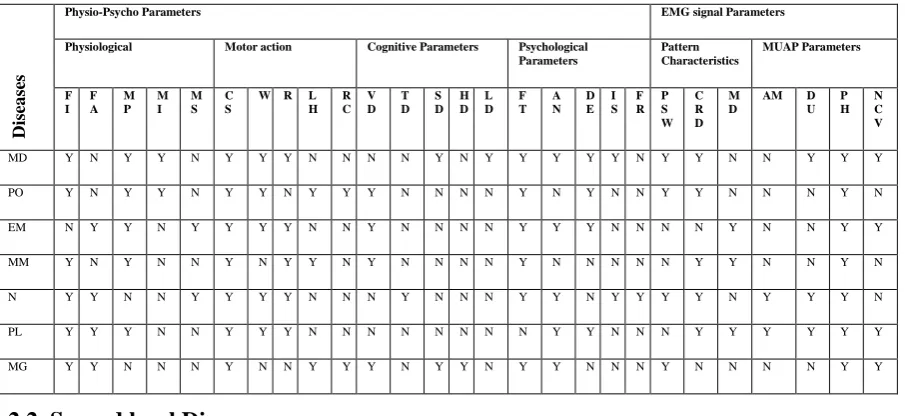
The other column of the Table 1 such as 22, 23 and 24 of a particular row contains „„Y” or „„N” depending upon the characteristics of MUAP of the disease. The columns 25–27 contains” Y” if amplitude is less than 270 lm, duration is greater than10.2 ms and phase is greater than or equal to 5,
[image:2.595.50.502.165.370.2]respectively ,and „„N” if amplitude is less than 160 lm, duration is less than9.8 ms and phase is less than 5, respectively. The column 28contains „„Y” if there is normal decrease in nerve conduction velocity.
Table 1: Sign and Symptoms of NMD diseases at first level
Dise
a
se
s
Physio-Psycho Parameters EMG signal Parameters Physiological Motor action Cognitive Parameters Psychological
Parameters Pattern Characteristics MUAP Parameters F I F A M P M I M S C S
W R L H R C V D T D S D H D L D F T A N D E I S F R P S W C R D M D
AM D U P H N C V
MD Y N Y Y N Y Y Y N N N N Y N Y Y Y Y Y N Y Y N N Y Y Y PO Y N Y Y N Y Y N Y Y Y N N N N Y N Y N N Y Y N N N Y N EM N Y Y N Y Y Y Y N N Y N N N N Y Y Y N N N N Y N N Y Y MM Y N Y N N Y N Y Y N Y N N N N Y N N N N N Y Y N N Y N N Y Y N N Y Y Y Y N N N Y N N N Y Y N Y Y Y Y N Y Y Y N PL Y Y Y N N Y Y Y N N N N N N N N Y Y N N N Y Y Y Y Y Y MG Y Y N N N Y N N Y Y Y N Y Y N Y Y N N N Y N N N N Y Y
2.2. Second level Disease
Table 2 describes NMD diseases with their two important parameters: physio-psycho (PP) parameters and EMG signal characteristics (EMG). Physio-psycho parameter‟s further divided into four parts: muscular parameter which is further divided into two parts: Muscular(MUS) and motor(MOT) parameters such as: muscle pain (MP), muscle inflammation (MI)and muscle stiffness(MS)fibrillations(FI),fasciculation (Fa), muscle pain (MP), muscle inflammation (MI)and muscle stiffness(MS) difficulty in lifting above the head or shoulder (LH) and difficulty in rising above the chair (RC) (see columns 2–10 in Table 2); The cognitive parameters are visual disability (VD), touch disability(TC), speech disability (SD), hearing disability (HD) and learning disability (LD) (see columns 12–15 in Table 2);The muscular psychological parameters are: fatigue (FT), anxiety (AN), depression (DP), isolation (IS), (see columns 16–21 in Table 2); The internal ligual parameters are (see columns 22–27 in Table 2) lung problem(LP), Cardiac arrhythmia(CA), congestive heart
[image:2.595.50.503.166.374.2]Table2: Signs and symptoms of muscular dystrophy at second level.
3. FUZZY LOGIC
The fuzzy model was elaborated based on experience and knowledge of neuromuscular diseases experts and literatures. These experts and literatures considered following inputs as important variables: physiological symptoms (Phy), motor symptoms (Mot), Cognitive symptoms (Cog), psychological symptoms (psy) as well as on EMG test variables such as: Spontaneous activity (SPO) and MUAP parameters (MUAP). Fuzzy rule base system consists of four major components: (1) fuzzification module which translates crisp inputs into fuzzy values through linguistic variables, (2) fuzzy rule base; (3) fuzzy inference method; (4) defuzzification.
3.1 Fuzzification
In fuzzification step, numerical inputs and output variables are converted into linguistic terms or adjectives (such as low, high, big, small, etc.), and the corresponding degrees of the one or more several membership functions are determined. The fuzzification is done in following steps:
3.1.1 Compute the domain interval of each input
The domain interval of variable means that most probability the variables lie in their domain intervals. It is computed as follow:a. Represent the six parameters Phy, Mot, Cog, Psy, SPO and MUAP given in table 1, into binary strings. Where number of bits are equivalent to number of sub parameters taken under particular parameters. For example, phychological parameter is represented by 5 bits.
b. Take the minimum and maximum decimal value represented by binary string. For example, using five bits the minimum and maximum decimal numbers represented by string are 0 and 31. Therefore the domain interval for phy is [0, 31]. Similarly, the domain interval for Mot, Cog and Psy, SPO and
3.1.2 Divide each domain interval into regions
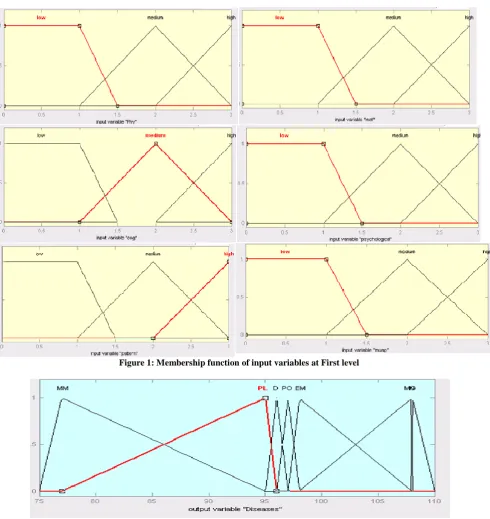
The next step in divide each domain interval into regions. The Physiological, Motor, Cognitive and Psychological symptom (Phy) are divided into five regions: very high (VH), high (H), medium (M), low (L), very low (VL). The SPO and MUAP activities are divided into three regions: high (H), medium (M), low (L). The corresponding fuzzy membership functions for input variables are shown in Figure 1. The range and fuzzy membership expression of all the input variables are given in Table 2. First column, in Table 1 contains the input parameters, 2nd and 3rd column contains the fuzzy set and their ranges. The 4th column contains the fuzzy membership expression for the corresponding input parameter in 1st column. The fuzzy output sets, is shown in Figure 2. The domain interval of output is computed as follow:1. Determine the degree of given inputs Phy, Mot, Cog, Psy, SPO and MUAP in different regions. For this first convert the signs and symptoms given in Table 1, to its binary equivalent where Y is converted to „1‟ and N is converted to „0‟. For example, the binary string equivalent to phy in DMD is „10110‟ as shown in second cell of column 2 in Table 3. Then convert the binary string to equivalent decimal number. The equivalent decimal to „10110‟ is 22 as shown in the right of equal sign in second cell of column 2 in Table 3. This is called, score of phy for DMD. Similarly, the score of each input for each disease is calculated and shown in right side of equal to sign in Table 3. This score of Phy in DMD as from the Figure 1 has degree less than 0.5 in VH, degree greater than 0.5 in H and zero degree in all other regions.
2. Assign a given inputs Phy, Mot, Cog, Psy, SPO and MUAP to maximum degree. For example, in case of DMD, Phy be in H set as shown in 2nd cell of row
headed by R1.For example, in case of DMD, Phy be
D
isea
se
s
Physio-psychological parameters EMG parameters
Muscular Parameter Cognitive
parameters Muscular psychological Internal ligual parameters Spontaneous abnormality MUAP parameters
Muscular Motor
M P M I M S M T M B L H R C M M M H E M V D T D L D H D S D F T A N D P I S F N D Z L P C A C H F C P H M D S K D F I F A P S W M D A M D U P H N C V
DMD Y Y Y Y Y N Y N N N N N Y N Y Y Y Y Y N N Y Y Y N N Y Y Y Y N Y Y Y Y
BMD Y Y Y Y Y N Y N N N N N Y N N Y N N N N Y Y Y Y Y Y Y Y Y N N Y Y Y Y
CMD Y N N N Y N N N N N Y N Y N Y Y N N N N N Y N N N N Y Y N Y N Y Y Y N
EDMD Y N N N N Y N N Y N N N Y N N N N N Y N N N Y N N Y Y Y N N N Y Y Y Y
FSH Y N N N N Y N Y Y Y Y N Y Y Y Y N N N N N Y Y N N N N Y N N N Y Y Y N
LGMD Y N N Y N Y Y N N N Y N N N N N N Y N N N Y Y Y N N Y Y N N N Y Y Y Y
MMD Y N N Y N N Y N N N Y N Y N Y N N N N Y Y N Y N N Y Y Y N N N Y Y Y N
3. Then, different weights are given to different inputs depending upon the number of bits used to represent the particular input. For example, the weight assigned to Phy (Wphy)is 5 as 5 bit string is used to
represent it. Similarly, the weight assigned to mot (Wmot), cog (Wcog), psy (Wpsy), spo (Wspo), and
MUAP (Wmuap), are 5, 5, 5, 5, 3 and 4 and .
4. Next step is to calculate the score of diseases as follows:
Score of DMD = Wphy* Level of Phy in DMD +Wmot *
Level of Mot in DMD + Wcog+
Level of Cog in DMD+ Wpsy*
Level of Psy in DMD +Wspo *
Level of SPO in DMD +Wmuap+
Level of MUAP in DMD
= 5 * 4 + 5 * 5 + 5 * 1 + 5 * 5 + 3 * 3 + 4 * 3 = 96
[image:4.595.86.508.238.329.2]Similarly, score of other diseases are calculated. The score of PO, EM, MM, N, PL and MG are 97, 98, 77, 110, 95 and 108 respectively in last column of Table 3, the value given. These score of diseases decide the boundaries of output. The boundaries of output are [77, 110].The member ship functions used for input are trapezoidal and triangular functions. The membership function of output variable is shown in Figure 2.
Table 3: Computation of score of diseases
Diseases Phy Mot Cog Psy SPO MUAP Score
DMD 10110=22 11100=28 00101=3 11110=30 110=6 0111=7 96 PO 10110=22 11011=27 10000=16 10100=20 110=6 0010=2 97 EM 01101=13 11100=28 10000=16 11100=28 001=1 0011=3 98 MM 10100=6 10110=22 10000=16 10000=16 011=3 0010=2 77 N 11001=25 11100=28 01000=8 11011=27 110=6 1110=14 110 PL 11100=28 11100=28 00000=0 01100=12 011=3 1111=15 95 MG 11000=24 10011=19 10110=22 11000=24 000=0 0011=3 108
3.1.3 Rule base
The defined fuzzy rule base is formed by 7 rules (Table 4) and therefore is not complete because with six input features the number of combinations that can be made is greater than seven. That doesn‟t mean that the model is poorly
representative though because many feature combinations don‟t necessarily represent a real case or class. These rules were generated by some computation as mentioned in section 3.1.1 and 3.1.2 points of section 2 and verified with the help of a NMD expert.
Table 4: Fuzzy Rule Base at first level
Rule Phy Mot Cog Psy SPO MUAP Diagnosis
R1 H VH VL VH M M DMD
R2 H VH M H M L PO
R3 M VH M VH L M EM
R4 L H M M M L MM
R5 VH VH L VH M H N
R6 VH VH VL M M H PL
[image:4.595.105.481.427.518.2]Figure 1: Membership function of input variables at First level
Figure 2: Membership function of output variables at first level.
3.1.4 Fuzzy Inference and Defuzzification
Designed system uses inference mechanism Mamdoni approach. The programming environment MATLAB 10a along with the FUZZY LOGIC TOOLBOX was used for the implementation of the fuzzy model and the classification algorithm. For defuzzification process, designed system uses “Centroid” method. On the basis of above-mentioned fuzzy steps, a detailed schematic of the MIMO (multiple inputs and multiple outputs) fuzzy system applied in this study is depicted.
3.2 Fuzzy logic at second level
Table 5: Computation of score of diseases at second level
Fuzzy Rules at second level
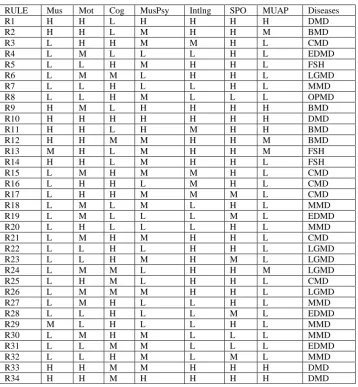
Fuzzy rules are generated with the help of computed scores.
Table 6: fuzzy rules at second level
Diseases mus mot cog MusPsy intlig Spo MUAP Score
DMD 1111=15 101000=40 00101=5 111100=57 111001=57 1110=14 1111=15 95 BMD 1111=15 101000=40 00100=4 100001=33 111111=63 1100=12 1111=15 85 CMD 1000=8 100000=32 10101=21 100000=32 100001=33 1010=10 1110=14 77 EDMD 1000=8 010010=18 00100=4 000100=4 010011=19 1000=8 1111=15 49 FSH 1000=8 010111=23 10111=23 100000=32 110000=48 1000=8 1110=14 83 LGMD 1001=9 011000=24 10000=16 001000=8 111001=57 1000=8 1111=15 66 MMD 1001=9 001000=5 10101=21 000011=3 010011=19 1000=8 1110=14 53 OPMD 1001=9 000101=5 10001=17 100000=32 000100=4 1000=8 0011=3 51
RULE Mus Mot Cog MusPsy Intlng SPO MUAP Diseases
R1 H H L H H H H DMD
R2 H H L M H H M BMD
R3 L H H M M H L CMD
R4 L M L L L H L EDMD
R5 L L H M H H L FSH
R6 L M M L H H L LGMD
R7 L L H L L H L MMD
R8 L L H M L L L OPMD
R9 H M L H H H H BMD
R10 H H H H H H H DMD
R11 H H L H M H H BMD
R12 H H M M H H M BMD
R13 M H L M H H M FSH
R14 H H L M H H L FSH
R15 L M H M M H L CMD
R16 L H H L M H L CMD
R17 L H H M M M L CMD
R18 L M L M L H L MMD
R19 L M L L L M L EDMD
R20 L H L L L H L MMD
R21 L M H M H H L CMD
R22 L L H L H H L LGMD
R23 L L H M H M L LGMD
R24 L M M L H H M LGMD
R25 L H M L H H L CMD
R26 L M M M H H L LGMD
R27 L M H L L H L MMD
R28 L L H L L M L EDMD
R29 M L H L L H L MMD
R30 L M H M L L L MMD
R31 L L M M L L L EDMD
R32 L L H M L M L MMD
R33 H H M M H H H DMD
[image:6.595.120.479.309.697.2]Figure 3: Membership functions of input variables at second level
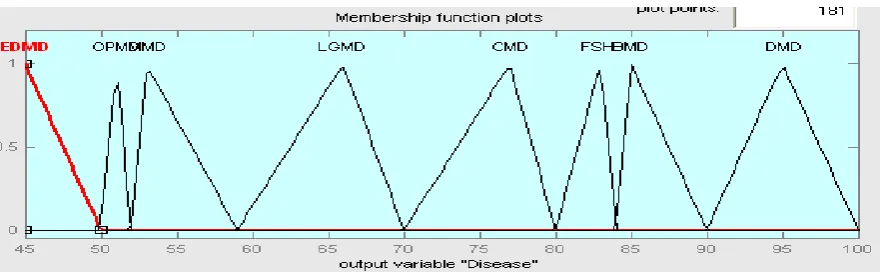
Figure4: Membership functions of output variables at second level
4. RESULT
4.1 Result at first level diagnosis of EMG
based diseases
The test data consist of 61 cases. It was created from expert opinion and literature survey. It consists of 10 DMD cases, 20 PO cases, 5 EM cases, 6 MM cases, 5 N cases, 5 PL cases and 10 MG cases. The accuracy of a classifier can be computed using sensitivity and specificity. For the given seven classes, we consider in terms of positive tuples (diagnosis =any particular disease like DMD) versus negative tuples (eg., diagnosis = not that particular disease like not DMD). True positives refer to the positive tuples that were correctly labeled by the classifier, while true negatives are the negative tuples that were correctly labeled by the classifier. False positives are the negative tuples that were incorrectly labeled by the classifier, while false negatives are the positive tuples that were incorrectly labeled by the classifier. These measures are defined as
Sensitivity = tpos /pos
tpos is the number of true positives (i.e. samples that were correctly classified suffering with a particular disease) and pos
suffering with a particular disease) samples. For example, while testing among the 10 cases of DMD, 8 are classified correctly by fuzzy logic and 2 are classified wrong. Therefore, Sensitivity == 8/10= 0.8.
Specificity =tneg/ neg
tneg is the number of true negatives (i.e. samples that were not suffering with particular disease and were correctly classified) an neg is the number of positive (i.e. samples that were actually not suffering with particular disease) samples and fpos is the number of false positives ("samples that are actually not suffering with a particular disease but were incorrectly classified). For example, while testing among the 51 cases that are not suffering with DMD, 47 are classified correctly by fuzzy logic and 4 are classified wrong. Therefore, Sensitivity = 47/51= 0.92.
Table7: Comparative table of Measures of different disease
Measure DMD PO EM MM N PL MG
Specificity 0.92 0.9 0.98 0.96 0.98 0.98 0.92 Sensitivity 0.8 0.9 0.8 0.66 0.8 0.8 0.8 The results are shown in Table 7, in terms of sensitivity and
specificity. The results indicate that the proposed method performs well in classifying NMD‟s. Plots of the seven results
[image:8.595.47.477.112.305.2]given in Table 7 are shown in ROC space in the Figure 5. For all the diseases, the result is above the diagonal, which represent good classification results.
Figure 5: ROC Curve of result at first level
4.2
Result at second level diagnosis of EMG
based diseases:
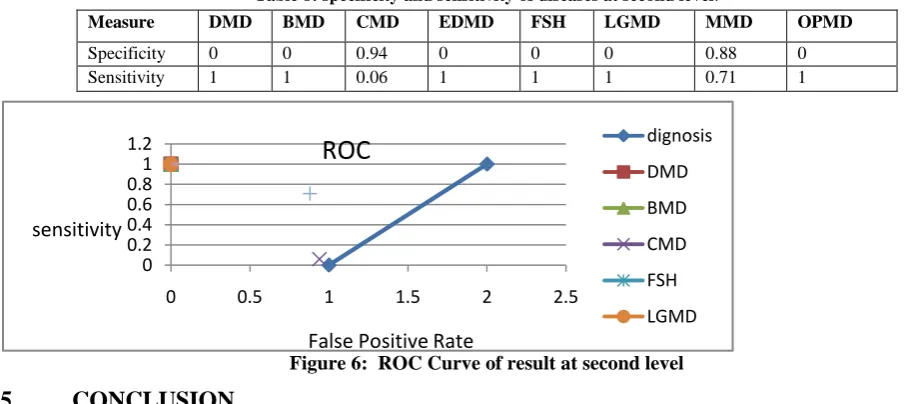
The test data consist of 34cases. It was created from expert opinion and literature survey. It consists of 4 DMD cases, 4 BMD cases, 6CMD cases, 4 EDMD cases, 3 FSH cases, 5
[image:8.595.54.509.385.587.2]LGMD cases and 7 MMD cases and 1 OPMD case. The sensitivity and specificity for each disease are computed and shown in table 8.
Table 8: specificity and sensitivity of diseases at second level.
Figure 6: ROC Curve of result at second level
5.
CONCLUSION
This work integrates in the context of medical system development. It has been devoted particularly to classify NMDs based at first level on the analysis of the EMG signal such as: amplitude, phase and duration and clinical parameters such as: physical, cognitive, psychological and motor parameters using fuzzy logic, and at second level analysis of muscular dystrophy diseases using signal such as muscular, cognitive, Muscular psychological, Internal ligual, Spontaneous abnormality and MUAP parameters using fuzzy logic.
After presenting the limits of the classical approach and intelligent technique such as ANN, CBR and RBR,I n solving the problem of classification in the medical domain, we have seen the reasons for choosing a new fuzzy method to achieve
the goal of designing a system capable of making reliable diagnoses. Finally, the classification results were presented. The results were satisfactory and were shown in the form of sensitivity and specificity. However, the design of the fuzzy model, including the fuzzy rule base and the membership functions, was rather hard to achieve Although it may seem simple. This difficulty was due to then tuitive nature of the human way of thinking which cannot be easily transformed to a numerical model.
Measure DMD BMD CMD EDMD FSH LGMD MMD OPMD
Specificity 0 0 0.94 0 0 0 0.88 0
Sensitivity 1 1 0.06 1 1 1 0.71 1
0 0.5 1 1.5
0 0.2 0.4 0.6 0.8 1 1.2
Sensitivity
False Positive Rate
ROC
diag
DMD
PO
EM
MM
0 0.2 0.4 0.6 0.81 1.2
0 0.5 1 1.5 2 2.5
dignosis
DMD
BMD
CMD
FSH
LGMD
ROC
sensitivity
6. REFERENCES
[1] R. B. Mishra, R. S. Rao, A heuristic pattern detection algorithm for assessment of EMG signals, Indian Journal of the Institution of Engineers 76 (1997) 52–58.
[2] B. Pandey, R.B.Mishra, Case-based reasoning and data mining integrated method for the diagnosis of some neuromuscular disease, Int. J. Medical Engineering and Informatics 3(1) (2011) 1–15.
[3] B. Pandey, R.B. Mishra, An integrated intelligent computing model for the interpretation of EMG based neuromuscular diseases, Expert System with Application 36 (5) (2009) 9201-9213.
[4] A. MESSAOUD, M. B. MESSAOUD, A. KACHOURI and F. SELLAMI, Fuzzy logic based system for classification of atrial fibrillation cardiac arrhythmias, IEEE, 2006, pp. 347-350
[5] A. Subasi, Medical decision support system for diagnosis of neuromuscular disorders using DWT and fuzzy
support vector machines, Computers in Biology and Medicine archive Volume 42 Issue 8, August, 2012,Pages 806-815.
[6] A. P. Picon, R. S. Ortega, R. Watari, C. Sartor, I. C. N. Sacco, Classifiction of diabetic neuropathy: a new approach taking uncertainity into account using fuzzy logic, Clinics, 2012, 67(2):151-156.
[7] B. Pandey, R.B. Mishra, Data Mining Approaches for the EMG absed classification of neuromuscular diseases, National conference on Artificial Intelligence and Agents(2011),136-148.
[8] B.Pandey, R. B. Mishra,Performance index assessment of intelligent computing methods in EMG-based neuromuscular diseases.IJKESDP, 4(1):42-71(2013). [9] B.Pandey, R. B. Mishra , An Intelligent Method Model