A Study on the Causes for Child Trafficking using
Indeterministic Triangular Fuzzy Cognitive Maps
A.Praveen Prakash
Department of MathematicsHindustan University Padur, Chennai-603103
M.P.Kannan
Department of Mathematics Velammal,Mat,Hr,Sec,SchoolMogappair, Chennai-600037
J.Esther Jerlin
Department of MathematicsHindustan University Padur, Chennai-603103
ABSTRACT
“Dad who sold three babies caught during fourth deal is the headline of the news in Indian Express dated 31.05.2014. The culprit named Praveen (37) confessed to the crime and is in police custody. His wife Manju was already rescued and admitted to a Home. News of this kind have become a regular feature. Child trafficking takes place all over the world, and is indeed prevalent in India. There have been reports from many areas about the increase of trafficking taking place in India. This paper analyses the causes of Child Trafficking and ranking the causes using the newly proposed Indeterministic Triangular Fuzzy Cognitive Model . This model has an advantage of ranking the causes by the calculated membership value also showing indeterminacy relation between the nodes obtained from the experts. This paper has four sections. Section one deals with the overall existing problem of child trafficking. Section two deals with the description of the model. Section three gives the study and analysis of the problem using the prescribed model. Section four gives the conclusion and suggestions based on the study.
Keywords
FCMs, NCMs, TrNCMs, Hidden pattern, fixed point, Child Trafficking.
1.
INTRODUCTION
According to the US State Department, there are approximately 600,000 to 820,000 people trafficked a year across international borders, and up to 50% of those are children. This is definitely seen as a growing issue in Asia, with many children that are and continue to be trafficked for many reasons as well as being exploited. It acts as a form of modern – day slavery. It is defined as the recruitment, harboring, transportation, obtaining a person by means of force, fraud or coercion for the purpose of a commercial sex act or labor services. It continues to be the second largest criminal industry in the world.
The newly proposed model helps in ranking the attributes in a refined manner. It involves the basis of FCM, NCM and TrFCM. FCM deals with the on-off state of the attributes. NCM deals with the indeterminacy condition between the attributes. TrFCM ranks the attributes based on the membership value obtained from Traverage. TrFCM relies on giving interrelationship degree value between the attributes though indeterminacy is seen between them. But this new model have an advantage of using inderterminate condition by denoting I so that the membership value obtained from TrNCM average shows the minute difference in ranking than TrFCM. [1, 2, 4]
2.
PRELIMINARIES
2.1
Triangular Fuzzy number
It is a fuzzy number represented with three points as follows. The membership function defined as
1 1 1 2 2 1 3 2 3 3 2 3
0,
( )
0
Afor x
a
x a
for a
x
a
a
a
x
a
x
for a
x
a
a
a
for x
a
2.2
Operation of Triangular Fuzzy Number
The following are the four operations that can be performed
on triangular fuzzy numbers: Let
A
( ,
a a a
1 2,
3)
and1 2 3
( ,
,
)
B
b b b
then,(i) Addition (+):
A B
(
a
1
b a
1,
2
b a
2,
3
b
3)
(ii) Subtraction (-):
A B
(
a
1
b a
1,
2
b a
2,
3
b
3)
(iii) Multiplication (
) :(a)
k
A
(
ka ka ka
1,
2,
3),
k
R k
,
0
(b)
A
b
(
a b a b c c
1 1,
2 2,
1 2),
a
1
0,
a
2
0
(iv) Division (
):1 1
1 1 1 1
1 1 1
1
1
1
( )
A
( , , )
a b c
,
,
,
a
0
c
b
a
1 1 1 1 2
2 2 2
,
,
,
0,
0
a
b
c
A B
a
a
c
b
a
2.3
Degrees of the Triangular Fuzzy
Number
35
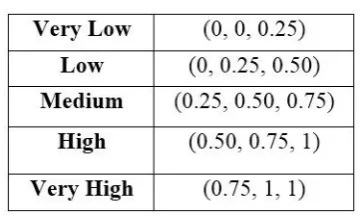
Table 1 : Linguistic Values of the Triangular Fuzzy Numbers
DEFINITION 2.3.1
: In the neutrosophic logic every logical variable x is described by an ordered triple x = (T, I, F) where T is the degree of truth, F is the degree of false and I l e v e l o f i n d e t e r m i n a c y .DEFINITION 2.3.2
: A Neutrosophic Cognitive Map(NCM) is a neutrosophic directed graph with concepts like policies, events etc. as nodes and causalities or indeterminates as edges. It represents the causal relationship between concepts.
Let C1, C2, …Cn denote n nodes, further we assume each node is a neutrosophic vector from neutrosophic vector space V. So a node Ci w i l l be represented by (x1, …,
xn) where xk’s are zero or one or I (I is the indeterminate) and xk = 1 means that the node Ck is in the on state and xk =0
means the node is in the off state and xk = I means the nodes state is an indeterminate at that time or in that situation. Let Ci and Cj denote the two nodes of the NCM. The directed edge from Ci to Cjdenotes the causality of Ci on Cj called connections. Every edge in the NCM is
weighted with a number in the set {-1, 0, 1, I}. Let eij be the weight of the directed edge CiCj, eijє {–1, 0, 1, I}. eij = 0 if Ci does not have any effect on Cj, eij = 1 if increase (or decrease) in Ci causes increase (or decreases) in Cj, eij = –1 if increase (or decrease) in Ci causes decrease (or increase) in Cj . eij= I if the relation or effect of Ci on Cj is an
indeterminate. [3]
2.4
Basic Definitions of Indeterministic
Triangular Fuzzy Cognitive Maps
(TrNCMs)
DEFINITION 2.4.1
: Triangular NCMs with edge weights or causalities from the set {-1, 0, 1, I} are called simple Triangular NCMs.DEFINITION 2.4.2
: A TrNCM is a directed graph with concepts like policies, events etc, as nodes and causalities as edges, It represents causal relationships between concepts.DEFINITION 2.4.3
: Consider the nodes/concepts TrC1, TrC2,…,TrCn of the Triangular NCM. Suppose the directedgraph is drawn using edge weight Treij∈ {-1, 0, 1, I}. The
triangular neutrosophic matrix M be defined by TrN(M) = (Treij) where Treij is the triangular neutrosophic weight of the
directed edge TrCiTrCj. TrN(M) is called the adjacency matrix
of Triangular Neutrosophic Cognitive Maps, also known as the connection matrix of the TrNCM. It is important to note that all matrices associated with a TrNCM are always square matrices with diagonal entries as zero.
DEFINITION 2.4.4
: Let TrC1, TrC2,…,TrCn be the nodesof an TrNCM. A= (a1, a2,…, an) where Treij∈ {-1, 0,1, I}. A is
called the instantaneous state vector and it denotes the on-off position of the node at an instant.
Instantaneous vector
ai =0 if ai is off (has no effect)
ai =1 if ai is on, (has effect)
ai =I if ai is indeterminate, (effect cannot be determined)
where i = 1, 2, …, n.
DEFINITION 2.4.5
: Let TrC1, TrC2,…,TrCn be the nodesof TrNCM. Let be the edges of the TrNCM (i≠j). Then the edges form a directed cycle. A TrNCM is said to be cyclic if it possesses a directed cycle. A TrNCM is said to be acyclic if it does not possess any directed cycle.
DEFINITION 2.4.6
: A TrNCM is said to be cyclic it is said to have a feedback.DEFINITION 2.4.7
: When there is a feedback in a TrNCM, i.e., when the causal relations flow through a cycle in a revolutionary way, the TrNCM is called a dynamical system.DEFINITION
2.4.8
: Let1 2
,
2 3,
3 4,...
1Tr
C
TrC
TrC
TrC
TrC
TrC
TrC
n TrC
n be acycle. When TrCi is switched ON and if the causality flows through the triangular edges of a cycle and if it again causes Ci, we say that the dynamical system goes round and round. This is true for any triangular node TrCi for i =1, 2,…, n. The equilibrium state for this dynamical system is called the hidden pattern.
DEFINITION 2.4.9
: If the equilibrium state of a dynamical system is a unique state vector, then it is called a fixed point. Consider a TrNCM with TrC1, TrC2,…,TrCn asnodes. For example let us start the dynamical system by switching on TrC1.Let us assume that the TrNCM settles
down with TrC1 and TrCn ON i.e., in the state vector remains as (1, 0, 0,…, 0) is called fixed point.
DEFINITION 2.4.10
: If the TrNCM settles down with a state vector repeating in the form A1→A2→…→Ai→A1 thenthis equilibrium is called a limit cycle.
2.5
Algorithm used to manipulate TrNCM
Step 1: Consider the attributes given by the experts for the problem as TrC1, TrC2,…. TrCn. According to the feedback
given by the expert directed graph is drawn.
Step 2: Let TrN(M) denotes the connection matrix with {-1,0,1,I} as causalities.
Step 3: Let the instantaneous state vector be A1= (1 0 0 0 0 0
0 0 0 0). It is passed into TrN(M). The on state vector TrN(M)avgweightis obtained.
Step 4: Maximum membership value is threshold as 1 and other as 0 and I. Consider the threshold and updated vector as A2.
Step 5: A2 is passed into TrN(M) the above said calculation is
3.
ANALYSIS OF THE PROBLEM
According to the experts opinion ten attributes were taken for the analysis of the problem.[7,9]
1
Tr
C
- Entertainment2
Tr
C
- Illiteracy3
Tr
C
- Unemployment4
Tr
C
- Poverty5
Tr
C
-Sexual Exploitation6
Tr
C
- Bonded Labour7
Tr
C
- Political Uprising8
Tr
C
- Illegal Activities9
Tr
C
- Social Factor10
Tr
C
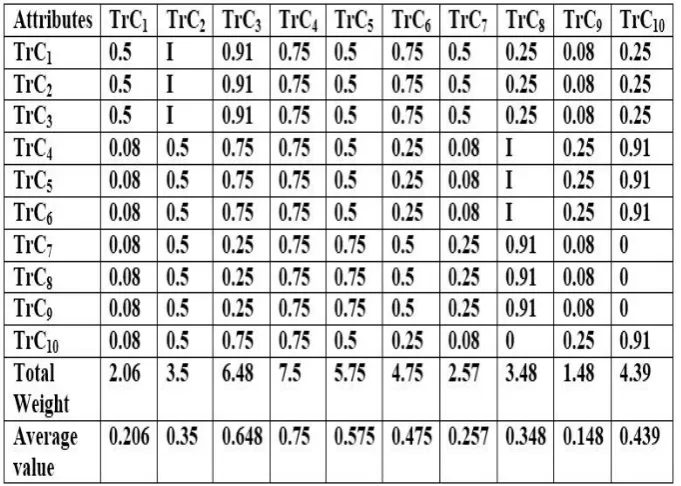
- High profit at low riskThe following matrix TrN(M) gives the linguistic connection matrix with inderterminacy.
Fig 1: Linguistic Connection Matrix with Inderterminacy
TrN(M)average weight matrix is given below.
37
3.1
First Process
W h e n t h e n o d e Tr
C
1 i.e “Entertainment” is in on state and other nodes in off state.A0= ( 1 0 0 0 0 0 0 0 0 0 )
A0M = ( 0 0 . 9 1 0 . 2 5 0 . 5 0 . 7 5 0 . 7 5 0 . 5 0 . 0 8 I
0 . 0 8 )
( 0 1 0 0 0 0 0 0 I 0 ) = A1
A1M = ( 0 . 5 + 0 . 7 5 I 0 + 0 . 7 5 I 0 . 9 1 + 0 . 2 5 I
0 . 7 5 + 0 . 0 8 I 0 . 5 + 0 . 5 I 0 . 7 5 + 0 . 2 5 I 0 . 5 + 0 . 0 8 I 0 . 2 5 + 0 . 9 1 I 0 . 0 8 + 0 I 0 . 2 5 + 0 . 5 I )
( 0 I 1 0 0 0 0 0 0 0 ) = A2
A2M ( 1 0 I 0 0 0 0 0 0 0 ) = A3
A3M ( I 1 0 0 0 0 0 0 I 0 ) = A4
A4M ( 0 I 1 0 0 0 0 0 0 0 ) = A5= A2
A2 i s t h e f i x e d p o i n t .
3.2
Second Process
W h e n t h e n o d eTr
C
4 i.e “Poverty” is in on state and other nodes in off state.A0= ( 0 0 0 1 0 0 0 0 0 0 )
A0M ( 0 0 0 0 0 0 0 I 0 1 ) = A1
A1M ( 0 0 0 0 0 0 0 1 0 I ) = A2
A2M ( 0 0 0 0 0 0 0 I 0 1 ) = A3= A1
[image:4.595.132.473.268.511.2]A1 i s t h e f i x e d p o i n t
Table 2: Weightage of the Attributes
4.
CONCLUSIONS AND SUGGESTIONS
From the above table it is clear that the indeterminate relation between the nodes play a vital role in calculating the accurate total weight of the attributes in correspondence with the other. From the calculated average value ranking of the dominant causes are done. Poverty - 0.75, Unemployment- 0.648,
Sexual Exploitation - 0.575, Bonded Labour- 0.475, High profit at low risk- 0.439 , Illiteracy-0.35, Illegal Activities-
0.348, Political Uprising- 0.257, Entertainment - 0.206, Social Factor- 0.148.
The government can conduct awareness program to develop and make each individual to realize their responsibilities and duties to the society. Volunteers can organize an anti-trafficking committee and collect fund for the welfare measures against trafficking.
5.
REFERENCES
[1] Kaufmann, “Introduction to the Theory of Fuzzy Subsets”, Academic Press, INC. (LONDON) LTD, 1975.
[2] Kosko, “Neural Networks and Fuzzy systems: A Dynamical System Approach to Machine Intelligence”, Prentice Hall of India, 1997.
[3] W.B Vasantha Kandasamy and Smarandache Florentin; ‘Fuzzy Cognitive Maps and Neutrosophic Cognitive Maps’, Xiquan, Phoenix. (2003).
[4] H.J. Zimmermann, “Fuzzy Set Theory and its application”, Fourth Edition Springer 2011.
[5] M.Clement Joe Anand , A.Victor Devadoss, “Using new Triangular Fuzzy Cognitive Maps(TRFCM) to analyze causes of Divorce in Family”, International Journal of Communications and networking Systems vol 02,pages;205-213,Integrated Intelligent Research(IIR)205.
[6] A.Praveen Prakash , J.Esther Jerlin and J.Bennilo Fernandes, “A Study on the causes for aversion to mathematics by engineering students using Fuzzy Cognitive Maps” (FCMs), International Journal of Innovative Research in Science, Engineering and Technology, ISSN: 2319-8753, Vol. 3, Issue 3, March 2014.
Mathematical Sciences International Research Journal, ISSN:2278-8697, ISBN:978-93-84124-03-8, Vol. 3, Issue 1, March 2014.
[8] A.Praveen Prakash, N.Lakshmipathy and J.Esther Jerlin, “Problems of Housemaids in Chennai City A Study Using Combined Fuzzy Cognitive Maps” (CFCMs), International Association of Engineers, ISBN: 978-988-19252-7-5, ISSN: 2078-0958, ISSN-2078-0966, Vol.I-July 2014.
[9] A.Praveen Prakash , M.P Kannan and Esther Jerlin.J, “A
Study on the causes for Child Trafficking using Combined Fuzzy Cognitive Maps” (CFCMs), ELSEVIER, ISBN: 978-93-51072-61-4, September 2014.
[10]Child Trafficking in India in Wikipedia