Mobile Hospitalization
Iraky Khalifa
Department of Computer Science, Faculty of Computers
and Information, Helwan University, Egypt
Hala Abd Al-glil
Department of Computer Science, Faculty of Computers
and Information, Helwan University, Egypt
Mohamed M. Abbassy
Department of Information Technology, Faculty of Computers and Information,
Helwan University, Egypt
ABSTRACT
Due to the rapid development of smart hospital, doctors have an urgent need to access Electronic Medical Record System (EMR) through mobile tablets, in wireless environments. Since most of the EMR systems are based on Windows Operating systems, the mechanisms of making EMR mobiles become an important research issue in smart hospital. This paper presents an application to a Smart Hospital based on cloud computing. This system could be achieved by using service oriented architecture, and XML (Extensible Markup Language) technology; It improves the mobile tablets that provide the needed information to the doctors, which are based on their context work. Thus, the doctors would be able to follow up their patients’ treatments and medical services. Moreover, they would be able to send back their review whether the patients took their treatment on time or not. Besides, this smart hospital system helps the doctors in taking critical decisions like in kidney transfer, depending on both the patient’s and the volunteer’s results.
Keywords
Mobile computing, Smart Hospital, Cloud Computing, Health Care and Cloud Health Care.
1.
INTRODUCTION
Mobile computing and Mobile devices enhanced the relationship between humans and computers. They introduced a new form of communication based on context. According to Figueiredo [1] a new form of communication allows people to interact easily with the object, computer, environment and others. Technological progress is a significant development of the existing computing paradigm, in which users need to explicitly interact with the system to achieve the desired results. Due to the development of mobile tablets and wireless network technology, many hospitals started to carry out researches and applications in the field of mobile medical information system. Manhattan Research [2] shows that physician’s use of tablets has grown more than 75 percent in the past year. Development of mobile devices and corresponding medical software applications creates opportunities for hospitals to better organize, store, and share medical data using mobile technology. Among these tablets, smart phones, are the best. Smart phones are highly wide-spread among all physicians, because of their long- life battery, ergonomic designs, and efficient user’s interface. The existence of those tablets enables their users to easily access records and references anytime and anywhere. It does not only introduce a new digital view, but also it brings unprecedented challenges in mobile health care. According to the mobile health care development, doctors are able to review electronic medical records, at the patient’s bedside via tablets or smart phones. Doctors will accurately receive the patient’s clinical diagnosis and treatment information through smart phones,
instead of using stationary desktops or recording their work in papers. The current medical systems are based on Windows platform and highly integrated information systems. Those medical systems have accumulated a great number of valuable clinical data with high quality and business logic. That’s why providing new appropriate mechanisms and methods to support medical systems used on mobile devices, becomes a vital issue research.
The last but not the least, this paper presents Smart hospital based on smart phone and tablets. Moreover, these systems are based on Cloud Computing. They depend on PHP as a foreground developing platform, MySQL server as a background database, and smart phone and tablets as running platforms. All those are used to realize a natural extension of Smart hospital.
2.
BACKGROUND AND RELATED
WORK
There are several academic and industrial features in this field. The healthcare sector is not only widely distributed and fragmented, but it also exhibits a high degree of heterogeneity with strong local autonomy [3]. The current lack of standards across different institutions prevents from using a single software solution to support a co-operative working environment [4]. It is also important to realize that the domain is very information-intensive and mission-critical [5]. The large volume of medical data with its complexity and variety makes it impractical to be transported between ‘point-of-source’ and ‘point-of-delivery’ as in the traditional client-server case. In addition, the hospital environment by default is ‘highly mobile’ with caregivers constantly on the move [6].As a result of the existence of much medical information and medical resources, the hospital staff needs some support while passing by the hospital. Thus, the mobile computing technique properly fits this need. Mobile computing offered many flexible techniques, but at the same time it has some major challenges that are not found in traditional systems, For example, the key issue of low bandwidth and highly unreliable connections. Health care domain is regarded as a quite unique one, that it needs some requirements and restrictions, which are important to the success of any application development in different environments.
provides mobile users with the data processing and storage services in clouds. ""The mobile devices do not need a powerful configuration (e.g., CPU speed and memory capacity) since all the complicated computing modules can be processed in the clouds.
The healthcare cloud has many advantages as well as some challenges. An advantage of the healthcare cloud is it can be a tool that medical professionals use to coordinate amongst various medical departments, institutions, and other healthcare related businesses. Through the use of strong information technology and patient flow optimization, cloud computing can improve efficiency in the use of medical resources [9]. One of the key optimizations achieved with the use of the cloud is in terms of fiscal expenditures. As compared to conventional methods, where institutions set up their own infrastructures, cloud users can significantly reduce capital costs by using the cloud [10]. Furthermore, the Health care cloud could be expanded depending on health information and user needs. The main challenge of Health Care Cloud (HCC) is the security part and the other personnel health care information. This challenge is critical to the patients to receive their treatment effectively. However, we cannot sacrifice the personnel health care for the health care cloud efficiency.
Cloud based patient record keeping system proposed in [11][12] is an innovative area in the field of healthcare which can enable doctors to view patient health records from anywhere and at any time in order to provide expert advises and monitor treatment. Some advanced applications like management of medical image data in a cloud computing environment which can be accessed through handheld mobile devices has been proposed in [13]. The possibility of real time health monitoring and analysis of patient data has been propounded in [14] for ECG data. The use of sensors to gather patient data and uploading to a cloud environment for further analysis has been introduced in [15]. Cloud Computing offers a new way of implementation of a wide variety of systems. But, Cloud Computing can be used to offer e-health services? To answer this question some examples of running e-health solutions with Cloud Computing in several Hospitals around the world are shown. In July 2011 Chelsea and Westminster London’s Hospital set a Cloud Computing system to manage and store their EHRs. With this system patients have full control over who has access to their health records.[16] Another example of Cloud Computing and e-Health services is found at the Italian Hospital of Bambino Gesú. This hospital, placed in Rome, is famous for being one of the largest research and treatment centers in the field of pediatrics. Since they are using Cloud they have experienced advantages such as: better collaboration between the medical staff, better connection with patients and more free time for the IT group [17]. Mobile Healthcare The purpose of applying MCC in medical applications is to minimize the limitations of traditional medical treatment (e.g., small physical storage, security and privacy, and medical errors [18], [19]). Mobile healthcare (m-healthcare) provides mobile users with convenient helps to access resources (e.g., patient health records) easily and quickly. Besides, m-healthcare offers hospitals and healthcare organizations a variety of on-demand services on clouds rather than owning standalone applications on local servers.
There are a few schemes of MCC applications in healthcare. For instance, [20] presents five main mobile healthcare applications in the pervasive environment.
Comprehensive health monitoring services enable patients to be monitored at anytime and anywhere through broadband wireless communications.
Intelligent emergency management system can manage and coordinate the fleet of emergency vehicles effectively and in time when receiving calls from accidents or incidents.
Health-aware mobile devices detect pulse-rate, blood pressure, and level of alcohol to alert healthcare emergency system.
Pervasive access to healthcare information allows patients or healthcare providers to access the current and past medical information.
Pervasive lifestyle incentive management can be used to pay healthcare expenses and manage other related charges automatically.
3.
PROPOSED SYSTEM
ARCHITECTURE:
Managing clinical information is considered as a challenge with unique needs. Moreover, till now, there is not any current system invented to address the complexity of the entire hospital area. However, there are some medical information systems are used in hospitals, nowadays, such as Hospital Information System (HIS), Picture Archiving and Communication Systems (PACS), Radiology Information System (RIS), and Laboratory Information System (LIS). Nevertheless, those systems are usually heterogeneous and isolated; they have uncompleted data, temporary workflow, and separated unconsolidated management. Thus, it was regarded an impossible idea for the medical staff, to establish the Enterprise Hospital Information System, which could integrate all the heterogeneous systems. It was also so hard to gather, anytime and anywhere, all the clinical data, including clinical reports, lab results, and clinical images available whenever and wherever they are needed.
Our study presents proposed Smart Hospital System designed to be applied in a hospital rather than the manual paper based system. The new system controls patients’ information, and their diagnosis details. It also enables the doctors to have different tests to diagnose the patient’s disease properly and accurately. In addition, it includes patients’ injection entry records, prescriptions and medicines. It also helps the doctors in taking important decisions regarding kidney transfer operations. Moreover, the system used to monitor the patient's treatment process, inside the hospital. This monitoring process works by sending real time notification will be send to nurse before the treatment time by 5 minutes. Furthermore, the doctor could checkup and monitors his nurse's work through those real time notifications. These will be sent to doctor by the system. Through those notifications, doctors will be able to know whether the patient took the treatment on time or not. All those facilities and services are to be applied in an efficient way to saving time and resources wasted currently in such cases.
3.1
System Description
data base of their patients. They, also, could modify their medical treatments and orders whenever they want. Besides, the most important advantages of architecture are, first, Portable terminals and simple HIS interface is available. Second, it could follow the process and the change of the medical orders’ execution items in a real-time mode. Third, the doctors can access patients’ information anytime, prescribe medical orders, and note the patients’ diagnosis. Figure 1 shows the architecture of the system.
[image:3.595.42.277.413.574.2]The Mobile Smart hospital is easily and naturally extended towards and bedsides. The mobile system can determine the work flow of the nurses. It aims at saving the nursery fees and time with the best nursery effect and the most influential service quality. Figure 1 shows different functions of the Smart hospital Information System. Key Modules and their functions are described in details. For instance, a bedside digital collection of the patients’ physical symptoms data, which is one of the important nursery work in collecting all kinds of physical symptom data. In contrast with the old traditional work process, the clinical collected data couldn’t be written on the desktops and recorded to anamnesis immediately. This traditional method wastes the nurses’ effort and time. Moreover, this traditional method is full of mistakes, which can affect the consistency and the efficiency of the datum. The new Mobile Information System allows the doctors and nurses to record data during their visits to the patients’ bedsides or in emergency cases. Then all this data will be sent immediately in a wireless real-time mode to the desktops and the background data base of HIS. In addition, doctors can use smart phone, tablets to examine patients’ detailed information anytime and anywhere.
Fig 1: Architecture of Mobile Hospitalization Integrated With HIS
Smart hospital system helps the doctors and nurses to exactly accomplish reports in a real-time mode. Those reports are considered objective documents of clinical work which are very hard for nurses to accomplish them. Furthermore, every patient has an independent volume of nursing records. That’s why it is impossible for nurses to carry all the nursing anamneses during their clinical work. However, in the traditional HIS nurses have to firstly note information in one paper. Secondly, nurses have to either copy them in formal nursing reports or keep them in minds to copy them later. Nevertheless, the first way wastes time and the second one has many mistakes and information omitted. Besides, there are other additional problems that could be found while analyzing nursing records. Those problems are the nurses’ rough handwriting, using informal fonts, random alternations,
over time nursing records and inexactly records. Opposite to this traditional system, the new Smart Hospital System detects and overcome all those problems.
It is easily for nurses to adopt smart phone, tablets, to perform all clinical electronic nursing records. In addition, the nursing recording time would be noted according to the temporal system time, and will co-relate with the standard terms to form the formal dictionary. By using this formal dictionary, nurses will avoid informal records and improves writing speed and quality rather than manual work.
By smart phone, tablets, nurses could complete a continuous report while visiting patients at their bedside. then the system will automatically produce complete and formal statistic documents based on the uploaded data. Thus, all the data are correct and the nursing reports are ready to be printed and achieved, to avoid repetitive operations. The usage of smart phone, tablets, greatly improves the original clinical work-flow in terms of informing, processing, and executing medical orders. In the traditional procedure of executing medical order; firstly the nurses on duty receive prescribed medical orders from doctors, through HIS in the nurse work station. Secondly, they copy and convey them to clinical nurses. Thirdly, based on the previous steps clinical nurses execute the corresponding treatments and operations. Finally, clinical nurses should return back to the workstation to confirm and sign after executing the medical orders. Absolutely this procedure doesn’t cope with real time medical orders’ execution. In contrary, in the new Smart Hospital System, the process has been redesigned with smart phone, tablets.
In addition, clinical nurses can simultaneously receive the latest doctors’ orders and any related information anytime with smart phone, tablets. Nurses, moreover, can execute corresponding therapies operations at the bedsides. Once the doctors’ orders change, smart phone, tablets would alert and warn clinical nurses to receive real time information and modify corresponding clinical therapy. If any unexpected situation happened during executing medical orders, clinical nurses can write down and explain reasons in the remark column so that definite responsibilities are directly managed.
Thus, clinical nurses can easily complete a real time record about executing medical words just by clicking smart phone, tablets on the spot, rather than returning to the work station to check after executing the order. This mobile hospital system offers great help and support to doctors in taking important decisions concerning kidney transfer operations. It also helps in comparing between the patient and the volunteer urine, stool, sonography, gastroscopy, colonoscopy, blood, and biochemistry tests. This comparison will greatly help doctors to take the right decision and effectively help in operations success.
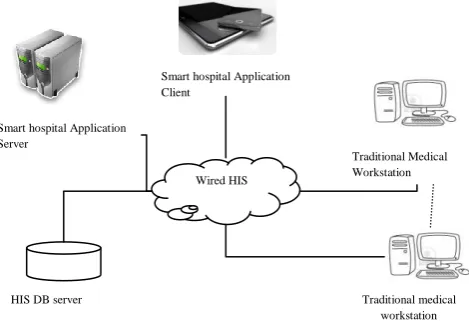
The system application as shown in Figure 2, shows facilities of application like doctors order, nursing management and check examination.
Wired HIS
Traditional Medical Workstation
Traditional medical workstation HIS DB server
Smart hospital Application Server
Fig 2: System Application
3.2
SYSTEM DESIGN:
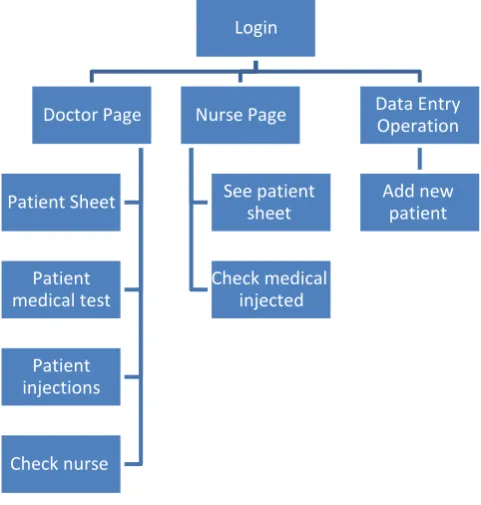
The system design is shown in Figure 3.When the user (doctor, nurse, data entry)accessing the smart hospital system has to write down his name, password, and choose his type whether a doctor or a nurse, because each has his own authorities and responsibilities. The doctor is allowed to access his patients’ data and modify it. He can also follow up his patients’ case and treatment. In addition, he can check whether the patient took the treatment on time or not. In case the nurse forgot to give the patient his treatment on time, the doctor receives notifications in his system with the nurse, treatment name. The nurse executes the doctor’s order and check whether the patient received the treatment or not. Furthermore, the nurses receive continuous notifications as a reminder before the patient’s treatment by ten minutes then five minutes.
[image:4.595.319.560.83.336.2]The nurses’ duty starts by accessing patient’s information from HISDB server through tablets or smart phones. During the nursing shift, the nurses could share and retrieve patient’s data from tablets or smart phones. They can also input the new data into them and execute the doctors’ order. The doctors’ duty starts exactly the time the patients arrive. Doctors give medical orders according to the patients’ conditions. Doctors, moreover, provide the suitable treatment and follow up the patients’ conditions. They also analyze the patients’ medical tests. Doctors also monitor the nurses to check whether the patients took the medicine on time or not. This system helped the doctor in making the right decision regarding kidney transfer operations by following up the medical test between the volunteer and the patient.
Fig 3: System Architecture
4.
SYSTEM IMPLEMENTATION:
This section describes the implementation of the design System for Smart hospital, as described above in the design system section. The limitations of the screen size of PDA, how to arrange presented contents in a screen is an issue. The screen was seen as too small requiring too much time to enter data quickly. The use of thumb keyboards was an option but nurses demonstrated a preference for not entering text using these formats. So users and their tasks should be paid more attention to in the arrangement of an interface and the switch mode between menu and toolbar is introduced. Also, graphics, colors and appearances would affect applications, the interface is designed to be concise and identical to Windows series which are familiar to users. Moreover, combos and check boxes are adopted for reducing the operation of manual typing.
This system was applied based on PHP and Mysql language. Mysql and PHP are together regarded as an easy and powerful way to create dynamic web pages that really interact with the medical staff. HTML can create well formatted web pages. Besides PHP and Mysql, we can gather data for medical staff, create special content on the fly, and do many other difficult things that can’t be handled alone by HTML. The design of PHP is considered a unique merit, as it is designed to a company HTML. The main aim in using this platform is to solve the application building problem in iPad, iPhones, Android, Windows Mobiles, and so on.
Thus, the doctors can easily find the patients’ name list, data medical treatments. Moreover, doctors could check whether the patient took the medicine on time or not. Same to nurses, they can also easily find their patients’ name list. Through this system, they can receive doctors’ orders and execute the order by using the medical order checking module. By just one click on the patients’ name the nurses can receive the doctors’ orders.
Browser
Enter Patient
Data Doctor Order
Nursing Management
Check and examination Report
Disease Case Archive Management
Authority Management
Transfer Kidney
Login
Doctor Page
Patient Sheet
Patient medical test
Patient injections
Check nurse
Nurse Page
See patient sheet
Check medical injected
Data Entry Operation
Add new patient
This system starts by a login page. Inside this login, there are the users name, password and user's type; whether s/he is a doctor or nurse. On the one hand, if a doctor log into his/her page, it will appear only his/her patients' name besides the notifications. Moreover, his patient's recent changes, development and treatment will be shown by real time notifications. Because this system is mainly applied by kidney transfer cases , thus; the patient's and the volunteer's tests will be highlighted by different colors and will be indicated by (below Normal, Normal, above Normal).
On the other hand, if a nurse log into his/her page, it will appear only his/her patients' name, their treatment's time and doses. Moreover, real time notification will alert her before the patient treatment by 10 minutes then five minutes. Those notifications used to remind the nurse by patients' treatment's time and doses. The nurse has to check after performing any action.
In this study, cloud technology was used to build Smart mobile hospital system because the cloud can vastly benefits in hospital work. There are some of the advantages of this system, such as storing information in the smart hospital system based on cloud gives unlimited storage capacity. Hence, no more need to worry about running out of storage space or increasing your current storage space availability. Since all data is stored in the cloud, backing it up and restoring the same is relatively much easier than storing the same on a physical device. Therefore, this makes the entire process of backup and recovery much simpler than other traditional methods of data storage. In addition, this technology helps to access the information from anywhere, where there is an Internet connection.
On the other hand we didn't depend on web service technology because Web services use plain text protocols that use a fairly verbose method to identify data. This means that Web service requests are larger than requests encoded with a binary protocol. The extra size is really only an issue over low-speed connections, or over extremely busy connections. Although HTTP and HTTPS (the core Web protocols) are simple, they weren't really meant for long-term sessions. Typically, a browser makes an HTTP connection, requests a Web page and maybe some images, and then disconnects. The server may periodically send data back to the client.
5.
CONCLUSION:
The last but not the least, Smart hospital is an important aspect in the Mobile Health Care field by providing the ability to review by a smart phone or a tablet. This proposed approach presents, to the doctor, new medical patterns. Doctors will be able to access their electronic medical records at the patients’ bedside via iPad or any other tablet. This review only needs few simple clicks and slides or even virtual keyboards tabs. As for the nurses, this approach greatly helped them. Nurses, can easily find their patients’ name lists, receive doctors’ orders, and execute the order by using the medical order checking module. This proposed system based on cloud computing has many advantages such as storing information , easy backup and recovery and can access the information from anywhere than Web services use plain text protocols . In contrast with the old traditional system, the new one reduces the burden on doctors, saves time and effort for nurses, improves the efficiency of medical treatment, and finally, enhances a great accurate and safe care upon the patient.
6.
REFERENCES
[1] Figueiredo, C., Nakamura, E., Computação Móvel. 2003 Novas Oportunidades e Novos Desafios T&C Amazônia,
[2] Manhattan Research, http://manhattanresearch.com/News-and- Events/In-The-News/informationweek-051612, 2012.
[3] J.Grimson; G.Stephens; B.Jung; W.Grimson; D.Berry. And S.Pardon, 2001.“Sharing Health-care Records over the Internet”, IEEE Internet Computing, Vol. 5, No. 3, pp. 49-58.
[4] Bilykh, Y.Bychkov, D.Dahlem, JH.Jahnke, G.McCallum, C.Obry, A.Onabajo, C. Kuziemsky, 2003. “Can GRID Services Provide Answers to the Challenges of National Health Information Sharing?”,proceedings of the Centre for Advanced Studies conference on Collaborative Research, Toronto, pp.39-53.
[5] J.Grimson, W.Grimson, W.Hasselbring, 2000. “The SI Challenge in Health Care”, Communications of the ACM, pp. 48-55.
[6] U.Arshad, C.Mascolo ,M.Mellor, 2003.“Exploiting Mobile Computing in Health-care”, Proceedings of the 23rd International Conference on Distributed Computing Systems (ICDCS’03).
[7] White Paper, “Mobile Cloud Computing Solution Brief,” AEPONA, November 2010.
[8] Jacson H. Christensen, “Using RESTful web-services and cloud computing to create next generation mobile applications,” in Proceedings of the 24th ACM SIGPLAN conference companion on Object oriented programming systems languages and applications (OOPSLA), pp. 627-634, October 2009.
[9] L. Liu, R. Moulic, and D. Shea, “Cloud Service Portal for Mobile Device Management,” in Proceedings of IEEE 7th International Conference on e-Business Engineering (ICEBE), pp. 474, January 2011.
[10] J. Lin and et.al. 2010 “Fine-grained Data Access Control Systems with User Accountability in Cloud Computing”, in the proceedings of 2010 IEEE Second International Conference on Cloud Computing Technology and Science (CloudCom), Indianapolis, pp. 89-96.
[11] Binczewski, A., Kurowski, K., Mazurek, C., and Stroinski, M., 2011, A Concept of a Patient-centered Healthcare System Based on the Virtualized Networking and Information Infrastructure. In Proceedings of the eTELEMED2011: The Third International Conference on eHealth, Telemedicine, and Social Medicine, IARIA, 51-58.
[12] Pardamean, B., Rumanda, R.R., Integrated Model of Cloud-Based E-Medical Record for Health Care Organizations, Recent Researches in E-Activities, 157-162.
[13] Somasundaram, M., Gitanjali, I.S. Govardhani, T.C., et al. 2011 ,Medical Image Data Management System in Mobile Cloud Computing Environment, Proc. of the International Conference on Signal, Image Processing and Applications IPCSIT 21 IACSIT Press, Singapore, 11-15.
services, Future Generation Computer Systems 28, 147– 154.
[15] Suresh, R., Robin, C.R.R., 2011 , An Efficient VOIP Enabled Health Monitoring System using Cloud Computing, Proc. International Conference on Emerging Technology Trends, 6-14.
[16] Coles-Kemp, L., Reddington, J., and Williams, P. A. H., 2011, Looking at clouds from both sides: The advantages and disadvantages of placing personal narratives in the cloud. Inf. Secur. Tech. Rep. 16:115–122.
[17] Bosch-Andersen, L., Hospital uses Cloud Computing to improve patient care and reduce costs 2011. Retrieved January 15,2011, from
http://www.microsoft.eu/cloud-computing/casestudies/ hospital-uses-cloud-computing-to-improve-patient-careand- reduce-costs-c16m1l.aspx.
[18] L. T. Kohn, J. M. Corrigan, and S. Donaldson, 1999 “To Err Is Human: Building a Safer Health System,” NATIONAL ACADEMY PRESS Washington.
[19] D. Kopec, M. H. Kabir, D. Reinharth, O. Rothschild, and J. A. Castiglione, 2003, “Human Errors in Medical Practice: Systematic Classification and Reduction with Automated Information Systems,” Journal of Medical Systems, vol. 27, no. 4, pp. 297 - 313.