http://dx.doi.org/10.4236/ojop.2015.43009
Solving Ordinary Differential Equations with
Evolutionary Algorithms
Bakre Omolara Fatimah1, Wusu Ashiribo Senapon2, Akanbi Moses Adebowale2
1Department of Mathematics, Federal College of Education (Technical), Lagos, Nigeria 2Department of Mathematics, Lagos State University, Lagos, Nigeria
Email: [email protected], [email protected], [email protected]
Received 2 June 2015; accepted 1 September 2015; published 4 September 2015
Copyright © 2015 by authors and Scientific Research Publishing Inc.
This work is licensed under the Creative Commons Attribution International License (CC BY).
http://creativecommons.org/licenses/by/4.0/
Abstract
In this paper, the authors show that the general linear second order ordinary Differential Equa-tion can be formulated as an optimizaEqua-tion problem and that evoluEqua-tionary algorithms for solving optimization problems can also be adapted for solving the formulated problem. The authors pose a polynomial based scheme for achieving the above objectives. The coefficients of the pro-posed scheme are approximated by an evolutionary algorithm known as Differential Evolution (DE). Numerical examples with good results show the accuracy of the proposed method compared with some existing methods.
Keywords
Evolutionary Algorithm, Differential Equations, Differential Evolution, Optimization
1. Introduction
For centuries, Differential Equations (DEs) have been an important concept in many branches of science. They arise spontaneously in physics, engineering, chemistry, biology, economics and a lot of fields in between. Many Ordinary Differential Equations (ODEs) have been solved analytically to obtain solutions in a closed form. However, the range of Differential Equations that can be solved by straightforward analytical methods is rela-tively restricted. In many cases, where a Differential Equation and known boundary conditions are given, an ap-proximate solution is often obtainable by the application of numerical methods.
Several numerical methods (see [1]-[3]) have been developed to handle many classes of problems but yet, the quest for reasonably stable, fast and more accurate algorithms is still on the search in the field of calculus.
to improve a candidate solution with regard to a given measure of quality (see [4]-[7]), interest in the adaptation of these techniques to Differential Equations is recently on the rise. Approximate solutions of Differential Equa-tions are obtained by formulating the equaEqua-tions as optimization problems and then solved by using optimization techniques.
Nikos [8] in his work proposed the idea of solution of ODEs via genetic algorithm combined with collocation method. In [6], the combination of genetic algorithm with the Nelder-Mead method was introduced and imple-mented for the solution of ODEs and the idea of neural network for obtaining approximate solutions of ODEs was also proposed in [9]. The author in [10] adapted the classical genetic algorithm to the solution of Ordinary Differential Equation.
In this paper we show that the Differential Evolution (DE) algorithm can also be used to find very accurate approximate solutions of second order Initial Value Problems (IVPs) of the form
( )
( )
( )
;( )
0 0,( )
0 0,[ ]
0,y′′+p t y′+q t y=r t y t =y y t′ = y′ t∈ t b (1)
2. Basic Notions of Differential Evolution Algorithm
Formally, let : nf R →R be the function which must be optimized. The function takes a candidate solution as argument in the form of a vector of real numbers and produces a real number as output which indicates the fit-ness of the given candidate solution. The gradient of f is not known. The goal is to find a solution m for which
( )
( )
f m ≤ f p for all p in the search-space, which would mean m is the global minimum. Maximization can be performed by considering the function : : n
g = −f R →R instead.
Let x∈Rn designate a candidate solution (agent) in the population. The basic Differential Evolution algo-rithm can then be described as follows:
• Initialize all agents x with random positions in the search-space;
• Until a termination criterion is met (e.g. number of iterations performed, or adequate fitness reached), repeat the following.
• For each agent x in the population do:
* Pick three agents a b, , and c from the population at random, they must be distinct from each other as well as from agent x;
* Pick a random index R∈
{
1,,n}
(n being the dimensionality of the problem to be optimized); * Compute the agent’s potentially new position y=[
y1,,yn]
as follows:• For each i, pick a uniformly distributed number ri ≡U
( )
0,1 ;• If ri<CR or i=R then set yi = +ai F b
(
i−ci)
otherwise set yi=xi;• (In essence, the new position is outcome of binary crossover of agent x with intermediate agent
(
)
F
= + −
z a b c ):
* If f
( )
y < f( )
x then replace the agent in the population with the improved candidate solution, that is, re-place x with y in the population.• Pick the agent from the population that has the highest fitness or lowest cost and return it as the best found candidate solution.
Note that F∈
[ ]
0, 2 is called the differential weight and CR∈[ ]
0,1 is called the crossover probability, both these parameters are selectable by the practitioner along with the population size NP≥4.3. Construction of Proposed Algorithm
In this section, we show the steps involved in formulating the general linear second order initial value problem (1) as an optimization problem and then use the Differential Evolution algorithm to obtain approximate solution of the ODE.
Consider the second order initial value problem (1), in this work we assume a polynomial solution of the form
( )
0, k
i i i
y t ψt k +
=
=
∑
∈Z (2)where ψi are coefficients of the monomials i
( )
2( )
1( )
( )
2 1 0
1
k k k
i i i
i i i
i i i
i i ψt− p t i tψ − q t ψt r t
= = =
− + + =
∑
∑
∑
(3)Using the initial conditions we have the constraint that
0 0 1 0 0 0 1 , and k k i i i i
i t t i t t
t y i t y
ψ ψ −
= = = =
= = ′
∑
∑
(4)Using (3), at each node point tn, we require that
( )
(
)
2( )
1( )
( )
2 1 0
1 0
n
k k k
i i i
n i i i
i i i t t
t i i ψt− p t iψt− q t ψt r t
= = = =
= − + + − =
∑
∑
∑
E (5)
To solve the above problem, we need to find the set of coefficients
{
ψi i=0 1( )
k}
, which minimizes theex-pression
( )
2 1 N n n t =∑
E (6)where N b t0
h −
= and h is the steplength. We now formulate the problem as an optimization problem in the
following way:
( )
2 1 Minimize: N n n t =∑
E (7)0 0
1
0 0
0 1
Subject to: , and
k k
i i
i i
i t t i t t
t y i t y
ψ ψ −
= = = =
= = ′
∑
∑
(8)Equations (8) and (9) together is the formulated optimization problem of the IVP (1). The next objective of this work is to solve Equations (8) and (9) using the Differential Evolution algorithm.
Using the Differential Evolution algorithm we are able to obtain the set
{
ψi i=0 1( )
k}
which minimizes theexpression
∑
Nn=1E2n( )
t for each problem. We shall refer to this proposed method as “Differential Evolution forODEs (DEODEs)”.
4. Numerical Experiments
We now perform some numerical experiments confirming the theoretical expectations regarding the method we have proposed. The propose scheme is compared with the Runge-Kutta scheme for solving (1).
The table of “CPU-time” and the maximum error of all computations are also given. The following parameters are used for all computations.
Differential Evolution: Cross Probability =0.5; Initial Points = Automatic; Penalty Function = Automatic; Post Process = Automatic; Random Seed = 0;
Scaling Factor = 0.6; Search Points = Automatic; Tolerance =0.001.
All computations were carried out on a “Core i3 Intel” processor machine.
4.1. Problem 1
( )
( )
;( )
0 1,( )
0 1y t′′ = y t′ y = y′ = (9)
with the exact solution y t
( )
=exp( )
t .Implementing the proposed scheme with k=10, we obtain
{
ψi i=0 1 10( )
}
as5429956875 283916051 42051617 15735741
1,1, , , , ,
10859913749 1703496320 1009238446 1888307702
360751 80248 17906 1622 202
, , , ,
259690976 405518915 703880563 708257343 441661305
4.2. Problem 2 Consider the equation
( )
100 0;( )
0 1,( )
0 10y t′′ − = y = y′ = − (10)
with the exact solution y t
( )
= −1 10t+50t2Implementing the proposed scheme with k=10, we obtain
{
ψi i=0 1 10( )
}
as{
1, 10, 50, 0, 0, 0, 0, 0, 0, 0, 0−}
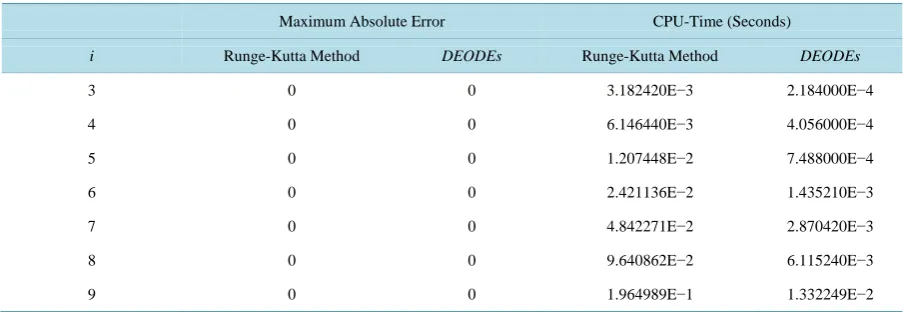
[image:4.595.88.539.368.529.2]From the results obtained in Table 1, the proposed algorithm gave very accurate coefficients for the solution form for Problem 1. The algorithm gave the exact solution for Problem 2 as seen in Table 2.
Table 1.Maximum absolute error and CPU-time in seconds for Problem 1 with step-size h=2 ,−i i=3 1 9
( )
.Maximum Absolute Error CPU-Time (Seconds)
i Runge-Kutta Method DEODEs Runge-Kutta Method DEODEs
3 4.984042E−6 5.573320E−14 5.210430E−3 4.056000E−4
4 3.281185E−7 6.594725E−14 1.014006E−2 6.864000E−4
5 2.104785E−8 7.016610E−14 2.009293E−2 1.248010E−3
6 1.332722E−9 7.105427E−14 3.996746E−2 2.464820E−3
7 8.383871E−11 7.149836E−14 8.018451E−2 4.836030E−3
8 5.258460E−12 7.149836E−14 1.608682E−1 1.023367E−2
[image:4.595.87.539.559.715.2]9 3.286260E−13 7.149836E−14 3.238269E−1 2.162174E−2
Table 2. Maximum absolute error and CPU-time in seconds for Problem 2 with steplength h=2 ,−i i=3 1 9
( )
.Maximum Absolute Error CPU-Time (Seconds)
i Runge-Kutta Method DEODEs Runge-Kutta Method DEODEs
3 0 0 3.182420E−3 2.184000E−4
4 0 0 6.146440E−3 4.056000E−4
5 0 0 1.207448E−2 7.488000E−4
6 0 0 2.421136E−2 1.435210E−3
7 0 0 4.842271E−2 2.870420E−3
8 0 0 9.640862E−2 6.115240E−3
We see that the Differential Evolution algorithm for solving ODEs gave better approximate results for differ-ent steplengths (h) compared with the Runge-Kutta Nystrom method. The proposed solution process also gave better CPU-Time for both problems solved.
5. Conclusion
In this paper, we have been able to formulate the general linear second order ODE as an optimization problem, and we have also been able to solve the formulated optimization problem using the Differential Evolution algo-rithm. Numerical examples also show that the method gives better approximate solutions. Other evolutionary techniques can be exploited as well.
References
[1] Buctcher, J.C. (2008) Numerical Methods for Ordinary Differential Equations. Wiley,New York.
http://dx.doi.org/10.1002/9780470753767
[2] Lambert, J.D. (1973) Computational Methods in ODEs. Wiley, New York.
[3] Lambert, J.D. (1991) Numerical Methods for Ordinary Differential Systems. Wiley, New York.
[4] Goldberg, D.E. (1989) Genetic Algorithms in Search, Optimization and Machine Learning. 2nd Edition, Addison-
Wesley,Boston.
[5] Holland, H.J. (1975) Adaptation in Natural and Artificial Systems. University of Michigan Press, Ann Arbor.
[6] Mastorakis, N.E. (2006) Unstable Ordinary Differential Equations: Solution via Genetic Algorithms and the Method of
Nelder-Mead. Proceedings of the 6th WSEAS International Conference on Systems Theory & Scientific Computation,
Elounda, 21-23 August 2006, 1-6.
[7] Michalewiz, Z. (1994) Genetic Algorithm + Data Structure = Evolution Programs. 2nd Edition, Springer-Verlag,
Ber-lin.http://dx.doi.org/10.1007/978-3-662-07418-3
[8] Mastorakis, N.E. (2005) Numerical Solution of Non-Linear Ordinary Differential Equations via Collocation Method
(Finite Elements) and Genetic Algorithms. Proceedings of the 6th WSEASInternational Conferenceon Evolutionary
Computing, Lisbon, 16-18 June 2005, 36-42.
[9] Junaid, A., Raja, A.Z. and Qureshi, I.M. (2009) Evolutionary Computing Approach for the Solution of Initial Value
Problems in Ordinary Diffential Equations. International Scholarly and Scientific Research & Innovation, 3, 516-519.
[10] George, D.M. (2006) On the Application of Genetic Algorithms to Differential Equations. Romanian Journal of