
A generalized exploratory method for
managerial analysis and business
communication
Săvoiu, Gheorghe and Viorel, Crăciuneanu
University of Pitesti
February 2008
Online at
https://mpra.ub.uni-muenchen.de/13563/
A GENERALIZED EXPLORATORY METHOD FOR MANAGERIAL
ANALYSIS AND BUSINESS COMMUNICATION
1
Gheorghe SĂVOIU, 2Viorel CRĂCIUNEANU
1,2
University of Piteşti, Faculty of Economic Science,
e-mail: [email protected] , [email protected]
Key words: information, language, communication, message, decoding/encoding, negotiation, the method of the four “E”, efficaciousness, degree of economy, efficiency and effectiveness.
Abstract: Contemporary managerial processes are focused on communication and negotiation, where efficiency acquires an essential importance and its variation related to the managerial programme, with its time or space details, respectively related to the effectiveness of management, statistics, mathematics, etc. All these sciences and their methods meant to identify regularities and to generalize the alternatives, emphasizing their fundamental contribution to the majority of the results of the organizations, regions and national economies. This paper illustrates cybernetic communication’s theories based on information (with special stress being laid on the notions of data, language, message and decoding/encoding), and also underlines the functions and models of communication, the kind of form, and expression relationship human communication intends to achieve, the types of information with relation to communication, knowledge and creation, semantic, statistical and mathematical aspects woven into communication, the levels of theoretical approach of communication (with respect to the accuracy of symbol transmission, the accuracy of signification conveyed through symbols, and the efficacy of its influence on the recipient). The latter analysis (belonging to Warren Weaver) is specifically dwelt on, with special emphasis on the managerial activities. Initially the author proposes six solutions of using some methods of analysis, out of which one is strictly logical, then four distinct methods mainly statistical and mathematical in nature, and, in the end, one that is mainly sociological (the method of the flattened networks of internet type). The methods briefly presented easily characterize the communication, negotiation, and, finally, the decision-making processes, but especially their aggregation in an ample process, the managerial one. The frame method of the four “E” becomes the expression of the statistical way of thinking through effects and efforts of the economic activities, but it does not exclusively belong to them, it initiates a chain of efficaciousness-degree of economy-efficiency-effectiveness type, a chain that allows the interpretation, the placement in hierarchical order and the comparison of the processes and systems, whereas mathematics through the richness of the solutions, from using the probabilities of occurrence of the effects, to the informational energy, complete and generalize the entirety. Thus, there results a new economic paradigm of Homo Effectus, able to substitute the already contested Homo Rationalis.
1. INTRODUCTION
In a concise and reductive manner [1], the main communication theories can be
reunited in rhetoric or the practical art of speech, semiotics or the inter-subjective
mediation through signs, phenomenology or the experience of alterity or otherness through
dialogue, cybernetics or the processing of information, socio-psychology or the reunion of
articulation with interaction and influence, and critical theory or the discursive reflection, to
which contemporary solutions are added, more and more numerous and varied (analytical,
pragmatic, cultural theories, etc.). In the cybernetic theory or the processing of information,
is emphasis of communication is on the significance of knowledge and creation. There is no communication without knowledge or creation and there is no knowledge or creation without communication. The simplest model of representational communication is that of
Karl Bühler[2] synthesized by the first variant of the sender-message-receiver type:
MESSAGE
Fig. no. 1. Karl Bühler’s communication model, sender-message-receiver
In Roman Jakobson’s intermediary variant there appear three other elements, code, channel and context (referent), offering the possibility of outlining, through pluralism, a
potential model with six components: sender-code-message-channel-context-receiver [3]:
Fig. no. 2. Reunited model of communication (Karl Bühler - Roman Jakobson)
In the cybernetic model of communication of Claude Shannon and Warren Weaver the contextual component is missing, the model avoids the semantic information, in favour of the selective one, and it additionally contains three new components, the transmitter, the receiver and the noise, and in order to constitute itself statistically and mathematically, that is to submit its object to measurement one resorts to a special characteristic of information, the fact that it benefits from an invariance all along a series of reversible
operations and for this reason it quantizes in bits (which thus became units of
measurement)[4-6]. Warren Weaver, through a relevant question, regarding the exactness
with which the symbols of communication can be transmitted generated the complex
(classical) system of communication:
CONTEXT
Initial message Sender CODE Receiver Final message
COMMUNICATION CHANNEL
COMMUNICATION CHANNEL
Fig. no.3. The systemic model of communication (Claude Shannon-Warren Weaver)
The fundamental theorem of the statistical-mathematical theory of communication,
considered valid for a channel without noise and for discreet signals, refers to the channel
of communication having the capacity of C bits per second, receiving symbols from a source with the entropy of H bits per second (the information communicated) and it states that, thanks to the procedures of coding adequate to the sender it is possible to transmit symbols through the channel with an average debit close to C/H, but this debit, regardless the inventiveness of the coding, cannot exceed C/H. This theorem emphasizes the totally special significance of the coding process and the need of finding an optimum solution that can correlate the technical aspects with the informational ones. The maximization of the relation C/H becomes a first aim in communication. This fact, based on the background of the similarity with economy (production-exchange-consumption) reduce communication to an exchange of messages, just as economy is an exchange of merchandise, which also allows to attach to the process of communication one of the six methods of multidisciplinary analysis, considered as possible solutions of the method of the four “E”:
a) a chain of logical approach of the type: efficaciousness-degree of
economy-efficiency-effectiveness;
Efficaciousness in the model of communication: message and noise;
Degree of economy in the model of communication: the C/H relation or the limit of the resource of h type;
Efficiency in the model of communication: maximization of the C/H relation for a given level of H;
Effectiveness in the model of communication: monitoring/controlling the communication channel.
b) a statistical evaluation of indexes of procedural transformation through the law of
equivalence and the dynamics of the factorial asymmetries (the index-numbers method);
c) a delimitation of the informational transformation thresholds, of the maximum and
minimum type, with the help of the law of the minimum and the law of the maximum (the method of the smallest squares through the use of the partial derivatives);
d) a mathematical and physical interpretation of the economic relations centred upon the
principle of losses, successive inequalities and of the inclinations of the slopes of effect
and cause or of the angular coefficients of the m = (Y1-Y2)/ (X1-X2) type;
Transmitter Source of information
Sender Receiver
Addressee / destination of information Initial
message
Initial signal
Final signal
Final message
e) a determination of the informational energy ( S = Σ pi2 );
f) a modern sociological vision with the help of the new organizational solutions of network
type (having as model the internet or the intranet) and of the shared trust networks
described by Francis Fukuyama in the work called “The Great Disruption.”
Claude Shannon and Warren Weaver’s model of communication has become the canonical scheme of communication (the founder model of communication and information sciences), and it was extended with the feedback component from the receiver and thus the permanent adjustment of communication is accomplished:
- if the reaction of the cause’s effect is positive, the message’s transmission is confirmed; - if the reaction is negative, the resumption of the integral or partial transmission of the message is imposed through its correction or elimination of a part of the noise of the channel, going as far as changing the channel.
From the functionalist or expressive (organic) perspective, the act of communication, in Harold Lasswell’s view, can be described through an ample process of analysis:
Who? - Control analysis Says what? - Content analysis In what channel? - Media analysis To whom? - Audience analysis With what effect? - Effect analysis
Analysed with the help of the information-decision function, negotiation can be
defined as a decision-making process, through which the parties try to reach together a solution, materialized in a contract or agreement, the partners pursuing the maximization of their results (obtaining a more advantageous situation than in the absence of the negotiation), either a communication process between the people involved, or transfer of information and their understanding (to negotiate being equivalent with to communicate in
the hope of concluding an agreement) [7]. In a fundamental typological approach of the
negotiations one can distinguish among the three classes considered classical, placed
between the pure conflict and its solution: integrative negotiation (the result being
victory/victory), distributive (the result mathematically corresponds to the game with naught
sum, in the final transaction it is not possible for a party to win without the other one losing)
and rational (the partners do not only want to obtain concessions, but they rationally try to
solve the important long-term litigations from an objective position).
An interpretation of the integrative negotiation centred on the principle of the slopes’
inclinations of effect and cause or of the angular coefficients of the m = (Y1-Y2)/(X1-X2) type
is interesting through the simple and prompt evaluation of the differentiated effectiveness
of the negotiators, even in the specific context of the victory/victory result. In order to
exemplify this one resorts to the simplest formalized model [8] of the equilibrium in the economic negotiation, redefined through other elements, in order to concretely determine the inclinations of the slopes and the angular coefficients (Y and X appear as p and q): 1. a pair of variables defining the points announced in negotiation P1(p1q1) and P3 (p3q3),
representing tow negotiators’ requests regarding the value of a sale or of a delivery (p1 and
q1 being the price and the quantity announced by the seller and p3 and q3 being the price
and the quantity announced by the buyer);
2. a state of balance of the final agreement that will coincide with the point of agreement
P2(p2q2), situated on the disruption threshold of the negotiation, but internal to the
environment of the negotiation, both as announced environment and as reserved
environment, that confirms the victory/victory result (p2 and q2 defining a price of
agreement and, respectively, a quantity of agreement);
maximum level or as reserved or minimum level, in relation with the point of agreement of
the negotiation: mV = (p1-p2) / (q1-q2) and a similar one of the buyer: mC = (p3-p2) / (q3-q2);
4. generally, the two angular coefficients will be different (mV # mC) and underline different
degrees of effectiveness in negotiation, the identity condition being generated by equal
inclinations and by median position P2, as compared with P1 and P3, rarely met in reality.
Another established theory, theory of games tries to elaborate the optimal rational strategy in negotiation, from a mathematical point of view, with the aim of completing a game (simply as a game, with no reference to the “real world”). The theory of the games[9] considered an interactive variant of the theory of decisions benefits from the analysis of the behaviour of some independent decision-makers (the players), whose decisions mutually influence. The difference between the two theories is given by the fact that in the theory of decision the decision-maker acts in relation with the nature, that is in a context deprived of interactivity (he/she makes decisions and evaluated their effects), whereas in the theory of games the context is interactive (in the terms of the minimal mathematical model of the economic or commercial negotiation the request is immediately followed by a counter-request). The similarity between the two theories is that both of them impose that the analysis be made based on rationality criteria and not out of psychological or sociological motivations.
2. THE PRIMACY OF EFFICACIOUSNESS AND THE TRADITION OF ECONOMICS Each science defines and is defined by a certain type of thinking. The logical thinking, maybe the only type of thinking present in all the attempts of human cognition, proposes the solution of the direct definition, but it also capitalizes in frequent situations the one of the denial of the negation, by defining the opposite and then „per a contrario,” of all that is not the opposite thus confined. In the case of a presentation about efficiency and effectiveness, two concepts which have a visibility out of the ordinary in the contemporary economy and in the management specific to it, must be defined, first, the economic thinking or that of the degree of economy whose fundamental products certainly are both the one and the other. But in order to define the thinking of the degree of economy, we should get down one more step from the high tower of logical thinking and begin with what is defined as human activity, next to the notions of its immediate results or effects, in other words with the primacy of efficaciousness. There certainly was a thinking of the efficaciousness, easier to be defined by opposition with the thinking of the non-efficaciousness. The thinking of the non-efficaciousness precedes the organization and the institutional. The thinking of the non-efficaciousness remains that type of thinking which is able to establish the existence of a result without obtaining it in an effective way or to record the presence of an object with certain properties, respectively without being able to identify it. A number of two limit-situations, in which the human beings and their natural way of cogitating are involved, become illuminating examples:
(a) an odd number (2n +1) of messages is communicated to “n” receivers (obviously in positive whole numbers), but it cannot be clearly individualized nor specifically named how much has each received, although it results nevertheless that one of the receivers has received at least 3.
(b) an arbitrator (an observer) in an extended multilateral negotiation finds out that he/she has an unopened envelope left, representing the anonymous request of a negotiator, when all the parties have gone, after having practically concluded the agreement, and he/she assumes that one of the parties is in the situation of a round in which his/her own conditions do not appear in the final signed agreement (the arbitrator not being able to identify the negotiator nor to stop him/her and return the envelope).
possibility of the clear delimitation of the principle non-efficaciousness from the practical non-efficaciousness[10]. Another important type of non-efficaciousness results from the contrast between the accuracy of the effects as information estimated with global character and those with local character (individual, spatial or momentary). On a general economic level, the thinking of the efficaciousness dominates, as a simple consequence of the observation that all the activities manifest themselves through effects whose huge
diversity always has a well-individualized owner. One can unconditionally state that the
primacy belongs to efficaciousness. Analogously, both the economic and managerial thinking are always identical through their common origin in the sphere of efficaciousness. As a consequence, the manager also, as possessor of the thinking of efficaciousness will be the owner of some effects or results and will design effects of the organization’s activity, as an expression of the efficiency and efficaciousness of his/her management.
3.STATISTICS’ CONTRIBUTION IN EVALUATING EFFICIENCY AND EFFECTIVENESS Practically any managerial team or any solitary manager will have a managerial programme, which efficaciousness will transcribe into a matrix of the designed effects. The announced matrix model is achieved starting from the hypothesis that the management of the organization will identify, name and draw up the main effects that give content to its managerial policy in hierarchical order as compared to the estimated probability of their occurrence or production (the sum of the probabilities being equal to 1).
The managerial programme as a matrix of the designed effects and placed in hierarchical order according to their occurrence probability
Table no. 1.
The designed effect and placed in hierarchical order according to the
occurrence probability
U.M. (unit of measurement)
The designed level
The estimated occurrence probability of the effect
- A - - B - - 1 - - pa -
E1 RON 0,20
E2 % 0,12
E3 tons 0,10
… … …
En hours 0,01
Total Σ pa = 1,00
The specificity and originality of the managerial strategy finds its expression in a second matrix, which multiplies the estimated occurrence probability of the effect with its impact as such and generates a new hierarchy of the effects according to the explanatory factors.
The matrix of the prognosticated and re-placed in hierarchical order effects according to the final importance
Table no. 2.
The effect designed and re-placed in hierarchical order according to
the final importance
U.M. The designed
level
The estimated occurrence probability
of the effect
The estimated strategic
impact
Final importance
(OEp) -A- -B - - 1 - - pa - - pj - (pa x pj)
E1 RON 0,20 0,10 0,0200
E3 tons 0,10 0,15 0,0150
E2 % 0,12 0,08 0,0960
… … … … …
En hours 0,01 0,01 0,0001
Total Σ pa = 1,00 Σ pj= 1,00 -
criterion of the expected value (of expectancy), the criterion of rationality (the Laplace criterion, applicable to decisions under conditions of uncertainty), the criterion of maximum probability (based on which the state of nature with maximum probability is chosen). A solution that benefits from an increasing utility but also from a real capitalization both of the information managerial system and of the complete communication of the necessary and possible level of the objectives or of the negotiation within the team, which subsequently ensures homogeneity for the entire managerial team and also higher perspectives of putting a common managerial strategy into practice is constituted by an average evaluation based on a scale of report in the generalized Fishbein-Rosenberg variant with the constant sum (but not in its classical form, in percents, but in coefficients, expressed with two decimal fractions), briefly described [11-12] in the following chart:
The evaluation of the average coefficients given by the managerial team’s members
Table no. 3.
Coefficients given by the members of the managerial team / effect Number of
managers E1 E2 …Ej… En
Variant I = k1 E11 E21 Ej1 En1
Variant II =k2 E12 E22 Ej2 En2
… … …
Variant ”i” =ki E1i E2i Eji Eni
… … …
Variant “n”= kn E1n E2n Ejn Enn
Average coefficient
Emji=(ΣEjiki)/(Σki) Em1=(ΣE1iki)/(Σki) Em2=(ΣE2iki)/(Σki) Emj=(ΣEjiki)/(Σki) Emn=(ΣEniki)/(Σki) Hierarchy of effects It is established according to the final relationship “>” or“<” type among all Emji
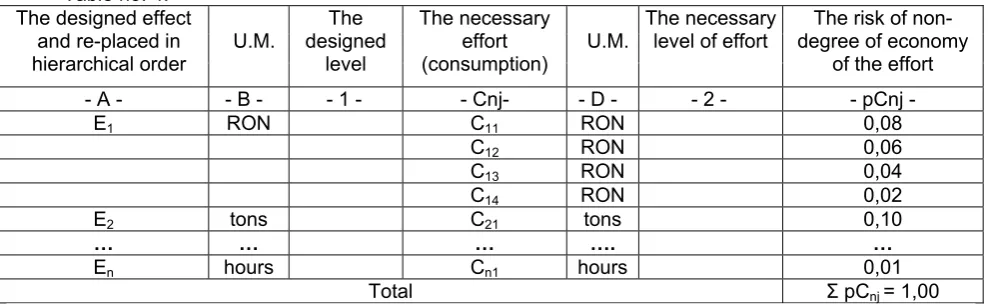
The solution for measuring the degree of economy resumes the procedure already mentioned and presented, including here a larger spectrum of analysis of the efficaciousness and the degree of economy (than the usual one in the audit of European economic projects, where the efficiency and effectiveness of the project and its management are reference points of the whole in the analysis of the project), inventorying the efforts, in direct dependence on the effects already designed with specific units of measurement, but also potentially detailed or multiplied as compared to the effects placed in hierarchical order as estimated occurrence probability, according to the following matrix:
[image:7.595.52.547.541.693.2]The matrix of the efforts (consumptions) necessary according to the risk of non-degree of economy of the effort
Table no. 4. The designed effect
and re-placed in hierarchical order
U.M.
The designed
level
The necessary effort (consumption)
U.M.
The necessary level of effort
The risk of non-degree of economy
of the effort - A - - B - - 1 - - Cnj- - D - - 2 - - pCnj -
E1 RON C11 RON 0,08
C12 RON 0,06
C13 RON 0,04
C14 RON 0,02
E2 tons C21 tons 0,10
… … … …. …
En hours Cn1 hours 0,01
Total Σ pCnj = 1,00
The matrix instrument identifies in an associated way the main efforts (consumptions) in parallel with the effects re-placed in hierarchical order. The value of the aggregate of the risks of all effort (consumption) components, reunited on the level of distinct category of designed effort, coincides with the estimated occurrence probability of the category of effort (pC11+pC12+pC13+pC14=pa for E1 and pC11+pC12+pC13+…+pCnj= Σpa=1,00). The
capitalizing the multiplication of the risk of non-degree of economy with its impact and without generating a new hierarchy of the effects, but only a re-placing in hierarchical order of efforts within the classes of effort afferent to a distinct category of effect:
The matrix of the prognosticated effects and of the necessary efforts (consumptions) re-placed in hierarchical order according to the final importance
Table no. 5. The designed effect replaced
in hierarchical order
U.M.
The designed
level
The necessary effort (consumption)
U.M.
The necessary
level of effort
The risk of non-degree of economy of the
effort
The estimated
strategic impact
The final importance
(OCp)
- A - - B - - 1 - - C- - D - - 2 - - pCnj - - pj - - pCnj x pj
-E1 RON C11 RON 0,08 0,04 0,0032
C12 RON 0,06 0,03 0,0018 C13 RON 0,04 0,02 0,0008 C14 RON 0,02 0,01 0,0002
E2 tons C21 tons 0,10 0,15 0,0150
… … … …
En hours Cn1 hours 0,01 0,01 0,0001 Total Σ pCnj= 1,00 Σ pj= 1,00 -
The presented risks and probabilities can be determined analogously, starting either from the same subjective or objective criteria, recorded in the case of efficaciousness or from a generalized Fishbein – Rosenberg scale of report. The two results of the products between the occurrence probability of the effects and their impact and between the risk of non-degree of economy of the efforts and their impact defined as informational energy of the designed effect (OEp) and informational energy of the designed effort (OCp), through analogy with the Onicescu informational energy defined as product of probabilities can be considered as essential indicators in the analysis of efficiency and effectiveness in the general plan of the organization and, especially, in the organizational managerial plan.
The conclusion of the degree of economy brings along a rendering relative of the importance of the effect and an emphasis of the significance of the balance between results and resources or between effects and consumptions (E > C), as well as of the
absolute change (Δ = E-C or Δ = ΣE – ΣC). One can thus appreciate that the degree of
economy of an activity, exclusively in the situation in which there appear economies determined as positive difference between effects and efforts (E – C > 0).
their existential environment and the real relational one of the effect-effort or consumption-result effect. This approach based on principles is founded on the new thinking of the organization’s efficiency and its management. The efficiency expresses the relationship between efforts and effects, through specific indicators resulted from abstracted and evaluated associations, such as the association of the efforts (consumptions) of the resources as designed and accomplished level, in parallel with the association between the level of the designed and accomplished effects, the temporal (chronological)
association or the spatial one of the effort/effect or effect/effort type. In practice two criteria
of efficiency are attached: the criterion of saving through the relation to effort and the criterion of intensification, through correlation with the effect. Approached from an applicable point of view, efficiency is defined through two methods, respectively through
the direct one as relationship between any of the values of the effects or of the results (E1,
E2,…, En) and any of the values of the efforts or consumptions (Cn1, Cn2,…,Cnj), or
through the indirect method, respectively described as relationship between efforts or consumptions (Cn1, Cn2,…, Cnj) and effects or results (E1, E2,…, En).
[image:9.595.65.541.316.403.2]The determination of the efficiency of activity in economy
Table no. 6.
Direct method (Effect / Effort) Indirect method (Effort / Effect) Effect
Effort
E1 E2 … En Effort Effect
C1j C2j … Cnj
C1j E1
C2j, E2,
… …
e = (En / Cnj)x 100
Cnj En
e = (Cnj / En )x 100
No matter how modelling and methodical, the thinking of efficiency still remains a static and purely observing one. The need for dynamism is related to and even imposed by the performance analysis in time and in space of the organization’s management. Thus, there appear the options between the variants designed by efficiency, in the logical length of the efficaciousness-degree of economy-efficiency-effectiveness chain, between the level of losses, of the successive inequalities, between the inclination of the slopes of the ramps of effect and cause, between the thresholds of informational transformation, of the maximum and minimum type, with the help of the law of the minimum and the law of the maximum, but also between the slopes of the multiple efficiencies designed in a modern sociological vision with the help of the new organizational solutions of network type (having
as model the internet or the intranet) and of the networks of shared trust. At this stage one
can appreciate that the whole defines a new method, simply called the method of the four
“E” that will impose the final appreciation of the management of the organization.
the loss in case of a unique point of decision presented and accepted). But according to the observations from the statistics of the managerial teams there are quite enough cases (approximately a third), in which the team’s final decision is weaker than the best variant of the top manager’s unique initial decision (thus individual). This takes place only in the hypothesis in which the knowledge is fragile and there are many pieces of erroneous information (the difference between the designed and the effective informational energies being much above the 5%, limit frequently accepted in the economic decision), the decisional communication of the team of managers having high chances to lead to cognitive performances inferior to the individual ones.
In conclusion, among the six methods of analysis, considered as possible solutions of the method of the four “E,” only four are the result of the direct contribution of statistics: I. The statistical evaluation of the procedural transformation indexes through the law of equivalence and the dynamics of the factorial asymmetries, respectively through the method of indexes which has the Walsh index as adequate solution, applied to effects and to efforts both in their temporal evolution and in relation to the initial managerial plan.
Walsh index used for effects with emphasis on the Walsh index used for efforts with emphasis on the
j1 a1 a0
1
j0 a1 a0
1
p p p
p p p
n i n i = = × ×
∑
∑
a1 j1 j0
1
a0 j1 j0
1
p p p
p p p
n i n i = = × ×
∑
∑
j1 Cn j1 Cn j0
1
j0 Cn j1 Cn j0
1
p (p ) (p )
p (p ) (p )
n i n i = = × ×
∑
∑
Cn j1 j1 j0
1
Cn j0 j1 j0
1
(p ) p p
(p ) p p
n i n i = = × ×
∑
∑
impact occurrence probability impact risk of economy’s non-degree
II. The delimitation of the informational transformation thresholds, of maximum and minimum type, with the contribution of the law of the minimum and of the law of the maximum (the method of the smallest squares by using the partial differentials);
III. The statistical interpretation of the differences of slope of the effect and effort ramps or of the different angular coefficients of m = (Y1-Y2)/ (X1-X2) type;
IV. The determination of the informational energy, but not in the classical formula (S=Σpi2),
but either as informational energy of the designed effect (OEp0=Σpa0×pj0), compared to the
informational energy of the achieved effect (OEp1=Σpa1×pj1) or as informational energy of
the designed effort (OCp0 = ΣpCnj0×pj0), compared to the informational energy of the
achieved effort (OCp1 = ΣpCnj1×pj1). The differences higher than 5% become relevant to
the analysis of the effectiveness (effective value being below 95% of the projected one). The other two methods, a chain of logical approach of the type: efficaciousness-degree of economy-efficiency-effectiveness and a modern sociological vision by means of the new organizational solutions of network type (having as model the internet or the intranet) and of the shared trust described by Francis Fukuyama in the work “The Great Disruption” under the result of the contribution of logic and psycho-sociology. In essence an
effectiveness measured this way can be detailed on three degrees of importance: 1st
degree effectiveness, that will compare the efficaciousness (the effects), 2nd degree
effectiveness, that will compare the degree of economy (effects and efforts, but also the
difference between them) and 3rd degree effectiveness that will compare the efficiency.
4. CONCLUSIONS
The first theoretical premise, which certifies the necessity and the importance of the four “E” becomes obvious in the practice of project management and it is related to a totally new conceptualisation in this field of efficaciousness, degree of economy, efficiency, and effectiveness in the managerial process as such, the performance of the project management already outlining three dimensions apparently contradictorily shaded:
efforts and the elimination of the losses, the prognosticated effects being limited or narrow, the project once auctioned and won, and the resources limited by budget.
II. The effectiveness of management and even of the project manager are defined starting from the duality of the performance criteria in the project, respectively the quality criterion as well-specified threshold but minimum and that of the maximization of the managerial instruments of collecting information about the project (carefully monitoring efforts/costs, time and area) also redefining at the same time the degree to which effects and efforts respond to the prognosis or anticipation that is the very drawn up project.
III. The adaptability of management and of the project manager, defined by the reaction to change, actually considered the hardest to evaluate from the three dimensions and almost always exclusively post-project, the adaptability that tends to permanently be in conflict with efficiency and effectiveness through communication and negotiation processes that tend to sacrifice the other two dimensions.
The compensatory principle of the economic and ethical pragmatism proves to accomplish a partial balance, between an inefficient communication and a fully effective negotiation. The wearing down of the performance caused by the confused communication or by the extensive development of the negotiation as a formula of ethical compromise is nevertheless recovered by the favourable evolution of the social efficiency and of the managerial effectiveness. The systems of the European funds, programs and projects, as European integrated systems of development, financing and especially of optimisation and expansion of the impact of development, also constitutes a valuable example through the dismemberment of the communication and negotiation of the funds policies and of the programmes of projects efficiency and the effectiveness of the project management. It is a very interesting case of temporal and institutional fracture or break of the two main categories of concepts, with the purpose of maximizing the final impact on the population’s welfare in the European area. But even more important proves to be the construction of this system of economic, social, cultural and educational convergence, a system based on the action of simultaneous financing of the European fund for regional development with that of the European social fund, next to that of the cohesion fund. From the competition or confrontation through diverse projects, financed and programmed on European level, the effects can only be advantageous both for the communities and regions administratively delimitated and for the promoter firms and institutions and their organizational cultures.
Communication and negotiation versus efficiency and effectiveness become thus a modus
vivendi, a European compromise by definition between apparent adversities, although
communication and negotiation belong exclusively to the managers of the fund and of the program, and efficiency and effectiveness characterize the project manager and its team, a compromise that if well negotiated can allow a maximization of results, a way of social and economic life with high performances.
REFERENCES
[1] Craig, R.T., (1999), Communication Theory
[2] Bühler, K., (1933), Die Axiomatik der Sprachwissenschaft, Kant Studieri, vol. I, pp. 19-90
[3] Jakobson,R,(1960),Linguistics &Poetics,Style in Language,ed.Th.A.Sebeok,MITPress,Cambridge, Mass [4] Shannon, C., (1948),The Mathematical Theory of Communication, Bell System Technical Journal, vol. 27 [5] Shannon, C., Weaver, W., (1949),The Mathematical Theory of Communication, Urbana Illinois
[6] Cherry, C., (1966), On Human Communication, MIT Press, Cambridge, Mass
[7] Pasco C., Prevet O., (1994),-Mercatique et negociation internationales, Dunod, Paris, pp. 466 [8] Maliţa, M., (1972), Theory and practice of negotiations, Ed. politică, Bucharest, pp. 271-275 [9] *** (1991), A Dictionary of Economics, The New Palgrave vol. II, Macmillan, London, pp. 460-461 [10] Marcus, S., (1989)The Algorithmic Thinking, Ed.Tehnică, Bucharest, pp. 9-10
[11] Chelcea S., (2004), The methodology of the sociological research, Ed. Economică, 2nd edition, Bucharest, pp. 330-350


![[−2]proPSA versus ultrasensitive PSA fluctuations over time in the first year from radical prostatectomy, in an high-risk prostate cancer population: A first report](data:image/gif;base64,R0lGODlhAQABAIAAAP///wAAACH5BAEAAAAALAAAAAABAAEAAAICRAEAOw==)