Proceedings 2nd ICSD 2014 7 56. Actively Managed Investment Portfolio Dilemmas,
'Lost Returns Approach'
Dr.Mohamed Fathy Mohamed Elmesseary
73
57. Stock Picking And Market Timing Of The Egyptian Fund Managers: Evidence From The Financial Crisis
Dr.Mohamed Fathy Mohamed Elmesseary
74
58. Managing Refurbishment Projects Through Selection of Procurement System: The Case of Malaysia
Professor Dr. Azlan Shah Ali
75
59. The role of informal networks in community development Case study of the 151 poorest villages in Egypt
Mrs lngy Mohamed Abdel Hameed
76
60. Stock Picking And Market Timing Of The Gulf Fund Managers: Evidence From The Financial Crisis
Dr.Mohamed Fathy Mohamed Elmesseary.
77
61. Temporal Energies
Analyzing the Way Time is Framed in Competing Energy Narratives Barbara George
78
62. Future teachers' relationships with physical and technological environments. Dr. Diane Pruneau, Mrs Kerry, Jackie, Dr. Freiman, Viktor
Mrs. Langis, Joanne
79
63. Siyakhulisa: Community engagement towards quality Early Childhood Education Prof Elsa Fourie, Une Pourie
80
64. Research on Efficacy of Using Social Networks in Academic Teaching. Metrics, Experiments and Results
Prof Maria Grazia Albanesi,Ing. Riccardo Amadeo, Prof Giovanni Vecchio
81
65. Studying Sciences through the Integrated Sciences Modules Aspects related to the Students' perception
Assistant ProfRadu Lucian Olteanu, Associate Professor Ph.D. Dumitrescu Crinela Associate Professor PhD. Gorghiu Gabriel, Associate Professor Ph.D. Gorghiu Laura Monica
82
66. Our Manner of Dwelling: An Ecopsychological Education for Sustainable Development.
Dr. Lori Pye
83
67. Determination Of Mentally Disabilities Teacher's Opinions Regarding The Special Field Competence
Prof DrA Giinul AK~TE, Research Assistant Gamze ALAK Research Assistant A.Emel SARDOHAN YLLDIRIM
Research Assistant Banu BAH(:ECI
84
68. Social Modification With The Changing Technology InThe Case Of Simplification Theory
Research Assistant Rana Nur Illker, Research Assistant Bu§ra Turhan
85
69. Applications, smart phones and value assessment: digital information in academic studies
Niidai Julianna PhD, GARAl, Anna PhD
86
Proceedings 2ndICSD2014 75
Managing Refurbishment Projects Through Selection of
Procurement System: The Case of Malaysia
Azlan Shah Ali, Au Yong Cheong Peng and Susie Chieng Ling
ABSTRACT
The study examined relationship between challenges enc~:>unteredby contractors using different types of procurements towards refurbishment projects performance. Triangulation technique was used in the study. 316 sets of closed-ended questionnaires were sent out to respondents which included site agents, project engineer, contract administrator, contract manager and project manager who were working in various construction companies. From the sent out questionnaire, 268 questionnaires found to be useful for data analysis. Semi-structured interview has been carried out with 15 contractors to validate the result. The findings shown that 54.3% of the projects were used traditional procurement systems. Refurbishment projects using traditional procurement systems were performing well compared to the others. Besides, out of seven contractor challenges variables (independent) which are cash flow and financial, communication with client and consultants, client decision making, frequent change order by client, insufficient or discrepancies of contract documents, material price escalation and skill, expertise and experience tested were significantly correlated with at least one performance variable (dependent). The findings would be useful for future references, especially to those stakeholders who involved in refurbishment projects in
Malaysia.
Keywords: Malaysia, Procurement system, Performance, Refurbishment
Azlan Shah Ali is a professor in the Department of Building Surveying, Faculty of Built Environment, University of Malaya, Malaysia. He has a PhD specialising in building refurbishment from UniversitiTeknologi MARA, Malaysia. He is a Fellow of The Institution of Surveyors Malaysia and of The Chartered Institute of Building, UK (GOB); a professional member of The Royal Institution of Chartered Surveyors, UK (RlCS). DrAzlan has been involved in a number of academic research and publications. His research interests are in project management (refurbishment) and facilities management (building maintenance) and have published numerous papers in both reputable local and international journals.
Au Yong Cheong Peng and Susie Chieng Ling are researchers at the Centre for Construction, Building and Urban Studies (CeBUS), Faculty of Built Environment, University of Malaya, Kuala Lumpur, Malaysia.
European Journal of Sustainable Development
(2014),3,4, 163-174
Doi: 10.14207/ejsd.2014.v3n4p163
ISSN: 2239-5938
Managing Refurbishment Projects Through Selection
of Procurement System: The Case of Malaysia
Azlan Shah
Alit',Au Yong Cheong Peng' and Susie Chieng Ling'
Abstract
The type of procurement method determines how the project would be managed. This is because project uncertainty could be found in the way that projects are awarded and how the construction project is managed into a system of contract. Procurement methods also influenced the time performance of construction projects. Time would be affected by the flow of project that was driven by different type of procurement method. However, it's still inconclusive to what extent that different types of procurement systems could affect the performance of refurbishment projects. This study conducted to identify types of procurement methods used in Malaysian refurbishment projects and what are the problems and difficulties encountered by contractor using different types of procurement systems. On top of that, the study also would examine relationship between challenges encountered by contractors using different types of procurements towards refurbishment projects performance. Triangulation technique was used in the study.
316
sets of closed-ended questionnaires were obtained from targeted respondents which included site agents, project engineer, contract administrator, contract manager and project manager who were working in various construction companies. From the questionnaire sent out,268
questionnaires were found to be useful for data analysis,giving a final response percentage of 24.53%. Semi-structured interview has been carried out with 15 contractors to validate the result. The findings shown that 54.3% of the projects were used traditional procurement systems, 39.9% using design and build, 4.3% using management procurement, 1.1% of the refurbishment project using turnkey system and 0.3% using built-operate-transfer (BOT) system. Refurbishment projects USlng traditional procurement systems were performing well compared to the others. Besides, out of seven contractor challenges variables (independent) which are cash flow and financial, communication with client and consultants, client decision making, frequent change order by client, insufficient or discrepancies of contract documents, material price escalation and skill, expertise and experience tested were significantly correlated with at least one performance variable (dependent). The findings would be useful for future references, especially to those stakeholders who involved in refurbishment projects in Malaysia.
Keywords:
Malaysia, Procurement system, Performance, Refurbishment1. Introduction
Compared to new build project, the refurbishment projects are more risky and
complex, in which makes it more difficult to manage
(Ali,2008). A review of current
practices in Malaysia shows different approaches to the refurbishment
procurement
1 Centre for Construction,Buildingand UrbanStudies(CeBUS)
164
European Journal
if
Sustainable Development
(2014),3,4, 163-174systems. The introduction of different types of procurement systems has contributed to higher difficulties in managing refurbishment project under various circumstances
(Ali
et al., 2011).Hardcasde and Tookey (1998) also has highlighted that the refurbishment industry has been heavily criticized for its inefficient and ineffective procurement strategies and processes. The inefficient and ineffective procurement strategies and processes have been considered as a factor that has affected the industry's performance.The different types of procurement system have different methods and process of designs and constructions. It described a different systems and a different organization structure in term of roles, responsibility and the authority of each members in the team. However, it's still uncertain on how far do the different types of procurement system have different methods, process and organization structure and how it can affect the performance of a refurbishment project in term of cost, time and quality. These problems and impacts have to be measured so that it can be used as a guide in selecting a better procurement system.
Therefore, it is essential to understand today's practice procurement method and to identify problems face by the contractor in using different types of procurement systems, and the impact of the problems towards project performance in term of cost, time and quality.
2. The Growth of Refurbishment Projects
Demands for refurbishment works are differ every year depending on the various factors that contribute to the growth of the projects. Figure 1 shows Total Project Value for Refurbishment projects in Malaysia from year 2004 to year 2011.
TOTAL REFURBISHMENT
PROJECT
VALUE (RM Million) FROM
2004-2011
14,000.00
12,000.00
10,000.00
8,000.00
6,000.00
4,000.00
2,000.00
2004 2005 2006 2007 2008 2009 2010 2011
~TOTAL REFURBISHMENT PROJECTVALUE (RM Million)
Figure1:Total Value for Refurbishment projectfrom 2004-2011 (CIDE Statistic, 2006 - 2011)
A.
S. Ali,
A. Y.C.Peng and S.
C.Ling
165Refurbishment Works are still demanded in Malaysian Construction Industry due to
several factors. Rapid changes of technology used, change in building used, economic
change and limited vacant land for new development shall be factors that induce to
development of refurbishment project (Rahmat et al., 2003; Ali et al., 2009). More often
than not, building refurbishment is initiated by physical deterioration and obsolescence,
which includes change in technology, social, image, legal and environment.
3.
Types of Procurement Systems
There are numerous types or variations of project procurement systems being
widely used in the refurbishment industry from the range from the traditional system to
the many variations of "fast-tracking" systems such as turnkey, design and build,
build-operate-transfer and management contracting, (Rosli et al.,
III 11.1 (11'1 R \ II IR \"~III\·II(11
Figure
2:
Types of Project Procurement Systems in Construction Industry
3.1
Traditional System
The traditional procurement system is predominant in the Malaysian construction
industry and, until 1992 at least, able to satisfy its requirements (Masterman, 1992). It is
characterized by the
contractor
not
being responsible
for the
design or
the
documentation work (Goldfayl, 1999) and with a clear division between the design and
construction process responsibilities (Rowlinson, 1999).The main advantages of using a
traditional approach to procurement are produces lowest bid, assuring quality control
and familiar in the industry whereby its disadvantages are builders not involved in design
process, slower speed and potential adversarial (peter et al., 2008).
3.2
Design and Build System
The term "Design and Build" refers to the procurement strategy that entails the
contractor carrying out the work; the design works as well as the construction and
completion of the work.The main advantages of using a design and construct approach
to procurement are contractor act as single point of responsibility, Price Certainty,
Effective communication and Multi-disciplinary approach and the disadvantages are
166 European Journal
of
Sustainable Development (2014), 3,4, 163-174higher costs, the limitation of competition inthe public section, Difficulties inpreparing an adequate and sufficiently comprehensive brief, requires early confirmation of concept designand absence of a bill of quantities (peter et al., 2008).
3.3
Management Procurement System
Several variants of management procurement forms exist, which include; management contracting, construction management and design and manage. In the case of management contracting, the contractor has direct contractual links with all the works and a contractor is responsible for all construction work. In construction management, a contractor is paid a fee to professionally manage, develop a programme and coordinate the design and construction activities, and to facilitate collaboration to improve the project's constructability.The main advantages of using a management approach to procurement areenables improved coordination and collaboration, potential for time savings, roles, risks and responsibilities for allparties are clear and flexibility for changes
in design The main disadvantages are proactive client is required, poor price certainty, client loses direct close time and information control required and client must provide a good quality brief to the design team (peter et al., 2008):
3.4
Built-Own-Operate- Transfer (BOOT)
Developers use their own funding sources to build a public facility in return for the right to operate it and charge a fee for its use. At the end of an agreed period the facility may revert to the landholder. This type of contract focuses on final service delivery and relies upon the required performance standards being properly documented. Building contractors involved in this type of development are usually part of a consortium (Department of Infrastructure Building Services Agency, 1998). BOOT procurement system is less implemented in Malaysia refurbishment project. The main advantages of using these approaches is time and cost savings whereby the main disadvantages of BOOT procurement system are due to additional cost and in flexibility. From this chapter, it can be concluded that there are four main types of procurement systems which are traditional, design and build, management contract and BOOT systems. Different types of procurement systems have different characteristics and it serve a different way in affecting the refurbishment project performance.
4. Difficulties Encounter by Contractor
Over-due, over cost and poor quality construction today is frequently blamed on the procurement route selected. In reality serious problems can be attributed to the interaction of a whole series of smaller problems acting at once. Several researches and studies have been done by numerous researchers to identify challenges encounter by the contractor in managing construction works in design and build, traditional, contract management procurement and others. Primary amongst these problems is regarded as 'human aspects'. This is exemplified in construction today as a lack of common, shared purpose in a project leading towards a confrontational management style.
Figure 3 shows the common challenges encounter by Contractor in using different types of procurement method.
A.
S. Ali,
A. Y. C.Peng and S.
C.Ling
167
4.1. Methodology
The study approach incorporated triangulation techniques that combined both
qualitative and quantitative approaches. The objective of employing a quantitative
method is to minimize personal prejudice or bias and to ensure that the social reality
would be presented as it is. It is expected to have true value, applicability, consistency
and conformability (Guba and Lincoln, 1989). On the other hand, qualitative data refer
to information gathered in a narrative through interviews, experience and observations
(Sekaran, 2005).The combination of both research methods in a social science study
could produce robust and valid findings at the end of the study. This is because the
qualitative approach could complement results obtained from a quantitative approach,
which would make it more reliable (Ali et al, 2009).
Figure 3: Difficulties and Problems Encounter fry COfltractor(Nuhu and Issaka, 2008; Wellillgtoll and Mpelldlllo, 2008)
Four hundred and ten, 410 closed-ended questionnaires were obtained and received
and
the
targeted
respondents
included
site agents, project
engineer, contract
administrator, contract manager, project manager and other parties who are working in
Construction Company; which three hundred sixty eight, 368 questionnaires were found
to be useful for data analysis, giving a
finalresponse percentage of approximately 24.53
%.Findings shows that almost 60% of the respondents were manager and director level
and 63% of them had more than 10 years' experience in construction industries. This
indicated the data collected from this survey are reliable. The data were analysed by using
the Statistical Package for the social science (SPSS)software, version 17.0.
168 European Journal
of
Sustainable Development (2014), 3, 4, 163-1745. Result and Discussion
Figure 4 illustrated types of procurement systems used in Malaysian Refurbishment Projects. The result indicated that traditional systems is the most preferred system used in Malaysia with record of 54%, followed by design and build with record of 40%, Management procurement, 4%, Turnkey System with record of 1% and Built-Operate-Transfer BOT with record of 0.3%.Besides, semi-structured interview shown that 12 out of 15 interviewees highlighted that traditional is the most preferred and suitable procurement system for Malaysia Refurbishment Projects if the contract value exceeded RM500,000.00.Turnkey, management and built-operate-transfer BOT system are less opted in Malaysian Refurbishment Projects as they are found not suitable. As pointed out by Peter et al. (2008), there are three types of traditional procurement method which is consist of lump sum contract, measurement contract and cost reimbursement/ cost plus contract. Most of the interviewees mentioned that cost reimbursement/ cost plus are the best option opted for refurbishment project due to the activities carried out are uncertain. For this contract, the contractors were being paid for an agreed fee to cover management, overheads and profits.
Types of Procurement
Systems in Malaysia
• Design and Build • Traditional • Turnkey System
• Management Procurement • Built-Operate-Transfer BOT
Figure 4:Types
of
Procurement Systems in MalqysiaThomas et al. (2002) and Josephson and Lindstrom (2007) developed numerous parameters for measuring project performance which are cost, time and quality. The results shows most of the refurbishment projects using traditional system were completed within time, budget and quality (less complaint and NCR received) whereby refurbishment projects using design and build procurement system were completed within time. The results also shows that the refurbishment projects using BOT systems were completed with less non-compliance records (NCR).
A. S. Ali, A. Y.C. Peng and S. C. Ling 169
Table
2: Performance of the refurbishment project in MalaysiaPROCUREMENT /PERFORMA COSTT TIME % VO NCE
COMP
L NCR
..!~!!_I._2~~
..~~L~!~~-...P.~?l.~!.:'r._.~_~!!.I._~P._s.Xs.!~~
TURNKEY SYSTEM
-MANAGEMENi-'-CONTRACT
SYSTEM
·Buiii:oPERATE:TRANSFER;···
BOT
-{>
-{>
-{>
-{>
·· .. ·1···:···+···- ..: -1···:···-1
...
,
$:
+
.
-{>r
···t···
Legend: - IVithin targeted (perform)
Traditional system is separated into different process with design and construction. The drawings, specification, and bill of quantities breakdown are provide by the client to the contractor during tender stage for ease of pricing. It also gives the client firmer and more competitive price because the design plus the complete working drawings have been fully developed and detailed out prior to tendering.
It
eliminates any design or construction ambiguity or uncertainty, which often causes the contractors to unnecessarily inflate the price. In the case where bill of quantities is used, the bidding tend to be more fair as such the project cost is lower. The system also has a better cost control (Masterman, 1996). In Design and Build and Turnkey procurement system, the cost to construct the refurbishment works is often higher than the traditional contracting system. This is due to the lack of design, specification detailing and absence of bill of quantities during tender and contractors are not considering the certain part of the work that are uncertain. Thiswill
consequently increase the construction cost and lead to the construction cost exceeded the budgeted cost. Furthermore, client is required to come out with a concept design at an early stage for design and build system. Undecided and incomplete concept committed to contractor at the early stage of the projectwill
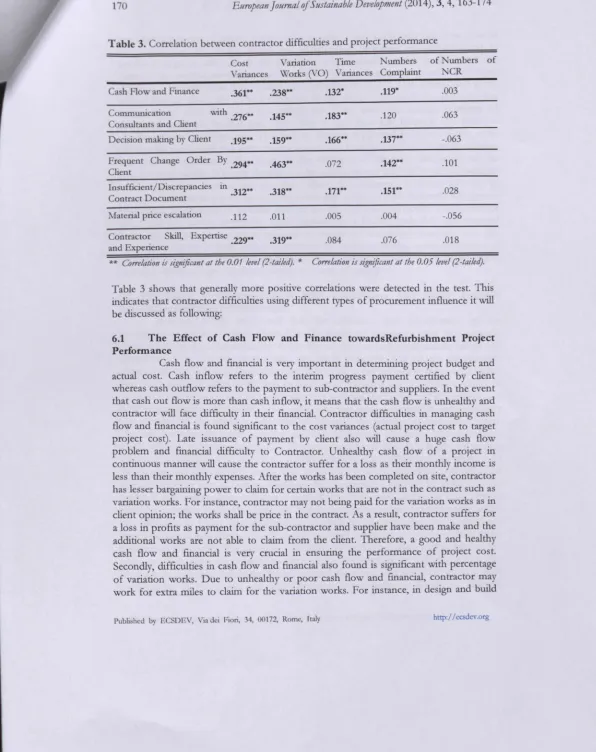
lead to higher frequent change order by client during construction stage.In this study, independent variables refer to cash flow and finance, communication with consultant and client, decision making by client, frequent change order by client, insufficient and discrepancies in contract document, material price escalation and contractor skills, expertise and experience in handling refurbishment works whereas dependant variables refer cost variances, time variances, percentage of variation works, average numbers of complaints received and average numbers of non-compliance report. These analyses are used to achieve third objective of the present study, which is to examine relationship between problem and difficulties encountered by contractor using different types of procurements towards performance of Refurbishment Projects. The result was expected to show a positive correlation that would indicate that lesser difficulties face by the contractor in using different types of procurement systems is associated with higher project performance in Refurbishment Projects. The results of the correlation test are shown in Table 3.
170
European Journal of Sustainable Development
(2014), 3, 4, 163-174Table 3. Correlation between contractor difficulties and project performance
Cost Variation Time Numbers of Numbers of
Variances Works (VO) Variances Complaint NCR
Cash Flow and Finance .361*' .238" .132* .119* .003
Communication with
.276** .145*' .183*' .120 .063
Consultants and Client
Decision making by Client .195·· .159" .166*' .137·* -.063
Frequent Change Order By .294•• .463'* .072 .142** .101
Client
Insufficient/Discrepancies in
.318'* .171'· .151·* .028
Contract Document .312·'
Material price escalation .112 .011 .005 .004 -.056
Contractor Skill, Expertise
.229·· .319'· .084 .076 .018
and Experience
**
Correlation is significant at the 0.01 level (2-tailed).*
Correlation is significant at the 0.05 level (2-tailed).Table 3 shows that generally more positive correlations were detected in the test. This
indicates that contractor difficulties using different types of procurement influence it
will
be discussed as following:
6.1
The Effect of Cash Flow and Finance
towardsRefurbishment
Project
Performance
Cash flow and financial is very important in determining project budget and
actual cost. Cash inflow refers to the interim progress payment certified by client
whereas cash outflow refers to the payment to sub-contractor and suppliers. In the event
that cash out flow is more than cash inflow, it means that the cash flow is unhealthy and
contractor
will
face difficulty in their financial. Contractor difficulties in managing cash
flow and financial is found significant to the cost variances (actual project cost to target
project cost). Late issuance of payment by client also
will
cause a huge cash flow
problem and financial difficulty to Contractor. Unhealthy cash flow of a project in
continuous manner
will
cause the contractor suffer for a loss as their monthly income is
less than their monthly expenses. After the works has been completed on site, contractor
has lesser bargaining power to
claimfor certain works that are not in the contract such as
variation works. For instance, contractor may not being paid for the variation works as in
client opinion; the works shall be price
in
the contract. As a result, contractor suffers for
a loss
in
profits as payment for the sub-contractor and supplier have been make and the
additional works are not able to
claimfrom the client. Therefore, a good and healthy
cash flow and financial is very crucial in ensuring the performance of project cost.
Secondly, difficulties
in
cash flow and financial also found is significant with percentage
of variation works. Due to unhealthy or poor cash flow and financial, contractor may
work for extra miles to
claimfor the variation works. For instance, in design and build
1f1
A
S. Ali,A.
Y. C.Peng and S.C.Linglairn certain of the works may not been price in
t .stem contractor may c
tu>..
.
.
pr cur men S) , . . t d specification provided are not sufficlent in
t as the deslgn mten an th
th contraC . .
will
mpt to high variation works. In the event atd. t In this case, it pro .'
ten cnng s age. come out with an alternative proposal With cheaper
. fu that contractor may .
cli nt re ses .on. ' ality and consequently lead to high defects and at the
ial
Thlswill
cause poor qu 1 .di
thmateO s. .
will
make complaints on the works. The result a so in cates atend of ~e day, clientfl d fmancial is significant with the average numbers of diffi ulc ties in cash. d BOWidan th t difficulties in cash flow and financi
ial
a so toun1 cd' lSlaints rece1ve. est es a , d
1
K dir1
comp .' . This fmding result is supported by Ab u a ,et a .
.O1'lifiant With ume vatlances. 11
f
.
1
dinsigr» c . d th t most contractors do not have an exce ent mancia stan g (2005) who mentibone tr a ring most of the works. The progress and speed of the
d they are su -con ac ail bili f th k
an. k . largely depend on the efficiency and av a ty 0 e wor ers.
furblshment wor s 1S . faci diff 1 .
re l' payment from client, the contractor lS acing lCUty m
In .the event ate iSsuancebl Y to the sub-contractor and suppliers. This. . .indirec Ytl
will
give an.
v1 g or not a e to pa .
par~ .' of material delivery on site and sub-contractors tend to reduce implicationd in stoppagerks at site.The result lIDplies that a healthy cash. .
fl
ow andfi
inancial.
speed an. th stop wotruction stage lS reqUited to ensure the contractor.' complete their Job. . durmg. . d e consrmined budget, reduce percentage of vanatlon. . wor s, assist contractork' .in
Wlthin ete tification which can avoid delay in the progress. Moreover, with the health
payment cer . f li
financial
will
encourage contractor perform interm 0 qua ty.6.2 The
Effect of Communication
With Consultants
And Client Towards
R furbishment Project Performance
e Somogyi
(1999)
mentioned that the efficiency and effectiveness of the efurbishment process strongly depend on the quality of communication. For instance, :Uprovement in the communication wi~ the parti~s inv?lved could reduc~ failu~e and smoothen of the project. In the seIDl-structured mtetv1ew, half of the mtervtewees commented that failure in communication may cause actual project cost incurred higher than budgeted cost, delay in the project, increase of variation works and poor quality of the works. For instance, lack of communication between contractor and consultants and client may cause the information given are not convey among the parties and contractor may constructed the works on site without knowing the changes or instruction given. Thiswill
consequently cause argument and dispute between contractor and consultants whichwill
lead to hacking and re-do and repeated works on site. As a result, the projectwill
incur a higher cost as contractor required additional overhead and materials to do the hacking and reinstallation works. Due to this, the progress may delay as itwill
cause other elements or part of building could not be constructed / installed.In addition to the above, if the communication failure is part of the client fault, contractor is entitled toclaim
for variation works and client has to issue a variation order to contractor to adjust the contract sum. Other than that, in order to catch up the programme and to avoid any liquidated ascertained damage(LAD),
contractor may accelerate the works without much concern on the quality. For instance, concreting of foundation must require 14 days for curing process; however, in order to catch up for the progress the contractor may start for the column works before the foundation is fully cured. Thiswill
consequently cause poor quality of the works and lead to major defect works in future. As a result,1 _
Ellropean [ouma!
of
SlIstainable Development
(2014),3,4, 163-174
nrra t r m av r ceive high numbers of complaints from the cli~nt due to the poor
li Thi . li s that effectiveness communication between client, consultant and
quo t) . S imp e . . . . .
t ' t r
i
crucialin
order to ensure the project 1S completed within budget, timecon ra ' . . d dditi I
fram and qualitv In addition-s : , it may also reduce vananon works an a tiona cost to
It nt,
6.3 The
Effect
of Client Decision
Making Towards
Refurbishment
Project
Performance
Contractors' difficulties inclient decision making is found significant to the cost variances (actual project cost to targ~t .project cost) and ~ercentage of variation works. Client plays an important role in dec1ding. and solves the.1ssues and ?robl~ms that may give a huge impact
in
cost, ~e and. qua~ty. In th.e semt-structur~d mterview, 8 of the interviewees said that inexperience client in refurbishment works 1Snot able to make a prompt decision on the pro~lems hig~light~d _whereas some of the clients make a wrong decision and it has caused increase 10 vananon works as well as the costs. Although contractors are able to claim for the variation works due to the wrong and slow decision making, contractor is also suffering for certain cost that might not able to be claimed; which are overhead and machineries cost. For instance, slow decision making by client may cause idling of the machineries such as crane, generator set, compactor, and any others. Therefore, slow and wrong decision making not onlywill
affect the additional works and cost to client but alsowill
give impact to the contractorin
terms profits and loss. In addition to that, contractor difficulties in client decision making also found significant with the time variances and number of complaint received. Slow and wrong decision making by client alsowill
cause delay in the site progress. The delay of the decision may lead stop work or changes of sequence of construction for the Refurbishment Projects. As a result, contractor has to expedite and accelerate the work progress on site and this may affect the quality of the works. A right and fast decision making can prevent delayin
a Refurbishment Project especially in fast track project.The result implies that a prompt and appropriate decision making by client during the construction stage is crucial to ensure and determine project performance in terms of cost, time and quality. Moreover, with the prompt and appropriate decision it can reduce percentage of variation works and cost to the client.6.4 The Effect of Frequent
Change Order
ByClient Towards Refurbishment
Project Perfonnance
Client needs for the projects are normally described through the briefing process. Designers
will
translate the client needs by producing a concept followed by detailed design. However, client frequently change their preferences throughout the design process and some clients are not able to prepare an adequate and sufficiently comprehensive brief. Without adequate and sufficient comprehensive brief, it is difficult for the designers to complete the design before work starts on site. The "theoretically completed" design, which keeps on changing, requires the designers to allocate anamount of provisional sum
in
the contract to cater for the uncertaintyin
the clients" needs. This result supports statements by Mitropoulos and Howell(2002)
who stated that design changes were caused by clients changing their needs as the projectA .. Aill,A.Y.C.PengandS.C.Lillg 173
.' 1 dditi nal variation works and costs to client. In addition,
This
will
resu t to a 0 ····fi· hprogre ses. iffi ulti . f equent change order by client 1S also S1gru icant wit
facing eli IC ties m r . . k d
c ntractor bers of complaints received. Variation wor s ue to
. es and average num
cost vatlanc. . huge possibility ill re-do and hacking works. Contractor
h of drawmgs may give a . .
will
.
c anges .' d ill controlling labours and machineries cause increase
.th Iw productiV1ty an poor d . d
W1 0 d hi ries cost. Besides that ill the event contractor un er-pnce
. an powers an mac ne , hi h
in m _ t y variation works shall be followed contract rate; w c mean
the items m the contrac , an h there
i
fih t Proceed to the variation works althoug ere 1S no pro its on
that contractor ave 0 - - h 1
ul tractor may use cheaper materials 10order to cover t e osses.
works. As a res t, con ....
.' li th frequent change order by client durmg construction works m progress
This tmp es at . f ddi - I .. k
. . - t to the project performance m terms 0 a nona variation wor s,
will
give irnpac .additional cost and poor quality.
6 5 The Effect of Contract Difficulties In Insufficient And Discrepancies
In
Contract Document Towards Refurbishment Project Performance
Contract documents consist of conditions of contract, specification, drawings and bill of quantities (BQ). As discussed earlier, Okoroh (1992) has pointed out that inadequacy the specifications from the architects make it difficult for contractors to define the exact scope of work in advance. Due to this, the planning and control of refurbishment works tend to be difficult ill determining the actual time and cost of the works and ill producing method statements and programmes (CIOB, 1987). As a result of poor planning and control, it
will
cause delay in the project, higher cost incurred by contractor due to wrong construction sequence, increase percentage of variegation works and additional cost to clients and resulting in poor quality of the works. Therefore, sufficient contract document such as detailing specification, drawings, and bill of quantities are required for ensuring the project is well perform in terms of cost, time and quality.6.6. The Effect of Contractor Difficulties without Skill, Expertise and Experience
towards Refurbishment Project Performance
The BRE (1990) cited that due to the condition of the existing building is uncertain; the responsibilities of the organizations and individuals on site cannot be clear-cut. Refurbishment work proceeds as a succession of technical problems requiring quick solutions. Frequently, techniques and methods of repair have to be uniquely developed for each building, eve n for similar building s built in the same period. Consequently, to plan and incorporate all uncertainties would be extremely difficult. Therefore, skill, expertise and experience contractors especially in design and build project is a must in ensuring the project can be perform within budget and lesser variation works. Skill and experience contractor able to come out with the design in cost savings and also reduce variation works by suggests better technical solutions. The correlation test results in Table 3 indicate that there are significant correlations between the contractor difficulties in using different types of procurement systems variables and the Refurbishment Project performance variables. Seven out of seven contractor difficulties variables tested were correlated with at least one Refurbishment Project performance variable.
174
European Journal
if
Sustainable Development
(2014),3,4, 163-174
Conclusion
b . d from the questionnaire surveys and semi-structured
The results 0 tame fi d
.' d d th t traditional procurement systems are the most pre erre
. it'S conclu ea. d build Th
mterview, . al . R fu bishment projects then followed by design an . e
sed inM aysla e r '. . d
ystem u th ditional procurement systems IS the most suitable to be use
findin
also shows at tra .gs .
.
t with contract value more than RMSOO,OOO.OO due to ItS. refurblshment proJec .
f
BOTill . M t procurement Turnkey system and built-operate trans er,
uncertatnty. anagemen '. . f
d . fu bi hment project, In addition to that, Seven out 0 seven contractor
are less use In re r s .
. . bl (independent) tested were correlated With at least one
difficulttes varia es .
Refurbishment Project performance variable (dependent).
References
Abdul Kadir M. R., Lee, W. P., Jaafar, M.S., Sapuan, S.M., & Ali, A.A.A. (2005). Factors affecting co~struction labour productivity for Malaysian residential projects. Structural Survey, Vol. 23 Iss: 1, pp.42 - 54
Ali, AS., Rahmat, I.,& Hassan, II. (2008). Involvement of key design participants in refurbishment design process, Facilities. Vol. 26 No. 9/10, pp 389-400
Ali, AS., NorhanimZakaria&Adi-IrfanChe-Ani (2011). The Effect of Procurement System towards the Performance of RefurbishmentWorks:Faculty of Built Environment, University of Malaya, Kuala Lumpur, Malaysia Conference
Ali, AS., SyahrulNizamKamaruzzaman, & Hafez Salleh (2009).The characteristics of refurbishment projects in Malaysia. Facilities Vol. 27 No. 1/2, pp. 56-65
British Research Establishment (1990). Assessing traditional housing for rehabilitation. I-IMSO: London,
UK.
Chartered Institute of Building (crOB) (1987). Code of Estimating Practice Supplement One: Refurbishment and Modernization. CrOB: Ascot.
DETR (1998). The Report of the Construction Industry Task Force: Rethinking Construction. The Egan Report,I-IMSO.
Goldfayl, G. (1999). Construction Contract Administration. Victoria: Deakin University Press. Guba, E.G., & Lincoln, YS. (1989).Fourth generation evaluation. Newbury Park, CA.
Hardcastle e. & J.E. Tookey, (1998).Re-engineering the Building Procurement Decision Making Process. Department of Building and Surveying, Glasgow Caledonian University: Cobra 1998 Conference Josephson, P. E. and Lindstrom,
J.
(2007).Measuring Performance in Construction Projects. Proceeding ofthe CIB World Building Conference on Construction for Development, Cape Town, South Africa, 14 - 18 May 2007, pp 383-394
Masterman,
J.
W.E. (1992). An Introduction to Building Procurement Systems. London: E&FN Spon. Masterman J W E (1996). Building Procurement Systems: An Introduction, E & FN Spon, LondonNuhu Braimah &Issaka Ndekugri. (2008). Factors influencing the selection of delay analysis methodologies. International Journal of Project Management, 26, 789-799.
Okoroh, M.e. (1992). Knowledge-based decision support system for the selection and appointment of subcontractors for building refurbishment contracts. PhD thesis, Loughbourough University, Loughbourough.
Peter D., Peter L., David B., Geoff W., Robert L. (2008). Capital Works Procurement: The Selection of a Building Procurement Method. Project Affiliates Curtin University of Technology Western Australia Department of Housing & Work Royal Melbourne Institute of Technology Research Program: Deliver and Management of Built Assets
Rahmat, I., Torrance, V.B., & Ezanee, AH. (2003). Refurbishment cycles and the management of refurbishment projects. UiTM Research Centre, Shah A1am, Selangor, Malaysia.
Rosli Abdul Rashid, Ismail Mat Taib , Wan Basiron Wan Ahmad, Md. AsrulNasid, Wan Nordiana Wan Ali &ZainabMohdZainordin (2006). Effect of procurement systems on the performance of
A. S.
Ali,
A. Y.C. Peng and S. C. Ling 175con~rruction projecrsDeparrmenr of Quantiry Surveying, Faculry of Built Environment, niversitiTcknologi Malaysia.
R()wlin~on, S. (1999).A Definition of procurement Systems. In Procurement Systems: A Guide to Best Practice in Construction (ed). 27-51. London: E&FN Spon.
Sekaran, U. (2005). Research Methods For Business: A Skill Building Approach. 4 ed. Carbondale: John Wiley&Sons, Inc.
Somogyi, A. (1999) The Role of projec.t Managem~nt. Report unpublished.
Thomas, S.R., Macken, c.L., Chung, 1'.II.,and Kim, I. (2002).Measunng the Impact of the Delviery System on Project Performance: Delsgn-Build and Design-Bid-Build NIST GCR 02- 840. Construction J ndustry J nstitute. Austin.
WeUington D.T.& Mpendulo M. (2008). Current challenges and problems facing small and medium size contractors in Swaziland. African