5
X
October 2017
Experimental Study of Self Curing Concrete
Vaseem Akram. N1, P. Balachandran2
1
Post Graduate Student, Department of Civil Engineering,ANNA University Chennai
2
Assistant professorDepartment of civil Engineering,JCT CET Coimbatoor, ANNA University, Chennai
Abstract: With advancement in technology, concrete had been subjected to various techniques and modification. In spite of these modifications, it exhibits good mechanical properties. Curing promotes hydration of cement, controls temperature and movement of moisture from and into the concrete. To continue hydration, the relative humidity inside the concrete should be 80%. Self-curing is the process in which the water is retained in the concrete and evaporation of water is also reduced. In this paper self-curing concrete is done by using polyvinyl alcoholat a rate of 0%, 0.5%,1%,1.5% and 2%. The mechanical properties like strength and tensile. The test results were studied at normal temperature outside the lab for air curing. It is found that the optimum of 1.5% of PVA gives higher strength.
Key words: self-curing concrete. Polyvinyl alcohol, Compressive strength, Split tensile strength.
I. INTRODUCTION
A. Self-Curing concrete
Curing is the process of adding water to the concrete externally after the concrete is being finished. Proper curing of concrete allows hydration of cement and continuous gain of strength. Curing maintains the moisture movement from and into the concrete. Hydration stops when relative humidity within capillary pores drops to 80%.Self curing or internal curing is a technique by which the hydration of cement prevails with the availability of extra internal water which is not the external water. The internal water is maintained by incorporating the self-curing agent polyvinyl alcohol (PVA) which reduces the evaporation of water from the concrete, thereby increasing the water retention capacity of concrete. The advantages of internal curing are increased hydration process and strength development, reduced autogeneous shrinkage and cracking, reduced permeability and increased durability
II. MATERIALS USED
A. Cement
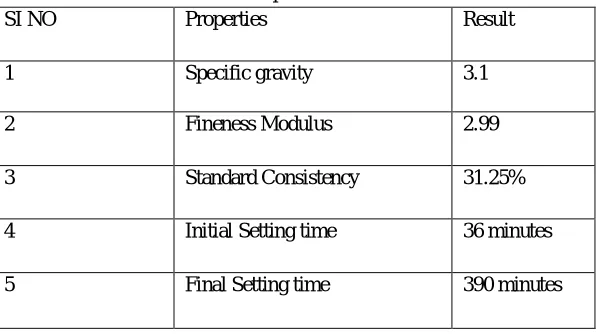
[image:2.612.159.458.498.665.2]Cement is a good binder. The most common type of cement used is ordinary Portland cement. It usually originates from limestone. In this study, OPC of 53 grade is used.. The cementproperties were evaluated as per the IS: 4031-1996 and IS: 12269-1987
Table 1: Properties of Cement
SI NO Properties Result
1 Specific gravity 3.1
2 Fineness Modulus 2.99
3 Standard Consistency 31.25%
4 Initial Setting time 36 minutes
5 Final Setting time 390 minutes
B. Fine aggregate
Table 2Properties of Fine aggregate
SI NO Properties Result
1 Specific gravity 2.47
2 Fineness Modulus 2.99
3 Bulk density(kg/m3) (loose state) 1542
4 Bulk density(kg/m3) (compacted state) 1701
5 Water absorption(%) 1
C. Coarse aggregate
Gravel is composed of unconsolidated rock fragments and havingAggregates passing through 20mm sieve and retained on 4.75mm sieve were sievedand tested as per Indian Standard Specifications IS: 383-1970.
Table 3Properties of Coarse aggregate
SI NO Properties Result
1 Specific gravity 2.74
2 Fineness Modulus 7.34
3 Bulk density(kg/m3) (loose state) 1426
4 Bulk density(kg/m3) (compacted state) 1706
5 Water absorption(%) .5
D. Water
Water plays a vital role in concrete mix. It forms paste after mixing with cement that helps in binding with the aggregate. The chemical reaction between water and cement is called Hydration. Thus hydrates or hydration products are formed during hydration by the formation of chemical bond between cement and water. Hardening of concrete is caused by water during hydration.
E. Polyvinyl alcohol
Polyvinyl alcohol is formed from the chemical compound of polyvinyl acetate ,regularly by a continuous process .it is a clear and white coloured cementpowder it melt in hot water and soluble in ethyle alcohol. It has the idealized formula [CH2CH(OH)]n. ph range of a 5% solution of poly vinyl alcohol exhibit 5.0 to 6.5 ppm. It has a properties like emulsifying and gum properties . PVA is a fully degradable and dissolve quickly
F. Super plasticizer
Super plasticizer reduces the water 3 to 4 times in the concrete mixes. So they are known as high range water reducing admixture. When they are added to cement particles, they emit a strong negative charge, which helps in lowering the surface tension of the surrounding water
.By which the fluidity of the concrete mix is increased. They can be added to a certain limit of 2% of cement to the concrete mix so as to stop bleeding and segregation. The strength of concrete increases as water cement ratio decreases. Workability is greatly achieved by adding super plasticizer. In this study, Ceraplast 300 is used as super plasticizer at a dosage of 2% by weight of cement.
III. MIX PROPORTION FOR SCC
There is no standard mix design for self-compacting concrete (SCC).Using IS: 10262 (2009) the mix design for M30 grade is achieved. SCC is achieved by taking 55% of total aggregate as fine aggregate as per EFNARC specification. In this design water to powder ratio is taken as 0.35 and super plasticizer is added at dosage of 2% by weight of cement.
Table 4Mix proportion for M30 grade of concrete for 1m3
Cement Fine Aggregate
Coarse
Water
Super
Aggregate Plasticizer
(kg/m3) (kg/m3) (lit/m3)
(kg/m3) (%)
IV. TEST RESULTS
A. Compressive strength and split tensile strength result
Compression test and tensile strength is carried out in the cube of size 150mmx150mmx150mm and cylinder of size 150mmx300mm. The specimen with self-curing agent PVA at a dosage of 0%,0.5%,1%,1.5%,2% by weight of cement is added. The test results are taken for 7days, 14 days, 28 days. The test results of the specimen are observed for both water curing at normal temperature.Compression test and tensile strength was carried out by 400 tonne universal testing mcompressing testing machine.
Table 5Compressive strength test results
Specimen Details Compressive strength(N/mm2)
7 Days 14 Days 28 Days
PVA 0% Conventional (WC) 20.7 27.54 31.45
PVA 0% AC SCC 19.45 26.76 30.21
PVA 0.5% AC SCC 20.51 27.45 31.55
PVA 1.0% AC SCC 20.73 27.98 31.78
PVA 1.5% AC SCC 21.23 28.78 32.42
[image:4.612.80.533.178.417.2]PVA 2.0% AC SCC 20.54 27.13 31.13
[image:4.612.67.541.443.721.2]Figure 1Graphical representation for Compressive strength test results
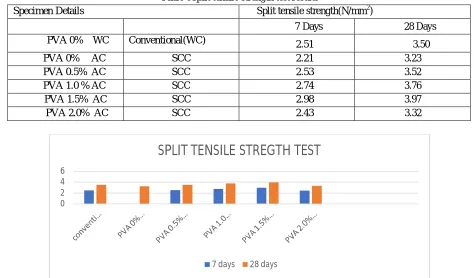
Table 6Split tensile strength test results
Specimen Details Split tensile strength(N/mm2)
7 Days 28 Days
PVA 0% WC Conventional(WC) 2.51 3.50
PVA 0% AC SCC 2.21 3.23
PVA 0.5% AC SCC 2.53 3.52
PVA 1.0 % AC SCC 2.74 3.76
PVA 1.5% AC SCC 2.98 3.97
PVA 2.0% AC SCC 2.43 3.32
Figure 1Graphical representation for Split tensile strength test results 0
50
Conventional (WC)PVA 0% ACPVA 0.5% ACPVA 1.0% ACPVA 1.5% ACPVA 2.0% AC
COMPRESSIVE STREGTH TEST RESULT
7 Days 14 Days 28 Days
0 2 4 6
SPLIT TENSILE STREGTH TEST
V. CONCLUSION
The following conclusion was drawn from this study
A. It was observed that 2% PVA gives lower compressive strength and spilt tensile strength compared to 1.5% PVA. Thus it is found that addition of PVA in high dose over 1.5% of cement would not give expected results in strength and those cannot be used practically.1.5% gives higher compressive strength and spilt tensile strength compared to the normally used water cured specimens without self-curing chemicals.
B. It is observed that the specimen with PVA when placed outside the lab gives same result as that of normal water cured specimen. The usage of PVA gives better strength than the water cured conventional concrete when stored inside the lab.
C. So self-curing agent (PVA) works well in a normal environment
D. Curing Chemical Admixture (SCCA) ie. PVA can promote effective hydration of cement without any externally applied curing
procedure
REFERENCES
[1] Ambily P S and Rajamane N P (2007) , ‘Self curing concrete – an introduction Part 1’, Masterbuilder, Vol. 9, pp. 116-123. [2] Ambily P S and Rajamane N P (2007), “Self curing concrete – an introduction Part 2”, Masterbuilder, Vol. 9, pp. 108-114
[3] Ambily P S and Rajamane N P (2007), “Self curing concrete – an introduction”, New Building Materials and Construction World, Vol. 13, pp. 74-86. [4] Bentz, D.P., and Stutzman, P.E., “Curing, Hydration, and Microstructure of Cement Paste,” ACI Materials Journal, 103 (5), 348- 356, 2006.
[5] Magda I. Mousa, Mohamed G. Mahdy, Ahmed H. AbdelReheem, Akram Z. Yehia, “Physical properties of selfcuring concrete (SCUC),” HBRC Journal. [6] Neville A. M. (2004), Properties of Concrete, 5th Edn, Addison Wesley Longman, England, pp. 844.