Technology (IJRASET)
Agile Manufacturing: A Case Study in India
Khan Nasir1, Sanjay Gomasta2 1,2
Department of Mechanical & Automation Engineering Amity University Gwalior, MP,
Abstract- Agile manufacturing is a new concept in manufacturing intended to improve the competitiveness of firms.
Manufacturing processes based on Agile Manufacturing are characterized by customers supplier integrated process for product design, manufacturing, marketing, and support services. Now a day’s Manufacturers are under tremendous pressure to improve productivity and quality while reducing cost. The new competition is in terms of reduced cost, improved quality products with higher performance, a wider range of products and better services all delivered simultaneously to enhance value to customers. To provide good quality product at low cost, small industries need a formulation of some manufacturing approaches like agile manufacturing to manufacture defect free products within their materials cost limit. Medium scale steel manufacturing industries like Magnum steel limited (MSL), banmore are facing problems of higher rejections in form of wastes so as to increase their cost. This paper aims to analyze the application of agile manufacturing in magnum steel limited in order to reduce wastages through implementing lean tools and techniques. An agility audit questionnaire is used for assessing the agility level of the company to identify the current level of performance within the company with respect to the key elements of agility. MSL’s agile experience is reported including a list of recommendation for improving its competitiveness to offer solution alternatives not only to the current problems but also to the ones that may be encountered in the future. Realizing the importance of agile manufacturing in the 21st century manufacturing competitiveness, an attempt has been made in this paper to review the literature available on AM with the objective to identify key strategies and techniques of AM and develop a framework for the development of agile manufacturing systems (AMSs) along four key dimensions which include strategies, technologies, systems and people.
Key words- Agile Manufacturing, Lean technology, medium scale industry, audit questionnaire, cellular manufacturing.
I. INTRODUCTION
The agility was originally introduced in the report entitled ‘‘21st Century Manufacturing Enterprise Strategy’’ and published by the Iacocca Institute of Lehigh University (Goldman and Nagel, 1991) as an option for managing firms in a dynamic world. Since then, it has been adopted by researchers, managers and consultants as the last stage in the evolution of manufacturing models or systems This style of manufacturing resulted in inflexible plants that could not be easily reconfigured, and were associated with swollen raw materials, work-in-process and finished goods inventories. Automotive companies are attracted to agile manufacturing systems, because of the potential for equipment reuse and equipment investment cost reductions over time Since the early 1980s, in pursuit of greater flexibility, elimination of excess in inventory, shortened lead-times, and advanced levels of quality in both products and customer service, industry analysts have popularized the terms `world-class manufacturing’ and lean production’ .
The aim is to generate a framework that will reduce wastes and subsequently increase the flexibility in production. Customer Demand Uncertainty including lean and agile paradigms has been widely investigated so far and there are available research studies regarding this area.
Gunasekaran (2002) et.al [1] presents a case study conducted on agile manufacturing in the GEC Marconi Aerospace (GECMAe) company. The study provides the reader with an insight into the company and its agility level. An agility audit questionnaire is used for assessing the agility level of the company.
Technology (IJRASET)
©IJRASET 2015: All Rights are Reserved
478
suggests it need and importance in global context. Mahesh Pophaley and Ram Krishna Vyas (2010) et.al present a classification, review and analysis of the literature on Plant Maintenance Management Practices (PMMP) employed in Automobile Industries.
II. RESEARCH METHODOLOGY
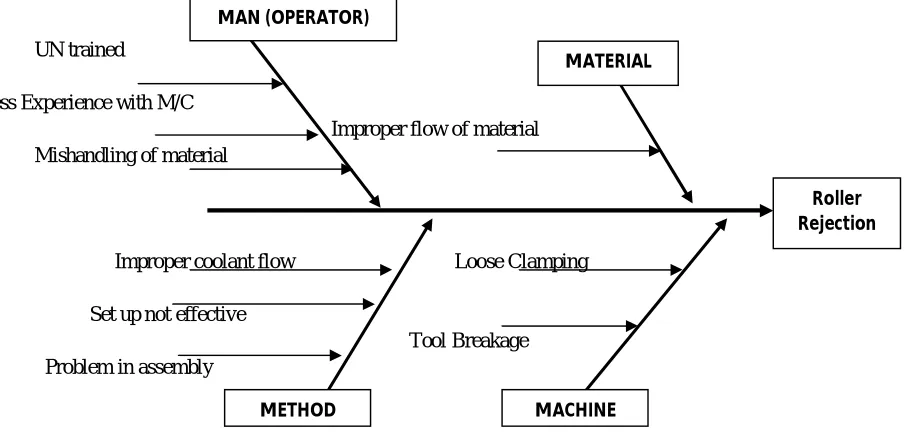
Once companies find out the major sources of waste and tools such as continuous improvement, autonomous maintenance, just in time, fishbone diagram and others will guide companies through corrective actions so as to eliminate waste. Continuous Improvement is the fundamental principle of lean manufacturing. One of the effective tools for continuous improvement is 5S, which is the basis for an effective lean company. Japanese name of Autonomous maintenance is JISHU HOZEN. This pillar is geared towards developing operators to be able to take care of small maintenance tasks, thus freeing up the skilled maintenance people to spend time on more value added activity and technical repairs. Cellular manufacturing is one of the cornerstones when one wants to become lean. The Fishbone Diagram is an easy to use and effective cause and effect technique developed by Kauoru Ishikawa (1982).
III. CASE STUDY
This research work is carried out in Magnum steel limited (MSL) located at banmore industrial area near Gwalior. The purpose is to perform an agility audit on the company using the questionnaire to identify the current level of performance. So first of all lean philosophy is implemented in MSL in order to minimize the wastages. As seen in industry, during production the maximum rejection occurs near about 14 % per month of total production in these rolling mills. The data has been analyzed for year 2013 so as to find out the areas of rejection. After analyzing the data, there are 10 areas are identified which contributes the maximum rejections during the whole processes.
S.N Process Defects % Rejection
1 Raw Material Plastic, Claw etc 1.17
2 Casting Penal, Crack, Slag etc 1.28
3 Welding Piping, Clay, Slag, Balancing 1.76
4 Furnace Max Temp, Thermal Insulation etc 1.27
5 Peeling Popper, Overheating 1.26
6 Roller Gapping, Bearing Failure 2.93
7 Conveyor Jamming, Bearing Failure, Bending 5.71
8 Pushing Mishandling 1.79
9 Cutting Over cutting, Cracking 2.02
10 Inspection Gauge, Eye 0.80
Table 1: process wise rejection of leave spring in 2013
Technology (IJRASET)
UN trained
Less Experience with M/C
Improper flow of material Mishandling of material
Improper coolant flow Loose Clamping
Set up not effective Tool Breakage
[image:4.612.66.520.97.314.2]Problem in assembly
Figure 1: Fish bone diagram for roller rejection
A. Data Analysis
Data collected for the past three months. The operation is based on one shift per day. Every shift is for eight hours. The planned down time is 10 minutes per hour during shift for cooling and tiding up the work area. The collected data is shown in given tables:
S. No Name of the process % Rejection in various months
Oct 13 Nov 13 Dec 13
1 Raw material 5.90 5.85 5.86
2 Casting 6.48 6.37 6.44
3 Welding 8.84 8.78 8.90
4 Furnace 6.38 6.44 6.34
5 Peeling 6.26 6.34 6.31
6 Roller 14.60 14.65 14.57
7 Conveyor 28.50 28.61 28.55
8 Pushing 8.96 8.88 8.99
9 Cutting 10.10 10.16 10.15
10 Inspection 3.97 3.91 3.88
Table 2: % Rejection in various processes from Oct 13 to Dec 13
In this paper the focus is on roller rejections, finding causes and suggests solutions and implements lean techniques in order to minimize wastages. After applying the adopted methodologies, providing the necessary training to the workers, supervise them and strictly follow the work instructions, the defects are reduced.
IV. RESULT AND DISCUSSIONS
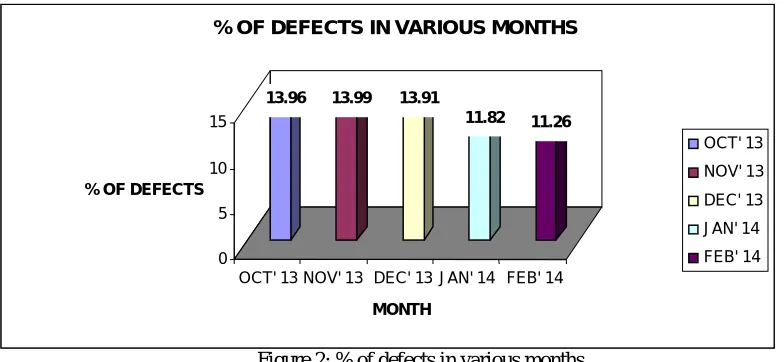
So after implementing lean tools and techniques on selected rolling mill (16”/10”), there is a reduction in rejected pieces from 13.94 % to 11.26 % in the month of January and February 2014. This results in saving of Rs. 891000 (per piece cost Rs 2700 at that time) due to reduction of defects in February month (368 more pieces were produced in February 2014).The detailed result is shown in tabulated form.
METHOD MACHINE
MATERIAL MAN (OPERATOR)
[image:4.612.82.530.368.539.2]Technology (IJRASET)
©IJRASET 2015: All Rights are Reserved
480
S. No Leave spring Before Lean After Lean 1 Month Oct 13 Nov 13 Dec 13 Jan 14 Feb 14 2 Total production 12245 11990 12176 12183 12211 3 Total defected pieces 1707 1677 1694 1440 1364 4 % of total Production 13.94 13.99 13.91 11.82 11.26
Table 3: Total production and % of defects after Lean from Jan 14 to Feb 14 S.
No
Leave spring Before Lean After Lean
1 Month Oct 13 Nov 13 Dec 13 Jan 14 Feb 14 2 No of rejected pieces 1707 1677 1694 1440 1364 3 Amount in rupees 4608900 4527900 4573800 3888000 3682800
4 Reduction in defects 254 368
5 Saving in terms of Rupees ( × Rs 2700 ) 685800 891000
Table 4: Total rejection in pieces and rupees after Lean from Jan 14 to Feb 14 S.
No
[image:5.612.84.526.54.383.2]Type of Rejection Before Lean After Lean Oct 13 Nov 13 Dec 13 Jan 14 Feb 14 1 Raw material Rejection 1.18 1.17 1.18 1.13 1.09 2 Process Rejection 18.82 18.83 18.82 15.88 15.00 3 Total Rejection 20 20 20 17.01 16.09
[image:5.612.96.488.401.582.2]Table 5: Comparison chart for type of rejection (in %) before and after Lean
Figure 2: % of defects in various months SUGGESTIONS FOR REDUCING WASTAGES:
S. No
Process Types of Defects Reason of Rejection Suggestion
1 Roller Gapping, Bearing failure,
Improper machining causes gapping and bearing failure.
Rollers to be checked for correctness of positioning.
.
Table 6: Defects, reason and suggestions for defects in various processes
13.96 13.99 13.91
11.82 11.26
0 5 10 15
% OF DEFECTS
OCT' 13 NOV' 13 DEC' 13 JAN' 14 FEB' 14
MONTH
% OF DEFECTS IN VARIOUS MONTHS
OCT' 13
NOV' 13
DEC' 13
JAN' 14
Technology (IJRASET)
A. Agilty Audit Questionnaire
After approaching towards lean mindset, the current level of agility is to be investigated with the help of a standard audit questionnaire administered within the company studied, Magnum steel limited (MSL) with respect to the five key elements of agility are Enriching the customer, Co-operating to enhance competitiveness, Mastering change and uncertainty, Leveraging people and information and Manufacturing advancement and Safety aspects. Results for enriching the customer (MSL) (maximum possible score=12; current performance for enriching the customer=6/12=50% agility index; suggested performance for enriching the customer=11/12=91% agility index)
Results for co-operating to enhance competitiveness (MSL) (maximum possible score=9; current performance for enhancing competitiveness=4/9=44% agility index; suggested performance for enhancing competitiveness=9/9=100% agility index)
Results for mastering change and uncertainty (MSL) (maximum possible score=8; current performance for mastering change and uncertainty=2/8=25% agility index; suggested performance for mastering change and uncertainty=(7,1/2)/8=94% agility index) Results for leveraging people and information (MSL) (maximum possible score=14; current performance for leveraging people and information =4/14=28.5% agility index; suggested performance for mastering change and uncertainty=13/14=93% agility index) Results for manufacturing advancement and Safety aspects (MSL) (maximum possible score=12; current performance for leveraging people and information=(4,1/4)/12=35% agility index; suggested performance for mastering change and uncertainty=12/12=100% agility index)
B. Recommendations
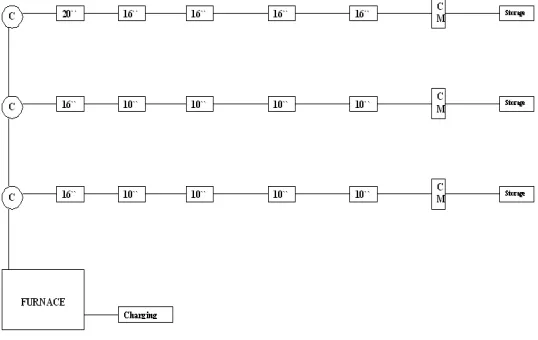
[image:6.612.172.441.390.560.2]After analyzing the questionnaire, the some recommendations made for improving the agility level of the company. One of the most important suggestion is to apply a cellular manufacturing approach to shop floor for established products to reduces wastages, throughput time and hence unit cost. Consequently, cellular manufacturing would go a long way towards improving the turn/around delivery times as well. A short attempt is made to suggest the layout which is shown in given figure.
Figure 3: Proposed layout
V. CONCLUSION
Technology (IJRASET)
©IJRASET 2015: All Rights are Reserved
482
improving its overall business competitiveness. Not all of them, however, need to be incorporated, or be implemented at the same time. Some of the recommendation have been reviewed at MSL, bearing in mind the future opportunities and threats to the business.
REFERENCES
[1] A.Gunasekaran (2002). “An investigation into the application of agile manufacturing in an aerospace company” Technovation 22 (2002) 405–415.
[2] Nitin Upadhye, S. G. Deshmukh and Suresh Garg (2010). “Lean manufacturing system for medium size manufacturing enterprises: an Indian case” International Journal of Management Science and Engineering Management 5(5): 362-375, 2010.
[3] Fawaz Abdullah (2003). “Lean manufacturing tools and techniques in a process industry with a focus on steel” University of Pittsburgh, 2003.
[4] Debra A. Elkins, Ningjian Huang and Jeffrey M. Alden (2004). “Agile manufacturing systems in the automotive industry” International Journal of Production Economics 91 (2004) 201–214.
[5] Kalpakjian and Schimd (2003). “Manufacturing processes for engineering materials” Prentice Hall, 4th edition, 2003.
[6] Mahesh Pophaley and Ram Krishna Vyas (2010). “Plant maintenance management practices in automobile industries: A retrospective and literature review” Journal of Industrial Engineering and Management, 3(3), 512-541, 2010.