Technology (IJRASET)
Experimental Analysis On Dsdv Protocol For
Fanets
Simarjot Kaur1, Arvinder Singh2
Department of Computer Science Engineering,Chandigarh Group of Colleges,Landran, Punjab, India
Abstract— In these days the capability and role of Mobile Ad hoc Networks have rapidly increased. Their use in emergency, Natural catastrophe, army war fields and UAVs is getting very popular because of cutting side technologies in networking and conversation. The usage of the idea of MANET new networking paradigms like VANET and F ANET have developed. FANET is comparably new idea of MANET and it has talents to tackle with situations where traditional MANET can't achieve this. Because of excessive mobility and fast topology change in FANET. This is distinctly challengeable for researcher to put the effect routing in FANETs. Routing protocols play a dominating role in improving the overall performance of ad hoc networks .In this paper, experimental evaluation is performed on DSDV routing protocol in order to check its performance by adding certain parameters.
Keywords- FANET, MANET, MAVs, Routing, DSDV
I. INTRODUCTION
Flying ad hoc Networks (FANET) represents a mainly new class of ad hoc networks. FANET is permit to send data quickly and correctly in a scenario, where standard ad hoc networks aren't capable to achieve this. At the time of natural catastrophe like flooding, earthquakes and even in navy battle field FANET can carry out better than different form of mobile ad hoc networks. FANET makes use of a set of homogenous flying agents known as MAVs (Micro Air automobile) communicates locally among each other, and additionally interacts with their environment to get some kind of facts. In FANETs there is no support for the central control system . Here as the position of MAVs rapidly changes and due to this frequent changes are occurred in the topology. As the mobile ad hoc networks have versatile technology but there's a need of certain era which can overcome from the situation in which traditional MANET are not usable which includes disaster conditions along with drowning or military combat discipline. It is not possible to install the portable nodes (which flow on surface) in such region. F ANET can offer technique to tackle such situations by way of the use of flying object known as micro air-automobiles (MAVs). The swarm of MAVs is basically used to converse in a huge operational area. MAVs structure themselves to shape wi-fi communicating network. There are no GPS, radar or cameras installed with them and they communicate within only the neighbourhood. In FANET, MAVs adjustments changes frequently. So, due to this there is a frequent change in topology. So this is a very necessary challenging project to discover a appropriate routing technique for FANET.
Routing is the process of selecting the best route for data transmission between sender and receiver. Many routing protocols were established for routing purpose which are divided into two categories like topology and position based. The principle purpose of each routing protocol is to locate the precise path for forwarding of data packets. Some protocols like Destination Sequenced Distance Vector (DSDV), Ad Hoc On demand Distance Vector Routing protocol (AODV), Distance Vector Routing (DVR) have been set up. The main aim of each protocol is to find the shortest path for the data transmission by considering the distance as a main factor. In the paper, we performed the experimental analysis on DSDV protocol by adding certain parameters like throughput ,trust rate and packet delivery ratio of nodes.
II. DESTINATION–SEQUENCEDDISTANCEVECTORPROTOCOL
Destination sequenced distance vector routing is a routing Protocol basically designed for ad hoc networks which uses the concept of Bellman-Ford algorithm. This routing protocol discovered by C. Perkins and P. Bhagwat in 1994. DSDV is a modified model of Distance Vector Routing.
Technology (IJRASET)
these numbers are for the most part regardless of the possibility that a connection is available; else, an odd number is utilized. The number is created by the destination, and the emitter needs to convey the following updates with this number. Routing data is disseminated between hubs by sending full dumps rarely and the smaller incremental upgrades all the more every now and again. We consider an accumulation of versatile computers,(nodes) which might be a long way from any base station. The PCs (hubs) trade control messages to set up multi-bounce ways similarly as the Distributed Bellman-Ford calculation. These multi-hop ways are utilized for exchanging messages among the PCs (nodes).Packets are transmitted between the hubs utilizing routing tables put away at every hub. Each routing table records all accessible destinations and the number of hopes to each destination. For every destination, a hub knows which of its neighbors prompts the most brief way to the destination. Consider a source hub S and a destination hub D. Each route table passage in S is labeled with a sequence number that is begun by the destination hub. For instance, the passage for D is labeled with a sequence number that S got from D (perhaps through other nodes).We needs to keep up the consistency of the routing tables in a powerfully changing topology. Every hub periodically transmits updates. This is done by every hub when noteworthy new data is accessible. We don't expect any clock synchronization among the portable hubs. The route upgrade messages demonstrate which hubs are available from every hub and the number of bounces to contact them. We consider the bounce consider
the separation between two hubs. Be that as it may, the DSDV convention can be altered for different measurements also. A neighbor thus checks the best path from its own table what's more, advances the message to its proper neighbor.
III. DSDVROUTING
A. Route Advertisement
The DSDV convention requires every portable hub to promote its own particular routing table to all of its present neighbors. Since the hubs are portable, the entries can change progressively after some time and look after table consistency. The route advertisements ought to be made at whatever point there is any adjustment in the neighbourhood or occasionally. Every portable hub consents to forward route publicizing messages from other versatile hubs. This sending is important to send the advertisement messages everywhere throughout the system. The advertisement messages help portable hubs to get a general picture of the topology of the system.
B. Route Table entry structure
The route advertisement which is broadcast by each mobile node contains the following information for each new route:- 1) The address of destination
2) The total number of hops to the destination
3) The sequence number of the information that received from that destination. This sequence number is the original number that is assigned by the destination
C. Respond to topology changes
Two types of packets must be defined for route updates-
1) full dump packets
a) Carry all accessible directing data
b) It also carries the size of multiple network protocol data units (NPDUs)
c) Transmitted infrequently the information during period of occasional movement
2) Incremental packets
a) Carry just data changed since last full dump
b) Also carries size of a NPDU
c) Transmitted data more frequently
Additional table is used to store the data that comes from the incremental packets., A full dump is preferred when the size of an incremental dump becomes too large.
3) Route Selection Criteria:- At the point when a hub i gets incremental dump or full dump from another hub j, the accompanying moves are made :
Technology (IJRASET)
IV. PERFORMANCEEVALUATION
We considers the following parameters for the evaluation of this protocol and compares the performance of the protocol before and after adding these parameters .The evaluation is done in MATLAB.
A. Packet delivery ratio
Packet Delivery Ratio is just the ratio of packets delivered to the number of packets sent by a sender.
Mathematically, Packet Delivery Ratio = (DATAR/DATAS)×100 Where DATAR is the number of packets received by receiver and DATAS is the number of packets sent by the sender.
[image:4.612.101.513.203.436.2]If the Packet Delivery Ratio is higher ,this means the protocol is better.
Figure 1-Comparison of packet delivery ratio B. Surety level of nodes
[image:4.612.108.504.495.712.2]Technology (IJRASET)
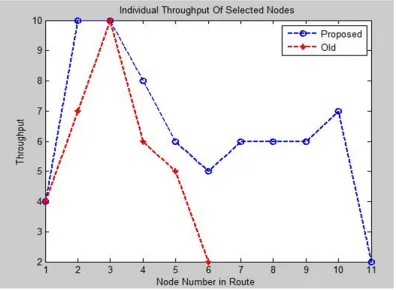
C. Throughput
[image:5.612.110.506.119.409.2]It is basically the ratio of number of bits or data packets that are received successfully over a transmission time.It is measured in bits per second (bps) or kilo bits per second (kbps).
Figure 3-Throughput Comparison
V. CONCLUSION
There are many routing protocols like DVR ,DSR, DSDV, AODV for finding the efficient route for data transmission between sender and receiver generally on the basis of shortest distance or path .In this paper a modified approach of destination sequenced distance vector routing protocol is defined in which many parameters like throughput, surety or trust value of nodes, packet delivery ratio must be considered for selection of best path among sender and receiver for data transmission. We can implement this protocol by considering these parameters as well as distance on the Flying Ad Hoc Networks (FANETs).
REFERENCES
[1] OzgurKoraySahingoz, “Networking Models in Flying Ad-Hoc Networks (FANETs): Concepts and Challenges”, Springer Science, 14th September, 2013. .
[2] Michael Muller, “Flying Adhoc Network” Proceedings of the 4th Seminar on “Research Trends in Media Informatics”, Institute of Media Informatics, Ulm
University, 14th February. 2012
[3] P.Jacquet, T.Clausen, L. Viennot, “Optimized link state routing [OLSR] protocol for adhoc network”, Multi Topic Conference,2001. IEEE INMIC 2001.
Technology for the 21st Century. Proceedings. IEEE International, March 2001.
[4] Sudip Misra and Gopidi Rajesh,” Bird Flight-Inspired Routing Protocol for Mobile Ad Hoc Networks”, ACM Transactions onAutonomous and Adaptive
Systems, Vol. 6, No. 4, Article 25, October 2011 .
[5] Bixio Rimoldi Karol Kru˙zelecki, Louis Traynard, and Stefano Rosati,”Speed-Aware Routing for UAV Ad-Hoc Networks”,24 Jul 2013
[6] Thomas Clausen (editor), Philippe Jacquet (editor) C. Adjih, A. Laouiti, P. Minet, P. Muhlethaler, A. Qayyum, L. Viennot,” The Optimised Routing Protocol
for Mobile Ad-hoc Networks: protocol specifications”, INRIA, March 2004.
[7] Analysis and Improvement of DSDV Protocol by Nayan Ranjan Paul,Laxminath tripathy and Pradipta Kumar Mishra, Deptt. Of Computer Science and Engg.,
KMBB college of Engg. and Technology, Odisha, India.
[8] Destination-Sequenced Distance Vector (DSDV) Protocol by Guoyou He, Networking Laboratory Helsinki University of Technology
[9] The Destination Sequenced Distance Vector (DSDV) protocol by Dr. R.B. Patel
[10] C.E. Parkins and TJ. Watson, "Highly dynamic destination sequenced distance vector routing (DSDV) for mobile computers", in ACMSIGCOMM_94
Conference on Communication Architecture, London, U.K., 1994
[11] J. Clapper, J. Young, J. Cartwright, and J. Grimes, “Unmanned systems roadmap,” Tech. rep., Dept. of Defense, pp. 2007–2032.
Technology (IJRASET)
Network,” ISBN-13: 9780521895842, pp. 179–199.
[13] J. Elston, E. Frew, D. Lawrence, P. Gray, and B. Argrow, “Net-centric communication and control for a heterogeneous unmanned aircraft system,” Journal of
Intelligent and Robotic Systems, vol. 56(1-2), pp. 199–232, 2009.
[14] E. Frew and T. Brown, “Networking issues for small unmanned aircraft systems,” Journal of Intelligent and Robotics Systems, vol. 54 (1-3), pp. 21–37, 2009.
[15] I. Bekmezci, O. K. Sahingoz, and S. Temel, “Flying ad-hoc networks (FANETs): A survey,” Elsevier, Ad Hoc Networks 11, pp. 1254–1270, 2013.
[16] O. K. Sahingoz, “(FANETs): Concepts and challenges,” Springer J Intell Robot System, vol. 74, pp. 513–527, 2014.
[17] S. Cameron, S. Hailes, S. Julier, S. McClean, G. Parr, N. Trigoni, M. Ahmed, G. McPhillips, R. de Nardi, J. Nie, A. Symington, L. Teacy, and S.Waharte,
“SUAAVE: Combining aerial robots and wireless networking,”25th Bristol International UAV Systems Conference, 2010.
[18] A. Purohit and P. Zhang, “SensorFly: a controlled-mobile aerial sensor network,” in ACM,7th ACM Conference on Embedded Networked Sensor Systems,