International Journal of Emerging Technology and Advanced Engineering
Website: www.ijetae.com (ISSN 2250-2459,ISO 9001:2008 Certified Journal, Volume 3, Issue 11, November 2013)
83
A Study on the Mechanical Properties of Concrete by Replacing
Sand with Waste Foundry Sand
Sohail Md
1, Abdul Wahab
2, Arfath Khan Md
31
Sr.Design Engineer, L&T
2Asst Prof, CED, NSAKCET 3Asst Prof, CED, NITS
Abstract-- Conservation of natural resources and
preservation of environment is the essence of any development. The problem arising from continuous technological and industrial development is the disposal of waste material. If some of the materials are found suitable in concrete making not only cost of construction can be put down, but also safe disposal of
waste materials can be achieved. Metal foundries use large amounts of sand as part of the
metal casting process. Foundries successfully recycle and reuse the sand many times in a foundry. When the sand can no longer be reused in the foundry, it is removed from the foundry and is termed “foundry sand.” Foundry sand production is nearly 6 to 10 million tons annually. Like many waste products, foundry
sand has beneficial applications to other industries. Foundry sand consists primarily of silica sand, coated with a
thin film of burnt carbon, residual binder ( sea coal, resins) and dust. Foundry sand can be used in concrete to improve its strength and other durability factors. Foundry Sand can be used as a partial replacement of cement or as a partial replacement of fine aggregates or total replacement of fine aggregate and as supplementary addition to achieve different properties of concrete.
In the present study, effect of foundry sand as fine aggregate replacement on the compressive strength, split tensile strength and flexural strength having mix proportions of M30 was investigated. Fine aggregates were replaced with eleven percentages of foundry sand. The percentages of replacements were 0, 10, 20, 30, 40, 60,70,80,90 & 100 % by weight of fine aggregate. Tests were performed for compressive strength, split tensile strength and flexural strength tests for all replacement levels of foundry sand at different curing period (7-days,28 days & 56-days).
Keywords-- Waste Foundry sand, Compressive Strength,
Split Tensile Strength & Flexural Strength.
I. INTRODUCTION
Concrete is a composite material composed of gravels or crushed stones (coarse aggregate), sand (fine aggregate) and hydrated cement (binder). It has been in use for over a century in all construction works. A variety of new materials in the field of concrete technology have been developed during the recent past with the ongoing demand of construction industries to meet the functional, strength, economical and durability requirements.
The worldwide consumption of sand as fine aggregate in concrete production is very high and several developing countries have encountered some strain in the supply of natural sand in order to meet the increasing needs of infrastructural development in recent years. To overcome the stress and demand of river sand, researchers and practitioners in the construction industries have identified some alternatives.
Ferrous and non ferrous metal casting industries produce several million tons of byproduct in the world. WFS is major byproduct of metal casting industry and successfully used as a land filling material for many years. But use of waste foundry sand for land filling is becoming a problem due to rapid increase in disposal cost. In an effort to use the WFS in large volume, research has being carried out for its possible large scale utilization in making concrete as partial replacement of fine aggregate
Foundry industry produces a large amount of by-product material during casting process. The ferrous metal casts in foundry are cast iron and steel, non ferrous metal are aluminum, copper, brass and bronze. Over 70% of the total by-product material consists of sand because moulds consist usually of molding sand, which is easily available, inexpensive, resistance to heat damage and easily bonded with binder and other organic material in mould. Foundry industry use high quality specific size silica sand for their molding and casting process. These WFS is black in color and contain large amount of fines. The typical physical and chemical property of WFS is dependent upon the type of metal being poured, casting process, technology employed, type of furnaces (induction, electric arc and cupola) and type of finishing process (grinding, blast cleaning and coating).
II. LITERATURE REVIEW
International Journal of Emerging Technology and Advanced Engineering
Website: www.ijetae.com (ISSN 2250-2459,ISO 9001:2008 Certified Journal, Volume 3, Issue 11, November 2013)
84
Compressive strength, splitting- tensile strength, flexural strength, and modulus of elasticity were determined at 28, 56, 91, and 365 days. Test results indicated a marginal increase in the strength properties of plain concrete by the inclusion of UFS as partial replacement of fine aggregate (sand) and that can be effectively used in making good quality concrete and construction materials.
Gurpreet Singh and Rafat Siddique (2011) carried out an experimental investigation to evaluate the strength and durability properties of concrete mixtures, in which natural sand was partial replaced with (WFS). Natural sand was replaced with five percentage (0%, 5%, 10%, 15%, and 20%) of WFS by weight. Compression test and splitting tensile strength test were carried out to evaluate the strength properties of concrete at the age of 7, 28 and 91 days. Test results indicate a marginal increase in strength properties of plain concrete by inclusion of WFS as a partial replacement of fine aggregate.
H. Merve Basar and Nuran Deveci Aksoy (2012) studied the potential re-use of waste foundry sand (WFS) in ready-mixed concrete (RMC) production. Regular sand was replaced with five percentages (0%, 10%, 20%, 30%, 40%) of WFS by weight and solidification/stabilization (S/S) process was applied to all concrete mixtures. Three aspects were investigated for the qualification of WFS-based-RMC, i.e., the mechanical, leaching and micro-structural properties. Various tests for the mechanical and physical performance of the solidified products were carried out, and the results indicated that the addition of WFS as partial replacement of sand reduced the strength performance and density and also increased the water absorption ratio of the concrete mixtures. Nevertheless, the concrete having 20% WFS exhibited almost similar results with the control one. The findings of this research suggest that WFS can be effectively utilized in making good quality RMC as a partial replacement of fine aggregates with no adverse mechanical, environmental and micro-structural impacts; however, the partial replacement should not exceed 20%.
Rafat Siddique and El-Hadj Kadri (2011)dealt with the effect of foundry sand (FS) and metakaolin (MK) on the near surface characteristics of concrete. A control concrete having cement content 450 kg/m3 and w/c of 0.45 was designed. Cement was replaced with three percentages (5%, 10%, and 15%) of metakaolin weight, and fine aggregates were replaced with 20% foundry sand. Tests were conducted for initial surface absorption, sorptivity, water absorption and compressive strength at the ages of 35, 56, and 84 days.
III. EXPERIMENTAL INVESTIGATION
A. Materials
Cement: Ordinary Portland cement (Ultra tech cement) of 53 grade confirming to IS: 12269-1987was used. It was tested for its physical properties as per IS 4031 (part II)-1988 and chemical properties as per IS: 12269 at lucid laboratories, Hyderabad.
Aggregate: The size, shape and gradation of the aggregate play an important role in achieving a proper concrete. The flaky and elongated particles will lead to blocking problems in confined zones. The sizes of aggregates will depend upon the size of rebar spacing.
The coarse aggregate chosen for Concrete was typically angular in shape, well graded, and smaller than maximum size suited for conventional concrete; typical conventional concrete should have a maximum aggregate size of 20mm. Gradation is an important factor in choosing a coarse aggregate. Gap-graded coarse aggregate promotes segregation to a greater degree than the well graded coarse aggregate.
Fine Aggregate: The locally available river sand was used as fine aggregate in the present investigation. The sand was free from clayey matter, salt and organic impurities. The sand was tested for various properties like specific gravity, bulk density etc., and in accordance with IS 2386-1963.
Coarse Aggregate: Machine crushed angular granite metal of 20mm nominal size from the local source was used as coarse aggregate. It was free from impurities such as dust, clay particles and organic matter etc. The physical properties of coarse aggregate were investigated in accordance with IS 2386 -1963.
Waste Foundry Sand: Waste foundry sand was obtained locally from Hinduja Casting Uppal Hyderabad. WFS was used as a partial replacement of fine aggregate (natural river sand). Metal poured in the foundry is gray iron. The sand was tested for various properties like specific gravity, bulk density etc., and in accordance with IS 2386-1963. The fine aggregate was conforming to standard specifications.
Water: Locally available water used for mixing and curing which is potable and is free from injurious amounts of oils, acids, alkalis, salts, sugar, organic materials or other substances that may be deleterious to concrete or steel.
International Journal of Emerging Technology and Advanced Engineering
Website: www.ijetae.com (ISSN 2250-2459,ISO 9001:2008 Certified Journal, Volume 3, Issue 11, November 2013)
85
B. Mixes:
The present experiment is carried out to investigate strength properties of concrete mixes of grade M30 in which fine aggregate (river sand) is to be fully replaced with Waste Foundry Sand. Fine aggregate will be replaced with six percentages (10%, 20%, 30%, 40%, 50% ,60%,70%,80%,90%,100%) of WFS by weight.
C. Mixing, Casting, Curing and Testing:
All the triple blended composites were mixed in the pan mixer. Required number of specimens for various combinations were cast. Continuous curing was maintained upto the age of 7, 28 & 56 days. Mixing, casting, curing and testing were carried out as per the standard specifications.
IV. RESULTS AND DISCUSSIONS
The study was conducted to find out the influence of waste foundry sand on strength properties of plain concrete.
The effects of following parameters were studied.
Compressive strength, Split tensile strength and flexural strength at various percentage replacement of fine aggregate with waste foundry sand on some of plain concrete.
i. Workability: The dosage of super plasticizer was kept constant throughout the experimental program at 0.5% of the weight of the binder.
As the waste foundry sand percentage increased in the concrete the workability was reduced. This may be due to the void filling action of the waste foundry sand as it is finer than the fine aggregate, which gives a high cohesion to the mix. Mix with increase in waste foundry sand content tends to become harsh, sticky and stiff.
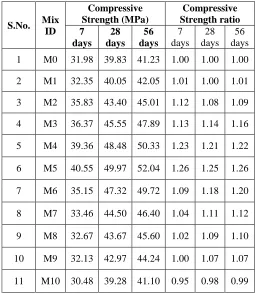
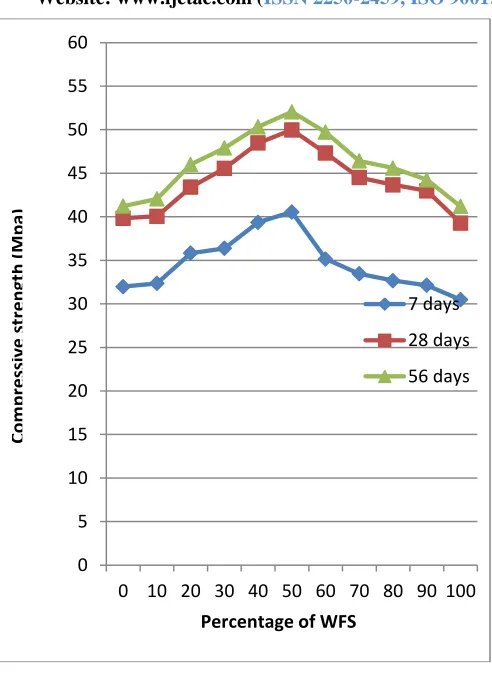
[image:3.612.319.574.195.489.2]ii. Compressive Strength: Cube specimens were tested for compression and ultimate compressive strength was determined from failure load measured using compression testing machine. The average value of compressive strength of 3 specimens for each category at the age of 7 days, 28 days and 56 days are tabulated in the Table 1. .The increase in strength of various concrete mixtures over the plain concrete is also tabulated in the Table 1.
Table 1
Compressive Strength of Various Concrete Mixes with Replacement of Fine Aggregate over Waste Foundry Sand at Different Ages and
Compressive Strength Ratio of Various Concrete Mixes with Replacement of Fine Aggregate over Waste Foundry Sand at Different
Ages to Normal Concrete.
S.No. Mix ID
Compressive Strength (MPa)
Compressive Strength ratio 7
days 28 days
56 days
7 days
28 days
56 days 1 M0 31.98 39.83 41.23 1.00 1.00 1.00
2 M1 32.35 40.05 42.05 1.01 1.00 1.01
3 M2 35.83 43.40 45.01 1.12 1.08 1.09
4 M3 36.37 45.55 47.89 1.13 1.14 1.16
5 M4 39.36 48.48 50.33 1.23 1.21 1.22
6 M5 40.55 49.97 52.04 1.26 1.25 1.26
7 M6 35.15 47.32 49.72 1.09 1.18 1.20
8 M7 33.46 44.50 46.40 1.04 1.11 1.12
9 M8 32.67 43.67 45.60 1.02 1.09 1.10
10 M9 32.13 42.97 44.24 1.00 1.07 1.07
11 M10 30.48 39.28 41.10 0.95 0.98 0.99
International Journal of Emerging Technology and Advanced Engineering
Website: www.ijetae.com (ISSN 2250-2459,ISO 9001:2008 Certified Journal, Volume 3, Issue 11, November 2013)
[image:4.612.45.291.126.463.2]86
Fig 1 Compressive Strength of Various Concrete Mixes withReplacement of Fine Aggregate over Waste Foundry Sand at Different Ages
iii.
Split Tensile Strength:
Cylinder specimens were tested for splitting tensile strength. The test was carried out according to IS: 5816-1970(10). In this test compressive line loads were applied along a vertical symmetrical plane, which causes splitting of specimen. The average values of 3 specimens for each category at the ages of 28 & 56 days are tabulated in the Table 2. The increase in the splitting tensile strength of various concrete mixtures over plain concrete is also tabulated in Table 2.There is a considerable improvement in the split tensile strength of concrete with inclusion and increase in the percentage of waste foundry sand up to 70%. However on replacement of 80%-100% aggregate the concrete showed marginal decrease in strength.
It is observed that the split tensile strength increased with increasing age of curing. The maximum strength was achieved with 40% replacement of fine aggregate with waste foundry sand.
Table 2
Split Tensile Strength of Various Concrete Mixes with Replacement of Fine Aggregate over Waste Foundry Sand at Different Ages and Split Tensile Strength Ratio of Various Concrete Mixes with Replacement of Fine Aggregate over Waste Foundry Sand at Different Ages to Normal
Concrete.
S.N
o.
Mix
ID
Split Tensile
Strength (MPa)
Split Tensile
Strength Ratio
28 days 56 days 28 days 56 days
1 M0 4.38 4.53 1.00 1.00
2 M1 4.40 4.62 1.00 1.01
3 M2 4.77 5.06 1.08 1.11
4 M3 5.01 5.26 1.14 1.16
5 M4 5.81 5.78 1.32 1.27
6 M5 5.74 5.98 1.31 1.32
7 M6 5.20 5.46 1.18 1.20
8 M7 4.45 5.10 1.01 1.12
9 M8 4.32 4.51 0.98 0.99
10 M9 4.29 4.29 0.97 0.94
11 M10 3.92 4.07 0.89 0.89
iv.
Flexural Strength:
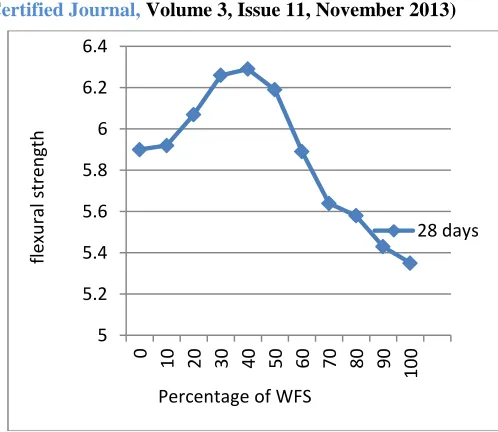
Prism specimens were tested for flexural strength. The tests were carried out confirming to IS: 516-1959(8). The specimens are tested under two-point loading . The average value of 3 specimens for each category at the age of 28 days is tabulated in the Table 3.The increase in strength of various concrete mixtures over the plain concrete is also tabulated in the Table 3.There is considerable increase in the flexural strength of concrete with the inclusion and increase in the percentage of waste foundry sand upto 50%. However after 50% there was decrease in the strength compared to normal concrete mixture.
0 5 10 15 20 25 30 35 40 45 50 55 60
0 10 20 30 40 50 60 70 80 90 100 7 days
28 days
56 days
Co
m
p
re
ssi
ve
str
e
n
gth
(M
p
a)
[image:4.612.324.571.242.524.2]International Journal of Emerging Technology and Advanced Engineering
Website: www.ijetae.com (ISSN 2250-2459,ISO 9001:2008 Certified Journal, Volume 3, Issue 11, November 2013)
[image:5.612.44.291.116.361.2]87
Fig 2 Split Strength of Various Concrete Mixes with Replacement ofFine Aggregate over Waste Foundry Sand at Different Ages Table 3
Flexural Strength of Various Concrete Mixes with Replacement of Fine Aggregate over Waste Foundry Sand at Different Ages and Flexural Strength Ratio of Various Concrete Mixes with Replacement of Fine Aggregate over Waste Foundry Sand at Different Ages to Normal
Concrete.
S.No. Mix ID
Flexural
Strength (MPa)
Flexural
Strength Ratio
28 days 28 days
1 M0 5.90 1.00
2 M1 5.92 1.00
3 M2 6.07 1.02
4 M3 6.26 1.06
5 M4 6.29 1.06
6 M5 6.19 1.04
7 M6 5.89 0.99
8 M7 5.64 0.95
9 M8 5.58 0.94
10 M9 5.43 0.92
[image:5.612.322.571.120.336.2]11 M10 5.35 0.90
Fig 3 Flexural Strength of Various Concrete Mixes with Replacement of Fine Aggregate over Waste Foundry Sand at 28 days.
V. CONCLUSIONS
Based on the experimental study undertaken the following conclusions are drawn.
1. Waste foundry sand can be effectively used as fine aggregate in place of conventional river sand, in concrete.
2. Replacement of fine aggregate with waste foundry sand showed increase in the compressive strength of plain concrete up to 90% and then there was a marginal decrease in the strength.
3. At 40% & 50% replacement of sand with waste foundry sand concrete had gained full strength at the end of 7 days.
4. The maximum compressive strength was achieved with 50% replacement of fine aggregate with waste foundry sand.
5. 25.45% increment in the compressive strength was found at 50% replacement of fine aggregate with waste foundry sand at 28 days compared to normal concrete..
6. Replacement of fine aggregate with waste foundry sand showed increase in the split tensile strength of plain concrete up to 70% and then there was a marginal decrease in the strength.
7. There was increase in flexural strength of concrete upto 50% replacement.
8. Flexural strength of concrete decreased after 50% compared to the plain concrete.
3.4 3.6 3.8 4 4.2 4.4 4.6 4.8 5 5.2 5.4 5.6 5.8 6 6.2
0 10 20 30 40 50 60 70 80 90 100 28 days
56 days
Percentage of WFS
Sp
lit
Te
n
sile
Strengt
h
5 5.2 5.4 5.6 5.8 6 6.2 6.4
0 10 20 30 40 50 60 70 80 90
10
0
28 days
Percentage of WFS
fle
xu
ra
l s
tren
International Journal of Emerging Technology and Advanced Engineering
Website: www.ijetae.com (ISSN 2250-2459,ISO 9001:2008 Certified Journal, Volume 3, Issue 11, November 2013)
88
9. Thus, sand replaced with waste foundry sand upto 70% is suitable in the construction works.
REFERENCES
[1 ] Rafat Siddique, Geert de Schutter, Albert Noumowe, (2008), “Effect of used-foundry sand on the mechanical properties of concrete”, Construction and Building Materials, vol. 23, pp 976–980.
[2 ] Yogesh Aggarwal, Paratibha Aggarwal, Rafat Siddique, El-Hadj Kadri and Rachid Bennacer, (2010), “Strength, durability, and micro-structural properties of concrete made with used-foundry sand (UFS)”, Construction and Building Materials, vol. 25, pp 1916–1925. [3 ] Gurpreet Singh and Rafat Siddique, (2011), “Effect of waste foundry
sand (WFS) as partial replacement of sand on the strength, ultrasonic pulse velocity and permeability of concrete”, Construction and Building Materials, vol. 26, pp 416–422.
[4 ] Khatib JM, Ellis DJ., (2001), “Mechanical properties of concrete containing foundry sand”. ACI special publication (SP-200), American Concrete Institute; pp. 733–748.
[5 ] Siddique R., Gupta R, Kaur I., (2007), “Effect of spent foundry sand as partial replacement of fine aggregate on the properties of concrete”. In: 22nd International conference on solid waste technology and
management, Widener University, Philadelphia, USA.
[6 ] Gurdeep Kaur, Anita Rajor and Rafat Siddique, (2011), “ Properties of concrete containing fungal treated waste foundry sand”, Construction and Building Materials, vol. 29, pp 82–87.
[7 ] Gurpreet Singh and Rafat Siddique, (2011), “Abrasion resistance and strength properties of concrete containing waste foundry sand (WFS)”, Construction and Building Materials, vol. 28, pp 421–426.
[8 ] H. Merve Basar and Nuran Deveci Aksoy, (2012), “The effect of waste foundry sand (WFS) as partial replacement of sand on the mechanical, leaching and micro-structural characteristics of ready-mixed concrete”, Construction and Building Materials, vol. 35, pp 508–515.
[9 ] Rafat Siddique and El-Hadj Kadri, (2011), “Effect of metakaolin and foundry sand on the near surface characteristics of concrete”, Construction and Building Materials, vol. 25, pp 3257–3266. [10 ]IS 2386-1963 “Method of Test for Aggregate for Concrete”, Bureau of
Indian Standards, New Delhi.
[11 ]IS 516-1959 “Method of Tests for Strength of Concrete”, Bureau of Indian Standards, New Delhi.
[12 ]IS 383-1970 “Specifications for Coarse and Fine Aggregate from Natural Source of concrete”, Bureau of Indian Standards New Delhi. [13 ]IS 12269-1987 “Specifications for 53 Grade Ordinary Portland
Cement”, Bureau of Indian Standards, New Delhi.
[14 ]IS 10262-2009 “Recommended Guidelines for Concrete Mix Design”, Bureau of Indian Standards, New Delhi.
[15 ]IS 456-2000 “Code of Practice for Plain and Reinforced Concrete”, Bureau of Indian Standards New Delhi.
[16 ]IS: 5816-1970 “Method of Test for Splitting Tensile Strength of Concrete Cylinder”, Bureau of Indian Standards, New Delhi. [17 ]IS: 1199-1959 “Methods of Sampling and Analysis of Concrete”,