International Journal of Emerging Technology and Advanced Engineering
Website: www.ijetae.com (ISSN 2250-2459,ISO 9001:2008 Certified Journal, Volume 3, Issue 10, October 2013)
241
Performance Evolution and Simulation of Energy Efficient
Routing Protocols in Wireless Sensor Network
Aashish Sharma
1, Purneshwari Varshney
2, Kushagra Bhatia
3 1Assosiate Professor, 3M. Tech. Scholar, Department of Computer Science Engineering, Jodhpur National University, Jodhpur, Rajasthan
2Assistant Professor, Department of Electronics & Communication Engineering, JIET Group of Institutions, Jodhpur, Rajasthan
Abstract— Wireless sensor networks consist of small
nodes with sensing, computation, and wireless
communications capabilities. The nodes in WSN can receive and relay packets as a router. Routing is a critical issue and an efficient routing protocol makes the network reliable. Routing protocols in WSNs might differ depending on the application and architecture of network. The routing protocols are divided into proactive and reactive categories. In this work a study and evolution has been done on the behavioral aspect of three different MANET routing protocols i.e. AODV (Ad Hoc On-Demand Distance Vector), DSDV (Destination Sequenced Distance-Vector) and DSR (Dynamic Source Routing Protocol) using the NS-2 simulation tool. The performance of these routing protocols is analyzed in terms of their throughput, average end to end delay, packet delivery fraction, normalized routing load, residual energy and their results are shown in graphical forms. Also we highlight the performance issues of each routing technique.
Keywords – AODV, DSDV, DSR, Routing Protocols, WSN.
I. INTRODUCTION
A.Wireless Sensor Network
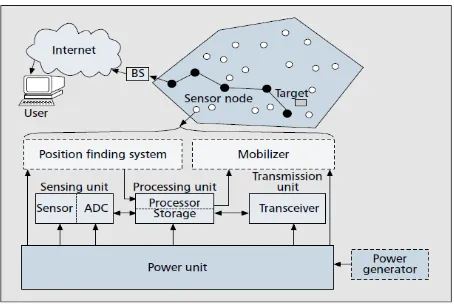
A wireless sensor network is a collection of nodes organized into a network. Each node consists of processing capability, may contain multiple types of memory, have a RF transceiver (usually with a single Omni- directional antenna), have a power source, and accommodate various sensors and actuators.
Fig. 1 The components of a sensor node [6]
The nodes communicate wirelessly and often self-organize after being deployed in an ad hoc fashion. Systems of 1000s or even 10,000 nodes are anticipated. Many routing, power management, and data dissemination protocols have been specifically designed for WSNs where energy awareness is an essential design issue.
II. ROUTING PROTOCOLS FOR WIRELESS SENSOR NETWORKS
Many routing, power management, and data dissemination protocols have been specifically designed for Wireless Sensor Networks where energy awareness is an essential design issue.
A.Proactive Protocol
Proactive MANET protocols are also called as table-driven protocols and will actively determine the layout of the network. Through a regular exchange of network topology packets between the nodes of the network, at every single node an absolute picture of the network is maintained. There is hence minimal delay in determining the route to be taken.
[image:1.595.51.278.604.757.2]1)Destination Sequenced Distance Vector (DSDV) Protocol: It is a proactive routing protocol which is a modification of conventional Bellman-Ford routing algorithm. This protocol adds a new attribute, sequence number, to each route table entry at each node. Routing table is maintained at each node and with this table, node transmits the packets to other nodes in the network. This protocol was motivated for the use of data exchange along changing and arbitrary paths of interconnection which may not be close to any base station.
International Journal of Emerging Technology and Advanced Engineering
Website: www.ijetae.com (ISSN 2250-2459,ISO 9001:2008 Certified Journal, Volume 3, Issue 10, October 2013)
242 The DSDV protocol requires that each mobile station in the network must constantly advertise to each of its neighbours, its own routing table. Since, the entries in the table my change very quickly, the advertisement should be made frequently to ensure that every node can locate its neighbours in the network. This agreement is placed, to ensure the shortest number of hops for a route to a destination; in this way the node can exchange its data even if there is no direct communication link.
The data broadcast by each node will contain its new sequence number and the following information for each new route:
–The destination address
–The number of hops required to reach the destination and
–The new sequence number, originally stamped by the destination
The transmitted routing tables will also contain the hardware address, network address of the mobile host transmitting them. The routing tables will contain the sequence number created by the transmitter and hence the most new destination sequence number is preferred as the basis for making forwarding decisions.
B.Reactive Protocol
Reactive protocol is identified as On-demand protocols because it creates routes only when these routes are needed. The need is initiated by the source, as the name suggests. When a source node requires a route to a destination, it initiates a route discovery process within the network. This process is completed once a route is found or all possible route permutations have been examined. After that there is a route maintenance procedure to keep up the valid routes and to remove the invalid routes. The various Reactive Routing Protocols are discussed below:
1) Ad hoc On Demand Distance Vector Routing (AODV): AODV is a routing protocol for mobile ad hoc networks and other wireless ad-hoc networks. It is jointly developed in Nokia Research Centre of University of California, Santa Barbara and University of Cincinnati by C. Perkins and S. Das [12]. It is an on-demand and distance-vector routing protocol, meaning that a route is established by AODV from a destination only on demand. AODV is capable of both unicast and multicast routing. It keeps these routes as long as they are desirable by the sources. The sequence numbers are used by AODV to ensure the freshness of routes. It is loop-free, self-starting, and scales to large numbers of mobile nodes [17]. AODV defines three types of control messages for route maintenance:
RREQ- A route request message is transmitted by a node requiring a route to a node. As an optimization AODV uses an expanding ring technique when flooding these messages.
Every RREQ carries a time to live (TTL) value that states for how many hops this message should be forwarded. This value is set to a predefined value at the first transmission and increased at retransmissions. Retransmissions occur if no replies are received.
RREP-A route reply message is unicasted back to the originator of a RREQ if the receiver is either the node using the requested address, or it has a valid route to the requested address. The reason one can unicast the message back, is that every route forwarding a RREQ caches a route back to the originator.
[image:2.595.323.565.354.477.2]RERR-Nodes monitor the link status of next hops in active routes. When a link breakage in an active route is detected, a RERR message is used to notify other nodes of the loss of the link. In order to enable this reporting mechanism, each node keeps a precursor list, containing the IP address for each its neighbours that are likely to use it as a next hop towards each destination.
Fig. 2 A possible path for a route replies if A wishes to find a route to J [17]
International Journal of Emerging Technology and Advanced Engineering
Website: www.ijetae.com (ISSN 2250-2459,ISO 9001:2008 Certified Journal, Volume 3, Issue 10, October 2013)
243 If a link break occurs while the route is active, the node upstream of the break propagates a route error (RERR) message to the source node to inform it of the now unreachable destinations. After receiving the RERR, if the source node still desires the route, it can reinitiate route discovery.
2)Dynamic Source Routing (DSR): Dynamic Source Routing is a routing protocol for wireless mesh networks. It is similar to AODV in that it establishes a route on-demand when a transmitting mobile node requests one. However, it uses source routing instead of relying on the routing table at each intermediate device.
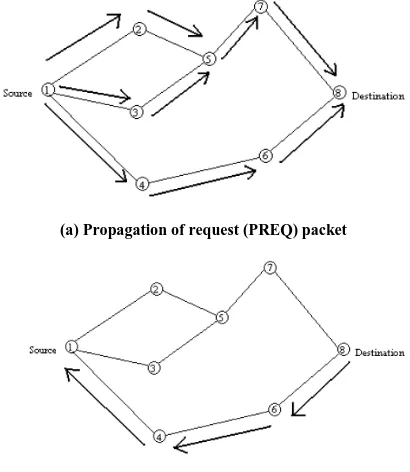
Dynamic source routing protocol (DSR) is an on-demand, source routing protocol [11], whereby all the routing information is maintained (continually updated) at mobile nodes. DSR allows the network to be completely self-organizing and self-configuring, without the need for any existing network infrastructure or administration. The protocol is composed of the two main mechanisms of "Route Discovery" and "Route Maintenance" which work together to allow nodes to discover and maintain routes to arbitrary destinations in the ad hoc network [16]. The fundamental approach of this protocol during the route creation phase is to launch a route by flooding Route Request packets in the network. The destination node, on getting a Route Request packet, responds by transferring a Route Reply packet back to the source, which carries the route traversed by the Route Request packet received.
(a) Propagation of request (PREQ) packet
[image:3.595.62.267.479.715.2](b) Path taken by the Route Reply (RREP) packet
Fig. 3 Creation of route in DSR
A destination node, after receiving the first Route Request packet, replies to the source node through the reverse path the Route Request packet had traversed.
Nodes can also be trained about the neighbouring routes traversed by data packets if operated in the promiscuous mode. This route cache is also used during the route construction phase. If an intermediary node receiving a Route Request has a route to the destination node in its route cache, then it replies to the source node by sending a Route Reply with the entire route information from the source node to the destination node.
III. SIMULATION ENVIORNMENT
There are number of quantitative metrics that can be used for evaluating the performance of MANET routing protocols.
A.Performance Matrices
We have used the following metrics for evaluating the performance of three routing protocols (DSDV, AODV & DSR):
1)Average End-to-End Delay (second): This includes all possible delay caused by buffering during route discovery latency, queuing at the interface queue, retransmission delay at the MAC, propagation and transfer time. It is defined as the time taken for a data packet to be transmitted across an MANET from source to destination.
D = (Tr –Ts)
Where Tr is receive Time and Ts is sent Time.
2)Throughput : Ratio of the packets delivered to the total number of packets sent.
3)Packet Delivery Fraction : It is the ratio of data packets delivered to the destination to those generated by the sources. It is calculated by dividing the number of packet received by destination through the number packet originated from source.
PDF = (Pr/Ps)*100
Where Pr is total Packet received & Ps is the total Packet sent.
4)Normalized Routing Load : Number of routing packets “transmitted” per data packet “delivered” at destination. Each hop-wise transmission of a routing is counted as one transmission. It is the sum of all control packet sent by all node in network to discover and maintain route.
International Journal of Emerging Technology and Advanced Engineering
Website: www.ijetae.com (ISSN 2250-2459,ISO 9001:2008 Certified Journal, Volume 3, Issue 10, October 2013)
244 B.Simulation Setup
[image:4.595.308.564.149.477.2] [image:4.595.55.284.349.558.2]As already outlined we have taken one Table-Driven (Proactive) and two On-demand (Reactive) routing protocols, namely Destination Sequenced Distance Vector Routing (DSDV), Ad hoc On-Demand Distance Vector Routing (AODV) and Dynamic Source Routing (DSR). The mobility model used is Random waypoint mobility model because it models the random movement of the mobile nodes. For all the simulations, the same movement models were used, the simulation time was fixed at 150s and speed is varied as 1m/s, 2m/s, 3m/s, 4m/s, 5m/s, 10m/s, 30m/s, 50m/s and 100m/s. The performance analysis is done on Ubuntu Operating System. Ns-2 was installed on the platform. In this scenario some parameters with a specific value are considered. Those are as shown in TABLE I.
TABLE I
Scenario For Implementation Of DSDV, AODV And DSR
Platform Ubuntu
Simulator NS2
Protocols DSDV, AODV, DSR
Channel type Wireless channel
Simulation time 150 sec
Traffic type Constant bit rate (CBR)
Number of nodes 3
Simulation area size 500 x 400
Mobility model Random way point mobility
Antenna model Antenna/Omnidirectional
Packet size 512 Bytes
Max. packet in ifq 50
IV. RESULT AND DISCUSSION
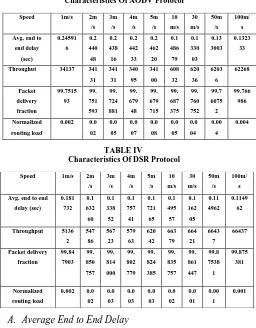
[image:4.595.318.565.543.652.2]The characteristics of different routing protocols at different node speed are shown in Table II-IV.
TABLE II
Characteristics Of DSDV Protocol
Speed 1m/s 2m /s 3m /s 4m /s 5m /s 10 m/s 30 m/s
50m/s 100m/s
Avg. end to end delay (sec) 0.163 039 0.1 317 02 0.1 328 46 0.1 434 36 0.1 427 47 0.1 486 12 0.1 287 51
0.128751 0.108955
Throughut 5263 7 602 47 604 70 652 65 662 84 662 95 663 68
66368 66388
Packet delivery fraction 99.80 3600 99. 768 942 99. 712 340 99. 705 828 99. 710 815 99. 710 536 99. 811 777 99.81177 7 99.82221 6 Normalized routing load
0.007 0.0 06 0.0 08 0.0 08 0.0 08 0.0 08 0.0 05
0.005 0.005
TABLE III
Characteristics Of AODV Protocol
TABLE IV
Characteristics Of DSR Protocol
A. Average End to End Delay
In Fig. 4, if node speed increases, average delay of AODV decreases while in DSDV and DSR, average delay increases with the increase in node speed. It means packet delivery in between source to destination take the less time as node speed increases in AODV.
Average End to End Delay
0 0.05 0.1 0.15 0.2 0.25 0.3
0 20 40 60 80 100 120
speed a v g. e nd t o e nd de la y DSDV AODV DSR
Fig. 4 Average End to End Delay versus speed for DSDV, AODV and DSR
B. Throughput
As seen in Figure 5 if Mobility/ Node speed is increases, AODV gives the maximum throughput, DSDV and DSR throughput is decreased with increase in node speed.
Speed 1m/s 2m /s 3m /s 4m /s 5m /s 10 m/s 30 m/s 50m /s 100m/ s
Avg. end to end delay (sec) 0.181 732 0.1 632 60 0.1 338 52 0.1 757 41 0.1 721 65 0.1 495 57 0.1 162 05 0.11 4962 0.1149 62
Throughput 5136 2 547 86 567 23 579 63 620 42 663 79 664 21 6643 7 66437 Packet delivery fraction 99.84 7903 99. 850 757 99. 814 000 99. 802 779 99. 824 385 99. 835 757 99. 861 447 99.8 7538 1 99.875 381 Normalized routing load
0.002 0.0 02 0.0 03 0.0 03 0.0 03 0.0 02 0.0 01 0.00 1 0.001 Speed 1m/s 2m
/s 3m /s 4m /s 5m /s 10 m/s 30 m/s 50m /s 100m/ s Avg. end to
end delay (sec) 0.24591 6 0.2 440 48 0.2 438 16 0.2 442 33 0.2 462 20 0.1 486 79 0.1 330 03 0.13 3003 0.1323 33
Throughut 34137 341 31 341 31 340 95 341 00 608 32 620 36 6203 6 62268 Packet delivery fraction 99.7515 93 99. 751 593 99. 724 881 99. 679 48 99. 679 715 99. 687 375 99. 760 752 99.7 6075 2 99.766 986 Normalized routing load
[image:4.595.21.295.599.748.2]International Journal of Emerging Technology and Advanced Engineering
Website: www.ijetae.com (ISSN 2250-2459,ISO 9001:2008 Certified Journal, Volume 3, Issue 10, October 2013)
245 Throughput
0 10000 20000 30000 40000 50000 60000 70000
0 20 40 60 80 100 120
speed
throu
gh
pu
t
[image:5.595.50.299.138.230.2]DSDV AODV DSR
Fig. 5 Throughput versus speed for DSDV, AODV and DSR
C. Packet delivery ratio
In Fig. 6, with increase in node speed Packet delivery ratio decreases in AODV and DSDV while it increases in DSR, So in terms of packet delivery ratio, DSR is better.
Packet Delivery Fraction
99.65 99.7 99.75 99.8 99.85 99.9
0 20 40 60 80 100 120
speed
P
D
F DSDV
[image:5.595.316.547.175.296.2]AODV DSR
Fig. 6 Packet delivery ratio versus speed for DSDV, AODV and DSR
D. Normalized Routing Load
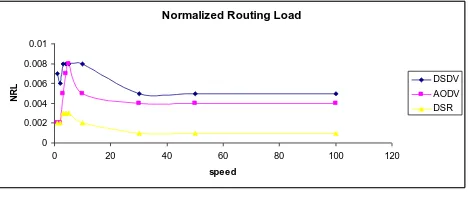
In Fig. 7, with increase in node speed normalized routing load decreases in AODV and DSR while it increases in DSDV. When the mobility increases, DSDV perform better.
Normalized Routing Load
0 0.002 0.004 0.006 0.008 0.01
0 20 40 60 80 100 120
speed
NRL
DSDV AODV DSR
Fig. 7 Normalized routing load versus speed for DSDV, AODV and DSR
E. Residual Energy v/s Time
The figure 8 shows the relationship between Residual Energy along y-axis and Time at x-axis for Destination-Sequenced Distance-Vector (DSDV) Routing Protocol. It can be analyzed from the graph that the energy gets reduced gradually along with the time. Because DSDV is a proactive routing protocol in which each node maintains its routing table to forward packet to its neighbours.
[image:5.595.52.278.310.418.2]But at the end of the simulation, the energy of the node varies due to the addition of new nodes in the path because the MANET’s do not have fixed infrastructure.
Fig. 8 Residual energy Vs time in DSDV
The Fig. 9 shows the relationship between Residual Energy at y-axis and Time at x-axis for Ad Hoc on Demand Distance Vector(AODV) Routing Protocol.
Fig. 9 Residual energy Vs time in AODV
The Fig. 10 shows the relationship between Residual Energy at y-axis and Time at x-axis for Dynamic Source Routing (DSR) Protocol. This graph shows that initially the reduction of energy is more. It happens because in DSR, initially route gets discovered from source to destination before sending a packet. After completing the route discovery, the packet gets transmitted from source to destination by using the same path.
Fig. 10 Residual energy Vs time in DSR
[image:5.595.316.546.349.469.2] [image:5.595.51.285.511.610.2] [image:5.595.323.540.574.688.2]International Journal of Emerging Technology and Advanced Engineering
Website: www.ijetae.com (ISSN 2250-2459,ISO 9001:2008 Certified Journal, Volume 3, Issue 10, October 2013)
246 V. CONCLUSION
Routing in sensor networks is a new area of research, with a limited but rapidly growing set of research results. Because of the remote nature and the size of sensor nodes, they rely on limited battery energy that cannot be replenished in many applications. Thus, the energy efficiency is a critical factor in wireless sensor networks in order to prolong system lifetime. Due to the time-varying nature of the wireless channel, the throughput is very sensitive to the packet length. In this paper, we present a comparison of the different routing techniques for WSNs from the recent work. Although many of these routing techniques look promising, there are still many challenges that are need to be solved. The main categories explored in this paper are proactive and reactive routing protocols. Each routing protocol was described and discussed under the appropriate classification.
REFERENCES
[1] Parth M Dave, Purvang D Dalal, “Simulation & Performance Evaluation of Routing Protocols in Wireless Sensor Network”, International Journal of Advanced Research in Computer and Communication Engineering Vol. 2, Issue 3, March 2013. [2] Anurag Malik, Shivanshu Rastogi, Sajendra Kumar,
“Performance Analysis of Routing Protocol in Mobile Ad Hoc Network using NS-2”, MIT International Journal of Computer Science & Information Technology Vol. 1 No. 1 Jan. 2011 pp. 47-50.
[3] Ewa Niewiadomska-Szynkiewicz, Piotr Kwaśniewski, and Izabela Windyga, “Comparative Study of Wireless Sensor Networks Energy-Efficient Topologies and Power Save Protocols,” J. Telecommun. and info. Tech., 2009.
[4] J. Kulik, W. R. Heinzelman, and H. Balakrishnan, “Negotiation-Based Protocols for Disseminating Information in Wireless Sensor Networks,” Wireless Networks, vol. 8, 2002, pp. 169–85. 2009.
[5] K. Akkaya and M. Younis, “A survey of routing protocols in wireless sensor networks”, Elsevier Ad Hoc Network Journal, vol. 3, no. 3, pp. 325--349, 2005.
[6] Jamal N. Al-Karaki and Ahmed E. Kamal, “Routing Techniques in Wireless Sensor Networks: A Survey”, Wireless Communications IEEE, Vol. 11, Issue 6, pp. 6-28, December 2004.
[7] I.F. Akyildiz, W. Su, Y. Sankarasubramaniam, and E. Cayirci, "A Survey on Sensor Networks”, IEEE Communications Magazine, pp. 102-114, August 2002.
[8] C. Schurgers and M.B. Srivastava, “Energy Efficient Routing in Wireless Sensor Networks,” MILCOM Proc. Commun. for Network-Centric Ops.: Creating the Info.Force, McLean, VA, 2001.
[9] C. Intanagonwiwat, R. Govindan, and D. Estrin, “Directed Diffusion: a Scalable and Robust Communication Paradigm for Sensor Networks”, Proc. ACM Mobi- Com 2000, Boston, MA, 2000, pp. 56–67.
[10] W. Heinzelman, J. Kulik, and H. Balakrishnan, “Adaptive Protocols for Information Dissemination in Wireless Sensor Networks”, Proc. 5th ACM/IEEE Mobicom, Seattle, WA, Aug. 1999. pp. 174–85.
[11] C.E. Perkins and E.M. Royer, “Ad-hoc On-Demand Distance Vector Routing”, Proceedings of the 2nd IEEE Workshop on Mobile Computing Systems and Applications, New Orleans, LA, pp. 90-100, February 1999.
[12] Charles E. Perkins, “Ad Hoc On Demand Distance Vector (AODV)” Routing Internet draft, draft-ietf-manetaodv-02.txt, November 1998.
[13] J. Schiller, “Mobile Communications”, Addison Wesley Publishers, 2006.
[14] C. S. Raghavendra, K. M. Sivalingam, and T. Znati, “Wireless Sensor Networks”, Springer Academic Publishers, 2004. [15] T. Rappaport, "Wireless Communications: Principles and
Practice," Prentice Hall, 2002.
[16] D. B. Johnson and D. A. Maltz, “Dynamic Source Routing in Ad Hoc Wireless Networks”, Mobile Computing, Chapter 5, pp. 153-181, Kluwer Academic Publishers, 1996.
[17] Ad-hoc distance vector protocol for mobile ad hoc network http://www.olsr.org.
![Fig. 2 A possible path for a route replies if A wishes to find a route to J [17]](https://thumb-us.123doks.com/thumbv2/123dok_us/8724357.885017/2.595.323.565.354.477/fig-possible-path-route-replies-wishes-route-j.webp)